
科技

Search documents
专访欧委会贸易总司原司长:数字监管分歧或将引发欧美贸易新争端
2 1 Shi Ji Jing Ji Bao Dao· 2025-11-11 00:12
Group 1: U.S.-EU Trade Relations - The U.S. trade policy is causing a fundamental shift in U.S.-EU trade relations, moving away from a rules-based system to a more aggressive stance [1][5] - The EU is facing a "perfect storm" in its steel and automotive industries due to U.S. tariffs of 50% on steel and 15% on automobiles, leading to significant pressure on these sectors [2][6][7] - The recent framework agreement between the U.S. and EU is viewed as a "risk mitigation" measure rather than a stable foundation for trade relations [5][12] Group 2: EU's Strategic Response - The EU is adopting a "diversification" strategy to reduce reliance on the U.S. by pursuing trade agreements with countries like Indonesia, Malaysia, Thailand, and India [2][10][11] - The EU aims to strengthen its internal market resilience while avoiding a protectionist path similar to the U.S. [2][11] - The EU is committed to compliance with WTO rules while addressing the challenges posed by U.S. unilateral actions [2][11] Group 3: Future Trade Disputes - The digital regulation area is anticipated to be a new focal point for trade disputes, with U.S. tech companies pressuring the government to counter EU digital rules [2][13] - Potential conflicts may also arise from EU climate legislation, particularly regarding environmental regulations [2][13] - The U.S. has threatened to initiate investigations under Section 301 against EU digital regulations, indicating a risk of escalating tensions [12][13] Group 4: WTO Reform and Leadership - The EU is called to take a leadership role in WTO reforms, focusing on key areas such as subsidy rules, economic security policies, and dispute resolution mechanisms [3][14] - Cooperation with like-minded countries and key players like China is essential for effective WTO reform, particularly in subsidy rule discussions [3][14] - The EU's strategy includes enhancing its free trade agreement network, aiming to solidify partnerships that adhere to a rules-based trade system [17]
格林大华期货早盘提示-20251111
Ge Lin Qi Huo· 2025-11-11 00:02
1. Report's Industry Investment Rating - No industry investment rating information is provided in the given content. 2. Report's Core View - The global economic situation is complex. The US government's "shutdown" crisis is about to be resolved, with about $1 trillion of TGA funds expected to flow back into the economic system, injecting large - scale liquidity. However, the global economy is entering the top - region due to the US's continuous wrong policies. The AI application is moving from the concept to the practical stage, but there are signs that AI demand may be moderating. There are also significant capital flows and style changes in the stock market, such as US funds flowing into Japanese technology and AI sectors [1][2]. 3. Summary by Related Catalogs 3.1 Macro and Financial - Global Economy - **Policy and Liquidity**: The US Senate passed a temporary appropriation bill to end the government "shutdown", providing funds until January 30, 2026. About $1 trillion of TGA funds is expected to return to the economic system, and the increase in S&P 500 index futures open - interest by about $21 billion indicates new long - position entry [1]. - **AI Development**: In Q3 2025, 24% of AI - adopting enterprises have achieved quantifiable benefits. Compared with the 1999 dot - com bubble, current leading enterprises have a free cash flow yield of 3.5% (1.2% in 2000), showing fundamental support for high valuations. But the slowdown in TSMC's monthly sales growth is seen as a sign of possible easing AI demand, leading to a sell - off of tech stocks last week [1]. - **US Consumption**: Pandemic - accumulated excess savings of US households are almost exhausted, but the high ratio of household net worth to disposable income, mainly due to asset values like stocks, still supports consumption to some extent [1]. - **Stock Market Capital Flow**: US funds are flowing into Japanese technology and AI sectors at the fastest pace since "Abenomics", potentially triggering a shift from value to growth stocks. However, Citigroup warns that Japanese tech stocks are over - valued [1]. - **Fed Policy**: Powell's cautious remarks after the October rate cut suggest that December rate cut needs data support. Current alternative data shows a gradual cooling of the labor market, giving the Fed a reason to pause rate cuts [1]. 3.2 Global Economic Logic - **AI and Geopolitics**: NVIDIA CEO Huang Renxun believes China will win the AI competition due to a more favorable regulatory environment and lower energy costs [2]. - **Stock Market Outlook**: Goldman Sachs CEO is optimistic about the Hong Kong and mainland Chinese stock markets, stating that many Chinese stocks are "very attractive" with rising global valuations [2]. - **Data Center Construction**: The US is planning or building data center projects with a total capacity of over 45 gigawatts and an expected investment of over $2.5 trillion. There is a shortage of construction workers for data centers [2]. - **AI Energy Demand**: Apollo Global Management warns of a huge gap between AI's large energy demand and the current global power supply, which may not be filled in our lifetime [2]. - **US Market Valuation**: The US stock market's cyclically - adjusted price - to - earnings ratio (Shiller P/E) has reached 40 for the second time in history, similar to the 1999 dot - com bubble [2]. - **US Consumption and Employment**: Consumption in the US is slowing, especially among the 25 - 35 - year - old middle - income group. In October, US corporate layoffs reached 153,074, mainly in the tech and warehousing industries, a 183% increase from September and nearly three times that of last year, which may be an economic warning signal [2].
上市即巅峰?除中签的全是套牢盘,3天跌40%,卖还是等?
Sou Hu Cai Jing· 2025-11-10 17:11
Core Viewpoint - The article highlights the extreme volatility and risks associated with new stock listings in the A-share market, where initial high returns can quickly turn into significant losses for investors. Group 1: Stock Performance and Volatility - On November 26, 2024, a new stock "Hong Sifang" was purchased at 120 yuan, reaching a peak of 160 yuan, resulting in a 30% unrealized gain, but the next day it plummeted to 90 yuan, leading to a 17% loss upon selling [1] - Wireless Media's stock surged from an opening price of 29.11 yuan to a peak of 361 yuan within four trading days, only to drop 64.48% in a single day to 80.99 yuan, causing losses of up to 78% for late investors [3] - In 2024, the average first-day gain for new stocks was 249.97%, significantly higher than 2023's 66.45% and 2022's 30.2%, indicating a trend of "listing as the peak" [3] Group 2: Market Dynamics and Investor Behavior - Over 50% of new stocks experience a price correction or crash shortly after listing, with most investors who buy at the first-day closing price facing short-term losses [3] - The absence of price limits in the first five trading days of new listings amplifies stock price volatility, turning the market into a speculative frenzy [3][6] - High turnover rates, such as 87.39% for Wireless Media, indicate that trading is driven more by short-term speculation rather than long-term investment [5] Group 3: Psychological Factors and Market Sentiment - Investors often have unrealistic expectations for new stocks, driven by a "new stock always profits" mentality, leading to blind following of market trends [7][8] - The allure of new stocks, combined with a low initial offering price, can lead to severe overvaluation and subsequent losses for those buying at inflated prices [9][10] - The speculative nature of new stock trading is exacerbated in bull markets, where optimism can lead to excessive price inflation and subsequent crashes [18] Group 4: Implications for Investors - Investors face a dilemma when new stocks drop significantly: whether to cut losses or hold out for a potential rebound, often leading to a cycle of further declines [15] - The market does not guarantee recovery for investors who choose to wait, as seen in the rapid decline of Wireless Media's stock from 361 yuan to around 80 yuan [16] - The increasing number of IPOs in 2024 suggests that new stock allocations may not guarantee profits, necessitating a reassessment of investment strategies and risk tolerance [18]

午盘:美股维持涨势 市场关注美国政府停摆事件进展
Xin Lang Cai Jing· 2025-11-10 17:08
Group 1 - The U.S. stock market maintained its upward trend amid ongoing negotiations to end a historic government shutdown that has lasted over 40 days [1][3] - The Dow Jones Industrial Average rose by 68.22 points (0.15%) to 47,055.32, the Nasdaq increased by 361.16 points (1.57%) to 23,365.70, and the S&P 500 gained 59.33 points (0.88%) to 6,788.13 [3] - A procedural motion allowing for further voting on the agreement received at least 60 votes, with eight Democratic senators breaking party lines to support the deal [3] Group 2 - The agreement aims to keep the government operational until January and partially reverse recent large-scale federal layoffs, while also including follow-up measures for government employees [3] - The deal does not include provisions for extending credits related to the Affordable Care Act, which was a core point of contention for many Democratic senators, but it requires a vote on related subsidies in December [3] Group 3 - Consumer confidence has dropped to its lowest level in over three years due to concerns over the government shutdown, as reported by the University of Michigan [4] - The shutdown has halted the release of several key economic reports, including non-farm payroll data and consumer price indices, contributing to increased market anxiety [4] - Major stock indices experienced significant declines last week, with the Nasdaq Composite falling by 3% and the S&P 500 down by 1.6% [4] Group 4 - Data from OpenBrand indicates that the price increase of consumer goods in October slowed for the first time in three months, reflecting increased discounting by retailers [5] - The price index for consumer durable and personal goods rose by 0.22% in October, down from 0.48% in September, with discounts rising to 20.4%, nearing the highest level since July of the previous year [5] - Despite the overall slowdown in inflation, certain categories such as household equipment and electronics still showed resilience in pricing [5]

5万亿港元!南向资金,新纪录!
券商中国· 2025-11-10 15:22
Core Viewpoint - Southbound funds have significantly increased their investment in Hong Kong stocks, with net purchases reaching record highs, indicating strong market interest and potential for future growth [1][2][3]. Group 1: Southbound Fund Inflows - On November 10, southbound funds recorded a net inflow of HKD 6.653 billion, marking the 14th consecutive trading day of net buying [1]. - Year-to-date, the total net inflow from southbound funds into Hong Kong stocks has exceeded HKD 1.3 trillion, surpassing the previous year's total [1]. - Cumulatively, since the launch of the southbound trading scheme, net purchases have historically exceeded HKD 5 trillion for the first time [2]. Group 2: Market Performance and Investment Opportunities - The Hong Kong stock market has seen impressive gains this year, driven by opportunities in AI asset revaluation, innovative pharmaceuticals, and the rise of new consumption [3]. - Major indices such as the Hang Seng Index and the Hang Seng Tech Index have risen over 30% year-to-date, while the Hong Kong Stock Connect Innovative Pharmaceutical Index has surged over 80% [3]. - Despite market fluctuations, the inflow of southbound funds remains robust, supported by a growing number of quality IPOs and secondary listings from US and A-share companies [3]. Group 3: Role of ETFs in Investment - The rise of passive investment strategies has made ETFs a key tool for buying Hong Kong stocks, with significant inflows into various ETFs [4]. - The China Universal Hong Kong Stock Connect Internet ETF has attracted HKD 55 billion this year, leading the inflow rankings among ETFs [4]. - Other notable ETFs, such as the ICBC Hong Kong Stock Connect Technology ETF and the E Fund Hong Kong Securities Investment Theme ETF, have also seen inflows exceeding HKD 20 billion [4]. Group 4: Pricing Power and Market Dynamics - The influx of southbound funds is gradually enhancing their pricing power in the Hong Kong market, with foreign capital starting to dominate trading volumes [5][6]. - Southbound funds are increasingly influencing the pricing dynamics in sectors like new consumption, dividends, and finance [6]. - ETFs have played a significant role in this shift, with substantial increases in holdings of Hong Kong brokerages by various ETFs [6]. Group 5: Valuation and Future Outlook - Current valuation levels in the Hong Kong market are considered attractive, with expectations of continued foreign capital inflows and enhanced pricing power for southbound funds [7]. - Analysts predict that the market will see a clearer influx of new capital in 2026, potentially exceeding HKD 1.5 trillion due to favorable conditions such as low allocation and anticipated interest rate cuts by the Federal Reserve [8].
信贷支持、线上引流、小程序连接……银行这样深度促消费
Jing Ji Guan Cha Wang· 2025-11-10 15:03
Core Insights - The article highlights the role of banks, particularly China Construction Bank (CCB), in promoting consumption through innovative financial products and services, addressing various industry pain points and enhancing consumer experiences [2][10]. Group 1: Financial Support for Small Businesses - CCB introduced the "民宿贷" (Homestay Loan) as part of its "农商场景" (Agricultural Business Scene) loan products, specifically targeting homestay businesses, which has helped entrepreneurs like Xing Hailong recover from financial difficulties [3][4]. - As of September 2025, CCB has provided 4.5 million yuan in funding support to one-third of the merchants in Xiaowan Village, facilitating over 17,000 transactions worth more than 11 million yuan through its platform [4]. Group 2: Agricultural Sector Innovations - The article discusses the challenges faced by the blueberry industry in Chengjiang, Yunnan, including insufficient scale and brand recognition, which hinder its growth potential [5][6]. - CCB's "裕农快贷" (Quick Agricultural Loan) has enabled farmers to cover significant costs without collateral, with loans processed online and disbursed within three days, thus supporting agricultural development [6]. Group 3: Enhancing Consumer Experience - CCB has implemented a smart charging system for cold chain logistics in Kunming's Jinma Zhengchang Fruit Market, addressing previous inefficiencies and reducing management costs by 30% [7]. - The bank's "一部手机逛商圈" (One Mobile Phone to Explore Business Circles) platform has facilitated the distribution of government consumption vouchers, enhancing consumer access to various services and products [6][10]. Group 4: Consumer Financing and Promotions - CCB has actively participated in government consumption subsidy programs, distributing over 19.7 billion yuan in subsidies across 306 cities, which has stimulated consumption transactions exceeding 136.8 billion yuan [10][11]. - The bank's collaboration with retailers like JD.com has created a seamless experience for consumers, combining various promotional offers to alleviate the financial burden of purchasing large appliances [11][12].
AI“军备竞赛”拖垮现金流 美银建议做空科技巨头债券而非股票
Zhi Tong Cai Jing· 2025-11-10 13:37
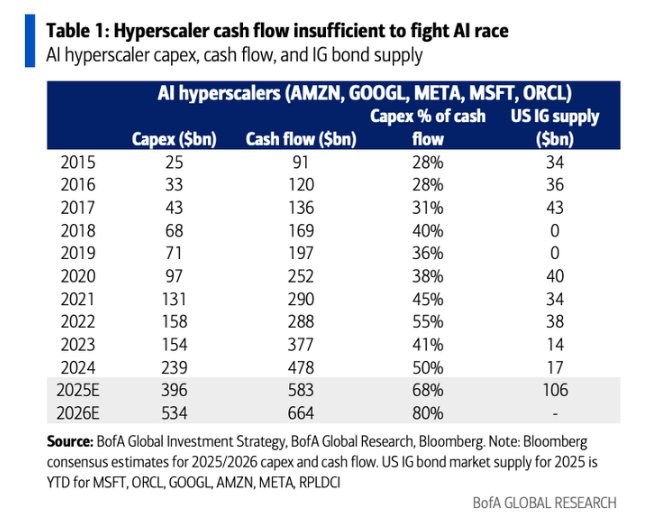
Core Viewpoint - Investors should consider shorting the bonds of large-cap technology companies, but should refrain from aggressively shorting the overall AI-related trades [1] Group 1: Financial Metrics - The report highlights that cash flows of major tech companies like Amazon, Google, Meta, Microsoft, and Oracle are insufficient to support the current "AI capital expenditure arms race" [1] - In 2023, these companies' capital expenditures (Capex) are projected to be $154 billion against cash flows of $377 billion, resulting in a Capex to cash flow ratio of 41% [2] - By 2025, estimated Capex is expected to rise to $396 billion, while cash flow is projected to decrease to $283 billion, leading to a Capex to cash flow ratio of 68% [2] Group 2: Market Trends - Over the past seven weeks, these companies have issued over $120 billion in bonds, indicating a significant increase in debt financing [2] - The credit spread for large-cap tech companies has widened from 50 basis points in September to nearly 80 basis points, suggesting that a low point has been established [2] - Historical context shows that in the 12 months leading up to the peak of the internet bubble in March 2000, U.S. tech company bond prices fell by 8% [2] Group 3: Market Sentiment and Signals - Hartnett notes that there are numerous "warning" signals in the AI sector, including a surge in market capitalization concentration (AI-related large-cap stocks now account for over 40% of total market capitalization) [4] - The market breadth has narrowed, and valuation bubbles are emerging, with leading AI stocks trading at price-to-earnings ratios around 45 times [4] - There has been a significant influx of global funds and retail investors into the market, with record inflows into tech stocks, leading to substantial price increases for companies like Advantest and SK Hynix [4] - However, Hartnett emphasizes that true "exit" signals typically arise from rising interest rates, which have not yet occurred as the Federal Reserve has not raised rates significantly [4]





当所有人都相信AI:这九张图看清“背后的隐忧”
Hua Er Jie Jian Wen· 2025-11-10 13:19
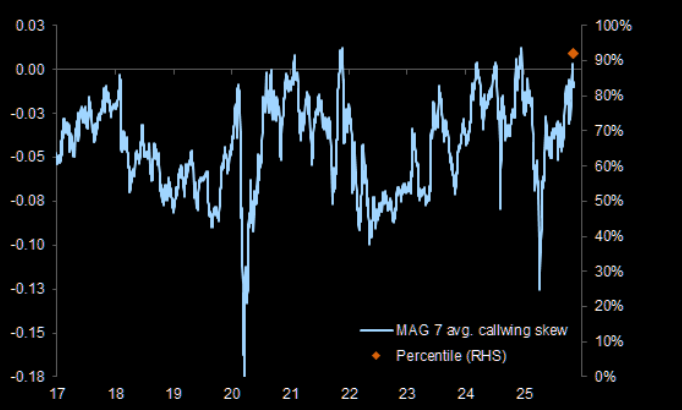
在经历数日抛售后,从华尔街到普通投资者,几乎所有人都在为AI进行有力辩护,而且,他们的理由都非常有说服力。 然而,多项指标显示当前AI投资已达到极端水平。大型成长股和科技股的持仓回到多季度高点,对冲基金的偏好股票已与散户投机者 趋同。更令人担忧的是,家庭股票敞口创下历史新高,一旦AI科技估值出现裂缝,仅财富效应就可能拖累美国GDP下滑2.9%。 Mag 7期权偏斜度仍处于历史高位 大型科技股的期权偏斜度已达到91百分位数。LSEG数据显示,自2012年5月以来,科技巨头七强(Mag 7)的3个月25 delta看涨期权偏斜 度处于历史高位,反映投资者对上涨的极度乐观预期。 科技股持仓大幅回升 德银数据进一步证实了这一趋势。大型成长股和科技股的持仓水平重新回到多季度高点,显示资金大量涌入这一领域。 对冲基金和散户已别无二致 最值得关注的是对冲基金行为的变化。Empirical Research Partners指出,基本面对冲基金已"拥抱高贝塔股票",即大型科技AI宠儿。换 言之,对冲基金的偏好股票已与散户投机者别无二致,专业投资与投机资金在同一赛道上拥挤不堪。 系统性风险加剧 产业集中度同样令人担忧。CB I ...
一则消息 黄金又爆了!
Jin Tou Wang· 2025-11-10 12:43
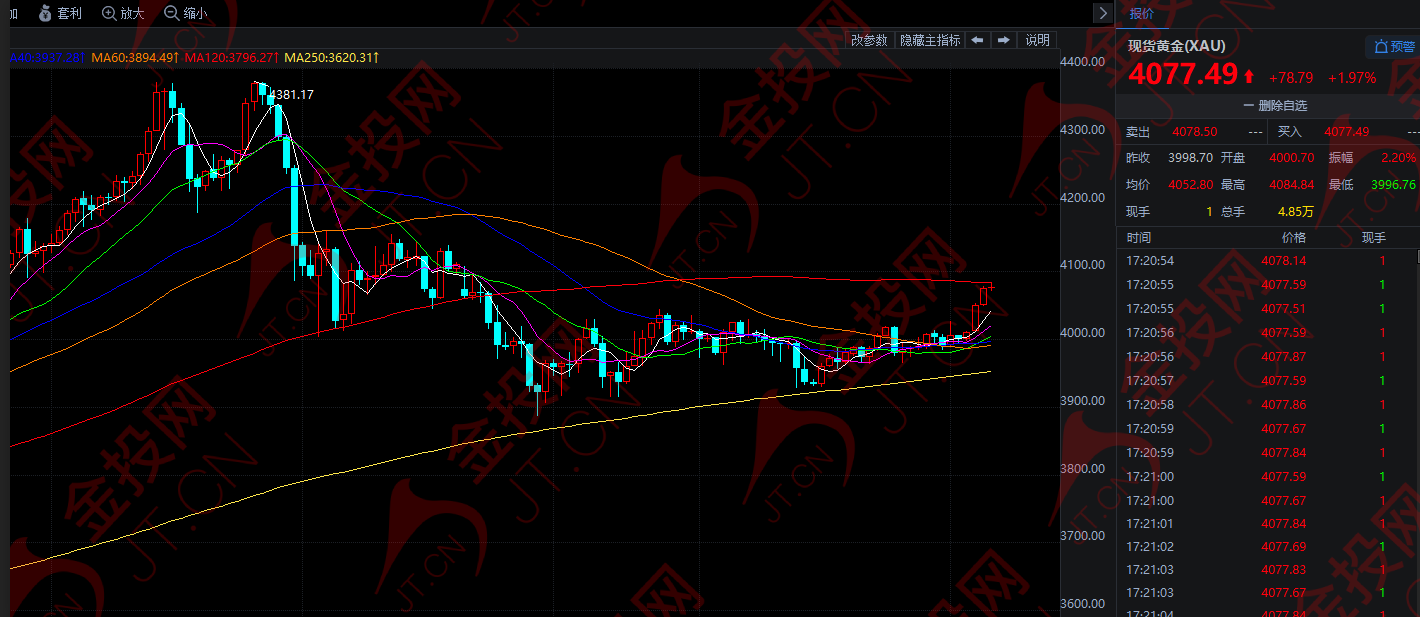
Group 1 - Gold prices experienced significant fluctuations, closing at $4000.91 after a drop of $1.57 or 0.04%, with a notable increase to around $4076 during European trading hours [1] - The U.S. stock market indices saw collective declines, with the Nasdaq down 3.04%, S&P 500 down 1.63%, and Dow Jones down 1.21% [2] - The U.S. government is expected to end its longest shutdown, with the Senate passing a temporary funding bill to provide government funding until January 30, 2026 [3][4] Group 2 - The potential economic impact of the government shutdown was highlighted, with warnings that continued shutdown could lead to negative economic growth in Q4 [5] - Recent announcements from the U.S. and China indicate a pause in certain trade measures, including the suspension of special port fees for U.S. vessels and the suspension of investigations into China's maritime and logistics sectors [6] - The upcoming release of the October CPI is anticipated to be a significant event, with analysts suggesting that a normal release could support interest rate cuts, while the absence of data may favor a more hawkish stance from the Federal Reserve [7] Group 3 - Concerns regarding high valuations in the U.S. stock market, particularly among AI stocks and the so-called "Tech Seven," have been raised by various financial institutions [8] - UBS noted that while there are warnings about potential market turbulence, the current market is still in the early stages of a bubble, lacking extreme valuation levels seen during the 2000 internet bubble [8] Group 4 - International developments include a large-scale attack by Russia on Ukraine's energy infrastructure, leading to power outages in multiple regions [10] - Russian defense forces reported intercepting 79 Ukrainian drones over ten regions [11] - Public support for President Putin remains high, with 74.5% of Russians approving of his work according to a recent poll [13]
美国政府史上最长停摆背后的政商博弈逻辑
Sou Hu Cai Jing· 2025-11-10 12:40
Group 1 - The U.S. federal government experienced a record 40-day shutdown from October 1 to November 9, 2025, surpassing the previous record of 35 days from 2018-2019, primarily due to disputes over the Affordable Care Act (ACA) subsidy extension [1][2] - The shutdown resulted in significant economic impacts, with the Congressional Budget Office estimating a permanent output loss of approximately $14 billion and a potential decline in fourth-quarter GDP growth rate by 1-2 percentage points [4][5] - Key sectors such as aviation and agriculture faced severe disruptions, with Delta Airlines losing $8 million daily and 42 million low-income individuals experiencing food stamp issuance delays [4][6] Group 2 - The political standoff reflects deeper ideological conflicts between the two parties, with Republicans advocating for a "small government, low welfare" approach, while Democrats support "big government, high welfare" policies [3][4] - The involvement of interest groups intensified during the shutdown, with lobbying expenditures increasing by 40%, highlighting the intertwining of political and economic interests [6][7] - The Federal Reserve's independence faced challenges, with internal divisions leading to unclear monetary policy signals, impacting market expectations and investment decisions [7][8] Group 3 - The shutdown's impact on consumer confidence was notable, with the University of Michigan's consumer sentiment index dropping to its lowest level in over three years, reflecting widespread dissatisfaction with Congress [4][5] - The market reacted negatively to the uncertainty, with the Nasdaq Composite Index falling by 3% in one week, marking its worst performance since April [9][10] - The shutdown has led to a potential long-term economic slowdown, with forecasts indicating a GDP growth rate of only 1.0% for the fourth quarter, down from previous expectations [23][24]