基础设施

Search documents
招商交通运输行业周报:OPEC+决定7月增产,义乌快递底部价格略有修复-20250602
CMS· 2025-06-02 09:36
证券研究报告 | 行业定期报告 2025 年 06 月 02 日 OPEC+决定 7 月增产,义乌快递底部价格略有修复 招商交通运输行业周报 周期/交通运输 本周关注:航运方面,OPEC+决定 7 月增产;基础设施方面,关注港股红利配置 价值;航空方面,关注 25-26 年行业基本面上行趋势及市值弹性;快递方面,关 注 25 年价格竞争情况和行业估值修复潜力。 推荐标的:东莞控股、皖通高速、粤高速、青岛港、招商港口。 ❑ 航空:5 月以来受益于需求增长和票价基数较低,收益指标同比大幅提升, 旺季主要指标有望企稳回升。1)高频数据表现上看,5 月 23 日-29 日,国 内机票价(撇除燃油附加费)周环比-2%,同比 2024 年+5%,同比 2019 年 -12%;国内旅客量周环比-2%,同比 2024 年+6%,同比 2019 年+17%。 2)供需基本面角度,出行消费需求有一定的韧性,同时经济和消费刺激政 策利好国内出行需求增长,国际出行需求有望持续向正常化恢复;供给端, 受全球供应链不畅及飞机利用率已经大幅恢复影响供给释放偏紧;同时燃油 成本大幅减轻,展望 25-26 年行业供需再平衡、盈利回升的趋势明确 ...
持续推荐航空集运旺季投资机会,关注无人车催化物流快递变革
ZHONGTAI SECURITIES· 2025-06-01 00:20
Investment Rating - The report maintains an "Overweight" rating for the transportation sector, with specific buy recommendations for several airlines and logistics companies [2][3]. Core Insights - The report emphasizes the ongoing recovery in the aviation sector, driven by increasing passenger demand and favorable pricing dynamics, particularly during the peak travel season [4][5]. - The logistics and express delivery sectors are expected to undergo significant transformation due to advancements in autonomous vehicle technology, which could enhance operational efficiency and service delivery [5][6]. Summary by Sections Investment Highlights - The report highlights the strong performance of airlines such as Spring Airlines, China Eastern Airlines, and China Southern Airlines, which are expected to benefit from rising passenger volumes and improved load factors [2][11]. - The logistics sector is seeing a surge in express delivery volumes, with a reported 41.47 billion packages collected in the week of May 19-25, reflecting a year-on-year increase of 15.42% [5][6]. Operational Tracking - The report provides detailed operational metrics for major airlines, indicating a positive trend in available seat kilometers (ASK) and revenue passenger kilometers (RPK) across the sector, with notable increases in passenger load factors [4][14]. - The logistics sector's performance is also tracked, showing a significant increase in both collection and delivery volumes, which are expected to continue growing due to favorable consumption policies [5][6]. Airline Data Tracking - Specific airlines are highlighted for their operational efficiency and market positioning, with metrics showing improvements in ASK and RPK, alongside rising load factors, indicating a robust recovery trajectory [4][14]. - The report notes that the average load factor for major airlines is above 80%, suggesting strong demand and effective capacity management [4][14]. Shipping Data Tracking - The report indicates a rise in shipping rates, with the SCFI index reaching 2072.71 points, reflecting a week-on-week increase of 30.68% [5][6]. - The report anticipates a seasonal increase in shipping demand, driven by factors such as replenishment needs and peak shipping seasons, which could lead to further price increases [5][6]. Logistics Data Tracking - The report tracks logistics performance, noting a significant increase in freight volumes across various transport modes, including road and rail, with a cumulative freight volume of 2.71 billion tons reported [5][6]. - The express delivery sector is highlighted for its resilience, with ongoing growth in package volumes supported by government consumption-boosting policies [5][6].





今年前4月海南经济增长保持稳中向好
Hai Nan Ri Bao· 2025-05-23 01:08
建安投资小幅增长,基础设施投资拉动明显。1—4月,全省建安投资增长2%。分领域看,基础设 施投资(不含电力、燃气及水的生产和供应业)同比增长31.4%,拉动全部投资增长6.6个百分点;公共 服务投资增长30.5%。 市场销售稳中提速,"以旧换新"成效明显。1—4月,全省社会消费品零售总额877.77亿元,同比增 长6.1%,较一季度加快1.9个百分点。按消费类型分,商品零售774.89亿元,同比增长6.9%;餐饮收入 102.87亿元,增长0.3%。"以旧换新"加力扩围工作持续推进,全省限额以上家用电器和音像器材类零售 额同比增长7.7%,通讯器材类零售额增长5.6%,家具类零售额增长2.8倍,建筑及装潢材料类零售额增 长3.3倍。汽车类零售额同比增长78.7%,其中新能源汽车零售额增长1.6倍。 服务贸易较快增长,财政金融运行平稳。1—4月,全省服务进出口总额216.26亿元,同比增长 19.2%。全省地方一般公共预算收入359.15亿元,同比增长3.8%。地方一般公共预算支出779.67亿元, 同比增长10.8%。 居民消费价格同比略降,绿色发展持续向好。1—4月,全省居民消费价格同比下降0.4%。全省环 ...
全球财经连线|专访匈牙利前总理迈杰希·彼得:中匈合作正当时,欢迎中国企业来匈投资兴业
2 1 Shi Ji Jing Ji Bao Dao· 2025-05-20 12:57
Group 1 - The friendship between China and Hungary is highlighted as a stable bridge amidst global uncertainties, with a history dating back to the Silk Road era [1][6] - Hungary is positioned as a key gateway for Chinese companies entering the European market, offering a welcoming environment and supportive policies for investment [8][9] - The cooperation between China and Hungary spans various sectors, including high technology, infrastructure, and cultural education, with significant potential for future collaboration [1][6][12] Group 2 - The importance of mutual understanding and cooperation over confrontation is emphasized, with China advocating for shared responsibility in building a community with a shared future [2][4] - Hungary's role in the Belt and Road Initiative is recognized, with ongoing projects like the Hungary-Serbia railway enhancing regional connectivity and economic opportunities [12] - The potential for increased cultural and educational exchanges is noted, with initiatives such as bilingual schools fostering deeper ties between the two nations [6][8]
详解4月经济数据:工业增速维持高位,扩内需政策效应持续释放
Di Yi Cai Jing· 2025-05-19 08:11
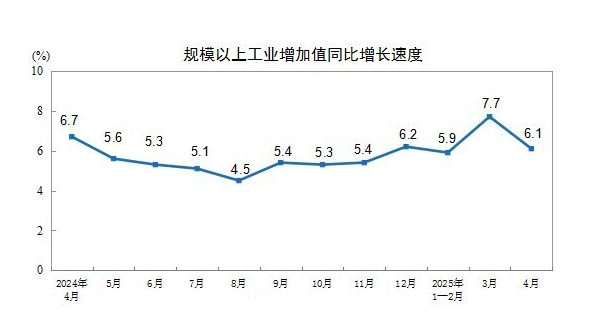
Economic Overview - The long-term positive fundamentals of the economy remain unchanged despite external shocks and internal challenges [1][2] - In April, major economic indicators showed stability under pressure, with industrial value-added increasing by 6.1% year-on-year, retail sales growing by 5.1%, and fixed asset investment rising by 4.0% [1][2] Industrial Production - Industrial production continues to be a key support for stable economic growth, with a notable increase in high-tech manufacturing, which grew by 10% in April [4][5] - Among 41 major industries, 36 experienced year-on-year growth, with significant increases in integrated circuit manufacturing (21.3%) and optoelectronic device manufacturing (19%) [5][6] - The "Two New" policies are driving industrial technology upgrades and expanding market demand, contributing to industrial production growth [6] Consumer Spending - Policies aimed at boosting consumption are showing effects, with retail sales of consumer goods increasing by 4.7% year-on-year in the first four months of the year [8][9] - Specific categories such as home appliances and cultural office supplies saw substantial growth, with increases of 38.8% and 33.5% respectively in April [8] - Service consumption, particularly in travel and communication, is also experiencing rapid growth, indicating a recovery in consumer confidence [8] Investment Trends - Fixed asset investment grew by 4% in the first four months, driven by significant increases in equipment investment (18.2%) [11][12] - Manufacturing investment rose by 8.8%, with consumer goods and equipment manufacturing investments growing by 13.4% and 8.2% respectively [11] - Infrastructure investment remains stable, with a year-on-year increase of 5.8%, supported by the issuance of local government bonds and increased corporate loans for infrastructure projects [12]

事关促进消费、投资、房地产…… 一文梳理这场国新办发布会
Sou Hu Cai Jing· 2025-05-19 06:40
Economic Overview - In April 2025, the industrial added value above designated size increased by 6.1% year-on-year and 0.22% month-on-month, while the service production index rose by 6.0% year-on-year [1][3] - The total retail sales of consumer goods reached 37,174 billion yuan, marking a year-on-year increase of 5.1% and a month-on-month increase of 0.24% [1][3] Consumption Insights - The sales of products related to the "old-for-new" policy saw significant growth, with retail sales of home appliances and audio-visual equipment, cultural and office supplies, furniture, and communication equipment increasing by 38.8%, 33.5%, 26.9%, and 19.9% year-on-year, respectively [7] - Basic living and upgraded goods also experienced rapid growth, with retail sales of grain and oil, sports and entertainment products, and gold and silver jewelry increasing by 14%, 23.3%, and 25.3% year-on-year [7] Investment Trends - Fixed asset investment grew by 4% from January to April 2025, with equipment investment rising by 18.2%, contributing 64.5% to total investment growth [9] - Manufacturing investment increased by 8.8% year-on-year, driven by the upgrade of traditional industries and the development of emerging industries [9] - High-tech service industry investment rose by 11.3%, with professional technical services and information services growing by 17.6% and 40.6%, respectively [9] Employment Situation - The urban survey unemployment rate in April was 5.1%, a decrease of 0.1 percentage points from the previous month, with notable declines in unemployment rates among migrant workers and youth [14] - Despite overall employment stability, structural issues remain, particularly for the youth demographic and a mismatch in labor supply and demand [14] Real Estate Market - The real estate market showed basic stability in April, with some first- and second-tier cities experiencing increased transaction activity [15][17] - New residential sales prices in first- and second-tier cities remained stable month-on-month, while year-on-year declines in prices continued to narrow [17] - The demand for green, smart, and safe housing is expanding, indicating a positive outlook for the renovation of old communities and improvements in real estate construction quality [17]
专访港投陈家齐:以耐心资本穿越周期,解码香港科技投资新逻辑
Di Yi Cai Jing· 2025-05-11 02:44
最具创新能力的科技机构能在不同的经济周期中脱颖而出。 在全球经济格局充满不确定性的当下,投资机构如何在波动中寻找机遇? 这家被业界誉为"港版淡马锡"的投资机构初始管理规模达620亿港元,由香港特区行政长官李家超在首 份《施政报告》中亲自规划,旨在通过直接投资或与私募基金合作,吸引重点企业落户香港,在争取长 期投资回报的同时,推动金融科技、人工智能、生物科技、高端制造业等四大核心领域发展。 在硬科技、生物科技、新能源/绿色科技这三大投资赛道上,港投公司展现出了前瞻性布局眼光。该公 司行政总裁陈家齐在接受第一财经独家专访时分享了她的洞察:"优秀的科技公司无论在什么经济周期 中都会崭露头角。历史上许多成功的公司,之所以能一路走来,是因为它们选择了正确的发展路径,并 解决了市场上的核心痛点。" 她认为,从历史来看,最具创新能力的科技机构,通常都是解决市场上核心痛点的企业,它们能在不同 的经济周期中脱颖而出。现在正是抓住这一窗口,快速寻找优秀伙伴和公司的好时机。 在风险中寻找科技投资机遇 第一财经:在全球经济不确定性加剧的背景下,港投如何在当前全球市场动荡中布局?如何在三大重点 赛道中平衡风险与机会? 陈家齐:投资本身 ...

Kennametal(KMT) - 2025 Q3 - Earnings Call Transcript
2025-05-07 14:32
Financial Data and Key Metrics Changes - Sales decreased by 6% year over year, with metal cutting sales declining 4% organically and infrastructure declining 2% organically [9][25] - Adjusted EPS increased to $0.47 compared to $0.30 in the prior year quarter, driven by restructuring benefits and an advanced manufacturing tax credit [12][28] - Adjusted EBITDA and operating margins were 17.9% and 10.3% respectively, compared to 14.2% and 8.1% in the prior year quarter [27] Business Line Data and Key Metrics Changes - Metal cutting sales were down 7% year over year, with a 4% organic decline and unfavorable foreign currency exchange of 3% [29] - Infrastructure sales declined 4% year over year, with an organic decline of 2% and unfavorable foreign currency exchange of 2% [32] - Aerospace and defense sales increased by 28%, while energy declined by 3% mainly in The Americas [33] Market Data and Key Metrics Changes - EMEA remained the slowest market, down 4% on a constant currency basis, while The Americas and Asia Pacific both declined by 1% [9][30] - General engineering and transportation were largely impacted by market conditions in EMEA and The Americas [11][30] - Aerospace and defense showed slight improvement as supply chain constraints eased [49] Company Strategy and Development Direction - The company is focused on executing growth initiatives in aerospace and defense, despite overall market weakness [8][10] - A restructuring action was announced to lower structural costs by reducing employment costs and consolidating manufacturing operations [7][10] - The company aims to fully mitigate the impact of tariffs through various actions, including optimizing product flow and evaluating alternative supply options [20][21] Management's Comments on Operating Environment and Future Outlook - Management noted that while there are short-term pressures across end markets, long-term trends for industrial production remain positive [11][12] - The company expects to achieve a $15 million annualized run rate savings from restructuring actions by June 30 [40] - Management remains committed to executing value creation initiatives to deliver a strong finish to fiscal 2025 [43] Other Important Information - The company returned $40 million to shareholders through share repurchase and dividend programs [36] - The estimated annual impact of tariffs is approximately $80 million, with ongoing mitigation actions in place [20][21] Q&A Session Summary Question: Can you discuss the outlook for the fourth quarter and demand trends? - Management indicated steady improvement in demand trends, with general engineering and transportation remaining flat, while aerospace and defense showed slight improvement [48][50] Question: Can you provide more details on tariff mitigation actions? - Management confirmed that they are confident in fully mitigating the direct impact of tariffs and have already begun implementing several actions [54][56] Question: What were the biggest surprises in the quarter relative to previous guidance? - The advanced manufacturing tax credit was a significant driver of performance, with tungsten prices expected to impact costs moving forward [66][68] Question: How is the competitive landscape affected by tariffs? - Management noted that they are performing better than peers and are well-positioned to utilize their global footprint to mitigate tariff impacts [73][74] Question: Are there any opportunities for M&A or portfolio optimization due to the changing trade situation? - Management acknowledged ongoing discussions regarding strategic priorities and potential portfolio actions in light of the tariff situation [81] Question: What is the pricing outlook for the final quarter of the year? - Management confirmed that the pricing outlook remains at approximately 2%, excluding tariff impacts [107]

Kennametal(KMT) - 2025 Q3 - Earnings Call Transcript
2025-05-07 14:30
Financial Data and Key Metrics Changes - Sales decreased by 6% year over year, with metal cutting sales declining 4% organically and infrastructure declining 2% organically [8][23] - Adjusted EPS increased to $0.47 compared to $0.30 in the prior year quarter, driven by restructuring benefits and an advanced manufacturing tax credit [11][26] - Adjusted EBITDA and operating margins were 17.9% and 10.3% respectively, compared to 14.2% and 8.1% in the prior year quarter [25] Business Line Data and Key Metrics Changes - Metal cutting sales were down 7% year over year, with a 4% organic decline and unfavorable foreign currency exchange of 3% [28] - Infrastructure sales declined 4% year over year, with an organic decline of 2% and unfavorable foreign currency exchange of 2% [31] - Aerospace and defense sales increased by 28%, while energy sales grew by 2% [32] Market Data and Key Metrics Changes - EMEA remained the slowest market, down 4% on a constant currency basis, while The Americas and Asia Pacific both declined by 1% [8][28] - General engineering and transportation were impacted by market conditions in EMEA and The Americas, while aerospace and defense showed slight improvement [10][29] Company Strategy and Development Direction - The company is focused on executing growth initiatives in aerospace and defense, despite overall market weakness [7][10] - A restructuring action was announced to lower structural costs by reducing employment costs and consolidating manufacturing operations [6][12] - The company aims to fully mitigate the impact of tariffs through various actions, including optimizing product flow and evaluating alternative supply options [19][20] Management's Comments on Operating Environment and Future Outlook - Management noted that most markets have been modestly declining for over thirty months, but they remain focused on controllable factors [7][10] - The company tightened its fiscal 2025 sales outlook to reflect the latest forecasts of specific market drivers and general market conditions [12][37] - Management expressed confidence in long-term mega trends for industrial production, including growth in aerospace and defense [10][40] Other Important Information - The company achieved approximately $6 million in restructuring savings during the quarter and is on pace to achieve a $15 million run rate savings [9][11] - The estimated annual impact of tariffs is approximately $80 million, with ongoing mitigation actions in place [19][96] - The company returned $40 million to shareholders through share repurchase and dividend programs [35] Q&A Session Summary Question: Can you discuss the outlook for the fourth quarter and demand trends? - Management indicated steady improvement in demand trends, with most markets remaining flat, and noted that they expect to gain market share [44][49] Question: Can you provide more details on tariff mitigation efforts? - Management confirmed that they are confident in fully mitigating the direct impact of tariffs and are already implementing several actions [52][54] Question: What were the biggest surprises in the quarter relative to previous guidance? - Management highlighted the advanced manufacturing tax credit as a significant driver of performance, with overall cost structure coming in better than expected [60][66] Question: How is the competitive landscape affected by tariffs? - Management noted that they are performing better than peers and are well-positioned to utilize their global footprint to mitigate tariff impacts [71][72] Question: Are there any opportunities for M&A or portfolio optimization due to the changing trade situation? - Management acknowledged ongoing discussions regarding strategic priorities and potential portfolio actions in light of the tariff situation [80] Question: What is the pricing outlook for the remainder of the year? - Management confirmed that the pricing outlook remains at approximately 2%, excluding tariff impacts, but could be higher with tariff surcharges [105][106]