银行业

Search documents
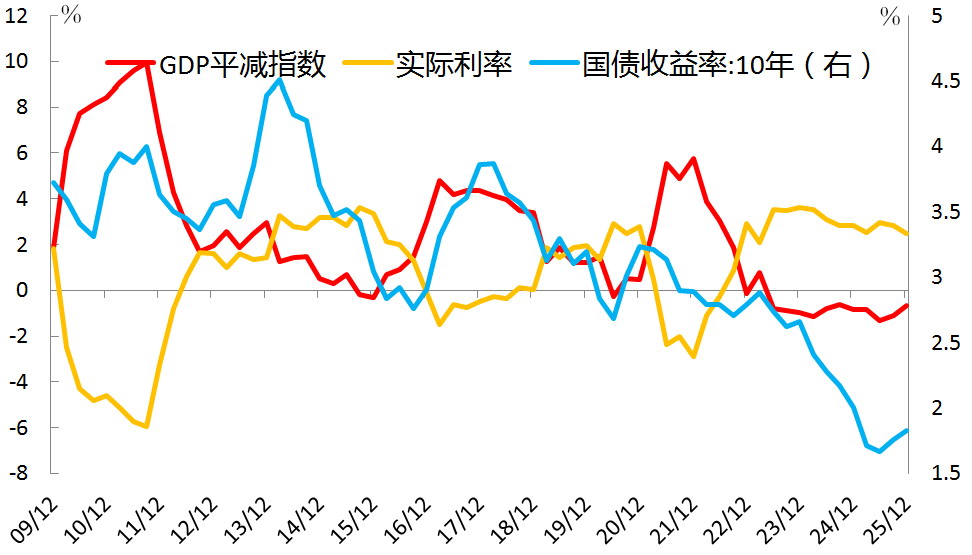
每日债市速递 | 央行14天逆回购呵护跨节流动性
Sou Hu Cai Jing· 2026-02-10 07:54
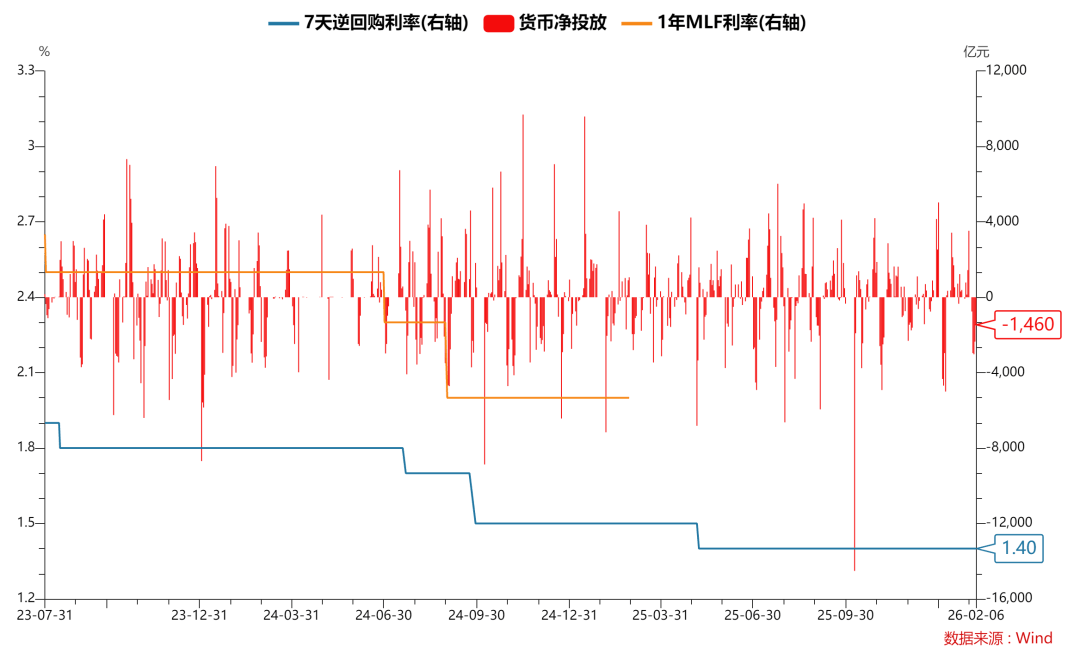
Market Overview - The central bank conducted a 315 billion yuan 7-day reverse repurchase operation at a fixed rate of 1.40%, with a total bid and awarded amount of 315 billion yuan. Additionally, a 3000 billion yuan 14-day reverse repurchase operation was carried out, indicating a total of 6000 billion yuan in reverse repos over two days to support liquidity during the Spring Festival [1][3] - The interbank market showed a more relaxed liquidity environment, with the weighted average rate of DR001 dropping over 4 basis points to around 1.27%. Overnight quotes in the anonymous click (X-repo) system fell to 1.25%, indicating ample supply [3] - The latest overnight financing rate in the U.S. was reported at 3.65% [3] Interbank Certificates of Deposit - The latest transaction for one-year interbank certificates of deposit in the secondary market was around 1.590% [7] Bond Market - The yields on major interbank bonds mostly declined, reflecting a downward trend in bond prices [9] - The closing prices for government bond futures showed slight increases, with the 30-year main contract rising by 0.42%, the 10-year by 0.08%, the 5-year by 0.03%, and the 2-year by 0.02% [14] Global Macro - The European Central Bank maintained its benchmark interest rate, marking the fifth consecutive pause since June of the previous year. However, no clear signals regarding future policy direction were provided, leading to expectations of stable monetary policy in the near term [14]

历史首次!印度资金加速拥抱黄金,金价坚守5000大关
Jin Shi Shu Ju· 2026-02-10 07:53
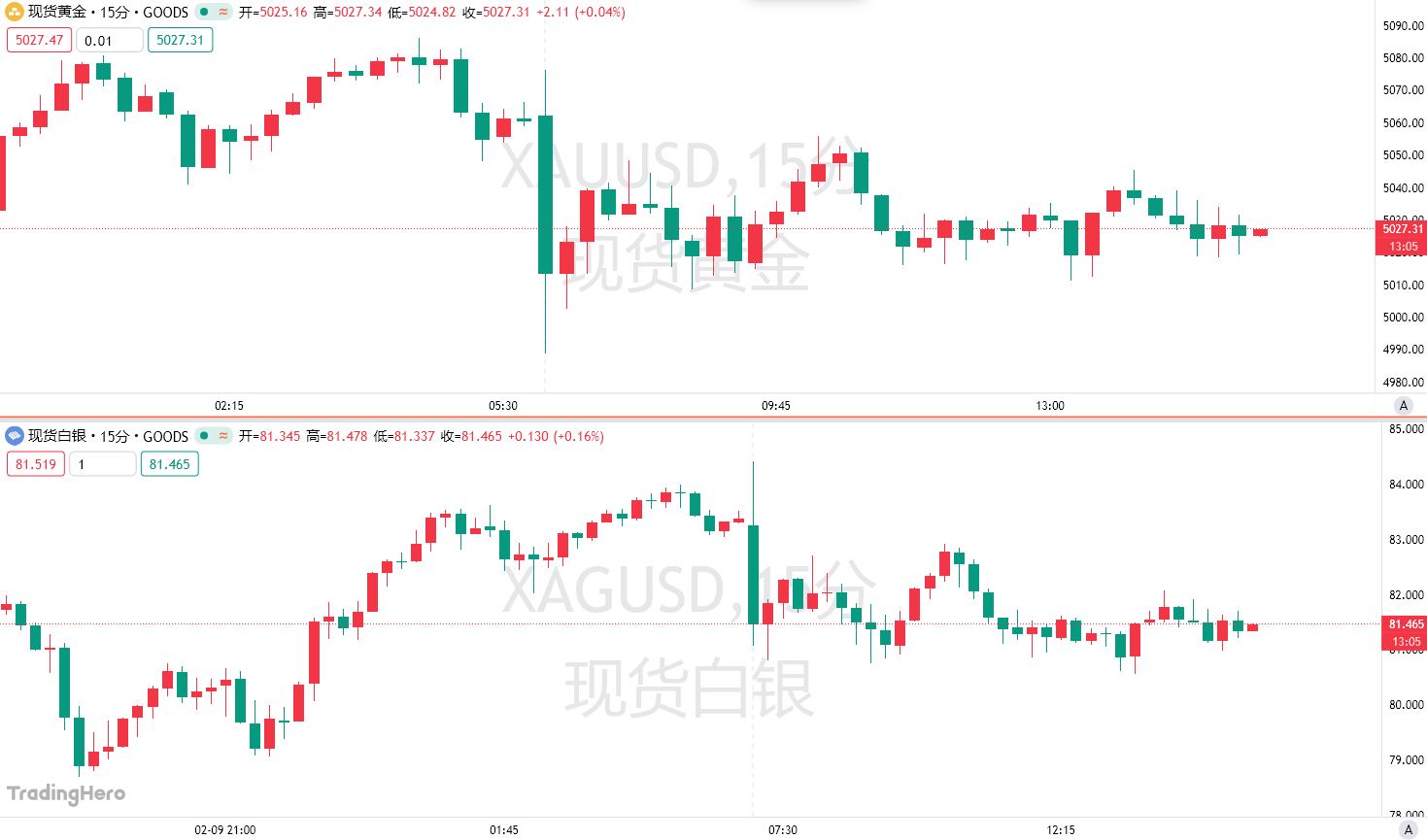
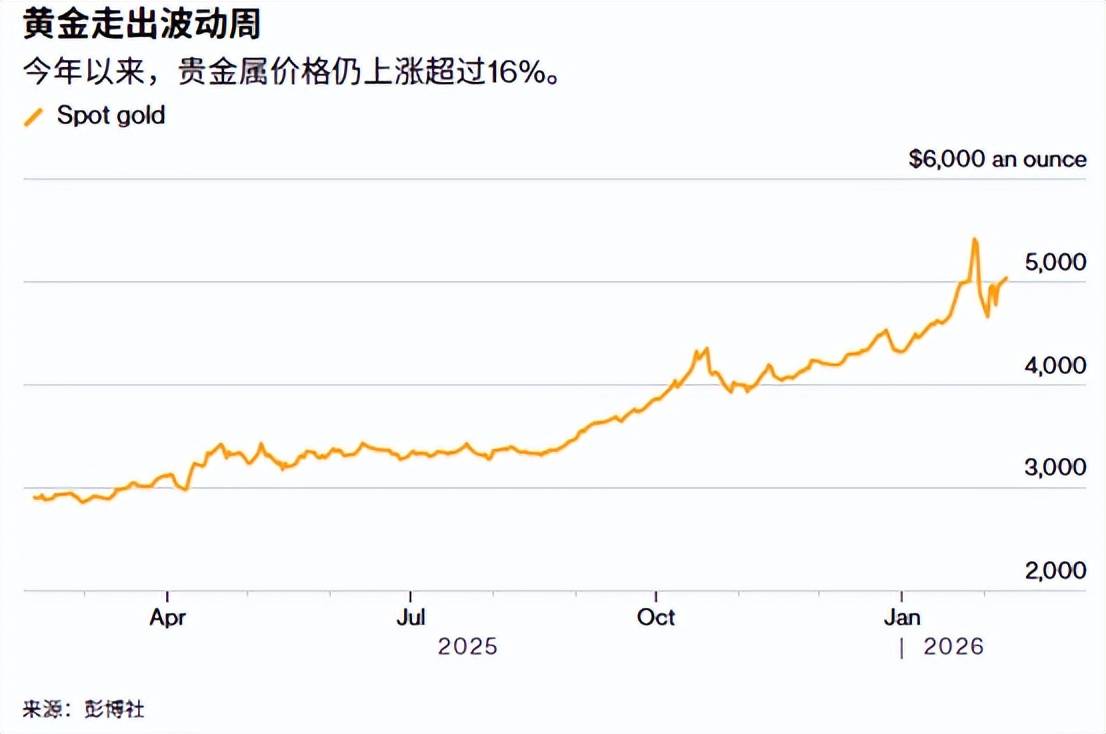
Group 1 - Gold prices experienced a decline after two consecutive days of increase, with spot gold dropping by 1.4% before stabilizing slightly above $5000 per ounce, as investors sought to take profits amid a volatile market [1][3] - Despite a 10% drop from the historical high reached on January 29, gold prices have shown steady growth this year, indicating underlying demand factors remain intact [1][3] - Analysts suggest that the recent price drop indicates profit-taking rather than a mass exit from the market, with $5000 per ounce serving as a psychological support level [3][4] Group 2 - Central banks, including the People's Bank of China, have continued to increase gold reserves, highlighting strong official demand [3] - In India, net inflows into gold exchange-traded funds (ETFs) reached a record 240.4 billion rupees (approximately $2.65 billion), surpassing inflows into stock mutual funds, indicating a strong endorsement of gold by local investors [3] - Structural drivers supporting gold prices remain intact, with expectations of a gradual recovery in prices following the recent market correction [4]
道指破5万黄金冲5千美元后,市场超级震荡周延续!
Sou Hu Cai Jing· 2026-02-10 07:43
Core Viewpoint - The financial markets experienced significant volatility last week, particularly in gold and silver, with the Dow Jones Industrial Average closing above 50,000 for the first time and gold surpassing $5,000, driven by a resurgence in buying on dips ahead of upcoming U.S. non-farm payroll and CPI reports [1] Group 1: Market Volatility - The stock market's volatility has been lower than that of precious metals and currencies this year, but concerns over AI threats have led to sharp fluctuations in software stocks, with a notable ETF dropping 12% from Monday to Thursday before rebounding 3.5% on Friday [3] - European stock markets experienced one of the highest volatility levels in years, with the weighted average volatility of the Euro Stoxx 50 index components soaring to over 30 points, marking the second-largest gap since 2009 [5] - The current market dynamics are driven by a resonance of "macro uncertainty and micro structural fragility," with upcoming U.S. CPI and non-farm data acting as a "judgment day" for market expectations regarding the Federal Reserve's interest rate path [7] Group 2: Asset Reactions to Economic Data - If the CPI and non-farm data reflect a "Goldilocks economy" (steady inflation decline and moderate employment slowdown), both U.S. stocks and gold could rise simultaneously, supported by soft landing expectations and solid corporate earnings [9] - In contrast, if the economy appears "overheated" (rising inflation and strong employment), both asset classes may face downward pressure due to heightened interest rate expectations [10] - The market is expected to be in a "high sensitivity waiting mode" before key macro data is released, transitioning into a "dramatic repricing mode" immediately after the data is published [7] Group 3: Investment Strategy - In light of high volatility and market divergence, a strategy of "core defense + flexible maneuvering" is recommended, with a proactive reduction of positions, especially in high-valuation and high-volatility assets before the CPI/non-farm data release [10] - The long-term bullish foundation for gold remains intact, driven by de-dollarization and central bank purchases, suggesting a strategy of "gradual accumulation on deep pullbacks" rather than chasing highs before data releases [10]
金价连续十天定格1125元!没意外的话,明天或迎更大级别变盘?
Sou Hu Cai Jing· 2026-02-10 07:34
Core Viewpoint - The gold market is experiencing an unusual period of calm, with domestic gold recycling prices holding steady at 1125 CNY per gram for ten consecutive days, while international gold prices hover above 5000 USD, indicating a cautious stance from major funds ahead of key economic data releases [1] Price Dynamics - There is a significant price disparity in the gold market, with retail prices for gold jewelry ranging from 1556 to 1560 CNY per gram, while recycling prices are at 1125 CNY, reflecting a split between retail demand driven by weddings and gifts and investment demand focused on the US dollar index and Federal Reserve actions [3] - The Shanghai Gold Exchange's T D price is at 1125.86 CNY per gram, while the spot price in the wholesale market is only 1110.8 CNY, indicating that the market is functioning through price differentials that account for various channel costs and expectations [3] Market Sentiment - The futures market shows a stable position with no significant buying or panic selling, as the main funds appear to be waiting for clearer direction, reflected in the RSI and MACD indicators [4] - Geopolitical factors are currently neutral, with no new conflicts in the Middle East, maintaining a standby mode for safe-haven demand [6] Economic Indicators - The upcoming US non-farm employment data is anticipated to influence market sentiment, especially after the ADP employment data showed a lower-than-expected increase of 22,000 jobs, raising speculation about a shift in Federal Reserve policy [6] - Central banks continue to support the gold market, with the People's Bank of China increasing its gold reserves for 14 consecutive months, purchasing over 50 tons in the first half of January [6] Market Behavior - The physical gold market shows contrasting trends, with wholesale prices remaining strong at 1261 CNY per gram, while recycling prices have dropped to 1070 CNY, indicating a shift in consumer behavior towards a wait-and-see approach [8] - Young investors are increasingly participating in the market through small-scale investments, such as accumulating gold in small amounts, which complements larger institutional trades [8] Historical Context - Historical data indicates that after similar periods of price stability, there is a 76.9% probability of a subsequent daily price movement exceeding 3%, suggesting potential volatility ahead [8] - Recent trading dynamics have shown significant fluctuations, with gold prices dropping to 1070 CNY per gram before rebounding to 1141.7 CNY, highlighting the competitive nature of the 1120-1140 CNY price range [10] Institutional Perspectives - There is a divergence in institutional forecasts for gold prices, with Goldman Sachs predicting 6000 USD per ounce by 2026, while Citigroup maintains a target of 5000 USD for the next three months, indicating varying outlooks among analysts [10] - The dynamics of gold ETFs reflect market sentiment, with recent net redemptions indicating some investors are opting to secure profits [10]

掌控日本的“铁娘子” 正牵动着美股与日元的命运?
智通财经网· 2026-02-10 07:06
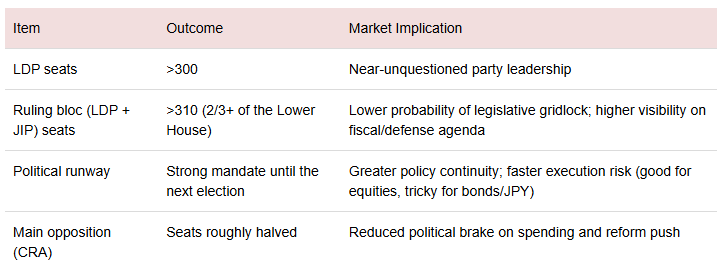
Core Viewpoint - The recent election results in Japan have granted Prime Minister Sanna Takashi and her ruling coalition significant political power, enabling efficient decision-making and potential economic policy changes that could impact global markets [1][2]. Group 1: Political Landscape - The ruling coalition led by Takashi's Liberal Democratic Party (LDP) secured approximately 316 seats, forming a majority with the Japan Innovation Party (JIP) to control around 350 seats in the House of Representatives [2]. - This majority allows the coalition to streamline legislative processes, reducing the likelihood of political gridlock and facilitating quicker implementation of policies [2][3]. - The opposition party's seats have been roughly halved, diminishing their influence on spending and reform initiatives [3]. Group 2: Market Implications - The election outcome has led to a bullish sentiment in the stock market, with indices like Nikkei 225 and TOPIX reaching historical highs, driven by expectations of fiscal stimulus and economic growth [4]. - The Japanese yen has depreciated significantly, with the USD/JPY exchange rate nearing 159, as market participants anticipate increased government spending and rising debt levels [6][7]. - Long-term Japanese government bonds (JGB) are experiencing higher yields due to concerns over fiscal risks and potential government spending plans [7]. Group 3: Investment Strategies - The "Takashi Trade" strategy involves going long on Japanese equities while being cautious with long-term JGB investments, which are viewed as high-risk assets [5]. - Investors are advised to consider the dynamics of yen carry trades, where borrowing in yen to invest in higher-yielding assets could lead to significant losses if the yen appreciates unexpectedly [10][11]. Group 4: Economic Scenarios - Analysts have outlined three potential scenarios for Japan's economic outlook: 1. **Moderate Reflation**: Continued fiscal stimulus with controlled debt levels, leading to stable yen and manageable bond yields [13]. 2. **Bond Vigilante 2.0**: Aggressive tax cuts and defense spending could lead to a reassessment of long-term bond risks, potentially pushing yields above 4% [14]. 3. **Yen Shock & Carry Trade Unwind**: A shift towards hawkish monetary policy could result in a rapid appreciation of the yen, triggering a sell-off in global equities as investors liquidate positions [15].
——全球货币转向跟踪第11期:全球降息潮或近尾声
Huachuang Securities· 2026-02-10 06:52
Group 1: Global Monetary Policy Trends - Since the beginning of 2026, among 26 major economies tracked, only 1 has cut rates (Israel) and 1 has raised rates (Australia), while the US, EU, and Japan have kept rates unchanged[2] - Market expectations indicate that the Federal Reserve may cut rates approximately 2 times in 2026, while the European Central Bank (ECB) is not expected to cut rates further as inflation has reached target levels[3][10] - The Bank of Japan is anticipated to raise rates about 2 times in 2026, reflecting a complex economic situation characterized by "stagflation"[3][24] Group 2: Liquidity Tracking - The Federal Reserve's reserve balance has risen to $2.94 trillion, with a reserve-to-GDP ratio of approximately 9.6%, nearing the desired range of 10%-12%[4][44] - The effective federal funds rate (EFFR) and the interest on excess reserves (IOER) spread has stabilized at -1 basis point, indicating no further deterioration in liquidity conditions[5][45] - The liquidity environment remains stable, with US 10-year Treasury bid-ask spreads slightly increasing to around 0.4 basis points, and credit risk premiums remaining low across various markets[6][11]
每日投资策略:国都港股操作导航-20260210
Guodu Securities Hongkong· 2026-02-10 06:28
Market Overview - The Hang Seng Index rose by 467 points or 1.76%, closing at 27,027 points, after reaching a high of 27,111 points during the day [3][4] - The total market turnover was 255.14 billion HKD, with a net outflow of 1.887 billion HKD from northbound trading [3] Key Stock Performances - Among the 88 blue-chip stocks, 70 saw an increase, with notable gains from Alibaba (up 1.9% to 157.9 HKD), Tencent (up 2.3% to 560 HKD), and Baidu (up 3.2% to 142.2 HKD) [4] - Kuaishou experienced a decline of 2.7%, closing at 69.3 HKD, while China Mobile fell by 2.1% to 78.5 HKD, marking it as one of the weaker performers [4] Real Estate Market Insights - DBS Bank indicated that the commercial real estate market in Hong Kong is under pressure, with office and retail sectors still finding their floor, and transactions occurring at discounted prices [8] - The bank noted that despite some ongoing transactions, the influx of new developments continues to exert pressure on office inventory [8] Employment Regulations - The Ministry of Human Resources and Social Security in China has initiated administrative guidance for 16 major platform companies, including Meituan and JD, to ensure compliance with labor management and protect workers' rights [9] Entertainment Industry Projections - The domestic box office for the upcoming Spring Festival is expected to reach between 7 billion to 8 billion RMB, with optimistic forecasts suggesting it could exceed 8 billion RMB [10] - Eight films have been scheduled for release during this period, with "Fast Life 3" anticipated to perform well based on its previous popularity [10] Company-Specific Developments - Pop Mart reported global sales of over 400 million units across all IP categories in 2025, with the "THE MONSTERS" category alone exceeding 100 million units [11] - China Resources Pharmaceutical is initiating the sale of a 17.87% stake in Hefei Tianmai Biotechnology, with a starting price of approximately 1.42 billion RMB [12] - Yingda Real Estate reported a 51% increase in revenue, with total income from continuing operations reaching 1.046 billion HKD [13] - Hong Kong Telecom is establishing a new AI data center in the Lok Ma Chau area, aiming to enhance cross-border connectivity and meet the growing demand for fiber optics [14]
2月10日央行开展3114亿元7天期逆回购操作
Zhong Guo Xin Wen Wang· 2026-02-10 06:12
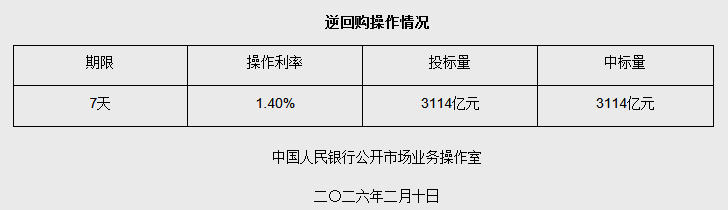
Core Viewpoint - The People's Bank of China conducted a 7-day reverse repurchase operation amounting to 311.4 billion yuan at a fixed interest rate of 1.40% on February 10, 2026 [1]. Group 1: Reverse Repo Operation Details - The operation was conducted using a fixed rate and quantity tender method [1]. - The total bidding amount was 311.4 billion yuan, which matched the amount awarded [1]. - The interest rate for the 7-day reverse repurchase agreement was set at 1.40% [1].
沃什掌舵美联储或政策常规化 沪金高位消化强支撑1095
Jin Tou Wang· 2026-02-10 06:10
Group 1 - Gold futures are currently trading around 1133.04, with a recent price of 1120.74 yuan per gram, reflecting a 4.88% increase, and a high of 1134.46 and a low of 1116.40 [1] - The short-term outlook for gold futures appears bullish, as the market is showing signs of upward momentum [1] Group 2 - Former Federal Reserve Governor Walsh, known for prioritizing anti-inflation measures, has criticized the Fed's expanded role in the economy and advocates for a return to traditional functions [3] - Walsh's potential appointment as Fed Chair is unlikely to lead to significant changes in monetary policy, as decisions are heavily reliant on the consensus of the Federal Open Market Committee (FOMC) [3] - Walsh and Treasury Secretary Basant advocate for reducing the Fed's market footprint, primarily through accelerated balance sheet reduction, but this approach may create conflicting signals regarding interest rates and balance sheet management [4] Group 3 - The gold market is currently in a clear upward trend, with prices oscillating upwards along the moving average system, indicating a solid bullish foundation [5] - Recent price action suggests a normal consolidation phase after a rapid increase, rather than a trend reversal, with key support levels remaining intact [5] - Resistance is noted in the 1125-1130 range, while support is identified in the 1100-1095 range, with a potential for upward movement if resistance is broken [5]
节后市场波动加大
Qi Huo Ri Bao· 2026-02-10 06:06
Group 1 - The core viewpoint of the articles indicates that the bond market is stabilizing, driven by monetary policy adjustments and market conditions, while the real estate sector continues to face challenges [1][4][5] Group 2 - In early 2025, fixed asset investment decreased by 3.8% year-on-year, primarily due to declines in real estate development and infrastructure investment, with manufacturing investment showing a slight increase of 0.6% [2] - Real estate development investment fell by 17.2% year-on-year, and the sales of commercial housing dropped by 12.6%, indicating ongoing instability in the real estate market [2] - The consumer price index (CPI) rose by 0.8% year-on-year in December 2025, marking a 34-month high, while the producer price index (PPI) decreased by 1.9%, suggesting gradual improvement in domestic demand [2] Group 3 - As of the end of January, the bond market's outstanding scale exceeded 197.71 trillion yuan, with net financing in January amounting to 14,189 billion yuan, showing a slight year-on-year decline [4] - The central bank indicated that there is still room for further interest rate cuts and reserve requirement ratio reductions in 2026, aiming for a moderately loose monetary policy [4][5] - The central bank's net bond purchases in January amounted to 1,000 billion yuan, contributing to a generally loose market liquidity ahead of the Spring Festival [4][5] Group 4 - Looking ahead, the bond market is expected to stabilize before the holiday, with potential fluctuations and increased volatility in the long-end bond market after the holiday [6]