债券

Search documents
美国国债:收益率跌至低点,投资者追逐避险资产
Sou Hu Cai Jing· 2025-10-17 05:06
Core Viewpoint - The 5-year U.S. Treasury yield has dropped to its lowest point in a year, driven by investor uncertainty regarding regional banks and trade tensions, leading to a flight to safety [1] Group 1: Treasury Yield Movements - The 5-year U.S. Treasury yield fell by 3 basis points to 3.51%, marking the lowest level since early October 2024 [1] - The 2-year U.S. Treasury yield has also reached its lowest point since 2022, while the benchmark 10-year Treasury yield has dipped below 4% [1] Group 2: Market Reactions - Strategists indicate that the rise in U.S. Treasury prices reflects a pursuit of safe-haven assets, as credit-related challenges have heightened uncertainty in the market [1] - There is a subconscious market reaction to the increasing uncertainty surrounding credit conditions [1]
【申万固收|信用】新变局下的挑战,短端为盾票息为矛——2025年四季度信用债市场展望
申万宏源证券上海北京西路营业部· 2025-10-17 03:08
Core Viewpoint - The article discusses the challenges and opportunities in the credit bond market for the fourth quarter of 2025, emphasizing the importance of short-term strategies and interest rates as protective measures [2] Group 1: Market Challenges - The credit bond market is facing new challenges due to changing economic conditions and regulatory environments [2] - Increased volatility in interest rates is expected to impact bond pricing and investor sentiment [2] Group 2: Strategic Recommendations - Short-term bonds are recommended as a defensive strategy to mitigate risks associated with long-term investments [2] - The article suggests focusing on interest income as a key component of investment returns in the current market landscape [2]


大类资产早报-20251017
Yong An Qi Huo· 2025-10-17 02:09
1. Report Industry Investment Rating - There is no information about the report industry investment rating in the provided content. 2. Core Views - There is no information about the core views of the report in the provided content. 3. Summary by Relevant Catalogs Global Asset Market Performance - **10 - year Treasury Bond Yields**: On October 16, 2025, the 10 - year Treasury bond yields of major economies showed various values and changes. For example, the US was 4.034, with a one - week change of - 0.105, a one - month change of - 0.013, and a one - year change of 0.021. Japan was 3.503, with a one - week change of - 0.091, a one - month change of - 0.042, and a one - year change of - 0.456 [3]. - **2 - year Treasury Bond Yields**: Also on October 16, 2025, the 2 - year Treasury bond yields of some major economies were presented. The US was 3.480, with a one - week change of - 0.150, a one - month change of - 0.130, and a one - year change of - 0.180. Japan was 0.913, with a one - week change of - 0.012, a one - month change of 0.064, and a one - year change of 0.514 [3]. - **Dollar - to - Major Emerging Economies Currency Exchange Rates**: As of October 16, 2025, the dollar - to - major emerging economies currency exchange rates had different values and changes. For the Brazilian real, it was 5.521 on that day, with a one - week change of 2.82%, a one - month change of 2.07%, and a one - year change of - 0.24%. The on - shore RMB was 7.135, with a one - week change of 0.07%, a one - month change of 0.20%, and a one - year change of 1.02% [3]. - **Major Economies' Stock Indexes**: On October 16, 2025, major economies' stock indexes had their respective closing values and changes. The S&P 500 closed at 6552.510, with a one - week change of - 2.71%, a one - month change of 0.31%, and a one - year change of 13.93%. The Hang Seng Index closed at 26290.320, with a one - week change of - 1.73%, a one - month change of 0.34%, and a one - year change of 25.63% [3]. - **Credit Bond Indexes**: On October 16, 2025, the US investment - grade credit bond index was 3529.690, with a one - week change of 0.34%, a one - month change of 0.28%, and a one - year change of 5.19%. The emerging economies' high - yield credit bond index was 1746.620, with a one - week change of - 0.45%, a one - month change of - 0.08%, and a one - year change of 10.98% [3][4]. Stock Index Futures Trading Data - **Index Performance**: The A - share closed at 3916.23 with a 0.10% increase. The Shanghai and Shenzhen 300 closed at 4618.42 with a 0.26% increase [5]. - **Valuation**: The PE (TTM) of the Shanghai and Shenzhen 300 was 14.40 with a 0.09环比 change. The PE (TTM) of the S&P 500 was 27.26 with a 0.00环比 change [5]. - **Risk Premium**: The risk premium of the Shanghai and Shenzhen 300 (1/PE - 10 - year interest rate) was 3.70 with a 0.00环比 change. The risk premium of the S&P 500 was - 0.37 with a 0.00环比 change [5]. - **Fund Flow**: The latest value of A - share fund flow was - 1098.75, and the 5 - day average was - 803.28. The latest value of Shanghai and Shenzhen 300 fund flow was 70.26, and the 5 - day average was - 110.92 [5]. - **Trading Volume**: The latest trading volume of the Shanghai and Shenzhen stock markets was 19311.38 with a - 1417.21环比 change. The latest trading volume of the Shanghai and Shenzhen 300 was 5605.67 with a - 467.59环比 change [5]. - **Main Contract Premium or Discount**: The basis of IF was - 28.42 with a - 0.62% amplitude. The basis of IH was - 0.20 with a - 0.01% amplitude [5]. Treasury Bond Futures Trading Data - The closing prices of T00, TF00, T01, and TF01 were 108.165, 105.705, 107.870, and 105.600 respectively, with corresponding percentage changes of - 0.04%, - 0.04%, - 0.05%, and - 0.03% [6]. - The domestic money market's R001, R007, and SHIBOR - 3M were 1.3531%, 1.4751%, and 1.5810% respectively, with daily changes of - 12.00BP, 1.00BP, and 0.00BP [6].
中信期货晨报:国内商品期货多数上涨,新能源材料涨幅居前-20251017
Zhong Xin Qi Huo· 2025-10-17 01:56
Report Industry Investment Rating - Not provided in the given content Core View of the Report - Next week, there is a risk of increased volatility in global major asset classes. Investors are advised to maintain a strategic allocation to precious metals such as gold and be relatively cautious about risk assets like equities, waiting and seeing. In the medium - term of the fourth quarter, the basic allocation view of equities > commodities > bonds is still held, and attention can be paid to potential buying opportunities for equity assets after the turmoil subsides [6] Summary by Related Catalogs Market Performance Summary - **Financial Market**: In the stock index futures, technology events catalyze the active growth style; the market turnover of index options slightly declines; the bond market of treasury bond futures remains weak. For example, the current price of CSI 300 futures is 4,590 with a daily increase of 0.30%, and the 2 - year treasury bond futures price is 102.362 with a daily decrease of 0.02% [2][7] - **Commodity Market**: Precious metals like COMEX gold and silver have significant increases, with COMEX gold rising 1.57% daily and COMEX silver rising 4.69% daily. In the energy sector, NYMEX WTI crude oil and ICE Brent oil have daily increases of 0.27% and 0.31% respectively, but have declined this year. In the agricultural products sector, CBOT soybeans and other varieties show different trends [2] - **Shipping Market**: The freight rate of container shipping to Europe is under pressure, with a monthly decline of 3.37% [3] Macro - situation Analysis - **Overseas Macro**: Next week, attention should be paid to new tariff threats from Trump and the marginal changes in the US government shutdown. There is a risk of conflict escalation before the APEC meeting at the end of October. If the US government shutdown exceeds 30 days, it will increase the recession risk [6] - **Domestic Macro**: China will gradually enter the period of focusing on the "15th Five - Year Plan" and tracking incremental policies. The progress and effectiveness of a batch of incremental policies such as 500 billion new policy - based financial instruments are worthy of follow - up [6] Asset Views - **Short - term**: Maintain a strategic allocation to precious metals such as gold, and be cautious about risk assets like equities next week [6] - **Medium - term (Fourth Quarter)**: Hold the basic allocation view of equities > commodities > bonds, and pay attention to potential buying opportunities for equity assets after the turmoil [6] View Highlights - **Financial**: Stock index futures are expected to rise in shock, index options to fluctuate, and treasury bond futures to oscillate [7] - **Precious Metals**: Gold and silver are expected to rise in shock [7] - **Shipping**: Container shipping to Europe is expected to fluctuate [7] - **Black Building Materials**: Most varieties such as steel, iron ore, coke, etc. are expected to oscillate [7] - **Non - ferrous Metals and New Materials**: Most non - ferrous metal varieties are expected to oscillate, and aluminum is expected to rise in shock [7] - **Energy and Chemicals**: Most varieties are expected to decline in shock, and some varieties such as asphalt and high - sulfur fuel oil are expected to oscillate [9] - **Agriculture**: Most varieties are expected to oscillate, and some varieties such as sugar and paper pulp are expected to decline in shock [9]
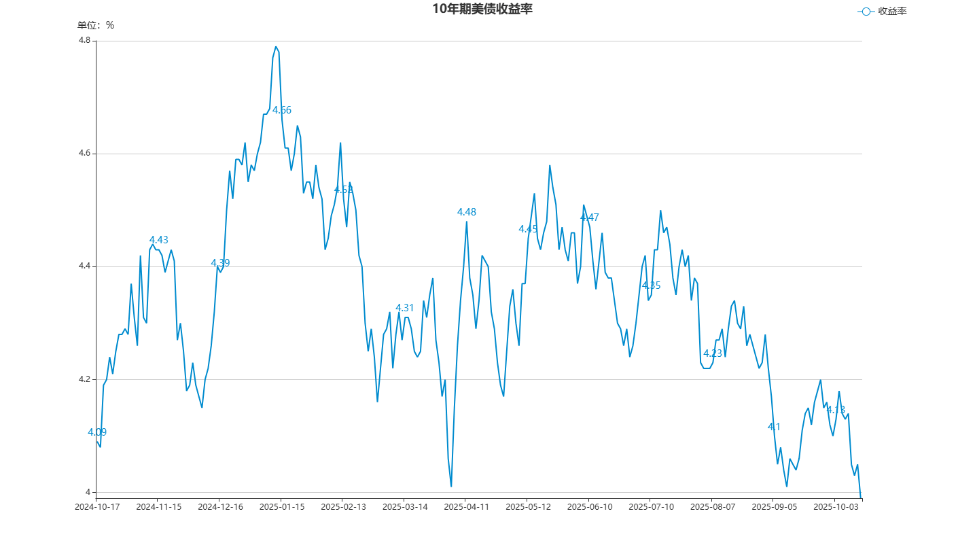
10年期美债收益率跌至4%以下 创4月份以来最低水平
Sou Hu Cai Jing· 2025-10-17 00:25
转自:新华财经 欧洲市场方面,欧债走势与美债类似,中短期德债收益率下跌,其中10年期德债收益率微涨0.1BP至2.571%;意债涨多跌少,其中10年 期意债收益率跌0.7BP至3.352%;法债收益率当天全线下跌,10年期法债收益率跌0.3BP至3.334%。 费城联储当天公布的地区经济状况调查指数下跌36点,至-12.8点,远低于华尔街经济学家普遍预期的9.5点。该地区发货量下降20点,但 新订单上升,就业下降1点,但仍为正值,调查中的预期指数更高。 同在周四,美联储理事克里斯托弗·沃勒、迈克尔·巴尔和斯蒂芬·米兰,以及美联储负责监管的副主席米歇尔·鲍曼都在各种活动上发表了 讲话。面对劳动力市场疲软和地缘政治紧张局势加剧,米兰和沃勒对美联储应该以多快的速度降息提出了不同的看法。 在美国政府关门进入第三周之际,投资者正密切关注这些讲话,希望从中找到未来货币政策走向的线索。政府停摆意味着官方经济数据 的持续封锁,这已经推迟了有关劳动力市场状况的关键数据,而美联储本可以利用这些数据来为其决策提供信息。 通常情况下,美国劳工统计局会在美国东部时间周四上午8点30分公布9月份生产者价格指数,而即将发布的消费者价格指数 ...
U.S. 10-year Treasury slides below 4%
Youtube· 2025-10-16 19:01
Core Insights - The current 10-year bond yield is below 4%, marking a significant moment in the market with the announcement of a government surplus of $198 billion [1][3]. - Despite the surplus, the fiscal year is projected to incur $1.2 trillion in debt servicing costs, indicating ongoing financial pressures [2]. - The market's movement below the 4% threshold occurred prior to the surplus announcement, suggesting underlying market dynamics at play [3][4]. Group 1 - The 10-year bond yield has been closing at a three-year low, with a notable drop observed in recent days [3]. - The market has been testing the 4% support level consistently throughout the week, indicating investor anxiety regarding economic conditions and potential tariff impacts [4]. - The recent decline in bond yields may not be sustainable, as concerns about economic slowdown and trade issues persist [4].

对内支撑实体对外助力开放 “债市基石”立起来
Zheng Quan Ri Bao· 2025-10-16 16:07
Core Viewpoint - The "14th Five-Year Plan" outlines a clear strategy for expanding China's bond market, which has achieved significant growth in scale, product innovation, risk control, and international connectivity, positioning it as a cornerstone for building a financial powerhouse and promoting high-quality economic development [1][2][4]. Group 1: Market Scale and Growth - As of August 2025, the total custody balance of China's bond market exceeded 192 trillion yuan, representing a growth of over 60% compared to the end of the "13th Five-Year Plan," with a single-year issuance scale of 79.62 trillion yuan in 2024 [2][3]. - The bond market has become the second largest in the world, with a robust framework supporting its expansion [1][2]. Group 2: Product Innovation - Continuous product innovation has led to the introduction of specialized financial tools targeting sectors like artificial intelligence and renewable energy, enhancing the market's ability to meet diverse financing needs [1][2][8]. - The launch of the "Technology Board" in May 2025 specifically caters to financing needs in semiconductor and biomedicine sectors, while public REITs have expanded to cover various asset types, unlocking over 100 billion yuan in existing assets [2][8]. Group 3: Risk Control - The bond market has maintained a low default rate of around 1%, supported by a market-oriented and legal framework for default resolution [3][4]. - By June 2025, over 60% of local government financing platforms had exited, effectively mitigating systemic financial risks [3][4]. Group 4: International Connectivity - By August 2025, 1,170 foreign institutions from 80 countries and regions had entered the market, holding approximately 4 trillion yuan in bonds, marking a nearly fourfold increase since the launch of the "Bond Connect" [3][4]. - China's bonds have been included in major international indices, enhancing their global appeal and positioning [3][4]. Group 5: Future Directions - The bond market is expected to focus on product innovation, risk control, and deepening international openness to support economic transformation and enhance financial competitiveness [8]. - There is a need to optimize the bond product structure, develop high-yield bond markets, and improve risk management tools to better serve diverse financing demands [8][9].
固收-债市“收官战”,预计Q4债市表现优于Q
2025-10-16 15:11
Summary of Conference Call on Bond Market Outlook Industry Overview - The conference call focuses on the bond market, specifically the performance and outlook for the fourth quarter of 2025. Key Points and Arguments Bond Market Performance - The bond market experienced a prolonged adjustment in Q3, with a minor decline in yields, contrasting with the rapid adjustments seen at the beginning of the year [1][3] - It is anticipated that the bond market will perform better in Q4 compared to Q3, with the 10-year government bond yield expected to reach 1.7% initially, and potentially drop to 1.65% if it breaks through [1][4] Economic Indicators - China's economy showed a quarter-on-quarter growth of over 1% and a year-on-year growth exceeding 5% in the first three quarters, indicating that the economy has not significantly weakened [1][5] - A low interest rate environment is aligned with the current economic fundamentals, but further weakening of the fundamentals is necessary for lower interest rates [1][5] Impact of U.S.-China Trade Tensions - Ongoing uncertainties regarding U.S.-China trade tensions could affect the capital and bond markets, necessitating caution in investment strategies [1][6] - The market currently expects a tough stance from the Trump administration, but there is significant uncertainty regarding future trade policies [1][7] Market Dynamics - Trade tensions influence the bond market through equity market fluctuations and monetary easing [1][8] - The correlation between the equity and bond markets has weakened as the stock market rises above 3,900 points, indicating that further equity gains may have limited negative impacts on the bond market [1][8] Fund Sales and Redemption Fees - The most significant impact from increased fund sales and redemption fees has already passed, with redemption fees fully accounted for in fund assets, thus not significantly affecting overall market points [1][9] - However, certain bond types, such as long credit bonds, may still face some pressure [1][9] Future Outlook - The expected recovery range for Q4 is between 1.65% and 1.7%, with no significant risks or changes in odds currently visible [1][10] - A detailed outlook for 2026 will be provided in the annual strategy report [2][10]
人民银行:我国债券市场托管余额192万亿元,稳居全球第二位
Bei Jing Shang Bao· 2025-10-16 12:21
Core Insights - The People's Bank of China emphasizes the importance of financial services to the real economy, aiming to steadily expand the financing scale of financial markets and optimize the financing structure [1] Group 1: Financial Market Developments - The bond market financing scale is being steadily expanded, significantly increasing the proportion of direct financing [1] - As of August 2025, the bond market custody balance in China reached 192 trillion yuan, maintaining the second position globally, with a growth of 64.2% compared to the end of 2020 [1] - The balance of corporate credit bonds is 34.1 trillion yuan, making it the second-largest financing channel for real enterprises after bank credit [1] Group 2: Support for the Real Economy - During the 14th Five-Year Plan period, the net financing scale of bonds in China reached 55.7 trillion yuan, accounting for 35.3% of the incremental social financing scale, providing strong support for economic growth [1]
法国总理侥幸闯关不信任投票 欧债市场重拾信心
智通财经网· 2025-10-16 11:48
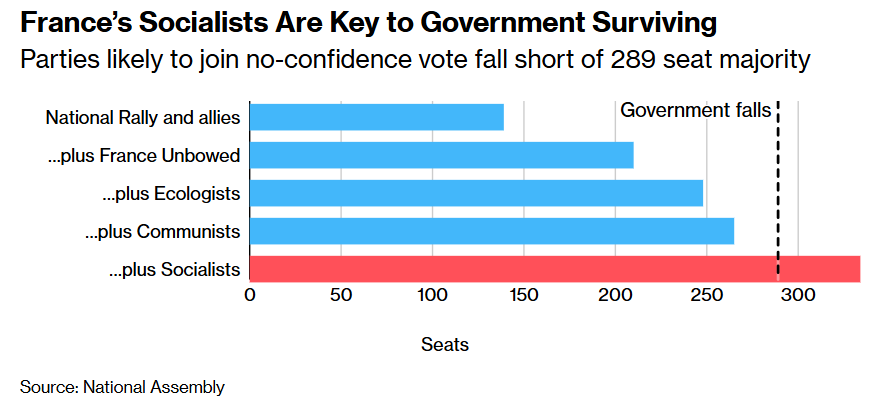
Core Viewpoint - The reappointment of French Prime Minister Sebastien Lecornu and the suspension of a controversial pension reform have alleviated political tensions, positively impacting the European bond market, particularly French government bonds [1][2][8] Group 1: Political Developments - Lecornu survived two significant no-confidence votes, with the first motion receiving only 271 votes, failing to reach the required 289 for his resignation, and the second motion garnering 144 votes [1] - The Socialists in the French Parliament have pledged support for Lecornu's government after he promised to suspend the pension law that aimed to raise the retirement age from 62 to 64 starting in 2023 [2][5] - The current political landscape in France is characterized by a "hung parliament" and a minority government, leading to increased uncertainty in legislative and budgetary processes [5][6] Group 2: Economic Implications - The suspension of the pension reform is expected to incur significant financial costs, estimated at approximately €400 million (about $465 million) next year and around €1.8 billion by 2027 [2] - The spread between French and German 10-year government bond yields, a key market risk indicator, narrowed to 78 basis points, indicating a reduction in selling pressure on French bonds [1][8] - The CAC 40 index rose by 0.8%, outperforming other European stock indices, reflecting improved market sentiment following the political developments [1] Group 3: Market Reactions - The recent political stability has provided a temporary reprieve for the European bond market, which had been experiencing significant selling pressure [7][8] - Investors remain cautious, focusing on upcoming budget negotiations and sovereign debt rating risks, as the long-term outlook for the European bond market remains uncertain [8]