医药

Search documents
【十大券商一周策略】短期或进入宽幅震荡阶段,中长期向好趋势不改
券商中国· 2025-11-16 14:54
Group 1 - The market is expected to continue showing a rotation between technology and cyclical sectors, despite a marginal weakening of macro liquidity drivers in the domestic market [2] - The current market is in a "bull market 1.0" phase, with high volatility expected in the near term, particularly in technology growth stocks, which may have limited short-term adjustment space [3] - A structural "rebalancing" is occurring globally, with funds rotating from previously leading technology sectors to lower-valued sectors such as resources, consumption, and pharmaceuticals [4] Group 2 - The A-share market is in a consolidation phase, with rapid sector rotation and a focus on lithium battery and consumer sectors benefiting from policy support [5] - The current style expansion is driven by valuation, expectations, and capital, with value stocks benefiting from economic stabilization and performance verification [6] - The market may enter a wide fluctuation phase in the short term, with a focus on defensive and consumer sectors, while TMT and advanced manufacturing sectors are expected to perform better in the medium term [7] Group 3 - The "small and mid-cap + thematic investment" strategy remains a core focus for November, with attention on themes related to the 14th Five-Year Plan, such as energy storage and domestic substitution [8] - The current economic environment is characterized by a divergence between investment and consumption, with a focus on power-related assets as a key investment theme [9] - The A-share market's high-cut low trend is expected to continue until the end of the year, with a focus on strong fundamentals supporting technology stocks [10] Group 4 - The market is anticipated to maintain a short-term oscillation around the 4000-point level, with limited directional breakthroughs expected [12] - The upcoming economic data and Federal Reserve policy expectations are critical variables that will influence market dynamics and sector performance [12]


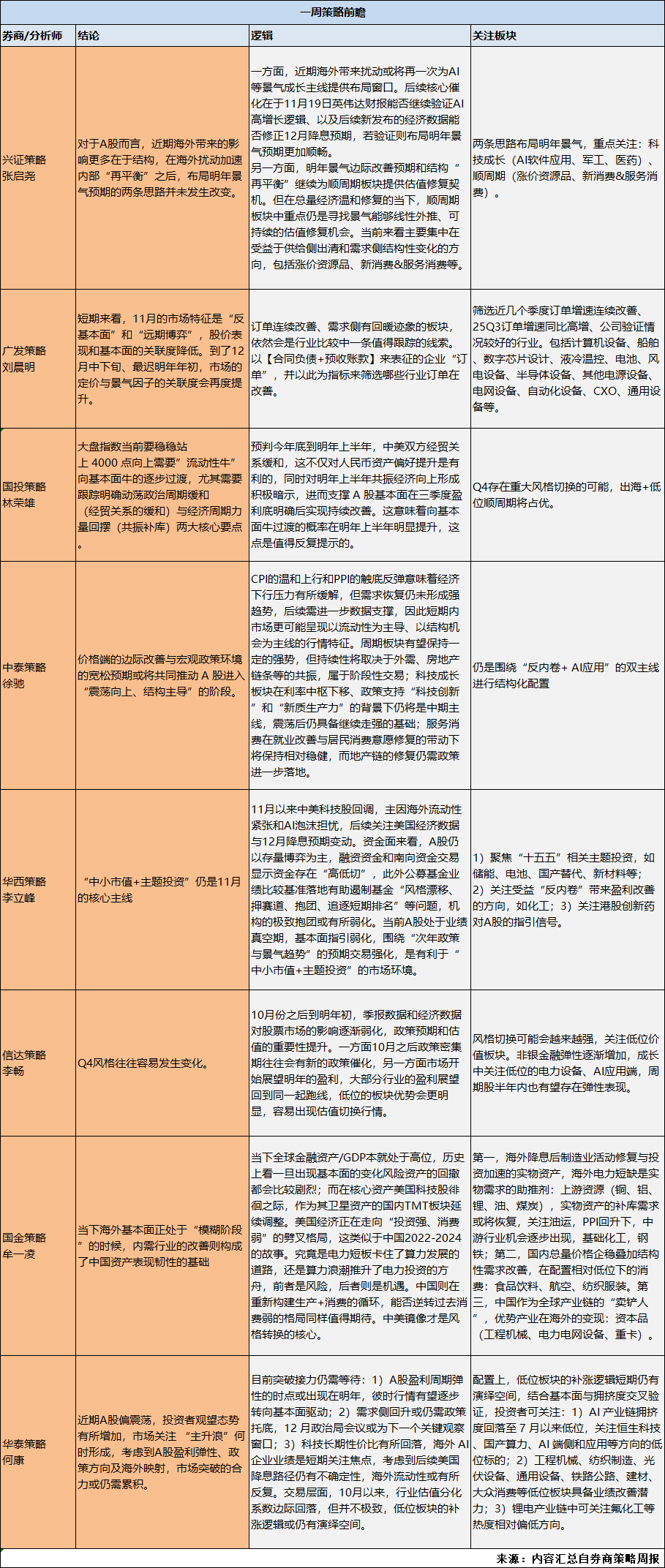
A股分析师前瞻:11月,主题投资更占优
Xuan Gu Bao· 2025-11-16 14:07
Core Insights - The main discussion among analysts revolves around the year-end style switch, with a focus on the impact of U.S. economic data and interest rate expectations on market performance [1][2][3] Group 1: Market Trends - Analysts from Huaxi Strategy noted that the recent pullback in Chinese and U.S. tech stocks is primarily due to tight overseas liquidity and concerns over the AI bubble, with attention shifting to U.S. economic data and December rate cut expectations [1] - The current A-share market is characterized by stock selection based on existing liquidity, with a notable "high-low cut" in trading activities, indicating a preference for mid and small-cap stocks and thematic investments [1][4] - The market environment in November is favorable for "small and mid-cap + thematic investments," as the fundamental guidance is weak and trading is increasingly based on expectations for next year's policies and economic trends [1][4] Group 2: Sector Focus - The focus on sectors benefiting from improving order growth includes computer equipment, shipbuilding, digital chip design, liquid cooling, batteries, wind power equipment, semiconductor equipment, and automation equipment [2][3] - Analysts from Xingzheng Strategy highlighted that the upcoming Nvidia earnings report on November 19 is crucial for validating the high growth logic of AI, which could provide a clearer outlook for next year's economic expectations [2][3] - The emphasis on sectors that have shown continuous improvement in order growth over recent quarters suggests a strategic focus on industries that are likely to benefit from structural changes in demand [2][3] Group 3: Policy and Economic Outlook - The period from October to early next year is expected to see a diminishing impact of quarterly reports and economic data on the stock market, with policy expectations and valuations becoming more significant [1][4] - The anticipated policy catalysts following the October period may lead to a reassessment of next year's earnings outlook, with many industries returning to a common starting line, making low-valued sectors more attractive [1][4] - The overall market is expected to transition from a liquidity-driven phase to one more influenced by fundamental factors, particularly as economic conditions stabilize and improve [4]
中银量化大类资产跟踪:股指窄幅波动,微盘股实现显著正收益
Bank of China Securities· 2025-11-16 11:05
- The report does not contain specific quantitative models or factors for analysis [1][2][3] - The report primarily focuses on market performance, style indices, valuation metrics, and fund flows without detailing quantitative models or factor construction [1][2][3] - Key metrics such as PE_TTM, ERP, and style index performance are discussed, but no explicit quantitative model or factor development process is provided [41][51][59]

广西促进“三医”协同发展 惠民政策减轻民众就医负担
Zhong Guo Xin Wen Wang· 2025-11-16 02:00
Core Viewpoint - Guangxi is actively establishing a multi-department consultation mechanism to promote the coordinated development and governance of medical services, medical insurance, and pharmaceuticals, aiming to improve the healthcare experience for the public [1][2] Group 1: Healthcare Policy Improvements - Guangxi has implemented several policies since 2024, including special medical services management in public hospitals and "pre-admission" treatment management, aimed at enhancing the healthcare experience for citizens [1] - The "pre-admission" treatment management effectively reduces waiting times for patients needing hospitalization, thereby alleviating the burden of medical care [1] - The "no accompanying caregiver" ward pilot allows nurses and medical caregivers to take care of patients during hospitalization, reducing the pressure and costs on family members [1] Group 2: Accessibility and Support for Vulnerable Groups - Measures such as priority windows for elderly patients in registration, payment, and medication collection have been established to improve the healthcare environment for older individuals [1] - The "Pediatric Medical Service Year" action plan (2025-2027) aims to enhance the accessibility of pediatric medical services [1] Group 3: Financial Relief and Medical Aid - Guangxi has launched a special action to improve medical services, with 7069 convenience service measures implemented across 458 secondary and higher medical institutions, benefiting 125 million people and reducing patient costs by approximately 168 million yuan [2] - The region has advanced medical insurance reforms, with a 100% medical expense assistance ratio for extremely poor individuals, and a total of 34.79 billion yuan spent on medical aid by September 2025, benefiting over 301 million insured individuals [2] Group 4: Drug Cost Management - Guangxi has optimized the medical insurance payment scope, including 147 nationally negotiated drugs, with 44 covering 34 rare diseases, and increased the number of outpatient special chronic disease categories to 38, with 1658 corresponding drugs [2] - 211 new medical service items have been included in medical insurance, optimizing 863 payment categories, with a total of 5.82 billion yuan spent on 291,100 cases [2] Group 5: Drug Safety and Regulation - Guangxi has deepened drug regulatory reforms, ensuring strict adherence to drug safety responsibilities, with 2902 batches of drugs tested this year and a compliance rate of 99.21%, maintaining a "zero occurrence" of drug safety incidents [2]
陆家嘴财经早餐2025年11月16日星期日
Wind万得· 2025-11-15 22:23
Group 1 - The article emphasizes the importance of developing new productive forces tailored to local conditions, with a focus on technological innovation and the real economy, to accelerate the construction of a modern industrial system during the 14th Five-Year Plan period [2] - The Chinese Ministry of Foreign Affairs has advised citizens to avoid traveling to Japan, leading to changes in airline policies and travel agency operations [2] Group 2 - The State Administration for Market Regulation has released a draft guideline for antitrust compliance for internet platforms, highlighting the need for major platform operators to regularly assess their market dominance and avoid abusive practices [3] - The Ministry of Ecology and Environment has initiated the third round of central ecological and environmental protection inspections, focusing on several provinces and major state-owned enterprises [3] Group 3 - The National Health Commission has introduced a child-rearing subsidy system, with a total of over 31.7 million applications submitted, and subsidies of 3,600 yuan per year per child starting from January 1, 2025 [4] Group 4 - Yushu Technology has completed its IPO counseling report and plans to apply for an initial public offering in China, with CITIC Securities providing advisory services [5] - The Hong Kong IPO market for pharmaceutical companies has seen a surge, with 23 companies successfully listed this year compared to only 8 last year [5] - Foreign investors remain optimistic about Chinese assets, with several major banks raising target prices for companies like Tencent and XPeng Motors [5] Group 5 - The number of outdoor sports participants in China has exceeded 400 million, with new sports trends emerging, such as VR climbing and night hiking [6] - The 27th China International High-tech Achievements Fair is taking place in Shenzhen, showcasing over 5,000 new products and technologies [6] - The lithium battery supply chain is experiencing a price surge, with the price of ethylene carbonate rising by 68% to 110,000 yuan per ton due to strong demand and supply constraints [6] Group 6 - By September 2025, China's new energy storage capacity is expected to exceed 100 million kilowatts, a 30-fold increase compared to the end of the 13th Five-Year Plan, accounting for over 40% of global capacity [7] - The chairman of CIMC Vehicles emphasized the need for a comprehensive ecosystem for electric heavy trucks, addressing systemic challenges in the industry [7] - Jiangsu province is enhancing consumer incentives for new car purchases, significantly increasing subsidy standards for various price ranges [7] Group 7 - Tmall reported its best growth in four years during the Double 11 shopping festival, with nearly 600 brands achieving over 100 million yuan in sales [8] - Beijing Automotive Group signed a strategic cooperation agreement with Beijing Rural Commercial Bank for a credit line of 50 billion yuan to support its development [8] - The Northern Xin'an Tai Rare Earth Metals expansion project has been launched, enhancing production capacity and product variety [8] Group 8 - Luckin Coffee's largest shareholder is evaluating a potential bid for Costa Coffee, which could significantly impact the global coffee market [9] - Leap Motor has achieved its sales target of 500,000 vehicles for 2025 ahead of schedule, with plans to target 1 million vehicles next year [9] Group 9 - The Hong Kong Stock Exchange welcomed the issuance of sovereign bonds by the Chinese Ministry of Finance, totaling $4 billion [14] - Berkshire Hathaway successfully issued bonds in Japan, raising 210.1 billion yen, with market speculation about potential investments in major Japanese trading companies [14]

药企赴港IPO火爆,半个月8家递表,基石投资者“快看不过来了”
第一财经· 2025-11-15 13:45
Core Viewpoint - The article discusses the surge in IPO applications from pharmaceutical companies in Hong Kong, highlighting the competitive landscape and the challenges faced by these companies in securing investors amid a crowded market [3][5][10]. Group 1: IPO Market Dynamics - As of November 14, 2023, 23 healthcare companies have successfully listed on the Hong Kong stock market this year, compared to only 8 in the same period last year [3]. - Over 40 healthcare companies have applied for IPOs in Hong Kong this year, with 8 applications submitted in just the first half of November [3]. - The increase in IPO applications has led to heightened competition among companies to attract suitable investors, resulting in a more complex negotiation landscape between companies and institutional investors [3][5]. Group 2: Case Study of Baillie Gifford - Baillie Gifford's planned global offering was delayed due to market conditions, with reports suggesting that investor demand did not meet expectations [4][5]. - The company aimed to attract long-term value investors rather than those focused on short-term price fluctuations, indicating a strategic approach to its IPO [5][6]. - The IPO process involves cornerstone placements, book-building, and public offerings, with cornerstone investors playing a crucial role in validating the company's value [6]. Group 3: Market Sentiment and Trends - The pharmaceutical sector has seen significant stock price increases this year, leading investors to focus on new IPOs rather than existing stocks [7]. - The introduction of new IPO pricing mechanisms by the Hong Kong Stock Exchange has increased the participation of cornerstone investors in pharmaceutical IPOs [9]. - Despite a recent cooling in the secondary market, the enthusiasm for IPO applications remains strong, with expectations of multiple companies going public in the first quarter of the following year [10][11]. Group 4: Investment Focus Areas - Certain sectors within the pharmaceutical industry, such as siRNA and ADC drugs, are attracting more attention from investors, indicating a trend towards specialized investment opportunities [11]. - The competition among major pharmaceutical companies for acquisitions, particularly in the GLP-1 drug space, has heightened interest in related IPOs [11]. - The article notes that while many IPOs are being pursued, the quality of the offerings and their pricing will be critical in attracting investor interest [13].





投资大家谈 | 摩根资产管理中国主动权益团队季度最新观点
点拾投资· 2025-11-15 11:00
Core Viewpoint - The article discusses the current state of the A-share market, highlighting the potential for continued investment opportunities, particularly in sectors like artificial intelligence, engineering machinery, chemicals, power batteries, and non-ferrous metals, despite the market's recovery being seen as a mere correction after previous declines [2][4]. Market Overview - The A-share market has reached 4000 points for the first time in ten years, with many investors achieving good returns this year [1]. - The overall market valuation remains reasonable and potentially undervalued, indicating room for further recovery as policies take effect and the economy rebounds [2]. Investment Focus Areas - The focus remains on transformative opportunities brought by AI, with ongoing tracking for more investment prospects [2]. - Other sectors of interest include engineering machinery, chemicals, power batteries, and non-ferrous metals, with traditional industries also showing potential [2]. Stock Selection Strategy - The strategy emphasizes selecting growth stocks, particularly those with stable earnings growth despite significant past declines, which may yield excess returns as performance materializes [4]. - The investment approach will prioritize sectors benefiting from economic transformation and consumer spending, as disposable income continues to rise [4]. Economic and Market Outlook - The outlook for the fourth quarter suggests that market opportunities may outweigh risks, with a focus on stock selection as the primary strategy [4]. - Factors such as potential interest rate cuts by the Federal Reserve, domestic liquidity easing, and supportive policies are expected to benefit the overall stock market [6]. Sector-Specific Insights - AI is highlighted as a key area for growth, with expectations for significant advancements in commercialization and applications in various fields [6]. - The lithium battery sector is anticipated to see increased demand, particularly from electric vehicles and energy storage, with a positive outlook for the second half of the year [6]. - Non-ferrous metals, particularly copper and gold, are expected to maintain strong demand and profitability due to favorable supply-demand dynamics [8]. Consumer Trends - The article notes a shift in consumer behavior among younger generations, leading to increased spending and the emergence of new consumption patterns, which could benefit specific sectors [17].

宏观经济专题研究:年度展望之一:“十五五”增长新范式
Guoxin Securities· 2025-11-15 09:19
Economic Growth Framework - The core task for the "14th Five-Year Plan" period is to achieve a per capita GDP of approximately $29,000 by 2035, positioning China among "medium-developed countries" [2] - The bottom-line target for annual real GDP growth is set at 4.2%, while the consensus target suggests a compound GDP growth rate of around 4.4% over the next decade [2] - The expected economic growth rate for the "14th Five-Year Plan" period is projected to be between 4.5% and 4.9%, with a likely internal control target of 4.8% to 5.0% for the upcoming year [2] New Growth Paradigm - The new growth paradigm emphasizes "dynamic iteration + moderate inflation + currency appreciation" as the driving forces for economic growth [1] - This paradigm shift is expected to fundamentally alter asset return characteristics and risk premiums, leading to a systematic outperformance of equity assets over fixed-income assets [1] - The transition in asset allocation is anticipated to move from a real estate-dominated structure to one centered around equity assets [1] Market Implications - The anticipated recovery in corporate profits, particularly in upstream cyclical industries, is expected to create structural opportunities in the stock market [3] - The bond market is likely to experience a rebound in interest rates as inflation indicators improve, with the yield curve expected to steepen [3] - The shift in asset attractiveness is projected to favor equities over real estate and fixed income, driven by improved earnings and valuation dynamics [3] Risks - Potential risks include volatility in overseas markets and uncertainties in domestic policy execution [4]
券商批量调整个股评级!23股获上调
券商中国· 2025-11-15 04:55
Core Viewpoint - The A-share market is experiencing increased volatility and sector rotation, with brokerages adjusting stock ratings significantly as they anticipate a bullish trend for 2026, suggesting a transition towards a low-volatility slow bull market [1][8]. Group 1: Stock Ratings Adjustments - A total of 23 stocks have had their ratings upgraded since the end of October, primarily in the electronics, pharmaceutical, food and beverage, power equipment, and automotive parts sectors [2][6]. - The electronics sector has the highest number of upgrades, with companies like Guangliwei and Zhongwei receiving positive attention due to strong performance and high technical barriers [2][4]. - The pharmaceutical sector saw upgrades for companies such as Deyuan Pharmaceutical and Yiling Pharmaceutical, driven by innovation in drug development and expected performance recovery [3][4]. Group 2: Sector Performance - The food and beverage sector has also seen increased attention, with stocks like Ximai Food and Qingdao Beer receiving upgrades, indicating a positive outlook [3][4]. - Conversely, around 40 stocks have had their ratings or target prices downgraded, mainly in the pharmaceutical, food and beverage, electronics, and beauty care sectors, reflecting short-term performance pressures and declining gross margins [6][7]. - Notable downgrades in the pharmaceutical sector include Aibo Medical and Guizhou Moutai, with reasons linked to competitive pressures and performance under expectations [6][7]. Group 3: Market Outlook for 2026 - Major brokerages like CITIC Securities and CICC are optimistic about the A-share market in 2026, predicting a transition to a mature market with a focus on global demand rather than just domestic [8][9]. - The investment strategy emphasizes the importance of global market dynamics and the potential for Chinese companies to gain pricing power in the global value chain [8][9]. - CICC suggests a balanced market style in 2026, with a focus on growth sectors, external demand, and cyclical reversals, while also highlighting the importance of technology and resource sectors [9].




印度道破关键!中国是美国霸权唯一例外,让美国不敢任意妄为
Sou Hu Cai Jing· 2025-11-15 04:54
Core Points - Trump's sudden announcement to raise tariffs on Indian goods has caught the Indian government off guard, leading to urgent discussions on response strategies [1][3] - The criticism of India's economy as a "dying economy" highlights concerns over its slow growth and lack of competitiveness in international trade [3][8] - The potential impact of the tariff increase could lead to a significant drop in India's exports to the U.S., estimated at 15-20%, severely affecting the Indian economy [9][11] Group 1: Economic Impact - India's exports to the U.S. accounted for nearly 20% of its total exports in the first half of 2025, with textiles, jewelry, and pharmaceuticals being major contributors [8] - A 10% increase in U.S. tariffs could raise the prices of Indian textiles by at least 8%, resulting in a loss of orders [9] - A decline in exports could shrink production scales in related industries, potentially leading to over 500,000 job losses if exports drop by 20% [11] Group 2: Government Response - The Indian government is exploring various emergency measures, including expediting customs clearance for goods to minimize losses before the tariff increase takes effect [6] - Proposals include negotiating with the U.S. to reverse the tariff decision, implementing retaliatory tariffs, and seeking new trade partners to reduce reliance on the U.S. market [6][8] - The Finance Ministry has allocated emergency funds to support affected businesses during this crisis [6] Group 3: Market Reactions - The announcement has triggered panic among investors, leading to a significant drop in the Indian stock market and a depreciation of the Indian rupee against the dollar [11] - Increased import costs and inflationary pressures are anticipated as a result of the tariff hike [11] Group 4: International Context - The situation has drawn attention to China's unique position in the global market, as it continues to attract significant U.S. investment despite trade tensions [13][15] - China's independent foreign policy and emphasis on multilateralism contrast with India's current challenges, suggesting lessons to be learned from China's approach [15][17]