证券业

Search documents
同类地级市视角下青岛区域基本面探究
Si Lu Hai Yang· 2025-07-31 06:39
Economic Performance - Qingdao's GDP for 2024 is projected at CNY 1,671.95 billion, ranking third among selected cities, with a growth of CNY 431.89 billion since 2020[4] - The GDP growth rate for Qingdao in 2024 is expected to be 5.7%, tied for second highest among the eight cities, showing an increase of 2.0 percentage points from 2020[10] - Qingdao's per capita GDP in 2023 is CNY 152,000, ranking third, but lower than Nanjing and Ningbo by CNY 31,000 and CNY 18,000 respectively[10] Population Dynamics - Qingdao's population in 2024 is estimated at 10.443 million, reflecting an increase of 71,000 from 2023 and 337,000 from 2020[6] - Among the eight cities, Qingdao's population growth rate ranks fifth, indicating moderate population inflow compared to others like Hefei, which saw a growth of 632,000 over five years[6] Fiscal Strength - Qingdao's fiscal revenue for 2024 is projected at CNY 1,655.4 billion, ranking fifth among the eight cities, and is significantly lower than Nanjing and Ningbo by CNY 878.2 billion and CNY 855.6 billion respectively[51] - The city's general public budget revenue has shown a growth of CNY 85.4 billion over five years, ranking fifth in terms of growth rate among the cities[54] Industrial Structure - In 2024, Qingdao's primary industry value added is CNY 50.08 billion, leading among the cities, while its secondary industry value added is CNY 572.31 billion, ranking fourth[13] - The tertiary industry value added is CNY 1,049.55 billion, second only to Nanjing, indicating a strong service sector[13] Retail and Consumption - Qingdao's total retail sales of consumer goods in 2024 are expected to reach CNY 631.89 billion, ranking second, and showing a significant increase of CNY 138.1 billion from 2020[37] - The growth rate of retail sales in 2024 is projected at 4.2%, which is lower than the previous year, reflecting a decline in consumer spending due to economic uncertainties[38] Financial Sector - Qingdao's financial institutions' total deposits and loans are projected at CNY 2,866.95 billion and CNY 3,190.52 billion respectively, ranking seventh and fifth among the cities[41] - The growth rate of deposits and loans in Qingdao is 5.7% and 5.8%, placing it sixth and eighth respectively, indicating a relatively weak growth in the financial sector[41]
迈向更高能级!上海国际金融中心加速建设
Zhong Guo Jin Rong Xin Xi Wang· 2025-07-30 15:21
Group 1: Offshore Financial Development - The successful issuance of offshore bonds in Shanghai Free Trade Zone, with a scale of 500 million yuan, supports overseas entities in raising funds in international markets, marking a significant step in the development of offshore financial services [2] - The new pilot program for offshore trade finance aims to streamline settlement processes, reducing the time from 2-3 days to "second-level" transactions, enhancing competitiveness with established offshore centers like Hong Kong and Singapore [2] - As of July 18, participating offshore trade companies completed 22 transactions with a total cross-border revenue of 648 million yuan [2] Group 2: Growth in Offshore Trade - In Q1 2025, the offshore trading volume in the Lingang New Area reached approximately 8.15 billion USD, reflecting a year-on-year growth of 56.67% [3] - The Lingang New Area plans to leverage its offshore trade platform and financial pilot programs to create a "global order, overseas processing, Lingang settlement" model, aiming to unlock further growth potential in offshore trade [3] Group 3: Financial Market Infrastructure - Shanghai is recognized as one of the cities with the most comprehensive global financial factor markets, including stocks, bonds, futures, and gold markets, alongside essential financial infrastructure [3] - Recent financial management initiatives have strengthened Shanghai's international financial center, enhancing its market and infrastructure [3] Group 4: Capital Market and Foreign Investment - The recent approval of a new batch of Qualified Domestic Institutional Investor (QDII) quotas, totaling 3.08 billion USD, allows foreign banks to support clients in broader global asset allocation [7][8] - Foreign investment institutions are increasingly participating in China's capital market, with foreign entities accounting for about one-third of licensed financial institutions in Shanghai [9] - The expansion of QDII quotas is expected to optimize the ecosystem for capital market flows, injecting long-term confidence into the market [8]


上海最全央国企名单,很多人都不知道,以为这些企业都在北京。
Sou Hu Cai Jing· 2025-07-30 11:58
Group 1: Central Enterprises in Shanghai - Shanghai is home to 7 central enterprises, including China Shipbuilding Group, China Baowu Steel Group, and China Ocean Shipping Group, which have significant contributions to their respective industries [3][4][7][9]. - China Shipbuilding Group has a registered capital of 110 billion yuan, employs 347,000 people, and has an annual revenue of 361.9 billion yuan [3]. - China Baowu Steel Group has a registered capital of 52.791 billion yuan, employs 260,000 people, and has an annual revenue of 1,087.7 billion yuan [4]. - China Ocean Shipping Group has a registered capital of 11 billion yuan, employs 130,000 people, and has an annual revenue of 651.7 billion yuan [7]. - China Eastern Airlines Group has a registered capital of 25.287 billion yuan, employs 75,000 people, and has an annual revenue of 84 billion yuan [9]. - Commercial Aircraft Corporation of China has a registered capital of 50.101 billion yuan, employs 10,000 people, and has an annual revenue of 10.5 billion yuan [11]. - China Electrical Equipment Group has a registered capital of 30 billion yuan, employs 15,000 people, and has an annual revenue of 100 billion yuan [13]. - Bank of Communications, the first state-owned commercial bank, has a registered capital of 74.2 billion yuan, employs 90,000 people, and has an annual revenue of 403.9 billion yuan [15]. Group 2: Other State-Owned Enterprises in Shanghai - Shanghai hosts 45 state-owned enterprises, with notable examples including Shanghai International Group, Shanghai Guosheng Group, and Shanghai Shentong Metro Group [17]. - Shanghai International Group has a registered capital of 30 billion yuan, employs 15,000 people, and has an annual revenue of 725 million yuan [17]. - Shanghai Guosheng Group has a registered capital of 20.066 billion yuan, employs 5,000 people, and has an annual revenue of 1 billion yuan [17]. - Shanghai Shentong Metro Group has a registered capital of 290 million yuan, employs 15,000 people, and has an annual revenue of 402 million yuan [17]. - China Pacific Insurance Group has a registered capital of 9.62 billion yuan, employs 110,000 people, and has an annual revenue of 455 billion yuan [17]. - Shanghai Pudong Development Bank has a registered capital of 29.352 billion yuan, employs 59,000 people, and has an annual revenue of 173.434 billion yuan [17]. - Guotai Junan Securities, one of China's largest securities firms, has a registered capital of 8.905 billion yuan, employs 14,000 people, and has an annual revenue of 35.471 billion yuan [17]. - Shanghai Automotive Industry Corporation has a registered capital of 11.575 billion yuan, employs 200,000 people, and has an annual revenue of 744 billion yuan [17]. - Shanghai Electric Group has a registered capital of 15.579 billion yuan, employs 29,000 people, and has an annual revenue of 117.6 billion yuan [17]. - Shanghai Huayi Group has a registered capital of 12.131 billion yuan, employs 11,600 people, and has an annual revenue of 38.937 billion yuan [17].




7月政治局会议传递的信号:长期问题重于短期问题
ZHESHANG SECURITIES· 2025-07-30 11:16
Long-term Planning - The Politburo meeting in July emphasized long-term planning, focusing on the "14th Five-Year Plan" as a core topic for the upcoming Fourth Plenary Session in October[1] - The meeting highlighted the importance of new productive forces in the context of technological competition, particularly in the U.S.-China rivalry[2] Economic Performance - China's GDP grew by 5.3% in the first half of the year, with a nominal GDP target of approximately 140 trillion yuan for the full year[3] - The government anticipates maintaining a steady economic trend in the second half, with a target GDP growth of around 5%[3] Fiscal and Monetary Policy - The meeting called for a more proactive fiscal policy and moderately loose monetary policy, emphasizing the effective implementation of existing policies rather than new stimulus measures[4] - As of June 2025, new local government special bond issuance exceeded 2.2 trillion yuan, marking a significant increase from 1.5 trillion yuan in the same period last year[4] Domestic Consumption - Final consumption expenditure contributed 52% to the economy in the first half of 2025, with service trade retail growing by 5.3% and goods retail by 5.1%[7] - The government aims to enhance service consumption as a key driver for expanding domestic demand, supported by policies aimed at improving living standards[7] Industry Capacity Management - The meeting stressed the need for capacity governance in key industries, particularly in the new energy vehicle and photovoltaic sectors, to eliminate outdated production capacity[8] - Regulatory measures will focus on enhancing industry standards and preventing redundant capacity construction[8] Foreign Trade Support - China's exports to the U.S. saw a decline from a growth rate of 5.6% in March to -9.9% in June, while overall export growth remained at 7.2%[10] - The government is implementing financial policies to support foreign trade enterprises affected by external pressures, focusing on relief rather than filling external demand gaps[10] Capital Market Development - The government aims to enhance the attractiveness and inclusivity of domestic capital markets, with the Shanghai Composite Index rising over 7.8% by the end of July 2025[12] - Future policies will support technology-driven and growth-oriented enterprises, with expectations for increased dividend payouts to attract long-term capital[12]
国外1. 花旗:寻求进入中国A股的量化基金需求在不断增长。2. 德银:欧洲央行宽松周期已结束,下一步行动是加息。国内1. 中金:美国钢铁价格短期或维持高位,长期中枢或上移。2. 国泰海通:育儿补贴规模或达年均千亿,提振乳品等行业需求。3. 中信建投:REITs板块间分化持续,调整后有望迎来更佳配置机会。4. 中信证券:育儿补贴方案公布,母婴连锁受益明确。5. 华泰证券:WAIC上海新政推动Robotaxi加速。6. 民生固收:短期内利率上行空间有限,收益曲线受长端利率影响有所提高偏中性。7. 中信证券:继续
news flash· 2025-07-30 08:12
Group 1 - Citigroup reports increasing demand for quantitative funds seeking to enter China's A-shares market [2] - Deutsche Bank indicates that the European Central Bank's easing cycle has ended, with the next action being interest rate hikes [2] Group 2 - CICC suggests that U.S. steel prices may remain high in the short term, with a potential upward shift in the long-term average [3] - Guotai Junan estimates that the scale of childcare subsidies could reach an annual average of 100 billion, boosting demand in the dairy industry and others [3] - CITIC Securities highlights that the newly announced childcare subsidy plan will clearly benefit maternal and infant retail chains [3] - Huatai Securities notes that the new policies from WAIC in Shanghai will accelerate the development of Robotaxi [3] - Minsheng Fixed Income states that the short-term space for interest rate increases is limited, with the yield curve being influenced by long-term rates [3] - CITIC Securities continues to focus on issuers likely to obtain the first batch of stablecoin licenses and platforms that are deterministically involved in the creation of stablecoin usage scenarios [3]

信用策略系列:“信用策略”中场论
Tianfeng Securities· 2025-07-30 07:43
Group 1 - The credit market in the first half of 2025 can be divided into four phases: a market correction, a recovery phase, a volatile market, and a continuation of market fluctuations with favorable supply-demand dynamics for credit [2][13][28] - The supply side in 2025 shows structural changes, including continued low supply of local government bonds, increasing supply of industrial bonds, and a steady issuance of technology innovation bonds [2][28] - On the demand side, public funds and other products are the main buyers of credit bonds, indicating strong market interest [2][28] Group 2 - Looking ahead to the second half of 2025, supply is expected to remain stable, and the anticipated growth in bank wealth management products will support market demand for credit [3][30] - The expansion of benchmark credit bond ETFs and technology innovation bond ETFs is expected to continue in the third quarter, contributing to market dynamics despite some ongoing debates [3][34] - The liquidity environment remains favorable for the bond market, with a focus on selective paths for credit spread compression, suggesting that concerns about significant adjustments may not be immediate [3][30]
财长部署下半年财政四大工作重点:加大财政逆周期调节力度
Di Yi Cai Jing· 2025-07-30 02:00
Core Viewpoint - The article emphasizes the need for a more proactive fiscal policy to support economic stability and growth in China, highlighting the issuance of long-term special government bonds and local government bonds as key measures to enhance fiscal capacity and address economic challenges [1][2][3]. Fiscal Policy Measures - The Ministry of Finance plans to accelerate the issuance and utilization of ultra-long-term special government bonds and local government special bonds to quickly generate tangible work output [3]. - In 2023, the total new government debt is set at 11.86 trillion yuan, an increase of 2.9 trillion yuan from the previous year, indicating a significant boost in fiscal spending [1][2]. Budget Allocation and Spending - In the first half of 2023, the national general public budget expenditure reached 14.1 trillion yuan, maintaining a high intensity with strong support for key areas [2]. - By the end of June, the central government had allocated 9.29 trillion yuan in transfer payments to local governments, with over 90% of central budget investments disbursed [2]. Debt Management - The Ministry of Finance has issued 3.8 trillion yuan in new refinancing special bonds to replace existing hidden debts, with 3.44 trillion yuan already utilized, resulting in an average interest cost reduction of over 2.5 percentage points [4]. - The government aims to curb the creation of new hidden debts and enforce strict financial discipline among local governments [4]. Consumer Support and Economic Growth - The fiscal policy will focus on promoting consumption to expand domestic demand, including the implementation of personal consumption loan subsidies and support for the real estate sector [4][5]. - The introduction of a child-rearing subsidy system starting January 1, 2025, aims to reduce family costs associated with child-rearing, with an estimated annual expenditure of 100 to 120 billion yuan [5][6]. Social Welfare and Pension Reforms - Fiscal spending is increasingly directed towards social welfare, with significant year-on-year increases in expenditures for social security, education, and health care [6]. - The central government has allocated 1.1 trillion yuan for basic pension insurance subsidies, ensuring timely and full payment of pensions [6]. Tax System Reforms - The Ministry of Finance plans to deepen fiscal and tax reforms to enhance governance efficiency, including the development of a modern budget system and improvements to the fiscal transfer payment system [6].
票息资产热度图谱:10bp的利差调整足够吗?
SINOLINK SECURITIES· 2025-07-29 14:09
1. Report Industry Investment Rating - Not provided in the given content 2. Core View of the Report - As of July 28, 2025, the valuation yields and spreads of private enterprise industrial bonds and real estate bonds in the outstanding credit bonds are generally higher than other varieties. Compared with last week, the yields of non - financial and non - real estate industrial bonds have been adjusted, and the yields of state - owned enterprise private non - perpetual real estate bonds have increased across the board. In the financial bonds, the yields of various financial varieties have basically increased [3][4][13]. 3. Summary by Relevant Catalogs 3.1 Overall Credit Bond Situation - The weighted average valuation yields and spreads of different types of credit bonds (including urban investment bonds, industrial bonds, and financial bonds) are presented, along with their changes compared to last week [13][15][16]. 3.2 Urban Investment Bonds 3.2.1 Public Urban Investment Bonds - The weighted average valuation yields in Jiangsu and Zhejiang provinces are below 2.4%. Yields exceeding 4.5% are found in prefecture - level and district - county - level areas of Guizhou. Higher spreads are also observed in regions such as Guangxi, Yunnan, and Gansu. Compared with last week, the yields of public urban investment bonds have generally increased, with the 2 - 3 - year varieties having a larger adjustment range [3][26]. - Specific varieties with a large increase in yields include 2 - 3 - year Anhui provincial perpetual bonds, 1 - year - within Gansu prefecture - level non - perpetual bonds, 1 - 2 - year Liaoning prefecture - level non - perpetual bonds, and 2 - 3 - year Hainan provincial perpetual urban investment bonds [26]. 3.2.2 Private Urban Investment Bonds - The weighted average valuation yields in coastal provinces such as Shanghai, Zhejiang, Guangdong, and Fujian are below 2.9%. Yields higher than 4% are found in prefecture - level areas of Guizhou. Higher spreads are also present in Shaanxi, Yunnan, Gansu, etc. Compared with last week, the yields of private urban investment bonds have mainly increased. The varieties with a large increase in yields are 3 - 5 - year Guangxi district - county - level non - perpetual bonds, 1 - 2 - year Ningxia prefecture - level non - perpetual bonds, 2 - 3 - year Guizhou district - county - level non - perpetual bonds, and 1 - 2 - year Guangxi provincial non - perpetual urban investment bonds, with increases of 18.8BP, 15.6BP, 14.1BP, and 12.7BP respectively [3][40]. 3.3 Industrial Bonds - The valuation yields and spreads of private enterprise industrial bonds and real estate bonds are generally higher than other varieties. - For non - financial and non - real estate industrial bonds, the yields have been adjusted. The 2 - 3 - year private enterprise public perpetual varieties have a relatively larger increase, with an average increase of 147.5BP. In real estate bonds, the yields of state - owned enterprise private non - perpetual varieties have increased across the board, and the yields of 1 - 2 - year private enterprise public non - perpetual varieties have increased by 11.1BP [4][13]. 3.4 Financial Bonds - Varieties with high valuation yields and spreads include leasing company bonds, urban and rural commercial bank capital supplementary tools, and securities sub - bonds. - Compared with last week, the yields of various financial varieties have basically increased. In leasing bonds, the 1 - 2 - year varieties have a larger increase, with an average of about 10BP. In general commercial financial bonds, the interest rates of each variety have increased, with an amplitude of 4 to 7BP. In secondary perpetual bonds, the increase in the yields of rural commercial bank secondary capital bonds mostly exceeds that of other bank varieties, and the increase in the yields of rural commercial bank secondary bonds within 1 year and 2 - 3 years is greater than 20BP. In addition, in securities company bonds and sub - bonds, the increase in the yields of 3 - 5 - year securities company private non - perpetual sub - bonds exceeds 10BP [5][13].
【笔记20250729— 预期走太快 or 现实走太慢】
债券笔记· 2025-07-29 13:44
Core Viewpoint - The article emphasizes the importance of probability thinking in investment, suggesting that investors should prepare for potential losses before entering a position, rather than being overly confident [1]. Group 1: Market Conditions - The central bank conducted a 7-day reverse repurchase operation of 449.2 billion yuan, with 214.8 billion yuan maturing today, resulting in a net injection of 234.4 billion yuan [2]. - The funding environment is described as balanced and slightly loose, with the DR001 rate around 1.36% and DR007 at approximately 1.56% [2]. - The weighted rates for various repo codes indicate a decline, with R001 at 1.40% (down 9 basis points) and R007 at 1.61% (down 1 basis point) [3]. Group 2: Economic Indicators - The 10-year government bond yield opened at 1.715% and fluctuated to around 1.72%, reflecting cautious sentiment in the bond market amid ongoing US-China trade talks [4]. - The article notes a significant shift in bond market sentiment, with the 10-year government bond futures showing volatility, indicating a potential disconnect between market expectations and economic realities [4]. - The article highlights concerns regarding declining rental prices for office spaces and a sharp drop in the number of kindergartens, suggesting a challenging economic environment [4].
券商和基金大力卖出?30年国债收益率上行近4bp
Xin Lang Cai Jing· 2025-07-29 11:11
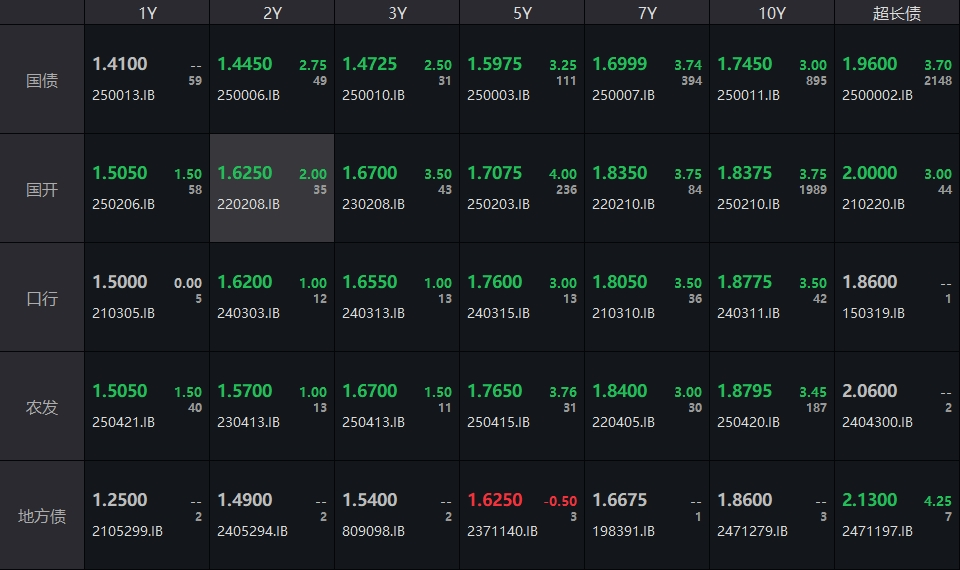
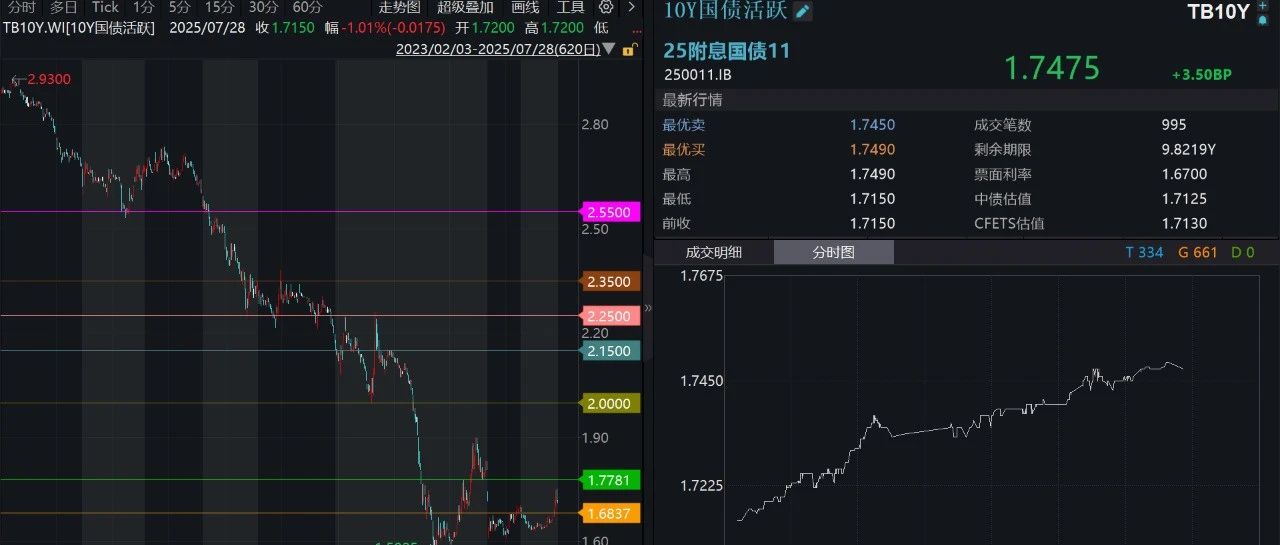
Market Overview - The bond futures market experienced a decline across the board, with the 30-year main contract falling by 0.78% to 117.870 yuan, and the 10-year main contract down by 0.25% to 108.130 yuan [1] - The yields on medium to long-term government bonds rose significantly, with the 10-year government bond yield increasing by 3 basis points to 1.745%, and the 30-year government bond yield rising by 3.7 basis points to 1.96% [1][2] Economic Sentiment - Market concerns are heightened regarding the potential introduction of anti-involution policies and measures to stabilize the real estate sector, coinciding with a rebound in the equity market [2] - Despite a decrease in interbank funding prices, non-bank funding remains high, with the average R001 rate at 1.65% [2] Central Bank Operations - The central bank conducted a 7-day reverse repurchase operation amounting to 4,492 billion yuan at a fixed rate of 1.40%, with a net injection of 2,344 billion yuan for the day [2] - Short-term Shibor rates mostly declined, with the overnight rate down by 10.1 basis points to 1.366% [2][3] Bond Auction Results - Recent bond auctions showed varying results, with the 2-year bonds yielding 1.598% and 1.7045% for different issuances, indicating strong demand with bid-to-cover ratios of 5.2 and 3.16 respectively [5] - The non-financial corporate bond market saw significant declines in certain bonds, with H0 Zhongjun 02 dropping by 78.16% [6] Credit Market Trends - The credit market displayed mixed performance, with some non-financial corporate bonds experiencing notable gains, while others faced substantial losses [6][7] - AAA-rated certificates of deposit showed demand at rates between 1.55% and 1.68%, reflecting a slight increase from the previous day [7]