
电子

Search documents
58只科创板活跃股获主力资金净流入
Zheng Quan Shi Bao Wang· 2026-01-15 09:55
换手率最高的是恒坤新材,该股今日收盘上涨10.23%,全天换手率34.36%,成交额10.53亿元,其次是 航天南湖,该股今日收盘上涨14.44%,全天换手率28.46%,成交额11.41亿元,换手率居前的还有浩瀚 深度、友车科技、海博思创等,换手率分别为27.37%、27.30%、22.14%。 市场表现看,换手率超5%的个股中,今日上涨的有66只,涨幅居前的有和林微纳、航天南湖、先惠技 术等,分别上涨15.56%、14.44%、13.14%。星环科技、卓易信息、光云科技等收盘跌停。 科创50指数今日下跌0.46%,报收1493.95点,科创板全日成交量57.44亿股,成交额3066.30亿元,加权 平均换手率为2.92%。 证券时报·数据宝统计显示,今日可交易科创板股中,277只股收盘上涨,涨幅超过10%的有5只,涨幅 在5%至10%的有34只,收盘下跌的有321只,跌幅超10%的有9只,光云科技、卓易信息、星环科技等4 股收盘跌停。 科创板股换手率区间分布显示,换手率超过20%的有5只,换手率10%~20%的有33只,换手率5%~10% 的108只,换手率3%~5%的128只,换手率1%~3%的263只 ...
固定收益点评:再论转债抢权配售策略
Guohai Securities· 2026-01-15 09:31
Core Insights - The report discusses the "subscription rights allocation strategy," which involves buying the underlying stock to obtain convertible bond subscription rights, benefiting from both stock price differences and convertible bond issuance [3][4] - The strategy's effectiveness is highly correlated with market conditions, showing better performance in bull markets compared to bear markets [13][15] - Key factors influencing the success of the strategy include the selection of underlying stocks, market environment, and timing of purchases [12][51] Strategy Overview - The subscription rights allocation strategy is characterized by buying the underlying stock at critical approval stages and holding until the subscription date to secure convertible bond rights [3][5] - The ideal entry points are when the listing committee approves or agrees to register, minimizing uncertainty and locking in subscription rights before bond issuance [5][6] Market Environment Analysis - The strategy's returns vary significantly with market conditions, with bull markets yielding the highest returns, primarily driven by stock performance [13][15] - In bear markets, returns are mainly derived from convertible bond allocations, with stock performance negatively impacting overall returns [13][15] Stock Selection Criteria - The report identifies that industries such as light manufacturing, automotive, and electronics show superior performance in the subscription rights allocation strategy [17][22] - Smaller-scale convertible bond issuances tend to yield higher returns due to lower market impact and higher per-share allocation amounts [22][26] - Stocks with larger market capitalizations and moderate ROE (Return on Equity) levels are preferred, as they contribute more significantly to overall returns [31][39] Performance Metrics - The report analyzes the performance of 690 convertible bonds issued between January 2020 and December 2025, highlighting the importance of entry and exit timing [12][13] - Average returns from different entry points show that buying on the listing committee approval day yields an average stock price increase of 4.47%, while buying on the registration agreement day yields 2.91% [6][12] Future Investment Opportunities - The report suggests focusing on convertible bonds currently in the approval or registration stages, particularly in high-performing sectors like automotive and electronics [49][50] - Recommended stocks include those with strong fundamentals, high growth rates, and favorable market conditions, ensuring a balanced approach to risk and return [49][50]
【盘中播报】64只A股跌停 综合行业跌幅最大
Zheng Quan Shi Bao Wang· 2026-01-15 08:45
| 申万行业 | 行业涨跌(%) | 成交额(亿元) | 比上日(%) | 领涨(跌)股 | 涨跌幅(%) | | --- | --- | --- | --- | --- | --- | | 基础化工 | 1.15 | 1062.78 | -12.33 | 七彩化学 | 20.00 | | 房地产 | 0.82 | 208.39 | -15.78 | 光明地产 | 10.09 | | 电子 | 0.66 | 3531.63 | -22.00 | 蓝箭电子 | 20.02 | | 建筑材料 | 0.61 | 191.62 | -3.07 | 中旗新材 | 8.00 | | 有色金属 | 0.53 | 1778.16 | -1.58 | 锌业股份 | 10.02 | | 石油石化 | 0.36 | 155.29 | -30.09 | 惠博普 | 10.14 | | 交通运输 | 0.16 | 221.40 | -26.91 | 德邦股份 | 9.97 | | 环保 | 0.10 | 179.72 | -21.79 | 通源环境 | 8.09 | | 电力设备 | 0.02 | 2279.43 | -30.63 | ...
英国经济专家:特朗普的计划是先摧毁美国民众的生活,再摧毁中国
Sou Hu Cai Jing· 2026-01-15 08:44
Group 1 - Trump's aggressive tariff policies aimed at revitalizing American manufacturing have led to increased costs for consumers, with household expenses rising by hundreds of dollars monthly due to a 25% tariff on Chinese goods, contributing to inflation rates climbing from 3% to 4.5% [1][3] - The automotive industry faced significant challenges, with General Motors delaying new car launches and a reduction in worker overtime, while agricultural exports, particularly soybeans, dropped by 40%, severely impacting farmers' incomes [3][4] - The trade war has resulted in a 15% decline in U.S. agricultural exports to China, with Brazil and Argentina filling the market gap, leading to a 10% increase in bankruptcy rates among small businesses in the U.S. [4][6] Group 2 - The U.S. economy has shown signs of contraction, with GDP growth expectations dropping from 2% to 1.6%, as domestic demand weakens and consumer confidence declines by 15% [4][13] - The trade war has led to a net loss of 70,000 manufacturing jobs, with many workers transitioning to lower-paying service jobs, while the unemployment rate increased from 4% to 4.4% [3][12] - By the end of 2025, the inflation contribution from tariffs reached 1.5%, and investment willingness among businesses significantly decreased, while the U.S. manufacturing index fell below 50, indicating economic shrinkage [10][11] Group 3 - Trump's tariffs have resulted in a 25% increase in battery costs for electric vehicles, slowing down the U.S. renewable energy sector and prompting consumers to shift towards public transportation [10] - The overall trade deficit only decreased by 11%, while exports fell by 18%, indicating a persistent economic struggle for the U.S. [11] - The trade policies have led to a significant decline in consumer quality of life, with rising protest sentiments and political crises brewing as Trump's approval ratings fell below 40% [12][15]


——12月进出口数据点评:再论出口强在中游:2026机电出口或延续景气
Huachuang Securities· 2026-01-15 08:43
Group 1: December Export Performance - In December, China's exports increased by 6.6% year-on-year, exceeding the expected 3% and the previous month's 5.9%[1] - The export growth rate in December was supported by four categories of electromechanical products: mobile phones, computers, vehicles, and integrated circuits[3] - Mobile phone exports in December saw a 10.5% increase in value, driven primarily by a low base effect from the previous year[15] Group 2: Key Product Insights - New energy vehicle exports reached 273,000 units in December, marking a 119.8% year-on-year increase, contributing significantly to overall vehicle export growth[20] - Integrated circuit exports surged by 48% year-on-year in December, benefiting from increased demand for technology imports driven by AI investments in developed markets[24] - Exports of computer parts showed strong performance, with a 36.6% year-on-year increase in November, while the overall equipment export remained weak[28] Group 3: Future Outlook for 2026 - The outlook for 2026 suggests continued strength in the midstream sector, supported by favorable product structures across electromechanical categories[49] - The overseas gross profit margin for midstream manufacturing has surpassed domestic margins, indicating improved competitiveness of Chinese products in international markets[59] - The share of intermediate goods in China's exports has risen from 41.8% in 2017 to 47.4% in 2025, while the share of consumer goods has declined from 36.6% to 28.8%[42]
融资盘突发降温!部分赛道恐短期承压,要不要撤?
Sou Hu Cai Jing· 2026-01-15 08:40
Market Overview - On January 14, a sudden announcement from three major exchanges raised the minimum margin requirement for financing from 80% to 100%, effective immediately, leading to a significant market downturn after an initial rally [1] - The A-share market's margin balance reached a historical high of 2.67 trillion yuan, with net financing inflow nearing 140 billion yuan in just the first seven trading days of 2026 [1][4] - Trading activity has been notably high, with daily transaction volumes exceeding 3 trillion yuan on multiple occasions, indicating elevated market sentiment [1] Impact of Margin Requirement Adjustment - Historical data suggests that previous increases in margin requirements in November 2015 and May 2017 resulted in a decrease of 6.3% and 4.1% in margin balances within a week, with the Shanghai Composite Index experiencing declines of 5% to 8% [4] - On January 14, the most affected sectors included TMT (Technology, Media, and Telecommunications) and non-bank financials, with the CSI 2000 index dropping by 4.6% and the number of stocks hitting the daily limit increase from 3 to 58 [4] - Northbound capital also reacted negatively, with a net outflow of 6.2 billion yuan, marking the largest single-day outflow in January [4] Sector Analysis - High Beta sectors such as TMT and non-bank financials, which have high financing balances and volatility, are expected to face immediate pressure due to the margin increase [4] - Key industries like electronics, power equipment, and computing, which are significant players in margin financing, may see a slowdown in capital inflow in the short term [4] - Despite the margin increase, existing investors are not required to add additional margin, which helps maintain stability in the over 2 trillion yuan of existing margin balances [4] ETF Market Insights - Certain ETFs, such as the Hai Fu Tong CSI Short Bond ETF and the Bosera Convertible Bond ETF, have seen active margin trading, although their overall contribution to total margin trading remains limited due to their large scale [6] - ETFs with high margin trading ratios, like the Hang Seng Technology ETF and the Huaxia Hang Seng Internet Technology ETF, should be approached with caution as forced liquidations could lead to significant price drops [6] Long-term Outlook - The adjustment of margin requirements is viewed as a "counter-cyclical fine-tuning," primarily affecting new contracts while leaving existing ones intact, suggesting limited long-term impact on market dynamics [10] - Historical patterns indicate that after initial emotional reactions, funds will likely return to selecting stocks based on fundamentals and valuations, minimizing the long-term effects of margin adjustments [10] - Despite short-term pressures, sectors such as AI applications and commercial aerospace continue to attract significant capital, indicating ongoing interest in certain growth areas [10] Future Projections - Analysts expect continued structural differentiation in the A-share market, driven by technological innovation and concentrated corporate performance, with a projected net profit growth rate for the CSI 300 index of 7.2% and 8.4% for 2026 and 2027, respectively [12][13]
今日65只个股涨停 主要集中在电子、化工等行业
Zheng Quan Shi Bao Wang· 2026-01-15 08:34
Group 1 - On January 15, among the tradable A-shares in the Shanghai and Shenzhen markets, 2,169 stocks rose, while 2,898 stocks fell, and 104 stocks remained flat [1] - Excluding newly listed stocks on that day, there were 65 stocks that hit the daily limit up, and 72 stocks that hit the daily limit down [1] - The industries with the most stocks hitting the daily limit up were primarily electronics, chemicals, power equipment, retail, and non-ferrous metals [1]
再论出口强在中游:2026机电出口或延续景气——12月进出口数据点评
一瑜中的· 2026-01-15 08:27
Core Viewpoint - In December, China's exports increased by 6.6% year-on-year, exceeding expectations of 3%, while imports rose by 5.7%, also surpassing the forecast of 0.9% [2][3] Group 1: December Export Performance - The increase in December exports was driven by four categories of electromechanical products: mobile phones, computers, vehicles, and integrated circuits [4][12] - Mobile phone exports improved mainly due to a low base effect from the previous year, with a year-on-year increase of 10.5% in December [14] - Vehicle exports, particularly in new energy vehicles, showed strong performance with a 119.8% year-on-year increase in December [18][19] - Integrated circuit exports surged by 48% year-on-year in December, benefiting from increased technology import demand [22] - Computer exports were mixed, with strong performance in parts and accessories, while the overall equipment export remained weak [24] Group 2: Outlook for 2025 and 2026 - The outlook for 2025 indicates sustained strength in electromechanical exports, with a projected growth of 8.4% for the year [28] - The contribution of intermediate goods to exports is increasing, while consumer goods are showing a negative contribution [34] - The profitability of midstream manufacturing has improved, with overseas gross margins exceeding domestic margins, indicating enhanced competitiveness [44] Group 3: Import and Export Data - December exports showed a significant recovery, with a month-on-month increase of 8.3%, higher than the historical averages [53] - The export quantity for major goods saw a substantial recovery, with a year-on-year increase of 17% in December [56] - The performance of major export regions varied, with the U.S. showing a decline of 30.6% in December, while non-U.S. markets performed strongly [65]

宏观点评20260115:春季躁动后半程,行业如何轮动?-20260115
Soochow Securities· 2026-01-15 08:21
Market Trends - The spring market rally from December to February historically shows an average increase of 16%-18% for the Shanghai Composite Index and the Wind All A Index from 2010 to 2025[1] - The current spring rally is considered to be in its latter half, with a potential for a price increase lasting about one month before entering a consolidation phase[2] Industry Performance - Growth and technology sectors have a win rate exceeding 80%, with average excess returns over 3%[12] - High-end manufacturing follows, with average excess returns above 2%, while sectors like computing, communication, and electronics show average excess returns exceeding 4%[12] Sector Rotation - As of 2026, strong sectors include military (commercial aerospace), automotive (robots), and utilities, while previously leading sectors like non-ferrous metals and machinery are in a consolidation phase[3] - The focus should be on sectors with unchanged industrial trends but relatively lower recent gains, such as lithium batteries, energy storage, humanoid robots, innovative drugs, and AI hardware[32] Risks - Market sentiment can change rapidly, leading to accelerated contraction in trading volume[34] - Potential risks include slow progress in technological breakthroughs, tightening global liquidity due to changes in overseas market expectations, and increased geopolitical risks[34]
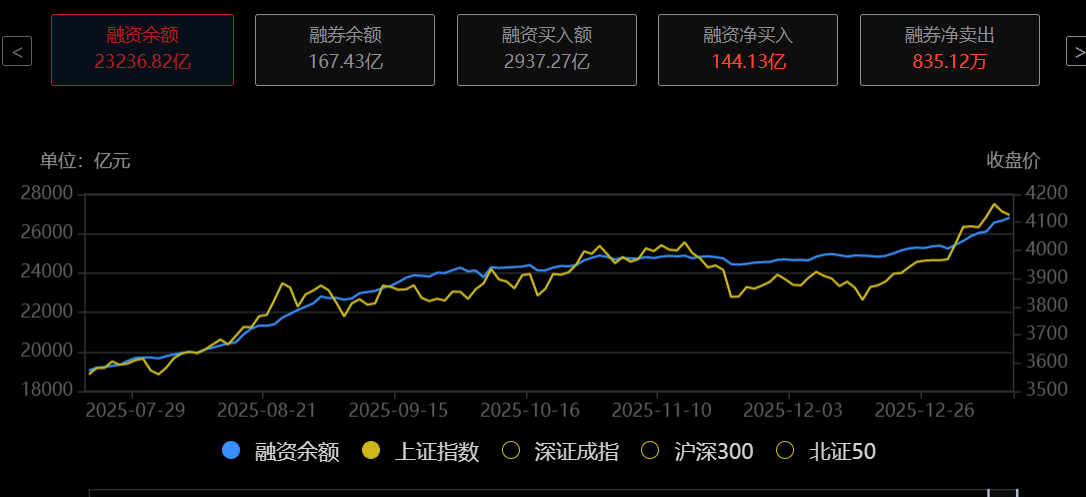
股市面面观丨市场“降温”背后:融资余额开年八连涨 一个月2000亿杠杆资金进场
Zhong Guo Jin Rong Xin Xi Wang· 2026-01-15 07:55
转自:新华财经 新华财经上海1月15日电(林郑宏)火热的A股市场近期出现降温,沪指在创纪录的日线十七连阳后出现两连阴。1月15日,沪指盘中一度跌破4100点,虽尾 盘收回这一整数关口,但仍收跌0.33%,已连续3个交易日下跌。两市成交额亦较前期下降超万亿元。 消息面上,1月14日,经中国证监会批准,沪深北交易所发布通知调整融资保证金比例,将投资者融资买入证券时的融资保证金最低比例从80%提高至 100%。上述通知自1月19日起施行。这一措施被认为是监管层引导市场"降温"。 沪深北交易所表示,近期融资交易明显活跃,市场流动性相对充裕,根据法定的逆周期调节安排,适度提高融资保证金比例回归100%,有助于适当降低杠 杆水平,保护投资者合法权益。 如果从月度数据来看,2026年开年以来,融资净买入额已超1500亿元,自"9.24行情"以来,已仅次于2025年8月和2024年10月。另有数据显示,1月14日参与 融资融券交易的投资者数量为72.35万名,创2024年10月09日以来新高。各方面数据显示出,近期杠杆资金入市的步伐大幅加快。 | 日期 | 沪深京合计 期间净买入额 | | | --- | --- | --- ...
