
制造业

Search documents
2025年11月经济数据点评:经济数据波动,不阻碍经济目标即将完成
Chengtong Securities· 2025-12-16 11:55
Economic Growth and Stability - Despite increased volatility in economic data in the second half of the year, the annual economic growth target is expected to be met due to a strong first half, with GDP growth of 5.2%[1] - Industrial production growth remains stable, with a year-on-year increase of 4.8% in November, slightly down from 4.9% in October[12] - Exports have rebounded significantly, with a year-on-year growth of 5.9% in November, up from -1.1% in October, driven by external demand[12] Investment Trends - Fixed asset investment cumulative year-on-year growth decreased from -1.7% to -2.6%, with a monthly decline of 11.5% in November[15] - Manufacturing investment maintained positive growth at 1.9% year-on-year, although monthly growth was negative at -4.5%[16] - Real estate investment saw a cumulative year-on-year decline of 15.9%, with a monthly drop of 30% in November[27] Consumer Spending - Social retail sales growth fell to 1.3% year-on-year in November, a decrease of 1.6 percentage points from the previous month, marking six consecutive months of decline[31] - The retail sales total saw a month-on-month decline of 0.42%, indicating weakened consumer momentum[31] - Major consumer categories, including jewelry and home appliances, experienced significant drops in sales growth, with jewelry sales falling from 37.6% to 8.5% year-on-year[34]
每日机构分析:12月16日
Xin Hua Cai Jing· 2025-12-16 11:31
Group 1 - Nomura Securities predicts that the Bank of Korea has ended its current rate-cutting cycle, with a shift in policy risk towards rate hikes by 2026, supported by economic recovery in consumption, construction, and the semiconductor industry [1] - Standard & Poor's Global reports that the UK's PMI has stabilized, with business confidence recovering, although growth remains weak, as the composite PMI rose to 52.1 in December [2] - The Australian Federal Bank expects the Reserve Bank of Australia to raise interest rates to 3.85% by February 2026, with a tightening cycle potentially beginning due to core inflation remaining above 3% for five consecutive quarters [3] Group 2 - The OECD Secretary-General states that the AI investment boom will continue, significantly boosting productivity and economic growth in the medium to long term, despite a projected slowdown in global growth from 3.2% in 2025 to 2.9% in 2026 due to increasing trade headwinds [2] - The economic outlook for the Eurozone is uncertain, with a decline in Germany's industrial performance dragging down overall results, as the composite PMI fell to 51.9 in December, indicating a contraction in manufacturing for two consecutive months [2] - Morningstar DBRS has a negative outlook on the global private credit industry, warning that declining borrower profit margins may increase default rates in 2026, although the industry remains resilient despite regulatory tightening in the US and UK [3]
——11月经济数据点评:需求延续弱势,生产保持韧性
Shenwan Hongyuan Securities· 2025-12-16 11:28
Group 1 - The report highlights a continued weakness in demand, particularly in consumer spending, which has been significantly impacted by a decline in automobile sales and the reduction of government subsidies for trade-ins [2][3] - Cumulative retail sales growth for January to November 2025 is reported at 4.0%, a decrease of 0.3 percentage points compared to the previous month, with automobile sales showing a cumulative year-on-year decline of 1.0% [3][22] - Industrial value-added growth for November 2025 is at 6.0%, down 0.1 percentage points from October, indicating a divergence between traditional industries related to real estate and high-tech sectors [3][4] Group 2 - The report notes a rebound in inflation, primarily driven by rising food prices, with the Consumer Price Index (CPI) increasing to 0.7% year-on-year in November, marking a 0.5 percentage point rise [3][5] - Fixed asset investment shows a cumulative year-on-year decline of 2.6% for November, with real estate investment down 15.9% and infrastructure investment at 0.13% [3][7] - The report indicates that the overall economic fundamentals are weakening, with investment growth and consumer spending declining, while inflation recovery remains uncertain [3][23]
2026年海外市场展望:先抑后扬
Tebon Securities· 2025-12-16 11:17
Group 1 - The 2026 US economy is expected to follow a "first suppress then rise" rhythm, influenced by midterm elections and monetary policy [3][8] - The midterm elections will see intensified political competition, with Trump likely to focus on maintaining support for large tech companies through tax incentives while also addressing issues for small businesses and low-income groups [3][11] - The monetary policy is anticipated to be cautious until the Fed chair transition in May 2026, with a potential shift to a more accommodative stance thereafter [3][26] Group 2 - Investment in the AI sector has been a significant driver of the US economy, with major tech companies' capital expenditures expected to slow down in 2026, leading to a cooling market sentiment [3][33] - The capital expenditures of the seven major tech companies are projected to be over 50% of their operating cash flow, with Amazon reaching over 90%, indicating a need for revenue growth to sustain such investments [3][38] - The geopolitical landscape remains turbulent, with ongoing pressures from the midterm elections potentially prompting the Trump administration to seek breakthroughs in the Russia-Ukraine situation [3][41] Group 3 - The report highlights the importance of asset allocation strategies, focusing on opportunities within the US AI sector and European defense and manufacturing industries [3][45] - The anticipated economic growth from the "Great Beautiful Act" is projected to increase GDP by 0.9% in 2026, supporting the overall economic outlook [3][22] - The report suggests that traditional industries and small businesses may benefit more from interest rate declines compared to large tech firms, which are less sensitive to rate changes [3][32]
2025年11月经济数据点评:需求待企稳
BOHAI SECURITIES· 2025-12-16 09:50
Economic Data Overview - In November 2025, the industrial added value for large-scale enterprises grew by 4.8% year-on-year, slightly below the expected 5.0% and previous value of 4.9%[2] - The total retail sales of consumer goods increased by 1.3% year-on-year, significantly lower than the expected 2.9%[2] - The cumulative year-on-year growth rate of fixed asset investment was -2.6%, worse than the expected -2.3% and previous -1.7%[2] Industrial Production Insights - The year-on-year growth rate of industrial added value showed a slight slowdown compared to the previous value, with the monthly growth rate aligning with historical averages[3] - High-tech manufacturing sectors outperformed overall industrial growth, indicating a shift in production dynamics[3] - The annual industrial production growth rate is projected to stabilize around 5.8%, with potential constraints from "anti-involution" and a slight weakening in exports affecting December's production[3] Consumer Spending Trends - The year-on-year growth rate of retail sales in November was impacted by early online shopping promotions and diminishing subsidy effects, leading to a broader decline across most categories[4] - Notably, furniture, building materials, and home appliances were significantly affected, with automotive consumption dragging down overall growth by nearly 2 percentage points[4] - The annual retail sales growth is expected to be around 3.7%, with a focus on stimulating service consumption in the short term[4] Investment Outlook - Fixed asset investment saw an expanded decline, particularly in manufacturing, where negative growth persisted for five consecutive months[5] - Infrastructure investment showed signs of stabilization, with improvements in transportation and energy sectors, while water conservancy and public facilities continued to lag[5] - Real estate investment experienced a significant drop of -30.3% year-on-year, with ongoing declines in new construction and completion areas[5] Risk Factors - Geopolitical uncertainties may elevate market risk preferences, potentially disrupting economic stability[6] - Unexpected changes in economic conditions or policies could arise due to increasing volatility in overseas markets and domestic economic transitions[6]
锡装股份(001332.SZ)拟设立韩国子公司 拓展海外市场
智通财经网· 2025-12-16 09:43
智通财经APP讯,锡装股份(001332.SZ)公告,公司董事会同意公司以投资金额不超过10万美元的自有资 金设立韩国全资子公司WCE CO., LTD.,并授权经营管理层负责办理设立韩国全资子公司的具体事宜。 该事项将将有利于进一步拓展海外市场,完善公司的业务布局。 ...
百宏实业(02299.HK)12月16日回购2000股
Ge Long Hui· 2025-12-16 09:43
格隆汇12月16日丨百宏实业(02299.HK)发布公告,2025年12月16日以9,300港元回购2,000股,回购价格 每股4.65港元。 ...
英国12月制造业PMI初值51.2,预期50.4,前值50.2
Mei Ri Jing Ji Xin Wen· 2025-12-16 09:38
每经AI快讯,12月16日消息,英国12月制造业PMI初值51.2,预期50.4,前值50.2。英国12月服务业PMI 初值52.1,预期51.6,前值51.3。 ...
欧元区12月制造业PMI加速萎缩,德国创10个月最差表现,法国意外重回扩张区间
Sou Hu Cai Jing· 2025-12-16 09:35
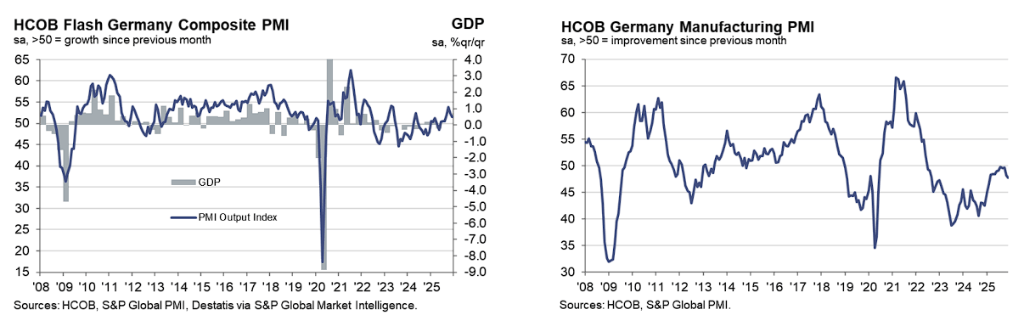
欧元区经济在2025年收官之际增长势头放缓,12月综合PMI指数降至为三个月来最低水平,主要受制造业重新陷入收缩和服务业增长放缓拖累。 德国制造业则录得10个月来最差表现,法国制造业表现创三年多新高,但服务业意外走软拖累整体活动。 12月16日最新公布的数据显示,欧元区12月商业活动增长放缓,综合PMI从11月的52.8降至51.9,创三个月新低。数据显示,欧元区制造业普遍疲 软,而服务业增长势头也在减弱。通胀压力上升,投入成本涨幅达到九个月高点,可能影响欧洲央行本周四(12月18日)货币政策决议。 德国私营部门进一步失去动力,综合PMI降至51.5,为四个月最低水平。制造业产出重返收缩区间,PMI跌至47.7的十个月低点,新订单停滞不 前。法国私营部门经济在12月基本停滞,综合PMI降至50.1,为两个月低点。尽管制造业PMI从47.8大幅升至50.6,为四十个月高位,但是服务业 PMI大幅降至50.2,拖累整体经济活动。 德国制造业深陷困境 德国私营部门12月再度失去增长动力,综合PMI从11月的52.4降至51.5。制造业成为拖累因素,产出指数跌至49.4,结束了连续九个月的增长态 势。制造业PMI降至 ...

海外利率周报20251216:担忧明年降息不及预期,美债利率下行受阻-20251216
Guolian Minsheng Securities· 2025-12-16 09:15
海外利率周报 20251216 担忧明年降息不及预期,美债利率下行受阻 glmszqdatemark 2025 年 12 月 16 日 宏观经济指标点评 就业:美国 2025 年 10 月 JOLTS 就业职位空缺数量为 767 万个,略高于 9 月份的 765.8 万个。同时,雇主招聘数量为 514.9 万个,低于 9 月份的 536.7 万个和去年 10 月的 535 万个。本周美国初请失业金人数为 23.6 万人,高于市场预期的 22 万人,较 前值 19.2 万人大幅回升。据 JOLTS 报告,上周初请失业金人数的反弹终结了此前连 续数周的下降趋势。 主要海外市场利率回顾 美国:担忧明年降息不及预期,美债利率下行受阻。本周(2025 年 12 月 5 日-2025 年 12 月 12 日,下同)美债收益率变动:1 个月期(-6bp,3.76%)、1 年期(-7bp, 3.54%)、2 年期(-4bp,3.52%)、5 年期(+3bp,3.75%)、10 年期(+5bp,4.19%)、 30 年期(+6bp,4.85%)。鉴于 2025 年降息预期已经实现,市场对于 2026 年上半 年的降息展望维持在 ...