服务

Search documents
21社论丨破除消费堵点,释放内需潜能
2 1 Shi Ji Jing Ji Bao Dao· 2025-08-20 22:38
Group 1 - The State Council's ninth plenary session emphasizes strengthening domestic circulation by removing restrictive measures in the consumption sector to stimulate consumer potential and promote high-quality economic development [1][2] - Systematic removal of restrictions will empower consumers with more autonomy, enhance their quality of life, and stimulate demand [1][3] - Optimizing the automotive purchase policy is crucial as it supports the automotive industry and its supply chain, facilitating normal consumption and industry transformation [1][2] Group 2 - Adjusting real estate market policies is essential to release the potential for improved housing demand, which is interconnected with various industries such as construction and furniture [2][3] - Accelerating the growth of service consumption and new consumption models, such as online education and shared economy, is necessary to meet the evolving needs of consumers [2][4] - The implementation of consumption restriction removal must follow a scientific and orderly approach, avoiding a one-size-fits-all strategy while enhancing the business environment [3][4] Group 3 - In the automotive sector, transitioning from purchase management to usage management can alleviate traffic pressure and meet consumer needs more effectively [3][4] - The real estate sector requires the comprehensive removal of purchase, sale, and price restrictions to promote healthy market development [3][4] - In the service consumption area, breaking down invisible market entry barriers and enhancing the supply of high-quality services can create job opportunities and drive economic growth [4]
中华内房股指数收报1427.9637点,涨幅0.41%
Jin Rong Jie· 2025-08-19 08:36
Group 1 - The China Real Estate Stock Index closed at 1427.9637 points on August 19, with an increase of 5.85 points, representing a rise of 0.41% [1] - The index reached a high of 1451.9756 points and a low of 1423.4219 points during the trading day [1] - The index includes stocks within the Hong Kong Stock Connect that are classified under real estate development, services, management, and parks [1] Group 2 - The China Real Estate Stock Index was launched on March 18, 2019, with a base value of 2000 points and consists of 30 constituent stocks [1]
7月同比增长 3.7%,消费增势良好|快讯
Hua Xia Shi Bao· 2025-08-15 03:16
Group 1 - In July, the total retail sales of consumer goods reached 38,780 billion yuan, with a year-on-year growth of 3.7% and a month-on-month decrease of 0.14% [2] - Urban retail sales amounted to 33,620 billion yuan in July, growing by 3.6% year-on-year, while rural retail sales were 5,160 billion yuan, increasing by 3.9% [2] - From January to July, urban retail sales totaled 246,669 billion yuan, up by 4.8%, and rural retail sales reached 37,569 billion yuan, growing by 4.7% [2] Group 2 - In July, the retail sales of goods were 34,276 billion yuan, with a year-on-year increase of 4.0%, while catering revenue was 4,504 billion yuan, growing by 1.1% [2] - From January to July, the retail sales of goods totaled 252,254 billion yuan, increasing by 4.9%, and catering revenue was 31,984 billion yuan, up by 3.8% [2] - Sales of basic living goods and some upgraded products showed strong growth, with retail sales of grain, oil, and food increasing by 8.6%, daily necessities by 8.2%, sports and entertainment products by 13.7%, and gold and silver jewelry by 8.2% [2] Group 3 - The policy of replacing old consumer goods with new ones has continued to show effectiveness, with retail sales of household appliances and audio-visual equipment increasing by 28.7%, furniture by 20.6%, communication equipment by 14.9%, and cultural office supplies by 13.8% [2] - From January to July, the total retail sales of consumer goods reached 284,238 billion yuan, with a year-on-year growth of 4.8% [3] - The national online retail sales amounted to 86,835 billion yuan, growing by 9.2%, with physical goods online retail sales at 70,790 billion yuan, increasing by 6.3%, accounting for 24.9% of total retail sales [3]


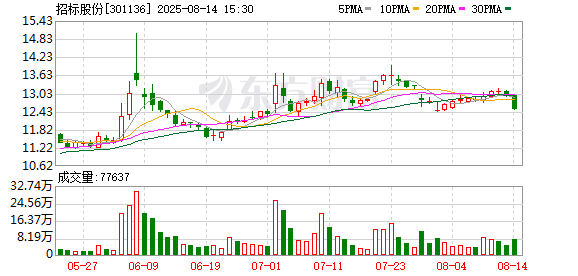
招标股份:8月14日召开董事会会议
Mei Ri Jing Ji Xin Wen· 2025-08-15 01:10
Core Viewpoint - The company, 招标股份, announced the convening of its 18th meeting of the third board of directors on August 14, 2025, held in its conference room [2] Group 1: Company Financials - For the year 2024, the company's revenue composition is as follows: 99.72% from the service industry and 0.28% from other businesses [2]
通胀先行指标“爆表”!美联储降息前景横生变数
Jin Shi Shu Ju· 2025-08-14 13:31
Group 1: Inflation and Economic Indicators - The Producer Price Index (PPI) for July increased by 0.9% month-over-month, significantly exceeding the market expectation of 0.2%, marking the largest monthly increase since June 2022 [1] - Year-over-year, the PPI rose by 3.3%, the highest growth since February, well above the Federal Reserve's 2% inflation target [1] - Service inflation was the primary driver of the overall PPI increase, with service prices rising by 1.1%, the largest increase since March 2022 [1] Group 2: Employment Data - Initial jobless claims unexpectedly decreased by 3,000 to 224,000 for the week ending August 9, lower than the expected 228,000 [2] - Continuing claims fell to 1.95 million, indicating that many unemployed Americans are struggling to find work despite the lower initial claims [2] - The decrease in initial claims suggests that employers are not engaging in large-scale layoffs, despite economic uncertainties related to tariffs [2] Group 3: Tariff Impact and Economic Outlook - The implementation of high tariffs has contributed to rising inflation, although the increase has not matched earlier predictions by economists [3] - If decisive data contradicts the notion that tariffs only cause temporary inflation, it could validate concerns from Federal Reserve Chairman Powell, potentially delaying interest rate cuts [3] - Some analysts downplay the significance of recent weak employment data, attributing labor market slowdowns to reduced labor supply from immigration policies [3]
业务多面开花,联想25/26财年Q1非PC业务占比达47%
智通财经网· 2025-08-14 00:45
Core Insights - Lenovo Group reported a 22% year-on-year revenue growth for Q1 of the 2025/26 fiscal year, reaching 136.2 billion RMB, marking a historical high for the same period [1] - The company achieved a net profit of 2.816 billion RMB, also reflecting a 22% increase, demonstrating enhanced profitability and fulfilling its commitment to maintain competitiveness, market share, and profitability [1] - All three main business groups of Lenovo experienced double-digit growth, with the IDG smart devices group revenue at 97.3 billion RMB (up 17.8%), ISG infrastructure solutions group revenue growing by 35.8%, and SSG solutions services group revenue increasing by 19.8% [1] Business Performance - Non-PC business revenue now accounts for 47% of total revenue, indicating a more balanced growth structure and providing a solid foundation for the company's mixed AI strategy [1] - The AI infrastructure business saw a remarkable 155% year-on-year revenue growth, with strong order reserves and nearly 30% revenue growth in liquid cooling technology solutions [2] - In the Chinese market, ISG maintained rapid growth with a 76% revenue increase and a 3 percentage point improvement in operating profit margin [2] Market Position and Strategy - The SSG group achieved a record high revenue of 16.3 billion RMB, with a 19.8% year-on-year increase and an operating profit margin of 22.2%, solidifying its position as a core profit driver [2] - The smartphone business continued its growth trajectory with double-digit revenue growth, and Motorola maintained over 50% market share in the overseas foldable phone market [3] - Lenovo's long-standing operational excellence in the PC sector, along with its global supply chain and brand influence, has positively impacted its non-PC businesses, accelerating their growth [3] Future Outlook - Lenovo is positioned to break away from traditional PC giant labels, achieving diversified breakthroughs and sustainable growth in the AI era [4] - The company is leveraging its full-stack AI capabilities and mixed AI strategy to enhance value across personal and enterprise segments, driving towards a new growth peak [4]

物价数据透露哪些积极信号(锐财经)
Ren Min Ri Bao Hai Wai Ban· 2025-08-10 22:48
Group 1 - The Consumer Price Index (CPI) in July showed a month-on-month increase of 0.4%, indicating a shift from decline to growth, while the year-on-year CPI remained flat [1][2] - The core CPI, excluding food and energy, rose by 0.8% year-on-year, marking the highest increase since March 2024, with a continuous expansion in growth for three consecutive months [2][6] - The increase in CPI was primarily driven by rising prices in services and industrial consumer goods, with service prices up 0.6% and industrial consumer goods prices up 0.5% month-on-month [2][3] Group 2 - The Producer Price Index (PPI) decreased by 0.2% month-on-month, but the decline was less than the previous month, indicating a potential improvement in supply-demand relationships in certain industries [3][5] - The domestic market's competitive order is improving, leading to a narrowing of price declines in industries such as coal, steel, photovoltaic, cement, and lithium batteries [5][6] - The overall judgment for the second half of the year suggests a mild recovery in prices, supported by stable economic conditions and effective demand expansion policies [6][10]

核心CPI温和回升 7月物价运行边际改善
Shang Hai Zheng Quan Bao· 2025-08-10 17:36
Group 1: CPI Analysis - In July, the CPI remained flat year-on-year, with a month-on-month increase of 0.4%, driven by rising service and industrial consumer goods prices [2][3] - The core CPI, excluding food and energy, rose by 0.8% year-on-year, marking the highest increase since March 2024, reflecting effective demand expansion and improved market supply-demand dynamics [3][6] - Food prices saw a year-on-year decline of 1.6%, primarily due to a high base from the previous year, with fresh vegetable prices dropping by 7.6% [2][3] Group 2: PPI Analysis - The PPI decreased by 3.6% year-on-year in July, with the decline remaining consistent with June, although some industries showed signs of price recovery [4][5] - The month-on-month PPI fell by 0.2%, but this marked the first narrowing of the decline since March, indicating improved market competition and price stabilization in certain sectors [5][6] - Industries such as coal mining, black metal smelting, and photovoltaic manufacturing experienced reduced price declines compared to June, contributing to a less negative PPI [5] Group 3: Future Outlook - Experts anticipate that proactive macroeconomic policies will continue to support demand recovery, leading to a stabilization of domestic prices [6] - New policies aimed at boosting consumption, such as support for childbirth and early education, are expected to further stimulate domestic demand and contribute to a gradual recovery in CPI [6] - The ongoing "anti-involution" measures are projected to elevate industrial product prices in August compared to July, with a significant reduction in year-on-year price bases expected to aid in this recovery [6]
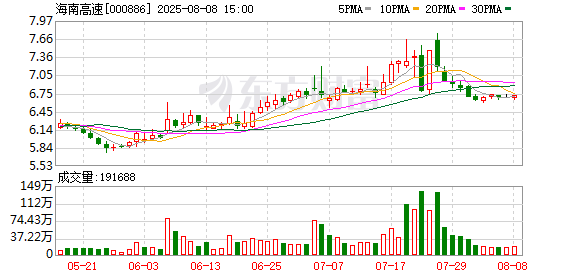
海南高速:胡东辞去公司副总经理职务
Mei Ri Jing Ji Xin Wen· 2025-08-08 08:21
2024年1至12月份,海南高速的营业收入构成为:交通业占比67.08%,服务板块占比20.24%,文旅业占 比10.89%,房地产开发与经营业占比1.8%。 海南高速(SZ 000886,收盘价:6.72元)8月8日晚间发布公告称,胡东先生因工作调动,申请辞去公 司副总经理职务,胡东先生辞职后仍在公司担任党委委员职务。 ...

从商品到服务 消费市场进入深度调整期
Bei Jing Shang Bao· 2025-08-07 12:27
Core Insights - The Chinese consumption market is undergoing a significant structural transformation, shifting from a goods-driven model to a service-oriented one, presenting both new growth opportunities and challenges [1][3][6] - The importance of consumption in the national economy has been increasingly recognized, with policies aimed at boosting consumption being prioritized at both national and local levels [3][10] Consumption Market Trends - The growth rate of social retail sales (社零额) has been declining, reflecting a broader economic transition as GDP growth slows [1][6] - Service consumption is projected to account for 47% of household consumption by 2024, indicating a shift in consumer spending patterns towards services such as education, healthcare, and tourism [1][5] - Digital consumption is rapidly expanding, with online retail sales of physical goods reaching 27.6% of total retail sales in 2024, and in Beijing, this figure is as high as 40% [4][8] Factors Influencing Retail Sales Growth - The decline in retail sales growth is attributed to the transition from high-speed to medium-speed economic growth, alongside a shift in consumption structure from goods to services [6][7] - The contribution of final consumption to GDP growth has surpassed that of investment, highlighting the foundational role of consumption in stabilizing economic growth [7][8] Emerging Consumption Dynamics - New consumption drivers such as green consumption and digital consumption are emerging, with significant growth in sectors like electric vehicles and energy-efficient appliances [8] - The rise of domestic brands in various sectors, including fashion and beauty, reflects a growing trend towards "Guochao" (national tide) consumption [8] Policy Support and Market Mechanisms - Recent government policies aimed at stimulating consumption have been innovative, promoting collaboration across departments and encouraging green and smart consumption [10][11] - Market mechanisms are crucial for achieving supply-demand matching, yet challenges remain due to a lack of diversified supply and institutional barriers in service sectors [11][12] Challenges Facing the Consumption Market - Employment and income issues significantly impact consumer confidence and spending capacity [12][13] - The traditional supply model struggles to meet diverse consumer demands, and systemic barriers in sectors like education and healthcare hinder service development [13] - The transition from quantity to quality in consumption is essential, requiring comprehensive reforms in statistical systems, governance, and corporate structures to enhance consumer experience and confidence [13]