证券业

Search documents
选举不确定性下,日本30年期国债拍卖“稳住市场”
Hua Er Jie Jian Wen· 2026-02-05 06:07
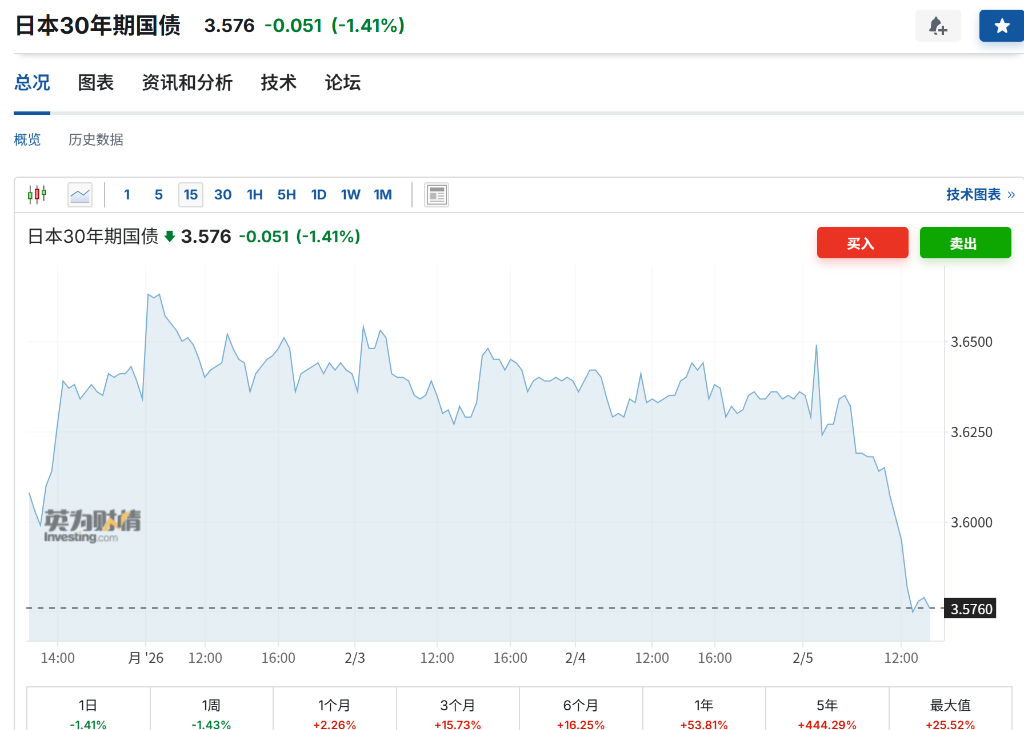
Core Viewpoint - The strong demand for Japan's 30-year government bonds in the recent auction alleviated short-term concerns about long-term debt, leading to a decline in yields ahead of the upcoming elections [1][3]. Group 1: Auction Results - The bid-to-cover ratio for the 30-year bonds reached 3.64, significantly higher than the previous auction's 3.14 and above the 12-month average of 3.35, indicating increased investor interest [4]. - The yield on the 30-year bonds fell by 5 basis points to 3.585%, while the 10-year bond yield decreased by 1.5 basis points to 2.23%, reflecting a positive market sentiment [1][4]. - Over 23% of the bonds were purchased by two large domestic companies, which is expected to support stable trading in the secondary market [4]. Group 2: Market Sentiment and Political Context - Despite concerns over rising fiscal spending, the auction results suggest that higher yield levels are attracting buyers, indicating a potential increase in demand as political uncertainties diminish [3][4]. - The upcoming House of Representatives election on February 8 will determine future fiscal spending, adding complexity to the current market environment [5]. Group 3: Currency and Monetary Policy Considerations - The depreciation of the yen has become a focal point, with hedge funds resuming short positions ahead of the elections, indicating concerns over currency volatility [6]. - Investors are closely monitoring how the election results may influence the Bank of Japan's interest rate path, as Prime Minister Kishi Sanae is known for advocating monetary easing [7].

资讯早班车-2026-02-05-20260205
Bao Cheng Qi Huo· 2026-02-05 02:20
1. Report Industry Investment Rating No relevant content provided. 2. Core Views - The report presents a comprehensive overview of macro - economic data, commodity investment trends, and financial news, offering insights into various sectors such as metals, energy, agriculture, and the stock market. It also includes bond market and foreign exchange market analyses, along with research reports from different institutions [1][2][29] 3. Summary by Directory Macro Data - GDP growth in Q4 2025 slowed to 4.5% year - on - year, compared with 4.8% in the previous quarter and 5.4% in the same period last year. The manufacturing PMI in January 2026 was 49.3%, and the non - manufacturing PMI was 49.4%. Social financing and new RMB loans decreased in December 2025. CPI and PPI showed positive and negative growth trends respectively [1] Commodity Investment - **Comprehensive**: The EU's investigation into Chinese wind power companies has drawn strong responses from China. The CME will continue contract business under certain conditions. There are differences in the basis of domestic commodities on February 4 [2] - **Metals**: Gold and silver prices fluctuated. Gold futures in New York exceeded $5030/ounce on February 5, and silver reached $90/ounce. The industry is focusing on key technology research and development. Exchanges have adjusted margin levels and price limits to control speculation [3][4] - **Coal, Coke, Iron Ore**: Indonesian coal miners have suspended spot coal exports due to production cuts [6] - **Energy and Chemicals**: Musk's team visited Chinese photovoltaic companies, boosting the A - share photovoltaic sector. Russia's oil revenue in January dropped significantly. Morgan Stanley adjusted its oil price forecast [8][9] - **Agricultural Products**: Most agricultural product prices rose as of late January. South Korea confirmed a new African swine fever case. The government announced key tasks for the "Three Rural Issues" this year [12] Financial News - **Open Market**: The central bank conducted 750 billion yuan of 7 - day reverse repurchase operations on February 4, resulting in a net withdrawal of 3025 billion yuan [13] - **Important News**: High - level diplomatic communications took place between China and the US, and China and Russia. The central bank emphasized financial services for key areas. The government announced measures for agricultural development and responded to EU investigations [14][15][16] - **Bond Market**: Bond yields in the inter - bank and exchange markets showed mixed trends. The money market interest rates had different movements. Some bonds had significant price changes, and new bond issuance and trading information was provided [23][24][25] - **Foreign Exchange Market**: The on - shore RMB exchange rate against the US dollar decreased slightly, and the dollar index rose [28] - **Research Reports**: Institutions such as CITIC Securities and CICC issued research reports, predicting a high probability of a reserve requirement ratio cut in Q2 2026 and the expansion of global liquidity [29] Stock Market - A - shares rose on Wednesday, with the Shanghai Composite Index up 0.85%. The Hong Kong stock market showed mixed performance, with the Hang Seng Index up 0.05%. The number of new margin trading accounts increased significantly in January [32][33]
固定收益|点评报告:信用情绪降温了吗?
Changjiang Securities· 2026-02-04 23:30
1. Report Industry Investment Rating No relevant content provided. 2. Core Viewpoints of the Report - From January 26th to January 30th, the performance of general credit bonds was stronger than that of secondary capital bonds, possibly due to some institutions taking phased profit - taking after the yields of secondary capital bonds declined for two consecutive weeks. Large banks increased their allocation of interest - rate bonds due to abundant liabilities, small and medium - sized banks became more cautious, wealth management products increased their allocation of low - volatility amortized cost - based bond funds under the net - value constraint, and insurance preferred local government bonds. In the next few weeks, the concentrated opening of amortized bond funds will benefit specific - term credit bonds, and the market of secondary capital bonds is driven by the buying power of funds and insurance, with different yield performances for each term. In terms of future allocation, it is recommended to focus on 5 - year AA+ and AAA urban investment bonds with more attractive interest - rate differentials, and for secondary capital bonds, focus on the allocation opportunities of medium - and long - term varieties after phased profit - taking and the warming of market sentiment [3]. - The overall credit bond market recently followed the fluctuations of interest - rate bonds but showed relative resilience. Urban investment bonds generally outperformed secondary and perpetual bonds. The short - end interest rates of interest - rate bonds rose due to the temporary tightening of the capital market, while the long - end and ultra - long - end interest rates fluctuated under the alternating influence of stock market sentiment and policy expectations. The weakening participation of trading - type funds in ultra - long - term interest - rate bonds led to a shift of funds to credit bonds, which is a key reason for the relatively better performance of credit bonds [7]. - The behaviors of major investment institutions have significantly diverged, affecting the supply - demand pattern of credit bonds. Large banks increased their net purchases of interest - rate bonds due to asset shortages and abundant liabilities, which created conditions for the narrowing of credit spreads. At the end of 2025, wealth management products slightly increased their holdings of credit bonds but significantly increased their holdings of public funds, cash, and deposits. This reflects the demand for stable asset net values under the net - value transformation [8]. - In the future, asset supply and specific product cycles will directly affect the credit bond market. Although the supply of government bonds in January was large, the market interest rates remained stable due to the active participation of insurance and other allocation funds, providing a good allocation window for credit bonds. The upcoming opening peak of amortized cost - based bond funds in the next 16 weeks will bring re - allocation demand for corresponding - term credit bonds, and the deepening of the net - value transformation of wealth management products may increase the demand for medium - and long - term amortized bond funds, benefiting medium - and long - term credit bonds [9]. - The recent strong market of secondary capital bonds is driven by the implementation of the new public - fund fee regulations, the structural change of bond - type funds, and the hot sales of dividend - insurance products. Currently, the market has shown signs of differentiation. The yields of 1 - 3 - year varieties have fallen back to near the previous lows, with a narrowing spread protection space, while the 5 - year, 7 - year, and 10 - year varieties still have a certain spread protection margin and relatively high allocation cost - effectiveness. The market rhythm is expected to slow down, and medium - and long - term secondary capital bonds still have certain allocation value. In terms of the allocation strategy, it is recommended to focus on 5 - year AA+ and AAA urban investment bonds and medium - and long - term secondary capital bonds with relatively sufficient spread protection [10]. 3. Summary According to Relevant Catalogs 10Y Treasury Bonds: Large Banks Net Buy, Small and Medium - Sized Banks Net Sell - Since January 7, 2026, as the yield of 10 - year treasury bonds gradually declined, the net purchase volume of 7 - 10 - year treasury bonds by large banks showed a fluctuating upward trend, with a single - day peak of 14.105 billion yuan. The increase in large - bank purchases of 10 - year treasury bonds has created conditions for the narrowing of credit spreads. On the demand side, bank deposits have shown super - seasonal growth, increasing the scale of on - balance - sheet funds and reducing the pressure on the liability side. On the supply side, the slow issuance of government bonds, especially local government bonds, has created an asset gap, forcing large banks to increase their net purchases [19]. - In contrast, small and medium - sized banks have a more obvious left - hand trading characteristic in bond investment. Since January 7, 2026, as the yield of 10 - year treasury bonds declined, their willingness to allocate medium - and long - term treasury bonds decreased. Their conservative trading strategy is a passive choice due to the weakening of the traditional profit model. The narrowing of the interest - rate spread of 3 - year large - denomination certificates of deposit between representative city commercial banks and large banks has limited their bond - allocation funds, and the increasing difficulty and risk of obtaining capital gains through trading in the volatile bond market have made them more cautious, focusing on stable coupon income [24]. Bank Wealth Management: Slightly Increase Holdings of Credit Bonds, Focus on Low - Volatility and High - Liquidity Assets - At the end of 2025, bank wealth management slightly increased its holdings of credit bonds, focused on increasing the allocation of public funds, cash, and bank deposits, and reduced its holdings of equity - type assets and inter - bank certificates of deposit. The proportion of bond investment was at a low level in recent years. The increase in public - fund investment may be related to the increase in the allocation of amortized cost - based bond funds and bond ETFs, and the increase in cash and bank - deposit investment may be due to the temporary increase in the supply of inter - bank deposits at the end of the year and the relatively attractive interest rates. The decrease in the scale of equity - type assets and inter - bank certificates of deposit may be due to the contraction of the net supply of inter - bank certificates of deposit [30]. New Trends in the Long - Term Bond Market: Slower Brokerage Trading, Insurance Allocation Shift - At the beginning of the year, the concentrated short - selling behavior of brokerage self - operation in 30 - year treasury bonds, combined with the weak承接 power of insurance and other allocation funds, suppressed the trading sentiment of interest - rate bonds. Trading - type investors, represented by funds, reduced their participation in 30 - year treasury bonds and shifted some funds to credit bonds, which is an important reason for the relatively better performance of credit bonds. The selling amount and borrowing balance of 20 - 30Y treasury bonds by brokerage self - operation have declined recently, but they are still at a relatively high level. Insurance institutions prefer local government bonds over 30 - year treasury bonds, mainly for the relatively higher coupon and continuous tax advantages [33]. Is the Supply of Government Bonds in January in Line with Expectations? - Although the supply of government bonds in January was large, the active participation of allocation funds, mainly insurance, in local government bonds effectively alleviated the supply pressure, and the market interest rates remained stable, providing a good allocation window for credit bonds. The actual issuance volume of government bonds in January 2026 was higher than the planned volume, and the issuance scale was basically the same as that of the same period in 2025. After adjusting for seasonal factors, the issuance scale was actually similar to that of the previous year [40]. Future 16 Weeks: Peak Opening of Amortized Bond Funds, Benefiting Corresponding - Term Credit Bonds - The next 16 weeks will be the peak opening period of amortized bond funds, with those with a fixed - opening period of less than 1 year and more than 5 years being the main types, which will have a positive impact on corresponding - term credit bonds. The demand of wealth management products for stable net values may benefit medium - and long - term credit bonds. The opening scale in February is small, but there will be a peak in March. The term structure shows that in February, bonds with a term of more than 5 years are the main type, and in March, bonds with a term of less than 1 year are the main type, which may increase the demand for corresponding - term credit bonds [48]. Adjustment of Cash - Bond Trading Data Caliber: Institutional Classification and Callable Bond Terms - The adjustment of the institutional net - purchase data caliber implemented in 2026 includes two dimensions. One is the simplification of the classification of all - market institutions, and the other is the adjustment of the calculation rule of callable bond terms from being based on the maturity date to being based on the exercise date. After the adjustment, the configuration behavior of wealth - management funds needs to be tracked through the "other" category, and the previous method of judging institutional allocation behavior of secondary capital bonds based on the net - purchase data of 5 - 10Y "other" - type bonds is no longer applicable [52]. How Long Will the Secondary Capital Bond Market Last? - The recent strong market of secondary capital bonds is driven by the improvement of policy expectations, the structural adjustment of bond funds, and the allocation demand of dividend - insurance products. Currently, insurance mainly undertakes long - term secondary capital bonds such as 10Y, while funds have become the main buyers of medium - and short - term secondary capital bonds since December 2025. However, due to the influence of the spread level of secondary capital bonds of different terms, the daily net - purchase growth rate of funds has slowed down. The yields of 1 - 3Y secondary capital bonds have fallen back to near the lows after the release of the draft new public - fund fee regulations in September 2025, with a narrowing spread protection space, while medium - and long - term secondary capital bonds still have a certain spread protection margin and relatively high investment cost - effectiveness [59]. Bond Allocation Strategy: Slightly Cooled Market Sentiment, Focus on Credit Bond Catch - Up - In the past four weeks, the market has shifted from the dominance of secondary capital bonds in mid - January to the recent leadership of general credit bonds. Based on the current interest - rate differential quantile, valuation level, and rotation rhythm, the next - week allocation priority is adjusted as follows: urban investment bonds (AA+, 5Y) > urban investment bonds (AAA, 5Y) > secondary capital bonds (AAA -, 5Y). The 5Y AA+ urban investment bonds have coupon advantages and certain credit - sinking space, and have clear valuation - repair potential; the 5Y AAA urban investment bonds have low credit risk and good liquidity; the 5Y AAA - secondary capital bonds have a relatively reasonable valuation in their sector. For previously strong varieties, such as 5Y AA and AA(2) urban investment bonds and 10Y local government bonds, caution is recommended in allocation [65].
央行昨日开展750亿元7天期逆回购操作
Zheng Quan Ri Bao· 2026-02-04 22:46
Group 1 - The People's Bank of China (PBOC) conducted a 750 billion yuan reverse repurchase operation with a fixed interest rate of 1.4%, resulting in a net liquidity withdrawal of 302.5 billion yuan after 3.775 trillion yuan of reverse repos matured [1] - From February 2 to February 4, the cumulative net withdrawal of 7-day reverse repos by the PBOC amounted to 674.5 billion yuan, indicating a stable liquidity environment ahead of the Spring Festival [1] - Analysts expect that as the Spring Festival approaches, the PBOC may shift to net liquidity injection through reverse repos and potentially utilize 14-day reverse repos to mitigate liquidity fluctuations [1] Group 2 - In January, the PBOC reported a net liquidity injection of 700 billion yuan through Medium-term Lending Facility (MLF) and a net injection of 100 billion yuan from government bond transactions, marking a significant increase compared to previous months [2] - The PBOC's approach to government bond transactions will be flexible, considering various factors to maintain ample liquidity and support the smooth issuance of government bonds [2] - The expectation for net bond purchases to gradually increase in February, with a projected net injection of around 100 billion yuan, reflects a cautious outlook on monetary policy [2] Group 3 - The large-scale liquidity injection by the PBOC in January reduces the urgency for a comprehensive reserve requirement ratio (RRR) cut before the Spring Festival, indicating a shift to an observation period for monetary policy [3] - The continuation of MLF operations and the resumption of 3-month reverse repos in February are seen as alternatives to an RRR cut, further decreasing the likelihood of such measures in the short term [3] - Analysts predict that the window for potential interest rate cuts or RRR reductions may open in the second quarter of the year, particularly in light of government bond issuance pressures [3]
1月全球投资十大主线
一瑜中的· 2026-02-04 15:22
Core Viewpoint - The article discusses the global asset performance in January 2026, highlighting that commodities outperformed global stocks, bonds, and currencies, with commodities at 9.06%, global stocks at 3.02%, global bonds at 0.94%, the Renminbi at 0.46%, and the US dollar at -1.35% [2]. Group 1: Global Asset Overview - Kevin Walsh's nomination by Trump as Fed Chair may indicate a significant policy shift, advocating for a restructuring of the Fed's $6.6 trillion balance sheet and a new agreement with the Treasury to reduce the Fed's market influence [4][11]. - The US dollar index rebounded after hitting a low on January 27, driven by expectations of tighter monetary policy, while US stocks and gold experienced volatility due to these tightening expectations [4][11]. - The implied volatility skew of US Treasury options has been rising since mid-October 2025, indicating that bond investors perceive inflation risks to be greater than recession risks, leading them to pay higher premiums for hedging against rising interest rates [5][17]. Group 2: Market Sentiment and Trends - Global fund manager sentiment reached its highest level since July 2021, with the sentiment composite indicator rising from 7.3 to 8.1, and cash levels among fund managers dropping to a new low of 3.2% [6][22]. - The 40-year Japanese government bond yield hit 4.0% in January 2026, raising concerns about Japan's debt amid fears that a large economic stimulus plan would worsen inflation and debt burdens [7][25]. - Growth stocks are showing excess returns correlated with overall market trends, suggesting that as the market maintains an optimistic outlook, funds may shift from defensive to growth sectors [8][26]. Group 3: Global Market Vulnerabilities - The liquidity in the Japanese government bond market has deteriorated significantly, with the Bloomberg liquidity index for Japanese bonds reaching 9.36, indicating a fragile link in the global interest rate system [9][29]. - The copper-to-oil ratio is rising, which may indicate improving industrial activity in China, potentially benefiting the CSI 300 index as it leads the index by about six months [10][32]. - Concerns over geopolitical tensions have emerged as a significant tail risk, with a notable percentage of fund managers identifying it as a primary concern in early 2026 [11][50]. Group 4: Currency and Precious Metals - Trump's interest in Greenland has accelerated the rise in gold and other precious metal prices, with gold prices increasing over 35% from November 2025 to January 28, 2026, despite a recent pullback due to Walsh's nomination [12][36]. - The Renminbi is experiencing upward pressure, with the USD/CNY exchange rate falling by 0.58% in January 2026, reflecting a shift in market sentiment towards Chinese assets [13][40].

【宏观月报】:1月全球投资十大主线-20260204
Huachuang Securities· 2026-02-04 09:42
Group 1: Macro Trends - In January 2026, global asset performance ranked as follows: commodities (9.06%) > global stocks (3.02%) > global bonds (0.94%) > RMB (0.46%) > 0% > USD (-1.35%) [2] - Kevin Warsh's nomination as Fed Chair suggests a significant policy shift, advocating for a restructuring of the $6.6 trillion asset portfolio, which may support the USD and tighten monetary policy [3] - The US Treasury bond market shows rising implied volatility skew, indicating investors are more concerned about inflation risks than recession risks, leading to higher premiums for hedging against rising rates [4] Group 2: Market Sentiment and Performance - Global fund manager sentiment reached its highest level since July 2021, with the sentiment index rising from 7.3 to 8.1, while cash levels fell to a record low of 3.2% [5] - The 40-year Japanese government bond yield hit 4.0%, raising concerns about Japan's debt amid a proposed ¥25 trillion supplementary budget, which could worsen inflation and debt burdens [6] - The copper-to-oil ratio has been rising, indicating stronger industrial activity in China, which may positively impact the CSI 300 index [8] Group 3: Investment Strategies and Risks - The divergence between the USD OIS and US cyclical sectors suggests a "Goldilocks" environment, but if OIS rates rise due to inflation data, cyclical stocks may face significant correction risks [5] - Gold prices surged over 35% from November 2025 to January 28, 2026, driven by geopolitical concerns and Fed rate cut expectations, despite a recent pullback due to Warsh's nomination [9] - The shadow variable of the counter-cyclical factor has surpassed 500 basis points, reflecting a shift in market sentiment towards RMB appreciation amid resilient economic data [10]
除了12315,还有哪些正规靠谱的投诉渠道?
Xin Lang Cai Jing· 2026-02-04 04:47
Core Viewpoint - The article emphasizes the importance of various complaint channels available for consumers to address service quality issues and consumer disputes, highlighting the evolution of these channels in the digital age. Group 1: Official Complaint Channels - In addition to the 12315 hotline, many industries have established their own complaint platforms through regulatory bodies or industry associations, which are reliable and authoritative [1][11]. - These official channels are backed by administrative regulatory power, making them effective for issues related to industry standards, qualification reviews, and administrative penalties [2][14]. Group 2: Industry-Specific Complaint Platforms - Certain industries have specialized complaint platforms that are more adept at handling specific issues due to their in-depth understanding of industry characteristics [3][15]. - These platforms are familiar with industry rules and common disputes, allowing for smoother processing of complaints that require professional knowledge [4][16]. Group 3: Social Complaint Platforms - With the rise of mobile internet, social complaint platforms have gained popularity, characterized by their convenience and public exposure, which can leverage public opinion to resolve issues [5][16]. - An example is the "Black Cat Complaint" platform, which allows consumers to quickly log complaints through various digital means, significantly reducing the time and effort required compared to traditional methods [5][17]. - The platform features a real-time tracking system for complaints, alleviating anxiety about the complaint process by providing visibility into progress and notifications at key stages [5][17]. Group 4: Choosing the Right Complaint Channel - Consumers are advised to select complaint channels based on the nature of the issue, urgency, and personal preferences [18][19]. - For issues involving safety, qualifications, or administrative penalties, official channels like 12315, the Ministry of Industry and Information Technology, and the China Banking and Insurance Regulatory Commission should be prioritized [19]. - For industry-specific issues requiring professional judgment, such as tourism or telecommunications, corresponding industry complaint platforms are recommended [19]. - For those seeking convenience and quick responses, social platforms like Black Cat Complaint are suitable, especially for common disputes in e-commerce and service sectors [19][20]. - Utilizing multiple platforms simultaneously can enhance the likelihood of resolution by combining regulatory oversight with public attention [20].
首批商业不动产REITs拟募资超314亿 资金锁定优质资产
2 1 Shi Ji Jing Ji Bao Dao· 2026-02-03 23:46
Core Insights - The public REITs market in mainland China is entering a consolidation phase, with the first batch of 8 commercial real estate REITs filing for a total fundraising of 31.475 billion yuan [1][10] - The underlying assets of these REITs include shopping centers, office buildings, and hotels, with some projects reporting full occupancy [1][10] - Despite the positive outlook for commercial real estate REITs, several previously filed REITs have been withdrawn, indicating a selective approach in the current market environment [1][10][15] Group 1: Market Dynamics - The recent surge in commercial real estate REIT applications is driven by policy support from the China Securities Regulatory Commission, which expanded the pilot scope to include commercial real estate [3][12] - The withdrawal of certain REIT applications reflects the market's expectation of a rigorous selection process, as investors are becoming more cautious about asset quality [2][11][15] - The overall investment logic in the capital market is expected to be reshaped, with a focus on long-cycle quality assets [2][11] Group 2: Asset Characteristics - The first batch of REITs includes diverse asset types, with the largest project aiming to raise 7.47 billion yuan, and underlying assets showing strong operational performance [1][3][12] - Notable projects include the CICC Vipshop project, which has seen over 17% revenue growth and maintained a weighted average occupancy rate of over 99% for three consecutive years [3][12] - The inclusion of office assets in REIT applications has shown promising indicators, such as high occupancy rates and favorable lease structures [4][13] Group 3: Investor Sentiment - Investors are adopting a more cautious stance, with a focus on high-quality assets that can meet the required return rates of over 4.5% after accounting for various fees [5][14] - The market is witnessing a trend where asset holders and fund managers are actively seeking to enhance investor trust through careful asset selection [4][13][15] - Despite the cautious approach, several brokerage firms remain optimistic about the future of public REITs, highlighting the potential for value discovery in the real estate sector [7][17]
每日债市速递 | 央行公开市场单日净回笼2965亿元
Wind万得· 2026-02-03 22:45
Group 1: Open Market Operations - The central bank announced a 7-day reverse repurchase operation of 105.5 billion yuan at a fixed rate of 1.40% on February 3, with a total bid amount of 105.5 billion yuan and a successful bid amount of 105.5 billion yuan [1] - On the same day, 402 billion yuan of reverse repos matured, resulting in a net withdrawal of 296.5 billion yuan [1] Group 2: Funding Conditions - The interbank market funding conditions remained stable, with the D R001 weighted average interest rate decreasing by approximately 5 basis points to around 1.31% [3] - Overnight quotes in the anonymous click (X-repo) system were around 1.3% with over 100 billion yuan in supply, while non-bank institutions' overnight quotes for pledged credit bonds were around 1.5% [3] - The latest overnight financing guarantee rate in the U.S. was reported at 3.68% [5] Group 3: Interbank Certificates of Deposit - The latest transaction for one-year interbank certificates of deposit among national and major joint-stock banks was at 1.60%, showing a slight increase from the previous day [8] Group 4: Government Bond Futures - The 30-year main contract closed down by 0.10%, while the 10-year, 5-year, and 2-year main contracts saw slight increases of 0.02%, 0.06%, and 0.03% respectively [12] Group 5: Key Policy Developments - The State-owned Assets Supervision and Administration Commission emphasized the need to develop strategic emerging industries and future industries, focusing on the modernization of the industrial system and promoting the integration of technological and industrial innovation [13] - The Shanghai mayor's government work report indicated a target of 255 billion yuan for major project investments this year, with a focus on strengthening the Sci-Tech Innovation Board and supporting key industries such as integrated circuits and artificial intelligence [13] Group 6: Global Macro Developments - The Reserve Bank of Australia raised interest rates by 25 basis points to 3.85%, marking its first increase in two years, and adjusted its economic growth and inflation forecasts [15] - The South Korean government announced measures to combat real estate speculation, urging multiple property owners to sell before a capital gains tax exemption expires [15] Group 7: Bond Market Events - The Export-Import Bank plans to issue no more than 5 billion yuan in financial bonds on February 4 [16] - The U.S. Treasury expects to issue 109 billion dollars in bonds in the second quarter [16] - Japan will issue 2.6 trillion yen in 10-year government bonds with a coupon rate of 2.1% [16]

中际联合(北京)科技股份有限公司关于使用闲置募集资金进行现金管理到期赎回并继续进行现金管理的进展公告
Shang Hai Zheng Quan Bao· 2026-02-03 19:08
Core Viewpoint - The company, Zhongji United (Beijing) Technology Co., Ltd., is utilizing idle raised funds for cash management to enhance fund efficiency and returns while ensuring the safety of the raised funds and normal operations [2][4]. Investment Overview - The investment aims to improve the efficiency of raised funds, increase returns, and reduce financial costs while ensuring that it does not affect the company's normal operations or the construction of fundraising projects [4]. - The total investment amount for this cash management is RMB 18 million [5]. - The source of funds for this investment is part of the company's idle raised funds [7]. Fundraising Background - The company raised a total of RMB 1,043.35 million through the issuance of 27.5 million shares at a price of RMB 37.94 per share, with a net amount of RMB 969.34 million after deducting issuance costs [8]. Investment Method - On February 3, 2026, the company's subsidiary purchased a structured deposit product from Industrial Bank, with a focus on high safety and liquidity [10]. Recent Cash Management Situation - As of the announcement date, the company has utilized idle raised funds for cash management, with a balance of RMB 49 million in financial products [17]. Approval Process - The company’s board and supervisory board approved the cash management proposal, which was also ratified by the annual shareholders' meeting, allowing for the use of up to RMB 60 million in idle funds [2][13]. Impact on the Company - The company maintains a reasonable debt level, with total liabilities of RMB 820.96 million and a debt-to-asset ratio of 22.34%, indicating a sound financial structure [17]. - The investment in financial products is recorded as "trading financial assets" on the balance sheet, with interest income classified under "investment income" [17]. Intermediary Opinions - The sponsor, CITIC Securities, confirmed that the cash management activities comply with relevant laws and regulations and do not alter the intended use of raised funds [18].