能源

Search documents
斗山集团凭借"变革DNA"布局未来产业 迎接130周年
Shang Wu Bu Wang Zhan· 2025-10-14 11:36
Core Insights - Doosan Group attributes its longevity to "transformational DNA" and "new generation power discovery" strategies, focusing on enhancing competitiveness in three future industries: energy, industrial machinery, and semiconductors [1] Energy Sector - Doosan Energy has achieved international certification for 8MW and 10MW offshore wind power projects and successfully completed full-load testing of a 380MW gas turbine developed in 2019 [1] - In the nuclear power sector, the company has supplied a total of 34 reactors and 124 steam generators globally [1] Industrial Machinery - Doosan Bobcat has doubled its scale over the past five years, with rapid growth in agricultural and landscaping equipment [1] - The company is leading the electrification transformation in the industry, launching the world's first fully electric compact tracked loader in 2022 [1] - Doosan Robotics has maintained its position as the leader in the collaborative robot market in South Korea since 2018, leveraging exclusive torque sensor technology, and has successfully entered the global top four [1] Semiconductor Sector - In 2022, Doosan Group acquired Tesna, a leading testing company in South Korea, which holds the top market share in the system semiconductor testing field, particularly in wafer testing [1]
红利国企ETF(510720)涨超1.7%,关注上市以来连续分红18个月,可月月评估分红的红利国企ETF
Mei Ri Jing Ji Xin Wen· 2025-10-14 06:37
中泰证券指出,高股息板块正成为短期资金的主要避险方向。红利板块ETF在近期持续获得长线资金申 购,反映国内配置型资金的稳健偏好;同时,北向资金日均成交额仍处于相对高位,显示北上资金在震 荡市中仍有较强的参与意愿。红利板块不仅具备防御价值,还受益于"反内卷"政策导向的强化。市场进 入震荡调整窗口期,红利板块仍是外资和长线资金偏好的方向,配置价值突出。 红利国企ETF(510720)跟踪的是上国红利指数(000151),该指数从市场中筛选具备高分红特征、分 红稳定性良好且兼具规模与流动性的股票作为成分股,主要覆盖金融、能源、工业等传统行业领域,集 中体现价值投资策略下稳健收益与长期分红的特性。 值得注意的是,红利国企ETF(510720)在上市后的每个月都做到了分红,已连续分红18个月,是市场 上少有的上市以来每月践行分红的ETF基金,感兴趣的朋友可以逢低布局。 (文章来源:每日经济新闻) ...
FICC日报:A股市场先抑后扬,关注市场预期-20251014
Hua Tai Qi Huo· 2025-10-14 05:37
Report Industry Investment Rating No relevant content provided. Core Viewpoints - The A-share market showed a pattern of first decline and then rise, with attention on policy expectations and the possible correction of the current off-peak season expectation. There are risks such as intensified China-US tariff friction, the US government shutdown, and geopolitical risks, while there are also investment opportunities in commodities like gold, non-ferrous metals, etc. [1][2][3] Summary by Related Catalogs Market Analysis - In China, the gap between strong expectations and weak reality has widened. In August, the economic pressure increased marginally, with economic data showing characteristics of "slow industry, weak investment, and sluggish consumption", and external tariff pressure rising. To counter the external pressure, China has frequently mentioned stable growth policies, with new policy-based financial instruments totaling 500 billion yuan. In the first three quarters, China's goods trade imports and exports reached 33.61 trillion yuan, a year-on-year increase of 4%, and in September, exports (in RMB) increased by 8.4% year-on-year, and imports increased by 7.5%. On October 13, the A-share market opened lower and closed higher, with sectors such as rare earths leading the rise. [1][5] - China-US tariff friction has intensified. As the postponement of China-US tariffs is about to expire on November 10, the US has taken measures such as adding Chinese enterprises to the entity list and imposing additional tariffs on various imported products. China has responded with export control measures on the rare earth industry chain. There are concerns about the risk of tariff escalation before the South Korea APEC Summit from October 28 to November 1. [2] - The US government shutdown has entered its third week after the Senate rejected the temporary funding bill in the sixth round of voting on October 8. Trump has repeatedly said he will use the shutdown to dismiss federal employees, and US economic data releases have been affected. The market may have underestimated the severity of the shutdown. [2] Commodity Analysis - In the commodity market, attention is mainly on gold, non-ferrous metals, etc. The black sector is still dragged down by downstream demand expectations. The long-term supply constraint in the non-ferrous sector remains unresolved, and it has been boosted by global easing expectations recently. The energy supply is expected to be relatively loose in the medium term, with OPEC+ planning to increase production by 137,000 barrels per day in November. The first-phase ceasefire agreement in Gaza has taken effect. In the chemical sector, the "anti-involution" space of varieties such as methanol, PVC, caustic soda, and urea is worth noting. Agricultural products are driven by tariff and inflation expectations in the short term but need signals from the fundamentals and attention to the impact of China-US negotiations. Precious metals, especially gold, are expected to continue to strengthen, with the spot gold rising 2% on October 13 and COMEX silver rising 6% to a high since the end of 2012, mainly driven by risk aversion. [3] Strategy - For commodities and stock index futures, it is recommended to allocate long positions in industrial products and precious metals on dips. [4] Key News - In the first three quarters, China's goods trade exports were 19.95 trillion yuan, a year-on-year increase of 7.1%, and imports were 13.66 trillion yuan, a year-on-year decrease of 0.2%. In September, exports (in RMB) increased by 8.4% year-on-year, and imports increased by 7.5%. The trade surplus was 645.47 billion yuan. In September, exports (in US dollars) increased by 8.3% year-on-year, and imports increased by 7.4%. The trade surplus was 90.45 billion US dollars. [5] - China's rare earth exports in September were 4,000.3 tons, and imports were 6,864.7 tons. From January to September, the total rare earth exports were 48,355.7 tons. [5] - On October 13, the Shanghai Composite Index fell 0.19% to 3,889.5 points, the Shenzhen Component Index fell 0.93%, the ChiNext Index fell 1.11%, the Beijing Stock Exchange 50 fell 1.29%, and the STAR 50 rose 1.4%. The A-share market turnover was 2.37 trillion yuan. Sectors such as rare earths and lithography machines led the rise, while consumer electronics, robotics, and CRO concepts led the decline. [5] - In the first three quarters, due to the decline in the prices of some international commodities, the import growth rate and data performance were affected. However, in terms of quantity, the import quantity index increased by 0.6% year-on-year. As of September, imports had increased for four consecutive months. Driven by domestic production and consumption demand, the imports of crude oil and metal ore sands increased by 2.6% and 4.2% respectively, and the imports of food, tobacco, alcohol, and cultural and entertainment products increased by 10.2% and 9.4% respectively. With the removal of restrictions on foreign investment access in the manufacturing sector, the imports of foreign-invested enterprises increased by 1.1%. [5]
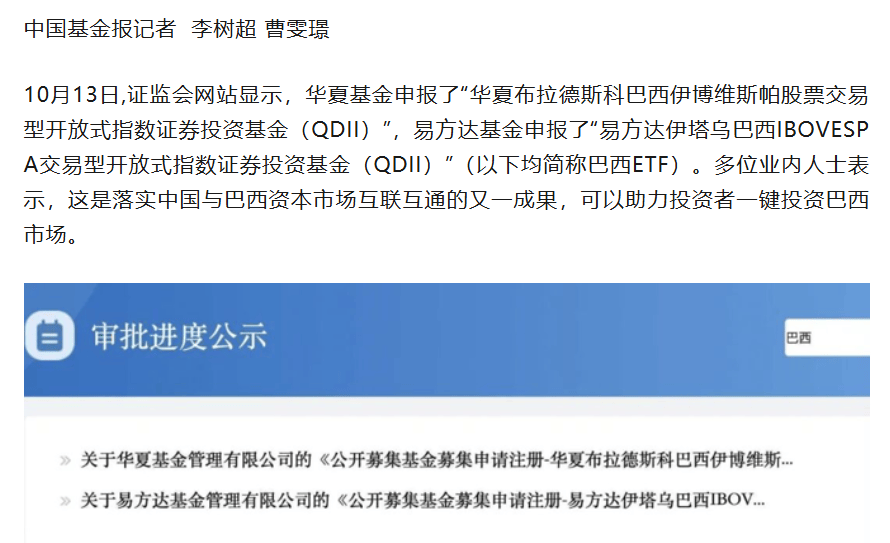
易方达上报首只巴西ETF:成分股含淡水河谷、巴西石油
Sou Hu Cai Jing· 2025-10-14 04:52
Core Viewpoint - The recent approval of the "E Fund Itaú Bovespa ETF" marks a significant step in the establishment of the China-Brazil ETF connectivity mechanism, allowing Chinese investors to access core Brazilian market assets directly through QDII [1][3] Group 1: Fund Details - E Fund's ETF aims to track the Bovespa Index, which includes major resource companies such as Vale and Petrobras [1] - The ETF will be linked with Itaú Unibanco's ETF products, facilitating direct investment in Brazilian assets for investors [1] Group 2: Market Implications - The approval indicates a growing interest among Chinese fund companies in South American resource cycle assets, following previous expansions into markets like Japan, Hong Kong, and Singapore [1][3] - The Bovespa Index is heavily weighted in mining, energy, and financial sectors, with resource companies accounting for over one-third of its composition, suggesting strong correlation with global commodity prices [3] Group 3: Competitive Landscape - Other fund companies, such as Huaxia Fund, have also attempted to enter the Brazilian ETF market, although their applications may have been withdrawn or delayed [1][3] - The potential for the Brazilian ETF to become a significant tool for Chinese investors in emerging markets is highlighted, especially if regulatory approvals proceed smoothly [3]

能源化工期权策略早报:能源化工期权-20251014
Wu Kuang Qi Huo· 2025-10-14 03:15
Group 1: Report Overview - Report Title: Energy and Chemical Options Strategy Morning Report [1] - Date: October 14, 2025 - Research Scope: Energy (crude oil, LPG), polyolefins (polypropylene, PVC, plastic, styrene), polyester (PX, PTA, short - fiber, bottle - chip), alkali chemicals (caustic soda, soda ash), others (rubber) [2] - Strategy Suggestion: Build option portfolio strategies mainly as sellers, and spot hedging or covered strategies to enhance returns [2] Group 2: Market Conditions of Underlying Futures - Crude oil (SC2512): Latest price 454, up 0 (0.02%), trading volume 6.51 million lots (+ 3.49 million), open interest 3.11 million lots (+ 0.33 million) [3] - LPG (PG2511): Latest price 4,121, up 52 (1.28%), trading volume 5.24 million lots (- 0.56 million), open interest 5.86 million lots (- 0.44 million) [3] - Methanol (MA2512): Latest price 2,319, up 0 (0.00%), trading volume 4.95 million lots (+ 1.18 million), open interest 4.02 million lots (+ 0.22 million) [3] - And other varieties with detailed price, change, volume, and open - interest data provided [3] Group 3: Option Factors - Volume and Open - Interest PCR - Crude oil: Volume PCR 1.11 (+ 0.41), Open - interest PCR 0.56 (- 0.03) [4] - LPG: Volume PCR 0.52 (- 0.13), Open - interest PCR 0.48 (- 0.07) [4] - Methanol: Volume PCR 0.68 (+ 0.01), Open - interest PCR 0.65 (+ 0.06) [4] - And other varieties with corresponding PCR data [4] Group 4: Option Factors - Pressure and Support Levels - Crude oil: Pressure point 570, support point 440 [5] - LPG: Pressure point 4,700, support point 4,050 [5] - Methanol: Pressure point 2,300, support point 2,250 [5] - And other varieties with their respective pressure and support levels [5] Group 5: Option Factors - Implied Volatility - Crude oil: At - the - money implied volatility 27.545%, weighted implied volatility 35.73% (+ 3.29%), historical average 37.02% [6] - LPG: At - the - money implied volatility 16.82%, weighted implied volatility 22.03% (+ 1.86%), historical average 24.00% [6] - Methanol: At - the - money implied volatility 17.03%, weighted implied volatility 19.61% (+ 3.13%), historical average 21.83% [6] - And other varieties with implied volatility data [6] Group 6: Option Strategies for Different Varieties Crude Oil - Fundamental: OPEC+ started a new round of production increase of 1.65 million barrels per day in October, market worries about long - term supply surplus, and the production increase cycle will continue until next year. The situation in the Middle East has eased [7] - Market Analysis: Since July, it has been weak, with a downward trend in October [7] - Option Factors: Implied volatility fluctuates above the average; Open - interest PCR below 0.60 indicates a weak market; Pressure point 570, support point 440 [7] - Strategies: Directional strategy: None; Volatility strategy: Sell a neutral call + put option combination; Spot long - hedging strategy: Build a long collar strategy [7] LPG - Fundamental: PDH device maintenance is stable, but profit is declining. It is expected that the capacity utilization rate will decline after entering the peak season [9] - Market Analysis: After a decline in July, it has shown an oversold rebound with pressure [9] - Option Factors: Implied volatility drops to near the average; Open - interest PCR below 0.60 indicates a weak market; Pressure point 4,700, support point 4,050 [9] - Strategies: Directional strategy: None; Volatility strategy: Sell a neutral call + put option combination; Spot long - hedging strategy: Build a long collar strategy [9] Other Varieties - Similar analysis and strategy suggestions are provided for methanol, ethylene glycol, polypropylene, rubber, polyester products, caustic soda, soda ash, and urea [9][10][11][12][13][14] Group 7: Charts - Charts for each variety include price trends, trading volume and open - interest, PCR, implied volatility, historical volatility cones, and pressure and support levels [15][36][56][75][94][113][133][152][170][188]
研究所晨会观点精萃-20251014
Dong Hai Qi Huo· 2025-10-14 01:38
Overall Core View - The global risk appetite has generally increased due to the restrained statements from both China and the US. The domestic economic growth has accelerated, and the issuance of multiple industry stabilization and growth plans has increased policy support, which helps boost domestic risk appetite. The short - term macro upward drive is not strong, and attention should be paid to the progress of Sino - US trade negotiations and the implementation of domestic incremental policies [2][3]. Market Analysis by Asset Class Macro - finance - **Stock Index**: Short - term high - level adjustment with increased volatility, short - term cautious long. The domestic stock market declined slightly due to the drag of sectors such as consumer electronics, auto parts, and short - drama games. The short - term macro upward drive is not strong, and short - term cautious waiting and watching are recommended [2][3]. - **Treasury Bonds**: Short - term oscillation, cautious waiting and watching [2]. - **Commodity Sector**: - **Black Metals**: Short - term oscillation, cautious waiting and watching. Steel futures and spot prices continued to be weak, while iron ore prices were short - term strong and silicon - manganese/silicon - iron prices were expected to continue range - bound oscillations [2][4][6]. - **Non - ferrous Metals**: Short - term adjustment, short - term cautious long [2]. - **Energy and Chemicals**: Short - term oscillation, cautious waiting and watching [2]. - **Precious Metals**: Short - term high - level strong - side oscillation, cautious long. The precious metal market continued to rise, and short - term long positions should be held, while medium - and long - term buying on dips is recommended [2][3]. Specific Commodities Metals - **Steel**: The domestic steel futures and spot markets continued to be weak, with low - level trading volume. Although the export data in September exceeded expectations and market risk appetite increased, real - world demand has not improved, and supply remains high. The steel market is expected to be weak in the short term [4]. - **Iron Ore**: Futures and spot prices rebounded slightly. Ore demand remains strong, but the expectation of steel mill production cuts has increased. Supply and inventory data show mixed trends, and the price is expected to continue to oscillate strongly. Attention should be paid to when steel mills start to cut production [4][5]. - **Silicon - manganese/Silicon - iron**: Spot and futures prices declined slightly. Alloy demand is still okay in the short term, but the prices are expected to continue range - bound oscillations [6]. - **Copper**: The global copper mine output growth rate is expected to be relatively high in 2026. However, the US economy has uncertainties, and the domestic electrolytic copper demand is facing challenges. The copper inventory reduction is less than expected, and the US copper inventory is high [7]. - **Aluminum**: The price recovered due to the alleviation of trade tension concerns. The inventory has increased, and the demand has weakened marginally. It is difficult for the price to rise significantly [8]. - **Tin**: The global tin ore supply is tight, and the demand improvement is limited. The price is expected to remain high - level oscillating, but the upside is pressured [8]. - **Carbonate Lithium**: The price of the main contract declined. Short - term upward drive is insufficient, and the market is expected to oscillate in a range [9]. - **Industrial Silicon**: The price of the main contract rose. The production has reached a new high, and the market is expected to oscillate in a range [9]. - **Polysilicon**: The price of the main contract declined. The supply is high, the demand is low, and the market is waiting for the implementation of the storage purchase news [10]. Energy and Chemicals - **Crude Oil**: The price rose due to the easing of Sino - US trade tensions, but it remains below $60. The long - term trend is bearish, and the short - term is oscillating [11][12]. - **Asphalt**: It maintains a weak - side oscillating pattern. The peak - season demand is almost over, the inventory pressure is increasing, and the fundamental driving force for recovery is weak [12]. - **PX**: It follows the polyester sector and remains in a weak - side oscillation. Although it gets some demand support, it is likely to continue to oscillate weakly [12]. - **PTA**: It maintains a low - level oscillation. The demand pressure will increase, and the supply will remain high, resulting in an oversupply situation [13]. - **Ethylene Glycol**: The port inventory has increased, the demand has weakened, and the price is expected to remain in a low - level range [13]. - **Short - fiber**: It adjusts with the polyester sector and is expected to continue to oscillate weakly in the short term [13]. - **Methanol**: The supply growth rate far exceeds the demand recovery, resulting in an oversupply situation, and the price is expected to oscillate weakly [14]. - **PP**: The post - holiday market shows a pattern of both supply and demand increasing, but the supply pressure in the long - term is large, and the price is expected to be under pressure [14]. - **LLDPE**: The supply pressure is increasing, the demand improvement is insufficient, and the price is expected to continue to oscillate weakly [15]. - **Urea**: The market is operating weakly due to the strong supply and weak demand. The short - term price is under pressure, and the future trend depends on the export policy [15]. Agricultural Products - **US Soybeans**: The concerns about Trump's tariff remarks in the CBOT market have eased, and the Brazilian soybean sowing progress is good [16]. - **Soybean and Rapeseed Meal**: The import of soybeans in the fourth quarter is expected to be abundant, and the basis of the soybean meal 01 contract is difficult to rebound significantly. The market should pay attention to the performance of the CBOT soybean market [17]. - **Soybean and Rapeseed Oil**: The soybean oil inventory has increased, and the price may be relatively weak. The rapeseed oil inventory is decreasing, which forms a support [18]. - **Palm Oil**: The Southeast Asian palm oil is in the production - reduction cycle. The October production in Malaysia increases, which suppresses the price, while the export increase also provides some support [18].
广发早知道:汇总版-20251014
Guang Fa Qi Huo· 2025-10-14 01:13
Report Industry Investment Rating No relevant content provided. Core Views of the Report - The overall market is affected by factors such as Sino-US trade frictions, Fed interest rate policies, and supply-demand relationships in various industries. Different sectors show different trends, with some facing pressure and others having potential opportunities [2][3][4] - Sino-US trade relations are a significant factor influencing the market, and their development will have an impact on multiple industries, including metals, agriculture, and shipping [3][4][12] Summary by Directory Financial Derivatives - Financial Futures Stock Index Futures - On Monday, A-shares opened lower due to weekend news but recovered during the day. The Shanghai Composite Index fell 0.19%, and the four major stock index futures contracts all declined. The basis spreads of the four major stock index futures contracts fluctuated narrowly [2][3] - The market is affected by Sino-US trade frictions. The short-term risk appetite may be suppressed, but the medium- to long-term upward trend remains unchanged. It is recommended to observe first and then look for opportunities [4] Bond Futures - Bond futures opened high and closed lower, with all contracts closing up. The spot bond yields rebounded. The market is affected by factors such as the easing of Sino-US relations and changes in risk appetite. It is expected to continue to fluctuate within a range, and it is recommended to wait and see [5][7] Financial Derivatives - Precious Metals - Due to the intensification of Sino-US trade frictions and the US government shutdown, the market's concerns have not been truly alleviated. The dollar index has strengthened, and precious metals have reached new highs under short squeeze trading. It is expected that precious metals will continue to be bullish in the future, but short-term fluctuations may occur [9] - It is recommended to buy precious metals at a low price above 910 yuan and set stop-profit and stop-loss points. For silver, it is recommended to maintain a long position above $50 [10] Financial Derivatives - Container Shipping Index (European Line) - The spot prices of container shipping on the European line are showing a downward trend, and the futures market is also under pressure. The macro factors are highly uncertain, and it is recommended to observe cautiously [11][12] Commodity Futures - Non-Ferrous Metals Copper - The price of copper is running strongly due to the easing of tariff concerns. The supply of copper mines is tight, and the demand has strong resilience. It is recommended to take profit on long positions at a high price and pay attention to the support level of 84,000 - 85,000 yuan [12][17] Alumina - The supply of alumina is sufficient, and the spot price is falling. It is expected that the supply will continue to be in excess in October, and the price will be under pressure. It is recommended to pay attention to the cost-profit change and overseas production growth [17][20] Aluminum - The price of aluminum is oscillating at a high level. The macro environment is favorable, and the supply and demand are in a tight balance. It is expected to continue to oscillate at a high level in the short term, and it is recommended to pay attention to the inventory reduction rhythm and downstream acceptance of high prices [21][23] Aluminum Alloy - The price of aluminum alloy is following the trend of aluminum. The supply is affected by factors such as raw material supply and tax policies, and the demand is recovering moderately. It is expected to oscillate at a high level in the short term, and it is recommended to pay attention to the upstream raw material supply and demand recovery rhythm [23][26] Zinc - The price of zinc is oscillating. The supply is abundant, and the demand is not outstanding. It is expected to continue to oscillate in the short term, and it is recommended to pay attention to the supply and demand changes and inventory performance [27][31] Tin - The price of tin is oscillating. The supply is tight, and the demand is weak. It is expected to continue to oscillate in the short term, and it is recommended to observe [31][34] Nickel - The price of nickel is affected by macro factors and news from the ore end. The supply is increasing, and the demand is diverse. It is expected to oscillate strongly in the short term, and it is recommended to pay attention to the macro expectations and Indonesian industrial policies [34][37] Stainless Steel - The price of stainless steel is oscillating downward. The macro environment is weak, and the supply is increasing while the demand is not strong. It is expected to oscillate weakly in the short term, and it is recommended to pay attention to the macro expectations and steel mill dynamics [38][40] Lithium Carbonate - The price of lithium carbonate is oscillating. The supply and demand are in a tight balance, and the inventory is decreasing. It is expected to continue to oscillate in the short term, and it is recommended to pay attention to the macro risks [42][44] Commodity Futures - Black Metals Steel - The price of steel is weakly consolidating. The Sino-US trade friction has a negative impact on the market, but the supply and demand are basically balanced, and the inventory pressure is not large. It is recommended to pay attention to the support levels of 3,000 yuan for rebar and 3,200 yuan for hot-rolled coil [45][46] Iron Ore - The price of iron ore is oscillating strongly. The supply is affected by factors such as shipping volume and negotiation results, and the demand is at a high level but slightly decreasing. It is recommended to go long on iron ore 2601 contract at a low price and consider the arbitrage strategy of long iron ore and short hot-rolled coil [47][50] Coking Coal - The price of coking coal is experiencing a phased correction. The supply is affected by factors such as mine production and import volume, and the demand is weakening. It is recommended to short the coking coal 2601 contract at a high price and consider the arbitrage strategy of long iron ore and short coking coal [51][53] Coke - The price of coke is oscillating downward. The first round of price increase has been implemented, but the space for further increase is limited, and there is a possibility of price reduction in the future. It is recommended to short the coke 2601 contract at a high price and consider the arbitrage strategy of long iron ore and short coke [54][58] Commodity Futures - Agricultural Products Meal - The price of meal is under pressure due to the uncertain Sino-US trade relations and supply pressure. The supply of soybeans in the fourth quarter of 2025 is sufficient, but there is a gap expected in the first quarter of 2026. It is recommended to pay attention to the support level of the M2601 contract and the 1-5 positive spread opportunity [59][61] Live Pigs - The price of live pigs is at a low level. The supply pressure is large, and the demand is weak. It is recommended to short live pigs on the futures market and consider the LH1-5 and LH3-7 reverse spread strategies [62][63]
帮主郑重:白银飙到几十年新高,大宗商品这波热闹藏着啥?
Sou Hu Cai Jing· 2025-10-14 00:51
Group 1: Oil Market - WTI crude oil rebounded by 1% to $59.49 per barrel, recovering from a 4.2% drop the previous Friday, supported by a rebound in the US stock market [3] - The market remains volatile due to unresolved trade tensions, with expectations of fluctuating prices in the short term [3] - If oil prices stay below $60, the number of US oil rigs is likely to decrease, which could lead to a reduction in production and provide a potential floor for oil prices in the long term [3] Group 2: Precious Metals - Silver prices surged over 4% to exceed $52 per ounce, approaching the record high from 1980, driven by a historic short squeeze in the London market [4] - The cost of borrowing silver has skyrocketed to over 30%, indicating a tight supply situation, prompting traders to transport silver across the Atlantic to exploit price differences [4] - Gold also reached a new high of $4,115, marking eight consecutive weeks of gains, with palladium and platinum prices following suit [4] - The core driver for the rise in precious metals is the tightening supply in the London market, with increasing borrowing costs signaling a clear shortage [4] Group 3: Base Metals - Copper prices increased nearly 3% to $10,820 per ton, recovering from previous losses, with the spot copper price turning into a premium of $224 per ton, marking the second-largest single-day increase since 1994 [5] - The rise in spot prices is attributed to traders and companies needing to roll over short positions in the LME, leading to increased costs and pushing spot prices higher [5] - The analysis indicates that the current copper price surge is significantly influenced by real supply and demand dynamics, rather than mere speculation [5] Group 4: Investment Strategy - Long-term investment in commodities should focus on underlying fundamentals rather than short-term price fluctuations, with oil prices dependent on trade stability and US production levels [5] - The tight supply and long-term safe-haven demand are critical for precious metals, indicating that recent price movements are not merely speculative [5] - The premium in copper prices reflects genuine industrial demand, emphasizing the importance of understanding supply-demand relationships in commodity markets [5]

美联储保尔森支持今年再降息两次,9月原油产量增长
Dong Zheng Qi Huo· 2025-10-14 00:47
Report Industry Investment Ratings No relevant content provided. Core Views of the Report The report offers a comprehensive analysis of various financial and commodity markets, presenting insights into market trends, influencing factors, and corresponding investment suggestions. It takes into account factors such as policy changes, supply - demand dynamics, and geopolitical events to assess market conditions and risks [1][2][3]. Summary by Directory 1. Financial News and Reviews 1.1 Macro Strategy (Gold) - Gold prices soared over 3% to above $4100, reaching a new high. The market's bullish sentiment was high, with funds flowing into gold. The short - term market sentiment dominated the trend, and market volatility increased as gold prices entered uncharted territory [13]. - Investment advice: Gold prices are strong in the short term, and market volatility intensifies [14]. 1.2 Macro Strategy (Foreign Exchange Futures - US Dollar Index) - Fed official Anna Paulson hinted at two more 25 - basis - point rate cuts this year, believing that tariffs have a controllable impact on inflation. This dovish stance led to a short - term weakening of the US dollar index [16]. - Investment advice: The US dollar is expected to weaken in the short term [17]. 1.3 Macro Strategy (Stock Index Futures) - On Monday, the A - share market showed three unexpected features: a sharp gap - down opening, shrinking trading volume despite strong dip - buying意愿, and significant divergence between the Sci - tech Innovation and ChiNext boards. - Investment advice: Balance the allocation of various stock index contracts to cope with the rapidly rotating market [21]. 1.4 Macro Strategy (US Stock Index Futures) - Fed official Paulson supports two more 25 - basis - point rate cuts this year. The AI sector remains the main driving force for the index's rise [22][23]. - Investment advice: Pay attention to the negotiation progress and look for opportunities to enter the market on dips [24]. 1.5 Macro Strategy (Treasury Bond Futures) - China's September import and export growth exceeded expectations. The stock market's bullish sentiment remained unchanged, and it is expected that the bond market will fluctuate in the short term [27]. - Investment advice: The bond market will fluctuate in the short term. After the new regulations on fund fees are implemented, there will be opportunities to buy on dips [28]. 2. Commodity News and Reviews 2.1 Agricultural Products (Sugar) - Overnight, the external market fell more than 3%. However, as Brazil's peak crushing season passes and the Northern Hemisphere enters a new crushing season, the downward space for ICE raw sugar is not optimistic [32]. - Investment advice: Due to the impact of the external market decline, Zhengzhou sugar is in a weak downward trend, but it is not recommended to short aggressively [33]. 2.2 Agricultural Products (Soybean Meal) - China's September soybean imports reached a record high for the same period. As of October 10, soybean inventory continued to rise, but soybean meal inventory decreased due to the drop in oil mill operating rates during the holiday [36]. - Investment advice: It is expected that the prices of domestic and foreign futures will fluctuate temporarily. Continue to monitor the planting situation of new Brazilian soybeans and the development of Sino - US relations [37]. 2.3 Agricultural Products (Soybean Oil/Rapeseed Oil/Palm Oil) - From October 1 - 10, Malaysia's palm oil production increased by 6.59% month - on - month. The domestic palm oil inventory decreased by 0.83% month - on - month but was still higher than last year [39][40]. - Investment advice: Look for opportunities to buy palm oil on dips, and pay attention to Indonesia's biodiesel policy and October production [40]. 2.4 Agricultural Products (Red Dates) - On October 13, the price of red dates in the Hebei Cuierzhuang market stabilized. The futures price of the main contract CJ601 closed slightly higher [41]. - Investment advice: It is recommended to wait and see. Focus on the price negotiation in the production area and the acquisition progress [42]. 2.5 Black Metals (Steam Coal) - India's coal production in September decreased year - on - year. Although coal prices rebounded in the short term, the seasonal weakness from October to November is difficult to change [44]. - Investment advice: Coal prices are expected to continue to decline [44]. 2.6 Black Metals (Iron Ore) - India's GPIL plans to expand its iron ore mine. Short - term policy factors may support ore prices, but terminal demand is weak, and the short - term upward space is limited [45]. - Investment advice: Pay attention to short - term policy impacts, but the short - term upward space is limited [46]. 2.7 Agricultural Products (Corn Starch) - Corn starch companies' theoretical profits have turned positive. It is expected that the spot rice - flour price difference will continue to narrow in the long - term [47]. - Investment advice: Consider short - term opportunities to short the spot rice - flour price difference [47]. 2.8 Agricultural Products (Corn) - On October 13, domestic corn prices continued to decline. The corn market has entered the production - area pricing stage, and the current price is unlikely to have bottomed out [48]. - Investment advice: Hold existing short positions and avoid early entry for long positions [48]. 2.9 Non - Ferrous Metals (Polysilicon) - The US government stopped a large - scale solar project. The spot price of polysilicon is expected to remain stable in October. The PS2511 contract is significantly discounted, and light - position long positions can be considered [52]. - Investment advice: Consider light - position long positions in the PS2511 contract and pay attention to the PS2511 - PS2512 reverse arbitrage opportunity [52]. 2.10 Non - Ferrous Metals (Industrial Silicon) - The US imposed high tariffs on Angolan industrial silicon. The price floor of industrial silicon is more definite, and it is recommended to buy on dips [54]. - Investment advice: Consider buying industrial silicon on dips, but be cautious when chasing up [54]. 2.11 Non - Ferrous Metals (Lead) - As of October 13, the social inventory of lead ingots decreased. Due to short - term supply - demand mismatch, Shanghai lead may fluctuate upward [56]. - Investment advice: Look for buying opportunities on pullbacks and beware of delivery risks [56]. 2.12 Non - Ferrous Metals (Zinc) - As of October 13, the domestic zinc inventory increased. The global visible inventory is rising marginally. The Shanghai zinc is expected to fluctuate widely [57]. - Investment advice: It is recommended to wait and see. Consider medium - term positive arbitrage opportunities [58]. 2.13 Non - Ferrous Metals (Copper) - The accident at El Teniente copper mine will affect production until 2026. The short - term copper price is likely to fluctuate upward [63]. - Investment advice: Buy copper on pullbacks and wait and see for arbitrage [63]. 2.14 Non - Ferrous Metals (Nickel) - Indonesia requires nickel mining companies to submit 2026 production plans. Nickel ore prices are expected to rise in Q4. It is recommended to buy on dips after sentiment is released [67]. - Investment advice: Look for opportunities to buy nickel on dips after sentiment is released [67]. 2.15 Non - Ferrous Metals (Lithium Carbonate) - Australia is considering a key minerals agreement with the US. The short - term lithium price may fluctuate narrowly. It is recommended to short on rallies [70]. - Investment advice: Short lithium carbonate on rallies and pay attention to the LC2511 - 2512 reverse arbitrage opportunity [70]. 2.16 Energy and Chemicals (Liquefied Petroleum Gas) - Trump's tariff statement brought uncertainty. The profit of PDH is unsustainable. It is recommended to short the PDH profit on the right - hand side [74]. - Investment advice: Look for opportunities to short the PDH profit on the right - hand side [74]. 2.17 Energy and Chemicals (Crude Oil) - OPEC's September crude oil production increased. The short - term market sentiment has recovered, but the upward space is limited [75]. - Investment advice: The short - term upward space for crude oil prices is limited [76]. 2.18 Energy and Chemicals (PX) - On October 13, the PX price fell. It is expected to follow the oil price and fluctuate downward [77]. - Investment advice: PX is expected to fluctuate downward following the oil price [79]. 2.19 Energy and Chemicals (Asphalt) - In September, domestic asphalt production increased. The supply - demand fundamentals are unlikely to have a continuous mismatch [81]. - Investment advice: It is recommended to wait and see [82]. 2.20 Energy and Chemicals (PTA) - On October 13, the PTA spot price declined. The short - term PTA price is expected to fluctuate downward, and the PTA - oil price spread may widen passively [83]. - Investment advice: PTA is expected to fluctuate downward, and the PTA - oil price spread may widen passively [85]. 2.21 Energy and Chemicals (Methanol) - On October 13, the methanol price in Taicang increased. The short - term methanol price is likely to rise but with limited upward space [86]. - Investment advice: The short - term methanol price is likely to rise, but the upward space is limited [86]. 2.22 Energy and Chemicals (Styrene) - As of October 13, the inventory of styrene in Jiangsu ports decreased. It is not recommended to expand the styrene - benzene spread [87]. - Investment advice: Do not expand the styrene - benzene spread [87]. 2.23 Energy and Chemicals (Bottle Chips) - On October 13, bottle chip factories lowered their export prices. The supply - demand contradiction may accumulate in the fourth quarter [91]. - Investment advice: Pay attention to the factory's resumption of production and the new device's commissioning [91]. 2.24 Energy and Chemicals (Caustic Soda) - On October 13, the price of liquid caustic soda in Shandong increased locally. It is necessary to be cautious when bottom - fishing [94]. - Investment advice: Be cautious when bottom - fishing caustic soda [94]. 2.25 Energy and Chemicals (Pulp) - On October 13, the price of imported wood pulp showed differentiation. The pulp market is expected to fluctuate downward [96]. - Investment advice: The pulp market is expected to fluctuate downward [96]. 2.26 Energy and Chemicals (Urea) - The utilization rate of compound fertilizer production capacity decreased. It is not recommended to be overly bearish on urea after the UR2601 contract falls below 1600 yuan/ton [100]. - Investment advice: Do not be overly bearish on urea after the UR2601 contract falls below 1600 yuan/ton [100]. 2.27 Energy and Chemicals (PVC) - On October 13, the PVC powder market price fluctuated slightly. Pay attention to macro changes [101]. - Investment advice: Pay attention to macro changes [101]. 2.28 Energy and Chemicals (Soda Ash) - As of October 13, the inventory of soda ash manufacturers increased. It is recommended to short soda ash on rallies [102]. - Investment advice: Short soda ash on rallies and pay attention to supply - side disturbances [102]. 2.29 Energy and Chemicals (Float Glass) - On October 13, the price of float glass in the Shahe market decreased. It is recommended to consider the arbitrage opportunity of going long on FG2601 and shorting SA2601 [105]. - Investment advice: Consider the arbitrage opportunity of going long on FG2601 and shorting SA2601 [105].
港股通红利低波ETF(520890)跌0.36%,成交额2026.92万元
Xin Lang Cai Jing· 2025-10-13 17:10
Core Viewpoint - The Hong Kong Dividend Low Volatility ETF (520890) has experienced a significant decrease in both share count and total assets in 2024, indicating potential challenges in attracting investment [1][2]. Group 1: Fund Overview - The Hong Kong Dividend Low Volatility ETF (520890) was established on September 4, 2024, with an annual management fee of 0.50% and a custody fee of 0.10% [1]. - As of October 10, 2024, the fund had a total of 70.08 million shares and a total size of 98.15 million yuan, down from 123 million shares and 146 million yuan at the end of 2024, representing a 43.09% decrease in shares and a 32.92% decrease in size year-to-date [1]. Group 2: Liquidity and Trading Activity - Over the last 20 trading days, the ETF has accumulated a total trading amount of 688 million yuan, with an average daily trading amount of 34.41 million yuan [1]. - Year-to-date, the ETF has seen a total trading amount of 2.643 billion yuan over 186 trading days, averaging 14.21 million yuan per day [1]. Group 3: Fund Performance and Holdings - The current fund manager, Li Qian, has managed the ETF since its inception, achieving a return of 40.20% during her tenure [2]. - The ETF's top holdings include Shougang Resources (3.83%), Far East Horizon (3.69%), Chongqing Rural Commercial Bank (3.27%), and others, with the total holdings reflecting a diversified portfolio [2].