
钢铁

Search documents
季节性累库持续,钢价偏弱运行
Zhong Yuan Qi Huo· 2026-02-09 09:47
1. Report Industry Investment Rating No relevant information provided. 2. Core View of the Report Last week, the five major steel products continued to accumulate inventory. The production and demand of rebar both decreased, and the inventory increase expanded. The inventory of hot-rolled coils turned to increase, with small increases in both social and factory inventories. As the terminal market continued to weaken, the fundamentals of steel products deteriorated, and prices declined under pressure, with futures falling more than spot. Steel prices are expected to be under slight pressure, and attention should be paid to the support near the previous low points [9]. 3. Summary by Directory 3.1 Market Review Last week, the five major steel products continued to accumulate inventory. The production and demand of rebar both decreased, and the inventory increase expanded. The inventory of hot-rolled coils turned to increase, with small increases in both social and factory inventories. As the terminal market continued to weaken, the fundamentals of steel products deteriorated, and prices declined under pressure, with futures falling more than spot [9]. 3.2 Steel Supply and Demand Analysis - **Supply**: Rebar weekly output was 191,680 tons (down 4.08% week-on-week, up 4.29% year-on-year), and the national hot-rolled coil weekly output was 309,160 tons (down 0.02% week-on-week, down 4.62% year-on-year). Rebar blast furnace weekly output was 162,810 tons (down 2.87% week-on-week, down 10.35% year-on-year), and rebar electric furnace weekly output was 28,870 tons (down 10.37% week-on-week, up 1212% year-on-year). The blast furnace operating rate increased slightly, while the electric furnace operating rate declined [15][17]. - **Profit**: The profits of rebar and hot-rolled coils both increased slightly. The rebar profit was +65 yuan/ton (up 14 yuan/ton week-on-week, down 35 yuan/ton year-on-year), and the hot-rolled coil profit was +2 yuan/ton (up 15 yuan/ton week-on-week, down 3 yuan/ton year-on-year) [25]. - **Demand**: The apparent consumption of rebar declined, and the demand for hot-rolled coils decreased slightly. The apparent consumption of rebar was 147,640 tons (down 16.30% week-on-week, up 143% year-on-year), the 5-day average of national building materials transactions was 3.49 tons (down 51.40% week-on-week, down 68.52% year-on-year), and the apparent consumption of hot-rolled coils was 305,540 tons (down 1.88% week-on-week, up 2.38% year-on-year) [30]. - **Inventory**: Rebar inventory increased for three consecutive weeks, with increases in both factory and social inventories. Rebar factory inventory was 153,650 tons (up 3.03% week-on-week, down 30.16% year-on-year), rebar social inventory was 365,920 tons (up 12.11% week-on-week, down 24.61% year-on-year), and rebar total inventory was 519,570 tons (up 9.26% week-on-week, down 26.34% year-on-year). The inventory of hot-rolled coils turned to increase, with small increases in both factory and social inventories. Hot-rolled coil factory inventory was 78,750 tons (up 1.94% week-on-week, down 18.77% year-on-year), hot-rolled coil social inventory was 280,450 tons (up 0.76% week-on-week, down 16.96% year-on-year), and hot-rolled coil total inventory was 359,200 tons (up 1.02% week-on-week, down 13.30% year-on-year) [35][39]. - **Downstream Industries**: In the real estate sector, the transaction volume of commercial housing and land decreased week-on-week. In the automotive sector, the production and sales of automobiles decreased both month-on-month and year-on-year in December [42][45]. 3.3 Spread Analysis The basis of rebar and hot-rolled coils widened, the 5 - 10 spread of rebar and hot-rolled coils fluctuated narrowly, the coil-rebar spread widened, and the 5 - 9 spread of coking coal and coke contracted slightly [47][52].
钢铁板块高质量发展,钢铁ETF(515210)收涨1.8%
Mei Ri Jing Ji Xin Wen· 2026-02-09 09:38
Core Viewpoint - The steel industry is expected to experience high-quality development driven by increased industry concentration and enhanced competitive advantages of leading companies, particularly in the context of stricter environmental regulations and carbon neutrality goals [1] Industry Summary - The steel ETF (515210) rose by 1.8% on February 9, indicating positive market sentiment towards the steel sector [1] - Long-term trends suggest that the steel industry's development will be characterized by a focus on high-quality growth and improved profitability for leading companies due to stricter environmental standards and low emissions [1] - The demand for steel from the real estate sector is declining, but the negative impact of this trend on overall steel demand is expected to diminish as infrastructure and manufacturing sectors show signs of stable growth [1] - Approximately 60% of steel companies are currently operating at a loss, indicating a need for market-driven supply adjustments, which are beginning to occur [1] - If supply-side policies are implemented effectively, the pace of supply contraction in the industry may accelerate, leading to a gradual recovery in the steel industry's fundamentals [1] ETF and Index Summary - The steel ETF (515210) tracks the CSI Steel Industry Index (930606), which includes listed companies involved in various steel sectors, reflecting the overall performance of the steel industry [1]
日本企业看好泰国经济前景 投资重心转向新能源与数字产业
Shang Wu Bu Wang Zhan· 2026-02-09 09:19
Group 1 - The Thai Investment Promotion Committee (BOI) reported that Japanese companies are optimistic about Thailand's economic outlook for the first half of 2026, expecting improvements due to recovery in production and consumption, particularly in new business growth across various sectors [1] - Key sectors expected to see good growth include automotive, electronics, chemicals, food, trade, and financial services, with 23% of Japanese companies planning to increase investments in Thailand in 2026 [1] - 35% of Japanese firms anticipate an increase in exports, while 26% plan to establish regional headquarters in Thailand [1] Group 2 - Japanese companies have suggested urgent measures to improve Thailand's investment environment, including stimulating domestic consumption, addressing household debt, enhancing tax review and refund efficiency, and strengthening transportation infrastructure [2] - In 2025, Japanese investment applications in Thailand reached 311, a 17% increase year-on-year, with investment amounts exceeding 119 billion Thai Baht, a 146% increase, primarily in automotive, electronics, and digital industries [2] - The digital industry saw significant growth, with investments rising from 0.42 million Thai Baht in 2024 to over 7.6 billion Thai Baht in 2025, driven by large data center projects supporting the digital economy and AI development [2]
人民网力挺小米2200MPa超强钢!国产材料真崛起了?
Sou Hu Cai Jing· 2026-02-09 08:49
Group 1 - The core focus of the articles is on Xiaomi's breakthrough in developing 2200MPa ultra-high-strength steel, which has been recognized as a key material for the new energy vehicle industry in China, supported by national strategy [1][3] - The collaboration involves Xiaomi, Northeast University, and Yucaitang, and the steel has achieved mass production and is included in China's "14th Five-Year" to "15th Five-Year" new materials industry strategy [1] - The steel exhibits significant performance improvements, with a 40% increase in tensile strength and a 24% increase in yield strength compared to the mainstream 1500MPa steel, and a 70.5% increase in load-bearing capacity for the A/B pillars in the YU7 model [3] Group 2 - The development of this steel marks a shift in China's manufacturing capabilities, moving from merely being able to produce materials to confidently surpassing international standards [3] - The technology, previously dominated by foreign giants like ArcelorMittal, has been developed using AI to screen 24.43 million formulas, indicating a significant advancement in independent research and development [3] - The article raises the question of whether this material revolution can truly end the era of reliance on imports in the steel industry [3]




中国钢铁行业展望:在压力中寻找新平衡
Zhong Cheng Xin Guo Ji· 2026-02-09 08:47
Investment Rating - The report maintains a stable but weakened investment rating for the Chinese steel industry, indicating a neutral overall credit impact despite ongoing challenges [4][6]. Core Insights - The Chinese steel industry is expected to stabilize at the bottom and show signs of fragile recovery in 2026, driven by structural upgrades and cost relief, while facing supply-demand contradictions and price pressures [4][6]. - The overall credit quality of the industry is projected to weaken in the next 12 to 18 months but will remain above a "negative" status level [4][6]. - The competitive landscape of the steel industry has entered a new phase focused on quality improvement and efficiency, with a notable recovery in operational performance since 2025 [6][22]. Industry Fundamentals Analysis - The steel industry is experiencing a mix of factors, including persistent overcapacity, demand pressure, and price suppression, leading to a stabilization at the bottom and a fragile recovery [7][8]. - The real estate sector continues to face challenges, with significant declines in investment and construction metrics, but policy support is expected to mitigate negative impacts on the steel industry [8][15]. - Infrastructure investment is projected to stabilize and support steel demand, with government measures aimed at increasing investment in key areas [8][15]. Industry Credit Analysis - The competitive landscape has shifted towards quality enhancement, with major players like China Baowu Steel Group and Ansteel Group leading consolidation efforts [34][35]. - The industry is characterized by a high level of financial leverage and weak debt repayment indicators, but no significant credit adjustments have been observed [34][39]. - The credit risk landscape is expected to remain controllable, although individual companies with persistent losses and weak financial management may face heightened credit risk exposure [34][39]. Investment Spending Analysis - The steel industry has entered a phase of investment contraction and structural optimization, with a focus on green and low-emission projects [31][32]. - Investment in the industry is expected to remain constrained due to ongoing financial pressures and the need for compliance with environmental regulations [31][32]. - The transition towards high-end product development and technological upgrades is anticipated to dominate capital expenditures in the coming years [31][32].
金属、新材料行业周报:价格波动较大,向好趋势不改-20260209
Shenwan Hongyuan Securities· 2026-02-09 08:43
Investment Rating - The report maintains a positive outlook on the metals and new materials industry, indicating a favorable investment rating [3]. Core Insights - Despite significant price fluctuations, the overall trend for the industry remains positive, with expectations for price recovery in the long term [2]. - The report highlights the performance of various metal sectors, noting that precious metals have seen a substantial increase year-to-date, while some industrial metals have experienced declines [11][10]. - The report suggests that the central bank's gold purchases will continue to support gold prices, with a long-term upward trend anticipated [5]. Weekly Market Review - The Shanghai Composite Index fell by 1.27%, while the Shenzhen Component Index decreased by 2.11%, and the CSI 300 Index dropped by 1.33%. The non-ferrous metals index fell by 8.51%, underperforming the CSI 300 by 7.18 percentage points [5][6]. - Year-to-date, the non-ferrous metals index has risen by 12.16%, outperforming the CSI 300 by 11.87 percentage points [10]. Price Changes - Industrial metals and precious metals saw price changes, with LME copper, aluminum, lead, and zinc prices decreasing by 1.24%, 1.88%, 2.44%, and 1.66% respectively. COMEX gold prices increased by 1.65% [5][18]. - Lithium prices showed mixed results, with lithium carbonate for battery-grade down by 7.65% and metal lithium up by 8.33% [21]. Key Company Valuations - The report provides valuations for key companies in the industry, indicating that Zijin Mining has a PE ratio of 31 for 2024, while Shandong Gold has a PE ratio of 79 for the same year [22]. - Other notable companies include Yunnan Aluminum with a PE of 25 and Huafeng Aluminum with a PE of 19 for 2024 [22]. Supply and Demand Analysis - The report notes that copper supply is expected to remain tight due to production disruptions, with domestic social inventory increasing to 336,000 tons [34]. - For aluminum, the report indicates that the operating rate of downstream processing enterprises has decreased to 57.90%, with social inventory rising to 1.109 million tons [49][50]. Growth Cycle Investment Analysis - The report recommends focusing on stable supply-demand dynamics in the new energy manufacturing sector, suggesting companies like Huafeng Aluminum and Baowu Magnesium as potential investment opportunities [5].





钢铁行业2025年信用回顾与2026年展望
新世纪评级· 2026-02-09 08:30
Industry Overview - The steel industry has seen a stable competitive landscape since 2025, with large-scale capacity replacement nearing completion[1] - The overall steel production capacity remains stable, while rolling steel capacity has expanded with the launch of advanced production lines[1] Market Dynamics - In 2025, the overall demand from downstream sectors remains weak, leading to a slight decline in sales volume and revenue for sample steel companies[2] - Despite a decrease in sales, the significant drop in raw material prices has helped control costs, leading to a recovery in profit levels[2] Financial Performance - The total liabilities of sample steel companies have continued to increase, but some have managed to reduce rigid debt due to improved cash flow and reduced capital expenditures[3] - In the first three quarters of 2025, the steel industry issued 144 bonds involving 28 entities, with the majority rated AAA, indicating stable credit quality[3] Future Outlook - For 2026, fiscal and monetary policies are expected to support demand in sectors like automotive and machinery, potentially stabilizing or slightly improving the steel market[4] - The global iron ore supply is expected to remain loose, with insufficient downstream demand to support iron ore prices, which may further alleviate cost pressures for the steel industry[4] Policy Environment - The steel industry is now subject to stricter capacity replacement policies aimed at promoting low-carbon development and optimizing industry structure[2] - The new capacity replacement measures introduced in October 2025 impose stricter requirements, which will impact the supply side of the steel industry[2] Production and Export Trends - In 2025, the production of crude steel and steel products is expected to show a mixed trend, with construction steel output shrinking while industrial and special steel output may grow[4] - The export volume of crude steel and steel products increased by 13.08% and 6.50% respectively in the first 11 months of 2025, as domestic demand remains insufficient[8]
A股风格之辩:成长不只科创!
Hua Er Jie Jian Wen· 2026-02-09 08:27
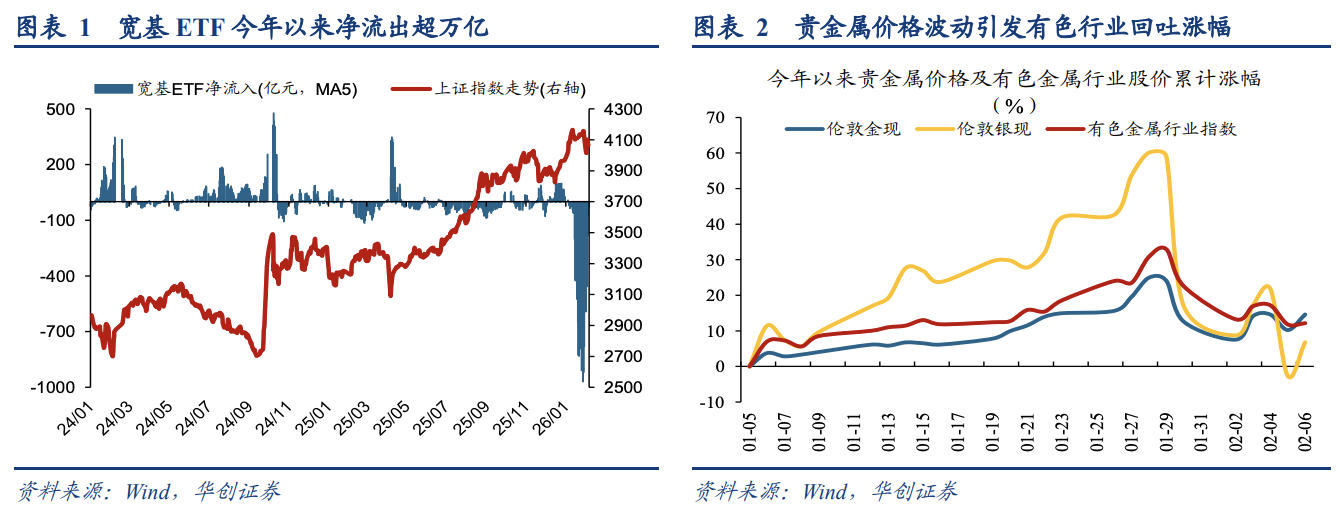
Core Viewpoint - The market has experienced a significant short-term adjustment, but a new allocation window has opened, with a focus on cyclical recovery and the real estate chain [1][11]. Market Adjustment and Liquidity - The market has undergone a sharp but brief adjustment, with a cumulative net outflow of 1.02 trillion yuan from broad-based ETFs this year and a net outflow of 58.2 billion yuan from leveraged funds over the past five trading days, marking a new high since April of last year [2][9]. - Investor sentiment indicators show that the market temperature near the 4000-point level of the Shanghai Composite Index is close to the 3800-point level from November of last year, with 130 companies hitting the daily limit down on February 2, surpassing the previous high of 107 companies on November 21 [6][9]. Investment Style Shift - A profound change in investment style is occurring, with growth stocks expected to outperform value stocks. Growth opportunities are not limited to the technology sector but also include cyclical and real estate chains [1][18]. - The remaining liquidity is expected to slow down, leading to large-cap stocks outperforming small-cap stocks. Since August 2025, large-cap stocks have significantly outperformed small-cap stocks, with the CSI 500 index rising by 31% compared to a 22% increase in the National Equity Index 2000 [23][25]. Annual Allocation Strategy - The main allocation theme for the year is expected to be driven by technology and cyclical sectors. Investors are advised to redefine the boundaries of "growth" and seek performance elasticity in cyclical and real estate chains, rather than focusing solely on the technology sector [26]. - The report highlights that the expected profit recovery for 2025 is clear, with the earnings forecast upgrade rate increasing from 65% in November last year to 96% currently [15][18]. Economic Indicators and Market Trends - The return of physical re-inflation is anticipated, with expectations of PPI turning positive, which will enhance EPS pricing and highlight the advantages of growth, profitability, and quality factors [21][22]. - The market environment is expected to shift, with valuation factors becoming less influential over the next year, and high valuations in small-cap stocks potentially reaching their limits [25].
每日报告精选(2026-02-06 09:00——2026-02-09 15:00)-20260209
GUOTAI HAITONG SECURITIES· 2026-02-09 08:23
Group 1: Macro Overview - The macroeconomic environment shows a continuation of the "Spring Festival effect," with consumer demand recovering but still needing stabilization [5][6] - Investment indicators are showing a marginal decline due to the approaching holiday, but real estate sales and land premiums are improving, likely influenced by seasonal factors and policy support [6] - External demand is mixed, with manufacturing sentiment in the US and Europe improving, while export freight rates are declining [6][8] Group 2: Strategy Insights - The report emphasizes maintaining stock positions during the holiday, despite recent market volatility and pessimism [10][11] - The Chinese government is shifting focus towards domestic demand, which is expected to enhance economic prospects and asset returns [11][12] - The report suggests that the current market conditions present a good opportunity for increasing holdings, particularly in sectors benefiting from domestic consumption [11][12] Group 3: Industry Analysis - The restaurant industry is experiencing a slowdown in price wars, with new subsidies expected to boost sales during the Spring Festival [25][26] - The steel industry is facing a seasonal inventory increase, but overall stock levels remain historically low, indicating potential for recovery [28][29] - The non-ferrous metals sector is advised to focus on stabilization opportunities, with copper prices showing resilience despite macroeconomic pressures [32][34] Group 4: Investment Recommendations - In the restaurant sector, companies like Gu Ming and Mi Xue Group are recommended due to ongoing subsidies and improved competitive dynamics [25][26] - For the steel industry, companies with strong product structures and cost advantages, such as Baosteel and Hualing Steel, are highlighted as key investment opportunities [30] - In the non-ferrous metals sector, firms like Zijin Mining and Huayou Cobalt are suggested due to their strategic positioning and market conditions [34][35]
利多驱动有限,节前偏弱运行:中辉期货钢材周报-20260209
Zhong Hui Qi Huo· 2026-02-09 08:12
1. Report Industry Investment Rating - Not provided in the given content 2. Core Viewpoints of the Report - This week, the black commodity market as a whole weakened, with iron ore experiencing the largest decline. Macro - level positive factors are still lacking, and the sharp correction in the precious metals and non - ferrous metals sectors has cooled market sentiment. In terms of supply and demand, from a lunar calendar perspective, rebar production is similar to that of the same period last year, but apparent demand is weaker, and inventory will accumulate more rapidly in the later stage. The raw material end shows the pressure of loose supply. Iron ore inventory continues to rise, and after the logic of steel mill restocking weakens, iron ore faces a supplementary decline. Coking coal faces tightened safety supervision around the Spring Festival and the Two Sessions, and the disturbance of Indonesian coal exports also provides a phased boost, but high Mongolian coal imports suppress the rebound space [2]. - The black commodity market faces the pressure of weaker year - on - year rebar demand, high hot - rolled coil inventory, and loose supply at the raw material end. Since rebar has been oscillating in a range, it will face a directional choice later, and there is a possibility of continuing to decline under the background of weak supply and demand. Before the Spring Festival, it is recommended to maintain the strategies of hedging on rallies and selling call options for covered writing [2]. - Although the current spread between hot - rolled coils and rebar is higher than in previous years, it usually widens after the Spring Festival. Due to differences in downstream demand, it may still follow seasonal patterns [3]. - The basis in East China is around 140, and the inventory in Hangzhou is at a relatively high level, with room for contraction [4]. 3. Summary by Related Catalogs Steel Production - **Monthly Data**: In December 2025, the monthly output of pig iron was 60720,000 tons, a year - on - year decrease of 9.9%; the cumulative output was 836,040,000 tons, a year - on - year decrease of 3%. The monthly output of crude steel was 68180,000 tons, a year - on - year decrease of 10.3%; the cumulative output was 960,810,000 tons, a year - on - year decrease of 4.4%. The monthly output of steel was 115,310,000 tons, a year - on - year decrease of 3.8%; the cumulative output was 1446,120,000 tons, a year - on - year increase of 3.1%. Steel imports were 520,000 tons, a year - on - year decrease of 16.7%; the cumulative imports were 6060,000 tons, a year - on - year decrease of 11.1%. Steel exports were 11,300,000 tons, a year - on - year increase of 16.2%; the cumulative exports were 119,020,000 tons, a year - on - year increase of 7.5% [7]. - **Weekly Data**: As of February 6, 2026, the weekly output of rebar was 1,916,800 tons, a decrease of 81,500 tons, with a cumulative year - on - year change of 0%. The weekly consumption was 1,476,400 tons, a decrease of 287,600 tons, with a cumulative year - on - year increase of 23%. The inventory was 5,195,700 tons, an increase of 440,400 tons, a year - on - year decrease of 26.34%. The weekly output of wire rod was 730,400 tons, a decrease of 33,700 tons, a cumulative year - on - year decrease of 1%. The weekly consumption was 620,000 tons, a decrease of 128,400 tons, a cumulative year - on - year increase of 14%. The inventory was 1,057,100 tons, an increase of 112,900 tons, a year - on - year decrease of 32%. The weekly output of hot - rolled coil was 3,091,600 tons, a decrease of 5,000 tons, a cumulative year - on - year decrease of 5%. The weekly consumption was 3,055,400 tons, a decrease of 58,700 tons, a cumulative year - on - year increase of 1%. The inventory was 3,592,000 tons, an increase of 36,200 tons, a year - on - year decrease of 13%. The weekly output of cold - rolled coil was 888,800 tons, an increase of 4,600 tons, a cumulative year - on - year increase of 1.22%. The weekly consumption was 853,300 tons, a decrease of 69,200 tons, a cumulative year - on - year increase of 8.69%. The inventory was 1,584,200 tons, an increase of 35,500 tons, a year - on - year decrease of 4.24%. The weekly output of medium and heavy plate was 1,571,400 tons, an increase of 78,400 tons, a cumulative year - on - year increase of 0.12%. The weekly consumption was 1,604,000 tons, an increase of 133,100 tons, a cumulative year - on - year increase of 4.84%. The inventory was 1,948,500 tons, a decrease of 32,600 tons, a year - on - year decrease of 15.35%. The total weekly output of the five major steel products was 8,199,000 tons, a decrease of 32,700 tons, a cumulative year - on - year decrease of 2.12%. The total weekly consumption was 7,610,000 tons, a decrease of 410,000 tons, a cumulative year - on - year increase of 8.15%. The total inventory was 13,380,000 tons, an increase of 592,400 tons, a year - on - year decrease of 19.95% [8]. - **Production Profit**: On February 5, 2026, in East China, the profit of rebar - blast furnace was 103, with a change of 5; the profit of rebar - electric furnace - off - peak electricity was - 15, with a change of - 46; the profit of rebar - electric furnace - normal electricity was - 121, with a change of - 33; the profit of hot - rolled coil - blast furnace was 65, with a change of 5. In North China, the profit of rebar - blast furnace was 8, with a change of 13; the profit of rebar - electric furnace - off - peak electricity was 34, with a change of 17; the profit of rebar - electric furnace - normal electricity was - 40, with a change of 27; the profit of hot - rolled coil - blast furnace was - 77, with a change of 13. In Central China, the profit of rebar - blast furnace was 175, with a change of 0; the profit of rebar - electric furnace - off - peak electricity was - 33, with a change of 0; the profit of rebar - electric furnace - normal electricity was - 167, with a change of 0; the profit of hot - rolled coil - blast furnace was 55, with a change of 0 [23]. Steel Demand - **Building Materials Consumption**: In 2025, the cumulative year - on - year decrease in the commercial housing transaction area of 30 large - and medium - sized cities was 10%, and the cumulative year - on - year decrease in the land transaction area of 100 cities was 19%. Due to the late Spring Festival this year, from a lunar calendar perspective, the current cement and concrete outbound/shipment volume is still lower than that of the same period last year [30][33]. - **Hot - Rolled Coil Consumption**: In December, steel exports reached 11.3 million tons, close to the historical high. The export profit of hot - rolled coils has rebounded slightly recently, but the absolute level is low [39]. Steel Inventory - **Rebar Inventory**: The rebar basis fluctuated this week with little change. Currently, the production profit of rebar is generally better than that of hot - rolled coils, which is also reflected in the month - on - month increase in rebar production. According to past patterns, the basis is expected to narrow. From a lunar calendar perspective, the inventory in Hangzhou has reached the highest level in the same period, and it may decline later [53]. - **Hot - Rolled Coil Inventory**: The hot - rolled coil basis fluctuates around - 0 with little change. The hot - rolled coil inventory has started to accumulate, and the overall level is high, which suppresses the basis [57]. - **Rebar Month - Spread**: The 5 - 10 month - spread of rebar continues to fluctuate in the negative range with limited fluctuations. The rebar inventory has started to accumulate rapidly, and the high inventory level in Hangzhou makes it difficult for the month - spread to strengthen [60]. - **Hot - Rolled Coil Month - Spread**: The 5 - 10 month - spread of hot - rolled coils fluctuates around - 20 with little change [62]. - **Spread between Hot - Rolled Coils and Rebar**: Although the current spread is higher than in previous years, it usually widens after the Spring Festival. Due to differences in downstream demand, it may still follow seasonal patterns [3].