农林牧渔

Search documents
【25日资金路线图】国防军工板块净流入逾61亿元居首 龙虎榜机构抢筹多股
Zheng Quan Shi Bao· 2025-12-25 13:33
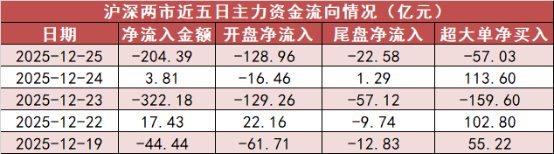
Market Overview - The A-share market experienced an overall increase on December 25, with the Shanghai Composite Index closing at 3959.62 points, up 0.47%, the Shenzhen Component Index at 13531.41 points, up 0.33%, and the ChiNext Index at 3239.34 points, up 0.3% [1] - The total trading volume in the A-share market reached 19440.6 billion yuan, an increase of 466.79 billion yuan compared to the previous trading day [1] Capital Flow - The main capital in the A-share market saw a net outflow of 204.39 billion yuan for the day, with an opening net outflow of 128.96 billion yuan and a closing net outflow of 22.58 billion yuan [2] - The CSI 300 index recorded a net outflow of 79.88 billion yuan, while the ChiNext saw a net outflow of 51.51 billion yuan and the STAR Market a net outflow of 16.01 billion yuan [4] Sector Performance - The defense and military industry led the sectors with a net inflow of 61.72 billion yuan, followed by machinery equipment with 60.79 billion yuan and the automotive sector with 39.51 billion yuan [6][7] - The electronic sector experienced the largest net outflow of 81.47 billion yuan, followed by retail with 50.64 billion yuan and telecommunications with 44.44 billion yuan [7] Individual Stocks - Goldwind Technology saw the highest net inflow of 8.29 billion yuan among individual stocks [8] - Institutions actively participated in several stocks, with Hainan Development showing a net institutional buy of 288.69 million yuan, while Tianji Co. had a net institutional sell of 21.35 million yuan [10][11]

兴业证券:哪些行业股价与人民币汇率相关性较强?
智通财经网· 2025-12-25 12:13
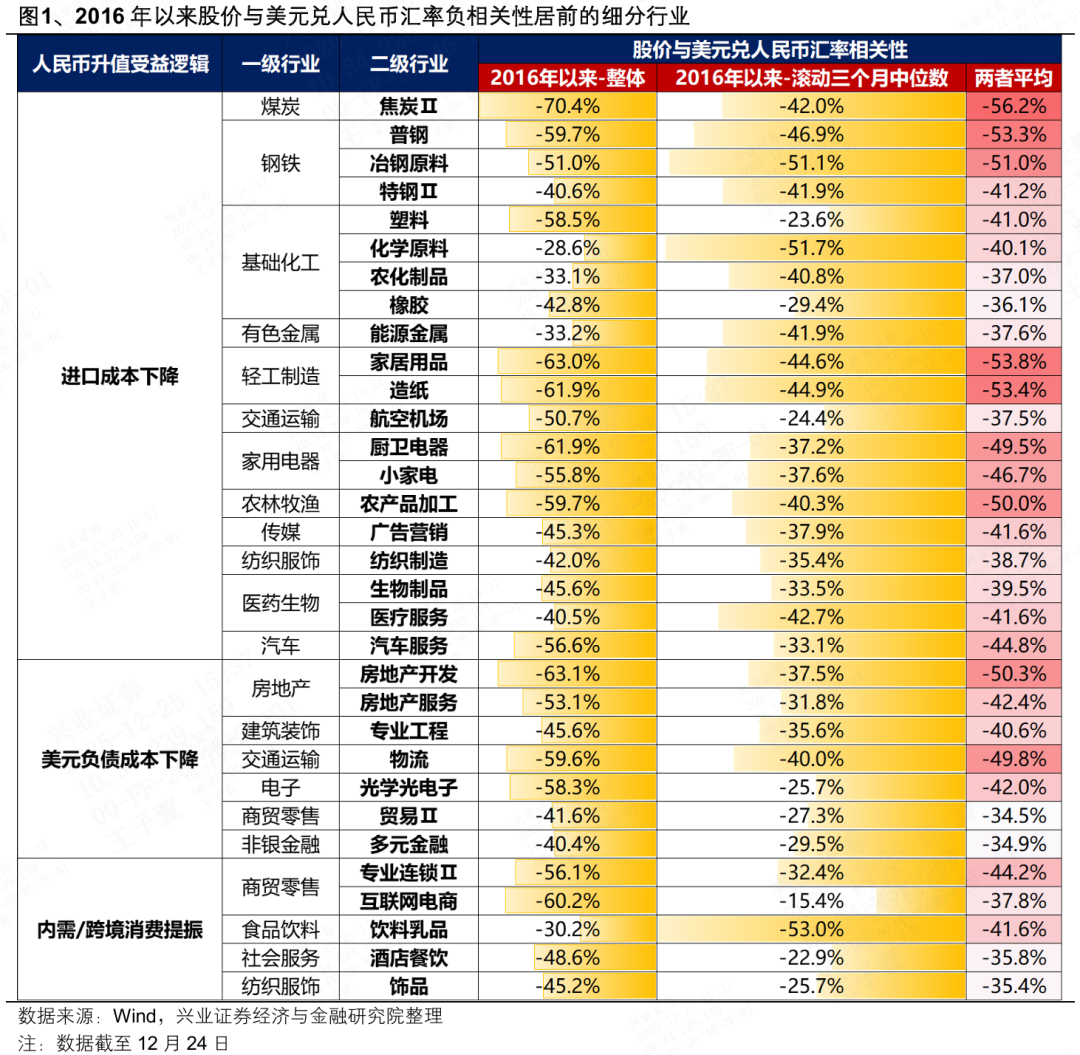
Core Viewpoint - The report from Industrial Securities highlights the negative correlation between stock prices and the USD/CNY exchange rate since 2016, indicating that a stronger RMB tends to drive stock prices higher across various sectors [1] Group 1: Industries Benefiting from RMB Appreciation - Industries with high reliance on imported raw materials benefit from RMB appreciation, leading to reduced import costs. Key sectors include coke, steel, certain chemicals (plastics, chemical raw materials, agricultural chemicals, rubber), energy metals, paper, airport operations, and agricultural product processing [1] - The construction and real estate sectors, which have high USD-denominated debt, see a decrease in financing costs due to RMB appreciation. This includes real estate development, real estate services, and specialized engineering [1] - The service and high-end consumption sectors, such as cross-border e-commerce, hotel and catering services, and jewelry, benefit from increased domestic demand and cross-border consumption driven by enhanced RMB purchasing power [1] Group 2: Correlation Data - The median negative correlation between stock prices and the USD/CNY exchange rate since 2016 shows significant figures for various sectors: - Coke: -70.4% overall, -42.0% rolling three months - Steel: -59.7% overall, -46.9% rolling three months - Basic chemicals: -58.5% overall, -23.6% rolling three months - Transportation (airports): -50.7% overall, -24.4% rolling three months - Real estate development: -63.1% overall, -37.5% rolling three months [2] Group 3: Impact on Financing Costs - Industries with high USD debt benefit from RMB appreciation, leading to lower financing costs. This includes logistics, optical electronics, trade, and diversified finance sectors [1] - Specific correlations include: - Logistics: -59.6% overall, -40.0% rolling three months - Optical electronics: -58.3% overall, -25.7% rolling three months - Trade: -41.6% overall, -27.3% rolling three months [2] Group 4: Domestic Demand and Cross-Border Consumption - The sectors benefiting from increased domestic demand and cross-border consumption include: - Food and beverage (dairy products): -30.2% overall, -53.0% rolling three months - Hospitality (hotels and restaurants): -48.6% overall, -22.9% rolling three months - Textiles (jewelry): -45.2% overall, -25.7% rolling three months [2]

风险月报 | 权益市场风险偏好温和修复,多维度指标分化持续缓和
中泰证券资管· 2025-12-25 11:32
Core Viewpoint - The overall market risk preference is showing a mild recovery, with the risk scoring system indicating a slight improvement in the stock market, while the bond market remains cautious due to weak economic data and credit risk concerns in the real estate sector [2][5]. Market Risk Assessment - The risk score for the CSI 300 index is 54.89, up from 52.77 last month, indicating a moderate recovery in market risk preference [2]. - The valuation of the CSI 300 has slightly increased to 61.54 from 60.68, remaining in a mid-high range over the past six months, with significant valuation differentiation across sectors [2]. - The market expectation score has decreased to 50.00 from 52.00, reflecting resilient external demand but a notable slowdown in internal demand [2]. Market Sentiment - Market sentiment has improved to 50.69 from 45.24, moving from a "depressed" to a "neutral" range, although sentiment indicators show significant differentiation [3]. - Margin financing scores have surged from historical lows to highs, indicating a recovery in sentiment, while public fund issuance remains stable at high levels [3]. Economic Indicators - Consumer Price Index (CPI) rose by 0.7%, the highest increase since March 2024, while core CPI increased by 1.2% [9]. - Industrial production value increased by 4.8%, with significant growth in equipment manufacturing and high-tech industries [9]. - Fixed asset investment decreased by 2.6% year-on-year, but excluding real estate development, it shows a growth of 0.8% [9]. Liquidity and Monetary Policy - The social financing scale increased by 8.5% year-on-year, with broad money (M2) growing by 8.0%, indicating a moderately loose monetary policy [11]. - The central bank has maintained a stable monetary policy, with the ten-year government bond yield around 1.85% and the thirty-year bond around 2.25%, reflecting a bear steepening trend in the bond market [11][12]. Investment Focus - In a structured market, sectors with high valuation and strong earnings certainty are emphasized, while those with high valuations but weak fundamentals are viewed with caution [3]. - The focus is on quality targets within a manageable risk range, prioritizing earnings realization and cash flow stability [3].

44家!湘潭2025年上市后备企业名单→
Sou Hu Cai Jing· 2025-12-25 11:30
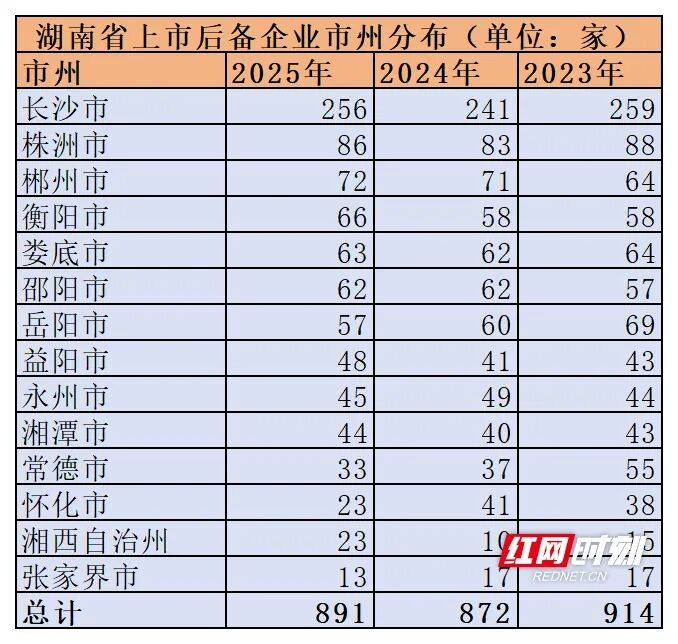
Core Viewpoint - The Hunan Provincial Financial Office has announced the list of 891 companies included in the 2025 reserve for potential public listings, indicating a growing interest in capital markets and innovation in the region [1][4]. Group 1: Company Distribution - The distribution of listed reserve companies across cities shows that Changsha leads with 256 companies, followed by Zhuzhou with 86 and Chenzhou with 72 [2]. - Other cities with significant numbers include Hengyang (66), Shaoyang (62), Loudi (63), and Yiyang (48), all having over 40 companies [2]. Group 2: Industry Distribution - The reserve companies span various industries, with a notable concentration in strategic emerging sectors such as new generation information technology, high-end equipment, new materials, and biomedicine [3]. - Manufacturing has the highest representation with 180 companies, accounting for approximately 20.20% of the total, followed by new materials with 122 companies, making up about 13.69% [3]. Group 3: Innovation and Market Proximity - The list includes a high concentration of technology and innovation-focused companies, with 257 firms (nearly 30%) being potential candidates for the Sci-Tech Innovation Board [4]. - Many of the listed companies are increasingly approaching capital markets, as evidenced by the successful review of Ying's Holdings Group Co., Ltd. by the Beijing Stock Exchange on the same day the list was published [4].
国新证券每日晨报-20251225
Guoxin Securities Co., Ltd· 2025-12-25 03:20
Domestic Market Overview - The domestic market experienced a steady rise, with the Shanghai Composite Index closing at 3940.95 points, up 0.53%, and the Shenzhen Component Index closing at 13486.42 points, up 0.88% [1][9] - Among the 30 sectors tracked, 26 saw gains, with notable increases in construction materials, defense, and electronics, while agriculture, coal, and food and beverage sectors faced declines [1][9] - The total trading volume for the A-share market was 189.72 billion yuan, showing a slight decrease from the previous day [1][9] Overseas Market Overview - The U.S. stock market recorded five consecutive days of gains, with the S&P 500 index reaching a new historical high, closing up 0.32% [2] - The Dow Jones increased by 0.6%, while the Nasdaq rose by 0.22% [2] Key Drivers - The People's Bank of China held a quarterly monetary policy meeting, emphasizing the need for integrated effects of incremental and stock policies to maintain low financing costs and stabilize the capital market [10] - On the same day, 4128 stocks in the A-share market rose, with 306 stocks increasing by over 5% [10] Industry Developments - The Chinese government released a document to support the construction of the Western Land-Sea New Corridor, proposing 21 key measures to enhance financial cooperation and support high-quality development [11] - The Ministry of Commerce continues to encourage foreign investment in advanced manufacturing, with a focus on sectors such as nucleic acid drug development and smart energy management systems [11] - A new fund for the commercial aerospace industry was launched, with an initial scale of 1-2 billion yuan, targeting investments in low-orbit satellite constellations and reusable launch vehicles [14]
A股市场大势研判:沪指六连阳
Dongguan Securities· 2025-12-25 01:24
Market Performance - The Shanghai Composite Index closed at 3940.95, up by 0.53% with an increase of 20.97 points [2] - The Shenzhen Component Index closed at 13486.42, up by 0.88% with an increase of 117.43 points [2] - The CSI 300 Index closed at 4634.06, up by 0.29% with an increase of 13.32 points [2] - The ChiNext Index closed at 3229.58, up by 0.77% with an increase of 24.57 points [2] - The STAR 50 Index closed at 1352.13, up by 0.90% with an increase of 12.11 points [2] - The Beijing Stock Exchange 50 Index closed at 1445.55, up by 0.39% with an increase of 5.61 points [2] Sector Rankings - The top five sectors by growth include Defense and Military Industry (2.88%), Electronics (2.12%), Building Materials (1.72%), Light Industry Manufacturing (1.69%), and Machinery Equipment (1.49%) [3] - The sectors with the largest declines include Agriculture, Forestry, Animal Husbandry, and Fishery (-0.85%), Coal (-0.70%), Food and Beverage (-0.36%), Banking (-0.30%), and Media (0.01%) [3] Market Outlook - The market showed a collective rise with the three major indices increasing, indicating a positive trend with the Shanghai Composite Index achieving six consecutive days of gains [4] - The trading volume in the Shanghai and Shenzhen markets was 1.88 trillion, a decrease of 196 billion from the previous trading day [5] - The report highlights a structural transformation at the bottom of the economic cycle, with manufacturing showing resilience and new industries emerging as bright spots [5] - It is suggested to focus on sectors such as dividends, TMT (Technology, Media, and Telecommunications), and consumer goods for potential investment opportunities [5]
清新区工商联:引导民企与村镇探索共富路径
Xin Lang Cai Jing· 2025-12-24 20:50
Core Insights - The article discusses the implementation of the "Hundred Million Project" by the Guangdong Provincial Committee, focusing on the collaboration between private enterprises and rural areas to promote economic development and rural revitalization [1][2] Group 1: Initiatives and Actions - The Qingxin District Federation of Industry and Commerce has developed an action plan to support the "Hundred Counties, Thousand Towns, and Ten Thousand Villages" high-quality development initiative, facilitating partnerships between 159 business associations and enterprises with 178 villages and communities [1] - The Longjing Town Chamber of Commerce has actively engaged in local resource research and communication with government departments, leading to an investment of nearly 600 million yuan by Qingyuan Lucky Dragon Clothing Co., Ltd. in the establishment of a tea garden and agricultural product processing facility [1] Group 2: Economic Impact - The establishment of the textile and footwear production project by Qingyuan Lucky Dragon Clothing Co., Ltd. is expected to stimulate local industry development, create numerous job opportunities, and enhance rural employment and income [2] - The village-enterprise partnership model allows businesses to leverage rural resource advantages to reduce production costs and expand market share, while rural areas benefit from capital, technology, and management expertise, leading to industrial upgrades and economic growth [2] Group 3: Mutual Benefits - The collaboration between enterprises and rural areas is framed as a win-win situation, where businesses gain from reduced costs and market expansion, while rural communities receive investment and expertise, resulting in job creation and improved living conditions [2] - The Qingxin District Federation of Industry and Commerce's efforts in facilitating these partnerships are seen as a bridge for mutual development, aiming for a shared vision of rural revitalization [2]
行业景气观察:电影票价明显修复,有色、存储器价格强势
CMS· 2025-12-24 14:33
Core Insights - The report indicates a notable recovery in movie ticket prices, alongside strong performance in metals and memory storage prices, suggesting an overall improvement in industry sentiment, particularly in resource products, midstream manufacturing, and information technology sectors [1][5]. Resource Products - The average transaction volume of construction steel has increased, with both steel billet and rebar prices rising. Coal prices have shown mixed trends, with some regions experiencing price increases while others see inventory fluctuations. The national cement price index has also risen [2][24]. - Industrial metal prices have generally increased, with copper, nickel, aluminum, tin, cobalt, and lead prices rising, while zinc prices have decreased. Most inventories have increased, particularly for zinc and tin [2][21]. Information Technology - The Philadelphia Semiconductor Index and Taiwan Semiconductor Industry Index have both risen, indicating a positive trend in the semiconductor sector. The prices of DDR4 and DDR5 DRAM memory have increased, reflecting strong demand in the market [5][25]. - The telecommunications sector has seen a three-month rolling year-on-year increase in main business revenue, suggesting robust growth in this area [5][24]. Midstream Manufacturing - Prices in the new energy supply chain have generally increased, with the photovoltaic price index also showing a week-on-week rise. The production of metal forming machine tools has seen a significant year-on-year increase, while the production of packaging equipment has declined [5][22]. - Port cargo throughput and container throughput have shown a narrowing year-on-year increase, indicating a potential slowdown in logistics activity [5][22]. Consumer Demand - Prices for fresh milk have risen, while the comprehensive price of sugar has decreased. Pork prices have increased, but the wholesale price of piglets has declined. The average price of live pigs has also decreased, indicating mixed trends in the livestock sector [5][18]. - The ten-day average box office revenue has increased, and movie ticket prices have risen, reflecting a recovery in consumer spending in the entertainment sector [5][20]. Financial and Real Estate - The monetary market has seen a net absorption of liquidity, with a decline in A-share turnover rate and daily transaction volume. The transaction area of commercial housing has increased, while the listing price index for second-hand houses has decreased [6][29]. Public Utilities - The ex-factory price of natural gas in China has decreased, while UK natural gas futures prices have risen. The average daily power generation of key power plants has shown a widening year-on-year decline [6][32].
晋控煤业:领跌煤炭板块,近5日跌3.32%,股价创逾三个月新低
Zheng Quan Shi Bao Wang· 2025-12-24 12:01
2023年公司控股子公司色连煤矿将"色连一号矿井"的生产、技术、安全生产管理整体委托给汇永集团运 营管理。色连煤矿与汇永集团签署矿井整体安全生产委托管理合同,协议即将到期。现色连煤矿拟继续 将色连一号矿井委托给汇永集团运营并续签相关合同。 12月24日,市场主要指数震荡收涨,国防军工、电子行业涨幅居前,均涨超2%;农林牧渔、煤炭等板 块逆市下跌,其中,煤炭指数跌0.7%。板块内,云维股份、中国神华、晋控煤业等跌幅居前。 业绩方面,晋控煤业前三季度营业收入及净利润同比均出现下降。公司表示,受煤炭市场阶段性影响, 公司收入减少,前三季度实现营业收入为93.25亿元,同比下降16.99%;归母净利润为12.77亿元,同比 下降40.65%。 进一步统计,近5日,煤炭指数上涨0.85%,板块内,江钨装备近5日涨超13%,涨幅居首;晋控煤业5日 跌幅为3.32%,是表现最差的煤炭股,最新收盘价为13.4元,收盘价创9月17日以来新低。 统计显示,12月12日,晋控煤业发生一笔大宗交易,成交量为56.02万股,成交价为14.3元,成交金额 801.09万元。 晋控煤业12月9日公告称,公司控股子公司内蒙古同煤鄂尔多斯矿业 ...

【24日资金路线图】电子板块净流入202亿元居首 龙虎榜机构抢筹多股
证券时报· 2025-12-24 11:28
12月24日,A股市场整体上涨。 截 至 收 盘 , 上 证 指 数 收 报 3940.95 点 , 上 涨 0.53% , 深 证 成 指 收 报 13486.42 点 , 上 涨 0.88%,创业板指收报3229.58点,上涨0.77%,北证50指数上涨0.39%。A股市场合计成交 18973.81亿元,较上一交易日减少241.46亿元。 | | | 今日资金净流出前五大行业 | | | --- | --- | --- | --- | | 行业 | 涨跌幅 | 净流入资金 (亿元) | 资金流出较多个股 | | 商贸零售 | 0. 05% | -17.63 | 东百集团 | | 银行 | -0. 14% | -17. 27 | 江苏银行 | | 有色金属 | 1. 15% | -13.86 | 中钨高新 | | 食品饮料 | -0. 34% | -13.67 | 山西汾酒 | | 农林牧渔 | 0. 08% | -9.06 | 牧原股份 | 4.德明利主力资金净流入9.55亿元居首 1. A股市场全天主力资金净流入3.81亿元 今日A股市场主力资金开盘净流出16.46亿元,尾盘净流入1.29亿元,全天净流 ...