
债券

Search documents
信用债市场周观察:短端中高等级信用债依然是首选
Orient Securities· 2025-09-15 09:41
Report Summary 1. Report Industry Investment Rating No industry investment rating is provided in the report. 2. Core Viewpoint of the Report - Short - term, medium - to high - grade credit bonds remain the top choice, and the idea of excavating based on the issuer's yield curve should be continued. In the current environment, the market pursues certainty and low volatility, so short - term, medium - to high - grade credit bonds are preferred for the pure - bond part. It is recommended to look for riding opportunities in the steep part of the curve or "convex points" of individual bonds when gradually moving towards the medium - and long - term [5][8]. - There are issuers with relatively large term spreads among those with an implied rating of AA+ or above. After the trading concentration in the 1 - 2Y segment further increases, the 2 - 3Y term spread may be repaired, which is suitable for institutions with strong liability - side stability to layout in advance. For issuers with an implied AA rating, there is also room for excavation, and investors can sink according to their needs [5][10][12]. 3. Summary by Directory 3.1 Credit Bond Weekly Viewpoint - The short - term, medium - to high - grade credit bonds are still the best option. Last week, the bond market sentiment was fragile, affected by the stock market sentiment and negative news such as fund fee adjustment and tax exemption cancellation. The short - term of credit bonds also adjusted last week, but the adjustment was limited due to the short duration, and the 2 - 3Y medium - term adjusted more, causing the 3Y - 1Y term spread to widen [5][8]. - For specific excavation, among issuers with an implied AA+ rating or above, the 2Y - 1Y term spread is mostly around 10 - 15bp, and the 3Y - 2Y is concentrated in the range of 15 - 20bp. For issuers with an implied AA rating, the 2Y - 1Y term spread of 20 - 30bp is relatively high, and 15 - 20bp has relatively large excavation space [5][10][12]. 3.2 Credit Bond Weekly Review 3.2.1 Negative Information Monitoring - There were no bond defaults, issuer rating or outlook downgrades, or bond rating downgrades this week. However, some overseas ratings were adjusted. For example, Fitch downgraded the long - term foreign - currency issuer default rating and senior unsecured rating of China State Construction Engineering Corporation Limited from "A" to "A - ", and Moody's downgraded the long - term credit rating of Sinochem Hong Kong (Group) Limited from A3 to Baa1 [15][16]. - There were several major negative events, including some real - estate companies facing litigation, being restricted from high - end consumption, and failing to repay debts on time [17]. 3.2.2 Primary Market Issuance - The primary issuance volume of credit bonds doubled week - on - week, the maturity volume was roughly the same, and the market returned to net financing. The primary issuance cost of medium - to high - grade new bonds was basically flat week - on - week. Six credit bonds were cancelled or postponed for issuance, with a total scale of 290 million yuan [17][18][20]. 3.2.3 Secondary Market Trading - The valuations of credit bonds across all grades and terms were adjusted again, with the central adjustment range around 5bp. Credit spreads were mostly flat, and some medium - and long - term spreads were passively narrowed. The 3Y - 1Y term spread of medium - to high - grade bonds widened, while most other spreads narrowed. The AA - AAA grade spread fluctuated slightly, with the 5Y spread widening by up to 3bp [22][24]. - In terms of credit spreads, most provincial credit spreads of urban investment bonds fluctuated within ±1bp, with medium - to high - valuation regions tending to narrow. Most industry spreads of industrial bonds were flat, and the steel industry spread narrowed by up to 3bp week - on - week [26][28]. - The liquidity of credit bonds further declined, and the turnover rate increased by 0.04 percentage points to 1.53%. The issuers of bonds with the top - widening spreads were mostly real - estate companies, and the valuation of private construction company Xinjie Investment also increased significantly [5][32].
ETF基金周报:股强债弱对未来债市不悲观-20250915
Dongguan Securities· 2025-09-15 09:01
Group 1 - The report indicates that global equity markets experienced a broad rally, with the MSCI Emerging Markets Index rising by 3.89% over the week, marking five consecutive weeks of gains, while the MSCI Developed Markets Index increased by 1.47% [4][9] - In the domestic market, all three major indices showed positive performance, driven by policy expectations and a focus on technology sectors, with only five out of 31 industries declining [4][9] - The report highlights that only bond ETFs recorded negative average weekly returns, while other types of ETFs achieved positive returns, particularly in stock and cross-border ETFs [4][9] Group 2 - The report notes a shift in market focus from the battery industry chain back to the artificial intelligence industry chain, particularly emphasizing the semiconductor sector due to a significant contract between Oracle and OpenAI [13][14] - The securities index continued to attract capital, with a net inflow of 61.43 billion yuan this week, following an 80 billion yuan inflow the previous week, indicating strong investor interest in this sector [14][16] - The report suggests that investors should consider taking profits in certain indices that have reached high valuations, while maintaining cash reserves for better investment opportunities [13][14] Group 3 - The report categorizes bond ETFs, noting that convertible bond ETFs performed well with an average increase of 0.24%, while the bond market adjusted due to the strong performance of the stock market [18][20] - The report mentions that the People's Bank of China released financial data indicating a significant year-on-year decrease in entity credit growth, which may pressure the growth rate of social financing [18][20] - It is suggested that if the Federal Reserve lowers interest rates as expected in September, it could create more room for further rate reductions in China, leading to a more optimistic outlook for the bond market [18][20] Group 4 - The report highlights that leveraged funds continue to rise, but the proportion of ETF financing is close to historical lows, with a preference for more stable convertible and pure bond ETFs [22][23] - The net financing purchases for ETFs tracking convertible bonds and exchangeable bonds were the highest this week, with 4.1 billion yuan for convertible bond ETFs and 3.4 billion yuan for policy financial bonds [22][23] - The report identifies specific stock ETFs that attracted leveraged funds, including those linked to the Chinese Internet 50, Hong Kong Stock Connect innovative drugs, and new energy batteries [22][23]
利率周报:债市或已企稳-20250915
Hua Yuan Zheng Quan· 2025-09-15 08:55
1. Report Industry Investment Rating - The report does not explicitly state the industry investment rating. 2. Report's Core View - The bond market adjusted significantly this week. The narrowing year - on - year decline in August's CPI and the four - month consecutive rise in core CPI indicate marginal improvement in domestic demand, but food prices still drag. The narrowing year - on - year decline in PPI and the end of eight - month consecutive decline in the month - on - month data are mainly supported by policy - driven industrial product price repairs. The export growth rate in the first eight months dropped to 6.9%, and the import decline narrowed to - 1.2%, reflecting the resilience of external demand but uneven domestic demand repair. The main reasons for the bond market adjustment this week may include policy expectation disturbances and the continuous disturbance of the stock - bond seesaw effect. The short - term bond market may be suppressed by sentiment, but the report is bullish on the bond market in the long run, expecting the 10Y Treasury yield to be between 1.6% - 1.8% in the second half of the year [2][10][82]. 3. Summary by Related Catalogs 3.1 Macro News - In August, CPI decreased by 0.4% year - on - year, with the same month - on - month figure as last month, and core CPI rose to 0.9%. PPI's year - on - year decline narrowed to - 2.9%, the first narrowing since February this year, and the month - on - month change turned flat, ending eight - month consecutive decline. - In the first eight months, the total value of China's goods trade imports and exports was 29.6 trillion yuan, a year - on - year increase of 3.5%. The export growth rate dropped by 0.4 pct to 6.9%, and the import decline narrowed by 0.4 pct to - 1.2%. - At the end of August, M2 balance was 332.0 trillion yuan, a year - on - year increase of 8.8%; M1 balance was 111.2 trillion yuan, a year - on - year increase of 6%. The cumulative increase in social financing scale in the first eight months was 26.6 trillion yuan, 4.7 trillion yuan more than the same period last year. - The US CPI in August increased by 2.9% year - on - year, a new high since January, and 0.4% month - on - month, higher than expected. Core CPI increased by 3.1% year - on - year and 0.3% month - on - month in August, both in line with market expectations [12][17][19][21]. 3.2 Medium - term High - frequency Data 3.2.1 Consumption - As of September 7, the daily average retail volume of passenger car manufacturers was 4.3 million vehicles, a year - on - year decrease of 10.3%, and the daily average wholesale volume was 4.4 million vehicles, a year - on - year decrease of 5.1%. - As of September 12, the total box office revenue of national movies in the past 7 days was 35782.6 million yuan, a year - on - year increase of 41.0%. - As of August 29, the total retail volume of three major household appliances was 1.337 million units, a year - on - year decrease of 9.9%, and the total retail sales were 2.13 billion yuan, a year - on - year decrease of 33.5% [24][28]. 3.2.2 Transportation - As of September 7, the weekly container throughput of ports was 6.646 million twenty - foot equivalent units, a year - on - year increase of 13.4%. - As of September 11, the average daily subway passenger volume in first - tier cities in the past 7 days was 37.473 million person - times, a year - on - year increase of 2.0%. - As of September 7, the weekly postal express pick - up volume was 3.86 billion pieces, a year - on - year increase of 9.2%. - As of September 7, the weekly railway freight volume was 79.043 million tons, a year - on - year increase of 4.1%, and the weekly highway truck traffic volume was 5.436 million vehicles, a year - on - year decrease of 0.6% [34][36][39]. 3.2.3 Industrial Operating Rates - As of September 10, the blast furnace operating rate of major steel enterprises nationwide was 77.3%, a year - on - year increase of 1.8 pct. - As of September 11, the average asphalt operating rate was 26.0%, a year - on - year increase of 5.0 pct. - As of September 11, the soda ash operating rate was 87.5%, a year - on - year increase of 12.9 pct, and the PVC operating rate was 79.8%, a year - on - year increase of 3.8 pct. - As of September 12, the average PX operating rate was 87.0%, and the average PTA operating rate was 74.7% [42][44]. 3.2.4 Real Estate - As of September 12, the total commercial housing transaction area in 30 large and medium - sized cities in the past 7 days was 1.488 million square meters, a year - on - year increase of 6.2%. - As of September 5, the second - hand housing transaction area in 9 sample cities was 1.234 million square meters, a year - on - year decrease of 5.5% [47]. 3.2.5 Prices - As of September 12, the average weekly pork wholesale price was 19.9 yuan/kg, a year - on - year decrease of 26.3% and a 1.3% decrease compared to four weeks ago; the average vegetable wholesale price was 5.1 yuan/kg, a year - on - year decrease of 16.0% and an 8.7% increase compared to four weeks ago; the average wholesale price of 6 key fruits was 6.9 yuan/kg, a year - on - year decrease of 4.4% and a 1.0% decrease compared to four weeks ago. - As of September 12, the average weekly price of thermal coal at northern ports was 682.0 yuan/ton, a year - on - year decrease of 19.8% and a 1.0% decrease compared to four weeks ago; the average weekly WTI crude oil spot price was 62.6 US dollars/barrel, a year - on - year decrease of 7.6% and a 1.5% decrease compared to four weeks ago. - As of September 12, the average weekly spot price of rebar was 3138.0 yuan/ton, a year - on - year decrease of 1.7% and a 5.5% decrease compared to four weeks ago; the average weekly spot price of iron ore was 804.9 yuan/ton, a year - on - year increase of 14.2% and a 1.5% increase compared to four weeks ago [48][53][55]. 3.3 Bond and Foreign Exchange Markets - On September 12, overnight Shibor was 1.37%, up 1.40 BP from September 8. R001 was 1.40%, down 1.01 BP from September 8; R007 was 1.47%, down 0.53 BP from September 8. DR001 was 1.36%, up 0.76 BP from September 8; DR007 was 1.46%, up 0.52 BP from September 8. IBO001 was 1.40%, up 0.84 BP from September 8; IBO007 was 1.50%, up 0.37 BP from September 8. - Most Treasury yields rose. On September 12, the 1 - year/5 - year/10 - year/30 - year Treasury yields were 1.40%/1.61%/1.87%/2.18%, up 0.2 BP/0.3 BP/4.1 BP/7.3 BP respectively from September 5. The 1 - year/5 - year/10 - year/30 - year yields of China Development Bank bonds were 1.58%/1.82%/2.03%/2.26%, up 4.1 BP/6.3 BP/15.8 BP/6.8 BP respectively from September 5. - On September 12, the 1 - year/5 - year/10 - year yields of local government bonds were 1.54%/1.84%/2.03%, up 8.7 BP/0.5 BP/2.1 BP respectively from September 5. The yields of AAA 1 - month/1 - year and AA+ 1 - month/1 - year inter - bank certificates of deposit were 1.55%/1.68%/1.57%/1.71%, up 12.1 BP/1.1 BP/12.1 BP/0.1 BP respectively from September 5. - As of September 12, 2025, the 10 - year Treasury yields of the US, Japan, the UK, and Germany were 4.1%, 1.6%, 4.7%, and 2.8%, down 4 BP/up 3 BP/up 3 BP/down 2 BP respectively from September 5. - On September 12, the central parity rate and spot exchange rate of the US dollar against the Chinese yuan were 7.10/7.12, down 45/154 pips respectively from September 5 [58][63][65][71][74]. 3.4 Institutional Behavior - Since the beginning of 2025, the duration of medium - and long - term pure bond funds investing in interest - rate bonds has shown a trend of first decreasing, then increasing, and then decreasing. As of September 12, 2025, the estimated median duration was about 4.7 years, a decrease of about 0.1 years compared to last week (September 5). - Since the beginning of 2025, the duration of medium - and long - term pure bond funds investing in credit bonds has shown a volatile trend. In the past month, the duration has risen rapidly and then fluctuated. As of September 12, 2025, the estimated average duration was about 3.1 years, and the estimated median duration was about 3.0 years, an increase of about 0.2 years compared to last week (September 5) [77][79]. 3.5 Investment Advice - The short - term bond market may be suppressed by sentiment, but the report remains bullish on the bond market. The year - on - year growth rate of prices in August was generally lower than expected, and this may be a stage of economic growth momentum transformation and income distribution structure adjustment. The year - on - year growth rates of exports and imports in August both declined. Coupled with the strong performance of consumption policies in the first half of the year, there may be some pressure on consumption and exports in the second half of the year. It is necessary to continuously monitor the continuation of incremental policies and price improvements. The report believes that the economic downward pressure may increase in the second half of the year, the capital market will remain loose, the central bank may restart Treasury bond purchases, and the self - operating allocation demand of banks will support the decline of bond market interest rates. The recent unexpected rise of the stock market has led to a significant adjustment in the bond market, but the bond market will ultimately return to fundamental and capital - based pricing. When the stock market adjusts, bond yields may decline rapidly. The report continues to expect the 10Y Treasury yield to be between 1.6% - 1.8% in the second half of the year, and the current 10Y Treasury yield of about 1.8% is highly cost - effective [80][82].
债市日报:9月15日
Xin Hua Cai Jing· 2025-09-15 08:48
Core Viewpoint - The bond market is experiencing slight differentiation in trends, with government bond futures rising while interbank bond yields are showing a slight upward trend in the afternoon. The market is expected to stabilize after a significant adjustment last week, but the potential for bullish moves may not be present in the short term. Attention will be on the adjustment of bond market pressures and clearer positive signals in the future [1][6]. Market Performance - Government bond futures closed higher across the board, with the 30-year main contract up 0.21% to 115.400, the 10-year main contract up 0.12% to 107.805, the 5-year main contract up 0.07% to 105.655, and the 2-year main contract up 0.01% to 102.376 [2]. - Interbank major rate bond yields initially decreased before rising, with the 10-year policy bank bond yield increasing by 0.25 basis points to 1.937%, and the 10-year government bond yield rising by 0.35 basis points to 1.793% [2]. International Bond Market - In North America, U.S. Treasury yields rose collectively, with the 2-year yield up 0.99 basis points to 3.549% and the 10-year yield up 4.57 basis points to 4.070% [3]. - In Asia, Japanese bond yields for mid-term maturities weakened, with the 3-year and 5-year yields rising by 0.9 basis points and 2 basis points, respectively [3]. - In the Eurozone, 10-year bond yields increased, with French yields up 6.6 basis points to 3.505% and German yields up 6 basis points to 2.713% [3]. Funding Conditions - The central bank conducted a 2800 billion yuan reverse repurchase operation at a fixed rate of 1.40%, resulting in a net injection of 885 billion yuan for the day [5]. - The Shibor short-term rates mostly increased, with the overnight rate rising by 4.1 basis points to 1.408% [5]. Institutional Perspectives - Huatai Fixed Income suggests that new regulations on public fund sales and uncertainties regarding fund tax exemptions may reshape the bond market's institutional ecology, leading to a slight increase in interest rates [7]. - CITIC Construction Investment indicates that the current adjustment is primarily due to changing market expectations, but there is no basis for a rapid bear market in the current fundamental and funding environment [7]. - Shenwan Fixed Income notes that the risks facing the bond market are not solely due to the stock-bond relationship but also stem from redemption pressures on fixed-income products due to limited asset space [7].
债市周观察:美联储降息或为四季度债市逆风转顺风的支撑性条件之一
Great Wall Securities· 2025-09-15 08:40
Report Industry Investment Rating - No industry investment rating is provided in the report. Core Viewpoints - Last week (September 8 - 12, 2025), the bond market experienced significant volatility and adjustment, showing a pattern of "falling first and then stabilizing." The 10 - year Treasury bond yield broke through the 1.8% key point, reaching a new high since April. The adjustment was mainly driven by the public - fund fee - rate new rules and the strong performance of the stock market [1]. - The current bond market is in a headwind period. Although the first pressure point of 1.8% has been broken through, in the long - term, the bond market has a certain basis for recovery as this breakthrough is mainly due to the stock market's strong sentiment and bond - fund redemption shocks rather than a fundamental shift in the fundamentals [2]. - There are four catalysts for the bond market in the fourth quarter: the possible restart of the central bank's Treasury bond trading operations, the potential Fed rate cut in September, the continued pressure on the fundamentals, and the ongoing Sino - US tariff negotiations [3]. Summary by Relevant Catalogs 1. Interest - rate Bond Last - week Data Review - **Funds Rate**: From September 8 - 12, the funds rate first rose and then fell, with an overall slight increase compared to the previous week. DR001 closed at 1.36% on September 12, R001 closed at 1.40%, DR007 closed at 1.46%, and FR007 closed at 1.46% [8]. - **Open - market Operations**: The central bank's reverse - repurchase net investment was 196.1 billion yuan last week, and it announced a 600 - billion - yuan outright reverse - repurchase operation on September 15 [1]. - **Sino - US Market Interest Rate Comparison**: The inversion of the Sino - US bond yield spread narrowed. The Sino - US 6 - month interest - rate spread was - 222BP, and the 2 - year/10 - year spreads were - 209BP and - 214BP respectively, with the inversion narrowing [15]. - **Term Spread**: The Chinese bond term spread remained basically unchanged, while the US bond term spread slightly decreased. The 10 - 2 - year spread of Chinese bonds was 44BP, and that of US bonds was 50BP [15]. - **Interest - rate Term Structure**: The Chinese bond yield curve remained basically unchanged, while the US bond yield curve had its middle section slightly move up [16]. 2. Real - estate High - frequency Data Tracking - **First - tier Cities**: The transaction volume of commercial housing in first - tier cities remained in a low - level volatile state. The average daily transaction area was 64,400 square meters, and the average daily number of transactions was 610 units. September 12 was the weekly high, and September 14 was the weekly low [23]. - **Top Ten Cities**: The transaction data of commercial housing in the top ten cities rebounded compared to the previous week, with an average daily transaction area of about 94,000 square meters, an increase of about 9,500 square meters per day compared to the previous week [23]. - **30 Large and Medium - sized Cities**: The commercial - housing transactions in 30 large and medium - sized cities remained at a historical low. The average daily transaction area was about 190,000 square meters, and the average daily number of transactions was about 1,728 units. September 11 was the weekly peak [23].
机构抛压导致债期进一步走弱
Guo Mao Qi Huo· 2025-09-15 08:23
1. Report Industry Investment Rating - Not provided in the given content 2. Core Viewpoints of the Report - This week, the market declined in the first four trading days and rebounded slightly on Friday. The pressure for bond futures adjustment mainly came from concerns about fund redemption fees and the cancellation of tax exemptions for funds. Funds became the main force in selling off. There were rumors of large - scale redemptions by major banks and the suspension of the release of redemption and subscription details. However, after the redemption ended, the funds of bond funds returning to proprietary trading would still be a source of allocation for the bond market. In the first half of the week, the market adjusted rapidly, with extremely fragile sentiment and high pressure to sell off in advance, and insufficient market support, leading the yields of 10 - year and 30 - year bonds to rise above 1.8% and 2% respectively. On Thursday and Friday, market sentiment improved marginally due to incremental news, including rumors of the Ministry of Finance's dissatisfaction with the rising yields and communication with the central bank, discussions among major banks, the Financial Department of the Ministry of Finance, and the central bank about restarting treasury bond purchases, a 600 - billion - yuan outright repurchase operation by the central bank, and weaker - than - expected August financial data [4]. - Looking forward, the recent decline in bond futures provides a good entry opportunity. The current stabilization of the bond market is supported by three factors: positive signals from monetary policy, a stabilizing capital market with reduced capital rotation between the stock and bond markets, and the attractiveness of bond yields after the previous adjustment. In the medium - to - long - term, insufficient effective demand is the main challenge for the domestic economy. With the marginal decline of the economic driving effect of land finance and debt, and the potential impact of trade frictions in the Trump 2.0 era, deflation is likely to continue. Therefore, the fundamentals are still favorable for bond futures. The coordinated efforts of monetary and fiscal policies, with monetary policy taking the lead, are expected to sustain the bullish bond market [8]. 3. Summary by Relevant Catalogs PART ONE: Main Viewpoints - Market performance: The market declined in the first four trading days of this week and rebounded slightly on Friday. The adjustment pressure of bond futures was mainly due to concerns about funds, and the yields of 10 - year and 30 - year bonds rose. On Thursday and Friday, market sentiment improved due to multiple incremental news [4]. - Market data: The report provides the closing prices, weekly price changes, weekly trading volumes, and weekly open interest changes of various bond futures contracts such as TL2509.CFE, TL2512.CFE, etc. [5] - Outlook: The recent decline in bond futures offers a good entry opportunity. The bond market is currently supported by three factors, and in the medium - to - long - term, the fundamentals remain favorable for bond futures [8] PART TWO: Liquidity Tracking - The report presents multiple graphs related to liquidity, including those on open - market operations (money supply, money withdrawal, and net money supply), medium - term lending facilities (amount and price), reverse repurchase rates, and various interest rates such as deposit - based pledged repurchase rates, SHIBOR, and upper - exchange pledged repurchase rates [11][12][14] PART THREE: Treasury Bond Futures Arbitrage Indicator Tracking - The report provides data on various arbitrage indicators of treasury bond futures, including basis, net basis, implied repo rate (IRR), and implied interest rate for 2 - year, 5 - year, 10 - year, and 30 - year treasury bond futures [44][52][59][65]
利率债周报:债市有所调整,收益率曲线陡峭化上移-20250915
Dong Fang Jin Cheng· 2025-09-15 07:11
Report Industry Investment Rating No information provided in the content. Core Viewpoints - Last week, the bond market adjusted, with the yield curve steepening and shifting upward. The long - term bond yields first rose and then fell, showing an overall increase. The short - term interest rates had a smaller increase than the long - term ones. This week, the bond market may stabilize, but a trend - based recovery is unlikely. The 10 - year Treasury yield is expected to fluctuate between 1.75% - 1.80% [3]. Summary by Directory 1. Last Week's Market Review 1.1 Secondary Market - The bond market adjusted last week. The 10 - year Treasury futures main contract fell 0.19% cumulatively. The 10 - year Treasury yield rose 4.10bp, and the 1 - year Treasury yield rose 0.41bp compared to the previous Friday, with the term spread widening [4]. - On September 8th, the bond market was weak due to a strong stock market and concerns about bond fund scale reduction. The 10 - year Treasury yield rose 2.54bp, and the 10 - year futures main contract fell 0.21% [4]. - On September 9th, the bond market remained weak due to concerns about redemption fees and tightened liquidity. The 10 - year Treasury yield rose 1.27bp, and the 10 - year futures main contract fell 0.06% [4]. - On September 10th, although the morning sentiment improved due to lower - than - expected inflation data, the bond market weakened significantly in the afternoon. The 10 - year Treasury yield rose 3.51bp, and the 10 - year futures main contract fell 0.27% [4]. - On September 11th, the bond market recovered due to improved liquidity and rumors of the central bank restarting bond purchases. The 10 - year Treasury yield fell 2.49bp, and the 10 - year futures main contract rose 0.07% [4]. - On September 12th, the bond market was slightly bullish due to loose liquidity, a falling stock market, and the central bank's over - renewal of repurchase agreements. The 10 - year Treasury yield fell 0.73bp, and the 10 - year futures main contract rose 0.06% [4]. 1.2 Primary Market - Last week, 83 interest - rate bonds were issued, with a total issuance of 1034.5 billion yuan, a net financing of 435 billion yuan. The issuance and net financing of Treasury bonds and local bonds increased, while the net financing of policy - financial bonds decreased [10]. - The subscription demand for interest - rate bonds was generally good. The average subscription multiples for Treasury bonds, policy - financial bonds, and local bonds were 3.37, 2.92, and 20.81 times respectively [11]. 2. Last Week's Important Events - In August, the export growth rate declined. The export value increased 4.4% year - on - year, 2.8 percentage points lower than in July. The import value increased 1.3% year - on - year, also 2.8 percentage points lower than in July. The export slowdown was mainly due to a higher base and a significant decline in exports to the US [12]. - In August, the CPI turned negative year - on - year, falling 0.4%. The PPI fell 2.9% year - on - year, with a flat month - on - month rate. The CPI decline was mainly due to a high food price base last year, and the PPI's flat month - on - month rate was affected by policies and international commodity prices [12]. - In August, new RMB loans returned to positive growth, with 590 billion yuan in new loans. New social financing was 2569.3 billion yuan. M2 grew 8.8% year - on - year, and M1 grew 6.0% year - on - year. The growth in new loans was due to improved economic sentiment and increased credit demand [12][13]. 3. Real - Economy Observation - Last week, most high - frequency production data increased, including the semi - steel tire, blast furnace, and asphalt plant operating rates, as well as daily hot - metal production. On the demand side, the BDI index rose, while the CCFI continued to decline. The 30 - city property sales area decreased. Pork and most commodity prices rose, except for the fluctuating decline in rebar prices [14]. 4. Last Week's Liquidity Observation - Last week, the central bank's open - market operations had a net capital injection of 196.1 billion yuan. The R007 and DR007, inter - bank certificate of deposit rates, and national and stock direct - discount rates all rose. The inter - bank market leverage ratio fluctuated downward [24][26][30].
【债市观察】长端收益率上行拉动曲线趋陡 10年期国债周中上穿1.8%
Xin Hua Cai Jing· 2025-09-15 06:19
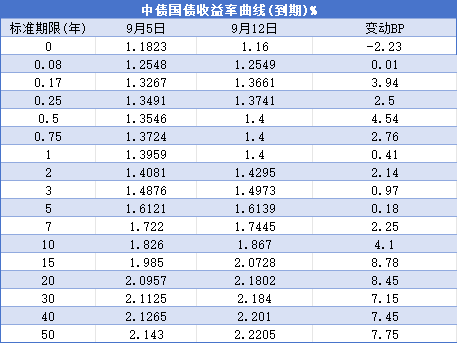
Market Overview - The funding environment was tight at the beginning of the week but eased later, maintaining overall balance [1] - The bond market experienced fluctuations due to news regarding fund fee rate adjustments and potential cancellation of tax exemptions for bond funds, leading to a rise in yields [1][4] - The 10-year government bond yield surpassed 1.8%, reaching a new high since April, before retreating later in the week due to weak export and financial data, as well as rumors of the central bank restarting bond purchases [1][4] Yield Changes - As of September 12, 2025, the yields for various maturities changed as follows: 1-year (0.41BP), 2-year (2.14BP), 3-year (0.97BP), 5-year (0.18BP), 7-year (2.25BP), 10-year (4.1BP), 30-year (7.15BP), and 50-year (7.75BP) compared to September 5, 2025 [2][3] Bond Market Dynamics - On Monday, the bond market weakened due to new fund fee regulations, with the 10-year bond yield rising to 1.784% [4] - On Tuesday, significant redemptions in index bond funds led to a quick rise in yields, with the 10-year bond yield reaching 1.795% [4] - By Wednesday, the yield peaked at 1.8325% before slightly retreating to 1.815% [4] - On Thursday, rumors of the central bank's bond purchases helped restore market sentiment, causing yields to drop [4] - By Friday, the central bank announced a 600 billion yuan reverse repurchase operation, contributing to further yield declines [4] Government Bond Issuance - A total of 83 bonds were issued last week, amounting to 10,345.42 billion yuan, including 5,663.70 billion yuan in government bonds [8] - For the upcoming week (September 15-19, 2025), 69 bonds are planned for issuance, totaling 5,005.19 billion yuan [8] International Bond Market - The U.S. Treasury market saw a slight rebound after reaching multi-month lows, with the 10-year Treasury yield dropping to 4.06% [9] - The U.S. August CPI rose by 2.9%, slightly above the previous value of 2.7%, while core CPI remained stable at 3.1% [10][12] Central Bank Operations - The central bank conducted 12,645 billion yuan in reverse repurchase operations last week, resulting in a net injection of 1,961 billion yuan [13] - An announcement was made for a 600 billion yuan buyout reverse repurchase operation scheduled for September 15, 2025 [13] Economic Indicators - The consumer price index (CPI) in August remained stable, with a year-on-year decrease of 0.4% [15] - The total social financing scale increased by 26.56 trillion yuan in the first eight months of 2025, showing a year-on-year growth of 8.8% [16] Institutional Perspectives - Huazhong Securities noted that the bond market sentiment remains fragile, with potential opportunities for long-term investments despite current volatility [19] - Financial institutions suggest a "barbell" strategy for bond investments, focusing on medium to high-grade credit bonds in the short term and long-term government bonds [19]

周周芝道 - 如何理解债券走势
2025-09-15 01:49
Summary of Key Points from Conference Call Industry Overview - The conference call primarily discusses the **Chinese bond market** and its relationship with **global liquidity** and **economic conditions** [1][5][6]. Core Insights and Arguments - **Current Market Dynamics**: The Chinese asset pricing logic is influenced by both domestic fundamentals and global liquidity conditions, leading to confusion in the bond market as the stock market remains strong [1][2]. - **2026 Bond Market Outlook**: The team holds a pessimistic view on the Chinese bond market for 2026, indicating a bear market risk and adjusting previous bullish predictions. The anticipated low for the ten-year government bond yield is now projected at **1.6%** [1][6]. - **Impact of Trade War**: The ongoing US-China trade war has accelerated the international expansion of Chinese companies, particularly in capital goods exports to emerging markets, which has mitigated the trade war's negative impacts [1][9]. - **2025 Bond Market Predictions**: The bond market is expected to exhibit volatility in 2025, with the ten-year government bond yield potentially stabilizing around **1.6%**. The social financing sector remains a crucial factor in determining bond market pricing [10]. - **Global Economic Recovery**: A rebound in global demand is anticipated in 2026, driven by monetary and fiscal easing in developed economies, which will likely enhance capital expenditures in non-US economies and stimulate overseas demand [11][15]. - **Inflation and Financial Conditions**: The relationship between internal and external inflation is critical. The current low internal inflation in China contrasts with rising external inflation, necessitating attention to liquidity changes and their effects on asset prices [17][19]. Additional Important Insights - **Export Performance**: Contrary to expectations of a significant decline due to the trade war, Chinese exports have exceeded forecasts, particularly in capital goods aimed at regions like Africa and Latin America [7][8][18]. - **Real Estate Market Dynamics**: Historical patterns suggest that while property prices may not see significant rebounds, sales and investment in real estate could exhibit greater elasticity, potentially impacting the bond market [23]. - **Policy Implications**: The effectiveness of fiscal policy in addressing potential deflation in 2024 will depend on its proactive nature. If the real estate market becomes an endogenous variable in economic growth, external demand will play a crucial role in driving domestic growth [14][21]. Conclusion - The conference call highlights the complexities of the Chinese bond market amid global economic shifts, trade tensions, and evolving domestic conditions. The insights provided suggest a cautious approach to investment in bonds, with a focus on external demand and inflation dynamics as key determinants of future market behavior.
如何理解债市对宏观脱敏?
2025-09-15 01:49
Summary of Conference Call Records Industry Overview - The conference call primarily discusses the bond market and its relationship with macroeconomic data, focusing on the current state of the bond market and future trends. Key Points and Arguments Bond Market Sensitivity to Macroeconomic Data - The bond market has become desensitized to macroeconomic data due to strong market expectations of weak economic recovery, central bank interest rate cuts, and increased fiscal support, making short-term data fluctuations less impactful [1][3][8] - The bond market's reaction to macroeconomic indicators like GDP, CPI, and PMI has diminished, with current trading focused on future scenarios rather than present data [3][4][8] - The market is currently pricing in expectations of insufficient effective demand and unresolved deflationary pressures, leading to a consensus that short-term data will not significantly alter the outlook [3][4][8] Interest Rate Trends - Anti-involution and de-real estate policies are expected to push the interest rate center upwards by approximately 10-15 basis points annually, with the long-term bond yield potentially stabilizing around 1.5% [10][11] - The bond market is experiencing a "slow bear" phase, where liquidity premium opportunities and fiscal policy effectiveness may outweigh current macroeconomic fundamentals [11][12] Stock-Bond Interaction - There is a significant stock-bond interaction, with the Shanghai Composite Index's movements directly affecting 10-year government bond yields, averaging a 4 basis point change for every 100-point shift in the index [25] - The current market environment shows a "see-saw" effect between stocks and bonds, influenced by redemption pressures and investor behavior [5][7] Future Market Predictions - If the 10-year government bond yield approaches 1.0%, it may signal an end to the interest rate bottoming process, contingent on the successful implementation of anti-involution and de-real estate policies [13] - The bond market's future trajectory will be influenced by liquidity conditions, institutional behavior, and policy directions rather than solely macroeconomic data [7][11] Current Economic Indicators - August's social financing growth slightly declined but remains high, with government debt share increasing and M1 growth reaching a yearly high, indicating improved monetary transaction vitality [21][22] - CPI and PPI data suggest some recovery in domestic demand, but external demand remains weak, and fiscal support is still under observation [23][24] Redemption Pressures - Concerns about large-scale redemptions exist, linked to liquidity issues, which could lead to rising long-term interest rates and significant adjustments in credit bond yields [26] - Historical data shows that the bond market has experienced multiple significant declines since 2022, with a notable pattern of pre-dip "shadow declines" [27][28] Market Recovery Post-Dip - After a bond market dip, there is typically a weak sentiment initially, but recovery generally occurs within an average of 7 trading days, with cumulative recovery around 10 basis points [29] Short-Term Trading Opportunities - The upcoming week may present left-side trading opportunities, suggesting that investors should prepare to capture potential rebounds [30] Other Important Insights - The bond market's desensitization is seen as a phase that could change if multiple economic indicators show consistent strong improvement [9] - The relationship between monetary and fiscal policies is crucial, with the potential for fiscal measures to drive economic recovery if inflation remains under control [20]