债券

Search documents
短线偏弱震荡运行
Qi Huo Ri Bao· 2025-09-10 21:09
Group 1: Market Dynamics - The stock and bond markets are exhibiting a "seesaw" effect since July, with A-shares entering a liquidity "bull market" due to stable fundamentals and policies, attracting steady capital inflows, while the bond market faces pressure [1] - Recent data indicates an expansion in the discount of long-term stock index futures contracts, and the implied volatility of call options has decreased more significantly than that of put options, suggesting a rebound in market risk appetite [1] Group 2: Central Bank and Treasury Coordination - A joint meeting between the Ministry of Finance and the central bank discussed the operation of government bonds and the coordination of fiscal and monetary policies, with expectations rising for the central bank to resume net purchases of government bonds [2] - The central bank's past net purchases of government bonds from August to December 2024 totaled 1 trillion yuan, leading to a rapid decline in the interest rate center by year-end [2] Group 3: Policy Implications - The expectation of the central bank's bond purchases may have limited short-term impact on the bond market due to sufficient liquidity management tools already in place and a lack of significant supply pressure in the fourth quarter [3] - The central bank's potential strategy of "buying short and selling long" could steepen the yield curve, which may not be favorable for long-term interest rates [3] Group 4: Fund Management Regulations - The China Securities Regulatory Commission proposed new regulations for public fund sales, including full allocation of redemption fees to fund assets and a unified redemption fee rate, aimed at encouraging long-term holding by investors [5] - The changes in fund management fees may reduce the attractiveness of bond funds for liquidity management, potentially shifting demand towards bond ETFs, while also enhancing the yield of bond funds over the long term [5] Group 5: Economic Indicators and Trading Strategy - Recent data shows an improvement in the manufacturing PMI, but issues of supply and demand mismatch persist, with lower growth in imports and exports [6] - The overall market sentiment remains high, but the bond market is expected to operate under "headwinds," with a forecast of weak fluctuations in the short term, while mid-term improvements in inflation and corporate earnings could lead to significant declines in the bond market [6]

转债市场日度跟踪20250910-20250910
Huachuang Securities· 2025-09-10 15:22
Report Industry Investment Rating No information provided in the content. Core Viewpoints - The convertible bond market showed weak performance on September 10, 2025, with compressed valuations. The CSI Convertible Bond Index decreased by 0.63% compared to the previous day, while the Shanghai Composite Index, Shenzhen Component Index, ChiNext Index, Shanghai 50 Index, and CSI 1000 Index all showed varying degrees of increase [1]. - The large-cap growth style was relatively dominant. The large-cap growth index increased by 0.49%, while the large-cap value, mid-cap growth, mid-cap value, small-cap growth, and small-cap value indices all decreased [1]. - The trading sentiment in the convertible bond market weakened. The trading volume of the convertible bond market was 72.447 billion yuan, a decrease of 1.82% compared to the previous day; the total trading volume of the Wind All A Index was 2.003952 trillion yuan, a decrease of 6.88% compared to the previous day; the net outflow of the main funds in the Shanghai and Shenzhen stock markets was 1.294 billion yuan, and the yield of the 10-year treasury bond increased by 3.51bp to 1.90% [1]. Summary by Relevant Catalogs Market Overview - **Index Performance**: The CSI Convertible Bond Index decreased by 0.63% compared to the previous day, while the Shanghai Composite Index increased by 0.13%, the Shenzhen Component Index increased by 0.38%, the ChiNext Index increased by 1.27%, the Shanghai 50 Index increased by 0.37%, and the CSI 1000 Index increased by 0.06% [1]. - **Market Style**: The large-cap growth style was relatively dominant. The large-cap growth index increased by 0.49%, while the large-cap value index decreased by 0.10%, the mid-cap growth index decreased by 0.79%, the mid-cap value index decreased by 0.65%, the small-cap growth index decreased by 0.03%, and the small-cap value index decreased by 0.51% [1]. - **Fund Performance**: The trading sentiment in the convertible bond market weakened. The trading volume of the convertible bond market was 72.447 billion yuan, a decrease of 1.82% compared to the previous day; the total trading volume of the Wind All A Index was 2.003952 trillion yuan, a decrease of 6.88% compared to the previous day; the net outflow of the main funds in the Shanghai and Shenzhen stock markets was 1.294 billion yuan, and the yield of the 10-year treasury bond increased by 3.51bp to 1.90% [1]. Convertible Bond Price - The central price of convertible bonds decreased, and the proportion of high-price bonds decreased. The weighted average closing price of convertible bonds was 129.71 yuan, a decrease of 0.64% compared to the previous day. Among them, the closing price of equity-oriented convertible bonds was 169.95 yuan, a decrease of 1.05% compared to the previous day; the closing price of bond-oriented convertible bonds was 118.52 yuan, a decrease of 0.67% compared to the previous day; the closing price of balanced convertible bonds was 126.34 yuan, a decrease of 0.67% compared to the previous day [2]. - From the distribution of convertible bond closing prices, the proportion of high-price bonds above 130 yuan was 52.86%, a decrease of 3.23pct compared to the previous day; the range with the largest change in proportion was 110 - 120 (including 120), with a proportion of 14.42%, an increase of 3.61pct compared to the previous day; there were 0 bonds with a closing price below 100 yuan. The median price was 130.86 yuan, a decrease of 0.56% compared to the previous day [2]. Convertible Bond Valuation - Valuations were compressed. The fitted conversion premium rate of the 100-yuan parity was 29.05%, a decrease of 0.29pct compared to the previous day; the overall weighted parity was 101.38 yuan, a decrease of 0.48% compared to the previous day. The premium rate of equity-oriented convertible bonds was 8.21%, a decrease of 0.72pct compared to the previous day; the premium rate of bond-oriented convertible bonds was 80.27%, an increase of 0.98pct compared to the previous day; the premium rate of balanced convertible bonds was 21.48%, a decrease of 0.10pct compared to the previous day [2]. Industry Performance - In the A-share market, the top three industries with the largest declines were power equipment (-1.18%), basic chemicals (-0.94%), and non-ferrous metals (-0.87%); the top three industries with the largest increases were communication (+3.49%), electronics (+1.78%), and media (+1.68%) [3]. - In the convertible bond market, 27 industries declined, and the top three industries with the largest declines were beauty care (-1.56%), automobile (-1.38%), and machinery and equipment (-1.31%); the only industry that rose against the trend was communication (+0.91%) [3]. - **Closing Price**: The large-cycle sector decreased by 0.67%, the manufacturing sector decreased by 1.15%, the technology sector decreased by 0.20%, the large-consumption sector decreased by 0.87%, and the large-finance sector decreased by 0.55% [3]. - **Conversion Premium Rate**: The large-cycle sector decreased by 0.52pct, the manufacturing sector decreased by 0.49pct, the technology sector decreased by 1.2pct, the large-consumption sector decreased by 0.51pct, and the large-finance sector decreased by 0.69pct [3]. - **Conversion Value**: The large-cycle sector decreased by 0.18%, the manufacturing sector decreased by 0.61%, the technology sector increased by 0.68%, the large-consumption sector decreased by 0.34%, and the large-finance sector decreased by 0.08% [3]. - **Pure Bond Premium Rate**: The large-cycle sector decreased by 0.95pct, the manufacturing sector decreased by 1.7pct, the technology sector decreased by 0.34pct, the large-consumption sector decreased by 1.1pct, and the large-finance sector decreased by 0.65pct [3]. Industry Rotation - The communication, electronics, and media industries led the rise. In the stock market, the daily increase rates of communication, electronics, and media were 3.49%, 1.78%, and 1.68% respectively; in the convertible bond market, the daily increase rate of communication was 0.91%, while other industries showed varying degrees of decline [56].
四季度债券投资策略:转折之年
Guoxin Securities· 2025-09-10 14:50
Market Review - The bond market in 2025 is characterized by a gap between expectations and reality, particularly regarding the anticipated "moderate easing" monetary policy that did not materialize as expected [2][12][15] - The macroeconomic narrative has shifted, with a focus on combating "involution" and promoting high-quality development, as highlighted by various government initiatives [21][25] - The economic environment remains cold, with GDP growth in the first half of 2025 recorded at 5.3%, indicating a stabilization after three consecutive quarters of improvement [15][60] Investment Strategy - The strategy emphasizes short-term positioning while engaging in long-term trading, with a focus on the 10-year government bond yield fluctuating between 1.6% and 1.9% [110] - The bond market is expected to experience a weak overall trend with potential for rebounds, driven by the accumulation of realistic market expectations [65][69] - The current bond market participants are increasingly unstable, with a notable rise in individual investors holding public bond funds, which increased by 3.6% to 7.6% in the first half of 2024 [82][83] Bond Market Dynamics - The yield curve has shown a widening in term spreads, with the 10-1 year government bond spread at 43 basis points and the 30-10 year spread at 28 basis points as of September 3, 2025 [71][73] - The absolute level of interest rates remains low, with credit spreads for major bond varieties at historical lows, indicating a crowded secondary market with low coupon rates [93][104] - Historical data shows that years with a flat yield curve have occurred 67% of the time since 2010, suggesting a tendency for bond markets to rise during such periods [99][100]
经济及债券市场分析框架
2025-09-10 14:35
Summary of Key Points from Conference Call Industry Overview - The conference call primarily discusses the **bond market** and its relationship with the **macro economy**. The bond market has grown significantly, from 20% to 120% of GDP over the past 20 years, indicating its increasing influence on the macro economy [2][3]. Core Insights and Arguments 1. **Reflexivity of Bond Market**: The bond market's reflexive impact on the macro economy is crucial for understanding economic conditions. Various factors such as economic fundamentals, liquidity, policy, supply-demand relationships, and market sentiment influence interest rate fluctuations [1][2]. 2. **Supply-Demand Dynamics**: The relationship between macroeconomic conditions and asset prices is characterized by supply-demand contradictions. Price fluctuations in assets like stocks and bonds reflect these contradictions [5][11]. 3. **Inflation and Interest Rate Predictions**: To determine whether the current macroeconomic environment is inflationary or deflationary, and to predict interest rate trends, analysts must examine output gaps and inflation gaps. The Taylor rule's effectiveness is limited in stagflation scenarios [6][11]. 4. **Long-term Relationship Between Interest Rates and GDP Growth**: There is a long-term intrinsic consistency between interest rates and nominal GDP growth. Historical data from countries like the US and Japan shows that rising nominal GDP growth correlates with increasing bond yields [7][8]. 5. **Capital Returns and Interest Rates**: Interest rates are fundamentally determined by capital returns, which are driven by economic growth and debt leverage. High debt leverage typically accompanies higher economic growth and capital returns [9][10]. 6. **Private Non-Financial Sector Debt Leverage**: The year-on-year growth rate of private non-financial sector debt leverage can measure debt leverage strength, which leads capital returns. Recent years have seen a slowdown in China's private sector debt leverage expansion, contributing to lower interest rates despite economic stimulus measures [10][17]. 7. **Predicting Future Bond Rates**: Future bond rates can be predicted by analyzing the contradiction between financing demand and funding supply, using metrics like the loan demand index minus M2 growth [11][12]. 8. **Real Estate Market's Impact**: The real estate sector plays a critical role in the economy, with its decline since 2021 leading to a significant reduction in financing demand, which in turn affects interest rates [16][17]. 9. **Government Debt and Interest Burden**: Increased government debt leverage raises interest burdens. China's interest payments on government bonds have doubled over the past 5-6 years, reflecting a growing concern about fiscal sustainability [28][30]. Other Important Insights - **Economic Cycles and Financing Demand**: China's economic cycles have seen shifts in financing demand, with different sectors becoming predominant over time. The recent trend shows a decline in both resident and corporate borrowing willingness [13][14]. - **Consumer Behavior and Economic Impact**: Consumer demand, which constitutes over 50% of GDP, is closely linked to employment and income levels. Recent trends indicate a decrease in consumer financing demand, contributing to lower interest rates [24][25]. - **Monetary Policy Adjustments**: The People's Bank of China has shifted its monetary policy focus from solely inflation to a more diversified approach, considering various economic indicators [33][34]. - **Future Economic Outlook**: The economic growth rate is expected to decline in the latter half of the year due to reduced external demand and internal consumption challenges, with inflation remaining weak [42][43][44]. This summary encapsulates the key points discussed in the conference call, providing a comprehensive overview of the bond market's dynamics and its implications for the macro economy.
债券崩了怎么办?
表舅是养基大户· 2025-09-10 13:26
Group 1 - The article discusses the recent significant decline in bond prices, particularly highlighting the 30-year government bond yield rising from around 2.06% to over 2.11% in a single day [1][11] - The article attributes the bond market's volatility to new public fund regulations regarding redemption fees and rumors about tax exemptions, which have created a sensitive environment for bonds in a low-interest-rate context [12][11] - It emphasizes the importance of strategic asset allocation, suggesting that investors should adopt a diversified approach rather than focusing solely on the performance of individual assets like bonds [17][16] Group 2 - The article notes that A-shares have seen a decrease in trading volume, dropping from 3 trillion to 2 trillion, leading to a "pants-snatching" situation where liquidity is concentrated in a few hot sectors [21][22] - It highlights the performance of specific stocks, particularly in the AI and battery sectors, which have shown significant trading activity and volatility [25] - The article mentions the strong performance of Alibaba in the Hong Kong market, with substantial net buying from mainland investors, indicating a positive sentiment towards the stock [26][27]

【笔记20250910— 债市空头 大秀肌肉】
债券笔记· 2025-09-10 11:41
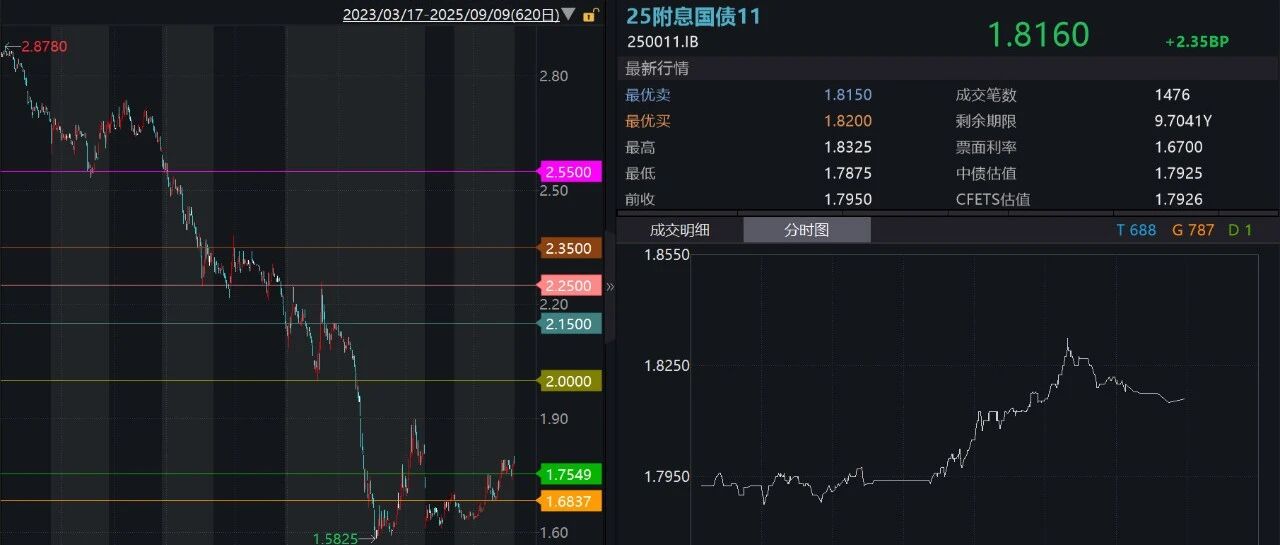
Core Viewpoint - The bond market is experiencing significant downward pressure, with the 10-year government bond yield surpassing 1.80%, indicating a bearish sentiment among investors [3][6][7]. Group 1: Market Conditions - The central bank conducted a 7-day reverse repurchase operation of 30.4 billion yuan, with a net injection of 74.9 billion yuan after 22.91 billion yuan of reverse repos matured [3]. - The liquidity in the market is stabilizing, with the DR001 and DR007 rates around 1.43% and 1.48% respectively [4]. - The stock market showed slight gains, while the bond market faced continued selling pressure, leading to a rise in yields [6][7]. Group 2: Yield Movements - The 10-year government bond yield opened at 1.7925% and peaked at 1.8325% before settling at 1.816% [6][7]. - The bond market is characterized by a lack of support, with futures being dominated by bearish positions, indicating a need for signs of short covering to stabilize the market [7]. Group 3: Trading Data - The weighted average rates for various repos on September 10, 2025, were as follows: R001 at 1.46%, R007 at 1.50%, and R014 at 1.51% [5]. - The total transaction volume for repos was approximately 74,596.27 billion yuan, reflecting a decrease of 94.54% compared to previous periods [5].
协会通知丨关于举办“2025年债券市场热点解读与展望”专题培训的通知
Sou Hu Cai Jing· 2025-09-10 11:24
Core Insights - The article discusses the upcoming training event organized by the China Insurance Asset Management Association to address the evolving bond market policies and trends in 2025 [3][4]. Group 1: Event Details - The training will take place on September 23, 2025, from 9:00 AM to 5:00 PM in Xicheng District, Beijing [3]. - The training is aimed at personnel from insurance companies, insurance asset management companies, and wealth management firms, with an expected attendance of around 150 participants [4]. - The training will be a paid event, with fees set at 450 RMB per person for member units and 900 RMB for non-member units [5]. Group 2: Training Content - The training will cover several key topics, including: - The interconnection of domestic and international financial markets, focusing on how insurance asset management and bank wealth management can participate in the "Bond Connect" southbound channel [6]. - Utilizing the bond market's "Technology Board" to support technological innovation [6]. - The impact of tax changes on the Chinese bond market, particularly the reintroduction of VAT on newly issued government and financial bonds after August 8, 2025 [6]. - An outlook on the bond market, considering the influence of U.S.-China relations and Federal Reserve policies on China's bond market [6]. - Investment strategies and outlooks for bond investments by insurance asset management institutions and wealth management companies [6]. Group 3: Agenda Overview - The training agenda includes: - Opening remarks by association leaders [7]. - Sessions on financial market interconnectivity, technology innovation bonds, and tax changes [7]. - Afternoon sessions focusing on market outlook and investment strategies for both insurance asset management and wealth management firms [7].

持续调整!年内上千只债基负收益
Zheng Quan Shi Bao· 2025-09-10 10:29
Core Viewpoint - The bond market has experienced significant adjustments since July, leading to negative returns for over a thousand bond funds, while the equity market has seen a rise in investor confidence due to supportive policies [1][4]. Group 1: Bond Market Performance - Since early July, the 30-year government bond futures have retraced over 5%, with other maturities also showing declines, indicating a broad adjustment in the bond market [2][3]. - As of September 9, the yields for various government bonds have increased, with the 30-year yield nearing 2.10%, reflecting a shift in market expectations and risk appetite [2][3]. Group 2: Fund Performance - Over a thousand bond funds have reported negative returns this year, with 50 funds showing returns below -2% and 181 funds below -1% [4]. - In contrast, convertible bond funds and mixed equity-bond funds have performed relatively well, with some convertible bond funds exceeding 20% returns [4]. Group 3: Market Dynamics - The adjustments in the bond market are attributed to a shift in expectations driven by macroeconomic policies aimed at stabilizing growth, leading to a stronger equity market and a "stock-bond seesaw" effect [3][6]. - The recent regulatory changes regarding fund fees may influence investor behavior, potentially increasing the attractiveness of bond funds despite current market challenges [5]. Group 4: Future Outlook - Analysts suggest that while the bond market faces short-term pressures from rising equity markets, there remains fundamental support for bonds, and a potential stabilization could occur if negative sentiment dissipates [6]. - The ongoing dynamics between equity and bond markets will continue to be a focal point, with the possibility of structural opportunities arising as the market adjusts [6].
持续调整!年内上千只债基负收益 30年期国债期货回撤超5%
Zheng Quan Shi Bao Wang· 2025-09-10 10:17
Core Viewpoint - The bond market has experienced significant adjustments since July, leading to negative returns for over a thousand bond funds, while the equity market has seen a rise in investor confidence due to supportive policies [1][4]. Group 1: Bond Market Performance - Since July, the 30-year government bond futures have retraced over 5%, with other maturities also showing declines, indicating a broad adjustment in the bond market [2][3]. - As of September 9, over a thousand bond funds reported negative year-to-date returns, with 50 funds showing returns below -2% and 181 funds below -1% [4]. - The bond market's downturn is attributed to changing market expectations, driven by macroeconomic policies aimed at stabilizing growth and a strong equity market performance [3][4]. Group 2: Fund Dynamics - The adjustment in the bond market has led to significant redemption pressures on bond funds, with nearly 20 funds experiencing large redemptions in the past month [4]. - Convertible bond funds and mixed equity-bond funds have performed relatively well, with some convertible bond funds achieving returns exceeding 20% [4]. - Recent regulatory changes regarding public fund fees have raised concerns among investors, potentially impacting the bond market's attractiveness [5]. Group 3: Market Outlook - The current environment suggests that the bond market may continue to face disturbances due to rising risk appetite and the strong performance of the equity market [6]. - Despite the challenges, there remains fundamental support for the domestic bond market, with expectations of a stable liquidity environment and ongoing growth policies [6]. - Analysts suggest that while a trend of recovery in the bond market may take time, there could be structural opportunities as market sentiment stabilizes [6].

持续调整!年内上千只债基负收益
证券时报· 2025-09-10 10:11
Core Viewpoint - The bond market has experienced significant adjustments since July, leading to negative returns for over a thousand bond funds, while the equity market has seen a resurgence in investor confidence due to supportive policies [2][8]. Group 1: Bond Market Adjustments - Since early July, the 30-year government bond futures have retraced over 5%, with other maturities also showing declines, indicating a broad adjustment in the bond market [4][5]. - The recent adjustments in the bond market are attributed to changing expectations, with macroeconomic policies aimed at stabilizing growth and a shift in risk appetite due to a strengthening equity market [6][11]. Group 2: Fund Performance - As of September 9, over a thousand bond funds reported negative year-to-date returns, with 50 funds showing returns below -2% and 181 funds not exceeding -1% [8]. - In contrast, convertible bond funds and mixed equity-bond funds have performed relatively well, with several convertible bond funds achieving returns exceeding 20% [9]. Group 3: Market Dynamics and Future Outlook - The bond market is facing redemption pressures due to declining net values, with nearly 20 funds experiencing significant redemptions in the past month [9]. - Analysts suggest that the current bond market adjustments may serve as a correction to previous overpricing, as the market had been overly crowded, leading to declining bond yields [9]. - The introduction of new regulations by the China Securities Regulatory Commission regarding public fund fees has raised concerns among investors, although some analysts believe the impact on the bond market will be limited [9][12].