
家电

Search documents
政策周观察第62期:两新补贴落地
Huachuang Securities· 2026-01-05 08:21
Consumption Policy Changes - The first batch of funds for the "Two New" subsidy program has been set at 62.5 billion yuan for this year, with a planned 81 billion yuan for 2025[2] - Subsidies for home appliances will focus on six product categories, with a 15% subsidy on the selling price for energy-efficient products, capped at 1,500 yuan per item[2] - The digital product subsidy has been expanded to include smartphones, tablets, smartwatches, smart glasses, and smart home products[3] Automotive Subsidy Adjustments - For scrapping and replacing vehicles, subsidies for new energy vehicles will be 12% of the sales price, with a maximum of 20,000 yuan, while for fuel vehicles, it will be 10% with a cap of 15,000 yuan[3] - The replacement subsidy for new energy vehicles will be 8% of the sales price, capped at 15,000 yuan, and for fuel vehicles, it will be 6% with a cap of 13,000 yuan[3] Investment Initiatives - The National Development and Reform Commission has announced an early release of investment plans totaling approximately 295 billion yuan, aimed at accelerating fund allocation and usage[4] - Major infrastructure projects approved or authorized have a total investment exceeding 400 billion yuan, including transportation and water resource projects[4] Risk Considerations - There are risks associated with the timely update of policies, which could affect the implementation of the subsidy programs[5]
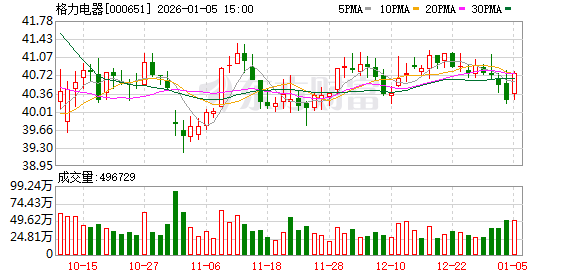
铜价持续大涨,格力回应:暂无“铝代铜”计划,家用空调也不会涨价!公司此前表示,铝材成本仅为铜材的十二分之一!
Mei Ri Jing Ji Xin Wen· 2026-01-05 08:16
1月5日,格力电器通过公众号"格力文传"对近期部分企业空调涨价和"铝代铜"计划等相关问题进行回应。 格力电器表示,格力积极响应2026年家电国家补贴政策,承诺格力家用空调不涨价。同时,为满足格力家用空调十年免费包修服 务标准,暂无"铝代铜"相关计划。未来若相关研究能完全满足格力质量和技术标准要求并正式应用,将予以明确标注。 受全球多个矿山停产导致的供应短缺以及特朗普政府潜在关税政策影响,今年以来,铜价不断飙升,伦敦铜价年内一度突破每吨 12900美元大关,创下历史新高,年内涨幅超47%。 叠加2025年3月,工信部等十部门印发《铝产业高质量发展实施方案(2025—2027年)》提到,提升产品高端化供给水平,扩大铝 产品在市政设施、汽车、光伏、家具家居等领域的应用规模及层次,拓展消费潜力。以铝节铜,支持汽车热交换器散热片,冰 箱、空调热交换器换热铝管等应用场景。 在此背景下,家电行业推进"铝代铜"工艺优化以节约成本的消息不断。 据中国证券报,2025年年末,美的、小米、TCL、海尔等多家头部空调企业共同发起空调铝应用自律公约,将科学宣传铝换热器 空调的特点,提升消费者对行业产品与技术的信任度。 2025年12月 ...


惠而浦:2025年净利润预增150%,营收因业务与成本改善提升
Xin Lang Cai Jing· 2026-01-05 07:47
惠而浦公告称,经初步测算,2025年年度归属于母公司所有者的净利润预计为5.05亿元左右,同比增加 150%左右,增加约3.03亿元;扣非净利润预计为4.55亿元左右,同比增加154%左右,增加约2.76亿元。 上年同期净利润为2.02亿元,扣非净利润为1.79亿元。业绩预增主要因主营业务收入增长,订单增加, 且成本费用改善,盈利能力提升。具体数据以2025年年报为准。 ...

招商证券家电行业2026年度策略:内需国补续期 出海科技成长
智通财经网· 2026-01-05 07:47
Group 1 - The core viewpoint is that the home appliance industry is expected to underperform the market in 2025 due to multiple factors including a preference for growth styles, a decline in domestic subsidies, and disruptions from overseas tariffs [1] - The home appliance sector achieved a positive return of 9% in 2025, ranking 22nd among all industries, influenced by the increasing share of TMT transactions and the reduction of domestic subsidies post-618 [1] Group 2 - For domestic sales in 2026, the government will continue to support the "trade-in" subsidy program, with an estimated total subsidy fund of 250-300 billion yuan, including 80 billion for home appliances [2] - The six major categories of home appliances will continue to receive subsidies, with new AI products being added to the 3C category [2] Group 3 - The company sees opportunities in technology exports, supply chain advantages, and hardware innovation in sectors like 3C consumption, consumer robotics, and 3D printing [3] - The transition to new national standards for power banks and the expected growth in the European balcony solar storage market are anticipated to drive hardware innovation in AI applications [3] Group 4 - Investment recommendations include focusing on high-dividend value leaders like Midea Group and Haier Smart Home, and paying attention to Gree Electric and other brands in the white goods sector [4] - For technology exports, companies like Anfu Technology and Anker Innovations are highlighted, along with opportunities in 3D printing and consumer robotics [4] - The tool export chain is recommended, with companies like Juxing Technology and Quanfeng Holdings being favored due to expected demand growth in North America [4]

格力回应网络流言:家用空调不涨价,暂无“铝代铜”相关计划
Sou Hu Cai Jing· 2026-01-05 07:10
格力电器今日(1月5日)发布声明称:近期,公司陆续收到投资者及媒体就部分企业推出空调涨价和'铝 代铜'计划等相关问题的咨询,询问公司的态度和计划。公司现说明如下: 格力积极响应2026年家电国家补贴政策,切实让利消费者。格力承诺,格力家用空调不涨价。 格力电器进一步表态称,为满足格力家用空调十年免费包修服务标准,暂无"铝代铜"相关计划。未来若 相关研究能完全满足格力质量和技术标准要求并正式应用,将予以明确标注,充分保障消费者的知情权 与选择权。 近年来,随着铜价大幅上涨,用成本较低的"铝替代铜"被认为是降低生产成本的有效方式之一。 董明珠曾多次回应"铝代铜"问题 作为行业龙头,格力与美的、海尔、奥克斯、小米等共同参与了《房间空气调节器用热交换器》国家标 准的修订,不过未参与《空调铝强化应用研究工作组自律公约》的联合发声。 早在2023年度股东大会上,董明珠就表示,已经有部分空调企业开始用"铝代替铜"作为原材料。目前来 看,铝作为替代,其耐久性和稳定性无法得到保证。所以,在没有百分之百的把握之前,格力就绝对不 会使用"铝代铜"。 去年12月,董明珠在谈及空调行业"铝代铜"问题时表示,"'铝代铜'能不能代?可以代 ...
年终犒赏自己!海信100吋E8S Pro,游戏党的专属巨幕
Sou Hu Wang· 2026-01-05 07:07
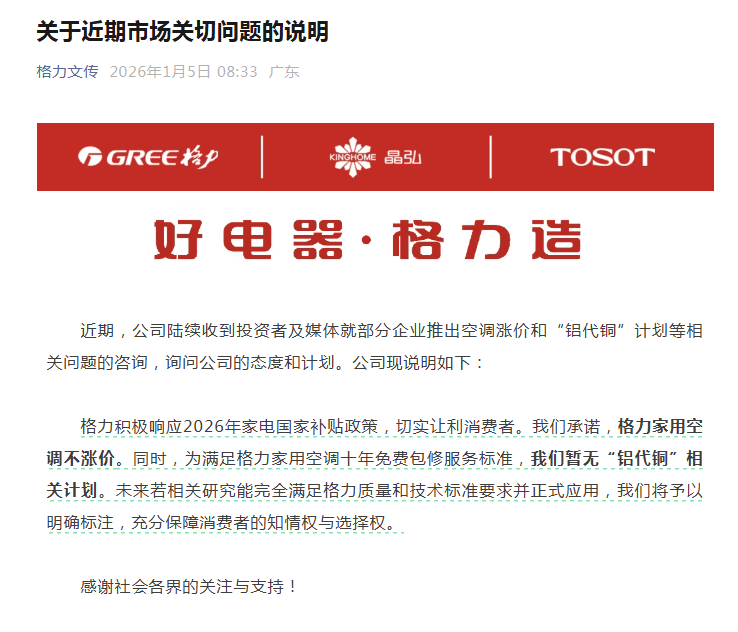
Core Viewpoint - The article highlights the exceptional gaming experience provided by the Hisense 100-inch E8S Pro television, emphasizing its immersive features and advanced technology that enhance gameplay enjoyment and visual quality [1][10]. Group 1: Immersive Gaming Experience - The 100-inch screen size significantly enhances the gaming experience by providing a broader field of view, allowing players to focus on gameplay without distractions [2]. - The television's large display facilitates group gaming sessions, creating a more interactive atmosphere among players [2]. Group 2: High Refresh Rate and Low Latency - The Hisense 100-inch E8S Pro features a native 4K 170Hz refresh rate, which can be upgraded to a variable refresh rate of 330Hz, offering more than double the frame information compared to standard 120Hz TVs [3][5]. - The ultra-low latency of 4.9ms and multiple HDMI 2.1 ports ensure seamless connectivity and real-time response during gameplay, enhancing the overall user experience [5]. Group 3: Superior Picture Quality - The television utilizes RGB-Mini LED technology, which prevents color distortion and achieves 100% BT.2020 ultra-wide color gamut, accurately reproducing over 97% of the visible spectrum [6][8]. - The AI picture quality chip H7 optimizes game scenes in real-time, enhancing dark details in shadowy areas while maintaining the overall atmosphere of the visuals [8]. Group 4: Emotional Connection and Value - The Hisense 100-inch E8S Pro is described as a "joy carrier," providing emotional relief and serving as a reward for hard work, making it a worthwhile investment for consumers seeking quality entertainment [10].

坚持内需主导,建设强大国内市场——着力推进全年经济工作八大重点任务①
Ren Min Ri Bao· 2026-01-05 07:06
Group 1 - The core focus of the Central Economic Work Conference is to ensure a strong start for the "14th Five-Year Plan" by emphasizing the importance of domestic demand and building a robust domestic market [1] - In 2026, the government plans to implement eight key tasks, with the first being to maintain domestic demand as the main driver of economic growth [1] - The "Two New" policies and "Two Heavy" projects will be optimized for implementation, with an initial allocation of 62.5 billion yuan for consumer goods replacement programs [1] Group 2 - The ice and snow economy is becoming a significant driver of consumption and domestic demand, with outdoor skiing searches increasing over threefold since December 2025 [2] - The "old for new" policy has led to a 20% increase in Haier's appliance sales, with air conditioning units seeing over a 50% rise [2] - In 2025, the sales from the "old for new" policy exceeded 2.6 trillion yuan, benefiting over 360 million people and supporting continuous consumption growth [2] Group 3 - Investment in equipment and tools has seen a 12.2% year-on-year increase, contributing 1.8 percentage points to overall investment growth [3] - Key sectors such as electricity and internet services have experienced significant investment growth, with electricity investment up 12.5% and internet services up 20.7% [3] - The domestic demand scale is expanding, with its quality and international influence improving, making it a crucial driver of economic growth [3] Group 4 - There is still substantial potential and space for expanding domestic demand, despite facing some challenges [4] - Digital technologies and AI are fostering new business models and consumption scenarios, indicating a continuous release of consumer potential [6] Group 5 - Effective investment opportunities remain vast, with technology companies requiring significant investment for R&D and equipment upgrades [7] - Traditional industries are undergoing transformation, creating a strong demand for equipment renewal and technological upgrades [7] Group 6 - The strategy to expand domestic demand must prioritize boosting consumption, with a focus on enhancing the supply of quality goods and services [9] - The government is expected to maintain high levels of fixed asset investment, projected to exceed 3.6 trillion yuan in 2025 [10] - The government aims to stimulate private investment and create a stable and transparent environment for private enterprises to participate in major projects [10] Group 7 - The commitment to expanding domestic demand is essential for leveraging China's large market advantages into competitive strengths for national development [11]
家电ETF(159996)盘中净流入1800万份,以旧换新政策推动行业产品结构升级
Mei Ri Jing Ji Xin Wen· 2026-01-05 07:04
根据wind数据,家电ETF(159996)盘中净流入1800万份,资金抢筹布局。 华西证券指出,2026年家电以旧换新政策明确了支持家电以旧换新,首批支持资金625亿元已下达,相 比2025年有所减少且更加聚焦,补贴品类从2025年的12类缩减至6类,主要为空调、冰箱、洗衣机、电 视等,补贴比例统一为15%,单件补贴上限1500元。这将有助于推动行业产品结构升级,利好中高端产 品布局完善的龙头企业。 家电ETF(159996)跟踪的是家用电器指数(930697),该指数从沪深市场中选取涉及空调、冰箱、洗 衣机等家电产品制造与销售的上市公司证券作为指数样本,以反映家用电器行业相关上市公司证券的整 体表现和市场趋势,能够较为全面地体现家电行业的整体发展状况。 (文章来源:每日经济新闻) ...
2026年山西消费品以旧换新活动启动
Yang Guang Wang· 2026-01-05 06:28
Core Viewpoint - Shanxi Province has launched a subsidy program for vehicle scrapping, replacement, and the exchange of old household appliances and digital products, effective from January 1, 2026, until December 31, 2026 [1] Group 1: Automotive Sector - The vehicle trade-in program will follow principles of "coordinated funding, public lottery, and orderly implementation," with monthly registration and lottery draws for consumers holding eligible old vehicles [1] - The first registration date for the vehicle trade-in program is tentatively set for January 9 [1] Group 2: Home Appliances and Digital Products - The subsidy for home appliances and digital products will be implemented based on "coordinated funding and limited implementation," using a first-come, first-served basis for qualification [1] - Consumers can redeem subsidies through consumption vouchers, with qualification platforms gradually opening from January 9 [1] Group 3: Additional Information - Specific subsidy standards and application processes for vehicles, home appliances, and digital products can be found in notifications from the Ministry of Commerce or on the Shanxi Provincial Department of Commerce's official website [1]
德昌股份(605555):汽车EPS电机国产替代龙头,前瞻布局人形机器人
ZHONGTAI SECURITIES· 2026-01-05 05:59
Investment Rating - The report assigns a "Buy" rating for the company, indicating an expected relative performance increase of over 15% against the benchmark index within the next 6 to 12 months [5][15]. Core Insights - The company has successfully transitioned from vacuum cleaner manufacturing to becoming a leader in domestic automotive EPS motor production, with a projected revenue of 4 billion yuan from automotive parts in 2024 [7]. - The company is also strategically investing in humanoid robotics, which is anticipated to become a significant growth driver alongside its automotive components business [7]. - The household appliance segment is expected to grow steadily, with revenues projected at 21 billion yuan in 2024, driven by new product categories despite short-term profit pressures from tariffs [7][12]. - The automotive parts segment is experiencing rapid growth, with revenues expected to reach 4 billion yuan in 2024, reflecting a significant increase from previous years [7][12]. - The company is diversifying its product offerings to reduce reliance on major clients, with the share of vacuum cleaner revenue decreasing from 71% in 2022 to an expected 52% in 2024 [7]. Financial Projections - Revenue projections for the company are as follows: 2,775 million yuan in 2023, 4,095 million yuan in 2024, 4,715 million yuan in 2025, 5,486 million yuan in 2026, and 6,478 million yuan in 2027, with growth rates of 43%, 48%, 15%, 16%, and 18% respectively [5][9]. - The net profit is forecasted to be 322 million yuan in 2023, 411 million yuan in 2024, 220 million yuan in 2025, 397 million yuan in 2026, and 632 million yuan in 2027, with growth rates of 8%, 28%, -47%, 81%, and 59% respectively [5][9]. - The earnings per share (EPS) are projected to be 0.87 yuan in 2023, 1.10 yuan in 2024, 0.45 yuan in 2025, 0.82 yuan in 2026, and 1.31 yuan in 2027 [5][9]. Valuation and Comparables - The company is compared with peers in the vacuum cleaner and small household appliance sectors, with an average P/E ratio of 30x for 2025, 24x for 2026, and 21x for 2027, indicating that the company has a favorable growth outlook with lower projected valuation multiples [10][11]. - The report highlights that the company's growth potential is significant, with a projected P/E of 40x for 2025, 22x for 2026, and 14x for 2027, which is lower than comparable companies, suggesting a margin of safety for investors [10][11].
