科技

Search documents
逾六成私募拟重仓过节,预期节后市场风格将趋于均衡
Xin Hua Cai Jing· 2025-09-29 03:27
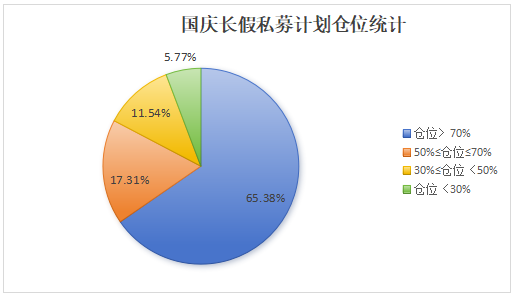
Group 1 - A significant majority of private equity firms (65.38%) plan to maintain high or full positions (over 70% allocation) during the upcoming National Day holiday, indicating a belief that external market disturbances will be limited [1] - 70.19% of private equity firms are optimistic about the post-holiday A-share market, expecting a gradual recovery after the pre-holiday consolidation [3] - 62.50% of private equity firms anticipate a balanced market style post-holiday, with rotation between technology growth, value blue chips, and traditional industry leaders [5] Group 2 - The main investment themes post-holiday are expected to focus on technology growth sectors such as AI, semiconductors, humanoid robots, smart driving, and innovative pharmaceuticals, with 59.62% of private equity firms expressing this view [7] - Current market conditions are characterized as being in the second phase of a bull market, with a focus on maintaining high stock positions and targeting sectors with upward momentum [9] - The market is expected to remain in a slow bull trend, with various sectors presenting opportunities, particularly in technology and consumer sectors due to favorable policies and economic recovery [10] Group 3 - The dual main lines of investment post-holiday are expected to be technology growth and valuation recovery, driven by policy support and technological innovation [11] - The market is experiencing structural differentiation, with a potential for valuation recovery in low-valued sectors as macroeconomic data improves [11] - The investment strategy should balance between high elasticity in technology growth and the stability of valuation recovery, allowing investors to capture structural opportunities in the post-holiday market [11]

美国股市的巴菲特指标处于危险区域
Sou Hu Cai Jing· 2025-09-29 03:17
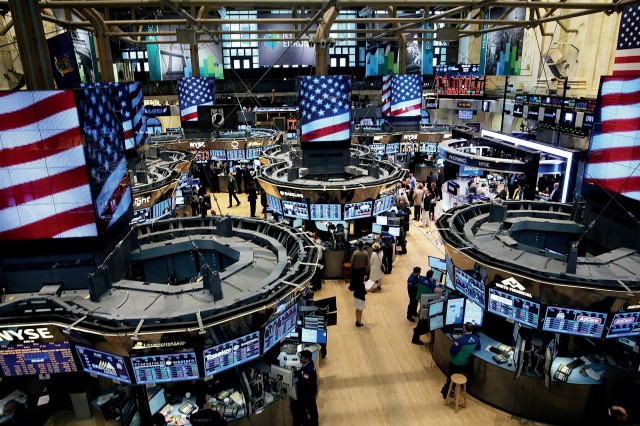
Core Insights - The article highlights Warren Buffett's emphasis on the ratio of U.S. stock market capitalization to GDP, known as the "Buffett Indicator," which currently stands at 218%, indicating a potentially dangerous overvaluation of the stock market [2] - The recent highs in the U.S. stock market are largely attributed to the rising stock prices of a few large technology companies, suggesting a false sense of prosperity that does not accurately reflect the state of the U.S. economy [2] - Buffett has significantly reduced his holdings in major stocks, including Apple and Bank of America, and currently holds over $330 billion in cash, indicating his belief that the risks in the current U.S. stock market outweigh the opportunities [2] - Federal Reserve Chairman Jerome Powell has also acknowledged the high valuations in the U.S. stock market, raising concerns about the sustainability of these elevated levels despite the Fed's recent interest rate cuts [2] Summary by Categories Market Valuation - The Buffett Indicator is currently at 218%, which is considered a signal of overvaluation [2] - Typically, a ratio around 70% indicates good investment opportunities, while levels above 200% are seen as dangerous [2] Market Dynamics - The recent stock market highs are primarily driven by a few large tech companies, leading to a perception of false prosperity [2] - The current market conditions do not reflect the broader economic reality of the U.S. [2] Investment Strategy - Buffett's strategy includes significant divestment from major stocks, reflecting a cautious outlook on market valuations [2] - The holding of over $330 billion in cash suggests a defensive position in anticipation of potential market corrections [2] Federal Reserve Insights - Jerome Powell's acknowledgment of high market valuations raises questions about the sustainability of current stock prices [2] - The Fed's interest rate cuts may provide temporary support, but the long-term viability of high valuations remains uncertain [2]
当前股票回报是否过高
Guo Ji Jin Rong Bao· 2025-09-29 02:54
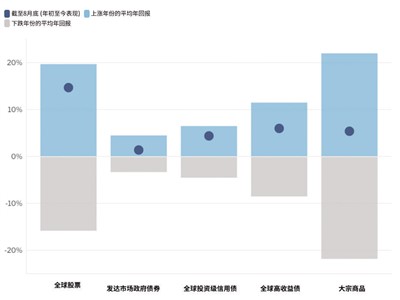
Core Insights - Global stock markets have shown strong performance since the beginning of 2025, with the MSCI Global Index rising approximately 15% year-to-date, continuing a robust trend from previous years [1] - The average annual return for global stocks since the end of the 2022 bear market has reached 20%, which may surprise some investors who typically anchor their expectations around a long-term average return of 7%-10% [1] - This strong performance is not an anomaly but a recurring feature in market cycles, with investment-grade credit bonds historically yielding 6%-7% during economic expansions, while high-yield credit bonds have averaged returns of 11%-12% [1] Investment Insights - Investors should not be deterred by strong market performance; the 15%-20% rise in stocks this year should not be a reason for concern unless an economic downturn is anticipated [2] - Managing downside risk is crucial for enhancing long-term average returns; investors may consider funds that maintain strong participation in rising markets while minimizing downside risk, such as defensive equity funds and hedge funds [2] - Assets with favorable return characteristics, such as credit bonds, are particularly valuable for asset allocators, as they tend to perform well in up years and experience smaller losses in down years [2] Areas of Focus - Key structural growth catalysts to watch include fiscal stimulus, policy reforms, and potential interest rate cuts by central banks [3] - Monitoring inflation trends and the potential rise in cross-asset correlations is essential, despite significant progress made by central banks in controlling inflation [3] - The ability of corporate earnings growth to extend beyond large tech companies to a broader range of industries will be critical for achieving a more balanced and sustainable market rally [5]
期指:或有所企稳
Guo Tai Jun An Qi Huo· 2025-09-29 02:46
Report Summary 1. Investment Rating - The report does not provide an investment rating for the industry. 2. Core View - The report suggests that the stock index futures may stabilize [3]. 3. Key Points by Category 3.1 Index Futures Data - On September 28, all four current - month index futures contracts declined. IF fell 1.16%, IH fell 0.43%, IC fell 1.48%, and IM fell 1.33% [1]. - In terms of trading volume, the total trading volume of index futures rebounded, with IF decreasing by 12,397 lots, IH decreasing by 3,587 lots, IC increasing by 6,370 lots, and IM increasing by 30,154 lots [2]. - Regarding positions, IF's total positions decreased by 6,449 lots, IH's increased by 1,041 lots, IC's increased by 3,365 lots, and IM's increased by 11,537 lots [2]. 3.2 Index Futures Basis - The report presents the basis data of IF, IH, IC, and IM from September 2 to September 26 [4]. 3.3 Top 20 Member Positions - The report shows the changes in long and short positions of the top 20 members of each index futures contract, with some data not disclosed [5]. 3.4 Trend Intensity - The trend intensity of IF and IH is 1, and that of IC and IM is also 1. The trend intensity ranges from - 2 to 2, with - 2 being the most bearish and 2 being the most bullish [6]. 3.5 Important Drivers - From January to August, the total profit of industrial enterprises above designated size in China was 4,692.97 billion yuan, a year - on - year increase of 0.9%. In August, the profit increased by 20.4% year - on - year, turning from a 1.5% decline in the previous month [6]. - The central bank's monetary policy committee proposed to strengthen monetary policy regulation, guide financial institutions to increase credit supply, and maintain the stability of the capital market [6]. 3.6 Stock Market Performance - A - share indexes fluctuated downward. The ChiNext Index fell more than 2% below 3,200 points. The Shanghai Composite Index fell 0.65% to 3,828.11 points, the Shenzhen Component Index fell 1.76%, the ChiNext Index fell 2.6%, the North Star 50 fell 1.81%, the Science and Technology Innovation 50 fell 1.6%, and the Wind All - A Index fell 1.2%. The trading volume of A - shares was 2.17 trillion yuan, down from 2.39 trillion yuan the previous day [7].
美银Hartnett:关键指标显示AI还没有风险,警惕美元反弹对热门交易的冲击
Hua Er Jie Jian Wen· 2025-09-29 00:27
Core Viewpoint - The discussion around a potential AI bubble is intensifying, but Bank of America strategist Michael Hartnett believes that the current credit spreads for tech stocks indicate that the AI-driven rally has not yet reached a dangerous level [1][2] Group 1: Credit Spreads and AI Bubble - The credit spreads for tech stocks are at an 18-year low, suggesting that investors are not pricing in potential risks for tech companies, contrasting with typical late-stage asset bubble scenarios where credit risks rise sharply [2][3] - Hartnett asserts that a comprehensive collapse of the AI sector is unlikely due to the current credit market conditions [2] Group 2: Market Risks and Dollar Strength - The immediate risk for investors is not a bubble burst but rather an unexpected strengthening of the dollar, with a consensus trade of "shorting the dollar" being a significant vulnerability [1][4] - If the dollar index experiences a chaotic rebound and surpasses the critical level of 102, it could trigger a collective risk-averse response among investors [4] Group 3: Asset Performance and Market Sentiment - Year-to-date, gold has been the best-performing asset with a gain of 41.3%, while international stocks rose by 24.7%, and the dollar index fell by 9.2% [4] - Recent EPFR data shows a continued inflow of global funds into various assets, indicating that investors remain optimistic and are actively allocating to risk assets despite discussions of potential market corrections [3] Group 4: Gold's Position in Asset Management - Although gold is currently viewed as "overbought" from a tactical perspective, it remains a "low allocation" asset in both private and institutional asset management, with only 0.4% and 2.4% allocations respectively [5]
击鼓传花的最后一棒?
鲁明量化全视角· 2025-09-28 04:44
Core Viewpoint - The market continues to show signs of divergence, with the broad indices rising while many individual stocks are experiencing consecutive declines. The current market structure is more fragmented than usual, making it difficult for traditional investment strategies to achieve stable positive returns [3]. Market Overview - The Shanghai Composite Index rose by 0.21% and the CSI 300 Index increased by 1.07% last week, while the CSI 500 Index saw a 0.98% rise. However, a significant number of stocks in the market have shown two consecutive weekly declines [3]. - The LPR (Loan Prime Rate) remained unchanged in September, indicating limited room for interest rate cuts in the near term, which may not be favorable for the market's high expectations [3]. - Domestic commodity prices have been performing better than overseas prices since August, largely due to the implementation of the "anti-involution" policy [3]. Investment Strategy - The recommendation is to reduce positions to low levels and focus on avoiding the market, particularly in the small-cap sector, as the market style shifts towards large-cap stocks [2][3]. - The technology sector, which has been active recently, may face macroeconomic headwinds due to the stable LPR and stronger domestic industrial prices compared to overseas [3]. - The financial sector, a key representative of large-cap industries, has already entered a phase of continuous adjustment, raising concerns about when the technology growth sector will no longer support the indices [3]. Technical Analysis - There are indications that the market's upward movement is being driven by retail investors, as institutional funds appear to be distributing shares to them, a common characteristic of market tops [4]. - The short-term momentum model suggests focusing on the basic chemical industry as a potential area of interest [4].

银行股连涨3年,99%的人都错过了什么?
Sou Hu Cai Jing· 2025-09-28 04:14
Group 1 - The A-share market is showing signs of recovery, with the Sci-Tech 50 Index leading the gains at 6.5% [1] - The LPR interest rate remains unchanged, and national standards for prepared dishes are being advanced; stable growth plans are being introduced in the steel industry [1] - Analysts generally believe that the market is likely to continue its upward trend after the holiday, with a particular focus on the TMT sector [1] Group 2 - Retail investors often fall into the trap of "buying low and selling high," mistakenly believing that stocks that have risen significantly are too risky [3] - The perception of "high" and "low" is often a retrospective judgment, and the willingness of institutional funds to participate is a more critical factor in stock price movements [3][5] - Institutional funds have been actively investing in bank stocks since 2022, despite ongoing skepticism about their valuations and earnings [5] Group 3 - The data indicates that institutional funds have withdrawn from the liquor sector, leading to short-lived rebounds without sustained support [8] - The strong performance of the Sci-Tech 50 Index is attributed to the continuous investment by institutional funds in the technology sector [8] - The TMT sector is favored by analysts due to quantitative data showing long-term institutional interest [8] Group 4 - In an era of information overload, investors need analytical tools that penetrate superficial data to understand the underlying trends in capital flow [8] - Investors should not rely solely on "high" and "low" judgments for trading decisions but should focus on core indicators like institutional participation [8] - The ultimate goal of investing is long-term stable growth rather than short-term profits, emphasizing the importance of data-driven analysis [9]
“下意识”里有商机
Jing Ji Ri Bao· 2025-09-28 01:10
Core Insights - The primary factor influencing consumer purchasing decisions is familiarity, which significantly impacts marketing success [2][6] - Familiarity acts as an invisible "purchase command," guiding consumers towards recognizable brands and products [1][6] Marketing Strategies - Brands should not be overly focused on creativity; utilizing "cognitive fluency" can enhance consumer engagement [4] - Simple and direct advertising messages are more effective in creating positive psychological feedback and increasing brand familiarity [4] - Establishing brand recognition is crucial in an information-overloaded environment, with high recognition leading to stronger consumer impressions [5] Brand Experience - Multi-sensory experiences, including sound and texture, contribute to a stronger and more lasting sense of familiarity [5] - Successful brands maintain consistency in their brand elements while innovating to keep the brand fresh [7] Consumer Behavior - Understanding the impact of familiarity on decision-making is essential for consumers to balance emotional preferences with rational choices [6] - Familiarity can be a powerful tool for both consumers and brands in navigating a world filled with choices [7]

A股高位震荡不要怕!美元贬值周期开启,黄金投资者笑到最后?
Sou Hu Cai Jing· 2025-09-27 16:21
Group 1 - Gold prices have surpassed $3,809, while silver has reached a 14-year high with an annual increase of over 40% [1][5] - The A-share market experienced a dramatic reversal on September 23, indicating that investors are waiting for the right opportunity, as evidenced by a trading volume of 2.52 trillion [3] - The strong performance of gold and silver is attributed to the Federal Reserve's interest rate cuts, which decrease the attractiveness of the dollar, and increasing demand for safe-haven assets due to global uncertainties [5][11] Group 2 - There is a notable divergence in market performance, with precious metals rising while industrial commodities are generally declining, reflecting complex judgments about future economic trends [7] - Investors are advised to remain calm amid short-term market fluctuations, as long-term trends are driven by fundamentals and global liquidity remains abundant [9] - The current market dynamics suggest a profound shift in the global economic landscape, with traditional growth drivers weakening and emerging industries on the rise [9][11]

始祖鸟在青藏高原「放烟花」,为何引发众怒? | Knock Knock 世界
声动活泼· 2025-09-27 04:27
Group 1 - The article discusses the impact of ultra-processed foods on human health, highlighting the use of unfamiliar additives that the body cannot recognize [4][5] - It emphasizes the unrealistic beauty standards perpetuated by various industries, including fitness and fashion, which can lead to unhealthy dieting behaviors [6][9] - The article notes that historical energy consumption patterns of ordinary farmers involved significant physical activity, contrasting with modern sedentary lifestyles [8] Group 2 - The article explains the carbon credit system, where companies can purchase credits to offset their carbon emissions, with one credit awarded for every ton of CO2 reduced [7][8] - It mentions that the Chinese government initially targeted major carbon emitters in the power generation sector, expanding to include industries like steel and cement, which contribute over 60% of the country's CO2 emissions [9] - The article points out that not all environmental projects generate carbon credits; only certified projects, such as renewable energy and afforestation, qualify [9][10] Group 3 - The article raises concerns about the environmental impact of fireworks on fragile ecosystems, specifically referencing an incident in the Tibetan Plateau where a large number of fireworks were set off [12][13] - It discusses the ecological consequences of such events, particularly on local wildlife, and the potential long-term effects of pollutants from fireworks [14][15]