生猪养殖

Search documents
8月起,中国将迎来“四大降价潮”?除汽车外,这3类也降价
Sou Hu Cai Jing· 2025-08-01 06:11
Economic Overview - As of June 2025, China's broad money supply (M2) reached 330.29 trillion yuan, growing by 8.3% year-on-year, indicating significant monetary expansion [1] - Despite the monetary expansion, the Consumer Price Index (CPI) showed a slight decline of 0.1% year-on-year, suggesting a deflationary trend in the economy [1][3] Reasons for Price Decline - The lack of inflation despite monetary expansion is attributed to two main factors: a significant portion of the newly issued money is circulating within the financial system and not reaching the broader economy, and a slowdown in income growth leading to reduced consumer demand [3] - The combination of excess inventory and declining consumer demand has forced companies to lower prices to stimulate sales [3] Price Decline in Key Sectors Automotive Sector - A price war has erupted in the automotive market, with domestic mid-range cars seeing price cuts of 20,000 to 30,000 yuan, while imported luxury cars are reduced by 80,000 to 100,000 yuan [7] - The price war is driven by the influx of new energy vehicles, reduced income among middle-class families, and intensified competition from tech companies entering the automotive space [7] Real Estate Market - The real estate market has been in a long-term adjustment since 2022, with average national housing prices dropping over 30% by mid-2025, and some cities experiencing declines exceeding 60% [10] - Contributing factors include an oversupply of housing, high price-to-income ratios, and a loss of investment appeal in real estate [10] Small Appliances - The small appliance sector is experiencing a price decline of 10% to 15%, with products like washing machines and refrigerators being affected [12] - Reasons for this trend include stagnant income growth, rapid technological advancements leading to new product releases, and fierce competition among brands [12] Pork Prices - Pork prices have significantly decreased from a peak of 40 yuan per jin to between 17 and 20 yuan per jin, marking a return to more affordable prices for consumers [15] - The decline is driven by overproduction in the pig farming industry and changing consumer preferences towards healthier meat options [15]

黑猪“逆袭”?产值持续走高,海南、广东消费缺口扩至30%
Nan Fang Nong Cun Bao· 2025-08-01 03:06
Core Insights - The black pig market in China is experiencing steady growth, with the market share increasing from less than 2% in 2014 to 5% currently, and projections suggest it could reach 10% in the next decade [4][5][8] - The overall value of the black pig industry is rising, with a compound annual growth rate exceeding 4%, indicating increased consumer demand and higher sales prices [8][9] - There is a significant consumption gap in regions like Hainan and Guangdong, where the demand for black pig products exceeds supply by over 30% [10][22] Industry Trends - The black pig output is projected to reach 21.8 million heads in 2024, an increase of 2.55 million heads from 2023 [3][4] - The Northeast, North, and East China regions account for 70% of the national black pig production capacity, with notable developments in local breeds and production [11][13] - The black pig market is characterized by a dynamic balance of supply and demand, but regional structural contradictions are becoming more pronounced [17][18] Market Dynamics - The black pig industry is seeing a shift towards large-scale farming, with 65% of production now coming from this model, which offers significant profit advantages compared to traditional farming [56] - The average market penetration rate for black pig products has reached 15%, driven by rising consumer recognition and demand for high-quality pork [31][35] - Innovations in breeding and farming practices, such as antibiotic-free farming and the development of new black pig breeds, are enhancing the industry's competitiveness [49][46][39] Consumer Preferences - Black pig meat is favored in high-end markets due to its higher intramuscular fat content and superior taste, with premium cuts commanding prices significantly above regular pork [54][55] - The industry is expanding its product offerings, including deep-processed foods, to cater to diverse consumer needs and preferences [60][68] - Companies are increasingly focusing on brand development and market diversification to enhance their competitive edge [52][72]

海证期货生猪“保险+期货”项目赋能天津生猪产业高质量发展
Qi Huo Ri Bao· 2025-08-01 02:56
为深入贯彻落实国家乡村振兴战略,积极响应金融服务实体的号召,保障地方生猪产业高质量健康发 展,近日,在大连商品交易所的支持下,海证期货有限公司(以下简称"海证期货")及子公司上海海证风 险管理有限公司联合中国大地财产保险股份有限公司天津分公司在天津市宁河区开展的生猪价格"保险 +期货"项目运行结束,下一步将根据交易所要求申请结项。 未来,海证期货将始终聚焦国家发展战略,以金融帮扶乡村振兴作为践行社会责任的契机与起点,持续 探索"保险+期货"模式及产业帮扶的落地场景,为农户提供更有效的风险管理工具,为推动我国农业现 代化进程贡献更多期货力量。 此次项目周期为一个月,覆盖生猪规模约3万头,折合约0.38万吨,项目金额约5000万元,其中大连商 品交易所提供25%的保费补贴,海证期货提供一部分保费补贴,其余部分为农户自缴。生猪养殖业作为 周期性较强的产业,生猪供需市场常常出现"价高伤民、价贱伤农"的情况。此次项目通过金融创新工具 为天津生猪养殖主体提供价格风险管理服务,缓解了生猪价格波动带来的风险,增强了养殖户对生猪养 殖业的信心,为当地生猪产业的稳定健康发展提供了有力保障。 ...
供需改善政策提振,盘面有望震荡偏强
Hua Long Qi Huo· 2025-08-01 02:50
研究报告 生猪月报 供需改善政策提振,盘面有望震荡偏强 投资咨询业务资格: 证监许可【2012】1087 号 期货从业资格证号:F0305828 投资咨询资格证号:Z0011566 电话:0931-8894545 邮箱:2367823725@qq.com 报告日期:2025 年 8 月 1 日星期五 考,请投资者务必阅读正文之 后的免责声明。 摘要: 【行情复盘】 研究员:张正卯 2025 年 7 月生猪期货主力合约 LH2509 期价在 13840-15150 元/吨之间运行。整体来看,7 月生猪期货主力合约呈现区间震荡、 冲高回落的"M"走势,当月总体小幅上涨。 截至 2025 年 7 月 31 日下午收盘,当月生猪主力合约 LH2509 上涨 205 元/吨,涨幅 1.48%,报收 14075 元/吨。 【后市展望】 2025 年 7 月,生猪期价主力合约呈现区间震荡、冲高回落的 "M"走势,当月总体小幅上涨。 展望后市,行业政策方面,国家连续召开会议推进"反内卷", 提振生猪远期价格。对供给端来看,从能繁母猪存栏量推算,后 续供应增加格局未改,供给端对猪价形成一定压力。但是考虑到 2 月前后猪病的影响 ...
建信期货生猪日报-20250801
Jian Xin Qi Huo· 2025-08-01 02:13
1. Report Industry Investment Rating - No relevant content provided 2. Core View of the Report - In the short - term, the supply of live pigs increases and demand is weak, putting pressure on pig prices. In the long - term, policies such as the anti - involution initiative and high - quality development of the pig industry are expected to benefit pig prices, and the impact of policies on production capacity needs to be monitored [9] 3. Summary by Directory 3.1行情回顾与操作建议 - **Futures market**: On July 31, the main 2509 live pig futures contract opened slightly higher, then fluctuated downwards, closing down 0.32% at 14,075 yuan/ton. The total open interest of the index decreased by 10,308 lots to 175,934 lots [8] - **Spot market**: On July 31, the average price of ternary pigs in China was 14.09 yuan/kg, up 0.16 yuan/kg from the previous day [8] - **Demand side**: The utilization rate of pigsties is high. Secondary fattening enthusiasm is average, mainly in a wait - and - see state. Due to hot weather, terminal demand is weak, and slaughterhouse orders are average. With the increase in enterprise sales at the end of the month, the slaughter rate and volume of slaughterhouses increased slightly. On July 31, the slaughter volume of sample slaughterhouses was 137,000 heads, down 500 from the previous day and up 2,400 from a week ago [9] - **Supply side**: In July, the planned sales volume of sample enterprises was 23.88 million heads, a 1.19% month - on - month decrease from June. At the end of the month, the sales progress of farmers accelerated, and the average weight of pigs for sale decreased slightly. The utilization rate of pigsties for secondary fattening is high, and there are still pigs for secondary fattening to be sold in the future [9] 3.2 Industry News - As of July 24, the average profit per self - breeding and self - raising pig was 162 yuan/head, a week - on - week increase of 51 yuan/head; the average profit per pig from purchased piglets was - 63 yuan/head, a week - on - week increase of 63 yuan/head [10][12] 3.3 Data Overview - The average sales price of 15 - kg piglets in the week of July 24 was 542 yuan/head, unchanged from the previous week [20] - At the end of the second quarter of 2025, the national live pig inventory was 424.47 million heads, a 2.2% year - on - year increase and a 1.72% quarter - on - quarter increase of 7.16 million heads [20] - As of the week of July 24, the average weight of live pigs for sale was 128.48 kg, a 0.27% week - on - week decrease and a 2.46% year - on - year increase [20]
山西证券研究早观点-20250801
Shanxi Securities· 2025-08-01 01:48
Group 1: Macro Economic Insights - The July 2025 Central Political Bureau meeting emphasized the integration of high-quality development with short-term economic growth, highlighting the need for flexible and anticipatory macro policies to enhance the attractiveness and inclusivity of the domestic capital market [6][7] - The meeting set a GDP growth target of 5.3% for the first half of 2025, indicating a solid foundation for achieving annual economic goals [6] - The focus on effective demand release and consumption growth was reiterated, with specific actions proposed to stimulate service consumption and expand commodity consumption [6][7] Group 2: Agricultural Sector Analysis - The agricultural sector showed a 3.62% increase in the week of July 21-27, 2025, with significant performance in sub-industries such as other planting, pig farming, and poultry feed [9] - Pig prices experienced a slight decline, with average prices in key provinces reported at 13.60, 15.54, and 14.13 CNY/kg, reflecting a decrease of 0.37%, 0.32%, and 1.74% respectively [9] - The feed industry is expected to see a recovery due to declining upstream raw material prices and improving conditions in the breeding sector, with companies like Haida Group positioned for growth [9] Group 3: Technology and Investment Trends - Meta and Microsoft have significantly increased their capital expenditure (CAPEX) forecasts for 2025, with Meta's CAPEX projected to be between 66-72 billion USD, up from a previous estimate of 64-72 billion USD [11] - The establishment of large-scale AI data centers by Meta is expected to enhance the penetration of HVDC technology in China, with recommendations for companies like Zhongheng Electric as key players in this sector [10][11] - The overall performance of major tech companies has exceeded expectations, providing a strong foundation for future CAPEX growth [11]
A+H上市潮涌!天岳先进通过聆讯,欣旺达、云天励飞同日递表
Sou Hu Cai Jing· 2025-07-31 08:00
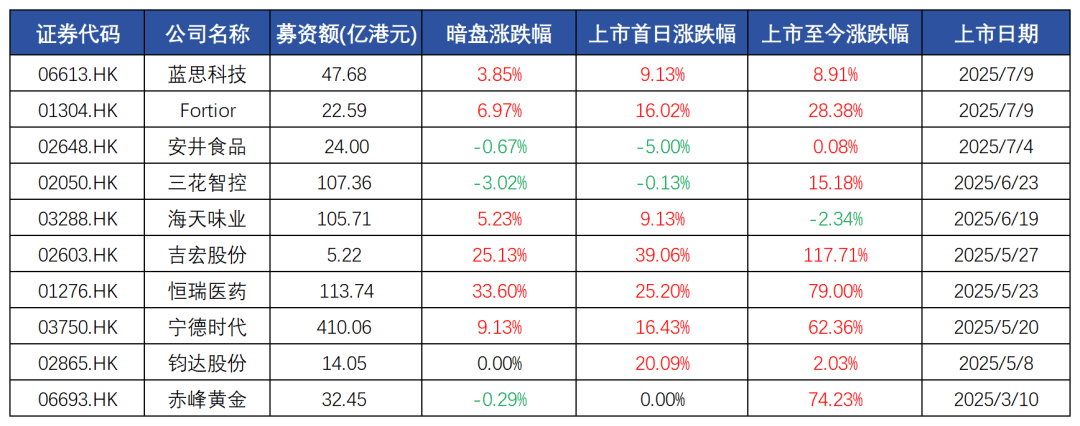
Group 1 - Tianyue Advanced, the world's second-largest silicon carbide substrate manufacturer, has passed the Hong Kong Stock Exchange hearing, while lithium battery giant XWANDA and AI inference chip service provider Yuntian Lifi have submitted their listing applications [1] - As of July 30, a total of 236 companies are queued for Hong Kong stock listings, with 42 A-share companies having submitted their applications [5][8] - In 2023, 10 companies successfully listed in Hong Kong, raising a total of HKD 88.286 billion, with CATL leading at HKD 41.006 billion, marking the largest IPO globally this year [2][4] Group 2 - The average cumulative increase for the 10 A+H shares listed this year is 38.55%, with notable performers including Jihong Co. at 117.71% and Hengrui Medicine at 79% [4] - The Hong Kong Stock Exchange has seen significant inflows, with over HKD 850 billion entering the market this year, surpassing the total for 2024 [12] - A growing number of A-share companies are choosing to list in Hong Kong due to supportive domestic policies and improved liquidity in the Hong Kong market [12][13]




浦银国际:本轮“反内卷”行情仍处政策预期上升驱动阶段 关注受益板块投资机遇
Zhi Tong Cai Jing· 2025-07-31 07:04
浦银国际发布研报称,当前,本轮"反内卷"行情仍处在政策预期上升驱动的阶段,行情的持续性仍需观 察政策落地、产能出清、产能利用率提升、供需结构动态平衡和企业盈利改善等的情况。本轮"反内 卷"与供给侧改革仍存在较多不同之处,供给侧改革针对的行业主要以国企为主,而本轮"反内卷"针对 的大部分为新兴行业,行业较为分散,民企占比较高。预计本轮"反内卷"政策有望带动相关行业的供需 关系、企业盈利以及市场表现等多方面改善,那些处于供给出清前期的行业或具有更大的改善空间。 一是针对的行业范围不同。本轮"反内卷"涉及的行业更广泛,除了传统产业之外,还涵盖光伏、锂电、 新能源汽车、互联网电商等多个新兴产业,以中下游行业为主。 二是涉及行业中民企占比较大。供给侧改革针对的行业主要以国企为主,而本轮"反内卷"针对的大部分 为新兴行业,行业较为分散,民企占比较高。 三是本次采取的政策手段将更多元。由于"反内卷"相关行业独特性更强,明确量化目标、大范围采取行 政手段推动产能出清未必适用,采取的政策手段会因行业而异,落实难度不小。 四是两者的推进路径和侧重点不同。与供给侧改革核心在于化解过剩产能不同,本轮"反内卷"需要供需 两端协同发力, ...
指数上涨遇阻!市场风向变了,还有哪些投资机会?
Sou Hu Cai Jing· 2025-07-31 06:22
Group 1 - The external situation has eased, reinforcing the internal certainty logic, with the Chinese stock market expected to have upward potential before the end of July due to a significant reduction in the risk-free interest rate and a shift in the RMB's depreciation expectations towards stability or slight appreciation [1] - The timely and reasonable macro policies focusing on investor returns and capital market reforms are crucial for changing investors' conservative attitudes towards risks [1] - Future investment should focus more on structural performance rather than short-term index movements [1] Group 2 - Pig prices continue to outperform expectations, and the cost improvements for pig farming companies may lead to better-than-expected profitability, with a focus on the pig farming sector [3] - The "anti-involution" policy is expected to benefit the pig price performance in the second half of 2025, with a seasonal price fluctuation anticipated in the latter half of the year [3] - The recent Central Financial Committee meeting has deepened the "anti-involution" work deployment, impacting various industries including construction materials, which may lead to better industry capacity planning and product pricing adjustments [3] Group 3 - Mini LED backlighting and direct display technologies are expected to see higher growth rates and profitability compared to traditional LED markets, with industry benefits likely concentrating among a few leading manufacturers [5] - The increase in non-hydropower renewable energy consumption responsibility weights is projected to support approximately 460 billion kWh of green electricity consumption this year [5] - High-energy-consuming industries such as steel and cement are now included in the green electricity consumption assessment, which may further support green electricity consumption and market development [5] Group 4 - The short-term market trend is strong, with significant new capital entering the market, although the overall profit-making effect remains weak [7] - The Shanghai Composite Index has fallen below the 5-day moving average but remains above the 10-day moving average, indicating a potential short-term adjustment phase [9] - The focus for the second half of the year should be on the establishment of the Class B directory and addressing structural contradictions in various industries [9]

北交所专题报告:生猪养殖困境反转
Dongguan Securities· 2025-07-31 03:58
Group 1 - The report highlights a reversal in the pig farming dilemma, indicating a potential recovery in the industry due to policy-driven capacity adjustments and supply reductions [2][8]. - The current pig cycle is in a de-stocking phase, with the number of breeding sows in China decreasing from a peak of 41.42 million in 2024 to 40.43 million in June 2025, a decline of approximately 2.4% [22][23]. - The Ministry of Agriculture and Rural Affairs has set a target to reduce the breeding sow population by about 1 million heads, aiming for a total of 39.5 million [22][23]. Group 2 - Short-term pig prices are expected to decline due to reduced second fattening and seasonal demand, but a long-term increase is anticipated if the breeding sow population stabilizes below 39.5 million [26][29]. - As of July 25, 2025, the profit from self-breeding pig farming was 62.16 yuan per head, a decrease of 31.61% from the previous week, while the loss from purchasing piglets expanded to 71.39 yuan per head [32][33]. - The report emphasizes that large-scale enterprises will have more stable profitability compared to smallholders due to cost advantages and industry chain synergies [32]. Group 3 - The report identifies two key companies in the pig farming industry: Yongshun Biological and Dayu Biological, detailing their business models and market positions [3][35]. - Yongshun Biological focuses on the research, production, and sales of veterinary biological products, with over 30 types of vaccines for pigs and poultry, maintaining over 90% of its revenue from vaccine sales [3][37]. - Dayu Biological specializes in feed additives and veterinary drugs, with its feed additive and feed businesses accounting for 65.39% and 29.74% of its revenue, respectively [50][56]. Group 4 - The report provides an overview of the pig farming industry chain, which includes upstream breeding, feed production, and veterinary supplies, midstream modern farming practices, and downstream processing and distribution [21][24]. - The entire industry chain is heavily influenced by technological advancements, management practices, disease control, and is subject to environmental regulations and government oversight [21][24].