稀土

Search documents
ETF日报:资金面上看,市场开始转向上游的半导体设备寻找潜在的投资机会,可关注半导体设备ETF
Xin Lang Ji Jin· 2025-10-13 12:00
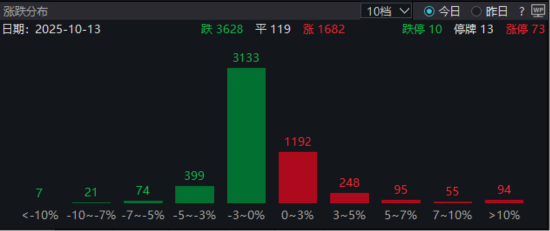
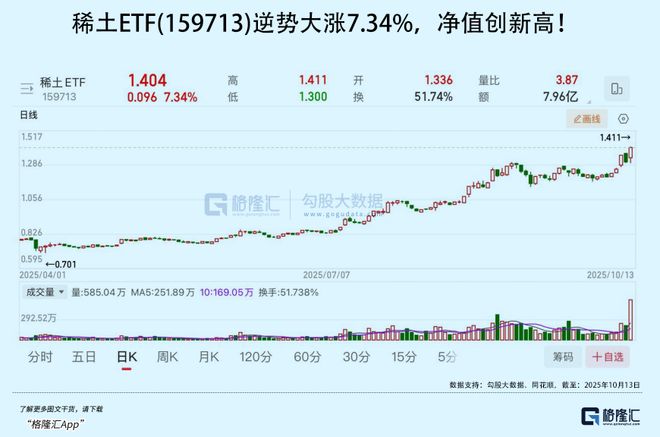
Market Overview - A-shares opened significantly lower due to Trump's threat of increased tariffs but quickly narrowed the decline as panic subsided, with the Shanghai Composite Index down 0.19% and the Shenzhen Component down 0.93% at the close, with total trading volume exceeding 2.3 trillion yuan [1] - The market's reaction to the tariff disturbances was quicker than in previous instances, indicating limited adjustment space for A-shares, with potential investment opportunities in rare earths, semiconductors, and AI industries amid the backdrop of US-China decoupling [1] Mining Sector - Mining stocks experienced a strong performance, with the mining ETF rising 4.59% and the Wind Rare Earth Index soaring 9.49%, driven by China's strengthened control over rare earth resources and the approaching traditional peak demand season [3] - The rare earth industry is expected to see a rise in both volume and price due to supply-side management and increasing global demand for elements like neodymium and praseodymium, particularly in green technology applications [3] - Long-term investment logic in the mining sector remains solid, with gold prices having risen over 50% since the beginning of the year, significantly enhancing the valuation space for gold mining stocks [3] Nonferrous Metals - Several metals are poised to benefit from a shift in supply-demand dynamics, particularly copper, which is expected to transition from a "tight balance" to a "shortage" over the next two years due to supply disruptions and expanding demand [4] - The Democratic Republic of the Congo's new export quota system for cobalt is anticipated to reverse the current oversupply situation, potentially leading to a shortage and driving cobalt prices to historical highs [4] - The mining sector is supported by multiple factors, suggesting further improvements in profitability and valuation, with recommendations to focus on mining ETFs [4] Semiconductor Industry - The STAR 50 Index showed resilience, with the semiconductor equipment ETF rising 3.43%, driven by the core theme of "domestic substitution and self-control" amid ongoing US-China tensions in the semiconductor sector [5] - Recent domestic measures include antitrust investigations against Nvidia and anti-dumping investigations on US-imported chips, aimed at enhancing the security and autonomy of the domestic semiconductor industry [5] - The market for domestic semiconductor equipment remains vast, with current domestic production rates for critical processes still below 20% [5] AI and Semiconductor Equipment - Semiconductor equipment manufacturers are expected to benefit from the growing demand for AI and high-performance computing (HPC), with strong investment in advanced processes driven by AI chip demand [6] - The high demand for high-bandwidth memory and 3D NAND is likely to lead to a structural supply shortage, further boosting related equipment investments [6] - The market is shifting focus from previously hot sectors like computing and chips to upstream semiconductor equipment for potential investment opportunities [6] Gold Market - Gold prices continue to rise, recently surpassing $4,090, with gold ETFs also showing significant gains, supported by increased market uncertainty and geopolitical tensions [6][8] - The trend of central banks increasing gold reserves is ongoing, with China's reserves reaching 74.06 million ounces, marking the 11th consecutive month of increases [8] - The combination of monetary expansion, fiscal deficits, and global geopolitical instability is expected to sustain demand for gold as a safe-haven asset [8] New Energy Vehicles - The new energy vehicle ETF rose 0.75% after a recent adjustment, supported by strong demand in the lithium battery sector and significant sales growth from leading manufacturers [9] - The lithium battery industry is experiencing favorable catalysts, including increased production and strong demand forecasts for 2026, alongside improved financial metrics for lithium companies [9] - The energy storage market is also showing robust demand, with significant growth in bidding for storage systems expected in the coming years [9]

A股奇迹日,自主可控乘风而起!稀土黄金大涨,有色龙头续刷新高,银行再走强,7.6亿资金进场512800
Xin Lang Ji Jin· 2025-10-13 11:53
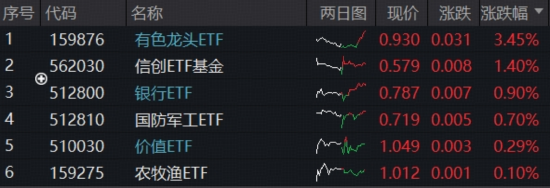
Market Overview - On October 13, the A-share market experienced a miraculous day, initially opening lower due to tariff uncertainties but later rebounding, with the Shanghai Composite Index closing down only 0.19% after a nearly 2% drop at the open [1] - A total of 1,682 stocks in the market rose, with a median decline of only 0.8% [1] Sector Performance - The Rare Earth sector saw a surge, with the Rare Earth Leading ETF (159876) experiencing a price increase of over 4.2% at one point, ultimately closing up 3.45% [2][5] - The domestic software sector also showed significant movement, with the Innovation ETF (562030) rising by 1.4% [3] - The Defense and Military sector outperformed, with the Defense ETF (512810) closing up 0.7%, driven by strong domestic demand and minimal impact from international trade disruptions [3][22] - The Banking sector demonstrated resilience, with the Bank ETF (512800) rising by 0.9% amid increased defensive positioning due to tariff uncertainties [3][14] Fund Flows and Investment Trends - The Rare Earth Leading ETF (159876) attracted significant capital, with a net inflow of 330 million units and a total of 2.58 billion yuan in the last three days [5][10] - The Bank ETF (512800) also saw substantial inflows, with a total of 7.63 billion yuan over the past three days, indicating strong investor interest [16][19] Regulatory Impact - The Ministry of Commerce's new regulations on rare earth exports have tightened controls, affecting the entire supply chain and potentially leading to price increases [7][12] - Analysts believe that the tightening of export controls will strengthen the supply side of the rare earth market, while demand is expected to remain robust due to seasonal factors [7][12] Earnings and Profitability - In the first half of 2025, over 91% of the 60 stocks in the China Nonferrous Metals Index reported profits, with notable increases in net profits for key players like Northern Rare Earth, which saw a staggering 1,951% increase [10][12] - The banking sector is expected to maintain stable profitability, with projected cash dividends exceeding 200 billion yuan from major state-owned banks, reflecting their strong earnings capacity [18][19] Future Outlook - The Rare Earth sector is anticipated to undergo a revaluation due to the supply-demand dynamics and regulatory changes, with analysts recommending strategic investments in this area [3][12] - The Defense and Military sector is expected to benefit from upcoming government plans and increased domestic orders, suggesting a positive outlook for the next few quarters [25][22]

稀土出口管制新观点评:稀土出口管制强化,板块战略价值凸显-20251013
Shenwan Hongyuan Securities· 2025-10-13 11:50
Investment Rating - The report rates the rare earth industry as "Overweight," indicating that the industry is expected to outperform the overall market [8]. Core Insights - The new export control regulations on rare earths, issued by the Ministry of Commerce and the General Administration of Customs, expand the range of controlled elements, adding five new heavy rare earth elements to the existing seven [3]. - The regulations impose stricter controls on the export purposes of rare earth products, particularly prohibiting military applications and requiring case-by-case approval for advanced semiconductor-related uses [3]. - The new regulations create a comprehensive control system over the entire rare earth industry chain, enhancing China's pricing power in the sector [3]. Summary by Sections Export Control Regulations - The new regulations include export controls on additional heavy rare earth elements and strengthen the control over the export purposes of rare earth products, particularly for military and advanced semiconductor applications [3]. - The regulations also cover the export of technologies, equipment, and raw materials related to rare earths, establishing a multi-layered control system [3]. Investment Analysis - The report suggests that the strengthened export controls will enhance the strategic value of the rare earth sector amid the ongoing US-China competition, indicating potential upward valuation for the sector [3]. - Recommended companies for investment include: - China Rare Earth: Focused on heavy rare earths with clear integration expectations - Northern Rare Earth and Baotou Steel: Strong in light rare earths with significant cost advantages - Guangsheng Nonferrous: A platform for rare earth resource integration in Guangdong with accelerated high-end magnetic material layout - Jieneng Permanent Magnet and Zhenghai Magnetic Materials: Expected to benefit from increased concentration in rare earth product exports [3]. Company Valuation - The report provides a valuation table for key companies in the rare earth sector, detailing their stock prices, earnings per share (EPS) forecasts, and price-to-earnings (PE) ratios for the upcoming years [4].



每日投行/机构观点梳理(2025-10-13)
Jin Shi Shu Ju· 2025-10-13 11:33
Group 1: Copper and Nickel Market Outlook - Goldman Sachs forecasts copper prices to remain in the range of $10,000 to $11,000 per ton in 2026/2027 [1] - Goldman Sachs predicts nickel prices will decline by 6% to $14,500 per ton by December 2026 due to the need for Indonesian nickel producers to lower profit margins to limit supply growth [1] Group 2: Gold Price Predictions - Canadian Imperial Bank of Commerce expects gold prices to rise to $4,500 per ounce in 2026 and 2027, before falling to $4,250 in 2028 and $4,000 in 2029, driven by long-term inflation concerns [1] - The recent surge in gold prices is attributed to fears of long-term inflation and wealth preservation, as the Federal Reserve's monetary policy has not adequately addressed these concerns [1] Group 3: Japanese Yen and Interest Rate Expectations - State Street Bank indicates that the delay in interest rate hikes has exacerbated the weakness of the Japanese yen, with market reactions expected if there is no consensus on the appointment of the new Prime Minister [2] Group 4: European Central Bank's Stance - Pantheon Macroeconomics suggests that the European Central Bank is unlikely to lower interest rates in the coming months despite a weak economic outlook, as they may view current economic weakness as temporary [3] Group 5: Chinese Market and Liquidity - China International Capital Corporation highlights October as a potential liquidity resonance window, suggesting that A-shares and Hong Kong stocks offer better value compared to U.S. stocks due to a shift towards a more accommodative monetary policy [4] - The report indicates that the recent escalation in U.S.-China trade tensions is expected to have a weaker impact on A-shares compared to previous events, with a focus on long-term asset revaluation in China [5] Group 6: Gold Market Dynamics - Guoxin Securities notes that the recent rise in gold prices is driven by expectations of Federal Reserve rate cuts, geopolitical risks, and increased investment demand, marking the beginning of a new strong cycle for gold [6] Group 7: Energy Storage and Lithium Battery Sector - CITIC Securities continues to recommend the energy storage sector, citing a turning point in domestic energy storage economics and a favorable outlook for the lithium battery industry [7] Group 8: Cobalt and Rare Earth Strategic Opportunities - CITIC Securities identifies strategic opportunities in cobalt and rare earths, with new export quotas from the Democratic Republic of Congo expected to lead to a market shift from surplus to shortage [8] Group 9: Market Volatility and Investment Strategy - Everbright Securities predicts that the market may enter a phase of wide fluctuations due to high valuations and cautious capital, while also noting potential support from upcoming policy expectations [9] Group 10: Long-term Outlook for Gold - Guoxin Securities maintains a positive long-term outlook for gold, suggesting that the third wave of opportunities may arise from shifts in capital flows due to the peak of the AI technology wave [10] Group 11: External Shocks and Chinese Market Opportunities - Guotai Junan Securities views external shocks as buying opportunities for the Chinese market, emphasizing the internal certainty of China's transformation and the demand for quality assets [11]
主力资金 | 尾盘抢筹6股超亿元
Sou Hu Cai Jing· 2025-10-13 11:17
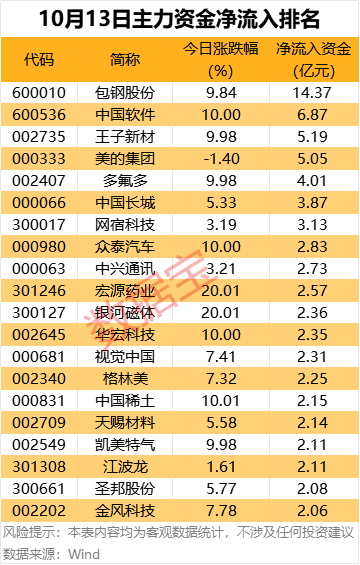
Core Viewpoint - The A-share market experienced significant fluctuations on October 13, with major indices opening lower but recovering throughout the day. The overall trend showed a net outflow of 39.864 billion yuan in main funds, while six industries saw net inflows, particularly in steel, environmental protection, and agriculture [1][2]. Group 1: Industry Performance - The A-share market saw a net outflow of 39.864 billion yuan in main funds, with six industries experiencing net inflows, including steel with 0.892 billion yuan, and environmental protection, agriculture, and light manufacturing each exceeding 0.2 billion yuan [1]. - The electronic and power equipment industries faced the largest net outflows, each exceeding 6 billion yuan, while the automotive and machinery sectors also saw outflows exceeding 3 billion yuan [1]. Group 2: Individual Stock Performance - Seven stocks received net inflows exceeding 0.3 billion yuan, with Baogang Co. leading at 1.437 billion yuan, followed by China Software with 0.687 billion yuan. Baogang Co. saw a significant increase due to active trading in the rare earth sector [2][3]. - A total of 44 stocks experienced net outflows exceeding 0.2 billion yuan, with BYD, Luxshare Precision, and Dongfang Wealth each seeing outflows exceeding 0.7 billion yuan [4][5]. Group 3: Tail-End Fund Flows - At the end of the trading day, the main funds saw a net inflow of 4.031 billion yuan, with the non-ferrous metal industry attracting over 1 billion yuan in buying [6]. - Individual stocks such as New Yi Sheng, ZTE, and North Rare Earth saw net inflows exceeding 0.1 billion yuan in the tail-end trading [7]. Group 4: Earnings Forecasts - Changchuan Technology announced an earnings forecast for the first three quarters, expecting a net profit of 0.827 to 0.877 billion yuan, representing a year-on-year growth of 131.39% to 145.38%, driven by strong demand in the semiconductor market [8].





揭秘涨停丨封板超330万手,稀土龙头获大资金抢筹
Zheng Quan Shi Bao Wang· 2025-10-13 11:00
Core Insights - The article highlights significant trading activity in the stock market, particularly focusing on companies involved in rare earth elements and advanced manufacturing technologies, indicating strong investor interest and potential growth in these sectors. Group 1: Rare Earth Sector - Baogang Co. saw a trading limit with a total order volume of 9.24 billion yuan, leading the market in rare earth stocks [2] - The Ministry of Commerce announced export controls on rare earth-related technologies, which may impact supply dynamics and pricing [2] - North Rare Earth announced an adjustment in the trading price of rare earth concentrates to 26,205 yuan per ton for Q4 2025, indicating a price increase [3] Group 2: Advanced Manufacturing Technologies - Companies like XGL Electronic and KMT Gas are involved in the production of advanced materials for photolithography, which is crucial for semiconductor manufacturing [4] - The controlled nuclear fusion sector is seeing increased activity, with companies like Hezhu Intelligent participating in the manufacturing of core components [5][6] Group 3: Market Activity - A total of 13 stocks saw net purchases exceeding 100 million yuan, with China Rare Earth and others attracting significant institutional investment [7] - The net buying amounts for key stocks included 2.03 billion yuan for Canxin Co. and 1.77 billion yuan for Duofluor, indicating strong market confidence [7]
中美都出了王牌,中国升级对稀土管控,美国威胁限制飞机零件出口
Sou Hu Cai Jing· 2025-10-13 10:49
Group 1: Trade Tensions and Responses - The trade friction between China and the U.S. has escalated, with China imposing stricter export controls on rare earth elements, including lanthanum, cerium, praseodymium, neodymium, and samarium, effective October 9, 2025 [1][3] - The U.S. responded swiftly, with Trump threatening to restrict the export of Boeing aircraft parts to China, highlighting the reliance of Chinese airlines on Boeing models, which account for a significant portion of Boeing's global market [1][3][5] Group 2: Impact on Companies - The announcement of China's export controls led to immediate market reactions, with Boeing's stock dropping by 2.4% and General Electric's by 2.6% on October 11, 2025 [5] - Analysts noted that while the impact on Boeing may be limited in the short term due to China's development of its domestic C919 aircraft, the potential for supply chain disruptions remains significant [5][8] - The export controls affect a wide range of products, from jet engines to smartphones, requiring foreign companies to obtain approval for exports containing rare earth elements [7][8] Group 3: Global Supply Chain Reactions - European manufacturers and Japan's electronics sector quickly convened to discuss stockpiling rare earth materials in response to China's announcement [3][8] - Australian mining companies saw stock price increases as they are viewed as alternative sources for rare earth materials [3][8] - The situation highlights the vulnerabilities in the global supply chain, with potential risks for various industries reliant on rare earth elements [7][8]



巨震之下!乱世“稀土+黄金”
Xin Lang Cai Jing· 2025-10-13 10:49
Group 1: Rare Earth Industry - The strategic value of rare earths is highlighted as an irreplaceable "countermeasure" in geopolitical conflicts, especially in the context of U.S.-China trade tensions [6][7]. - China's recent strict export controls on rare earths, including a ban on core technology exports, have raised expectations that controlling or halting rare earth exports to the U.S. could be a significant retaliatory measure [8][9]. - The global supply of rare earths is dominated by China, which accounts for over 60% of production and 85% of refining capacity, creating a significant barrier for other countries attempting to establish their own supply chains [14][15]. - The demand for rare earths is driven by the global energy revolution and technological advancements, particularly in electric vehicles, wind energy, and military applications [12][13]. - Recent price surges in rare earth materials, such as dysprosium and praseodymium, have led to significant increases in orders for leading companies in the sector, reflecting a clear price increase logic [19][20]. - The performance of companies in the rare earth sector, such as Northern Rare Earth and Shenghe Resources, has shown substantial profit growth, with Northern Rare Earth projecting a net profit increase of 272.54%-287.34% year-on-year [21][22]. Group 2: Gold Market - Gold has emerged as a key focus in the market, reaching historical highs due to its status as a safe-haven asset amid rising geopolitical tensions and market volatility [27][28]. - Factors supporting the rise in gold prices include expectations of interest rate cuts by the Federal Reserve and a global trend towards "de-dollarization," leading to increased central bank purchases of gold [28][30]. - The Gold ETF (518680) has shown strong performance, with a net asset growth of 52.07% over the past year, making it the top-performing gold ETF in the market [30][32]. - The low management and custody fees of the Gold ETF, along with its T+0 trading capability, make it an attractive option for investors seeking to hedge against market uncertainties [32]. - The combination of rare earths and gold represents a dual strategy for investors, with rare earths focusing on growth opportunities and gold providing stability and protection against market fluctuations [33].

A股大反弹,多股尾盘涨停
Zheng Quan Shi Bao· 2025-10-13 10:39
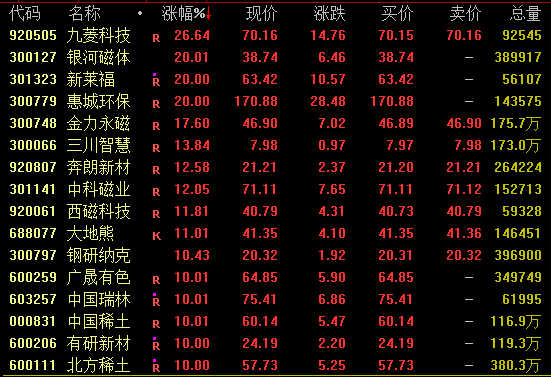
Market Overview - A-shares experienced a significant decline in the morning session but rebounded in the afternoon, with the Sci-Tech Innovation 50 Index showing strength [1] - The Shanghai Composite Index closed down 0.19% at 3889.5 points, the Shenzhen Component Index fell 0.93% to 13231.47 points, and the ChiNext Index decreased by 1.11% to 3078.76 points [1] - The total trading volume in the Shanghai and Shenzhen markets was 23,745 billion yuan, a decrease of 1,600 billion yuan compared to the previous trading day [1] Sector Performance - Over 3,600 stocks in the market were in the red, with declines in sectors such as automotive, oil, liquor, and pharmaceuticals [1] - The rare earth sector saw a resurgence, with stocks like China Rare Earth and Northern Rare Earth hitting the daily limit [3][4] - The banking sector experienced gains, with China Construction Bank rising over 5% [1] - The semiconductor sector rebounded, with Huahong Semiconductor hitting the daily limit and SMIC rising nearly 7% [1][7] Rare Earth Sector - The rare earth sector exploded again, with stocks like Jiuling Technology rising nearly 27% and several others hitting the daily limit [3][4] - The Ministry of Commerce announced new export controls on rare earth-related items, expanding the scope to include technologies and equipment related to rare earth recycling [5] - Citic Securities indicated that the security of rare earth resources has become a core aspect of national security, suggesting a positive outlook for the rare earth industry [5] Semiconductor Sector - The semiconductor sector rebounded after a significant pullback, with stocks like Ruvi Optoelectronics and Huahong Semiconductor both hitting the daily limit [7][8] - The market is closely monitoring potential export controls from the U.S. on key software types, which could impact the semiconductor industry [8] Hong Kong Market - Yao Cai Securities surged nearly 40% during trading, closing up 34.5% with a trading volume of 2.06 billion HKD [10] - The stock received approval from the Hong Kong Securities and Futures Commission for an acquisition by Ant Group, which is currently in the process of completing necessary approvals [10]

澳大利亚对中国稀土开首枪,中方叫停交易,订单清零,澳总理急了!
Sou Hu Cai Jing· 2025-10-13 10:37
值得关注的是,中方仅暂停美元结算交易,采用人民币结算的货物仍可正常清关,这一安排精准指向 "去美元化" 目标。目前巴西淡水河谷对华贸易中 28% 已采用人民币结算,非洲主要供应商也已接受这 一模式,唯有澳大利亚仍坚持美元结算。2023 年全球铁矿石人民币结算占比仅 5%,到 2025 年已跃升 至 25%,此次调整后预计 2026 年底将突破 40%。大连商品交易所铁矿石期货成交量已达新加坡市场的 23 倍,正逐步形成以人民币计价的定价参考体系。 这场结算货币调整,本质是全球资源贸易从 "澳企定价、美元结算" 向 "多元供应、多币结算" 转型的缩 影。中方以充足的资源储备与市场底气,推动贸易规则向更均衡的方向发展,既回应了不合理的地缘政 策,也为人民币国际化注入实质动力,为全球大宗商品贸易格局变革写下重要注脚。 中方矿产资源集团宣布暂停采购以美元计价的必和必拓铁矿石船货,这一贸易调整迅速引发全球市场连 锁反应:新加坡铁矿石期货价格当日波动上涨,必和必拓股价单日跌幅超 6%,市值蒸发超百亿美元, 一场围绕资源定价权与结算货币的博弈正式展开。此次举措并非偶然,而是对澳方近期政策的针对性回 应。2025 年 9 月 ...