汽车

Search documents
宏观周报(2月2日-2月8日):假日需求稳中有升,海外制造业景气回暖-20260208
Yin He Zheng Quan· 2026-02-08 09:42
Domestic Demand - Domestic travel demand is steadily increasing, with subway passenger volume up 8.8% compared to the same period in 2024, and domestic flight numbers averaging 14,500, a 1.6% increase year-on-year[2] - Movie ticket revenue has decreased by 37.2% year-on-year, averaging 62.245 million yuan per day[2] - Passenger car sales in January were 679,000 units, down 31.7% from the previous year[2] External Demand - The Baltic Dry Index (BDI) averaged 1993.2, showing a marginal decline but significantly higher than the previous year[2] - The China Export Container Freight Index averaged 1122.2, down 4.5% week-on-week and 16.4% year-on-year[2] - Port cargo throughput reached 281.597 million tons, a 25.5% increase compared to the same period in 2024[2] Production Sector - The operating rate of blast furnaces increased by 0.53 percentage points to 79.55%[2] - The operating rate for automotive semi-steel tires decreased by 2.08 percentage points to 72.76%[2] - PTA production increased by 35,500 tons to 1.4639 million tons, with an operating rate of 76.29%[2] Price Trends - Consumer Price Index (CPI) remains low, with pork prices down 1.12% week-on-week and vegetable prices down 1.46%[3][4] - Producer Price Index (PPI) shows significant increases in coking coal and coke prices, while non-ferrous metals have adjusted downwards due to a stronger dollar and seasonal demand decline[4] Monetary Policy - The central bank's reverse repurchase operations netted 756 billion yuan this week, with SHIBOR rates showing a seasonal decline[5] - The yield curve for government bonds has flattened, with the 30-year yield at 2.2510% and the 10-year yield at 1.8102%[5] International Context - U.S. consumer confidence index rose to 57.3, with one-year inflation expectations dropping to 3.5%, the lowest in 13 months[5] - The ISM Manufacturing PMI rebounded to 52.6%, indicating a return to expansion, with new orders and production indices showing significant growth[7]
热血渐凉:被耗尽的小米SU7 Ultra
虎嗅APP· 2026-02-08 09:42
Core Viewpoint - The article discusses the challenges faced by Xiaomi's high-end electric vehicle, the SU7 Ultra, including a significant drop in sales and customer dissatisfaction due to service issues and product controversies [5][6][14]. Group 1: Sales Performance - The Xiaomi SU7 Ultra was launched with high expectations, aiming for annual sales of 10,000 units, and achieved over 14,000 units sold within the first few months, surpassing the sales of the Porsche Panamera [4][5]. - However, starting from September 2025, monthly sales plummeted from over 3,000 units to just 45 units by December 2025 [6][15]. Group 2: Customer Experience and Service Issues - Customers of the SU7 Ultra, primarily young and affluent individuals, value emotional engagement and personalized service, which Xiaomi reportedly failed to provide, leading to dissatisfaction [9][14]. - The promotional gifts offered to SU7 Ultra owners were perceived as less thoughtful compared to those from luxury brands, which further impacted customer sentiment [9][14]. Group 3: Product Controversies - The "power lock" incident, where maximum horsepower was restricted until customers completed a specific track test, was poorly communicated and negatively affected customer experience [14][15]. - Additional controversies, such as issues with the carbon fiber hood and safety concerns regarding the electronic door locks, contributed to a decline in the vehicle's reputation [14][15]. Group 4: Future Prospects - Despite the challenges, Xiaomi continues to promote the SU7 Ultra, including its entry into a prestigious racing video game, indicating that the company still sees value in the model for showcasing its technological capabilities [16][18]. - However, the likelihood of the SU7 Ultra regaining its previous sales momentum appears low, as the sales team may lack the expertise to effectively communicate the vehicle's technical details [18].


长江证券:2025年年度业绩预告 盈利景气修复可期
Xin Lang Cai Jing· 2026-02-08 09:13
Group 1 - The overall A-share pre-announcement rate has improved, indicating a potential recovery in profitability [1][7] - As of February 3, 2026, approximately 3,000 out of 5,478 A-share companies have disclosed their 2025 annual performance forecasts, resulting in a disclosure rate of 54.0% and a pre-announcement rate of 37.0%, up from 33.7% in 2024 [1][7] - In the 2025 annual performance forecasts, there are 623 companies expecting profit increases and 378 companies expecting profit decreases [1][7] Group 2 - Large-cap stocks are expected to show better profitability compared to small-cap stocks, with the ChiNext board having a higher pre-announcement rate [2][8] - The maximum profit change for major indices in 2025 is projected to be 55.2% for CSI 300, 82.8% for SSE 50, 54.7% for CSI 500, and 50.8% for CSI 1000 [2][8] - The pre-announcement rates for major indices are 63.2% for CSI 300, 83.3% for SSE 50, 59.0% for CSI 500, and 49.4% for CSI 1000 [2][8] Group 3 - In terms of industry performance, the defense and electronics sectors have shown high disclosure and pre-announcement rates, indicating a strong potential for profitability improvement [3][9] - The highest disclosure rates among primary industries are coal (81%), real estate (78%), agriculture, forestry, animal husbandry, and fishery (74%), and computer industry (72%) [3][9] - The highest pre-announcement rates are in non-bank financials (96.2%), non-ferrous metals (67.6%), automotive (52.7%), and steel (50.0%) [3][9] Group 4 - The market outlook for 2026 suggests a gradual bull market, with signs of a profitability bottom emerging and ample liquidity supporting corporate earnings [4][10] - Valuation metrics are near historical averages, with a low interest rate environment providing upward valuation momentum [4][10] - There is significant potential for increased market capitalization in the Chinese stock market as long-term capital flows in [4][10] Group 5 - The industry allocation outlook favors technology and cyclical sectors, with a focus on U.S. stocks and commodities [5][11] - Key areas of interest include technology, domestic circulation, strategic security, and opening up to foreign markets, driven by policy directions from the next five-year plan [5][11] - The market is expected to experience a more comprehensive bull market driven by technological manufacturing and certain cyclical trends [5][11]

全球第四大汽车巨头,突然爆雷
Sou Hu Cai Jing· 2026-02-08 09:04
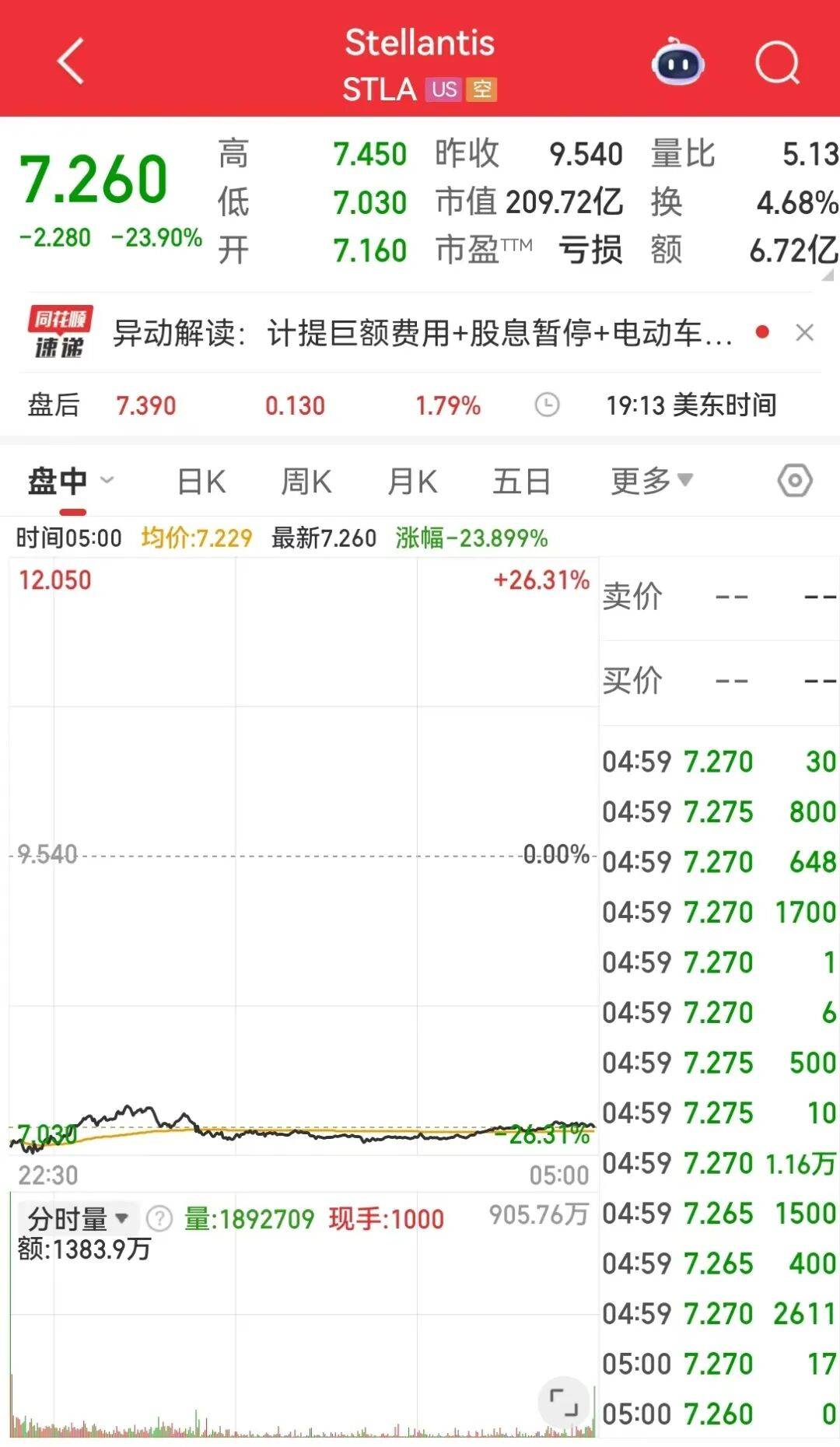
"每日经济新闻"微信公号 全球第四大汽车巨头,突然爆雷。 当地时间2月6日,全球第四大汽车制造商Stellantis集团(STLA.US)美股开盘后股价大幅下挫,盘中一度跌超26%,截至收盘跌23.79%。此前,该公司在 法国市场的股价(STLAP.PA)一度暴跌近30%,当日收跌25.24%。 | | Stellantis | | | | --- | --- | --- | --- | | | STLA US 空 | | | | 高 7.260 | | 7.450 昨收 9.540 量比 | 5.13 | | ਜ਼ਿੰ | 7.030 | 市值 209.72亿 换 | 4.68% | | -2.280 -23.90% 开 | | 7.160 市盈™ 亏损 额 | 6.72 Z | | | 异动解读:计提巨额费用+股息暂停+电动车 ... ● × | | | | 盘后 7.390 0.130 | 1.79% | | □ 19:13 美东时间 | | 織中・日K | 周K 月K 五日 | | 用多▼ | | 时间05:00 均价:7.229 最新7.260 涨幅-23.899% | | | | | 12.050 ...

印度下调美国豪华车关税至30%,不包括特斯拉
Guan Cha Zhe Wang· 2026-02-08 07:17
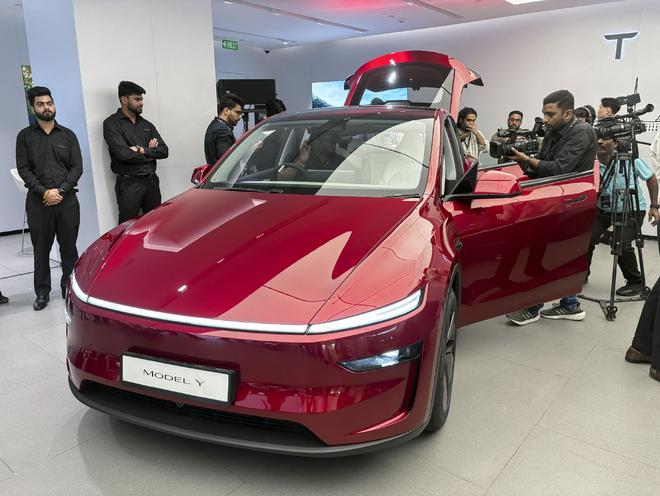
Group 1 - India will reduce tariffs on luxury cars from up to 110% to 30% under a temporary trade agreement with the US, while maintaining high tariffs on electric vehicles, including those from Tesla [1][3] - The US will lower tariffs on Indian goods from 50% to 18% as part of the agreement, with the implementation of these tariff reductions expected after a formal agreement is signed in March [1] - The agreement contrasts with India's previous deal with the EU, where it agreed to reduce tariffs on more car models to 10%, including some concessions for electric vehicles [4] Group 2 - Tesla faces challenges in the Indian market due to high tariffs, with the starting price of the Model Y reaching nearly $70,000, leading to unsold inventory and a significant discount being offered to clear stock [3] - Despite initial interest, Tesla's sales in India have been disappointing, with only 227 registrations for the year and a large portion of exported vehicles remaining unsold [3]

女子15元无人洗车百万豪车被洗坏
Xin Lang Cai Jing· 2026-02-08 07:10
(来源:猛犸新闻) 【#女子15元无人洗车百万豪车被洗坏#】#店家回应无人洗车机洗坏百万豪车#2月6日报道,浙江杭州。 卢女士花费15元通过无人洗车机洗车,上百万买来的保时捷被洗坏,维修费要一万多块钱,对方却只肯 承担1000块钱,她无法接受。卢女士说,车子前保险杠、轮眉、后视镜、车漆刮掉了,车衣也破了,当 天洗车完全是正常操作。出现这种情况,洗车的地方必须承担责任。洗车技术部经理:设备的改进有在 沟通中,洗车的技术没有那么先进,对于赔偿不是很清楚。(小强热线浙江教科) ...
华金证券:春季行情未完 持股过节
Xin Lang Cai Jing· 2026-02-08 07:05
炒股就看金麒麟分析师研报,权威,专业,及时,全面,助您挖掘潜力主题机会! 来源:华金证券 炒股就看金麒麟分析师研报,权威,专业,及时,全面,助您挖掘潜力主题机会! 来源:华金证券 春节前A 股短期走势对节后行情可能有一定影响。2010 年以来的16 年中,有9次春节前5 个交易日内上 证综指走强(弱)而节后1 个交易日上证综指下跌(上涨);有12 次节前5 个交易日内上证综指涨跌与 节后5 个交易日内涨跌同向。 春季行情未完,春节期间风险可能有限,可持股过节。(1)今年春节期间经济和盈利预期可能改善。 一是春节出行、消费数据可能偏好。二是今年春节地产销售可能有所回暖:首先,低基数效应下今年春 节期间地产销售同比增速可能有所回升;其次,各地刺激地产销售的政策预期较强,春节假期期间地产 销售可能延续回暖趋势。(2)春节期间流动性可能维持宽松。一是春节期间宏观流动性可能维持宽 松:首先,海外方面,2 月11 日美国1 月CPI 数据将公布,2 月17 日美国零售数据将披露,预计美元指 数可能继续维持低位震荡,海外对国内流动性宽松的掣肘有限;其次,国内方面,春节前流动性季节性 紧张下央行可能加大净投放力度。二是春节前 ...
全球第四大汽车巨头爆雷 ,斯特兰蒂斯半年巨亏超1500亿,股价暴跌超20%!
Xin Lang Cai Jing· 2026-02-08 06:43
#汽车产业观察#【#全球第四大汽车巨头爆雷# ,#斯特兰蒂斯半年巨亏超1500亿#,股价暴跌超 20%!】全球第四大汽车巨头,突然爆雷!当地时间2月6日,全球第四大汽车制造商Stellantis集团 (STLA.US)美股开盘后股价大幅下挫,盘中一度跌超26%,截至收盘跌23.79%。此前,该公司在法国 市场的股价(STLAP.PA)一度暴跌近30%,当日收跌25.24%。当地时间2月6日,Stellantis宣布计提260 亿美元(约合222亿欧元,1804亿元人民币)巨额转型支出。据其提前公布的2025年第四季度数据,初 步预计2025年下半年亏损金额达190亿至210亿欧元(约合人民币1550亿元至1720亿元)。鉴于这一亏损 情况,斯特兰蒂斯决定暂停2026年的股息发放,并计划通过发行混合债券筹集至多50亿欧元,以维持其 资产负债表。Stellantis预计,2026年整体调整后营业利润率目标为低个位数。Stellantis集团是由法国标 致雪铁龙集团(PSA)与意大利-美国菲亚特克莱斯勒集团(FCA)合并成立的跨国汽车制造商,旗下 拥有Jeep、玛莎拉蒂、标致、雪铁龙等14个品牌。作为全球第四大汽车 ...
全球首个汽车门把手安全强制性标准正式发布,工信部加快推进驾驶自动化等重点标准研制
Xinda Securities· 2026-02-08 06:41
Investment Rating - The industry investment rating is "Positive" [2] Core Insights - The report highlights the official release of the world's first mandatory safety standard for automotive door handles, which will take effect from January 1, 2027. This standard emphasizes safety in design and functionality, requiring independent mechanical release features for each side door and specific structural strength requirements [21][22] - The Ministry of Industry and Information Technology (MIIT) is accelerating the development of key standards related to driving automation and collision safety, aiming to enhance the safety and quality of the automotive industry [21] - The A-share automotive sector outperformed the broader market, with a weekly increase of 0.32%, while the CSI 300 index fell by 1.33% [3][12] Market Performance - The automotive sector's performance ranked 12th among A-share industries, with notable gains in the passenger vehicle segment led by companies like Seres and Haima [3][4] - The commercial vehicle segment saw significant increases, particularly for Jinlong Automobile and Foton Motor, while the automotive parts sector also experienced growth, with leading companies including Xingmin Zhitong and Yinlun [6][19][20] Key Industry News - Strategic partnerships and technological advancements are highlighted, such as the collaboration between Pony.ai and Moore Threads for L4 autonomous driving technology [21] - Changan Automobile's introduction of sodium-ion batteries in collaboration with CATL, aiming for multiple passenger vehicle launches this year [21] - The launch of a vehicle replacement subsidy program in Shanghai, offering an 8% subsidy for purchasing new energy vehicles [21] Upstream Data Tracking - The report includes tracking of key material prices relevant to the automotive industry, such as steel, aluminum, and lithium carbonate, which are critical for production costs [24][25]



回旋镖狠狠打脸,美国被加拿大脱钩断链?中国静观大势改变!
Sou Hu Cai Jing· 2026-02-08 06:41
Group 1 - Canada is experiencing a significant shift in its economic relations with the U.S., with Prime Minister Carney emphasizing the need for economic diversification rather than a complete detachment from the U.S. [1][3] - The trade volume between Canada and the U.S. is projected to be approximately $36 billion in 2024, supporting millions of jobs across various sectors [3]. - A notable trend is the increasing negative sentiment among Canadians towards the U.S., with 64% expressing negative views and 59% identifying the U.S. as the biggest threat to Canada [3]. Group 2 - Canada is actively seeking to diversify its trade partnerships, particularly with emerging markets in Europe and Asia, as a response to the instability of U.S. trade policies [3][5]. - The Canadian automotive market is shifting, with a significant decrease in imports of U.S. vehicles, as only 36% of passenger cars imported in the first ten months of 2025 came from the U.S. [3]. - Canada has approved the import of 49,000 electric vehicles from China, indicating a strategic pivot towards Chinese manufacturers in the automotive sector [3]. Group 3 - Canada has substantial oil reserves, with proven reserves of 168.1 billion barrels, ranking third globally, and is a major oil supplier to the U.S. [8]. - The Keystone XL pipeline project has faced numerous setbacks due to changing U.S. administrations, resulting in significant financial losses for Canada [10]. - By 2025, China has become the largest buyer of Canadian oil, purchasing approximately 64% of the oil transported through a newly expanded pipeline, marking a pivotal shift in Canada's oil export dynamics [13]. Group 4 - The trend of "de-Americanization" is not limited to Canada, as Europe is also moving away from reliance on the U.S. due to perceived risks associated with U.S. policies [5][16]. - The global landscape is shifting as countries seek to mitigate risks associated with U.S. influence, indicating a broader trend of re-evaluating international partnerships [16]. - The changes in Canada and Europe reflect a significant transformation in global trade dynamics, with the U.S. no longer seen as a stabilizing force in globalization [16].