
金融

Search documents
别不当回事!金价已发出强烈信号,黄金大风暴将一触即发
Sou Hu Cai Jing· 2026-02-12 16:45
Group 1: Market Volatility - The international gold market experienced extreme volatility in late January 2026, with prices soaring to a historical peak of $5,600 per ounce before plummeting over 20% to below $4,500 within a few trading days [1][2] - The volatility reached a 40-year high, with daily price swings exceeding 5% and some days seeing declines over 10% [1][2] - Major banks, including Industrial and Commercial Bank of China and China Bank, issued risk warnings and adjusted their gold accumulation business policies to manage the heightened volatility [1][2] Group 2: Structural Changes in Pricing Logic - The traditional pricing framework for gold is failing, as the relationship between gold prices and the US dollar index, as well as real interest rates, has weakened since 2026 [3] - Central banks are shifting from tactical gold purchases to long-term strategic reserves, with net purchases expected to reach 755 tons in 2026, significantly above historical averages [3] - The changing macroeconomic landscape, including rising global debt and persistent geopolitical conflicts, is enhancing gold's strategic value as an asset with no sovereign credit risk [3] Group 3: Leverage and Technical Risks - The concentration of leveraged trading and forced liquidations contributed to market turbulence, with high leverage accounts facing pressure due to increased margin requirements set by the CME [6] - Major banks raised margin requirements for gold and silver contracts, exacerbating liquidity issues in the market [6] - The largest gold ETF, GLD, experienced significant outflows, indicating a shift in investor sentiment and potential for further price declines if key support levels are breached [6] Group 4: Divergence Between Physical and Financial Attributes - A notable divergence between domestic and international gold prices has emerged, highlighting internal market discrepancies [7] - The price gap between physical gold consumption and financial derivatives trading is widening, with domestic retail prices remaining firm due to rigid demand [7] - Silver prices exhibited even greater volatility than gold, driven by both industrial demand and speculative trading [7] Group 5: Institutional Behavior and Policy Signals - Institutional investor actions are amplifying market volatility, with $5,000 identified as a critical psychological support level for gold prices [9] - UBS has adjusted its gold price forecasts for the end of 2026, reflecting the chaotic market expectations [9][10] - The nomination of the Federal Reserve chairman is a short-term disruptive factor, with potential implications for interest rate expectations and gold prices [10] Group 6: Irrational Investor Behavior - Emotional trading among investors is exacerbating market volatility, with many investors engaging in blind bottom-fishing after price declines [11] - Historical patterns indicate that significant price drops in gold often precede tightening monetary policies and liquidity crises [11] - Current market conditions resemble those before the 2008 financial crisis, with retail investors heavily investing in gold ETFs [11]


毕马威:2025年中国经济总量达140万亿元保持韧性,2026年经济增速将维持稳健
Zhong Guo Jing Ying Bao· 2026-02-12 15:47
Economic Overview - The report by KPMG indicates that China's economy is projected to reach 140 trillion yuan in 2025, with a real GDP growth of 5.0% year-on-year, meeting the initial target growth rate [1] - Industrial production is expected to improve steadily, with manufacturing value-added growth of 6.1%, an increase of 0.3 percentage points from the previous year [1] Consumption Insights - The total retail sales of consumer goods are expected to grow by 3.7% year-on-year in 2025, a slight increase of 0.2 percentage points compared to the previous year [2] - Despite a decline in retail sales in the fourth quarter, the service consumption maintains strong resilience, with a cumulative growth rate of 5.5%, accelerating by 0.3 percentage points from the previous three quarters [2] Investment Trends - Fixed asset investment is projected to decline by 3.8% year-on-year in 2025, marking the first annual negative growth since records began [3] - Infrastructure investment is expected to stabilize in early 2026 due to fiscal support, while manufacturing investment may show marginal improvement as technology innovation and industrial upgrades are prioritized [3] Export Performance - Exports are anticipated to grow by 5.5% year-on-year in 2025, driven by trade partnerships with regions such as ASEAN, Africa, and Latin America, contributing 5.0 percentage points to export growth [4] - High-end manufacturing categories, such as integrated circuits and new energy products, are expected to be the core growth engines for exports [4] Policy Outlook - The central economic work conference emphasizes higher quality economic growth, with macro policies expected to maintain a stable expansion, and a fiscal deficit rate around 4% [5] - Policies will focus on boosting domestic demand and optimizing supply, with increased support for projects aimed at enhancing consumption and lowering financing barriers for private enterprises [5]
[2月12日]指数估值数据(不同品种为何涨幅不同;红利指数估值表更新;领马年红包封面)
银行螺丝钉· 2026-02-12 13:48
Core Viewpoint - The article discusses the current state of the stock market, highlighting the performance of different indices and sectors, and emphasizes the importance of understanding the underlying fundamentals of various investment styles to identify potential opportunities and risks in the market [2][4][10]. Market Performance - The overall market showed a slight increase, with the Shanghai Composite Index and Shenzhen Component Index experiencing minor gains, while the CSI 500 index saw a more significant rise [2]. - The market is characterized by a rotation among different investment styles, with value stocks declining after a previous rise, and growth stocks rebounding after a decline [2][4]. - The Hong Kong stock market experienced a pullback after three consecutive days of gains, with dividend indices showing less volatility compared to technology stocks [2][4]. Earnings and Valuation Insights - In 2024, A-share companies are expected to see a year-on-year decline in earnings, leading to a low valuation star rating of 5.9 [2][4]. - By 2025, earnings growth for A-share companies is projected to be between 5% and 10%, with specific sectors like technology and healthcare showing significant growth rates [4][10]. - The article categorizes companies based on their earnings growth rates into three tiers: 1. **First Tier**: Companies in a booming cycle with earnings growth exceeding 20%, such as A-share technology and Hong Kong healthcare stocks [4]. 2. **Second Tier**: Companies in a recovery phase with earnings growth between a few percent to over 10%, including dividend and low-volatility stocks [4]. 3. **Third Tier**: Companies in a downturn, such as food and beverage sectors, with minimal growth [4]. Investment Strategy - The article emphasizes the importance of diversifying investments across different styles, especially during market downturns, to mitigate risks and capture potential future gains as fundamentals improve [4][10]. - It suggests that patience is required for investments, particularly in low-valued stocks that may take time to recover [5][10]. - The article also provides a valuation table for dividend indices, indicating which stocks are undervalued and suitable for investment [5][7]. Conclusion - The article concludes with a focus on the importance of understanding market dynamics and the fundamentals of different sectors to make informed investment decisions, highlighting the potential for significant returns in the future as market conditions evolve [4][10].

“史上最长春节假期”发力促消费,有奖发票将兑现超10亿元真金白银,20亿元新春大礼包来了
Sou Hu Cai Jing· 2026-02-12 13:12
Core Viewpoint - The Chinese government is implementing a series of measures to boost consumer spending during the upcoming Spring Festival, including financial support and promotional activities aimed at enhancing holiday consumption [2][3][5]. Group 1: Consumer Promotion Initiatives - The Ministry of Commerce has launched a special "Spring Festival Shopping" campaign, which includes three major initiatives to stimulate consumer spending [3]. - The first initiative involves a subsidy program with an allocation of 62.5 billion yuan to support consumers in exchanging old products for new ones during the holiday period [3][4]. - The second initiative is a lottery for consumers who obtain invoices over 100 yuan in 50 pilot cities, with a total prize pool exceeding 1 billion yuan during the Spring Festival [4]. - The third initiative focuses on financial support, encouraging financial institutions to offer various discounts and loans to promote spending in sectors such as travel, dining, and entertainment [4]. Group 2: Economic Context and Long-term Strategies - The Chinese economy is increasingly relying on consumer spending as a key driver of growth, with recent policies aimed at expanding domestic demand [5][6]. - The government is working on a long-term plan to enhance consumer spending, including the development of new consumption growth points in various service sectors [6]. - Experts suggest that optimizing income distribution and implementing targeted cash voucher policies could effectively stimulate immediate consumer demand [6].

深夜巨震!美国三大股指全线下跌!原因找到了
Xin Lang Cai Jing· 2026-02-12 12:26
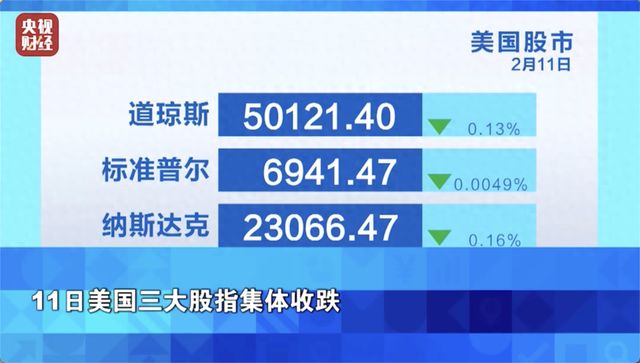
来源:红星新闻 11日,美国三大股指集体收跌。其中,道指下跌0.13%,标普500指数跌幅接近于零,纳指跌幅为 0.16%。 11日美国三大股指集体收跌 当地时间周三,美国劳工统计局公布了今年首份非农就业报告。经季节性调整后,1月美国非农业部门 新增就业人数13万人,大幅高于市场预期,当月失业率为4.3%,为去年8月以来新低。强劲的非农就业 报告促使投资者重新评估美联储的政策路径,今年首次降息的预期时间从6月推迟至7月,一定程度上打 击了市场风险偏好。叠加市场对软件行业将受到人工智能冲击的担忧再起,软件股遭到抛售,美国三大 股指盘中转跌,收盘时全线下跌。其中,道指下跌0.13%,标普500指数跌幅接近于零,纳指跌幅为 0.16%。 11日欧洲三大股指涨跌不一 原油期货方面,有媒体报道称,美国总统特朗普正私下评估退出《美墨加协定》的可能性,为三方谈判 注入了不确定性,引发市场对北美能源贸易前景的担忧。此外,欧佩克当天发布的月度原油市场报告显 示,受哈萨克斯坦、委内瑞拉及伊朗供应中断影响,OPEC+ 1月日均原油产量环比减少43.9万桶,远超 市场预期,进一步加剧了供应紧张局面。受以上因素影响,国际油价周三上涨。 ...
摩根大通减持潍柴动力(02338)约821.47万股 每股均价约26.67港元
Zhi Tong Cai Jing· 2026-02-12 11:40
Core Viewpoint - JPMorgan has reduced its stake in Weichai Power (02338) by approximately 8.21 million shares at an average price of about HKD 26.67 per share, totaling around HKD 219 million, resulting in a new holding of approximately 155 million shares, representing 7.98% of the company [1] Summary by Category Shareholding Changes - JPMorgan sold 8,214,741 shares of Weichai Power on February 6 [1] - The average selling price was HKD 26.6735 per share [1] - After the sale, JPMorgan's remaining shares in Weichai Power are approximately 155 million, equating to a 7.98% ownership stake [1]

金属涨跌互现 沪镍涨逾1% 碳酸锂涨超3% 欧线集运涨逾6%
Sou Hu Cai Jing· 2026-02-12 10:39
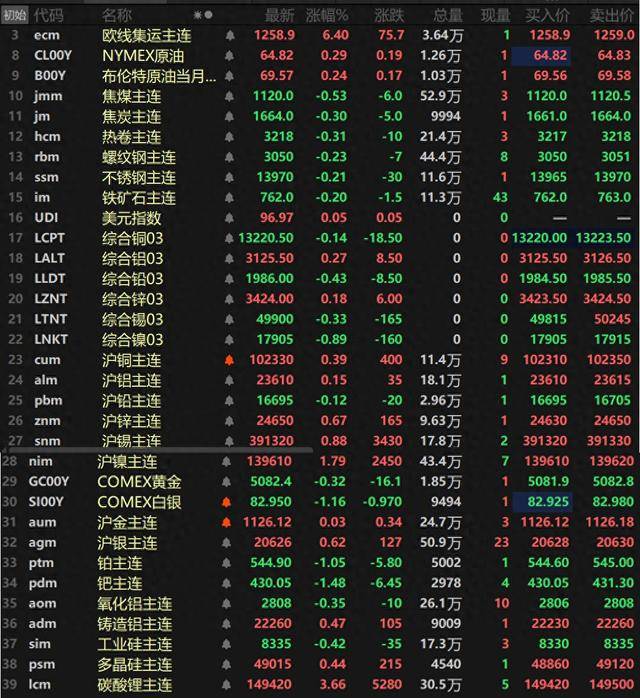
Metal Market - Domestic base metals experienced a general increase, with the exception of lead, which fell by 0.12%. Nickel led the gains with an increase of 1.79%, while other metals saw increases of less than 1% [1] - In the aluminum sector, alumina futures dropped by 0.35%, while casting aluminum futures rose by 0.47% [1] - Lithium carbonate futures increased by 3.66%, while industrial silicon futures fell by 0.42%, and polysilicon futures rose by 0.44% [1] - The European shipping index rose by 6.4% to 1258.9 [1] - In the black metal sector, iron ore, rebar, and stainless steel all saw declines of around 0.2%, with hot-rolled coil down by 0.31%. Coking coal fell by 0.53%, and coking coke dropped by 0.3% [1] - Internationally, base metals showed mixed results, with London aluminum up by 0.27% and lead up by 0.18%, while other metals experienced slight declines [1] - Precious metals saw COMEX gold down by 0.32% and silver down by 1.16%, while domestic gold rose by 0.03% and silver by 0.62% [1][2] Macro Environment - The State Administration for Market Regulation released guidelines for compliance in the automotive industry, highlighting significant legal risks associated with various pricing behaviors that could lead to below-cost pricing [5] - The National Energy Administration announced that by 2025, China's new wind and solar power installations are expected to exceed 430 million kilowatts, marking a 22% year-on-year increase [6][7] - The National Energy Administration emphasized the importance of developing new energy storage and future industries such as hydrogen and nuclear fusion energy [8] - The Ministry of Commerce announced that consumers purchasing new cars during the 2026 Spring Festival can apply for subsidies under the old-for-new vehicle policy [9] - The People's Bank of China conducted a net injection of 448 billion yuan through reverse repos, maintaining liquidity in the market [9]
一季度《中国经济观察》发布:经济韧性与分化并存,政策蓄力构建再平衡
Sou Hu Cai Jing· 2026-02-12 09:18
Group 1 - The core viewpoint of the articles indicates that China's economy is projected to reach 140 trillion yuan in 2025, with a real GDP growth of 5.0%, meeting the initial target growth rate [2] - In 2025, the industrial production showed steady improvement, with the manufacturing value-added growing by 6.1% year-on-year, supported by strong export demand and domestic equipment renewal policies [5] - The retail sales of consumer goods in 2025 increased by 3.7% year-on-year, although the fourth quarter saw a decline of 1.8%, marking the first quarterly negative growth since 2023 [9] - Fixed asset investment in 2025 experienced a decline of 3.8%, marking the first annual negative growth since records began, with significant contractions in real estate and infrastructure investments [12] - Exports in 2025 grew by 5.5%, with a trade surplus reaching nearly 1.2 trillion USD, the highest on record, driven by high-end manufacturing categories like integrated circuits and new energy products [15] Group 2 - Looking ahead to 2026, the central economic work conference emphasizes higher quality requirements for economic growth, with macro policies expected to maintain a steady expansion [3] - The government plans to support domestic demand and optimize supply, with a focus on increasing investment in human capital and lowering financing barriers for private enterprises [3] - The manufacturing PMI for January 2026 was reported at 49.8%, indicating a contraction in manufacturing activity, primarily due to insufficient domestic demand recovery [18] - The non-manufacturing business activity index for January 2026 was at 49.4%, with the construction sector returning to contraction territory, influenced by adverse weather and the upcoming holiday [19] - Public fiscal revenue in 2025 saw a year-on-year decline of 1.7%, with expenditures also falling short of budgeted growth, reflecting a cautious fiscal environment [22]

日度策略参考-20260212
Guo Mao Qi Huo· 2026-02-12 07:08
1. Report Industry Investment Ratings - Not provided in the given content 2. Core Views of the Report - Short - term pre - holiday stock index is expected to be in a strong sideways trend, accumulating strength for further upward movement. Long - term long positions in stock index futures should be held [1] - Asset shortage and weak economy are beneficial for bond futures, but the central bank has recently warned about interest rate risks. Attention should be paid to the Bank of Japan's interest rate decision [1] - Copper prices may be in a sideways and slightly upward trend; aluminum prices are likely to maintain a sideways movement; there are low - buying opportunities for alumina; zinc prices are expected to move sideways, and it is advisable to wait and see; nickel prices are in a strong sideways trend in the short - term, and long - term high global nickel inventory may still have a suppressing effect. Stainless steel futures are in a strong movement, and short - term low - buying is recommended [1] - Precious metal prices are expected to stabilize and move in a sideways range in the short - term. Platinum and palladium are expected to continue wide - range fluctuations [1] - For industrial silicon, the northwest is increasing production while the southwest is reducing it. For polysilicon, it is recommended to wait and see. For lithium carbonate, there is a need for a correction [1] - For steel products such as rebar and hot - rolled coil, it is not recommended to hold unilateral speculative positions during the holiday. For iron ore, it is not advisable to chase long at the current position. For black metals like manganese silicon and ferrosilicon, the situation is a combination of weak reality and strong expectations. For soda ash, the price is under pressure in the medium - term. For coking coal and coke, it is advisable to seize the opportunity of the price increase on the futures market to cash out the physical goods or establish a cash - and - carry arbitrage position [1] - For palm oil, it is recommended to wait and see before the holiday. For soybean oil, it is expected to move sideways in the short - term. For rapeseed oil, the subsequent supply contradiction is expected to ease. For cotton, the market is currently in a situation of "having support but no driving force". For sugar, the short - term fundamentals lack continuous driving force. For corn, it is recommended to wait and see in the short - term, and the market is expected to maintain a range - bound movement. For soybeans, it is recommended to pay attention to the low - buying opportunity of M2609 [1] - For pulp, it is advisable to wait and see. For logs, the futures price has an upward driving force [1] - For fuel oil and asphalt, the short - term supply - demand contradiction is not prominent and they follow crude oil. For rubber products such as natural rubber and BR rubber, the short - term is in a wide - range fluctuation, and BR rubber has an upward expectation in the long - term. For PTA and short - fiber, the downstream PTA industry is strong. For ethylene and glycol, the ethylene producers plan to maintain the operating rate of cracking units, and the glycol price is waiting at a low level. For pure benzene, the import demand is weak. For styrene, the spot price is supported. For water hyacinth, the upside space is limited. For methanol, it is a situation of long - short entanglement. For PP, the supply pressure is relatively large. For PVC, the future expectation is relatively optimistic. For LPG, the demand side is short - term bearish, suppressing the upward movement of the futures price [1] - For the container shipping European line, the pre - holiday freight rate has peaked and declined. The airlines are still cautious about trial resumption of flights and are expected to have a strong willingness to stop the price decline and raise prices after the off - season in March [1] 3. Summaries by Related Catalogs Macro - finance - Stock index futures: Short - term pre - holiday is expected to be in a strong sideways trend, and long - term long positions should be held [1] - Bond futures: Asset shortage and weak economy are beneficial, but the central bank has warned about interest rate risks, and attention should be paid to the Bank of Japan's interest rate decision [1] Non - ferrous metals - Copper: Pre - holiday downstream demand is weak, but copper prices may be in a sideways and slightly upward trend as market sentiment improves [1] - Aluminum: Industrial driving force is limited, and pre - holiday market risk - aversion sentiment has increased. Aluminum prices may maintain a sideways movement [1] - Alumina: Domestic operating capacity has decreased, and there are disruptions in the supply of a large - scale alumina enterprise in North China. Pay attention to low - buying opportunities [1] - Zinc: The cost center is stabilizing, and market sentiment has stabilized. Zinc prices are expected to move sideways, and it is advisable to wait and see [1] - Nickel: The US non - farm payrolls exceeded expectations, and market sentiment fluctuated. Indonesia's nickel ore quota policies have increased concerns about future supply. Short - term nickel prices are in a strong sideways trend, and there are high - inventory pressures in the long - term. It is recommended to pay attention to low - buying opportunities [1] - Stainless steel: Supply - side disturbances have emerged again, and macro sentiment is fluctuating. Stainless steel futures are in a strong movement. Short - term low - buying is recommended [1] - Tin: The short - term market sentiment has stabilized, but the price fluctuation is still large. In the short - term high - volatility situation, investors should pay attention to risk management and profit protection [1] Precious metals and new energy - Precious metals: The US non - farm payrolls in January were strong, and the interest - rate cut expectation was postponed. Due to high geopolitical uncertainties in the Middle East, precious metal prices are expected to stabilize and move in a sideways range in the short - term [1] - Platinum and palladium: The US non - farm payrolls in January were strong, and the US dollar index rebounded, suppressing the upward trend. However, fundamentals and key minerals support the prices, so they are expected to continue wide - range fluctuations in the short - term [1] - Industrial silicon: The northwest is increasing production, while the southwest is reducing it. The production schedules of polysilicon and organic silicon in December have decreased [1] - Polysilicon: It is recommended to wait and see [1] - Lithium carbonate: It is the off - season for new energy vehicles, but the energy - storage demand is strong. The price has increased significantly and needs a correction [1] Black metals - Rebar and hot - rolled coil: Spot trading is close to suspension, and futures prices are moving sideways. It is not recommended to hold unilateral speculative positions during the holiday. It is advisable to participate in the market by going long on the basis [1] - Iron ore: There is sector rotation, but there is obvious upward pressure. It is not advisable to chase long at the current position [1] - Manganese silicon and ferrosilicon: It is a combination of weak reality and strong expectations. Energy consumption dual - control and anti - involution may have an impact on supply [1] - Soda ash: It follows glass, and the medium - term supply - demand is more relaxed, so the price is under pressure [1] - Coking coal: It is the off - season for black metals, and the pre - holiday inventory replenishment is almost over. The futures market is more affected by capital sentiment. It is advisable to seize the opportunity of price increase on the futures market to cash out the physical goods or establish a cash - and - carry arbitrage position [1] - Coke: The logic is the same as that of coking coal [1] Agricultural products - Palm oil: The MPOB monthly report data has a bullish expectation difference, but the subsequent fundamentals still have pressure, which has little impact on the futures market. It is recommended to wait and see before the holiday [1] - Soybean oil: Supported by the strong movement of US soybeans, the South American weather is normal, and it is difficult to have weather - related speculation. More attention should be paid to the Sino - US soybean trade situation [1] - Rapeseed oil: The anti - dumping final ruling result of Canadian rapeseed has been released. After March, the tariff is expected to be adjusted to about 15%. Some oil mills have started purchasing, and the subsequent supply contradiction is expected to ease [1] - Cotton: The domestic new - crop harvest is expected to be good, and the purchase price of seed cotton supports the cost of lint cotton. The downstream operating rate is low, but the yarn mill inventory is not high, and there is a rigid demand for inventory replenishment. The cotton market is currently in a situation of "having support but no driving force" [1] - Sugar: There is a global surplus, and the domestic new - crop supply has increased. The short - term fundamentals lack continuous driving force, and attention should be paid to the change in the capital side [1] - Corn: Affected by the import restriction news, the futures market is strong. It is recommended to wait and see in the short - term. After the holiday, attention should be paid to the selling pressure of on - the - ground grain in the production area. The overall market is expected to maintain a range - bound movement [1] - Soybeans: The expected increase in US soybean exports has boosted the US futures market, but the decline in Brazilian basis has partially offset the impact. The domestic futures market is weaker than the overseas market. It is recommended to pay attention to the low - buying opportunity of M2609 [1] Others - Pulp: There are disturbances on the supply side, but the demand side has weakened after inventory replenishment. It is advisable to wait and see when the commodity market sentiment fluctuates greatly [1] - Logs: The spot price of logs has increased, the arrival volume in February has decreased, and the overseas quotation is expected to rise, so the futures price has an upward driving force [1] Energy and chemical industry - Fuel oil: OPEC+ has suspended production increase until the end of 2026, the Middle East geopolitical situation is uncertain, and the commodity market sentiment has cooled. The short - term supply - demand contradiction is not prominent, and it follows crude oil [1] - Asphalt: The short - term supply - demand contradiction is not prominent, following crude oil. The 14th Five - Year Plan rush - work demand is likely to be falsified, the supply of Ma瑞 crude oil is sufficient, and the asphalt profit is high [1] - Natural rubber: The raw material cost has strong support, the commodity market sentiment fluctuates, the pre - holiday downstream demand has weakened, and the futures - spot price difference has expanded to the same - period high [1] - BR rubber: The cost - end butadiene has strong bottom support, the profit of private butadiene rubber plants is still in a loss, the expectation of maintenance and production reduction has increased, the butadiene inventory is decreasing, and the high inventory of butadiene rubber is a potential negative factor. The short - term futures market is expected to fluctuate widely, and there is an upward expectation in the long - term [1] - PTA: The PX - mixed xylene price difference has narrowed to $150, PX maintains fundamental resilience during the high - level correction, and the downstream PTA industry is strong. The domestic PTA production in January is expected to reach a new high, and there is no production - reduction plan for the Spring Festival, and there is no new PTA production capacity throughout the year [1] - Ethylene and glycol: The production profit rate of naphtha cracking has declined, several Korean ethylene producers plan to maintain the operating rate of cracking units in February, and the glycol price is waiting at a low level [1] - Pure benzene: The inventory is high, and the import demand is weak. The US - Asia price difference is $88, which is not enough to open the arbitrage window [1] - Styrene: The Asian styrene price and economic situation are recovering, supported by supply tightening, unexpected Middle East shutdowns, surging export demand, and rising cost - end prices [1] - Water hyacinth: The export sentiment has eased slightly, the domestic demand is insufficient, and the upside space is limited. There is support from anti - involution and the cost end [1] - Methanol: Affected by the Iranian situation, the future import is expected to decrease, but the downstream negative feedback is obvious. It is a situation of long - short entanglement [1] - PP: The supply pressure is relatively large due to high operating load, the downstream improvement is less than expected, the price has returned to a reasonable range, and crude oil is in a slightly upward trend [1] - PVC: The global production capacity put into operation in 2026 is small, and the differential electricity price in the northwest region is expected to be implemented, forcing the elimination of PVC production capacity. The future expectation is relatively optimistic, but the current fundamentals are poor, and the export rush has slowed down stage by stage [1] - LPG: The February CP price has risen, and the March purchase is still relatively tight. The Middle East geopolitical conflict has cooled down, the short - term risk premium has declined, and the overseas cold - wave driving logic has gradually slowed down. The domestic PDH operating rate has declined, and the demand side is short - term bearish, suppressing the upward movement of the futures price [1] Shipping - Container shipping European line: The pre - holiday freight rate has peaked and declined. Airlines are still cautious about trial resumption of flights and are expected to have a strong willingness to stop the price decline and raise prices after the off - season in March [1]
2026年一季度中国经济观察报告-毕马威
Sou Hu Cai Jing· 2026-02-12 06:22
Economic Overview - In 2025, China's economy reached a total of 140 trillion yuan, with a real GDP growth of 5.0%, achieving the target set at the beginning of the year. The GDP growth rate for the fourth quarter was 4.5%, down 0.3 percentage points from the third quarter, with external demand being the main support while consumption and investment remained weak [1][15][30] - The economic landscape showed four distinct divergences: supply-demand, internal-external demand, new-old momentum, and macro data versus micro perception. Traditional industries faced demand losses and slow capacity clearance, leading to supply-demand mismatches that affected prices and corporate profits [1][31] Investment Trends - Fixed asset investment in 2025 saw a historic decline of 3.8%, marking the first annual negative growth since records began. In the fourth quarter, investment dropped by 12.8%, significantly worse than the 6.2% decline in the third quarter. Real estate, infrastructure, and manufacturing investments all saw substantial declines [19][50] - The government is expected to implement policies to stabilize and support investment, with a focus on "investing in people" and encouraging private investment. The manufacturing sector is anticipated to see marginal improvements due to the "14th Five-Year Plan" emphasizing technological innovation and industrial upgrades [2][51][60] Consumption Insights - The total retail sales of consumer goods in 2025 grew by 3.7%, with a notable decline of 1.8% in the fourth quarter, marking the first quarterly negative growth since 2023. However, service consumption and self-indulgent consumption showed resilience, with service consumption growth reaching 5.5% [18][37] - The consumption market is expected to continue its shift towards new and quality-driven consumption, with policies aimed at promoting green, intelligent, and elderly-friendly consumption [2][18] Export Performance - Exports in 2025 increased by 5.5%, with a trade surplus of nearly 1.2 trillion USD, a historical high. High-end manufacturing emerged as the core driver of exports, supported by strong demand from ASEAN, Africa, India, and other regions [21][30] - The government aims to address trade imbalances and enhance the quality of exports while navigating the challenges posed by global trade protectionism [21][30] Fiscal Policy - Public fiscal revenue in 2025 decreased by 1.7%, falling short of the initial budget growth target of 0.1%. Public expenditure growth was only 1.0%, the lowest completion rate on record at 96.8% of the budget [22][65] - The government plans to increase fiscal support for infrastructure and social welfare, with a focus on stabilizing investment and consumption in 2026 [22][65] Monetary Policy - In 2025, monetary policy was characterized by moderate easing, with a total of 50 basis points in reserve requirement ratio cuts and 10 basis points in interest rate cuts. The focus for 2026 will be on stabilizing expectations and promoting transformation [23][60] - The central bank is expected to maintain a flexible and effective monetary policy, with potential further cuts in interest rates and reserve requirements to support economic recovery [23][60]
