电商

Search documents
奈克萨斯资本7亿美元新基金半数投向印度初创企业
Xin Lang Cai Jing· 2025-12-04 12:16
如今许多风投公司似乎眼中只有人工智能(AI),但奈克萨斯风险投资公司(Nexus Venture Partners) 却在其 7 亿美元新基金的布局上刻意分散重心。 该公司将同时支持人工智能初创企业,并物色聚焦印度市场的初创公司,覆盖消费、金融科技及数字基 础设施领域。 人工智能已吸纳了全球大部分风险资本,这家拥有 20 年历史的风投公司也将人工智能视为具有决定性 意义的技术变革。但该公司认为,扎堆涌入单一过热领域本身存在风险。而印度数字经济恰好能提供平 衡:这一市场正不断扩张,人工智能的应用率持续上升,且机遇类型更为多元。 奈克萨斯风险投资公司美国区另一位管理合伙人阿比舍克・夏尔马(Abhishek Sharma)向 TechCrunch 透露,该公司的核心投资阶段仍集中在企业创立期至种子轮及 A 轮,初始投资金额通常低至几十万美 元,或在 100 万美元左右。 奈克萨斯的投资团队共有 8 名成员,公司最初以 1 亿美元基金起步,自 2023 年推出第七期基金以来, 始终将单只基金规模控制在 7 亿美元。该公司通常每 2.5 至 3 年募集一次资金。巴塔查尔吉表示,第八 期基金维持这一规模的原因在于,公司认 ...
不做外卖不谈 AI,拼多多暗渡陈仓
晚点LatePost· 2025-12-04 12:09
Core Viewpoint - Pinduoduo has quietly continued to grow in its tenth year, focusing on defensive strategies amid increasing competition and market challenges, while adapting its subsidy strategies to maintain market share and user engagement [2][3][4]. Group 1: Company Growth and Market Position - Pinduoduo's GMV (Gross Merchandise Volume) has continued to grow by 15% to 20%, outperforming Alibaba and JD.com, although slightly below Douyin's e-commerce growth [3][6]. - The company aims for its domestic e-commerce GMV to reach 6 trillion yuan, including various services like Duoduo Grocery and Kuaiduo [3]. - Pinduoduo's Duoduo Grocery has seen significant growth, with GMV nearing 300 billion yuan, surpassing the combined GMV of Duoduo Grocery and Meituan's grocery service from the previous year [8][9]. Group 2: Competitive Strategies - Pinduoduo has adjusted its subsidy strategies in response to national subsidies, focusing on fast-moving consumer goods rather than competing directly on high-value items [5][6]. - The company has implemented "smart coupons" to target users who frequently browse but do not purchase, offering discounts to encourage conversions [5]. - Pinduoduo has expanded its presence in less competitive regional markets, such as Xinjiang and Tibet, to capture more users and increase GMV [5][10]. Group 3: Operational Efficiency - Pinduoduo has maintained a lower operational cost structure compared to competitors, allowing it to offer competitive pricing without extensive subsidies [4][10]. - The company has a three-tiered workforce structure, which helps in controlling costs while maintaining service efficiency [10]. - Pinduoduo's focus on reducing human resource costs has enabled it to achieve profitability in its grocery business, with expectations of continued growth at 20% to 30% annually [10][11]. Group 4: International Expansion - Pinduoduo's international platform, Temu, has achieved significant revenue growth, with expectations to reach 90 billion dollars in sales, expanding into nearly 100 countries [13][15]. - Temu is shifting towards compliance and local operations, with a focus on optimizing logistics and merchant expansion in key markets [13][15]. - The management structure has evolved to better oversee both domestic and international operations, reflecting a strategic shift in focus [14][15]. Group 5: Financial Position - Pinduoduo holds a substantial cash reserve of 423.8 billion yuan, positioning it as one of the internet companies with the highest cash holdings in China [17].



看涨
第一财经· 2025-12-04 11:44
2025.12. 04 A股三大指数呈明显分化走势,全天震荡加剧, 沪指低开后探底回升, 险守3870点关键支撑, 而深成指、创业板指则震荡上行, 技术面上, 沪指失守5日均线, 上方3900点构成压力。 454家上涨 38745 涨跌停比 0H 2 3 个股仍呈普跌格局,但局部热点爆发力度较强。 盘面上,大消费走弱,零售、餐饮、白酒、电商方 向跌幅靠前;铝业、黄金、稀土、房地产行业表 现不振,商业航天、机器人、半导体概念股走 强。 资金情绪 主力资金净流出 两市成交额 ● 万亿元▼ 7.25% 散户资金净流入 机构谨慎偏积极,聚焦政策催化的高景气赛道,资金向人形机器人、商业航天、半导体等硬科技领域集中, 借市场震荡进行结构性加仓,同时对消费、AI应用等估值偏高或需求疲软的板块进行减仓;散户呈"跟随 性布局"特征,部分散户跟风买入硬科技相关板块龙头标的,与主力资金流向形成一定共振,而对调整中 的消费板块则普遍持观望态度,显示市场在分化中仍具备一定的自我修复能力。 散户情绪 75.85% HB7 足花 游 f PE VA 上证指数 10月9日 e a manufacturers a 今天你冲了还是撤了? 两市成 ...

分期乐商城双十二发力生活刚需,打造有温度的年末大促
Xin Lang Cai Jing· 2025-12-04 09:56
Core Insights - The article highlights the launch of the "12·12 Year-End Festival" by Fenqile Mall, aimed at enhancing consumer spending during the year-end shopping season through extended promotional periods and diverse discount offerings [1][4]. Group 1: Event Overview - The "12·12 Year-End Festival" runs from December 1 to December 12, providing a 12-day window for consumers to enjoy discounts without the need for last-minute rush [2][6]. - The promotional strategy includes a comprehensive welfare matrix, offering discounts across various categories such as electronics, fashion, beauty products, second-hand goods, and daily necessities [2][6]. Group 2: Discount Structure - Basic benefits include a 10% discount on purchases over 100 yuan, with additional tiered discounts available through a large coupon package valued at 780 yuan, which includes various thresholds for savings [2][6]. - Low-threshold payment discounts are also available, such as a 5 yuan discount on purchases over 10 yuan, catering to smaller transactions [2][6]. Group 3: Exclusive Benefits - The festival features exclusive benefits, including supermarket cards worth over one million yuan, which can be redeemed for essential goods after making a purchase during the event [7]. - Users can receive supermarket cards with values up to 200 yuan after confirming their orders, enhancing the appeal of the event [7]. Group 4: Market Performance - During the previous shopping event from October 22 to November 12, Fenqile Mall saw a 42% increase in order numbers, a 38% rise in total transaction value, and a 53% growth in the number of buyers [3][4]. - The essential consumer goods sector experienced a remarkable surge, with transaction values increasing by 237% and order numbers rising by 384%, indicating strong consumer preference for Fenqile Mall's services [4][7]. Group 5: Strategic Focus - Fenqile Mall's strategy emphasizes combining discounts with installment payment options to lower consumer spending barriers, particularly targeting the younger demographic [4][7].
阿里巴巴-W(09988):重启新篇章:聚焦、增长、重估
SINOLINK SECURITIES· 2025-12-04 09:19
Investment Rating - The report assigns a "Buy" rating for Alibaba Group, with a target market value of 3.36 trillion RMB and a target price of 192.48 HKD for FY2026 [5]. Core Insights - Alibaba has restructured its organization to focus on "e-commerce, cloud + AI," enhancing resource allocation and competitive response [2][25]. - The company is actively participating in the instant retail market, which is expected to exceed 2 trillion RMB by 2030, thus defending its market share [16]. - Alibaba Cloud is positioned as a top-tier player in AI and cloud computing, with significant investments in self-developed capabilities [4]. Summary by Sections Company Overview - Alibaba Group is a leading global e-commerce and internet technology group that has recently restructured its business into four main segments: China E-commerce Group, International Digital Commerce Group, Cloud Intelligence Group, and Others [2]. Investment Logic - Instant retail is crucial for maintaining e-commerce traffic advantages, with a notable increase in daily active users (DAU) and order volumes since May [3]. - The company has seen a significant rise in order volume, with peak orders reaching 120 million in July, and a substantial increase in market share in the food delivery sector [3][19]. - Alibaba's investment in user experience (UE) is expected to improve as scale and efficiency increase, with current losses narrowing significantly [3]. Financial Forecasts, Valuation, and Rating - The adjusted net profit forecasts for FY2026-2028 are 107.9 billion, 149.4 billion, and 175.8 billion RMB, respectively, with corresponding adjusted P/E ratios of 24.8, 17.9, and 15.2 [5]. - The e-commerce business (excluding instant retail) is valued at 11 times earnings, while the cloud business is valued at 7 times sales [5]. - The report anticipates stable market share for Alibaba's traditional e-commerce business and significant growth potential for its cloud services driven by AI [5]. Additional Insights - The report highlights the competitive landscape in the instant retail market, with Alibaba's aggressive strategies to boost user engagement and order fulfillment capabilities [19][39]. - Alibaba's cash reserves are the highest among competitors, providing a strong foundation for sustaining long-term investments in the instant retail sector [51][52]. - The introduction of the "High De" street ranking by Amap aims to synergize online and offline services, indicating potential growth in the in-store business [58].

新力量NewForce总第4917期
First Shanghai Securities· 2025-12-04 09:09
Group 1: Amazon (AMZN) - AWS revenue in Q3 increased by 20% year-on-year to $33 billion, with backlogged orders rising to $200 billion[5] - AI shopping assistant Rufus has been used by 250 million customers, increasing purchase likelihood by 60%[6] - Target price set at $303.50, indicating a 30% upside from the current price of $233.00[7] Group 2: Meta Platforms (META) - Q3 total revenue reached $51.24 billion, a 26.2% year-on-year increase, exceeding expectations[12] - Family of Apps revenue was $50.77 billion, with ad revenue growing by 25.6%[12] - Target price set at $800, representing a 23.63% upside from the current price of $647.10[15] Group 3: Cambricon (688256) - Q3 revenue was $1.73 billion, significantly exceeding the pessimistic forecast of $1-1.5 billion, with a year-on-year increase of 1,333%[19] - Target price set at ¥1,683, indicating a 26% upside from the current price of ¥1,332.3[22] - Expected revenue growth of 481% in 2025, reaching ¥6.82 billion[22] Group 4: SUTENG (2498) - Q3 revenue was $4.07 billion, flat year-on-year but down 10.6% quarter-on-quarter[29] - ADAS business revenue declined by 25.7% year-on-year, while robotics revenue surged by 157.8%[29] - Target price set at HK$41.25, indicating a 33% upside from the current price of HK$31.08[32]


四川出台新一轮稳增长政策,巩固拓展经济回升向好势头 新“18 条”延续了啥?调整了啥?
Si Chuan Ri Bao· 2025-12-04 08:41
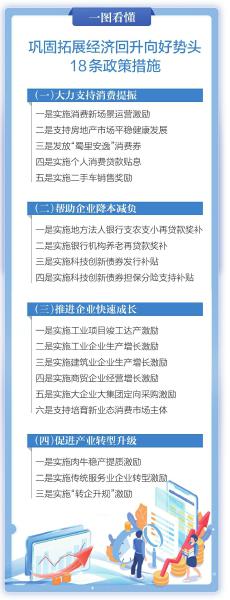
Core Viewpoint - The Sichuan Provincial Government has issued a new set of policies, referred to as the "new 18 measures," aimed at consolidating and expanding the positive momentum of economic recovery, focusing on consumption, production, circulation, and boosting expectations [4][8]. Group 1: Policy Framework - The new policies emphasize systematic planning and coordination with central and previously issued policies to enhance overall policy effectiveness and create a synergistic effect [3][5]. - The new 18 measures include 18 specific initiatives that support consumption, reduce costs for enterprises, promote rapid growth of businesses, and facilitate industrial transformation and upgrading [4][6]. Group 2: Continuity and Adjustments - The new 18 measures retain several initiatives from previous policies, such as incentives for second-hand car sales and targeted procurement by large enterprises, while also introducing new adjustments [5][6]. - The fiscal incentives for newly established industrial projects have been increased, with the maximum subsidy raised from 1 million yuan to 1.5 million yuan for projects meeting specific criteria [6]. Group 3: Targeted Measures - The new policies introduce measures to help enterprises reduce costs, such as subsidies for issuing technology innovation bonds, with increased support for first-time issuers [7]. - There is a focus on cultivating new market entities in the consumption sector, with financial incentives for service-oriented e-commerce platforms that achieve significant growth [7][8].
《京东“TGT 燃力之旅”在京举办,与青年技术天才共话未来》
Zhong Jin Zai Xian· 2025-12-04 08:05
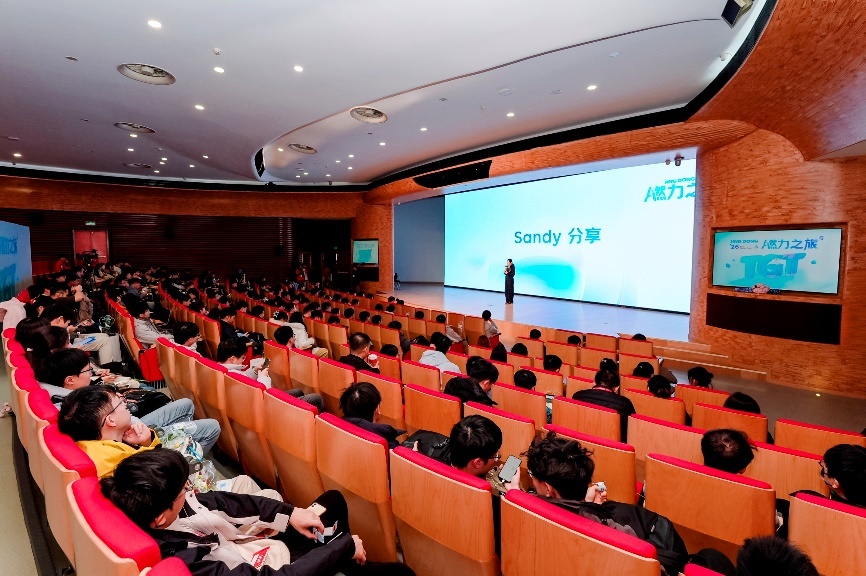
Core Insights - JD Group successfully held the "TGT Fuel Journey" technology open day event, focusing on the integration of cutting-edge technologies like artificial intelligence with industry trends [1] - The event provided a platform for outstanding technical talents to engage with technology leaders, showcasing JD's technology strategy, industry practices, and talent philosophy [1][3] Group 1: Talent Development - JD Group's SEC Vice Chair and CEO Xu Ran emphasized that talent is paramount, stating that all achievements stem from the team, and the primary virtue of corporate management is talent cultivation [3] - The company aims to create a fertile technological environment, encouraging young technical talents to transform cutting-edge technologies into industrial value while fostering curiosity and creativity [3] Group 2: AI Strategy - During the technology roundtable, JD's technology leaders shared insights on their AI strategy, with a focus on the competitive landscape of cloud computing [5] - JD Cloud's core advantage lies in its deep understanding of complex retail, logistics, and health scenarios, with a commitment to substantial investment in talent and resources [6] - The research institute has evolved from early-stage exploration of frontier technologies to a dual mission of "forward-looking research" and "key technology breakthroughs," emphasizing innovation as its core [6] Group 3: E-commerce Transformation - JD's AI strategy is not only about applying new technologies but also about creating a closed loop between self-developed technologies and business scenarios, aiming to build the next generation of AI-driven e-commerce [6] - Two employees who joined through the TGT program shared their experiences, highlighting JD's commitment to nurturing technical newcomers and its open and inclusive technical culture [6] Group 4: Immersive Experience - The event included immersive experiences such as a technology market, JD Pilot Space visits, and in-depth business line exchanges, allowing participants to experience the application of JD's technology in real-life scenarios [8] - The "TGT Fuel Journey" is a key component of the TGT program, designed to help young technical talents understand JD's mission of "technology-based, making life better" [8] - JD plans to continue investing in and nurturing top technical talents, creating an open, cutting-edge, and challenging platform to attract and support global top technical talents [8]

外卖、AI 2025年的阿里打赢了命运之战
新财富· 2025-12-04 08:04
Core Viewpoint - Alibaba is refocusing its strategy around e-commerce and AI cloud services, with significant investments planned for infrastructure and product development, aiming to reclaim its market position and enhance user engagement [2][3][31]. Investment and Strategic Focus - CEO Wu Yongming announced an investment of over 380 billion yuan in cloud and AI hardware infrastructure over the next three years, exceeding the total investment of the past decade [3]. - The company is prioritizing long-term investment in core businesses while seeking to monetize non-profitable segments quickly [2]. E-commerce Developments - In April, Alibaba launched "Taobao Flash Purchase," integrating various categories into a "30-minute delivery" system, marking its entry into the competitive food delivery market [4]. - By Q3 2025, the average daily order volume for Alibaba's delivery services surged to 28-30 million, increasing its market share from 18% to 32% [9][11]. AI and Technology Advancements - Alibaba's Qwen series of AI models has achieved over 600 million downloads globally, establishing itself as a leading choice for developers [4][17]. - The "Qwen" API offers competitive pricing, significantly lower than alternatives like GPT-4, enhancing its attractiveness in the market [16]. Product Launches and User Engagement - The "Qianwen" app, launched in November 2025, became the fastest-growing AI application, surpassing 10 million downloads in just one week [4][14]. - The introduction of Quark AI glasses represents a significant step in integrating AI into everyday life, allowing users to access various services seamlessly [5][27]. Market Position and Future Outlook - Alibaba's strategic shift is reflected in the rebranding of Ele.me to "Taobao Flash Purchase," emphasizing its integration into the broader Taobao ecosystem [29][30]. - The company aims to leverage both e-commerce and AI as dual engines for growth, signaling a return to its core strategic focus [31][32].

阿里卖掉子公司85%股权,收益60亿
2 1 Shi Ji Jing Ji Bao Dao· 2025-12-04 07:56
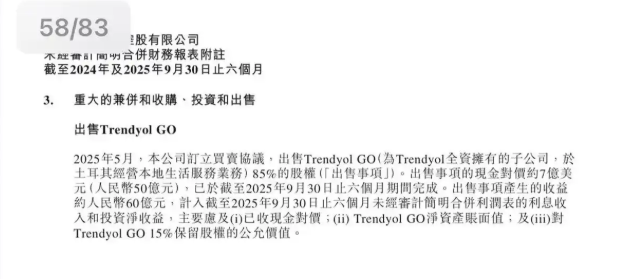
Group 1 - Alibaba disclosed in its mid-term report for the fiscal year 2026 that it sold 85% of Trendyol GO to Uber for approximately $700 million, generating a profit of about 6 billion RMB, which has been included in the investment net income for the first half of 2025 [1][3] - Trendyol GO, a rapid delivery service under Turkey's e-commerce giant Trendyol, completed over 200 million orders in 2024 with a transaction volume of $2 billion, making it a key player in Turkey's instant retail market [3] - The sale of Trendyol GO is part of a broader strategy, as Alibaba has also fully exited from offline retail formats by selling its stakes in Intime Retail and Sun Art Retail [3] Group 2 - Alibaba has established "AI-driven, cloud-first" as its core strategy, with CEO Wu Yongming indicating that the company is in a critical investment phase for building AI technology infrastructure and a consumer platform [3] - For the second quarter of fiscal year 2026, Alibaba reported revenue of 247.795 billion RMB, a year-on-year increase of 5%, while net profit decreased by 53% to 20.612 billion RMB [3] - The revenue from Alibaba's instant retail business reached 22.906 billion RMB, a 60% increase compared to 14.321 billion RMB in the same period last year [3] Group 3 - According to analysis from China Merchants Securities, Alibaba's e-commerce business is expected to maintain competitive strength, with growth potential in its food delivery services and long-term growth in cloud and AI businesses, projecting Non-GAAP net profits of 106.9 billion RMB, 166.6 billion RMB, and 201.8 billion RMB for FY2026-2028 [4]