
债券

Search documents
如何重新定义利率中枢?
2025-08-05 03:15
Summary of Conference Call Notes Industry Overview - The notes primarily discuss the bond market and its dynamics, particularly in relation to recent policy changes and market adjustments. Key Points and Arguments Policy Expectations and Market Dynamics - Recent adjustments in the bond market and commodity price increases are driven by policy expectations, particularly the "anti-involution" policy, which has created a short-term pulse effect in market trading [1][6] - The impact of the anti-involution policy on economic growth is limited and is not expected to lead to significant yield increases similar to those seen in 2016-2017 [1][9] - The current monetary policy environment shows low expectations for rate cuts or reserve requirement ratio reductions in the second half of the year, although conditions for a new round of monetary easing may gradually develop [1][10] Interest Rate Projections - The 10-year government bond yield is currently at 1.75%, which may represent a temporary peak, with potential for a decline to around 1.65% [1][10] - The introduction of a new VAT policy is expected to cause a one-time pricing impact on nominal interest rates, potentially leading to fluctuations of 5 to 11 basis points in the 10-year government bond yield [1][11] Credit Bond Market Insights - The secondary capital bond market ("二永") has shown significant performance, with the largest declines during market drops and the fastest recoveries during market rebounds [3][20] - Recent weeks have seen notable volatility in the credit bond market, with a mix of strong performance in short-term credit bonds and some underperformance in lower-rated city investment bonds due to liquidity issues [15][16] Institutional Behavior and Market Influence - Institutional behavior has played a crucial role in recent market dynamics, with banks and insurance companies increasing their net purchases of ordinary credit bonds, while public funds have been more cautious [24] - The current market recovery is primarily driven by institutional investors rather than speculative trading [24] Future Market Outlook - The bond market is expected to experience continued fluctuations in nominal interest rates, with a projected range of around 65 basis points [14] - The strategy moving forward should prioritize liquidity, focusing on short to medium-term investment opportunities, particularly in lower-rated city investment bonds, while maintaining a cautious stance on long-term investments [25] Additional Considerations - The anti-involution policy is expected to have long-term implications for the market, with its effects likely to persist beyond short-term adjustments [5][8] - The current steepness of the yield curve indicates potential for further downward movement in yields, particularly in the short to medium-term segments [18][19] Conclusion - The bond market is navigating through a complex landscape shaped by policy changes and institutional behaviors, with a cautious outlook for future interest rate movements and investment strategies.
债市早报:资金面均衡偏松;股市和商品市场反弹,债市承压转弱
Sou Hu Cai Jing· 2025-08-05 02:55
Group 1: Bond Market News - The People's Bank of China (PBOC) reported a net liquidity injection of 100 billion yuan through Medium-term Lending Facility (MLF) and 200 billion yuan through reverse repos in July 2025 [2] - The bond market experienced significant volatility due to the resumption of value-added tax on government bond interest, with the yield on 10-year government bonds initially dropping to around 1.68% before rising back above 1.7% [2] - The bond market is expected to see a short-term preference for existing bonds due to tax advantages, but this impact is not anticipated to affect the long-term trend of the bond market [2] Group 2: Service Trade - China's service trade grew steadily in the first half of 2025, with total service trade reaching 38,872.6 billion yuan, a year-on-year increase of 8.0% [4] - Service exports amounted to 16,883 billion yuan, up 15.0%, while imports reached 21,989.6 billion yuan, growing by 3.2% [4] - Travel services saw the fastest growth, with imports and exports totaling 10,802.9 billion yuan, a 12.3% increase, and exports growing by 68.7% [4] Group 3: Cross-Border Wealth Management - The Hong Kong Monetary Authority reported that over 160,000 individual investors participated in the "Cross-Border Wealth Management Connect" 2.0 program, marking a 120% increase compared to the previous version [5] - The market response has been positive, with the value of holdings by Hong Kong participating institutions exceeding 16 billion yuan, a twofold increase from the previous program [5] Group 4: Commodity Market - International crude oil prices continued to decline, with WTI September futures down 1.54% to $66.29 per barrel, and Brent October futures down 1.30% to $68.76 per barrel [8] - Natural gas prices also saw a significant drop, decreasing by 4.62% to $3.095 per million British thermal units [8] Group 5: Equity and Convertible Bond Market - The A-share market experienced a rebound, with major indices closing higher, and the convertible bond market also saw a collective increase, with the China Convertible Bond Index rising by 0.90% [19] - The trading volume in the convertible bond market reached 802.41 billion yuan, an increase of 10.16 billion yuan from the previous trading day [19] - A total of 415 convertible bonds rose in price, while 38 fell, indicating a generally positive market sentiment [19]
上交所:泰州市城市建设投资集团有限公司债券8月6日上市,代码243449
Sou Hu Cai Jing· 2025-08-05 02:10
8月5日,上交所发布关于泰州市城市建设投资集团有限公司2025年面向专业投资者公开发行公司债券 (第一期)(品种二)上市的公告。 依据《上海证券交易所公司债券上市规则》等规定,上交所同意泰州市城市建设投资集团有限公司2025 年面向专业投资者公开发行公司债券(第一期)(品种二)于2025年8月6日起在上交所上市,并采取匹 配成交、点击成交、询价成交、竞买成交、协商成交交易方式。该债券证券简称为"25泰城G2",证券 代码为"243449"。根据中国结算规则,可参与质押式回购。 来源:金融界 ...

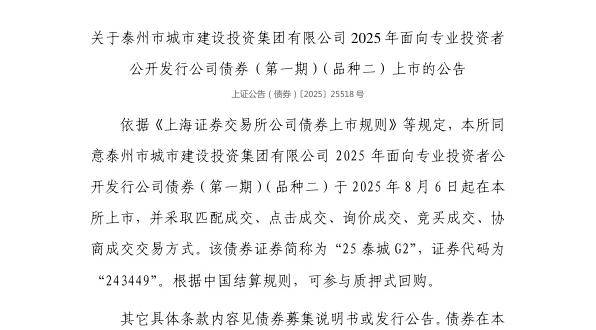
上交所:盐城市海兴集团有限公司债券8月6日上市,代码243453
Sou Hu Cai Jing· 2025-08-05 02:10
8月5日,上交所发布关于盐城市海兴集团有限公司2025年面向专业投资者公开发行公司债券(第三期) 上市的公告。 依据《上海证券交易所公司债券上市规则》等规定,上交所同意盐城市海兴集团有限公司2025年面向专 业投资者公开发行公司债券(第三期)于2025年8月6日起在上交所上市,并采取匹配成交、点击成交、 询价成交、竞买成交、协商成交交易方式。该债券证券简称为"25海兴06",证券代码为"243453"。 来源:金融界 ...
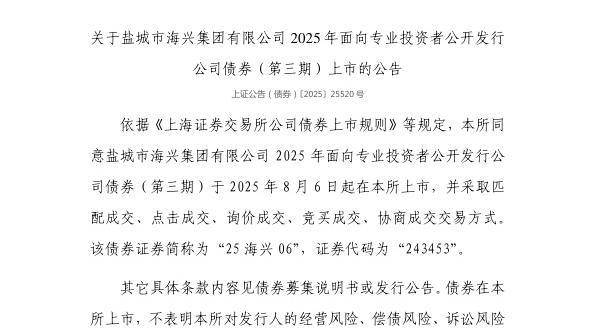
8月,债市或迎高光时刻
HUAXI Securities· 2025-08-05 01:44
Report Industry Investment Rating No relevant information provided. Core Viewpoints of the Report - In August, the bond market may reach its peak moment, becoming a decisive factor in the performance competition in the second half of the year. The opportunities in the first and middle ten - days of August may be greater, while the situation in the last ten - days needs further observation. With five major positive factors supporting, there is a 10 - 12bp downward space for the yields of 10 - year and 30 - year treasury bonds, and the potential returns are considerable when considering the duration [2][5]. Summary According to the Table of Contents 1. July Bond Market: "Unjust Disaster" - The bond market in July went against market expectations. The yields of 10 - year and 30 - year treasury bonds started at 1.64% and 1.85% respectively and rose to 1.75% and 2.00% by the end of the month, with an increase of 11bp and 15bp. The main reasons for the divergence between expectations and reality were the over - fermented risk appetite in the stock and commodity markets and the unexpected tightening of the capital market around the tax period [1][10]. - The bond market in July can be divided into three stages: a calm first ten - days, a turbulent middle ten - days, and a late ten - days when negative factors were released. In the late ten - days, affected by factors such as the start of a large - scale infrastructure project and the "anti - involution" trading, the bond market entered an irrational decline [11][12]. - In terms of various bond types, short - term bonds performed better than long - term bonds, and credit bonds outperformed interest - rate bonds. The yields of various bonds generally increased, and the 30 - year treasury bond had a single - month decline of 2.30%, making July the second - worst month for the bond market this year [15][16][18]. 2. Five Reasons to Be Bullish on the Bond Market in August 2.1. Do Not Underestimate the Change in the US Attitude on Tariff Issues - The result of the Sino - US tariff negotiation may become the main variable for asset pricing again. The US may use tariffs to seek benefits in investment or exports, which could damage global trade relations and create a negative atmosphere for Sino - US negotiations [2][21]. - In the new round of tariff negotiations, the US generally obtained favorable trade terms. This may make the US more aggressive in future Sino - US negotiations. If Sino - US relations deteriorate, it could suppress global and domestic risk preferences, which is beneficial to the bond market [22][24]. 2.2. The Fundamental Situation Weakens Marginally, but the Expectation of Policy Stimulus Retreats - The July PMI data showed that the manufacturing PMI was 49.3%, lower than the expected 49.7%. The new orders and production in the manufacturing industry declined, indicating weak demand. The large - scale net purchase of bills by major banks in July and the decline of bill interest rates to near zero may also suggest weak loan demand [25][26]. - The Politburo meeting at the end of July gave an optimistic assessment of the first - half economy, which may make it difficult to introduce short - term "stable growth" policies. If the economic data in the third quarter fluctuates, there may be a time lag before stimulus policies are introduced, which could lead to a decline in risk preferences and be beneficial to the bond market [29]. 2.3. The Suppression of Risk Appetite Caused by "Anti - Involution" Trading Weakens - From July 1st to 25th, affected by "anti - involution" trading, the futures prices of key commodities such as coking coal, coke, and polysilicon increased significantly, and the extreme risk preferences in the market were rapidly boosted, which was the main reason for the sharp adjustment of the bond market [30]. - To suppress speculation, commodity exchanges issued relevant policies at the end of July. The first stage of the general rise in the commodity market may have passed, and the over - risen commodities have entered the price correction stage. The market risk preference has returned to rationality, reducing the resistance to the rise of the bond market [31][32]. 2.4. In Terms of Liquidity, August May Be the Low Point of the Annual Capital Interest Rate - Generally, the capital interest rate in August does not increase significantly compared with July. The natural capital gap in August is not large. Although the net issuance of government bonds may increase, it is offset by the lower tax payment. The MLF maturity scale in August is 3000 billion yuan, and the maturity pressure of repurchase agreements has eased, which is conducive to maintaining a neutral and loose capital interest rate [34][35]. - Historically, the R001 and R007 in August can generally remain stable, and the increase in the capital interest rate usually occurs before the end of the month. After August, the capital interest rate may fluctuate due to factors such as the quarter - end pressure in September and uncertainties in the fourth quarter. Therefore, August may be the low point of the annual capital interest rate [36][37]. 2.5. Pay Attention to the Return of Redeemed Funds and the New Premiums of Insurance "Cost - Reduction" - In July, the continuous redemption of public bond funds by institutions amplified the adjustment of the bond market. However, the redemption pressure may only be within the "institution - fund" circle and has not spread outward. The liability of wealth management products and banks remained stable. For example, wealth management products continued to increase their holdings of certificates of deposit in July [46][49][50]. - If the redeemed funds of funds remain in the inter - bank market, they may flow back to the trading market as the bond market recovers in August, which could push the interest rate down. In addition, due to the adjustment of the insurance product interest rate, the yields of ultra - long - term local bonds and ultra - long - term treasury bonds have risen to around or above the "new cost line" of life insurance, and the ultra - long - term interest - rate bonds may experience an excessive decline in August [50][55][57]. 3. The Bond Market in August May Reach Its Peak Moment: Grasping the Rhythm Is Key - With five major positive factors, the bond market in August may reach its peak moment. The opportunities in the first and middle ten - days of August are greater, while the situation in the late ten - days needs further observation. From the end of July to the beginning of August, although the bond market entered the recovery stage, institutions were still cautious about the duration [5][59]. - It is recommended to extend the duration as much as possible with active individual bonds within the acceptable risk range. The bond interest tax - payment new rule announced by the Ministry of Finance on August 1st may affect the pricing of treasury bonds, local bonds, and financial bonds in three stages, but it is not a negative factor for the bond market [59][63].
大类资产早报-20250804
Yong An Qi Huo· 2025-08-04 14:09
Report Overview - The report provides a comprehensive overview of the global asset market performance on August 1, 2025, including bond yields, exchange rates, stock indices, and futures trading data [3][5][6] Global Bond Market 10 - Year Treasury Bond Yields - In major economies on August 1, 2025, the US was at 4.218%, the UK at 4.526%, France at 3.346%, etc. There were various changes in the latest, weekly, monthly, and yearly periods. For example, the latest change in the US was -0.172, and the one - year change was -0.067 [3] 2 - Year Treasury Bond Yields - Yields and their changes are presented for different countries. For instance, China (1Y) was at 3.940 on August 1, 2025, with a latest change of 0.080 [3] Exchange Rate Market Dollar against Major Emerging Economies' Currencies - On August 1, 2025, the exchange rate of the dollar against the Brazilian real was 5.542, with a latest change of -1.04%. There were also changes in weekly, monthly, and yearly periods [3] RMB Exchange Rates - The on - shore RMB was at 7.193, the offshore RMB at 7.194, etc. on August 1, 2025, with different changes in different time frames [3] Global Stock Index Market Major Economies' Stock Indices - As of August 1, 2025, the Dow Jones was at 6238.010, the S&P 500 at 43588.580, etc. There were different latest, weekly, monthly, and yearly changes. For example, the latest change in the Dow Jones was -1.60%, and the one - year change was 14.94% [3] Other Stock Indices - The report also includes data on the Russian, Japanese, and other countries' stock indices, such as the Nikkei at 40799.600 on August 1, 2025, with a latest change of -0.66% [3] Stock Index Futures Trading Data Index Performance - The closing prices and percentage changes of A - shares, CSI 300, etc. are provided. For example, the closing price of A - shares was 3559.95 with a -0.37% change [5] Valuation - PE (TTM) and its环比 changes are given for CSI 300, S&P 500, etc. For example, the PE (TTM) of CSI 300 was 13.12 with a -0.07环比 change [5] Risk Premium - The risk premium and its环比 changes are presented for some indices. For example, the 1/PE - 10 rate of the S&P 500 was -0.44 with a 0.22环比 change [5] Fund Flows - The latest values and 5 - day average values of fund flows for A - shares, the main board, etc. are shown. For example, the latest value of A - share fund flow was -522.29 [5] Trading Volume - The latest trading volumes and环比 changes of the Shanghai and Shenzhen stock markets, CSI 300, etc. are provided. For example, the latest trading volume of the Shanghai and Shenzhen stock markets was 15983.51 with a -3376.84环比 change [5] Main Contract Basis - The basis and basis ratio of IF, IH, and IC are given. For example, the basis of IF was -25.33 with a -0.62% basis ratio [5] Treasury Bond Futures Trading Data - The closing prices and percentage changes of T00, TF00, etc. are presented. For example, the closing price of T00 was 108.435 with a 0.17% change [6] - The money market shows the R001, R007, and SHIBOR - 3M rates and their daily changes in basis points [6]
银河基金魏璇:多空博弈,2025债市波动加剧
Sou Hu Cai Jing· 2025-08-04 13:35
风险提示:投资有风险,投资需谨慎。 来源:金融界 在2025年市场步入下半场之际,投资风向的演变成为各界瞩目的焦点。债市,作为金融市场的重要组成 部分,其动态牵动着众多投资者的心弦。在银河基金中期策略中,基金经理魏璇对2025年以来债市的深 入剖析,她表示,2025年宏观环境纷繁复杂,债市波动性显著加大,据Wind数据统计显示,国债利率 总体上行。 魏璇分析,第一阶段是2025年开年到3月17日,据Wind数据显示,10年国债利率震荡上行28.8bp至 1.90%,其中2月开始上行节奏加快。具体来看,1月利率先上后下,曲线走平。元旦之后债市情绪延 续,但随后央行提及防范资金空转的风险、以及更加关注长期限国债收益率的变化,通过公开市场操作 (OMO)连续净回笼等方式,对资金面进行了调节之后央行宣布暂停国债买卖,这一系列动作使得货 币政策边际收敛的情绪发酵,从而推动国债利率上行。不过1月下旬利率也短暂回落了一段时间,主因 在于特朗普就职美国总统后,触发了市场避险情绪,叠加春节前资金转松、市场降准降息的宽松预期所 致等。2月到3月中旬利率加速上行,曲线走陡。根据Wind中债10年国债收益率看,2.05-3.17期间 ...
[8月4日]指数估值数据(A股港股上涨;债券利息要收税,对我们投资有什么影响;月薪宝发薪日;黄金星级更新)
银行螺丝钉· 2025-08-04 13:26
Core Viewpoint - The article discusses the recent trends in the A-share and Hong Kong stock markets, the impact of tax changes on bond investments, and the performance of various investment products, particularly focusing on the "Fixed Income+" category and its implications for investors [8][26][44]. Market Trends - The A-share market showed slight fluctuations with a minor decline last week, while the Hong Kong market demonstrated a stronger upward trend this week [2][3]. - Large-cap stocks experienced minor gains, whereas small and mid-cap stocks saw more significant increases [4]. - Both value and growth styles in the market have risen [5]. Bond Market Insights - A recent announcement reinstated the value-added tax on interest income from newly issued government and local bonds starting August 8, which could negatively affect long-term pure bond investments [8][26]. - The 10-year government bond yield is currently around 1.7%, which is considered low compared to the normal range of 2%-3% [13][15]. - The article suggests that the bond market is nearing the end of a bull market phase, indicating potential overvaluation [12][30]. Investment Strategies - The "Fixed Income+" products, which combine bonds and a small portion of equities, have seen increased demand as investors seek stable returns amidst lower bond yields [32][36]. - Following the tax announcement, "Fixed Income+" products experienced a rise in value, reflecting a shift in investor preference [34][38]. - The article emphasizes the importance of monitoring tax and fee changes as indicators of market conditions, suggesting that increases in such costs may signal overvaluation in certain asset classes [20][25]. A-share and Hong Kong Market Implications - The flow of funds from long-term pure bonds may partially redirect into "Fixed Income+" products, which typically include equity allocations, providing a slight positive impact on the A-share and Hong Kong markets [44][46]. - High-dividend stocks are expected to benefit more significantly from this shift in investment strategy [48]. Product Offerings - The "Monthly Salary Treasure" investment product has lowered its entry threshold to 200 yuan and introduced a regular investment feature, catering to investors seeking consistent cash flow for needs such as retirement and education [50][53]. - The product employs a balanced strategy of 40:60 in stocks and bonds, with a rebalancing mechanism to optimize returns [52][54].
本轮信用债调整回顾与展望
HTSC· 2025-08-04 13:20
Report Industry Investment Rating No relevant content provided. Report's Core View - In August, credit bonds may fluctuate more on the whole, with more opportunities than risks, and credit buyers are relatively active. It is advisable for institutions with unstable liability ends to appropriately explore medium - and low - grade general credit bonds within 3 years, and trade 3 - 5 - year secondary perpetual bonds and high - grade general credit bonds with good liquidity. Institutions with strong trading capabilities can also appropriately trade ultra - long secondary perpetual bonds and take profit when the yield approaches the July low. General credit bonds are expected to have opportunities to narrow spreads, and the old secondary perpetual bonds are expected to have a small supplementary increase [22][23]. Summary According to the Directory Credit Hotspots: Review and Outlook of the Current Round of Credit Bond Adjustment - During July 18 - July 29, 2025, affected by policies and other factors, the bond market adjusted. Credit bonds had a larger correction amplitude than interest - rate bonds, with medium - and long - term adjustments more significant and secondary perpetual bonds adjusting more. Credit spreads generally widened, except for some passive narrowing [9]. - As of August 1, 2025, in the adjustment stage (7.18 - 7.29), secondary perpetual bonds had the largest correction amplitude, followed by 3Y, 5Y, 10Y general credit bonds. In the repair stage (7.29 - 8.1), short - and medium - term secondary perpetual bonds repaired first, and 1 - 5Y secondary perpetual bonds and medium - and high - grade 5Y, 10Y general credit bonds repaired relatively more [12]. - In terms of institutional behavior, from July 21 - July 29, funds sold a large amount of credit bonds, while wealth management and insurance increased their positions. From July 30 - August 1, institutional buyers were active, and the short - term redemption wave basically subsided. With the expected reduction of insurance product predetermined interest rates on August 31, buyers may continue to be active [14]. - Credit bond ETFs were affected by the bond market adjustment. During July 18 - July 29, the average closing prices of benchmark - making credit bond ETFs and science - innovation bond ETFs fell, and then repaired from July 29 - August 1. Most science - innovation bond ETFs increased in scale, while benchmark - making credit bond ETFs decreased slightly [15]. - The component bonds and non - component bonds of credit bond ETFs showed different trends in the adjustment and repair periods. Component bonds generally had a larger correction amplitude and a smaller repair amplitude, but the overall difference was not significant [19]. Market Review: "Anti - involution" Trading Cools Down, and Credit Bonds Fully Recover - From July 25 to August 1, 2025, after the July Politburo meeting, the "anti - involution" trading sentiment cooled down, the impact of the equity market on the bond market weakened, and the bond market recovered. Most credit bond yields declined, with short - and medium - term yields down about 3BP and medium - and long - term spreads up about 2BP passively. Secondary perpetual bond yields generally declined significantly, and spreads declined about 2BP. Wealth management and funds had net purchases, and the scale of credit bond ETFs increased by 1.26% compared with the previous week. Most median spreads of AAA - rated public bonds in various industries and most median spreads of urban investment bonds in each province declined, with Guizhou's spreads down more than 6BP [2][26]. Primary Issuance: Net Financing of Corporate Credit Bonds Soars, and Average Issuance Interest Rates Fluctuate - From July 28 to August 1, 2025, corporate credit bonds issued a total of 217.4 billion yuan, a 33% decrease from the previous period; financial credit bonds issued a total of 31.4 billion yuan, an 86% decrease. Corporate credit bonds had a net financing of 51.6 billion yuan, an 84% increase from the previous period, with urban investment bonds having a net repayment of 6.6 billion yuan and industrial bonds having a net financing of 48.2 billion yuan. Financial credit bonds had a net financing of 6.9 billion yuan. The average issuance interest rates of medium - and short - term notes fluctuated, and the average issuance interest rates of corporate bonds showed a downward trend except for AA - rated bonds [3][51]. Secondary Trading: Short - and Medium - Duration Trading is Active, and Long - Duration Trading Declines - Active trading entities are mainly medium - and high - grade, short - and medium - term, and central and state - owned enterprises. Urban investment bond active trading entities are divided into two types: mainstream high - grade platforms in economically strong provinces and core main platforms in areas with relatively high spreads in large economic provinces. Real - estate bond and private - enterprise bond active trading entities are mainly AAA - rated, with trading durations mostly in the short - and medium - term. There was no trading of urban investment bonds with a remaining term of more than 5 years, a decline from the previous week [4][61].
短暂回调无需紧张,政治局会议指明方向
Datong Securities· 2025-08-04 13:03
Market Overview - A-shares experienced a pullback after five consecutive weeks of gains, indicating a temporary adjustment rather than a complete market reversal[10] - The Shanghai Composite Index hovered around the 3600-point mark, with average daily trading volume exceeding 1.8 trillion yuan, reflecting strong market activity[13] - The political bureau meeting on July 30 expressed confidence in the economy, indicating continued macroeconomic policy support for the second half of the year[10] International and Domestic Factors - The U.S. has released stable signals regarding tariff policies, contributing to a more stable global economic environment[10] - Ongoing negotiations between China and the U.S. are trending positively, despite no clear outcomes yet[13] Sector Insights - Technology sectors are expected to benefit from eased restrictions on chip exports to China, with a focus on communication and semiconductor industries[15] - The "anti-involution" theme is gaining traction, with potential investment opportunities in solar energy and new energy sectors[15] - Service consumption is highlighted as a key area for domestic demand expansion, particularly in tourism and dining sectors[15] Investment Strategy - Short-term focus on innovation-driven sectors, while maintaining a balanced "barbell" strategy that includes both technology and dividend-paying stocks[16] - Long-term investments should consider sectors aligned with government policy directions, such as technology and service-oriented consumption[16] Bond Market - The bond market showed slight stabilization due to the pullback in equity markets, although future outlook remains cautious[35] - The bond market's performance is closely tied to equity market trends, necessitating ongoing monitoring[35] Commodity Market - The commodity market has seen a decline, with black metals and precious metals underperforming due to supply-demand dynamics[46] - Short-term recommendations include maintaining gold positions, while a cautious approach is advised for other commodities[46]