
商贸零售

Search documents
投资策略周报:“春季躁动”行情的启动,需具备哪些必要条件?-20251221
HUAXI Securities· 2025-12-21 13:28
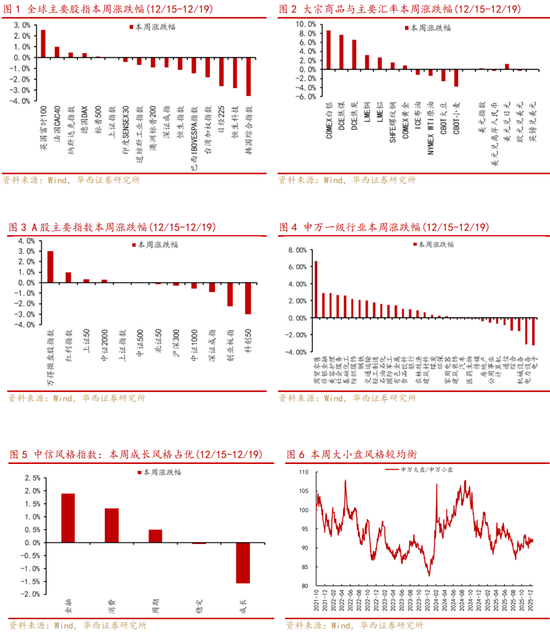
Market Review - Global stock indices mostly declined this week, with the Korean Composite Index, Hang Seng Tech, and Nikkei 225 leading the losses. A-shares saw a decrease in trading volume, with the average daily turnover of the Wind All A Index falling to approximately 1.76 trillion yuan. Market sentiment has turned cautious, with the ChiNext 50 and ChiNext Index leading the declines, while funds rotated into dividend sectors. In terms of styles, the financial and consumer sectors rose, while growth styles fell, with the electronics and power equipment indices dropping over 3%. In the commodity market, COMEX silver surged by 8.7%, and copper and aluminum prices fluctuated upward, while coking coal rebounded from the bottom. In the foreign exchange market, after the Bank of Japan's interest rate hike, the yen depreciated against the dollar, while the renminbi continued to appreciate against the dollar [1][2]. Market Outlook - The "Spring Rally" is accumulating positive factors, with a focus on buying on dips. Historically, the initiation of the A-share "Spring Rally" typically requires reasonable valuation levels, a loose liquidity environment, and effective catalysts to boost risk appetite, such as domestic policies, industrial events, or external risk alleviation. Currently, the Federal Reserve's interest rate cuts and the Bank of Japan's interest rate hike have been implemented, easing concerns about the reversal of arbitrage trades. The subsequent appreciation of the renminbi is expected to attract foreign capital, and the "good start" of insurance premium income at the beginning of the year is also anticipated to bring incremental insurance funds into the market. Recently, stock ETFs have seen large-scale net subscriptions, with multiple broad-based ETFs experiencing increased trading volume, indicating that incremental funds are inclined to buy on dips [2][5]. Historical Review - A review of history shows that, except for 2021 and 2022, the A-share market has often exhibited a "Spring Rally" calendar effect over the past decade. At the end of the year and the beginning of the year, the A-share market is in a "vacuum period" for economic data and corporate earnings reports, making it easier for the market to engage in thematic investments based on policy expectations and industrial trends. Since 2016, there have been 8 instances of "Spring Rally" in the A-share market. The timing of these rallies typically starts between December and January and lasts for 20 to 60 trading days [3][4]. Necessary Conditions for "Spring Rally" - The initiation of the "Spring Rally" requires several necessary conditions: 1) A reasonable market valuation range, as the elasticity of the rally is highly correlated with market valuation levels. In the years with the largest index gains during the past decade's Spring Rallies, the market had generally undergone sufficient adjustments beforehand. For instance, at the beginning of 2016, the "circuit breaker" triggered a liquidity feedback shock, leading to a sharp decline in major A-share indices; at the beginning of 2019, after previous declines, the price-to-earnings ratio of the CSI 300 Index was only 10 times; and in early February 2024, liquidity shocks from products like Xueqiu and quantitative funds brought the CSI 300 Index's price-to-earnings ratio back to around 10 times [4]. 2) A sustained loose liquidity environment with inflows of incremental funds. For example, in early 2018, the central bank implemented targeted reserve requirement ratio cuts, and in early 2019 and 2020, the central bank conducted comprehensive reserve requirement ratio cuts to maintain macro liquidity. In early 2023, there was a significant inflow of foreign capital, and in early 2025, regulatory authorities are expected to promote the entry of medium- and long-term funds into the market [4]. 3) Domestic policies, industrial event catalysts, or external risk alleviation that drive risk appetite upward. For example, in early 2016, supply-side reforms; in early 2019, progress in China-U.S. trade negotiations; in January 2020, the signing of the first-phase trade agreement between China and the U.S.; at the end of 2022, the optimization of epidemic prevention policies and the "three arrows" for real estate; in February 2024, an unexpected reduction in the Loan Prime Rate (LPR); and in early 2025, catalysts from trends in industries like DeepSeek and robotics [4][5]. Accumulating Positive Conditions - Positive conditions for the "Spring Rally" are accumulating, with a focus on buying on dips: 1) In terms of overseas liquidity, the dovish interest rate hike by the Bank of Japan has been implemented, leading to a weaker yen against the dollar and easing pressures from arbitrage trades. The Federal Reserve's expected dovish rate cuts in December are closely tied to the leadership transition, with the overall market expectation for the Fed's policy direction remaining loose [5]. 2) Domestically, the Central Economic Work Conference has set the tone for "continuing to implement an appropriately loose monetary policy," indicating that there is still room for reserve requirement ratio cuts and interest rate reductions [5]. 3) On the micro liquidity front, this week saw large-scale net subscriptions for stock ETFs, with multiple broad-based ETFs experiencing increased trading volume, boosting market sentiment. The anticipated inflow of foreign capital driven by the appreciation of the renminbi and the incremental insurance funds from the "good start" of premium income at the beginning of the year can also be expected [5]. 4) In terms of valuation, the current price-to-earnings ratio of the CSI 300 Index is 14 times, which is at the 76th percentile since 2010, below the historical median plus one standard deviation [5]. 5) From a policy perspective, the Central Economic Work Conference has laid a positive foundation, with 2026 marking the start of the "14th Five-Year Plan," and incremental policies in areas such as technological innovation, anti-involution, and expanding domestic demand are expected to continue to be introduced [5]. Industry Allocation Recommendations - It is recommended to focus on: 1) Growth directions benefiting from industrial policy support, such as domestic substitution, robotics, aerospace, innovative pharmaceuticals, and energy storage [5]. 2) Cyclical directions benefiting from "anti-involution" policies, such as chemicals, energy metals, and resource products [5]. 3) The deepening of consumption-promoting policies may bring short-term catalytic opportunities for the consumer sector [5].
量化择时周报:市场格局仍在反复,谨慎应对-20251221
ZHONGTAI SECURITIES· 2025-12-21 13:08
- The report discusses the "Industry Trend Allocation Model" which indicates that the communication, industrial metals, and energy storage sectors continue to show an upward trend[2][5][7] - The "Two Beta Model" is recommended for the technology sector, focusing on domestic computing power and commercial space[2][5][7] - The "Mid-term Distress Reversal Expectation Model" signals attention to retail and tourism service consumption[2][5][7] Model Construction and Evaluation - **Industry Trend Allocation Model**: This model identifies sectors with upward trends based on historical data and current market conditions. It uses various indicators to determine the sectors that are likely to perform well in the near future[2][5][7] - **Two Beta Model**: This model focuses on sectors with high growth potential, particularly in technology. It evaluates the beta coefficients of different sectors to identify those with higher expected returns relative to the market[2][5][7] - **Mid-term Distress Reversal Expectation Model**: This model identifies sectors that are expected to recover from a period of underperformance. It uses historical performance data and current market signals to predict which sectors will experience a turnaround[2][5][7] Model Backtesting Results - **Industry Trend Allocation Model**: The model continues to show an upward trend in the communication, industrial metals, and energy storage sectors[2][5][7] - **Two Beta Model**: The model recommends the technology sector, focusing on domestic computing power and commercial space, indicating strong growth potential[2][5][7] - **Mid-term Distress Reversal Expectation Model**: The model signals attention to retail and tourism service consumption, suggesting these sectors are poised for recovery[2][5][7]
招商策略:A股跨年行情加春季躁动或将拉开帷幕
Xin Lang Cai Jing· 2025-12-21 12:08
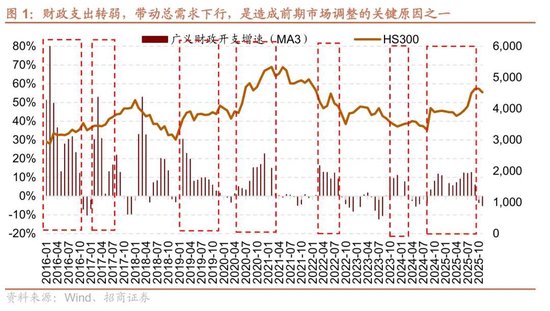
Market Outlook - A classic "cross-year-spring" market is brewing, with signals indicating that it has already begun. Key factors include the expected acceleration of central budget investments and significant institutional investors increasing their holdings in A500 ETF, providing stable incremental funds to the market [2][36][38] - The main focus of the market is likely to be on blue-chip indices represented by the CSI 300 and SSE 50, with an emphasis on cyclical sectors such as industrial metals, non-bank financials, and hotel aviation [2][36][38] Economic Indicators - In November, the year-on-year growth rate of social retail sales narrowed, with a total of 456,067 billion yuan, a decrease of 0.3 percentage points to 4.0%. The retail sales excluding automobiles reached 411,637 billion yuan, growing by 4.6% [43][57] - Major enterprises in the machinery sector showed improvement in sales, with loader sales increasing by 32.1% year-on-year, and the sales of excavators and road rollers also showing significant growth [49][51] Investment Trends - The A500 ETF has seen substantial net subscriptions, with a single-day subscription amount reaching a historical high of 7.1 billion yuan, indicating that significant institutional investors are entering the capital market through this product [13][36] - The offshore RMB exchange rate has been strengthening, suggesting that overseas funds are beginning to flow into the domestic market, which is often associated with expectations of positive changes in domestic policies [15][16][36] Sector Performance - The retail sector has been supported by policies aimed at expanding domestic demand, with notable growth in the commercial retail sector driven by holiday consumption expectations [40] - The technology sector, particularly AI, remains a strong growth engine for the economy, with Hong Kong stocks showing high investment value in technology companies that are not present in A-shares [29][38] Market Dynamics - The A-share market has shown mixed performance, with large-cap value stocks outperforming small-cap stocks as investors become more conservative due to year-end performance assessments [31][39] - The upcoming earnings forecast disclosure period in January is expected to increase pressure on small-cap stocks, while large-cap blue-chip stocks are likely to attract more investment due to their stability [33][36]

华西策略李立峰、张海燕:“春季躁动”行情的启动,需具备哪些必要条件?
Xin Lang Cai Jing· 2025-12-21 12:02
来源:策略李立峰与行业配置笔记 炒股就看金麒麟分析师研报,权威,专业,及时,全面,助您挖掘潜力主题机会! 投资要点 市场回顾:本周全球股指多数下跌,韩国综合指数、恒生科技和日经225指领跌。A股成交再度缩量, 万得全A日均成交额回落至1.76万亿元附近,市场情绪趋于谨慎,主要指数中科创50和创业板指领跌, 资金轮动至红利板块。风格上,金融和消费板块上涨,一级行业中,商贸零售、非银金融、美容护理、 社会服务领涨;成长风格下跌,电子和电力设备指数跌超3%。大宗商品方面,COMEX白银大涨 8.7%,铜铝价格震荡上行,双焦底部反弹。外汇方面,日央行加息落地后,日元对美元汇率走贬,人 民币对美元则延续升值态势。 市场展望:"春季躁动"行情积极因素累积,逢低布局为主。复盘历史,A股"春季躁动"行情启动通常需 满足以下条件:合理的估值水平、宽松的流动性环境以及有效提振风险偏好的催化剂,如国内政策、产 业事件催化或外部风险缓释等。当前来看,海外美联储降息和日本央行加息均已落地,市场对套利交易 逆转担忧缓解,后续人民币汇率升值带动的外资增配、年初保费收入"开门红"带来的增量保险资金入市 亦可以期待。近期股票型ETF再度大规模 ...
下周A股,关键时刻!
Sou Hu Cai Jing· 2025-12-21 11:56
Group 1 - The A-share market is showing signs of a rebound, with the Shanghai Composite Index up 0.03%, while the Shenzhen Component Index and the ChiNext Index fell by 0.89% and 2.26% respectively [1] - The retail trade sector has seen a significant increase, with a rise of over 6%, making it the top-performing industry this week [2] - The overall average stock price in the A-share market decreased by 0.15%, but a continuous rally starting Wednesday has sparked market sentiment, indicating the beginning of an upward trend [1][3] Group 2 - The central government has emphasized the importance of expanding domestic demand as a key task for the upcoming year, with domestic demand contributing 71% to economic growth in the first three quarters of this year [2] - The hydrogen energy industry is at a critical commercialization stage, with a focus on green hydrogen production relying on renewable energy sources, which is expected to drive growth in the sector [4] - The non-bank financial sector is currently undervalued, and institutions are optimistic about the performance of brokerage firms as market activity picks up [4]
新消费行业周报(2025.12.15-2025.12.19):密集政策提振消费,海南自由贸易港封关运作正式启动-20251221
Hua Yuan Zheng Quan· 2025-12-21 11:21
Investment Rating - The industry investment rating is "Positive" (maintained) [1] Core Insights - The report emphasizes the importance of expanding domestic demand as a strategic initiative, with multiple policies aimed at boosting consumption being introduced. The central economic work conference highlighted the need for a strong domestic market and specific measures to stimulate consumption [4] - The official launch of the Hainan Free Trade Port marks a new phase in China's high-level opening-up, with significant increases in flight bookings to Hainan, indicating a positive trend in consumer behavior [4] - The report notes a robust growth in the beauty and skincare sector, with top brands maintaining their positions and new domestic brands showing significant growth, reflecting changing consumer preferences among younger generations [5][17] Summary by Sections Industry Performance - The new consumption sector saw a weekly increase of 6.66% in the retail index from December 15 to December 19, 2025 [8] - The beauty and personal care sector increased by 2.87% during the same period [8] Policy Developments - The central government has introduced various measures to enhance service consumption, including promotional activities and optimizing service availability to meet diverse consumer needs [4] - A joint notification from multiple government departments aims to strengthen collaboration between commerce and finance to boost consumption in key areas [4] Market Trends - In the beauty and skincare market, the top five brands include Proya, L'Oreal, Han Shu, Lancôme, and Estée Lauder, with domestic brands like Proya showing strong performance [5] - The report highlights a significant increase in sales for Hainan's duty-free shops, with a 90% year-on-year growth on the first day of the free trade port's operation [5] Investment Recommendations - The report suggests focusing on high-quality domestic brands in beauty and skincare, traditional gold jewelry brands favored by younger consumers, and strong tea beverage brands with extensive market coverage [17]




“高息现金牛”策略:分红能力与意愿的双重验证
ZHONGTAI SECURITIES· 2025-12-21 10:13
Group 1: Allocation Demand in Low-Interest Rate Environment - The demand for dividend-related assets is expected to continue increasing, driven by the need for stable cash returns in a low-interest rate and asset scarcity environment [4][9]. - As of December 17, 2025, the tracking scale of dividend index ETFs approached 200 billion, while cash flow-related products reached 24.8 billion since their issuance in February of the same year [9]. Group 2: Comparison of Dividend and Free Cash Flow Indices - The report outlines the selection rules for the CSI Dividend Index and the National Index Free Cash Flow, emphasizing liquidity and consistent dividend payments over the past three years [12]. - The performance comparison shows that both dividend and cash flow indices outperformed the overall market during periods of market downturns, indicating their defensive characteristics [15]. Group 3: Relationship Between Dividend Capability and Willingness - There is a significant positive correlation between dividend yield and free cash flow, indicating that companies with high cash flow are more willing to distribute dividends [51]. - The analysis shows that companies with a history of consistent dividends and strong cash flow tend to have more stable and superior long-term stock price performance [59]. Group 4: "High-Yield Cash Cow" Strategy Construction - The "High-Yield Cash Cow" strategy involves selecting stocks based on high free cash flow rates and consistent dividend payments, excluding financial and real estate sectors [59]. - The strategy has shown strong performance, with the "Cash Cow 50 High Yield 30" combination achieving an annualized return of 25.9% since 2014, outperforming the CSI Dividend Index by 13.5% [62].





中信证券:人民币持续升值的背景下,可以关注 短期肌肉记忆驱动、利润率变化驱动 以及政策变化驱动三条线索
Sou Hu Cai Jing· 2025-12-21 09:16
推动人民币升值的因素逐渐增多,市场关注度也开始升温,投资者要逐步适应在一个人民币持续升值的 环境下去做资产配置。从过去20年间7轮人民币升值周期来看,汇率并不是主导行业配置的决定性因 素。然而,部分行业在持续升值预期形成的初期确实会有更好表现,市场可能会复制这样的肌肉记忆, 同时从成本收入分析来看,约19%的行业会因为升值带来利润率提升,这些行业也会逐步被投资者重视 起来。此外,为抑制过快单边升值趋势而做出的政策应对,反而是影响行业配置的更重要因素。行业配 置上,在人民币持续升值的背景下,可以关注短期肌肉记忆驱动、利润率变化驱动以及政策变化驱动三 条线索,我们在本期聚焦详细梳理了潜在受益行业。 推动人民币持续升值的因素逐渐增多,市场关注度也开始升温 我们认为投资者要逐步开始适应在一个人民币持续升值的环境下去做资产配置。今年前11个月中国的累 计贸易顺差达到1.076万亿美元,同比增长21.7%,创历史新高。更重要的是出口企业的结汇意愿开始不 断上升,今年10月顺差转化为顺收的比例已经超过100%,这是与过去几年最大的差异。2022年以来, 我们估算出口商积累的待结汇规模为1万亿美元左右,一旦人民币升值预期形成 ...

量化市场追踪周报:A500成跨年行情布局焦点-20251221
Xinda Securities· 2025-12-21 08:34
- The report focuses on the A500 index as a key tool for capturing future structural market opportunities, particularly in the context of cross-year market positioning[3][11][37] - The A500 index is highlighted for its balanced coverage of technology growth sectors (e.g., AI, high-end manufacturing) and cyclical industries with recovery potential, making it an ideal instrument for structural market trends[11][37] - Significant capital inflows into A500-related ETFs were observed, with net inflows exceeding 280 billion RMB in the past week, driven by long-term capital's forward-looking allocation strategies[11][37][59]
金融工程:AI识图关注非银、卫星、化工
GF SECURITIES· 2025-12-21 07:42
- The report introduces a quantitative model based on Convolutional Neural Networks (CNN) to analyze price-volume chart data and predict future prices. The learned features are then mapped to industry theme indices, such as the CSI 300 Non-Bank Financial Index, the CNI Commercial Satellite Communication Industry Index, and the CSI Sub-Chemical Industry Theme Index[79][81] - The construction process involves standardizing price-volume data into chart formats and applying CNNs to extract features. These features are subsequently used to allocate weights to specific industry themes[79][81] - The model's evaluation highlights its ability to capture complex patterns in price-volume data and its application in identifying promising industry themes like non-bank financials, satellites, and chemicals[79][81]