TMT

Search documents
国泰海通|固收:不惧扰动,保持定力
国泰海通证券研究· 2025-10-22 11:04
Core Viewpoint - The convertible bond market is experiencing significant short-term valuation compression, but given the resilience of the equity market, convertible bonds still present investment opportunities, particularly through a low premium strategy [1][2]. Group 1: Market Performance - The Shanghai Composite Index declined by 1.47% last week, while the China Convertible Bond Index fell by 2.35%, indicating a notable compression in convertible bond valuations [1]. - Institutional profit-taking is a major factor influencing short-term valuations in the convertible bond market, although long-term trends remain positive as long as the equity market continues its upward trajectory [1][2]. Group 2: Valuation and Risks - As of October 17, the average parity of convertible bonds was 97.34 yuan, with an average conversion premium rate of 39.99%. High premium convertible bonds have seen significant compression in their conversion premium rates due to increased expectations of forced redemptions [1]. - Large-scale convertible bonds, such as those from Liugong and Hengbang, have experienced rapid compression in premium rates following market speculation about forced redemptions, highlighting the risks associated with high premium and large-scale convertible bonds [1]. Group 3: Investment Strategy - Despite external disturbances, the equity market's upward trend is expected to continue, providing a favorable environment for convertible bonds, which exhibit relative resilience and investment value [2]. - In a sustained bull market, a low premium strategy is recommended as it allows for better participation in the upside of underlying stocks while minimizing valuation compression risks [2]. - The technology sector, particularly semiconductor stocks and TMT industries benefiting from increased overseas AI capital expenditure, is identified as a key investment focus, alongside a balanced approach to cyclical and financial sectors [2].



国泰海通|固收:不惧扰动,保持定力
国泰海通证券研究· 2025-10-21 11:58
Core Viewpoint - The convertible bond market is experiencing significant short-term valuation compression, but given the resilience of the equity market, convertible bonds still present investment opportunities, particularly through a low premium strategy [1][2]. Group 1: Market Performance - The Shanghai Composite Index declined by 1.47% last week, while the China Convertible Bond Index fell by 2.35%, indicating a notable compression in convertible bond valuations [1]. - Institutional profit-taking is a major factor influencing short-term valuations in the convertible bond market, although long-term trends remain positive as long as the equity market continues its upward trajectory [1][2]. Group 2: Valuation and Risks - As of October 17, the average parity of convertible bonds was 97.34 yuan, with an average conversion premium rate of 39.99%. High premium convertible bonds have seen significant compression in their conversion premium rates due to increased expectations of forced redemptions [1]. - Large-scale convertible bonds with high premiums face risks related to forced redemptions, particularly when conversion premium rates are elevated, which could lead to dilution of the underlying stock [1]. Group 3: Investment Strategy - Despite external disturbances, the equity market's upward trend is expected to continue, providing a favorable environment for convertible bonds, which exhibit resilience and potential for both appreciation and downside protection [2]. - In a sustained bull market, a low premium strategy is recommended as it allows for better participation in the underlying stock's gains while minimizing valuation compression risks. The technology sector, particularly semiconductor stocks and TMT industries benefiting from increased AI capital expenditure, is highlighted as a key area for investment [2].

中指研究院:三季度全国重点城市主要商圈写字楼平均租金为4.55元/平方米/天 环比下跌0.33%
智通财经网· 2025-10-21 09:11
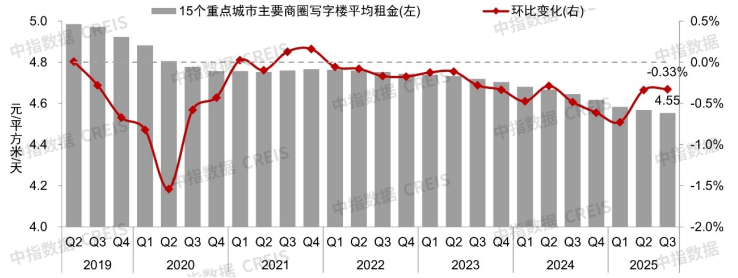
Group 1: Rental Market Overview - In Q3 2025, the average office rental price in key urban business districts across China was 4.55 yuan per square meter per day, reflecting a quarter-on-quarter decline of 0.33% and a cumulative decline of 1.39% for the first three quarters [1][5][10] - A total of 64 business districts experienced a quarter-on-quarter rental decline, accounting for 80% of the monitored districts, with 11 districts showing slight rental increases [10][7] - Major cities showed a significant rental decline, with 77.8% of first-tier districts and 81.8% of second-tier districts reporting lower rents [7][10] Group 2: Economic Environment - The overall economic performance remained stable, with GDP growth of 5.2% year-on-year in the first three quarters of 2025, although consumption and investment growth rates have slowed [1][5] - Retail sales growth for January to September was 4.5%, a decrease of 0.1 percentage points compared to the previous period, indicating a continuous slowdown in monthly growth [1][5] - Fixed asset investment (excluding rural households) turned negative, declining by 0.5% year-on-year, influenced by ongoing downturns in real estate investment [1][5] Group 3: Service Sector Dynamics - The service sector's value added grew by 5.4% year-on-year in the first three quarters, but this was a slight decrease of 0.1 percentage points compared to the first half of the year [2] - The business activity index for the service sector remained between 50% and 50.5%, with a September value of 50.1%, indicating weak expansion intentions among service sector enterprises [2] Group 4: Policy Environment - The central government emphasized the need for sustained macroeconomic policies, including proactive fiscal measures and moderately loose monetary policies to stimulate consumption and support small and micro enterprises [2] - The focus on technological innovation and the development of competitive emerging industries was reiterated, aiming to enhance the integration of technology and industry [2] Group 5: Leasing Trends - In the first three quarters of 2025, nearly 60% of leasing cases were concentrated in the financial, TMT (Technology, Media, and Telecommunications), and business services sectors [11][15] - The number of leasing cases for areas under 2000 square meters increased, indicating a shift in demand towards smaller office spaces [15] Group 6: Large Transactions - The number of large transactions decreased compared to the previous year, but the total transaction value increased significantly due to several high-value deals [16][19] - In the first three quarters, a total of 2130 large transactions were monitored, with a total transaction value of 133.6 billion yuan, marking a year-on-year increase of 37.4% [18][19]
市场调整后,后续如何配置?
2025-10-20 14:49
Summary of Key Points from Conference Call Records Industry or Company Involved - The discussion primarily revolves around the A-share and Hong Kong stock markets, with a focus on market sentiment, sector performance, and investment strategies. Core Insights and Arguments 1. **Market Sentiment and Adjustment** - A-share market sentiment has returned to a neutral level after a recent adjustment, with investor perception of the adjustment being less severe than actual data indicates. The market sentiment is currently in the 60-70% range, suggesting a need to monitor financing buy-ins and foreign capital inflows for future trends [2][1][4]. 2. **Sector Performance and Style Shift** - There has been a shift towards defensive sectors such as banking and coal, driven by risk aversion rather than demand-side improvements. This shift has limited its contribution to index breakthroughs [4][1]. - The technology sector remains a key focus, with potential for recovery if U.S.-China trade tensions ease, as indicated by the ongoing AI trends and TMT sector performance [5][1]. 3. **Global Liquidity and Market Structure** - Global liquidity is supportive of an upward market trend, with increased turnover rates in the Hong Kong market and a rise in southbound capital inflows to 40%, enhancing liquidity [10][12]. - The overall market structure has changed, with significant participation from southbound funds, which has led to a potential increase in the valuation center for large-cap stocks [12][13]. 4. **Investment Opportunities** - There are two key areas to watch: commodities with price increase expectations (e.g., non-ferrous metals, coal) and cyclical sectors like engineering machinery and consumer goods showing signs of recovery [7][1]. - The technology sector is expected to present new investment opportunities after digesting valuation pressures, particularly in AI and TMT sectors [5][1]. 5. **Hong Kong Market Dynamics** - The Hong Kong market sentiment index has shown fluctuations, indicating a need for cautious investment strategies. Risk-tolerant investors may consider increasing positions, while those seeking higher win rates should wait for more favorable conditions [8][1][9]. - The current valuation levels in the Hong Kong market are above historical averages, but the increase in turnover and foreign capital participation suggests a more favorable outlook than past periods [13][1]. 6. **AI Industry Impact** - The AI industry is expected to positively influence long-term growth expectations, with potential for private enterprises and listed companies to see improved profitability [14][1][16]. - The current state of the AI sector in China is compared to the U.S. in 2023, indicating a promising outlook for growth and development [16][1]. Other Important but Possibly Overlooked Content 1. **Credit Market Risks** - There is an increase in credit market risks, particularly in high-yield bonds, although the overall situation remains manageable without significant issues in the money market [23][24]. 2. **U.S. Market Volatility** - Recent volatility in the U.S. market is attributed to concerns over subprime auto loans and regional bank issues, alongside discussions of AI trading bubbles and rising debt yields [21][1][26]. 3. **Future Market Predictions** - While precise predictions are challenging, the overall sentiment suggests that risk assets, including those in the Hong Kong market, may continue to rise due to supportive macroeconomic conditions [27][1][28]. This summary encapsulates the key points discussed in the conference call, providing insights into market dynamics, sector performance, and investment strategies.
扎根产业的“沉浸研究”,解码汇添富科技战队的投资“底蕴”
Zhong Guo Zheng Quan Bao· 2025-10-20 08:49
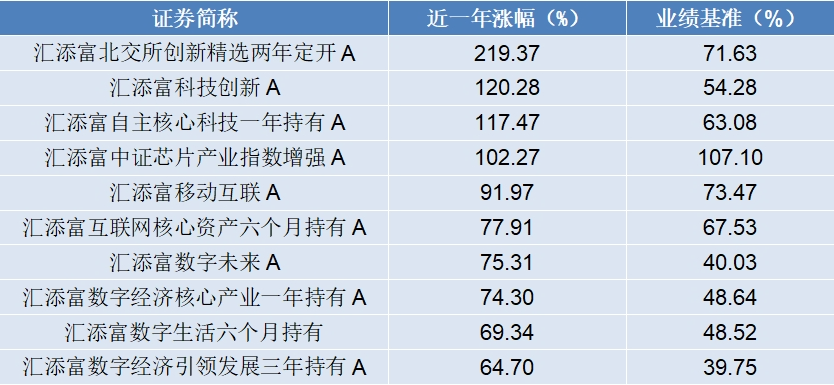
Core Viewpoint - The article emphasizes the importance of long-term investment strategies in the technology sector, highlighting the approach of Huatai Fuhua Fund's technology investment team, which focuses on deep industry research and systematic investment rather than chasing short-term trends [1] Performance Summary - As of August 28, Huatai Fuhua's digital and technology products have shown impressive performance over the past year, with four funds doubling in net value and ten funds increasing by over 50% [1] - Specific fund performances include: - Huatai Fuhua Beijing Stock Exchange Innovation Selection A: 219.37% increase - Huatai Fuhua Technology Innovation A: 120.28% increase - Huatai Fuhua Self-Core Technology One-Year Holding A: 117.47% increase - Huatai Fuhua Chip Industry Index Enhanced A: 102.27% increase [2] Long-term Performance Rankings - Huatai Fuhua Global Mobile Internet A ranks first among similar products over the past seven years, third over the past five and three years [3][4] - Huatai Fuhua Technology Innovation A ranks in the top 10% for the past five and three years, and in the top 5% for the past year [5] Research and Global Perspective - The technology team emphasizes a comprehensive research approach across the entire industry chain, including both domestic and international companies [6] - Since 2011, the team has conducted annual field research in Silicon Valley and other tech hubs, establishing connections with numerous companies to gauge technological advancements [6][7] Investment Philosophy - The investment philosophy is rooted in deep fundamental analysis, focusing on high-quality securities and long-term growth [8] - The team believes in building extensive touchpoints with companies to understand their governance, management, and motivations, often taking three to five years to track a company before investing [8][9] Team Structure and Collaboration - The team is structured to promote professional division of labor and efficient collaboration, covering six major sub-industries [10] - Huatai Fuhua has established subsidiaries in Hong Kong, the U.S., and Singapore to enhance local market insights and investment opportunities [10] Commitment to Long-term Development - The company maintains a long-term perspective in performance evaluation and talent development, ensuring team stability and coordination [12][13] - The investment strategy emphasizes clear product positioning and effective matching of fund managers' capabilities with investment goals [14] Conclusion - Huatai Fuhua's deep-rooted investment approach in the technology sector is a result of a long-term commitment to team building, research depth, and a systematic investment philosophy, providing a solid foundation for navigating technological cycles and capturing innovative value [15]
中金:通过三季报寻找结构性亮点
Mei Ri Jing Ji Xin Wen· 2025-10-20 00:40
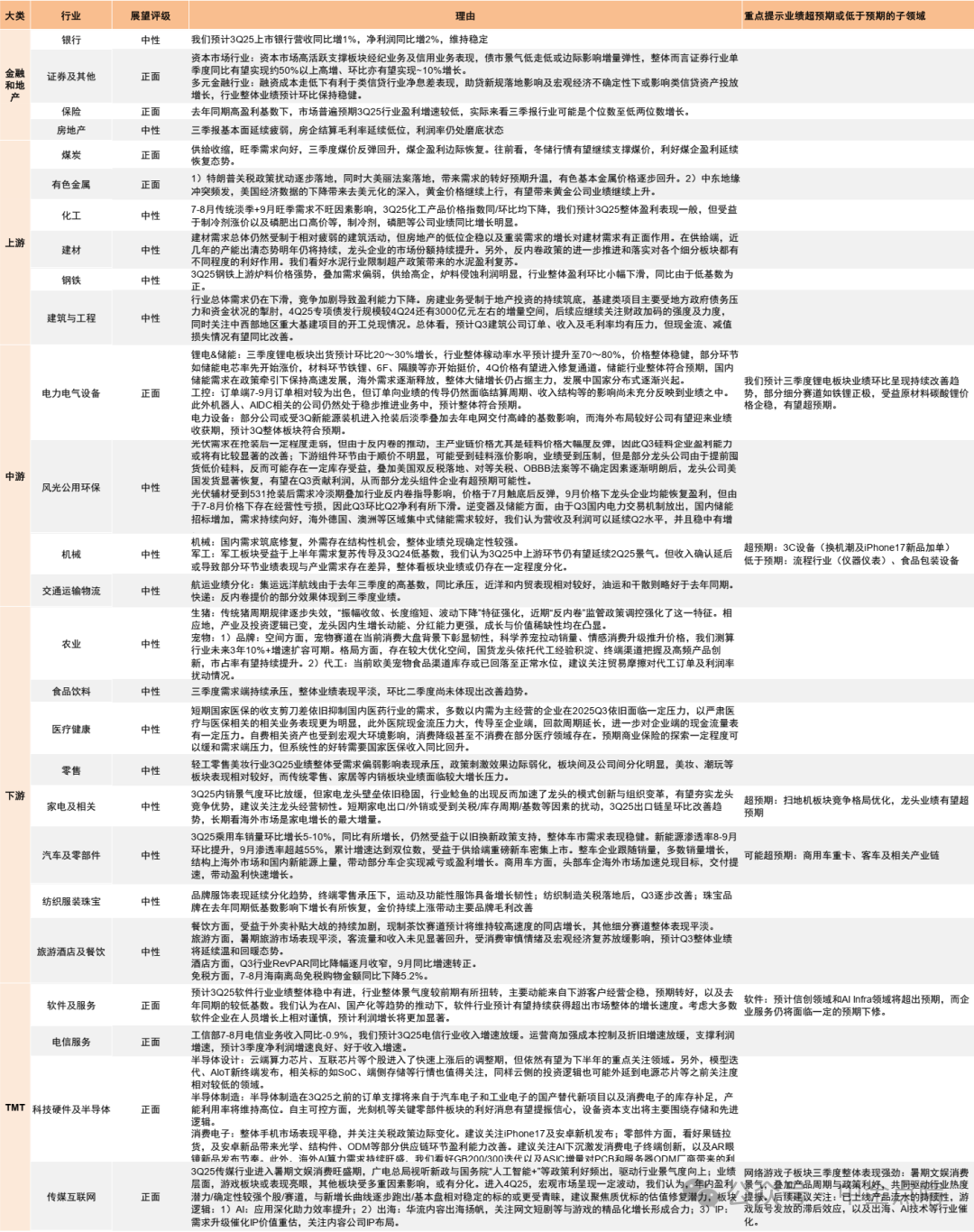
Core Viewpoint - Current internal growth expectations are relatively subdued, leading investors to focus more on fundamental movements during the earnings season, seeking structural highlights through the third-quarter reports [1] Summary by Categories Earnings Highlights - Key areas to focus on in the third-quarter reports include sectors such as gold, TMT (Technology, Media, and Telecommunications) benefiting from high AI demand, and non-bank financials [1] High-Growth Opportunities - High-growth opportunities that are less correlated with economic cycles and external risks include the AI industry chain, as well as white goods, construction machinery, and power grid equipment that are well-positioned for trade with non-US economies and have sufficient overseas production capacity [1] Supply-Side Improvements - Industries that have achieved supply-side clearing in a moderately recovering environment include industrial metals, lithium batteries, innovative pharmaceuticals, commercial vehicles, rail transit equipment, and railway and highway sectors [1]
策略周报:风格切换基础尚不牢固-20251020
Bank of China Securities· 2025-10-20 00:33
Group 1 - The report indicates that the current market sentiment is relatively high, making it sensitive to negative factors, and the speed of domestic capital inflow may slow down due to year-end profit-taking mentality [4][12][14] - The A-share market is expected to experience a "spring rally" starting as early as December, with the potential for a "bull market rally" also existing [4][30][36] - The report emphasizes that there is only style rotation in the market, not a style switch, and the current adjustments in the technology growth style are seen as healthy rather than a signal for a style change [4][29][30] Group 2 - The report highlights that the consumer goods and certain cyclical sectors are currently showing favorable performance expectations and reasonable valuation levels, with industries such as personal care, cosmetics, medical services, and beverages being particularly noteworthy [4][36] - The dividend sector is expected to become a safe haven for funds amid weak market sentiment, with a focus on banks, coal, electricity, and transportation sectors [4][36][42] - The upcoming 20th Central Committee's Fourth Plenary Session is anticipated to clarify major policies, which may lead to increased market activity and focus on sectors aligned with the "15th Five-Year Plan" [4][47]
中金:结合三季报业绩关注三条投资主线
Zheng Quan Shi Bao Wang· 2025-10-20 00:15
Core Insights - The article emphasizes three investment themes to focus on during the third quarter earnings reports, highlighting the relatively subdued internal growth expectations and increased external uncertainties due to the escalation of US-China tariffs [1] Group 1: Earnings Highlights - Key areas to watch in the third quarter earnings include sectors such as gold, TMT (Technology, Media, and Telecommunications) benefiting from high AI demand, and non-bank financials [1] - Investors are encouraged to identify structural highlights through the earnings reports, particularly in sectors with low correlation to economic cycles and external risks [1] Group 2: High-Growth Opportunities - High-growth opportunities include the AI industry chain and sectors with significant overseas capacity layout that cater to non-US economic trade, such as white goods, construction machinery, and power grid equipment [1] - The article suggests focusing on industries that have achieved supply-side clearing in a moderately recovering environment, including industrial metals, lithium batteries, innovative pharmaceuticals, commercial vehicles, and rail and road equipment [1]
中金:三季报哪些公司业绩有望超预期?
智通财经网· 2025-10-20 00:12
Core Viewpoint - The report from CICC indicates that the third quarter earnings growth of A-shares is expected to improve compared to the second quarter, with a focus on fundamental trends during the earnings disclosure period [1][2][3] Earnings Disclosure Peak - The peak period for third-quarter earnings disclosures for A-share companies will occur in mid to late October, with approximately 2.3% of companies having already released earnings forecasts as of October 16 [2][3] Earnings Growth Expectations - A-share earnings growth is anticipated to increase year-on-year in the third quarter compared to the second quarter, with non-financial earnings expected to grow by 8.2% [3][4] - Retail sales growth has shown marginal slowdown, with a year-on-year increase of 4.6% from January to August, down from 5.0% in the first half of the year [3][4] Sector Highlights - Key sectors to watch during the earnings period include: - Gold sector and TMT (Technology, Media, and Telecommunications) benefiting from AI trends [4][9] - High-growth opportunities less correlated with economic cycles, such as the AI industry chain and white goods [4][9] - Industries achieving supply-side clearing, including industrial metals, lithium batteries, and innovative pharmaceuticals [4][9] Financial Sector Insights - Non-bank financials are expected to benefit from high market activity, while the gold and technology hardware sectors are projected to be structural highlights [4][5] - The report suggests that the non-financial sector will see varied performance, with the gold sector expected to outperform due to rising prices amid geopolitical tensions [4][5] Manufacturing and Export Performance - The manufacturing sector, particularly in energy and raw materials, is expected to see improved performance, with rising prices for non-ferrous metals and coal [5][6] - The export sector remains resilient, with year-on-year growth in export amounts in the range of 8.0% to 8.4% from July to September [3][4] Consumer Sector Trends - The consumer sector is facing challenges, with overall demand needing to be stimulated, particularly in essential consumption areas like food and beverages [7][8] - New consumption areas, such as beauty and trendy products, are expected to perform relatively well despite a general slowdown in consumer demand [7][8] TMT Sector Outlook - The TMT sector is experiencing high growth, particularly in AI-related fields, with expectations for continued capital expenditure increases in technology [4][8] - The semiconductor and software industries are projected to maintain strong performance, driven by stable demand and low base effects [8][9]
【策略】短期调整,无需悲观——策略周专题(2025年10月第2期)(张宇生/王国兴)
光大证券研究· 2025-10-19 23:04
Core Viewpoint - The A-share market has experienced a pullback due to declining risk appetite, increased uncertainty in US-China relations, and a general market sentiment decline, with major indices showing a downward trend [4][5]. Market Performance - The A-share market saw a significant decline this week, with the STAR Market 50 index dropping the most at 6.2%, while the Shanghai 50 index fell the least at 0.2%. The overall valuation of the market is at a historically high level since 2010 [4]. - Market styles have diverged, with value stocks performing better. Large-cap value stocks increased by 2.1%, while mid-cap growth stocks decreased by 5.8% [4]. Short-term Market Outlook - The A-share market has shown notable volatility, with the Shanghai Composite Index briefly surpassing 3900 points, a level not seen since August 2015, before falling back below that threshold [5]. - Increased market volatility is attributed to high valuations and rising uncertainties in US-China relations, with the VIX index also showing a significant increase [5]. - Historically, pullbacks during bull markets are common, typically occurring after 60-80 trading days into a bull market, with a usual retracement of 6-7% before resuming upward movement [5][6]. Current Market Phase - The market is likely still in a bull phase, although it may enter a wide-ranging fluctuation stage in the short term. The maximum drawdown observed so far is 4.01%, which is within historical norms [6]. Sector Focus - In the short term, the focus should be on defensive and consumer sectors, as historically, these sectors perform better during market fluctuations. High-dividend stocks and consumer sectors such as food and beverage, social services, and beauty care are expected to benefit from increased domestic demand [7][8]. - In the medium term, attention should be directed towards TMT (Technology, Media, and Telecommunications) and advanced manufacturing sectors, which may gain traction due to liquidity-driven trends and ongoing developments in AI [8].