房地产行业

Search documents
1月20日主题复盘 | 创业板大幅调整,化工股、黄金逆势走强,房地产也迎资金关注
Sou Hu Cai Jing· 2026-01-20 08:41
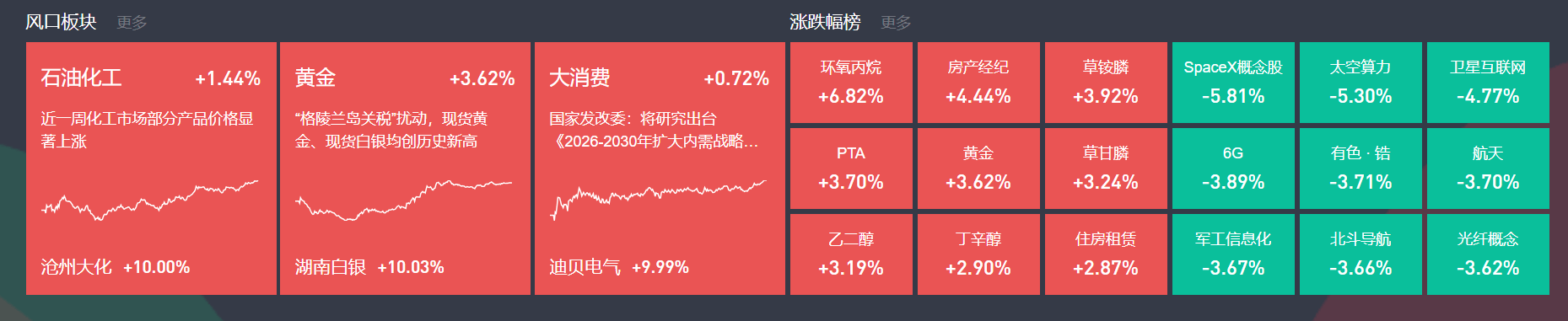
Market Overview - The market opened high but closed lower, with the ChiNext index dropping nearly 2%. Chemical stocks surged, with companies like Cangzhou Dahua and Xinxiang Chemical Fiber hitting the daily limit. Precious metals and consumer stocks also performed well, while real estate stocks rebounded. In contrast, the commercial aerospace sector faced adjustments, and computing hardware stocks fell sharply, with over 3,100 stocks declining across the Shanghai and Shenzhen markets, totaling a transaction volume of 2.8 trillion yuan [1]. Chemical Industry - The chemical sector experienced significant gains, with Cangzhou Dahua and Xinxiang Chemical Fiber achieving consecutive daily limits. Recent reports indicated that from January 12 to 18, the prices of certain chemical products, such as epoxy propylene, increased by 7.9% week-on-week, and prices for organic silicon intermediates also rose [4][5]. - The domestic epoxy propylene market continued its upward trend, supported by tight supply and low overall inventory levels. The price of propylene rose by 4.88% compared to the previous week, indicating strong cost support. The demand side was driven by the "last train" effect of the cancellation of export tax rebates for polyether, leading to active market trading [5][6]. Real Estate Sector - The real estate sector saw a significant rise, with companies like Hefei Urban Construction and Cheng Investment Holdings hitting the daily limit. Analysts noted that the changes in the second-hand housing inventory post-Spring Festival would be a key focus for the market, influencing supply-demand dynamics and financial institutions' concerns regarding collateral depreciation [7][8]. Gold Market - The gold sector remained active, with companies such as Hunan Silver and Zhaojin Mining reaching the daily limit. On January 20, spot gold prices broke the $4,700 per ounce mark, setting a new historical high. Since the beginning of the year, spot gold has consistently risen, surpassing multiple price thresholds [9][10]. - Analysts expect that the upcoming U.S. Federal Reserve meeting will influence gold prices, with a high likelihood of further interest rate cuts, which could provide upward momentum for gold [10][12]. Other Notable Sectors - The consumer sector, domestic chips, and smart grid industries showed localized activity, while AI applications and aerospace sectors faced the most significant declines [12].


稳预期信号增强
Orient Securities· 2026-01-20 06:16
Investment Rating - The report maintains a "Positive" outlook for the real estate industry, indicating an expectation of returns that outperform the market benchmark by over 5% [7]. Core Insights - The effectiveness of real estate policies is more important than their quantity, with a focus on interest rate cuts and direct financial support for enterprises and residents [2]. - Recent publications in "Qiushi" emphasize the importance of managing expectations in stabilizing the real estate market, suggesting a shift from gradual measures to more decisive actions [3]. - The expectation of a stronger policy combination by 2026 is reinforced by ongoing discussions in "Qiushi" regarding real estate and urban renewal [5]. Summary by Sections Policy Developments - The minimum down payment for commercial properties has been reduced from 50% to 30%, aimed at lowering entry barriers for buyers amid significant inventory issues [4]. - The interest rate for guaranteed housing re-loans has been cut by 25 basis points to 1.25%, which narrows the gap between funding costs and net rental yields, although large-scale storage initiatives still require further policy support [4]. Investment Recommendations - The report suggests focusing on the timing and intensity of policy announcements in 2026, with a left-side layout strategy recommended [5]. - Three categories of investment targets are highlighted for potential excess returns: 1. Quality developers with low historical burdens and strong sales growth expectations [5]. 2. Commercial real estate operations, particularly shopping centers that can maintain growth in a slowing economy [5]. 3. Real estate brokerage platforms that leverage scale and brand advantages for better bargaining power [5].
利率周报(2026.1.12-2026.1.18):12月进出口数据好于市场预期-20260119
Hua Yuan Zheng Quan· 2026-01-19 08:51
1. Report's Industry Investment Rating No information about the industry investment rating is provided in the report. 2. Report's Core View - In 2025, China's foreign trade imports and exports reached 45.47 trillion yuan, a record high, with a year - on - year increase of 3.8%. Exports were 26.99 trillion yuan, up 6.1% year - on - year, and imports were 18.48 trillion yuan, up 0.5% year - on - year. Exports to Africa were outstanding, with year - on - year growth rates of 6.0%, 8.0%, 18.4%, and - 18.2% for the EU, ASEAN, Africa, and the US respectively. High - tech product exports reached 5.25 trillion yuan, up 13.2% year - on - year. In December 2025, import and export growth accelerated. The total import and export value was 4.26 trillion yuan, up 4.9% year - on - year [2][98]. - In 2026, the bond market may perform better than expected. Long - term bonds may experience a rebound from oversold conditions. Since the second half of 2025, the bond market has often deviated from the fundamentals and may be dominated by institutional behavior. Currently, long - term bond yields are at a one - year high, making long - term bonds attractive for investment. It is expected that the yield of the 30Y Treasury active bond will gradually return to around 2.2% in the first quarter. However, due to the strong stock market, trading desks may not buy ultra - long - term bonds in the short term. Major opportunities for ultra - long - term bonds await a significant decline in institutional expectations for the stock market and a reduction in policy interest rates [4][98]. 3. Summary by Relevant Catalogs 3.1 Macro News - **Import and Export Growth**: In December 2025, the total import and export value was 4.26 trillion yuan, up 4.9% year - on - year, 0.9 percentage points higher than in November. Exports were 2.54 trillion yuan, up 5.2% year - on - year (a 0.5 - percentage - point decrease from November), and imports were 1.73 trillion yuan, up 4.4% year - on - year (a 2.7 - percentage - point increase from November). Emerging markets played a significant role in driving exports, while exports to the US continued to be a drag. Core drivers of export growth included the release of Christmas - season demand and the trade transfer effect. High - end and mid - end manufacturing became the core growth engine, with strong performance in electromechanical and high - tech products, while labor - intensive products still faced pressure [11][13][23]. - **Financial Statistics**: At the end of 2025, the stock of social financing scale was 442.12 trillion yuan, up 8.3% year - on - year. The annual increment of social financing scale in 2025 was 35.6 trillion yuan, 3.34 trillion yuan more than the previous year. At the end of December 2025, M2, M1, and M0 increased by 8.5%, 3.8%, and 10.2% year - on - year respectively. The balance of domestic and foreign currency loans increased by 6.2% year - on - year, and the balance of RMB loans increased by 6.4% year - on - year [19]. - **Policy Measures**: On January 15, 2026, the central bank announced two policy measures: lowering interest rates of various structural monetary policy tools and improving and expanding support for these tools. Specific measures included rate cuts, increasing quotas, and expanding the scope of support for different types of loans and tools [24][26]. 3.2 Medium - term High - frequency Data - **Consumption**: As of January 11, the daily average retail and wholesale volumes of passenger cars decreased by 32.0% and 40.0% year - on - year respectively. As of January 16, the 7 - day total national box office revenue decreased by 24.3% year - on - year. As of January 9, the total retail volume and total retail sales of three major household appliances decreased by 38.3% and 39.4% year - on - year respectively [25][30]. - **Transportation**: As of January 17, the 7 - day average migration scale index increased by 2.1% year - on - year. As of January 11, the number of civil aviation flights decreased by 2.5% year - on - year. As of January 16, the 7 - day average subway passenger volume in first - tier cities increased by 1.2% year - on - year. As of January 11, postal express collection and delivery volumes, railway freight volume, and highway truck traffic decreased year - on - year [33][36]. - **Industry**: As of January 16, iron ore inventory increased by 10.0% year - on - year, while rebar inventory decreased by 1.7% year - on - year, and float glass enterprise inventory increased by 20.9% year - on - year. As of January 8, the daily coal consumption of key power plants increased by 1.0% year - on - year. As of January 16, the apparent consumption of steel and rebar increased by 2.6% and 2.8% year - on - year respectively, while the apparent consumption of wire rods decreased by 2.7% year - on - year. As of January 14 - 15, the operating rates of blast furnaces, asphalt, soda ash, and PVC decreased year - on - year [38][40][47]. - **Real Estate**: As of January 16, the 7 - day total commercial housing transaction area in 30 large - and medium - sized cities decreased by 32.0% year - on - year. As of January 9, the second - hand housing transaction area in 9 sample cities decreased by 29.4% year - on - year. As of January 11, the land transaction area and land transaction price in 100 large - and medium - sized cities decreased year - on - year [48][52][55]. - **Prices**: As of January 16, the average wholesale prices of pork, vegetables, and 6 key fruits showed different year - on - year and 4 - week - on - 4 - week changes. The average prices of northern port thermal coal, WTI crude oil, rebar, iron ore, and glass also had various year - on - year and 4 - week - on - 4 - week changes [58][63][70]. 3.3 Bond and Foreign Exchange Markets - **Interest Rates**: On January 16, overnight Shibor, R001, R007, DR001, DR007, IBO001, and IBO007 had different changes compared to January 12. Most Treasury bond yields declined. On January 16, the yields of 1 - year/5 - year/10 - year/30 - year Treasury bonds decreased by 6.8BP/4.4BP/3.7BP/0.1BP respectively compared to January 9. The yields of 1 - year/5 - year/10 - year/30 - year China Development Bank bonds had different changes compared to January 9. The yields of 1 - year/5 - year/10 - year local government bonds decreased compared to January 9. The yields of AAA 1 - month/1 - year and AA+ 1 - month/1 - year inter - bank certificates of deposit decreased compared to January 9 [75][79][81]. - **Foreign Exchange**: As of January 16, 2026, the ten - year Treasury bond yields of the US, Japan, the UK, and Germany were 4.24%, 2.18%, 4.40%, and 2.89% respectively, with different changes compared to January 9. The central parity rate and spot exchange rate of the US dollar against the RMB on January 16 decreased compared to January 9 [87][90]. 3.4 Institutional Behavior - Since 2026, the durations of medium - and long - term bond funds have generally decreased. On January 16, 2026, the estimated median duration of medium - and long - term interest - rate bond funds was about 3.3 years, a decrease of about 1.2 years compared to December 31, 2025. The estimated median duration of medium - and long - term credit bond funds was about 2.2 years, a decrease of about 0.3 years compared to December 31, 2025 [93][95]. 3.5 Investment Recommendations - In 2026, the bond market may perform better than expected. Pay attention to the possible oversold rebound of long - term bonds. It is recommended to focus on the band - trading opportunities of ultra - long - term bonds, allocate 3 - 5Y capital bonds to obtain coupons, and also pay attention to multi - asset investment opportunities [4][98].
李迅雷:PPI“失去十五年”之谜
Xin Lang Cai Jing· 2026-01-18 09:25
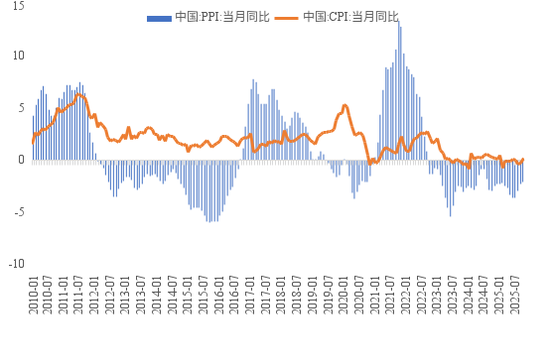
Core Viewpoint - The Producer Price Index (PPI) in China has shown a continuous decline, with a year-on-year decrease of 1.9% reported for December 2025, marking 39 consecutive months of decline since October 2021. This trend raises questions about the underlying reasons for the prolonged weakness in PPI despite significant GDP growth over the same period [1][52]. Group 1: PPI Trends and Historical Context - The PPI has been in negative territory for 111 months from 2012 to 2025, indicating that two-thirds of this period has been characterized by negative growth [1][52]. - From 2010 to 2025, China's GDP increased by 250%, yet the PPI index remained unchanged, suggesting a disconnect between economic growth and producer prices [1][53]. - The decline in PPI began after a significant investment stimulus in response to the 2008 financial crisis, which initially boosted PPI and CPI but later led to a prolonged period of negative PPI starting in March 2012 [2][53]. Group 2: Factors Influencing PPI - The PPI's long-term decline is primarily influenced by the prices of production materials, which have shown significant volatility but an overall cumulative increase of zero over the past 15 years [4][56]. - The prices of living materials have fluctuated less, with a cumulative increase of 4.4%, indicating a divergence in price trends between production and living materials [4][56]. - The divergence between Chinese and U.S. PPI post-2012 is attributed to rapid capacity expansion in China, leading to a significant drop in the export share of total industrial output [8][60]. Group 3: Demand and Supply Dynamics - Weak demand, particularly in the real estate sector, has been a critical factor in the inability of upstream price increases to transmit downstream, resulting in persistent PPI weakness [41][93]. - The real estate market's downturn has been linked to a broader economic slowdown, with real estate investment growth declining significantly since its peak in 2021 [35][88]. - The overall supply-demand imbalance, characterized by excess supply, has hindered price recovery, with industrial value-added growth lagging behind demand growth since 2020 [31][93]. Group 4: Recommendations for Economic Adjustment - To address the persistent weakness in PPI, it is essential to adjust the supply-demand relationship, particularly by expanding effective demand [41][93]. - Increasing the income of middle and low-income groups and promoting consumption are recommended strategies to stimulate demand and support price recovery [103]. - Stabilizing the real estate market is also suggested as a means to alleviate excess capacity and promote consumer spending, although achieving stable housing prices may be challenging [103].
通胀、地产与政策信号交织——2026年1月16日全球财经重点数据与事件前瞻解读
Sou Hu Cai Jing· 2026-01-16 04:42
Group 1 - The core focus of the upcoming financial market data on January 16, 2026, includes European inflation, U.S. industrial and real estate data, and multiple Federal Reserve officials' statements, which together will help assess economic resilience, inflation trends, and monetary policy direction [1] Group 2 - The final value of Germany's December CPI, released at 15:00, is a key indicator for the European market, as it serves as a significant signal for the European Central Bank's policy decisions. A consistent final value with a continued moderate or declining trend would confirm that inflation in the Eurozone is on a "controlled downward" path, allowing for a potential continuation of accommodative policies [3] Group 3 - The Bank of England's Governor Bailey is expected to address inflation outlook, financial stability, and interest rate policy balance at the Bellagio meeting. Market attention will be on whether he leans towards a "cautious accommodative" or "wait-and-see" signal [4] - Multiple Federal Reserve officials will speak, including Governor Bowman and Vice Chair Jefferson, focusing on inflation progress, labor market resilience, and interest rate maintenance duration, which may influence market expectations regarding interest rate adjustments and impact the dollar and U.S. Treasury yields [4] Group 4 - The U.S. December industrial production data, released at 22:15, is crucial for assessing the activity levels in the manufacturing and energy sectors. Positive growth in industrial output would reflect the U.S. economy's adaptability to tightening financial conditions, while a significant decline could reignite concerns about economic slowdown [5] - The January NAHB housing market index, released at 23:00, provides insights into the confidence within the real estate sector. A rebound in this index would indicate improved builder confidence amid stabilizing or declining mortgage rates, while continued low levels would suggest ongoing challenges for real estate recovery [5] Group 5 - The weekly U.S. oil rig count data, to be released at 02:00, impacts market sentiment regarding crude oil. A continued decline in rig counts may strengthen expectations of tightening supply, while an increase could exert downward pressure on oil prices [5] Group 6 - Overall, the data and events on January 16 are more trend-confirming rather than high-density data points. The German inflation final value validates the European inflation trajectory, while U.S. industrial and real estate data test economic resilience, and central bank officials' speeches provide a recalibration window for market policy expectations [5]

央行出台8项政策举措 支持经济结构转型优化
Sou Hu Cai Jing· 2026-01-15 08:26
Group 1 - The People's Bank of China will implement 8 policy measures to support economic structural transformation and optimization [1] - The interest rates for various structural monetary policy tools will be reduced by 0.25 percentage points, with the one-year relending rate decreasing from 1.5% to 1.25% [1] - The quota for agricultural and small enterprise relending will be increased by 500 billion yuan, with a total quota of 1 trillion yuan specifically for private enterprises [1] - The relending quota for technological innovation and technological transformation will be increased from 800 billion yuan to 1.2 trillion yuan, including support for high R&D investment private SMEs [1] - The previously established private enterprise bond financing support tool and technological innovation bond risk-sharing tool will be merged, providing a total relending quota of 200 billion yuan [1] - The carbon reduction support tool will be expanded to include more projects with carbon reduction effects, guiding banks to support comprehensive green transformation [1] - The support areas for service consumption and elderly care relending will be expanded, incorporating health industry standards [1] Group 2 - The minimum down payment ratio for commercial property loans will be lowered to 30% to support the destocking of the commercial real estate market [2] - Financial institutions are encouraged to enhance their foreign exchange risk hedging services, providing cost-effective and flexible foreign exchange risk management tools for enterprises [2]
渣打银行预测2026年越南经济继续保持高速增长
Shang Wu Bu Wang Zhan· 2026-01-14 16:54
Group 1 - Standard Chartered Bank maintains an optimistic outlook for Vietnam's economy, predicting a GDP growth rate of approximately 7.2% by 2026, despite being below the government's target of 10% [1] - Vietnam continues to be recognized as the fastest-growing economy in Asia, outperforming other economies amid a regional slowdown [1] - Trade and tariffs are identified as the biggest risk factors for Vietnam's economic development, with significant implications from ongoing negotiations with the U.S. government regarding origin rules and transshipment issues [1] Group 2 - The manufacturing sector remains a key driver for attracting foreign investment and plays a crucial role in Vietnam's economy [2] - There is a mixed outlook for capital flows, with foreign direct investment (FDI) showing positive growth last year, but new registered capital experiencing stagnation due to investor caution while awaiting the outcome of U.S.-Vietnam trade negotiations [2] - A favorable trade agreement with the U.S. is expected to lead to a strong rebound in new registered foreign investment, enhancing mid-term growth prospects [2]
关于延续实施支持居民换购住房有关个人所得税政策的公告
Xin Hua Wang· 2026-01-14 09:51
Core Points - The announcement extends personal income tax policies to support residents in purchasing new homes after selling their existing ones from January 1, 2026, to December 31, 2027 [1][2] - Taxpayers selling their homes within one year and purchasing new ones will receive a tax refund on the income tax paid on the sale, with conditions based on the purchase price of the new home relative to the sale price of the existing home [1][2] Summary by Sections Tax Refund Policy - From January 1, 2026, to December 31, 2027, taxpayers who sell their homes and buy new ones within one year will receive a tax refund on the income tax paid on the sale [1] - If the new home purchase price is greater than or equal to the sale price of the existing home, the full amount of income tax paid will be refunded [1] - If the new home purchase price is less than the sale price, the refund will be proportional to the new home purchase price relative to the sale price [1] Conditions for Eligibility - The sale and purchase of homes must occur within the same city, defined as the administrative areas under the same municipality or provincial-level city [2] - The taxpayer must be the owner or one of the owners of the new home purchased [2] - Taxpayers must provide valid sale and purchase contracts and any other required materials to the tax authority for the refund process [2] Information Sharing Mechanism - Local housing and urban-rural development departments are required to establish information-sharing mechanisms with tax authorities to ensure timely access to housing transaction contract information [2]
期待更优力度的政策
Orient Securities· 2026-01-12 06:44
Investment Rating - The report maintains a "Positive" investment rating for the real estate industry, indicating an expectation of returns exceeding the market benchmark by more than 5% over the next 12 months [8]. Core Insights - The report emphasizes that the quantity of real estate policies is less important than their effectiveness, highlighting the need for significant policy measures such as interest rate cuts and direct financial support for struggling enterprises and residents [3][4]. - It notes a shift in policy logic from "gradual control" to "precise and immediate action," which is expected to enhance market confidence and stabilize expectations in the real estate sector [5]. - The report anticipates a more robust policy combination by 2026, aligning with the urgency expressed in recent publications to stabilize the real estate market [4][5]. Market Overview - In the second week, the real estate sector index outperformed the CSI 300 index, with a weekly increase of 4.7%, resulting in a relative return of 1.9% compared to the CSI 300 [6]. - New home sales in 30 cities decreased by 57% compared to the previous week, while second-hand home sales increased by 21% [6]. Investment Recommendations - The report suggests focusing on three categories of assets likely to yield excess returns: 1. Quality developers with low historical burdens and strong sales growth expectations [7]. 2. Commercial real estate operators, particularly shopping centers that can maintain growth in a slowing economy [7]. 3. Real estate brokerage platforms that benefit from scale and brand advantages, which can leverage policy improvements or market recovery for significant performance upside [7].
消费者的预期是决定性的
Sou Hu Cai Jing· 2026-01-09 05:36
Group 1 - The core argument emphasizes that without expectations, measures like subsidies to stimulate consumption will not achieve the multiplier effect described by Li Daokui [1] - The discussion has shifted from how to stimulate consumption to focusing on expectations [2] - High mortgage debt is a significant issue for Chinese households, with leverage rates rising from 18% in 2008 to 60%-70% in many cities, primarily due to real estate [3] Group 2 - The real benefit for residents lies in reducing debt levels, with suggestions for implementing zero interest rates to decrease rigid expenditures [4] - The key to boosting consumption is tied to income expectations; without job and income prospects, subsidies become unnecessary [7] - There is a clear policy direction to increase residents' income and improve the social security system, with hopes for more substantial increases in low-income groups' income by 2026 [7]