
外汇

Search documents
【金融街发布】国家外汇局:9月货物贸易项下资金净流入保持高位
Xin Hua Cai Jing· 2025-10-22 13:50
Core Insights - The foreign exchange market in China showed stable operation in September 2023, characterized by active and balanced cross-border capital flows and a relatively balanced supply and demand in the forex market [1][2] Group 1: Cross-Border Capital Flows - In September, the total cross-border income and expenditure of non-bank sectors, including enterprises and individuals, reached 1.37 trillion USD, reflecting a month-on-month increase of 7% [1] - Both current and capital account cross-border receipts and payments continued to grow, indicating robust development in China's foreign-related economy [1] - There was a slight net outflow of 3.1 billion USD in September due to seasonal effects from the National Day holiday, but this trend reversed to net inflow in October [1] Group 2: Forex Market Supply and Demand - In September, the bank's customer settlement and sales of foreign exchange both saw significant month-on-month growth, with a settlement surplus of 51 billion USD [1] - The net settlement was higher in the first half of September, while the latter half showed a trend towards balance in settlement and sales [1] - Since October, the bank's customer settlement and sales have been roughly equal, indicating a basic balance in the forex market supply and demand [1] Group 3: Overall Foreign Exchange Performance - For the first three quarters of the year, China's total foreign-related receipts and payments reached 11.6 trillion USD, setting a historical record for the same period [2] - The net inflow of cross-border capital was 119.7 billion USD, and the bank's settlement surplus was 63.2 billion USD, both exceeding the levels of the previous year [2] - Overall, despite a complex external environment, China's foreign exchange market has operated steadily, with stable market expectations and strong resilience and vitality [2]

全球钱袋洗牌:美元霸权终结?黄金小币种逆袭,国际储备体系加速
Sou Hu Cai Jing· 2025-10-22 13:13
Core Insights - The share of the US dollar in global foreign exchange reserves has dropped to 56.32%, the lowest in nearly 30 years, and has not exceeded 60% for eleven consecutive quarters [1][3] - The International Monetary Fund (IMF) attributes this decline primarily to exchange rate fluctuations, stating that the actual drop in dollar share is only 0.13 percentage points when adjusted for these factors [3] - There is a significant shift in investment strategies, with central banks reducing their purchases of US long-term securities by 94% in the second quarter, and instead opting to buy US stocks [5][10] Investment Trends - The US stock market has rebounded by 11% in the second quarter, contributing an estimated $189.4 billion in valuation gains to global dollar reserves [5] - Central banks are increasingly favoring gold, with global official gold reserves surpassing US Treasury holdings for the first time, reaching $3.86 trillion, which accounts for 23.56% of total global reserves [13] - The demand for gold has hit record levels, with purchases exceeding the average of the past decade by 41% [13] Currency Dynamics - The share of "other currencies" in global reserves has increased by 1.42 percentage points since 2022, indicating a trend of countries bypassing the dollar in trade settlements [16][20] - The Chinese yuan has gained prominence, becoming the fourth largest payment currency globally, with over 80 countries including it in their foreign exchange reserves [20] - The ongoing trend of "de-dollarization" is reshaping the global financial landscape, moving towards a more diversified currency system [21][23] Future Outlook - The shift from a dollar-dominated system to a multi-currency framework is expected to enhance flexibility and stability in the global economy [23] - The process of transitioning away from dollar reliance will be gradual, but the trend towards a diversified monetary system is becoming increasingly clear [23]

【UNforex财经事件】美元回升压制金价 日元与油价分化
Sou Hu Cai Jing· 2025-10-22 10:56
Group 1 - Gold prices are under pressure after testing the $4,380 level, dropping over 4% to around $4,100, influenced by reduced safe-haven demand due to trade optimism and a rebound in the dollar, which raises the opportunity cost of holding gold [1] - Despite short-term pressure, the medium to long-term fundamentals remain supportive for gold, including central bank purchases, de-dollarization trends, structural safe-haven demand, and geopolitical uncertainties [1] - The dollar index has rebounded to the 98.8–98.9 range, driven by improved risk appetite and a slight increase in yields, with market participants reassessing interest rate cut expectations following comments from Federal Reserve officials [1] Group 2 - Recent API and EIA data indicate a larger-than-expected increase in U.S. crude oil inventories, contributing to WTI prices remaining at low levels, with short-term oil prices influenced by inventory levels, drilling counts, and geopolitical news [2] - Key variables for the week include U.S. CPI/PCE inflation data and statements from Federal Reserve officials, which could significantly impact market volatility and asset correlations [2] - The market is exhibiting a "news-driven rapid switch" characteristic, with trade optimism boosting risk appetite, a stronger yen due to economic data and rate hike expectations, and oil prices pressured by inventory and supply forecasts [2]
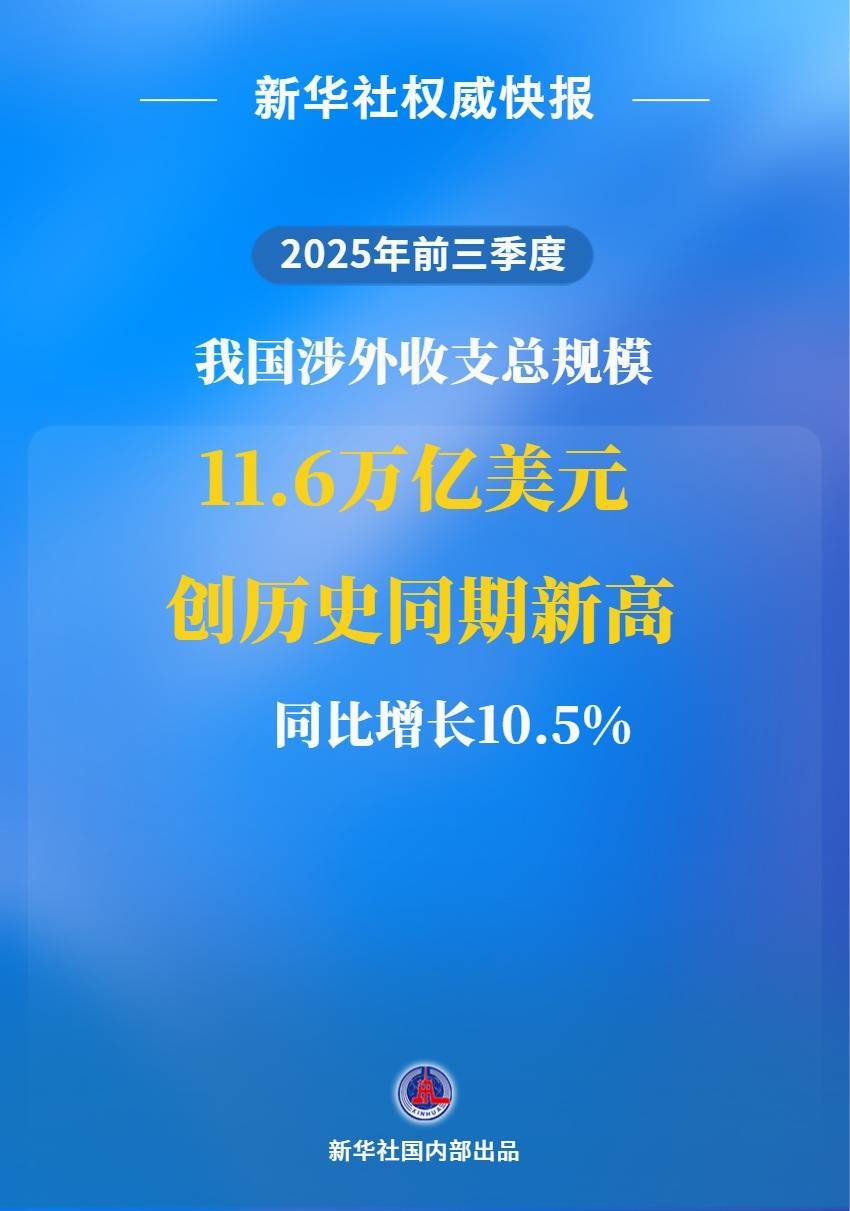
新华社权威快报|前三季度我国涉外收支总规模创历史同期新高
Sou Hu Cai Jing· 2025-10-22 08:52
Core Insights - The total scale of foreign-related income and expenditure in China reached 11.6 trillion USD in the first three quarters of 2025, marking a historical high for the same period [2][4] - This figure represents a year-on-year growth of 10.5% [2][4] - The net inflow of cross-border funds was 119.7 billion USD, and the bank's foreign exchange settlement surplus was 63.2 billion USD, both exceeding the levels of the previous year [4] Summary by Categories - **Foreign-Related Income and Expenditure** - The total scale reached 11.6 trillion USD, a historical high for the same period [2][4] - Year-on-year growth was recorded at 10.5% [2][4] - **Cross-Border Fund Flows** - Net inflow of cross-border funds amounted to 119.7 billion USD [4] - Bank's foreign exchange settlement surplus was 63.2 billion USD [4] - **Market Performance** - The foreign exchange market in China has shown stable operation and expectations, demonstrating strong resilience and vitality [4]
日本贸易赤字收窄日元升值
Jin Tou Wang· 2025-10-22 06:13
Group 1 - The core viewpoint of the news is that Japan's trade data has improved, leading to a strengthening of the yen against the dollar, with the USD/JPY exchange rate slightly declining to 151.8100, down 0.08% [1] - Japan's September trade deficit was reported at 234.6 billion yen, slightly lower than August's 242.8 billion yen, but still far below the market expectation of a surplus of 22 billion yen [1] - Exports increased by 4.2% year-on-year, marking the first rebound since April, although it was slightly below the expected 4.6% [1] Group 2 - Imports rose by 3.3%, reaching a three-month high, exceeding the market expectation of a 0.6% increase, indicating a recovery in Japan's economic activity [1] - Political factors, including the appointment of Japan's first female Prime Minister, have bolstered market confidence in the yen, as she promises to strengthen the economy and defense capabilities [1] - A market survey indicated that 64 out of 67 economists expect Japan's policy interest rate to remain at 0.75% until March 2026, with about 60% anticipating a 25 basis point rate hike this quarter [1] Group 3 - The technical analysis of the USD/JPY exchange rate shows it remains in an upward channel, with a medium-term bullish trend intact [2] - Short-term support is identified at the 9-day exponential moving average (EMA) around 151.20; a drop below this level could weaken the short-term upward momentum [2] - The initial resistance level is at the eight-month high of 153.27, and a breakthrough could lead to testing the upper boundary of the upward channel near 156.90 [2]
贸易战担忧缓解澳元收复失地
Jin Tou Wang· 2025-10-22 06:02
Group 1 - The Australian dollar (AUD) against the US dollar (USD) has shown a positive trend, rising above 0.6500, with the latest exchange rate at 0.6505, reflecting a 0.28% increase. This rise is attributed to optimistic signals in international trade, particularly regarding a potential trade agreement between the US and China [1] - US President Trump indicated that implementing comprehensive tariffs on China is not sustainable and expressed hope for a high-quality agreement between the two nations. However, he warned of a potential 155% tariff if negotiations fail, making the upcoming US-China trade talks a focal point for the market [1] - The US government shutdown has entered its 22nd day, with the Senate failing to pass a funding bill for the 11th time, indicating a continued legislative deadlock [1] Group 2 - Market attention is shifting towards the US Consumer Price Index (CPI) data set to be released on October 24, with expectations of a 0.4% month-on-month increase and a 3.1% year-on-year rise. Additionally, the Federal Open Market Committee (FOMC) meeting on October 29 is anticipated to result in a 25 basis point rate cut, which may further influence the AUD's performance [2] - Technical analysis indicates that the AUD/USD exchange rate has gained some bullish momentum, supported by the stability of the current support level at 0.6475. However, the negative pressure from trading below the EMA50 continues to limit recovery opportunities in the near term [2] - The AUD/USD has failed to break through the key resistance level of 0.6535, with a lack of new catalysts suggesting a potential for continued volatility in the short term. Analysts have identified support levels at 0.6440 and 0.6415, and resistance levels at 0.6535 and 0.6630, indicating the need for investors to monitor upcoming catalysts [2]
三季度中国GDP同比增4.8%,油厂豆粕库存
Dong Zheng Qi Huo· 2025-10-21 00:47
Report Industry Investment Rating No relevant content provided. Core Viewpoints of the Report - The US delays the G7 plan to expand the use of frozen Russian assets, indicating an intention to reduce tensions before Trump meets Putin, leading to a rise in market risk appetite [17]. - Affected by news such as Sino - US negotiations, on October 20, the A - share market rose with shrinking volume. Currently, market liquidity is rapidly contracting, and there is a strong wait - and - see sentiment. Future trends depend on domestic and foreign policy changes [2]. - During the Fourth Plenary Session, there are relatively many policies. It is advisable to be cautious in the short - term. If the market risk preference fails to strengthen, the bond market will turn stronger [25]. - The cost of imported soybeans supports the soybean meal price, but the current supply - demand situation is weak, and sufficient soybean supply is expected in the fourth quarter. The soybean meal futures price is likely to remain volatile [4]. - In September, economic data continued to show structural differentiation. The overall terminal demand was weak, with real estate and infrastructure demand remaining sluggish and manufacturing showing resilience. High pig iron production will suppress the subsequent inventory reduction speed, limiting the upward space for steel prices [5]. - The continuous inventory reduction during the peak season supports the lithium carbonate price, but further upward momentum may depend on unexpected supply - side disruptions [6]. Summary by Directory 1. Financial News and Reviews 1.1 Macro Strategy (Gold) - The US government continues to be shut down. The gold price hit a new high, and overseas gold and silver ETF holdings increased, while the domestic market was weak. Gold is expected to fluctuate at a high level this week, and attention should be paid to the callback risk [13]. - Investment advice: The gold price will fluctuate at a high level in the short - term, and attention should be paid to the callback risk caused by long - position profit - taking [14]. 1.2 Macro Strategy (Foreign Exchange Futures - US Dollar Index) - The US and Australia signed a key minerals agreement, and the US Senate will "pause" the new round of sanctions against Russia. The US delays the G7 plan to expand the use of frozen Russian assets, indicating an intention to reduce tensions before Trump meets Putin, and market risk preference has recovered [15][16][17]. - Investment advice: The US dollar is expected to decline in the short - term [18]. 1.3 Macro Strategy (Stock Index Futures) - China's GDP in the third quarter increased by 4.8% year - on - year. Affected by news such as Sino - US negotiations, on October 20, the A - share market rose with shrinking volume. Currently, market liquidity is rapidly contracting, and there is a strong wait - and - see sentiment [2][19]. - Investment advice: Allocate various stock indices evenly [21]. 1.4 Macro Strategy (Treasury Bond Futures) - The LPR quotation in October remained stable. China's economic data in September showed differentiation. The bond market fluctuated and declined today due to Trump's softened stance towards China, but market risk preference has not been strongly activated [22][23][24]. - Investment advice: Be cautious in short - term trading this week. If market risk preference fails to strengthen, look for opportunities to build long - term long positions at low prices [25]. 2. Commodity News and Reviews 2.1 Black Metal (Steam Coal) - On October 20, the steam coal price in the northern port market was strong. The downstream demand increased last week, and the coal price rose. After the Datong - Qinhuangdao Railway maintenance ends, the supply of port spot will increase, and the coal price increase is expected to narrow this week [26]. - Investment advice: The coal price will remain strong in the short - term [26]. 2.2 Black Metal (Iron Ore) - Fenix Resources' iron ore production in the third quarter increased significantly. The iron ore price continued to be weak and volatile. The terminal orders weakened, the steel mill inventory pressure increased, and the steel mill profit was compressed. It is expected that the pig iron production will decline in November [27]. - Investment advice: The potential for production cuts is approaching. The iron ore price will remain weak in the short - term, but the downward valuation space is limited [27]. 2.3 Agricultural Products (Cotton) - As of October 17, the inspection volume of US cotton was slow. In September, the export unit price of cotton products rebounded slightly month - on - month. China imported 100,000 tons of cotton and 130,000 tons of cotton yarn in September [28][29][30]. - Investment advice: The Zhengzhou cotton futures price has been resistant to decline recently. However, as the new cotton is listed, the hedging pressure will limit the upward space, and the downstream orders are insufficient. Attention should be paid to the new cotton listing, downstream orders, and Sino - US relations [31][32]. 2.4 Agricultural Products (Soybean Meal) - As of October 17, the national port soybean inventory decreased, the soybean inventory of major oil mills increased, the soybean meal inventory decreased, and the unexecuted contracts decreased. In September, China imported 0 tons of soybeans from the US, and the Brazilian soybean planting rate reached 24% [34][35][36]. - Investment advice: Pay attention to the weather in the Brazilian production area and Sino - US relations. The soybean meal futures price is likely to remain volatile [36]. 2.5 Agricultural Products (Soybean Oil/Rapeseed Oil/Palm Oil) - From October 1 to 20, the export volume of Malaysian palm oil increased by 3.4% month - on - month. As of October 17, the domestic palm oil inventory increased slightly [37][38]. - Investment advice: The market lacks driving forces in the short - term and is expected to remain volatile. In the long - term, pay attention to the long - position opportunities of palm oil [39][40]. 2.6 Black Metal (Rebar/Hot - Rolled Coil) - From January to September, China's infrastructure investment increased by 1.1% year - on - year. In the first three quarters, China's steel exports showed different trends, and the real estate investment continued to decline. The overall terminal demand was weak, and the high pig iron production limited the upward space for steel prices [41][42][44]. - Investment advice: Adopt a volatile trading strategy for steel prices in the short - term [46]. 2.7 Agricultural Products (Jujube) - In Xinjiang, jujubes in some areas are in the drying stage. The futures price of the main contract CJ601 fluctuated and closed down today. The price of jujubes in the distribution areas is stable, and merchants purchase goods as needed [47][48]. - Investment advice: Wait and see before the market logic becomes clear. Pay attention to the price game in the production area and downstream consumption [48]. 2.8 Agricultural Products (Corn Starch) - On October 20, the theoretical profits of corn starch enterprises in different regions showed differentiation. In the future, the inventory pressure and production reduction expectations of starch may be mainly concentrated in the Northeast [49]. - Investment advice: The price difference between starch and corn futures is expected to recover after entering the delivery month. The price difference of 01 and 03 contracts is at a low level and is not expected to shrink further [49]. 2.9 Agricultural Products (Corn) - The domestic corn price is rising. Snowy weather and farmers' reluctance to sell have led to a decrease in downstream arrivals. The spot price is expected to decline, while the futures price may enter a volatile bottom - grinding period [50]. - Investment advice: Wait and see in the short - term. Pay attention to the implementation of wheat auction rumors [50]. 2.10 Non - Ferrous Metals (Polysilicon) - In September, China's polysilicon export volume decreased by 28.17% month - on - month. The spot price of polysilicon is expected to remain stable. The terminal demand has weakened marginally since late October, and the silicon wafer price is under pressure [51][52]. - Investment advice: Maintain the view that the spot price will not decline in October. Consider long - position opportunities when the futures price is at a discount to the spot price. Pay attention to the reverse spread opportunity of PS2511 - PS2512 at around - 2000 yuan/ton [53]. 2.11 Non - Ferrous Metals (Industrial Silicon) - In September, China's industrial silicon export volume increased by 7.73% year - on - year. Some silicon plants in the South are expected to reduce production in late October. The inventory is expected to be difficult to reduce in November and will be reduced by 15,000 tons in December [54][55]. - Investment advice: It is more cost - effective to go long on industrial silicon at low prices [55]. 2.12 Non - Ferrous Metals (Lead) - On October 17, the LME0 - 3 lead was at a discount of $41.85/ton. In September, the import of lead concentrates increased month - on - month and decreased year - on - year. The export of lead - acid batteries decreased, and the import increased [55][56]. - Investment advice: Adopt a wait - and - see strategy for single - side trading. Pay attention to the medium - term positive spread opportunity for cross - market trading [56]. 2.13 Non - Ferrous Metals (Zinc) - Vedanta's zinc concentrate production in the third quarter increased by 6%. In September, the export volume of galvanized sheets increased both month - on - month and year - on - year. The import volume of zinc concentrates increased [57][58][60]. - Investment advice: Wait and see for single - side trading. Pay attention to the medium - term positive spread opportunity. Maintain a positive spread trading strategy for cross - market trading and take profits in batches at low prices [61]. 2.14 Non - Ferrous Metals (Nickel) - In September, China's unforged nickel import volume increased significantly, especially from Russia. The short - term macro situation is still volatile. The global visible inventory has increased significantly, and the price is fluctuating above the cash cost. The nickel ore price is expected to rise in the fourth quarter [62]. - Investment advice: Allocation portfolios can consider long - position opportunities at low prices. Speculative portfolios can consider selling near - the - money put options and buying deep - out - of - the - money call options [63]. 2.15 Non - Ferrous Metals (Lithium Carbonate) - In September, China's lithium ore import volume increased by 14.7% month - on - month. The first batch of lithium concentrate from the Bougouni lithium project was shipped. The inventory has been decreasing, which supports the price, but further upward momentum depends on supply - side disruptions [64][66]. - Investment advice: Use range - bound trading in the short - term. Consider short - position opportunities after the demand peaks this year. Pay attention to the reverse spread opportunity of LC2511 - LC2601 and the positive spread opportunity of LC2601 against more distant contracts [67]. 2.16 Non - Ferrous Metals (Copper) - Peru's Las Bambas copper mine is being affected by illegal mining. In September, China's scrap copper import volume increased by 14.84% year - on - year [68][69]. - Investment advice: The copper price is expected to remain volatile at a high level in the short - term. Consider long - position opportunities at low prices for single - side trading. Wait and see for spread trading [70]. 2.17 Energy Chemicals (Liquefied Petroleum Gas) - Guangzhou Petrochemical's partial device maintenance has reduced the liquefied gas production. The East China liquefied gas price has declined due to factors such as fundamental imbalance and falling paper - futures prices [71][72]. - Investment advice: The price is expected to remain volatile in the short - term [73]. 2.18 Energy Chemicals (Crude Oil) - A Russian refinery was affected by a drone attack. The oil price is weak and volatile. Market risk preference supports the oil price, but concerns about supply surplus continue to put pressure on it [74]. - Investment advice: The oil price will remain weak and volatile in the short - term [75]. 2.19 Energy Chemicals (PVC) - The domestic PVC powder market price has been slightly stronger. The downstream procurement enthusiasm is low, and the spot trading is light. The PVC fundamentals remain weak, and the inventory is high [76][77][78]. - Investment advice: The PVC price is expected to remain weak and volatile in the short - term, and the downward space is limited [78]. 2.20 Energy Chemicals (Styrene) - As of October 20, the styrene inventory in the East China main port increased. The styrene price declined, and the inventory is a key issue. The production profit has decreased, and the cost support is not obvious [79]. - Investment advice: Pay attention to the negative feedback of pure benzene downstream products. The styrene industry needs a low - profit level to slow down the inventory accumulation in the main port [80]. 2.21 Energy Chemicals (Asphalt) - As of October 20, the asphalt factory and social inventories decreased. The BU futures price was weak last week, and the spot price continued to decline. The demand recovery is limited, and the weak international oil price may affect the asphalt price [81][82]. - Investment advice: The asphalt price will be volatile in the short - term [83]. 2.22 Energy Chemicals (Soda Ash) - As of October 20, the domestic soda ash factory inventory increased slightly. The soda ash futures price rose and then fell, affected by the bearish sentiment in the glass market. The downstream demand is stable, and the inventory in the delivery warehouse is high [84]. - Investment advice: Adopt a short - selling strategy at high prices for soda ash in the medium - term, and pay attention to the new capacity release [84]. 2.23 Energy Chemicals (Float Glass) - On October 20, the float glass price in the Hubei market declined. The glass futures price continued to fall due to the failure of supply - reduction expectations and the cooling of macro - positive expectations [85]. - Investment advice: Wait and see in the short - term as the market is bearish, but the futures price is at a discount to the spot price, and the risk of short - selling is high [85].
南华期货外汇(美元兑人民币)周报-20251019
Nan Hua Qi Huo· 2025-10-19 13:19
Report Industry Investment Rating No relevant content provided. Core Viewpoints of the Report - Despite the US federal government shutdown for over two weeks and delayed release of key economic data, the US dollar index has not significantly declined recently. This is driven by data vacuum, the "comparative disadvantage logic" of major non - US currencies, and geopolitical risks pushing up market risk - aversion. The asset reallocation from non - US currencies to commodities also indirectly supports the US dollar. However, the USD/CNY exchange rate is expected to remain stable within a reasonable range under the "stability - first" policy of the Chinese central bank, especially before the important meeting at the end of October [1][17][19]. Summary by Relevant Directory 1. Weekly Market Review and Outlook 1.1 Foreign Exchange Market Review - Last week's foreign exchange market was dominated by policy variables (new trade war risks and Fed's monetary policy signals) and the impact of the US government shutdown. The market was immune to the new trade war risks, and the Fed Chair Powell's dovish signal boosted market liquidity expectations. The euro was positively affected by the Fed's signal and short - term political stability in Europe; the yen was affected by Japan's political uncertainty; the US dollar index depreciated, and the offshore RMB, yen, euro, and pound appreciated against the US dollar, while the on - shore RMB slightly depreciated [2][4][5]. 1.2 Weekly Review of USD/CNY Spot Exchange Rate - The USD/CNY spot exchange rate showed a "rising first then falling" volatile trend last week. Key events included Fed Chair Powell's dovish signal on the balance - sheet reduction process, which was due to short - term liquidity tightness in the US money market. China released September CPI and PPI data, with CPI showing signs of improvement and PPI expected to continue improving but unlikely to turn positive this year [11][12][14]. 1.3 Market Outlook - The US dollar index's short - term strength is supported by multiple factors. However, under the Chinese central bank's policy of maintaining RMB exchange rate stability, the USD/CNY spot exchange rate is expected to remain stable within a reasonable range before the end of October [17][19]. 1.4 Strategy Suggestion - It is recommended to mainly adopt a wait - and - see approach [20]. 2. RMB Market Observation 2.1 Policy Tool Tracking - Counter - Cyclical Factor - As of last Friday, the central parity rate of the USD/CNY exchange rate depreciated by 99 basis points. The counter - cyclical factor indicates that the central bank's attitude towards the exchange rate has shifted from neutral to stabilizing the exchange rate (in the direction of RMB depreciation expectations) [22]. 2.2 Investor Expectations and Sentiment Tracking - **Enterprise Sector Expectations**: In August, China's foreign exchange market was stable, with active trading and balanced supply and demand. Cross - border funds had a net inflow, and bank settlement and sales had a surplus [26]. - **Overseas Investor Expectations**: As of last Friday, the spread between offshore and on - shore RMB showed that overseas investors' depreciation sentiment towards the RMB had declined [30]. - **Professional Investor Expectations**: As of last Friday, the 1 - year NDF closing price of the USD/CNH slightly declined, and the sentiment in the market changed little, with only a slight increase in short - term depreciation sentiment towards the RMB [32]. 2.3 Derivatives Market Tracking - **Hong Kong RMB Futures Market**: Relevant charts show the price trends and basis differences of the Hong Kong Exchange's USD/CNH futures contracts [37][38]. - **Singapore RMB Futures Market**: Relevant charts show the price trends and basis differences of the Singapore Exchange's USD/CNH futures contracts [40][41]. 3. Key Data and Events to Watch 3.1 Weekly Global Key Events Review - **China**: In September, China's foreign trade increased year - on - year; economic policies were continuously promoted, including central bank operations, data releases of M1, M2, CPI, and PPI, and statements on maintaining RMB exchange rate stability [46][47]. - **US**: Economists raised the US economic growth forecast, but employment growth was expected to be weak. There were trade frictions, government shutdown issues, and differences in Fed members' views on interest rate cuts [49][51][56]. - **UK**: The unemployment rate rose, and the private - sector wage growth slowed, triggering an upgrade in interest - rate cut expectations [53]. - **Eurozone**: Germany's economy was unlikely to recover in the third quarter [54]. - **Japan**: No significant events were reported [54]. - **Others**: The IMF raised the world economic growth forecast for 2025 and warned about the global public debt issue [54][55]. 3.2 Weekly Global Central Bank Key Statements Summary - Different central banks, including the Chinese central bank, the Fed, the Bank of Japan, the European Central Bank, and the Reserve Bank of Australia, had various statements on monetary policies, interest rate cuts, and exchange rate stability [55][56][59]. 3.3 This Week's Key Financial and Economic Data and Events to Watch - A series of important economic data from China, the US, Canada, Japan, and the UK, as well as central bank speeches, are to be released this week [63]. 4. International Related Market Conditions 4.1 Exchange Rates of Major Countries - Charts show the trends of exchange rates between the US dollar and major currencies such as the euro, yen, pound, etc. [64][66][70]. 4.2 Linkage of Major Asset Classes - Charts show the trends of major assets including gold, crude oil, stock indices, etc., and their relationships [84][85][86]. 4.3 Capital Situation - Charts show central bank open - market operations, Shibor quotes, and SOFR quotes [94][96]. 4.4 Sino - US Interest Rate Spread - Charts show the trends of Sino - US interest rate spreads and the yields of 10 - year US and Chinese treasury bonds [98][99]. 4.5 RMB Exchange Rate Index - Charts show the trends of three major RMB exchange rate indices [102]. 4.6 Global Economic and Trade Friction Tracking - Charts show the monthly values of the global economic and trade friction index and the year - on - year and month - on - month changes in the amount involved in global economic and trade friction measures [104][106].
【UNforex本周财经总结】黄金冲高后急挫 风险与政策预期主导市场
Sou Hu Cai Jing· 2025-10-18 10:48
Group 1: Market Overview - Global financial markets experienced significant volatility this week due to geopolitical tensions and policy expectations, with a shift between risk and safe-haven assets [1][3] - The price of gold reached a historical high of $4,379 before retreating over 2% to around $4,240, influenced by a more moderate stance from Trump on tariffs against China [1] - The U.S. dollar index (DXY) rebounded to 98.40, ending a four-day decline, supported by comments from Federal Reserve officials regarding the 2% inflation target [2] Group 2: Commodity Performance - Oil prices continued to face pressure, with WTI crude reaching a five-month low of $56.5 per barrel, driven by an unexpected increase in U.S. crude inventories and concerns over oversupply [2] - Despite short-term adjustments, central banks' ongoing accumulation of gold and the trend of de-dollarization provide medium to long-term support for gold prices [1] Group 3: Economic Indicators and Future Outlook - Upcoming focus will be on U.S. CPI and PCE inflation data, which will be critical in determining the direction of the dollar and the stability of gold prices around the $4,200 support level [3] - The interplay between geopolitical events, such as the U.S. government shutdown and trade tensions, continues to add uncertainty to market conditions [3]
中国外汇市场韧性持续增强(锐财经)
Ren Min Ri Bao Hai Wai Ban· 2025-10-17 22:13
Core Insights - The foreign exchange market in China is projected to reach a trading volume of $41 trillion in 2024, representing a 37.4% increase from 2020 [1] - The scale of cross-border receipts and payments is expected to be $14 trillion in 2024, marking a 64% growth compared to 2020 [1] - From 2021 to mid-2025, net foreign investment inflow into China is anticipated to exceed $740 billion [1] Group 1: International Balance of Payments - China's international balance of payments has maintained basic equilibrium, which is crucial for promoting internal and external economic balance [2] - The average annual scale of goods trade imports and exports from 2021 to 2024 is nearly $6 trillion, a 43% increase compared to the average during the 13th Five-Year Plan [2] - The net foreign investment inflow into China from 2021 to mid-2025 is over $740 billion, with external financial assets exceeding $11 trillion and liabilities over $7.2 trillion by mid-2025 [2] Group 2: Resilience of the Foreign Exchange Market - The resilience of the foreign exchange market has improved, enhancing its ability to withstand external shocks [3] - The percentage of enterprises using foreign exchange hedging has increased from 17% in 2020 to approximately 30% [3] - The share of the renminbi in cross-border trade has risen from 16% to nearly 30%, significantly reducing foreign exchange risk exposure for enterprises [3] Group 3: Efficient Allocation of Foreign Exchange Resources - The foreign exchange market has become more complete and deeper, with a variety of products available, including spot, forward, swap, and options [4] - As of mid-2023, 703 banks and 115 non-bank institutions are participating in the interbank foreign exchange market, including 296 foreign institutions [4] - The renminbi has maintained its position as the fifth most traded currency globally, with a global trading share of 8.5%, an increase of 1.5 percentage points since 2022 [4] Group 4: Benefits for Enterprises and Citizens - The State Administration of Foreign Exchange has focused on optimizing policy supply to enhance convenience for enterprises and citizens during the 14th Five-Year Plan period [5] - By September 2025, approximately $4.7 trillion in convenience-related transactions have been processed nationwide [6] - The introduction of a "one-stop" service for trade foreign exchange business management aims to reduce the administrative burden on enterprises [6]