外汇

Search documents
历次贸易摩擦中市场反馈模式复盘
Minsheng Securities· 2025-10-13 10:15
Report Industry Investment Rating The provided content does not mention the report industry investment rating. Core Viewpoints of the Report - The current tariff upgrade is likely to follow the pattern of April 2025, with smaller market fluctuations. Trump's subsequent remarks have shown signs of moderation, and the market may have a strong learning effect from the previous negotiation model. As a result, market volatility may be lower and the recovery may be faster in this round of trade frictions. In the short term, it strengthens the long - end bullish momentum of US Treasuries [3][17]. Summary by Relevant Catalogs 1. Review of Market Feedback Patterns in Previous Trade Frictions - **2018.03 - 2018.06: Gradual Recognition Stage at the Beginning of Trade Frictions** - In March 2018, the US announced steel and aluminum tariffs and planned to impose tariffs on $60 billion worth of Chinese goods. Initially, the scope was relatively narrow, and the impact on the global market was not significant. - Over the next three months, as the market recognized the threat of trade frictions, the Chinese equity market was under pressure, with the Shanghai Composite Index falling about 11.45% cumulatively. The bond market strengthened due to risk - aversion sentiment, and the yield of 10 - year Treasury bonds declined by about 19bp, showing a "strong bonds, weak stocks" pattern [1][9]. - **2019.05 - 2019.12: Global Resonance Stage with Re - emergence of Conflicts** - In May 2019, Sino - US negotiations broke down, and trade conflicts escalated again after a brief cease - fire. - Against the backdrop of high trade environment uncertainty and the global manufacturing PMI entering the bottom cycle, most global markets were in a "strong bonds, weak stocks" seesaw pattern in the second half of 2019. The yield of 10 - year US Treasuries dropped from 2.45% to around 1.74% within three months [1][12]. - **2025.04: Amplification and Rapid Recovery of Impact from "Reciprocal Tariffs"** - On April 2, 2025, Trump announced the "reciprocal tariff" policy, imposing a "reciprocal tariff" starting at 10% on all countries. This tariff had an unexpected magnitude and also targeted non - Chinese countries, causing a global impact. - The market reacted quickly. Within five days, major global stock indices fell between 5 - 15%. Funds flocked to "safe - haven" bonds. The yield of 10 - year Japanese Treasury bonds declined by about 32bp within five days, and safe - haven currencies such as the yen and Swiss franc strengthened. - After several rounds of negotiations, the stock market rebounded significantly, and the market gradually alleviated concerns about tariffs. The trading sentiment became relatively insensitive to marginal changes in tariff policies, reaching a consensus of "high - opening and low - running tariffs." The main stock indices basically recovered to pre - tariff levels, while the bond market showed differentiated performance due to factors such as fundamentals, inflation expectations, and political situations [2][14]. 2. This Week's Overseas Macroeconomic Interest Rate Review 2.1 Macroeconomic Indicator Comments - As of the week ending October 3, driven by rising production and increased imports, US EIA crude oil inventories continued to rise after the previous week's rebound. The change in US EIA crude oil inventories for the week was 3.715 million barrels, higher than the forecast of 2.25 million barrels and the previous value of 1.792 million barrels. Despite the larger - than - expected increase in inventories, concerns about Russian crude oil supply disruptions and the recovery of US demand boosted market sentiment to some extent, causing oil prices to rise slightly one hour after the data release [18]. 2.2 Review of Main Overseas Market Interest Rates - **US**: Trade frictions may intensify, and US Treasury yields are falling rapidly. This week (October 3 - October 10, 2025), US Treasury yields declined. Trump's tariff threat on Friday led to pressure on the US stock market, with the Nasdaq Index dropping 3.56% in a single day, the largest decline since April. The yield of 10 - year US Treasuries dropped 9bp in a single day, and COMEX gold rose 1.58% to $4035.5 per ounce. As the government shutdown may continue and trade frictions may re - emerge, funds are expected to further flow into the bond market. The recent unexpected increase in short - term debt issuance may imply a reduction in long - term debt issuance in November, which is beneficial for lowering long - end market interest rates [19]. - **Auction Results**: The 3 - year US note auction was neutral to robust, the 10 - year US note auction was weak, and the 30 - year US Treasury auction was relatively robust [22]. - **Europe and Japan**: - **Japan**: Under the expectation of "pro - stimulus" policies, the yield of long - term Japanese bonds is approaching a 17 - year high. The yield of 10 - year Japanese bonds is stable at around 1.70%, close to the highest level since 2008. However, the breakdown of the Japanese ruling coalition on Friday makes the future policy direction uncertain [30]. - **Germany**: German bond yields declined overall this week [30]. 3. Comments on Other Major Asset Classes - **Equity**: Vietnam and Japan reached new highs, while European and American markets generally weakened. Vietnam's VN30 had the strongest performance (+6.51%), followed by Japan's Nikkei 225 (+5.07%). European, American, and Hong Kong markets generally declined. The political turmoil in Paris led to a significant decline in the French stock market, and Trump's threat against China pressured the US stock market [31]. - **Commodities**: Safe - haven precious metals and base metals were strong, while energy, agricultural products were weak, and crypto - assets tumbled. Gold and silver prices rose significantly, driven by risk - aversion demand and a weaker US dollar. Base metals and energy raw materials also generally strengthened. In contrast, Brent crude oil, agricultural products, and Bitcoin declined [32]. - **Foreign Exchange**: The Russian ruble led the gains, and the Japanese yen led the losses. The ruble rose 1.73%, while the yen fell 3.63% due to easing expectations [33]. 4. Market Tracking The report provides data on the changes in bond yields, stock index returns, commodity price changes, and foreign exchange rate fluctuations of major global economies this week, as well as the latest economic data panels of the US, Japan, and the Eurozone [39][48][55][59].
韩元汇率:韩官方口头干预,跌幅收窄至0.2%
Sou Hu Cai Jing· 2025-10-13 06:49
Core Viewpoint - South Korea's regulatory authorities have made a rare verbal intervention regarding the won's exchange rate, indicating they are closely monitoring its one-sided movements due to domestic and international factors [1] Group 1: Market Response - The won's decline narrowed to approximately 0.2%, trading at 1,427.95 won per dollar, after previously dropping by 0.5% [1] - The Bloomberg Asia Currency Index fell to its lowest level since May, reflecting a broader weakness in Asian currencies [1] Group 2: Official Statements - The joint statement from the South Korean Ministry of Finance and the Bank of Korea is the first since April 2024, highlighting the significance of the current market conditions [1] - Although the tone of the statement was mild, verbal interventions from officials are often interpreted as policy signals, which can lead to expectations of actual market interventions [1]
美元涨人民币跌,这事对咱老百姓影响大不大?
Sou Hu Cai Jing· 2025-10-13 00:02
Core Insights - The recent depreciation of the Chinese yuan against the US dollar has significant implications for both consumers and exporters, with the exchange rate affecting the cost of imports and the revenue from exports [1][3][7]. Exchange Rate Dynamics - The exchange rate operates like a seesaw, where a stronger dollar results in a weaker yuan, influenced by economic stability, interest rates, and investment flows [3][4]. - The US dollar's strength is attributed to multiple interest rate hikes and positive economic data, attracting global capital, while the yuan remains relatively stable due to slower domestic consumption and investment recovery [3][4]. Impact on Consumers - The depreciation of the yuan means higher costs for consumers purchasing imported goods, such as electronics and education expenses, which have increased significantly in yuan terms [3][4]. - For individuals holding dollar-denominated financial products, the appreciation of the dollar translates to gains from currency exchange [3][4]. Export Opportunities - A weaker yuan can benefit domestic exporters, as their products become cheaper for foreign buyers, potentially increasing sales and revenue when converted back to yuan [1][7]. - The current exchange rate scenario presents opportunities for savvy exporters to capitalize on favorable currency conditions [7][8]. Long-term Outlook - The yuan's value is not solely determined by current exchange rates but is a reflection of broader economic conditions, including trade balances and investment flows [6][8]. - The increasing use of the yuan in global trade indicates growing confidence in its stability, suggesting that as long as the domestic economy remains robust, the yuan will maintain its value over the long term [6][8]. Consumer Strategies - Consumers are advised to be strategic about currency exchange, particularly when planning international purchases, and to consider diversifying their investments to mitigate risks associated with currency fluctuations [6][8].



人民币兑美元约0.14,汇率变化对老百姓到底有多大影响
Sou Hu Cai Jing· 2025-10-12 21:19
Core Viewpoint - The fluctuation of the RMB to USD exchange rate reflects the relative value of currencies and is influenced by various global economic factors, rather than indicating a permanent devaluation of the RMB [1][3]. Impact of Exchange Rate Fluctuations - The rising cost of imported goods, such as milk powder and electronics, is directly linked to the USD's strength, which increases the cost of these items for consumers [3]. - Parents of students studying abroad face increased financial pressure as the cost of living in foreign currencies rises due to the depreciation of the RMB [3]. - For export-oriented companies, a weaker RMB can be beneficial as it makes Chinese goods cheaper for foreign buyers, potentially increasing export orders [3]. Underlying Logic of RMB Exchange Rate Changes - Exchange rate fluctuations are normal and reflect the broader economic environment, including China's strong economic fundamentals and foreign exchange reserves [3][4]. - The RMB's international standing is improving, despite temporary fluctuations caused by global economic conditions and U.S. monetary policy [3][6]. Long-term Outlook - The RMB is expected to remain stable in the long run, supported by China's robust economic foundation and ongoing efforts to enhance the currency's international influence [6][7]. - The increasing use of the RMB in international trade settlements indicates its growing significance and acceptance globally [7]. Recommendations for Individuals - Individuals are advised to stay calm during exchange rate fluctuations and consider strategic currency exchanges when rates are favorable [6]. - It is important to focus on personal financial planning and investment strategies rather than being overly concerned with daily exchange rate changes [9].

ETO Markets 出入金:英镑兑美元能否稳住涨势,还是将再度回落?
Sou Hu Cai Jing· 2025-10-11 09:51
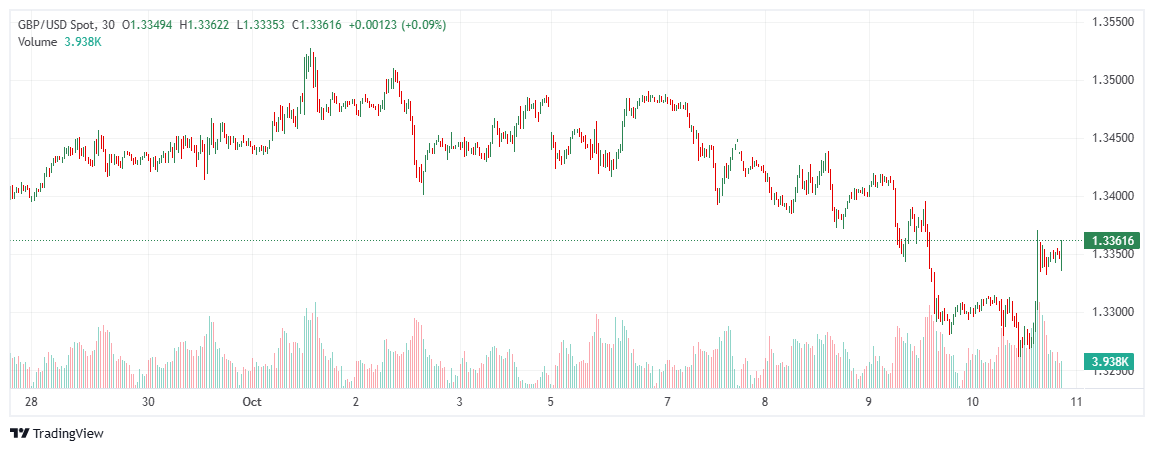
Core Viewpoint - GBP/USD reversed its trend during the US trading session, rebounding approximately 100 points from its intraday low, currently around 1.3360, due to concerns over US-China trade relations and strong selling pressure on the dollar [1] Technical Analysis - GBP/USD has faced resistance near the 100-period simple moving average (SMA) multiple times, with bearish sentiment prevailing due to signs of a breakdown from a descending channel since the beginning of the month [3] - The price may further decline towards the two-month low range of 1.3330-1.3325, with a potential new selling wave if it breaks below the 1.3300 level, targeting support at 1.3260-1.3255 and possibly extending to 1.3200 [3] - Conversely, if a rebound occurs, resistance is expected at the 1.3400 level, followed by the Asian session high of 1.3420, with further upward movement potentially facing resistance at 1.3465-1.3475 [3] Fundamental Analysis - Bank of England (BoE) official Catherine Mann emphasized the need for prolonged tight monetary policy to foster a conducive growth environment, citing persistent inflation and moderate growth prospects [4] - UK Treasury Chief Secretary James Murray stated that the government will not allow departments to use emergency funds for salary increases, aiming to prevent a wage spiral and establish a stable economic foundation [4] - Amidst the US government shutdown and Senate deadlock, market risk aversion is rising, which may provide some safe-haven support for the dollar, potentially suppressing GBP performance [5] - Market expectations suggest that the Federal Reserve will maintain a dovish stance, limiting the dollar's rebound momentum [5]
2025年9月境外人民币市场综述
Sou Hu Cai Jing· 2025-10-11 02:37
Core Insights - In September, the offshore (CNH) RMB depreciated against the USD while the onshore (CNY) RMB appreciated, with a daily average price difference of 67 basis points (BP), a decrease of 13 BP from the previous month [1][3]. Group 1: Offshore RMB Deposits in Hong Kong and Taiwan - As of August 2025, offshore RMB deposits in Hong Kong increased to 967.96 billion yuan, up 3.2% from the previous month, while Taiwan's deposits decreased to 120.59 billion yuan, down 3.0% [2]. Group 2: Offshore RMB Foreign Exchange Market - On September 30, the CNH/USD exchange rate closed at 7.1287, a depreciation of 0.09% from the previous month, while the CNY/USD exchange rate closed at 7.1186, an appreciation of 0.20% [3]. - The CFETS RMB exchange rate index rose by 0.21%, the BIS currency basket index rose by 0.20%, and the SDR currency basket index remained unchanged [3]. Group 3: Offshore RMB Bond Market - In September, the offshore RMB bond market issued 121 bonds, an increase of 11 bonds from the previous month, with a total issuance amount of 291.004 billion yuan, up 77.4% [5]. Group 4: Offshore RMB Money Market - By the end of September, the CNH HIBOR rates for overnight, 7-day, 3-month, and 1-year periods were 1.8127%, 1.6218%, 1.7100%, and 1.9688%, respectively, with changes of +22 BP, +5 BP, -3 BP, and +5 BP compared to the previous month [6]. - The average interest rate differentials between offshore and onshore borrowing rates showed mixed trends, with some periods experiencing declines and others increases [6]. Group 5: Dynamics of Foreign Institutions in Domestic Interbank Market - As of the end of September, the total number of foreign institutions participating in the domestic interbank foreign exchange market reached 237, an increase of 1 from the previous month [7]. - The total number of foreign institutions and their products in the domestic interbank currency market reached 5775, an increase of 20 from the previous month [7]. Group 6: Trading Volume of Foreign Institutions - In the domestic interbank foreign exchange market, the total trading volume for foreign institutions was 33,086.45 billion yuan, a decrease of 11.4% compared to the previous month [8]. - The trading volume in the domestic interbank bond market for foreign institutions totaled 9,648.90 billion yuan, a decrease of 16.6% [8].

外汇储备飙到3.34万亿美元,人民币却意外贬值,套利窗口来了?
Sou Hu Cai Jing· 2025-10-09 05:43
Core Viewpoint - The recent increase in China's foreign exchange reserves to $3.34 trillion contrasts sharply with the depreciation of the RMB against the USD, raising questions about the effectiveness of reserve accumulation in stabilizing the currency [2] Group 1: Data Paradox - The growth in reserves is accompanied by concerns over structural imbalances, with the proportion of USD assets falling to 58% from a peak of 73% in 2014, while holdings in EUR, JPY, and gold have increased to 32% [2] - The opportunity cost of holding USD assets is significant, with a yield of 2.3% compared to 4.8% for 10-year US Treasury bonds, resulting in an annualized opportunity cost exceeding $15 billion [2] - The RMB depreciation is driven by three main factors: widening interest rate differentials, narrowing trade surpluses, and diverging policy expectations [2] Group 2: Arbitrage Opportunities - The onshore-offshore price gap for the RMB has widened, creating an arbitrage opportunity with a potential annualized return of 1.9% [2] - The offshore RMB liquidity has tightened, as indicated by the spike in CNH Hibor to 13.4%, the highest since 2013, increasing the cost of arbitrage [2] - The derivatives market shows a 2.1% arbitrage opportunity between NDF and DF rates, with a significant increase in foreign institutional trading volume [2] Group 3: Policy Responses - The central bank has reactivated counter-cyclical factors in the exchange rate management model, adjusting the counter-cyclical coefficient to 0.8 to limit depreciation [2] - Capital controls have been tightened, requiring banks to conduct thorough reviews of large foreign exchange transactions, particularly in technology and real estate sectors [2] - The central bank has signaled stability by emphasizing the adequacy of reserves to manage short-term fluctuations and has increased gold holdings to diversify reserve assets [2] Group 4: Underlying Contradictions - Concerns about the quality of reserves are rising, particularly regarding the liquidity risks associated with the $1.1 trillion in US Treasury bonds held by China [2] - The balance between market-driven and interventionist approaches in exchange rate formation is challenged, with a significant increase in direct interventions by the central bank [2] - The real effective exchange rate has appreciated by 23% since 2015, impacting export competitiveness and increasing import costs for key commodities [2] Group 5: Future Outlook - Short-term arbitrage opportunities are expected to narrow by Q4 2025 as the US Federal Reserve nears the end of its rate hike cycle [2] - Long-term reforms are anticipated, including optimizing reserve structures and enhancing the flexibility of the RMB exchange rate [2] - The need for a new balance in reserve management, exchange rate mechanisms, and industrial upgrades is emphasized to ensure sustainable financial security [2]

大类资产早报-20251009
Yong An Qi Huo· 2025-10-09 01:08
Global Asset Market Performance 10 - Year Treasury Yields of Major Economies - Yields and Changes: The yields and changes (latest, weekly, monthly, yearly) of 10 - year treasury bonds in various economies like the US, UK, France, etc. were presented. For example, the US 10 - year treasury yield on 2025/09/30 was 4.151, with a latest change of 0.011, a weekly change of 0.044, a monthly change of - 0.111, and a yearly change of 0.421 [2]. 2 - Year Treasury Yields of Major Economies - Yields and Changes: Similar to the 10 - year bonds, the yields and changes of 2 - year treasury bonds in economies such as the US, UK, Germany were provided. For instance, the US 2 - year treasury yield on 2025/09/30 was 3.630, with a latest change of - 0.010, a weekly change of 0.060, a monthly change of 0.070, and a yearly change of 0.080 [2]. Dollar - to - Major Emerging Economies Currency Exchange Rates - Rates and Changes: The exchange rates and their changes (latest, weekly, monthly, yearly) of the US dollar against major emerging economies' currencies like the Brazilian real, Russian ruble, etc. were shown. For example, the dollar - to - Brazilian real exchange rate on 2025/09/30 was 5.322 with a latest change of - 0.01% [2]. Major Economies' Stock Indices - Indices and Changes: The values and changes (latest, weekly, monthly, yearly) of major economies' stock indices including the S&P 500, Dow Jones Industrial Average, etc. were given. For example, the S&P 500 index value on 2025/09/30 was 6688.460, with a latest change of 0.41%, a weekly change of 0.47%, a monthly change of 4.25%, and a yearly change of 16.67% [2]. Credit Bond Indices - Indices and Changes: The changes (latest, weekly, monthly, yearly) of credit bond indices such as the US investment - grade credit bond index, euro - zone investment - grade credit bond index were presented. For example, the latest change of the US investment - grade credit bond index was - 0.06% [2]. Stock Index Futures Trading Data Index Performance - Closing Prices and Changes: The closing prices and percentage changes of A - shares, CSI 300, SSE 50, etc. were reported. For example, the closing price of A - shares was 3882.78 with a 0.52% increase [3]. Valuation - PE Ratios and Changes: The PE (TTM) ratios and their环比 changes of indices like the CSI 300, SSE 50 were provided. For example, the PE (TTM) of the CSI 300 was 14.22 with a环比 change of 0.03 [3]. Risk Premium - Calculation and Changes: The risk premiums (1/PE - 10 - year interest rate) and their环比 changes of indices such as the S&P 500, German DAX were shown. For example, the risk premium of the S&P 500 was - 0.56 with a环比 change of - 0.03 [3]. Fund Flows - Values and Averages: The latest values and 5 - day average values of fund flows in A - shares, the main board, etc. were given. For example, the latest fund flow value of A - shares was - 288.47, and the 5 - day average was - 46.80 [3]. Trading Volume - Values and Changes: The latest trading volume values and环比 changes of the Shanghai and Shenzhen stock markets, CSI 300, etc. were reported. For example, the latest trading volume of the Shanghai and Shenzhen stock markets was 21814.11 with a环比 change of 199.50 [3]. Basis and Spread - Basis and Magnitude: The basis and magnitude of the main index futures contracts like IF, IH, IC were presented. For example, the basis of IF was - 22.69 with a magnitude of - 0.49% [3]. Treasury Bond Futures Trading Data Closing Prices and Changes - Closing Prices and Percentage Changes: The closing prices and percentage changes of treasury bond futures T00, TF00, etc. were reported. All had a 0.00% change [4]. Funding Rates - Rates and Daily Changes: The funding rates (R001, R007, SHIBOR - 3M) and their daily changes (in BP) were provided. For example, R001 was 1.5331% with a daily change of - 34.00 BP [4].
日元兑美元跌超0.5%,一度触及153日元
Sou Hu Cai Jing· 2025-10-08 21:13
Core Viewpoint - The US dollar strengthened against the Japanese yen, reaching a high of 153 yen during trading, indicating a bullish trend in the currency market [1] Currency Movements - The US dollar rose by 0.52% against the Japanese yen, closing at 152.69 yen, with an intraday trading range of 151.74 to 153.00 yen [1] - The euro appreciated by 0.29% against the yen, closing at 177.59 yen, and peaked at 177.86 yen during the day [1] - The British pound increased by 0.33% against the yen, ending at 204.678 yen, with a high of 205.322 yen [1]
闫瑞祥:黄金强势突破4000大关,欧美四小时阻力决定节奏
Sou Hu Cai Jing· 2025-10-08 08:18
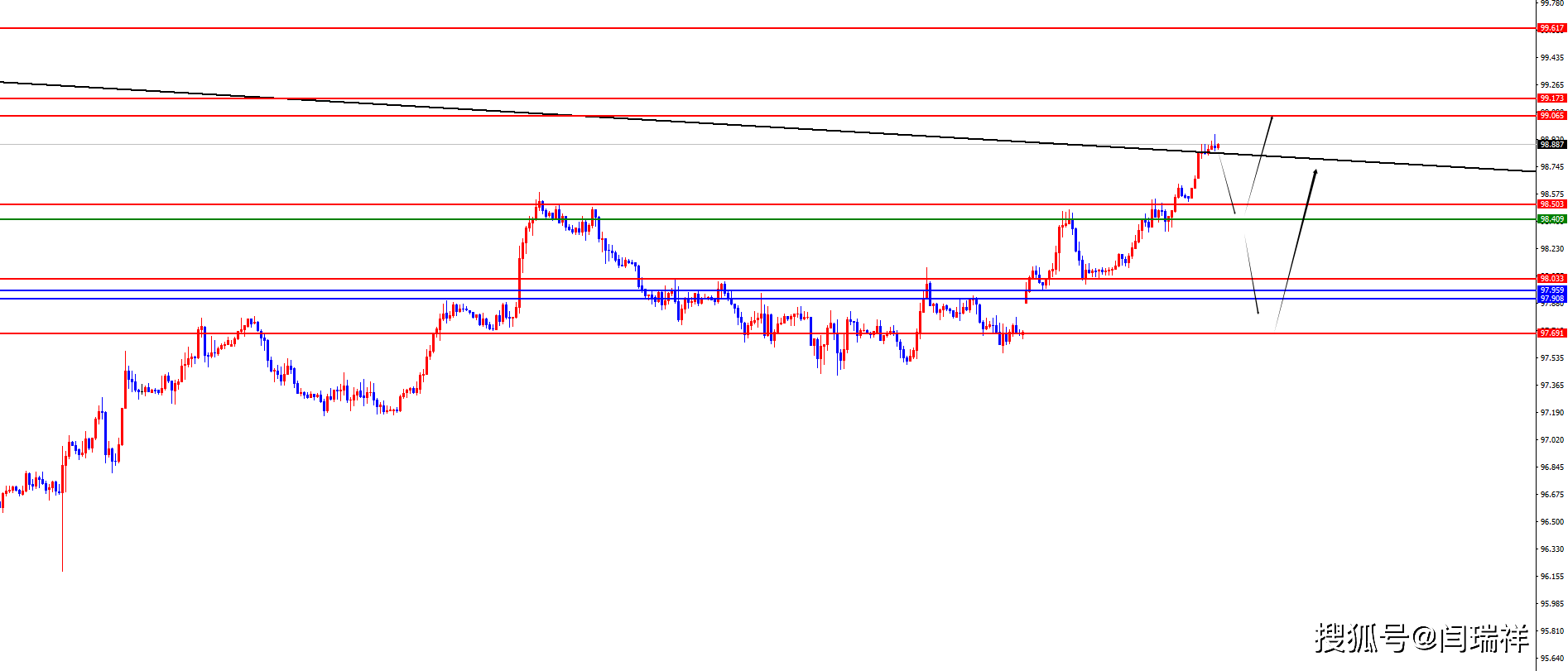
Group 1: US Dollar Index - The US Dollar Index showed an upward trend on Tuesday, reaching a high of 98.636 and a low of 98.059, closing at 98.561 [1] - The market exhibited a bullish sentiment, supported by previous low points, with a significant closing on a strong note [1] - Key support levels are identified at 97.90 for both weekly and daily charts, indicating potential for further upward movement if these levels are maintained [1] Group 2: Gold Market - Gold prices experienced an overall increase on Tuesday, with a peak of 3990.91 and a low of 3940.7, closing at 3984.31 [3] - The market remains bullish in the short term, supported by four-hour support levels, indicating a continuation of upward momentum [4] - Long-term analysis suggests that the price above 3130 is favorable for bullish positions, with key support at 3837 for short-term trading [4] Group 3: Euro/USD - The Euro/USD pair showed a downward trend on Tuesday, with a low of 1.1647 and a high of 1.1714, closing at 1.1657 [6] - The market is under pressure, with significant resistance at 1.1720 and a critical support level at 1.1690 for the weekly chart [6] - Short-term outlook suggests a cautious approach, monitoring the four-hour resistance levels for potential adjustments [6] Group 4: Economic Data and Events - Key economic data to watch includes Germany's industrial output and various EIA oil inventory reports scheduled for October 8, 2025 [8] - The Federal Reserve's upcoming speeches and the release of the monetary policy meeting minutes are also significant events to monitor [8]