
电力设备

Search documents
两融余额较上一日增加346.32亿元 电子行业获融资净买入额居首
Sou Hu Cai Jing· 2026-02-25 01:48
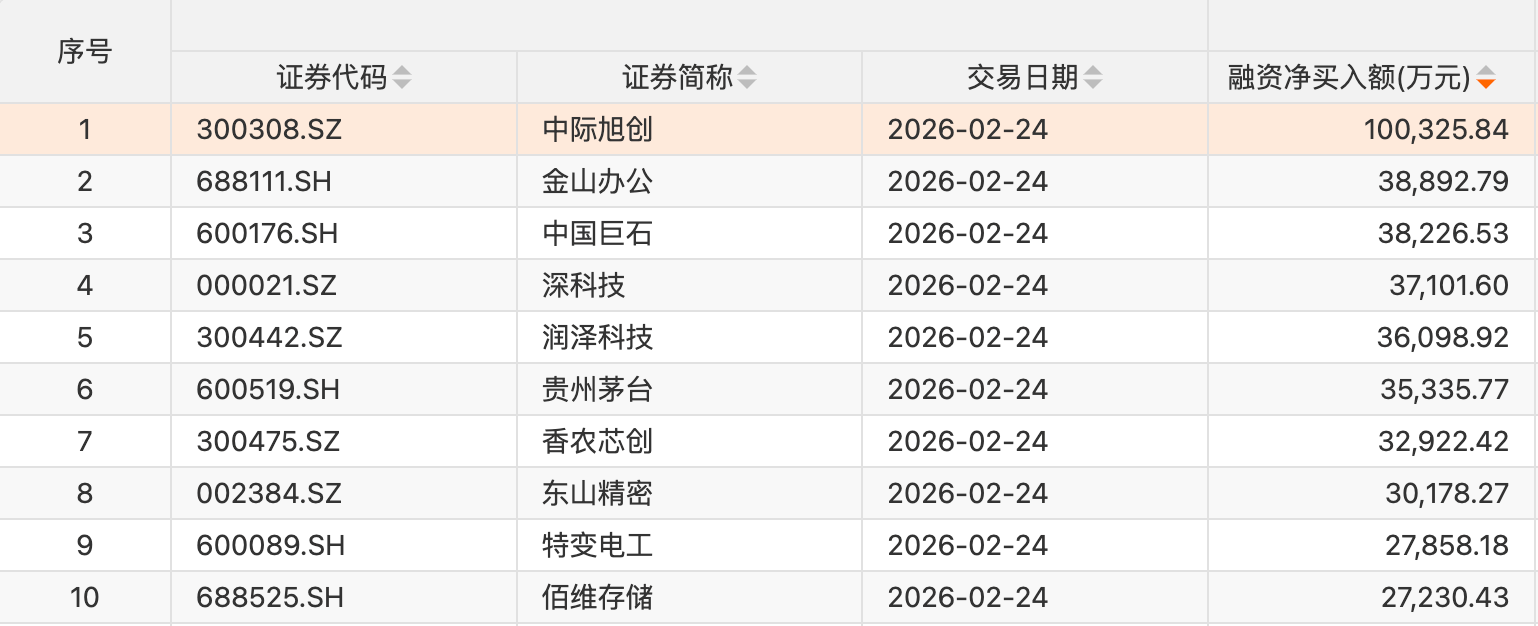
Group 1 - As of February 24, the margin trading balance in A-shares reached 26,227.57 billion yuan, an increase of 346.32 billion yuan from the previous trading day, accounting for 2.52% of the A-share circulating market value [1] - The trading volume of margin financing on the same day was 2,281.23 billion yuan, which is an increase of 482.89 billion yuan from the previous trading day, representing 10.28% of the total A-share trading volume [1] - Among the 31 primary industries in the Shenwan index, 26 industries experienced net financing inflows, with the electronics industry leading at a net inflow of 6.539 billion yuan [1] Group 2 - A total of 84 individual stocks had net financing inflows exceeding 100 million yuan, with Zhongji Xuchuang leading at a net inflow of 1.003 billion yuan [1] - Other notable stocks with significant net financing inflows include Kingsoft Office, China Jushi, Deep Technology, Runze Technology, Kweichow Moutai, Shannon Semiconductor, Dongshan Precision, TBEA, and Baiwei Storage [1][2] - The current storage super cycle is driven by explosive demand and supply lag, particularly in high-end storage chips due to AI demand, leading to significant price increases [2]

港股概念追踪|AI数据中心的电力需求大幅提升 全球电网设备需求强劲(附概念股)
智通财经网· 2026-02-25 01:04
Group 1 - Global grid investment has been rapidly increasing since 2020, with projections of reaching $390 billion in 2024 and exceeding $400 billion in 2025 [1][2] - The condition of the U.S. energy infrastructure is largely below standard, and the significant increase in AI electricity demand is expected to initiate a mandatory upgrade cycle for U.S. grid equipment [1][2] - The delivery cycle for transformers in the U.S. has extended from 50 weeks to over 120 weeks, indicating supply chain challenges [1] - Chinese companies in the grid equipment sector have advantages in delivery time, technology, and cost, leading to sustained export orders for transformers and other equipment [1] Group 2 - In 2025, the cumulative export value of transformers is projected to reach $9.036 billion, with a growth rate of 34.83%, marking a historical high [1] - In December 2025, the export values of key electrical equipment products such as transformers, wires and cables, copper winding wires, low-voltage switches, and insulators showed significant year-on-year growth rates [1] - The AIDC sector is expected to maintain high growth in 2026, driven by increased capital expenditure plans from leading domestic and international internet companies [2] - The contradiction between the rising electricity demand from data centers and the aging power equipment in the U.S. presents opportunities for Chinese electrical equipment exporters [2] Group 3 - Relevant Hong Kong-listed companies in the electrical equipment sector include Dongfang Electric (01072), Harbin Electric (01133), Shanghai Electric (02727), Weichai Power (02338), and Chongqing Machinery and Electric (02722) [3]

北美缺电持续演绎,燃气机组迎主电新机遇:重卡新视界系列之燃气发电机组
Changjiang Securities· 2026-02-25 00:45
Investment Rating - The report maintains a "Positive" investment rating for the industry [10]. Core Insights - In the short term, the electricity gap in North America continues to widen, leading to a supply-demand imbalance for gas turbines, which presents an opportunity for gas generator sets to become the primary power source [3][9]. - In the medium to long term, gas generator sets are expected to become a preferred choice for small to medium-sized data centers due to their advantages in speed of delivery and operational efficiency [3][9]. - Domestic companies, such as Weichai Power and Yinlun Co., are well-positioned to benefit from this opportunity due to their production capacity and quick delivery capabilities [3][9]. Summary by Sections Background - The demand for AI computing power has surged, resulting in a projected electricity gap of approximately 73.2 GW in the U.S. from 2025 to 2030, which could increase to 201 GW if data center growth exceeds expectations [6][27]. Demand - Gas generator sets are expected to experience explosive growth in the short term due to the electricity shortage, with a projected demand of about 9 GW for gas generator sets in North America by 2026 [7][56]. - The medium to long-term outlook indicates that gas generator sets will be favored for their modularity and lower redundancy costs, particularly for data centers with capacities around 100 MW [8][58]. Supply - There is a significant supply shortage of gas generator sets from overseas manufacturers, while domestic companies like Weichai Power can deliver quickly due to their ample production capacity [8][73]. Investment Recommendations - The report suggests a strong growth cycle for gas generator sets in North America, driven by the ongoing electricity shortage and the limited supply of gas turbines [9][3].


【电新环保】春节期间行业重点事件点评——电新环保行业周报20260223(殷中枢/郝骞/陈无忌/和霖/邓怡亮)
光大证券研究· 2026-02-24 23:03
Group 1 - The article discusses India's consideration to relax restrictions on the import of power and coal equipment from China due to project delays, with a projected 40% shortfall in transformers and reactors over the next three years [4] - India's peak electricity load for the fiscal year 2025-2026 is expected to reach 242 GW, with new coal power installations of 7.21 GW and renewable energy additions of 37.9 GW for solar and 6.3 GW for wind by November 2025 [4] - In 2024, India's total electricity generation is projected to be 2.03 trillion kWh, with power investments around $50.3 billion and grid investments approximately $22.4 billion, which are significantly lower than China's investments in the same sectors [4] Group 2 - The article highlights the U.S. tariff policy changes, including a 15% import tariff on global goods initiated by Trump, which may lead to a 5% reduction in tariffs on Chinese goods, impacting the renewable energy sector [5] - It is noted that some Chinese renewable products will still face anti-dumping duties, necessitating close monitoring of future policy developments [5]

常熟风范电力设备股份有限公司关于南方电网项目中标的公告
Xin Lang Cai Jing· 2026-02-24 17:17
Core Viewpoint - Company has won a bid for multiple projects under the Southern Power Grid, which is expected to positively impact its operating performance, accounting for approximately 5.70% of the company's audited revenue for 2024 [1]. Group 1: Bid Announcement - On February 13, 2026, the Southern Power Grid Company announced the results of its second batch of framework bidding for main network line materials for 2025 [1]. - The company won bids for several products, including 500kV substation steel structures and various types of steel towers, with a total bid amount of approximately 184 million yuan [1]. Group 2: Impact on Company - The signing and execution of the contract from the bid are expected to have a positive impact on the company's operating performance, although it will not affect the independence of the company's business [1].

创业板指全天涨近1%喜提开门红,创业板ETF易方达(159915)交投活跃
Sou Hu Cai Jing· 2026-02-24 12:17
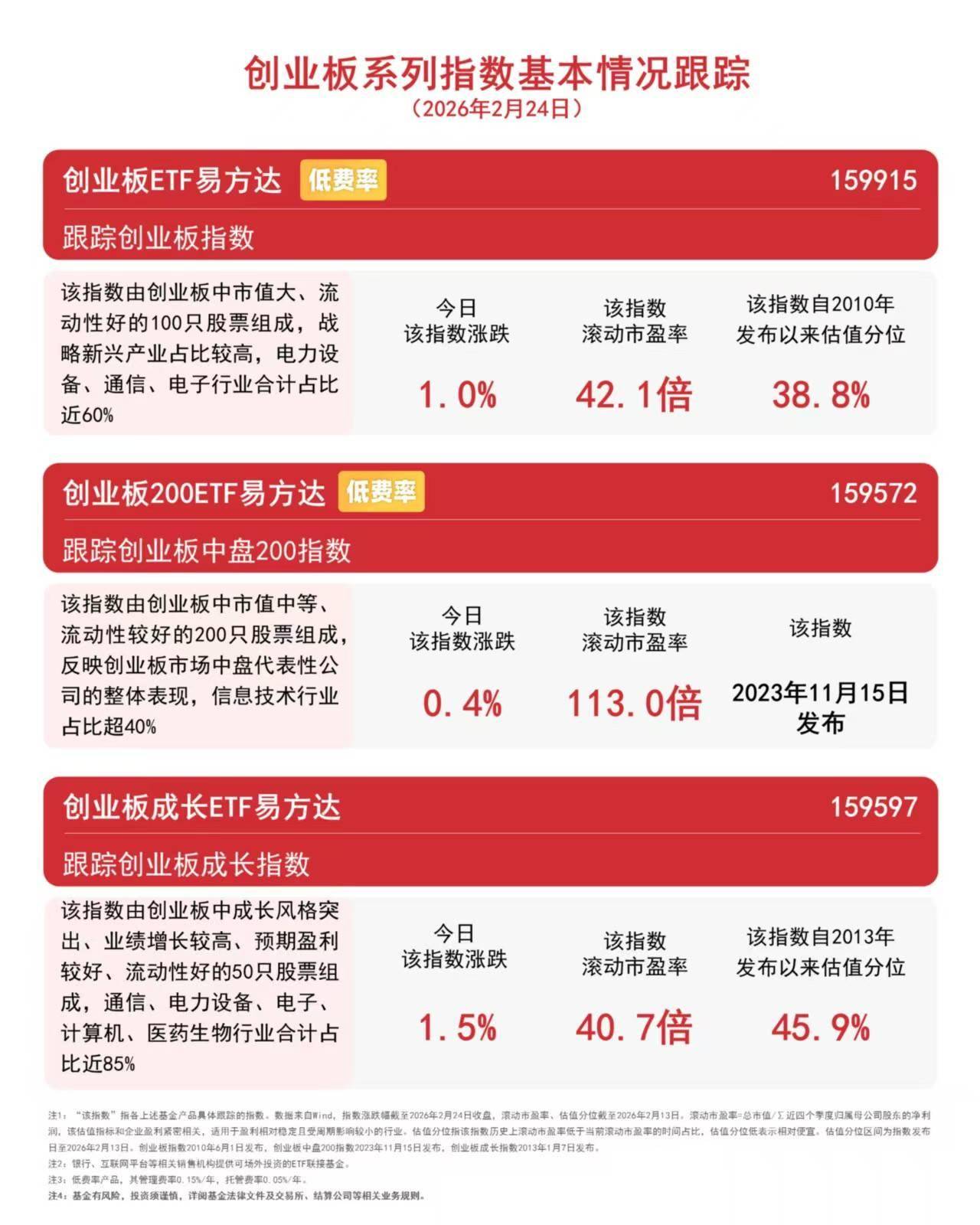
Group 1 - The article discusses three ETFs launched by E Fund that track different indices of the ChiNext market, focusing on low fees and specific sector compositions [2] - The ChiNext Index ETF tracks 100 stocks with large market capitalization and good liquidity, with nearly 60% of its composition in emerging industries such as power equipment, communication, and electronics [2] - The ChiNext 200 ETF tracks 200 mid-cap stocks, reflecting the overall performance of mid-cap companies in the ChiNext market, with over 40% of its composition in the information technology sector [2] - The ChiNext Growth ETF tracks 50 stocks characterized by growth potential and good liquidity, with approximately 85% of its composition in sectors like communication, power equipment, electronics, computers, and biomedicine [2] Group 2 - The rolling price-to-earnings (P/E) ratio for the ChiNext Index ETF is 42.1 times, while the ChiNext 200 ETF has a P/E ratio of 113.0 times, and the ChiNext Growth ETF has a P/E ratio of 40.7 times [2] - The performance of these ETFs since their launch shows varying growth rates, with the ChiNext Index ETF increasing by 1.0%, the ChiNext 200 ETF by 0.4%, and the ChiNext Growth ETF by 1.5% [2]

A股马年开门红!为何机器人板块却没能“稳住”?
Jin Shi Shu Ju· 2026-02-24 11:47
Group 1: Market Performance - On the first trading day of the Year of the Horse, the A-share market experienced a positive opening, with the Shanghai Composite Index rising by 0.87% to 4117.41 points, the Shenzhen Component Index increasing by 1.36% to 14291.57 points, and the ChiNext Index up by 0.99% to 3308.26 points [2] - The total trading volume for the day reached 2.22 trillion yuan, compared to 2 trillion yuan on the previous trading day [2] Group 2: Robotics Sector - The robotics sector gained attention following the performance of humanoid robots during the 2026 Spring Festival Gala, with a notable increase in related stocks [3][5] - Despite an initial rise of nearly 1.5% in the robotics index at market opening, it closed with only a 0.65% increase, indicating a "high open, low close" trend [2][4] - Investors expressed disappointment over the performance of humanoid robots, citing that the expected advancements in technology were not demonstrated during the gala [4] Group 3: Industry Insights - According to Feng Zuitian, chief analyst at Zheshang Securities, the 2026 Spring Festival Gala showcased several robotics companies, which could enhance public awareness and expectations for robots in real-life scenarios [5] - The robotics industry is currently in a phase of technological iteration and scene expansion, with the gala serving as a platform to demonstrate the maturity of related companies' hardware and software [5] - The manager of Tianhong CSI Robotics ETF noted that the humanoid robotics sector is still in the early design phase, requiring significant development in core components [4] Group 4: Film Industry Performance - The film industry faced significant declines, with major companies like Light Media and China Film hitting their daily limit down [6][7] - The total box office for the 2026 Spring Festival was projected to be 56.83 billion yuan, marking the lowest in nearly eight years, despite a record number of screenings [7][8] - Analysts pointed out that the lack of standout films capable of generating widespread discussion contributed to the disappointing box office performance [8] Group 5: Broader Market Trends - The cyclical stocks, particularly in oil, gas, and chemicals, saw a significant rise due to the impact of U.S. tariff policies [9][10] - The electric grid equipment sector continued to strengthen, driven by updates in North American power grids and increased demand for AI data centers [11] - Future market drivers are expected to include policy support for new productivity and energy systems, improved liquidity, and trends in technology commercialization [11]


流动性周报2月第3期:社融同比增速放缓,权益基金发行回暖-20260224
Guohai Securities· 2026-02-24 11:01
Group 1 - The macro liquidity environment is relatively loose, with the central bank conducting a net injection of 12,089 billion yuan through reverse repos and a 10,000 billion yuan six-month buyout reverse repo operation [11][12] - In January 2026, the social financing scale increased significantly to 72,208 billion yuan, with a year-on-year growth of 8.2%, although the growth rate decreased by 10 basis points compared to December 2025 [12][13] - The structure of new financing shows that new RMB loans played a leading role, with an increase of 49,016 billion yuan, while non-standard financing turned positive [12][13] Group 2 - The supply side of the stock market shows structural differentiation, with a recovery in equity fund issuance, as 22 new active equity funds were established, raising a total of 212.77 million fund units [19][20] - The net inflow of financing was observed in industries such as media and non-ferrous metals, while significant outflows were noted in the power equipment and non-bank financial sectors [20][25] - The stock ETF saw a net outflow of 486.45 billion yuan, with notable inflows into indices like CSI 2000 and CSI 1000, while outflows were prominent in indices such as CSI A500 and CSI 300 [20][26] Group 3 - The demand side of the stock market also shows structural differentiation, with an increase in equity financing to 206.23 billion yuan, driven mainly by directed placements [30] - The scale of locked-up shares released this week was significantly lower at 547.7 billion yuan, easing market pressure [30][32] - The net reduction in holdings by major shareholders increased to 125.16 billion yuan, with notable reductions in the electronics and power equipment sectors [30][39]
流动性&交易拥挤度&投资者温度计周报:杠杆资金净流出规模续创25年4月以来新高-20260224
Huachuang Securities· 2026-02-24 10:45
Group 1: Liquidity - The net outflow of leveraged funds reached a new high since April 1998, amounting to -737 billion CNY, placing it in the 1st percentile over the past three years[12] - The issuance of equity public funds rebounded to a historical high of 259 billion CNY, representing the 97th percentile[6] - The net outflow of stock ETFs increased to -488 billion CNY, which is in the 3rd percentile over the past three years[20] Group 2: Market Demand - Equity financing amounted to 206 billion CNY, placing it in the 83rd percentile over the past three years[26] - The net reduction in industrial capital reached -100.8 billion CNY, which is in the 83rd percentile over the past three years[29] - The net inflow of southbound funds decreased to 246 billion CNY, which is in the 77th percentile over the past three years[38] Group 3: Trading Congestion - The trading heat for the building materials sector increased by 19 percentage points to 68%, indicating strong market interest[55] - The trading heat for the liquor sector rose by 10 percentage points to 26%[50] - The trading heat for the medical services sector decreased by 18 percentage points to 58%[46] Group 4: Investor Sentiment - Retail investor net inflow decreased to 117.1 billion CNY, down by 447.4 billion CNY from the previous value, placing it in the 65.4th percentile over the past five years[2] - The search interest for A-shares on social media declined, reflecting a drop in trading sentiment ahead of the holiday[2]
投资者微观行为洞察手册·2月第2期:外资延续流入,公募新发积极
GUOTAI HAITONG SECURITIES· 2026-02-24 10:05
Market Pricing Status: Trading Activity Slightly Decreased, Profitability Increased - The trading turnover rate has decreased, with the average daily trading volume for the entire A-share market dropping to 2.1 trillion yuan, and the average number of daily limit-up stocks decreasing to 60.8 [8][12] - The proportion of stocks that increased in value rose to 47.6%, while the median weekly return for A-share stocks increased to -0.1% [12][15] - The trading concentration in both primary and secondary industries has declined, with six industries having turnover rates in the historical top 90% [12][19] A-Share Liquidity Tracking: Foreign Capital Slightly Inflows, ETF Capital Slightly Outflows - Foreign capital inflow amounted to approximately 3.67 million USD, with the northbound trading volume accounting for 34.6% of total trading [29][46] - The new issuance scale of equity funds increased to 43.63 billion yuan, indicating a rise in overall stock positions of public funds [29][31] - ETF funds experienced a net outflow of 44.18 billion yuan, with the proportion of passive trading decreasing to 6.6% [29][25] A-Share Industry Allocation Tracking: Divergence in Movements of Foreign Capital, ETF Capital, and Financing Capital - Foreign capital saw net inflows in the non-ferrous metals (+39.1 million USD) and banking (+21.4 million USD) sectors [29][43] - Financing capital showed net inflows in the media (+2.88 billion yuan) and environmental protection (+0.24 billion yuan) sectors, while there were significant outflows in power equipment (-6.5 billion yuan) and non-bank financials (-4.56 billion yuan) [29][19] - The ETF sector experienced widespread outflows, particularly in electronics (-11.47 billion yuan) and power equipment (-4.94 billion yuan) [29][19] Hong Kong Stock and Global Liquidity Tracking: Slowing Inflows from Southbound Funds, Marginal Inflows of Global Foreign Capital into Developed Markets - Southbound fund inflows decreased to 27.8 billion yuan, representing the 76th percentile since 2022 [29][4] - The Hang Seng Index fell by 0.6%, while global markets showed mixed performance, with South Korea leading with a 5.5% increase [29][4] - Global foreign capital saw marginal inflows into developed markets, particularly in the US (+8.13 billion USD), Japan (+3.9 billion USD), and the UK (+2.11 billion USD) [29][4]