
光模块

Search documents
廖市无双-本轮上涨是否-一去不回头
2025-12-29 01:04
Summary of Conference Call Records Industry or Company Involved - The discussion primarily revolves around the **A500 ETF** and the broader **Chinese stock market** performance in 2025, including various sectors such as **financials**, **technology**, **commercial aerospace**, and **defense**. Core Points and Arguments 1. **Market Trends and Performance** - The market showed a stabilizing upward trend in 2025, with significant fluctuations due to events like the **Deepseek** surge and the **Trump tariff war**. The **A500 ETF** inflow significantly influenced market momentum, leading to a bullish sentiment with the Shanghai Composite Index surpassing **3,950 points** [1][2][7]. 2. **Impact of Small Probability Events** - Frequent small probability events in 2025 had a notable impact on market dynamics, such as the **April tariff war** causing sharp declines followed by strong rebounds. The shift of funds from the brokerage sector to the **ChiNext** and **STAR Market** indices led to notable increases in these indices [2][4]. 3. **Role of A500 ETF** - The substantial inflow into the **A500 ETF** starting December 17 transformed the market outlook from expected downward adjustments to an upward trend, indicating strong buying interest. This trend could lead to potential peaks around the **Lunar New Year** [5][11]. 4. **Brokerage Sector's Influence** - The brokerage sector is crucial in the current market context, with solid fundamentals but suppressed stock prices. The direction taken by this sector could significantly influence the overall market trajectory, with potential for either upward breakthroughs or further corrections [6][15]. 5. **Market Highlights and Drivers** - Recent market performance was driven by factors such as the **A500 ETF** inflow, a booming **commercial aerospace sector**, and strong performance in the **optical module sector**. Growth indices like **CSI 1000** and **National Index 2000** approached previous highs, with notable gains in **non-ferrous metals** and **defense** sectors [8][9]. 6. **Future Market Predictions** - Short-term trends appear positive, but sustainability of driving factors remains uncertain. The overall market trend is expected to remain upward, with potential high points around **4,034** and long-term targets reaching **4,130** [3][11]. 7. **Year-End Adjustment Risks** - Potential adjustments similar to the previous year's end are anticipated, driven by fund switching dynamics. However, the current market strength suggests a higher probability of upward movement compared to declines [12][14]. 8. **Investment Strategy Recommendations** - Investors are advised to avoid chasing high-performing sectors like **optical modules** and **non-ferrous metals** due to potential correction risks. Instead, focus on sectors with lower valuations and rebound potential, particularly in **non-bank financials**, **electrical new energy**, **electronics**, and **chemicals** [16][18]. Other Important but Possibly Overlooked Content 1. **Sector Rotation Performance** - The sector rotation strategy in 2025 yielded over **20%** excess returns, indicating a strong performance in cyclical sectors. Preparations for 2026 should focus on maintaining flexibility in investment strategies [3][18]. 2. **Macroeconomic Outlook** - Expectations for 2026 include potential surprises in **PPI** and **CPI** due to rising commodity prices across various sectors, necessitating close monitoring of these economic indicators [21]. 3. **Focus on Specific Sub-Sectors** - Key areas of interest include **plastics and products** in chemicals, **tourism and leisure** in consumer services, **electrical equipment** in new energy, and **aerospace** in defense, all showing high value in the current market environment [20].
水到渠成-万舸争腾-A股2026年度投资策略
2025-12-29 01:04
Summary of Key Points from the Conference Call Industry and Company Overview - The conference call discusses the investment strategy for the A-share market in 2026, focusing on sectors such as AI applications, robotics, new consumption, and supply-side reforms [1][3][5]. Core Insights and Arguments - **Market Outlook for 2026**: The outlook is optimistic, expecting a transition from liquidity-driven growth to profit realization, with opportunities in midstream manufacturing, consumer stocks, and cyclical stocks [2][18]. - **2025 Strategy Implementation**: The strategy "source of living water, flowing in sight" has been gradually realized, with significant developments in AI, robotics, and new consumption from Q1 to Q3 of 2025 [3]. - **Global Monetary Policy**: Continued global monetary and fiscal easing is anticipated, with the U.S. possibly lowering interest rates further, benefiting stocks, commodities, and gold [4]. - **Domestic Economic Transition**: The key to domestic economic transformation lies in policy support for high-tech manufacturing and new consumption, leading to a mild recovery in profits and valuations [5][12]. - **Valuation and Growth Potential**: Current valuations of the Shanghai Composite Index and CSI 300 are high, but there remains potential for valuation expansion, with an expected overall index growth of 10-20% in 2026 [13][18]. Specific Industry Focus - **Key Sectors to Watch**: 1. **0-1 Technology Breakthroughs**: Focus on self-sufficiency in chips and materials, and resonance with global supply chains in robotics and commercial aerospace [7][21]. 2. **1-10 Accelerated Growth**: Emphasis on light modules, battery cells, and non-ferrous metals [7]. 3. **Resource Sector Acceleration**: Opportunities in resource products, particularly non-ferrous metals [8]. 4. **Supply Innovations**: Focus on battery sectors and chemicals [9]. 5. **New Consumption**: Attention to new supply creating new demand and opportunities from export recovery [10]. Additional Important Insights - **Traditional vs. Emerging Industries**: Traditional industries should be developed into globally competitive sectors, while emerging strategic industries like new energy and materials are expected to be future pillars [11]. - **AI Application Growth**: AI is showing significant cost-reduction and efficiency improvements, with a notable percentage of U.S. companies adopting AI technologies [15]. - **Low-Valuation Opportunities**: Low-valuation stocks may present opportunities, particularly in cyclical consumption and resource sectors, with a focus on supply-side constraints and policy support [17]. - **Market Dynamics**: The market is expected to experience a broadening of the bull market, with various sectors showing potential for growth [18][22]. Conclusion - The overall market outlook for 2026 is positive, with expectations of double-digit growth and a focus on high-tech industries and low-valuation stocks. Continuous monitoring of supply-side dynamics and policy support will be crucial for identifying investment opportunities [18][22].
236.88%,公募基金年度收益新纪录
Xin Lang Cai Jing· 2025-12-28 23:47
Core Insights - The highest annual return of public actively managed equity funds reached 236.88% as of December 26, 2025, setting a record and securing the top position for the year [1][15][19] - A total of 72 funds achieved over 100% returns this year, indicating a strong performance in the market [1][20][11] - Approximately 80% of actively managed funds outperformed their benchmarks, although the median return was 29.03%, lower than the average of 32.71% [1][11][16] Fund Performance - The top-performing fund, Yongying Technology Smart A, achieved a return of 236.88%, significantly surpassing the second-ranked fund, Zhonghang Opportunity Navigator A, by over 60 percentage points [4][19] - The number of funds with returns exceeding 100% ranks fourth in the past nine years, following 2007, 2020, and 2006 [5][20] - Among the 72 doubling funds, four had returns over 150%, with Yongying Technology Smart A leading at 236.88% [5][20] Market Trends - The strong performance of actively managed equity funds in 2025 is closely tied to the structural market conditions, particularly benefiting from the AI technology sector [7][22] - The average position of the top ten holdings in the doubling funds was 62.72%, significantly higher than the average of 46.2% [7][22] - Notable stocks in the portfolios of top funds include New Yisheng, Zhongji Xuchuang, and Tianfu Communication, which have seen substantial price increases [7][22] Future Outlook - Industry experts suggest that the active equity fund sector is recovering, and the management capabilities of public funds are being recognized [6][21] - There is a call for more funds with consistent performance to benefit a larger number of investors, emphasizing the need for sustainable growth in the sector [1][29] - The investment landscape is expected to evolve, with a focus on long-term value rather than short-term gains, as fund managers adapt to changing market conditions [30][29]

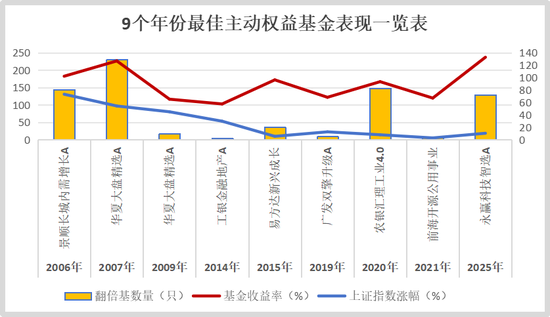
超236%!主动权益基金年度收益或刷新历史纪录
Zheng Quan Shi Bao· 2025-12-28 18:03
Core Insights - The active equity funds in the public offering sector have achieved a remarkable annual return of 236.88% as of December 28, 2025, securing the top position for the year and potentially breaking historical performance records, becoming the highest yielding fund in public offering history [1][2] Group 1: Performance Highlights - A total of 4,378 active equity funds were included in the statistics, with the top performer, Yongying Technology Smart Selection A, achieving a cumulative return of 236.88%, significantly surpassing the second-place fund, Zhonghang Opportunity Navigation A, by over 60 percentage points [2] - The number of funds with returns exceeding 100% reached 72, ranking fourth in the historical context of major A-share market years since 2006 [3] - The average return for active equity funds exceeded 30%, with 3,455 funds outperforming their benchmarks, representing nearly 80% of the total [3][6] Group 2: Market Dynamics - The outstanding performance of active equity funds in 2025 is closely tied to the structural market conditions, particularly benefiting from sectors like AI technology, with many top-performing funds heavily invested in technology sub-sectors [5][6] - The concentration of holdings in top-performing funds is notably high, with average positions in the top ten holdings reaching 62.72%, significantly above the average of 46.2% [5] Group 3: Future Outlook - There is a call for more sustainable performance across a broader range of funds to benefit more investors, as the current high returns are not expected to be consistently replicated [8][9] - The investment community is encouraged to adopt a more measured approach to fund investments, focusing on quality and long-term value rather than chasing high returns [8][9] - The transformation in research and investment mechanisms within the public fund industry is seen as a positive development, moving towards a dual-driven model of data and industry insights [10]

年末关口的强劲反弹能否延续?丨每周研选
Sou Hu Cai Jing· 2025-12-28 16:13
Core Viewpoint - The A-share market is experiencing a strong year-end rebound, with the Shanghai Composite Index achieving an eight-day consecutive rise, and trading volume in the Shanghai and Shenzhen markets returning to 2 trillion yuan, indicating a potential "spring rally" in the near future [4][6]. Group 1: Market Trends - The A-share market is showing signs of a "small rally" as it approaches the year-end, with significant trading volume and a notable rise in sectors such as non-ferrous metals, lithium mining, and commercial aerospace [8]. - The recent upward movement in the index is primarily driven by cyclical sectors, particularly non-ferrous metals, reflecting a recovery in market risk appetite [9]. - The current market environment is characterized by a "bottom consolidation" phase, preparing for a potential rally before the Spring Festival, rather than a full-blown upward trend [9]. Group 2: Capital Flow and Investment Strategies - Institutional buying power is expected to strengthen, driven by favorable policy expectations and a stable economic backdrop, with a notable increase in inflows into stock ETFs [10]. - The weak dollar and the appreciation of the RMB are enhancing the attractiveness of Chinese assets, leading to increased foreign investment [10]. - There is a strong willingness among various funds to enter the market, particularly as the new year approaches, indicating a potential continuation of the "spring rally" [11]. Group 3: Sector Focus and Investment Opportunities - High-growth sectors such as optical modules, PCB, and short-term supply-constrained areas like optical chips and high-speed copper cables are recommended for investment [12]. - The "price increase" narrative is acting as a catalyst for the current rally, with significant inflows into broad-based ETFs and a focus on sectors like chemicals and new energy materials [13]. - The consumption sector is also highlighted as a potential area for investment, given its relative underperformance this year and the supportive policy environment [16].
浙商证券:“未分胜负”变“利于多方” 防挖坑、不追高、逢低配
Xin Lang Cai Jing· 2025-12-28 08:51
Core Viewpoint - The market is experiencing a gradual upward trend driven by the strong performance of the A500 ETF, the booming commercial aerospace sector, and the continued strength of optical modules. The conclusion of a medium-term bullish outlook for A-shares, characterized as a "systematic slow bull," is deemed to have high confidence, although the sustainability of the driving factors needs to be verified in the short term [1][4][9]. Market Overview - Major indices collectively rose, with the CSI 500 leading in gains during the week of December 22 to December 26, 2025. The market showed broad-based gains, although the dividend consumption sector remained generally weak. Trading volume in Shanghai and Shenzhen saw a slight decline, and most stock index futures contracts were trading at a discount. The margin financing balance increased slightly, with a higher proportion of financing purchases and net inflows into stock ETFs. The valuation of the ChiNext index is relatively low, and the downward energy model is at a normal level [2][7]. Market Attribution - The IPO guidance status of Blue Arrow Aerospace has changed to "guidance work completed," and SpaceX has confirmed preparations for a potential IPO in 2026. The central bank has released a one-time personal credit repair policy to help individuals rebuild credit. Additionally, the central bank's monetary policy committee held its fourth-quarter meeting, emphasizing the need to "maintain the stability of the capital market" [3][8]. Future Market Outlook - The market has shifted from a state of indecision to one favorable for bulls, primarily due to three driving factors: the strong performance of the CSI A500 ETF, which saw total shares increase by 39.89 billion and 67.23 billion over the past week and two weeks, respectively; the ongoing boom in commercial aerospace, which has significantly boosted growth indices; and the continued strength of optical modules, which supports the innovation index. While these factors have shifted the market towards a bullish trend and laid the foundation for upward movement in the first half of the following year, their sustainability remains uncertain. The medium-term bullish outlook for A-shares is supported, but short-term developments require careful observation [4][9]. Investment Strategy - Based on the assessment of a medium-term bullish outlook and the need for short-term observation, it is advised to maintain current positions and avoid chasing after high-performing stocks, especially those with significant gains this year. If a situation similar to the "golden pit" seen earlier this year arises, it is recommended to actively increase allocations at lower prices. The focus should be on the brokerage sector, which has shown signs of lagging and potential for share expansion. Additionally, attention should be given to the Hang Seng Technology Index, which has undergone sufficient adjustments and formed a daily MACD divergence. A strategy of "light index, heavy stock" is suggested, with a focus on low-performing stocks above the annual line [5][10].

中信证券:以震荡市思维应对跨年行情
Xin Lang Cai Jing· 2025-12-28 08:45
Core Insights - In December, 39 out of 360 industry/theme ETFs reached new highs, primarily in the communication, non-ferrous metals, and military (aerospace) sectors, indicating strong market consensus on these areas [2][11] - Established sectors like communication and non-ferrous metals are seen as core investment themes, while emerging sectors such as commercial aerospace are gaining traction amid market volatility [1][3] Group 1: Performance of ETFs - The communication ETFs saw an average increase of 10% since October, with an annual average increase of 91.5% [2][12] - Non-ferrous metal ETFs experienced an average increase of 20.1% since October, with an annual average increase of 95.2% [2][12] - Military and aerospace ETFs had an average increase of 18.7% since October, with satellite ETFs rising by an average of 34.5% [2][12] Group 2: Emerging Investment Themes - Commercial aerospace is viewed as an active investment choice during market fluctuations, similar to previous low-altitude themes, driven by narratives around US-China space infrastructure competition [3][4] - The commercial aerospace sector, while promising, does not match the scale of humanoid robotics or low-altitude economies, indicating a more modest growth potential [4][14] Group 3: Under-the-Radar Sectors - Sectors like chemicals and engineering machinery are quietly rising and have reached new annual highs, reflecting China's manufacturing competitiveness and pricing power [5][15] - These sectors are characterized by low media attention and fragmented industry discussions, making them susceptible to being overlooked despite their potential for profit margin improvement [5][15] Group 4: Anti-Inflation Trends - Sectors related to anti-inflation, such as new energy and steel, are showing signs of recovery, with market sensitivity to supply dynamics increasing [6][16] - Recent supply chain disruptions in the new energy sector have led to positive stock price reactions, indicating market expectations for tangible supply reductions [6][16] Group 5: Investment Strategy - The current market strategy emphasizes structural opportunities in a volatile market, focusing on sectors with low heat and concentration but increasing attention and potential for long-term ROE improvement, such as chemicals, engineering machinery, and new energy [7][17] - The strategy also includes monitoring the trend of RMB appreciation, with sectors like brokerage and insurance being positioned as both offensive and defensive choices [7][17]

2.5万亿!A股融资余额创新高,6700亿杠杆资金最爱这些赛道
Sou Hu Cai Jing· 2025-12-26 16:27
Core Insights - The electronic industry leads with a net buying amount exceeding 160 billion yuan, indicating a significant shift from a leader in optical modules to a powerhouse in computing capabilities [1] - By the end of 2025, the financing balance in the A-share market reached a historical high of 2.52 trillion yuan, reflecting a net increase of 670 billion yuan, a growth rate of over 36% [3][5] Financing Growth - The financing balance in the A-share market has shown unprecedented expansion throughout 2025, reaching 2.52 trillion yuan by December 25, with a net increase of 670 billion yuan compared to the end of 2024 [3] - The growth of leveraged funds reflects market participants' confidence, remaining within a controllable range compared to the peak levels of 2015 [3] Industry Preferences - Among 31 primary industries, 28 experienced net buying, with the electronic, power equipment, and communication sectors being the biggest beneficiaries [5] - The electronic industry led with a net buying amount of 160.6 billion yuan, accounting for 24% of the total net buying for the year [5] Leading Stocks - Six stocks had net buying exceeding 10 billion yuan, with Xinyi Technology leading at 18.6 billion yuan, making it the most favored stock among investors [7] - Other notable stocks with significant net buying include Zhongji Xuchuang, Shenghong Technology, CATL, Han's Laser, and Sunshine Power [7] Star Stocks - Xinyi Technology emerged as a star stock in the financing market for 2025, with a financing balance of 20.7 billion yuan, representing 4.5% of its market capitalization [9] - The company's strong performance is linked to its fundamentals, with a revenue of 16.5 billion yuan and a net profit of 6.3 billion yuan, showing year-on-year growth of 221.7% and 284.4% respectively [9] Market Dynamics - The growth of the financing balance correlates with market trends, particularly between June 20 and September 25, when the financing balance increased by 623.5 billion yuan alongside a 14.6% rise in the Shanghai Composite Index [11] - There are variations in the distribution of financing funds across different exchanges, with the Shanghai Stock Exchange seeing an increase while the Shenzhen Stock Exchange experienced a decrease [11] Growth Drivers - Multiple factors support the significant growth in financing balance, including policy support from the China Securities Regulatory Commission and brokerage firms expanding margin financing business [13] - By November 6, the average maintenance guarantee ratio in the margin financing market was 281.62%, well above the 130% warning line, indicating manageable risk levels [13] Continued Preference for Electronics - The preference for the electronic industry persisted throughout the year, with Xinyi Technology's financing balance surpassing 20.7 billion yuan [15] - The overall financing transaction volume accounted for 10.59% of the A-share trading volume, indicating a strong influx of leveraged funds into the market [15]


4只大牛股飙涨超400%,A股算力22股年内翻倍
Xin Lang Cai Jing· 2025-12-26 14:59
Core Viewpoint - The A-share computing power sector underwent a significant value reshaping in 2025, transitioning from policy-driven expectations at the beginning of the year to performance verification by year-end, with the index showing an impressive annual increase of 80% [1][15]. Performance Summary - As of December 25, 2025, the Wind Computing Power Theme Index (399363.SZ) closed at 7108 points, reflecting a substantial rise [1][15]. - A total of 22 stocks in the A-share computing power sector doubled in value, with four stocks exceeding a 400% increase: Shijia Photon (457.28%), Xinyi Sheng (441.57%), Yongding Co. (425.89%), and Zhongji Xuchuang (410.21%) [2][16]. Market Dynamics - The capital market's perception of the computing power industry shifted from "concept speculation" to "value anchoring," indicating a necessary evolution of the Chinese computing power industry chain amid intensified global competition and domestic upgrade demands [3][18]. - The computing power sector exhibited a "ice-fire duality" structural differentiation, where the market focus transitioned from short-term policy benefits to long-term performance realization and technological barriers [4][18]. Key Sector Highlights - AI chips and semiconductor equipment emerged as the core areas of capital pursuit, with leading companies like Haiguang Information reporting a 54.65% year-on-year revenue increase to 9.49 billion yuan and a net profit of 1.96 billion yuan, up 28.56% [6][19]. - Another AI chip representative, Cambricon, reported a staggering 2386.38% year-on-year revenue growth to 4.607 billion yuan, marking a significant turnaround to profitability [7][19]. - The global AI server leader, Industrial Fulian, achieved record revenue of 603.931 billion yuan, a 38.4% increase, with net profit rising by 48.52% [7][19]. Technological Advancements - The data center sector is prioritizing quality over quantity, with national regulations mandating that new large data centers must achieve a PUE (Power Usage Effectiveness) of ≤1.2. Domestic liquid cooling technology has achieved a PUE of 1.03-1.08, becoming essential for energy efficiency [8][20]. - Companies like Yingwei Ke have reported a 40.19% revenue increase to 4.026 billion yuan, driven by their liquid cooling solutions that meet stringent energy efficiency requirements [8][20]. Domestic Substitution Progress - The domestic substitution process in the A-share computing power sector has transitioned from "policy-driven" to "market-driven," with a comprehensive ecosystem emerging that includes chips, servers, and foundational software [9][21]. - Leading companies like Huawei have established a vertically integrated capability from Ascend AI chips to the Euler operating system, playing a crucial role in the construction of AI computing centers [9][21]. Future Outlook - The computing power sector is expected to continue its value reshaping into 2026, with a focus on high-performance AI chips and the widespread adoption of liquid cooling technology [12][25]. - The competition will shift from individual products or technologies to ecosystem collaboration, with companies that can provide comprehensive solutions from hardware to software gaining a competitive edge [12][25].
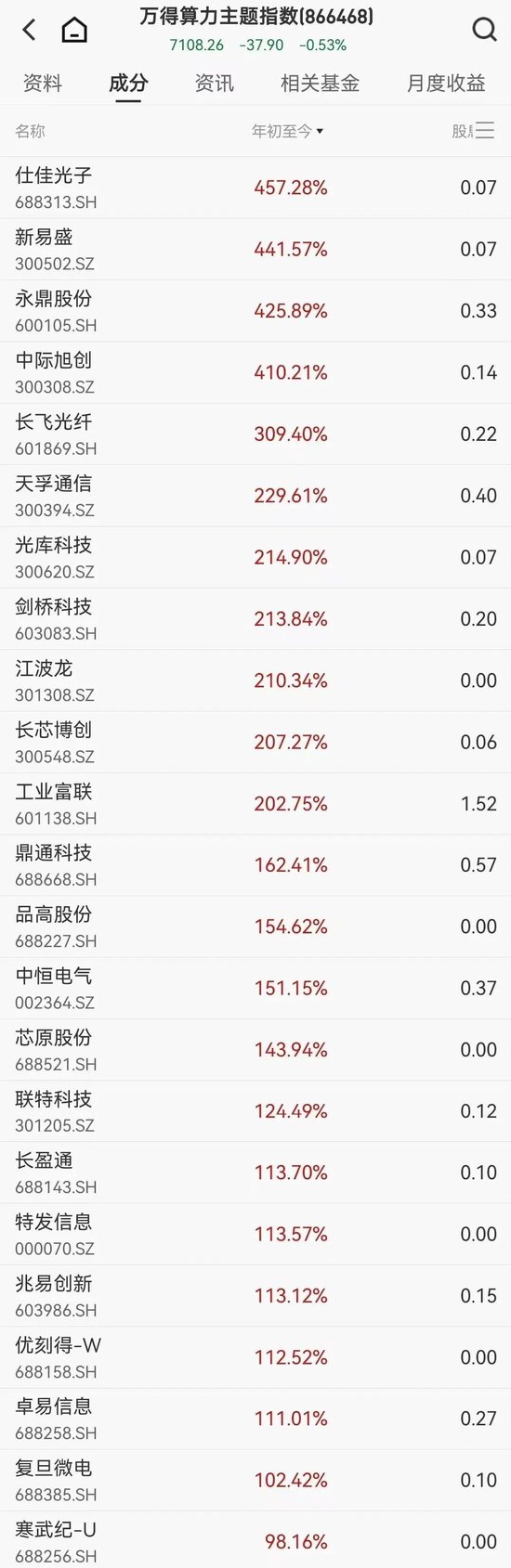
A股算力2025:资本叙事重构下的产业进阶
2 1 Shi Ji Jing Ji Bao Dao· 2025-12-26 09:20
Core Insights - The A-share computing power sector experienced significant value reshaping in 2025, transitioning from policy-driven expectations to performance verification, with the National Computing Infrastructure Index showing an 80.74% increase year-to-date by December 25, 2025 [1] - The market's perception of the computing power industry shifted from "concept speculation" to "value anchoring," reflecting intensified global competition and domestic industrial upgrade demands [1] - The domestic substitution process in the computing power sector evolved from policy support to market selection, driven by real demand and the establishment of a comprehensive domestic computing ecosystem [5][6] Group 1: Performance Highlights - AI chip and semiconductor equipment sectors were the main focus of capital investment, with companies like Haiguang Information reporting a 54.65% year-on-year revenue increase to 9.49 billion yuan and a 28.56% rise in net profit [2] - Cambricon Technologies reported a staggering 2386.38% year-on-year revenue growth to 4.607 billion yuan, indicating the rapid market adoption of domestic AI chips [3] - Industrial Fulian, a global leader in AI servers, achieved a 38.4% revenue increase to 603.931 billion yuan, with net profit rising by 48.52% [3] Group 2: Technological Advancements - Liquid cooling technology emerged as a critical growth point, with companies like Yingwei achieving a revenue increase of 40.19% to 4.026 billion yuan, meeting stringent energy efficiency standards [4] - The integration of hardware upgrades and software ecosystem improvements is driving the performance of domestic AI chips, with frameworks like MindSpore facilitating easier application development [9] - The shift towards liquid cooling technology is not only a response to energy efficiency requirements but also a foundational element for future high-density computing infrastructure [8] Group 3: Market Dynamics - The market is increasingly favoring companies with clear technological pathways and real profit growth, leading to a structural differentiation in the computing power sector [2] - The demand for self-controlled and secure computing solutions is accelerating domestic substitution, with companies like Haiguang Information and Cambricon creating valuable market space [7] - The competition is evolving from product-based to ecosystem-based, with companies that can provide comprehensive solutions across hardware, software, and services gaining a competitive edge [10] Group 4: Future Outlook - The value reshaping in the A-share computing power sector is expected to continue into 2026, with a focus on high-performance AI chips and broader applications of liquid cooling technology [10] - The growth structure of AI computing demand will further differentiate, favoring solutions that demonstrate high energy efficiency and specific application capabilities [10] - Companies that can prove their technology's commercial viability and integrate deeply into the domestic computing ecosystem will continue to attract capital investment [10] Group 5: Industry Transition - The Chinese computing power industry is transitioning from scale expansion to high-quality development, marking a critical period of proactive leadership in the digital economy [11]