
建筑业

Search documents
深度分析美国一月份就业数据:利好股市,不利于房地产和黄金白银市场
Sou Hu Cai Jing· 2026-02-11 23:25
Group 1 - The article argues against the view that employment growth has been revised down by 60,000 jobs monthly since March 2025, suggesting a smaller adjustment of about 20,000 jobs instead [1] - Recent data indicates that private sector employment has shown minimal downward adjustment, with healthcare sector jobs contributing significantly to the overall growth [1] - The construction industry has seen strong growth, adding 33,000 jobs, while manufacturing has recorded its first increase since November 2024, with 5,000 new jobs [1] Group 2 - The expected breakeven point for non-farm employment growth in 2026 has been revised down to between 0 and 20,000 jobs, reflecting a more cautious outlook [2] - The analysis suggests that limited labor supply growth and moderate demand will characterize the labor market, influenced by demographic trends such as aging population and immigration policy restrictions [2] - A decline in job vacancies has been noted, which may impact the Federal Reserve's policy adjustments, as lower vacancies often correlate with rising unemployment [2][3] Group 3 - The article highlights the importance of the Beveridge Curve in understanding the inverse relationship between job vacancies and unemployment, which has been used to justify past interest rate cuts by the Federal Reserve [3] - Future insights into labor demand may be revealed in the upcoming January JOLTS report, although the low response rate of the survey may lead to significant monthly revisions [3] - Preliminary estimates for February suggest a non-farm employment increase of 65,000 jobs and an unemployment rate of 4.3%, with expectations that employment growth will slightly exceed the structural breakeven point in 2026 [3][4]
美国非农“开门红”意外强劲!美联储将推迟至7月降息?
Xin Lang Cai Jing· 2026-02-11 23:07
热点栏目 自选股 数据中心 行情中心 资金流向 模拟交易 客户端 文章来源:金十数据 在经历了令人失望的2025年之后,美国劳动力市场在新年伊始展现出了惊人的韧性。最新公布的非农就业报告超预期,不仅打消了市场对经济快速衰退的担 忧,也促使交易员们重新评估美联储的政策路径,交易员们完全定价美联储7月降息,此前预期为6月。 美国1月季调后非农就业人口增加13万人,大幅高于市场预期中值7万人,创2025年4月以来最大增幅。美国1月失业率录得4.3%,略低于市场预期的4.4%, 创2025年8月以来新低。 11月份非农新增就业人数从5.6万人修正至4.1万人;12月份非农新增就业人数从5.0万人修正至4.8万人。修正后,11月和12月新增就业人数合计较修正前低 1.7万人。 非农数据公布后,现货黄金短线一度跳水近40美元,美国国债在非农就业数据公布后全线下跌。非美货币普遍跳水,欧元兑美元短线走低超60点;英镑兑美 元短线走低超70点;美元兑日元短线拉升近百点。 就业市场的结构性改善同样明显。作为衡量潜在购买力的关键指标,平均时薪环比增长0.4%,表现强于预期;平均周工时也回升至34.3小时。此外,劳动力 参与率从62 ...

大超预期!美国1月非农新增13万人,3月降息无望?
Sou Hu Cai Jing· 2026-02-11 15:28
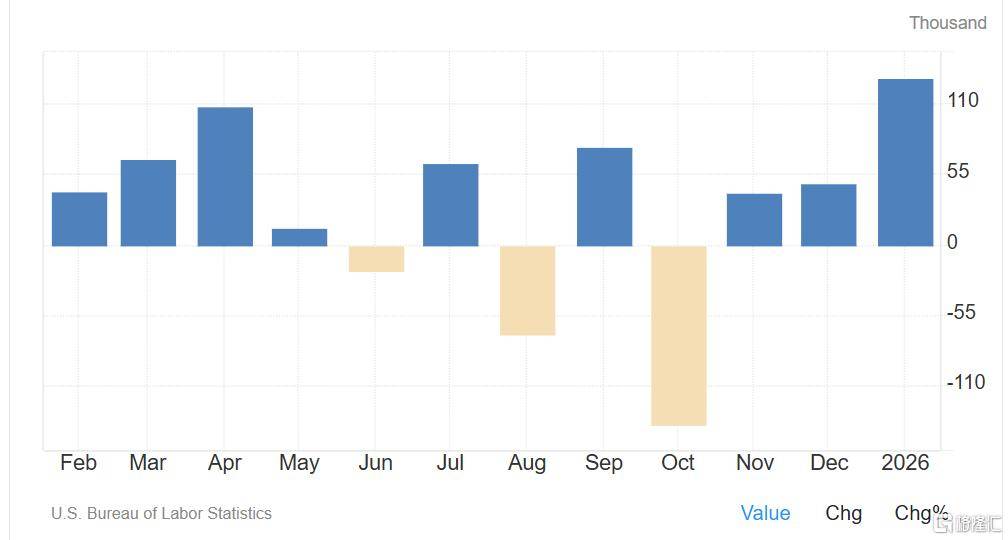
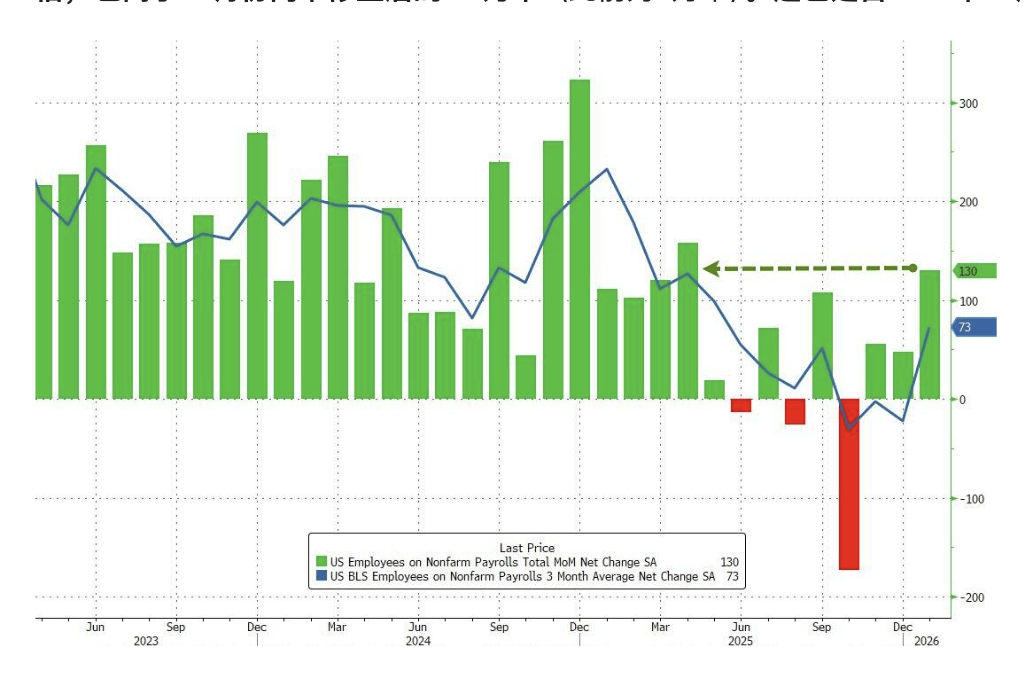
今晚,美国劳工统计局公布的数据显示,美国1月季调后非农就业人口增加13万人,大幅高于市场预期中值7万人,创2025年4以来最大增幅;前 值由5万人修正为4.8万人。 美国1月失业率录得4.3%,略低于市场预期的4.4%,创2025年8月以来新低;前值4.40%。 消息公布后,股指期货小幅走高,国债收益率也大幅上涨。 医疗保健行业强劲 由于部分政府停摆于2月3日结束,该报告推迟了近一周发布。报告显示,劳动力市场处于低增长状态,但裁员增加的迹象只是零星出现。 分行业来看,医疗保健行业在12月份引领了就业增长,新增职位8.2万个。 社会救助行业的就业人数也有所增加,增加了4.2万个,这两个类别几乎贡献了全部的净新增就业岗位。建筑业在经历了一年来增长乏力之后, 今年新增了3.3万个就业岗位。 多个行业出现就业下滑。由于去年因政府效率削减而被裁员但接受了延期辞职的员工不再计入工资统计,联邦政府就业岗位减少了3.4万个。金 融活动岗位减少了2.2万个。 薪资方面,1月平均每小时工资环比增长0.4%,超出市场预估的0.3%,同比增长3.7%。 劳动参与率从62.4%上升至 62.5%,也略好于预期不变的数据。 在主要劳动群 ...
美国1月非农新增就业13万人,创去年4月以来最大增幅,失业率降至4.3%,25年3月非农下修86.2万!
Sou Hu Cai Jing· 2026-02-11 14:35
但本次报告同时将2025年全年就业增长规模由最初报告的58.4万大幅下调至18.1万,基准修正幅度显著,表明去年劳动力市场的实际疲软程度远超 此前认知。 美国1月就业增长创下2024年12月以来新高,失业率意外降至4.3%,显示劳动力市场在经历疲弱的2025年后显现韧性。然而,劳工统计局同步进 行的年度基准修正,却大幅下修去年就业数据,令前期统计失真的程度进一步暴露。 当地时间周三,美国劳工统计局公布数据显示,1月非农就业人口增长13万人,大幅高于市场预期的6.5万人,创2025年4月以来最大增幅;失业率 小幅意外降至4.3%,预期和前值均为4.4%。平均时薪环比上涨0.4%,高于预期的0.3%及下修后的前值0.1%;劳动力参与率小幅升至62.5%,略优 于预期。 就业增长超预期但历史数据大幅下修 1月非农新增13万人,远超预期。此前多名白宫官员释放预警信号:贸易顾问彼得·纳瓦罗表示"必须大幅下调对月度就业数据的预期",前白宫经 济顾问凯文·哈塞特亦对CNBC称"近期就业数据将略显疲软"。相关言论引导市场部分参与者形成低至3.5万人的预期,远低于6.5万人的共识中值。 与此同时,劳工统计局发布年度基准修正,将 ...
美国1月非农报告全文
Xin Lang Cai Jing· 2026-02-11 13:44
家庭调查数据 1月失业率为4.3%,失业人数为740万人,均变化不大。这两项指标均高于一年前的水平,当时失业率 为4.0%,失业人数为690万人。 在主要劳动者群体中,1月青少年失业率降至13.6%。成年男性(3.8%)、成年女性(4.0%)以及白人 (3.7%)、黑人(7.2%)、亚裔(4.1%)和西班牙裔(4.7%)的失业率当月变化不大。 1月长期失业者(失业27周及以上)人数基本持平,为180万人,但较一年前增加38.6万人。长期失业者 占1月全部失业人口的25.0%。 1月劳动力参与率为62.5%,就业人口比率为59.8%,均变化不大。这些指标在过去一年中总体保持稳 定。 炒股就看金麒麟分析师研报,权威,专业,及时,全面,助您挖掘潜力主题机会! 来源:金十数据 美国劳工统计局今日报告称,1月非农就业人数增加13万人,失业率小幅变动,维持在4.3%。就业增长 主要来自医疗保健、社会援助和建筑业,而联邦政府和金融活动领域就业人数减少。 本新闻稿基于两项月度调查的数据。家庭调查按人口特征衡量劳动力状况,包括失业情况;企业调查则 按行业衡量非农就业人数、工作时长和收入水平。 1月因经济原因从事兼职工作的人数减 ...
1月非农今晚公布!真正的“深水炸弹”:百万级就业数据或被抹去
Jin Shi Shu Ju· 2026-02-11 03:07
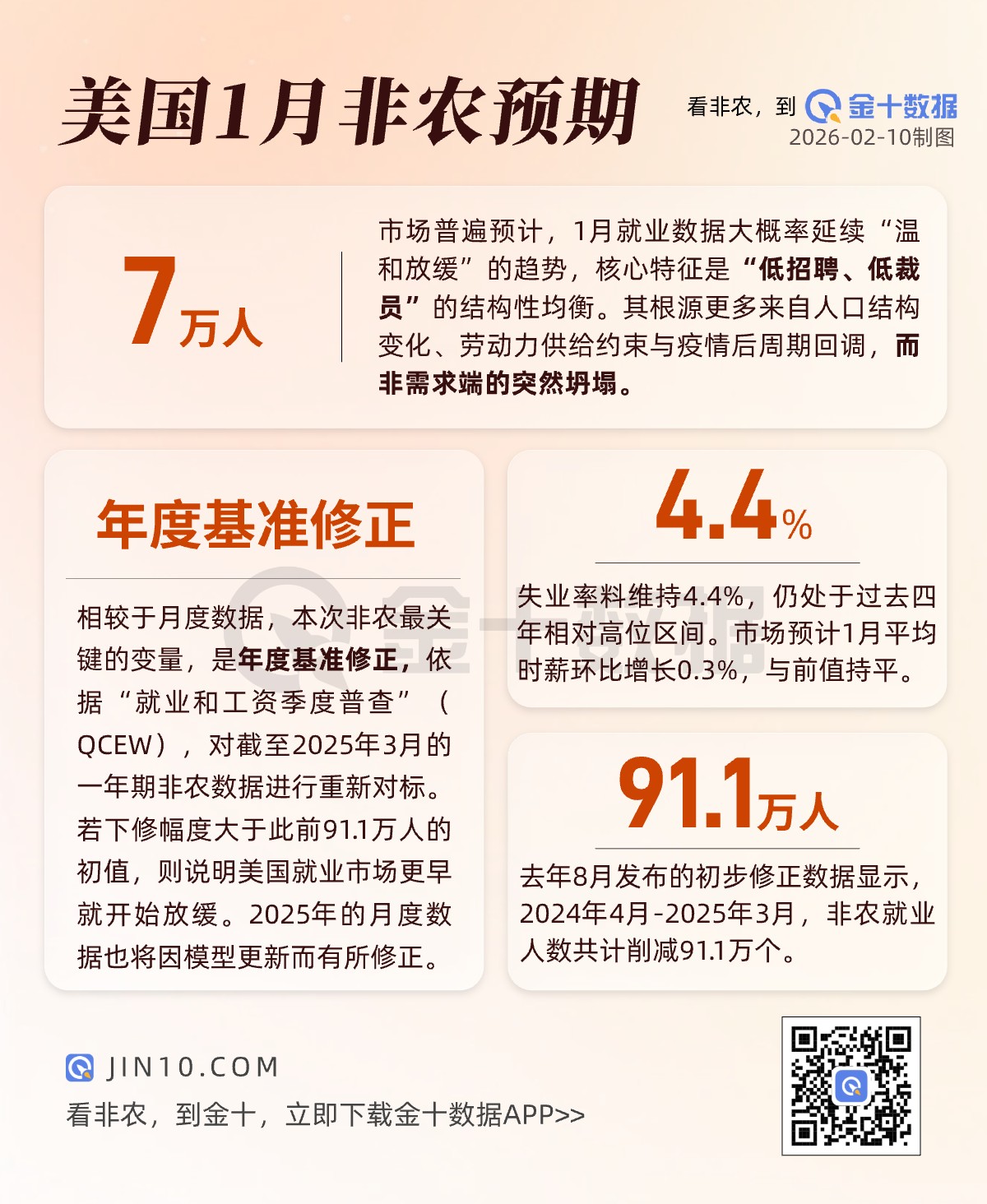
Group 1 - The January non-farm employment report, delayed due to the U.S. government shutdown, is expected to reveal a moderate slowdown in job growth, with an anticipated addition of approximately 70,000 jobs, slightly above December's 50,000 [1] - The core characteristic of the current U.S. labor market is a structural balance of "low hiring, low layoffs," indicating that while there are no large-scale layoffs, the pace of job creation has significantly slowed [6] - The upcoming report will include an annual benchmark revision, which could potentially revise employment data down by as much as 910,000, marking a historical record, although some analysts expect the final adjustment to be around 720,000 [7] Group 2 - Discrepancies within the Federal Reserve regarding the interpretation of revised employment data have emerged, with some officials suggesting that job growth may have been overestimated, while others argue that the economy remains resilient enough to maintain current interest rates [8] - The labor market is experiencing a return to normalcy rather than a sudden collapse in demand, driven by demographic changes and labor supply constraints, rather than a drastic drop in demand [9] - The healthcare sector remains one of the few areas still expanding, but its sustainability will be crucial for assessing the stability of employment structures [6]
掌控日本的“铁娘子” 正牵动着美股与日元的命运?
智通财经网· 2026-02-10 07:06
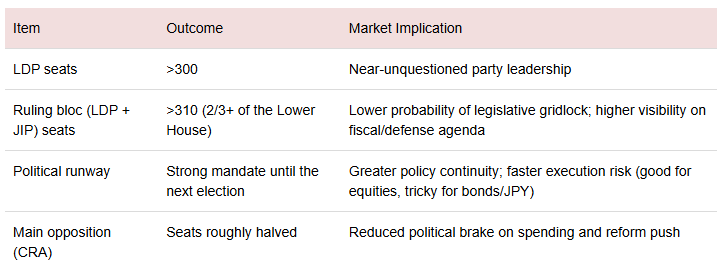
Core Viewpoint - The recent election results in Japan have granted Prime Minister Sanna Takashi and her ruling coalition significant political power, enabling efficient decision-making and potential economic policy changes that could impact global markets [1][2]. Group 1: Political Landscape - The ruling coalition led by Takashi's Liberal Democratic Party (LDP) secured approximately 316 seats, forming a majority with the Japan Innovation Party (JIP) to control around 350 seats in the House of Representatives [2]. - This majority allows the coalition to streamline legislative processes, reducing the likelihood of political gridlock and facilitating quicker implementation of policies [2][3]. - The opposition party's seats have been roughly halved, diminishing their influence on spending and reform initiatives [3]. Group 2: Market Implications - The election outcome has led to a bullish sentiment in the stock market, with indices like Nikkei 225 and TOPIX reaching historical highs, driven by expectations of fiscal stimulus and economic growth [4]. - The Japanese yen has depreciated significantly, with the USD/JPY exchange rate nearing 159, as market participants anticipate increased government spending and rising debt levels [6][7]. - Long-term Japanese government bonds (JGB) are experiencing higher yields due to concerns over fiscal risks and potential government spending plans [7]. Group 3: Investment Strategies - The "Takashi Trade" strategy involves going long on Japanese equities while being cautious with long-term JGB investments, which are viewed as high-risk assets [5]. - Investors are advised to consider the dynamics of yen carry trades, where borrowing in yen to invest in higher-yielding assets could lead to significant losses if the yen appreciates unexpectedly [10][11]. Group 4: Economic Scenarios - Analysts have outlined three potential scenarios for Japan's economic outlook: 1. **Moderate Reflation**: Continued fiscal stimulus with controlled debt levels, leading to stable yen and manageable bond yields [13]. 2. **Bond Vigilante 2.0**: Aggressive tax cuts and defense spending could lead to a reassessment of long-term bond risks, potentially pushing yields above 4% [14]. 3. **Yen Shock & Carry Trade Unwind**: A shift towards hawkish monetary policy could result in a rapid appreciation of the yen, triggering a sell-off in global equities as investors liquidate positions [15].
1月PMI数据点评:价格指数回升,结构亮点突出
Yong Xing Zheng Quan· 2026-02-09 08:33
1. Report's Industry Investment Rating No information provided about the industry investment rating in the report. 2. Core Viewpoints - Seasonal effects dragged down manufacturing production and demand, and the foundation for economic recovery needs to be consolidated. In January, the manufacturing PMI was 49.30%, down 0.8 percentage points from the previous value, falling below the boom - bust line. The new orders index on the demand side dropped 1.60 percentage points to 49.20%, and the production index on the supply side dropped 1.10 percentage points to 50.60% [1]. - Changes in the international trade environment disrupted the growth of external demand. In January, the new export orders index was 47.80%, down 1.20 percentage points from the previous value, while the import index was 47.30%, up 0.30 percentage points from the previous value. Although the manufacturing PMIs in the US and the Eurozone rebounded, changes in import policies or rules in some international markets expanded the impact on China's product exports [1]. - Driven by the rise in commodity prices, the price side of the manufacturing industry continued to recover. The raw material purchase price index remained in the expansion range, and the ex - factory price index rose above the boom - bust line, with the spread between the two widening by 1.3 percentage points to 5.50 pct [2]. - Non - manufacturing business slowed down, and the service industry was relatively stable. In January, the official non - manufacturing PMI was 49.40%, down 0.80 percentage points from the previous value. The service industry PMI was 49.50%, down 0.2 percentage points. The construction industry's business climate declined due to weather and holiday factors [2]. 3. Summary by Relevant Catalogs 3.1 PMI Presents Structural Highlights - The manufacturing PMI in January was 49.30%, down 0.8 percentage points from the previous value, falling below the boom - bust line. The new orders index on the demand side and the production index on the supply side both declined. The slowdown in demand due to the approaching Spring Festival and the pre - placement of some production capacity led to a seasonal contraction in manufacturing production and demand [12]. - Among different industries, the high - tech manufacturing PMI was 52.0%, remaining at a relatively high level for two consecutive months; the equipment manufacturing PMI was 50.1%, staying in the expansion range; the consumer goods industry and high - energy - consuming industries had PMIs of 48.3% and 47.9% respectively [12]. 3.2 External Environment Disturbance - In January, the new export orders index dropped, while the import index rebounded. Although the manufacturing PMIs in the US and the Eurozone improved, changes in international market import policies or rules increased the impact on China's exports, and the probability of export disturbances and uncertainties remained [19]. 3.3 Price - end Recovery - Driven by rising commodity prices, the manufacturing price - end continued to recover. The raw material purchase price index remained in the expansion range, and the ex - factory price index rose above the boom - bust line, with a wider spread. The current price recovery may be due to rising global commodity prices and previous policies to rectify "involution - style" competition, which may also be reflected in the next stage of PPI data. However, if raw material prices rise much faster than finished - product prices, it may put pressure on corporate profits [27][29]. 3.4 Attention to Corporate Business Vitality - In January, the PMIs of large, medium, and small enterprises all declined. Against the backdrop of rapidly rising raw material prices and uncertain external demand, improving corporate prosperity is a key link for continuous economic recovery, which helps promote the upstream - downstream transmission of prices and stabilize and expand domestic demand [31]. 3.5 Non - manufacturing Business Climate Decline - The non - manufacturing business slowed down in January, with the non - manufacturing PMI at 49.40%, down 0.80 percentage points from the previous value. The service industry PMI was 49.50%, down 0.2 percentage points. Some industries in the service sector, such as monetary and financial services, capital market services, and insurance, had high market activity, while the real estate industry was weak. The service industry's business activity expectation index increased, indicating enhanced confidence [34]. - The construction industry was still in the contraction range. Affected by weather and holiday factors, the construction industry's business climate declined, with the business activity index dropping 4.00 percentage points from the previous value. The business activity index and new orders index both decreased significantly, and the business activity expectation index fell below the critical point, showing cautious expectations from construction enterprises [35]. 3.6 Investment Suggestions - The domestic PMI data in January showed structural highlights. Although the manufacturing PMI, non - manufacturing PMI, and composite PMI output index declined from the previous values, indicating a short - term slowdown in economic prosperity during the traditional off - season, there were still highlights such as the expansion of the production side, the leading role of new - energy industries, and positive expectations in the service industry [3][40]. - The recovery of the price index was another feature of the manufacturing PMI in January. Affected by rising commodity prices, the main raw material purchase price index and ex - factory price index both increased, which was conducive to improving corporate revenue and profit margins [3][40]. - Looking forward to February 2026, manufacturing production may continue to slow down due to the Spring Festival, but it will gradually recover after the holiday. The service industry in the non - manufacturing sector is expected to benefit from Spring Festival consumption, and its business climate is likely to continue to improve. Overall, the economy will maintain a weak recovery trend, and the bond market will continue to show a slightly stronger oscillatory trend [3][40].
建议提案办理见成效丨以人民群众需求为出发点推动“好房子”建设——住房城乡建设部认真办理代表委员建议提案
Xin Hua Wang· 2026-02-09 08:29
Core Viewpoint - The new "Residential Project Standards" enhance 14 criteria related to height, sound insulation, fire prevention, and green energy efficiency, providing guidance for improving housing quality and promoting the construction of "good houses" [1] Group 1: Policy and Standards - The updated standards reflect the efforts of the housing and urban-rural development department to incorporate suggestions from representatives and address social concerns [1] - The shift in housing demand from "availability" to "quality" is highlighted, with current issues such as leaks, odors, poor sound insulation, and maintenance difficulties being prevalent [1] Group 2: Suggestions and Innovations - Wang Rongbin's proposal emphasizes the need for personalized and diverse housing products, collaborative innovation in the supply chain, and enhanced government guidance [1] - The Ministry of Housing and Urban-Rural Development has engaged in discussions with Wang Rongbin regarding the essence of "good houses," technical pathways, and policy support [2] - Peng Shou, a representative from China National Building Material Group, stresses the importance of "good materials" in achieving the vision of "good houses" and has proposed the establishment of a national innovation platform for high-quality building materials [2] Group 3: Implementation and Feedback - The Ministry has initiated several projects to address urgent housing issues such as sound insulation and leakage, deploying research projects aimed at improving housing quality [3] - The Ministry has organized a national "Good House" design competition and is promoting the application of over 50 types of new building materials [3] - A feedback mechanism has been established to ensure that all suggestions and proposals from representatives are thoroughly researched and addressed [4][5]
内蒙古“四上”单位 突破1.5万个
Xin Lang Cai Jing· 2026-02-08 19:33
Core Insights - The number of "Four Above" units in Inner Mongolia is projected to reach 15,098 by the end of 2025, representing an increase of 1,102 units or a growth rate of 7.9% compared to the previous year [1] Summary by Category - **Wholesale and Retail Units**: There are 4,362 units in the wholesale and retail sector, which is an increase of 469 units, reflecting a growth of 12.0%. This sector contributed the most to the overall growth of "Four Above" units, accounting for a 3.4 percentage point increase [1] - **Accommodation and Catering Units**: The number of accommodation and catering units reached 1,040, with an increase of 127 units, marking a growth rate of 13.9%, the highest among all categories [1] - **Service Industry Units**: There are 2,117 units in the scale of service industry (excluding trade), which increased by 116 units, showing a growth of 5.8% [1] - **Industrial Units**: The scale of industrial units stands at 4,343, with an increase of 271 units, resulting in a growth rate of 6.7% [1] - **Construction Units**: There are 1,604 qualified construction units, which increased by 112 units, reflecting a growth of 7.5% [1] - **Real Estate Development Units**: The number of real estate development units is 1,632, with a modest increase of 7 units, resulting in a growth rate of 0.4% [1]