建材

Search documents
除了140万亿元 这些突破同样值得关注
Jing Ji Guan Cha Wang· 2026-01-19 15:21
Group 1 - In 2025, China's GDP is projected to reach 140.1879 trillion yuan, reflecting a year-on-year growth of 5.0%, showcasing the resilience and adaptability of the Chinese economy in a challenging global environment [1] - The total retail sales of consumer goods in 2025 are expected to exceed 50.12 trillion yuan, with a growth rate of 3.7%, and final consumption expenditure contributing over 50% to economic growth, an increase of 5 percentage points from the previous year [2] - Research and development (R&D) expenditure intensity is anticipated to reach 2.8%, surpassing the OECD average for the first time, indicating a shift towards quality improvement and increased funding for foundational research and key technological breakthroughs [2] Group 2 - New energy vehicles (NEVs) are projected to account for over 50% of domestic new car sales in 2025, with annual production and sales exceeding 16 million units, reflecting significant growth in green energy products [2] - The share of non-fossil energy in total energy consumption is expected to increase by approximately 2 percentage points compared to the previous year, indicating progress in the green transformation of traditional industries [2] - The focus on high-quality development is evident as China moves beyond mere GDP growth, achieving effective quality improvements and structural transformations in its economy [3]
(经济观察)产业结构优化彰显中国经济动能
Xin Lang Cai Jing· 2026-01-19 15:07
Group 1: Economic Growth and Structural Optimization - In 2025, China's GDP is projected to grow by 5.0% compared to the previous year, with a significant shift towards optimizing industrial structure, injecting new momentum into economic growth [1] - The "Three New" economy, focusing on new industries, new business formats, and new models, is expected to account for 18.01% of GDP in 2024, maintaining a high level in 2025 [1] - The automotive industry is projected to maintain its global leadership in production, sales, and exports, with new energy vehicles expected to account for over 50% of domestic new car sales [1] Group 2: Green Transition - By 2025, clean energy sources such as hydropower, nuclear power, wind power, and solar energy are expected to see an 8.8% increase in generation from the previous year, with non-fossil energy consumption rising by approximately 2 percentage points [2] - The green transformation of traditional industries is yielding significant results, with major energy-consuming sectors like construction materials, steel, and non-ferrous metals showing a notable decrease in energy consumption per unit of added value [2] - New energy vehicle production is anticipated to exceed 16 million units, maintaining global leadership in production and sales for 11 consecutive years [2] Group 3: Future Industries - 2025 is viewed as the year of artificial intelligence, with rapid advancements in future industries, particularly in AI, which is becoming a core driver for new productive forces and new market opportunities [3] - The integration of 5G technology is expected to cover 86 out of 97 sectors of the national economy, while industrial internet applications will comprehensively cover 41 industrial categories, enhancing value in the real economy [3] - Future industries such as advanced manufacturing, information technology, materials, energy, space, and health are identified as key areas for breakthrough developments during the 14th Five-Year Plan period [3]
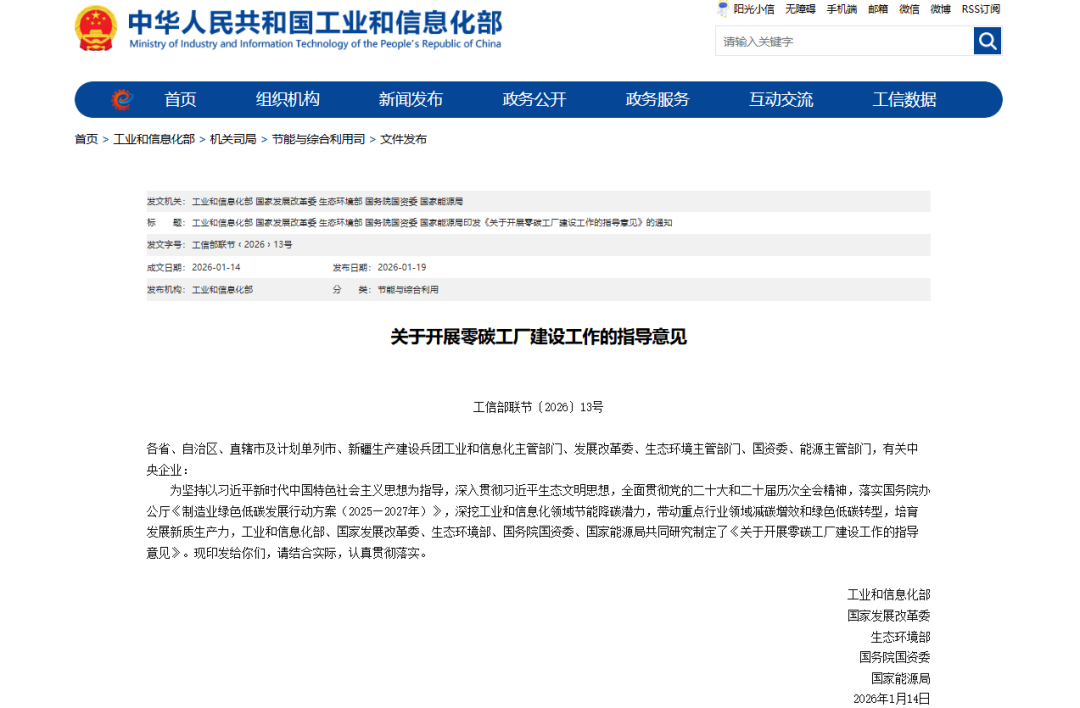
五部门发文建设零碳工厂:鼓励配置新型储能,开展绿电直连
中关村储能产业技术联盟· 2026-01-19 13:36
Core Viewpoint - The article discusses the "Guiding Opinions on the Construction of Zero Carbon Factories" issued by the Ministry of Industry and Information Technology, emphasizing the importance of reducing carbon emissions through technological innovation, structural adjustments, and management optimization in industrial settings [2][3]. Summary by Sections Phase Goals - By 2026, a selection of zero carbon factories will be identified to serve as benchmarks [3]. - By 2027, a batch of zero carbon factories will be cultivated in industries such as lithium batteries, photovoltaics, automotive, electronics, light industry, machinery, and computing facilities, establishing an industrial ecosystem for zero carbon factory construction [3]. - By 2030, the initiative will expand to include industries like steel, non-ferrous metals, petrochemicals, building materials, and textiles, exploring new decarbonization pathways for traditional high-energy industries [3]. Construction Paths - Establish a carbon emission accounting management system to accurately quantify emissions and removals, including direct and indirect emissions from production activities [4][15]. - Accelerate the transition to a green and low-carbon energy structure, encouraging factories to utilize zero carbon electricity, heat, hydrogen, and fuel supplies [4][15]. - Significantly improve energy efficiency through systematic optimization of production processes, aiming for compliance with national energy consumption standards [4][16]. Supply Chain and Digitalization - Promote zero carbon supply chain management by analyzing carbon footprints of key products and improving carbon emission reduction across the entire supply chain [5][18]. - Enhance digital and intelligent management levels by establishing digital energy and carbon management centers using technologies like IoT and big data for precise measurement and control of energy consumption and emissions [5][19]. Carbon Offsetting and Reporting - Implement carbon offsetting strategies and information disclosure to achieve and maintain near-zero carbon emissions, including participation in cross-border carbon trading [5][19]. - Encourage regular publication of sustainability reports, ESG reports, and zero carbon factory construction reports to disclose carbon emissions and construction progress [6][19]. Implementation Requirements - Strengthen organizational implementation by local industrial and information departments to develop specific plans for zero carbon factory construction [20]. - Improve the standard system to provide scientific and reasonable technical bases for zero carbon factory management and evaluation [21]. - Promote comprehensive services for energy saving and carbon reduction, facilitating technology transfer and market services for industrial enterprises [21].


五部门发布《关于开展零碳工厂建设工作的指导意见》
Zheng Quan Ri Bao Wang· 2026-01-19 11:46
Core Viewpoint - The Ministry of Industry and Information Technology, along with four other departments, has issued guidelines for the construction of zero-carbon factories, emphasizing a phased approach to prioritize industries with urgent decarbonization needs and lower decarbonization difficulties [1] Group 1: Goals and Phased Implementation - The guidelines propose a gradual cultivation of zero-carbon factories, starting with industries that primarily consume electricity and have a pressing need for decarbonization [1] - By 2026, a selection of zero-carbon factories will be identified to serve as benchmarks [1] - By 2027, zero-carbon factories will be developed in sectors such as automotive, lithium batteries, photovoltaics, electronics, light industry, machinery, and computing facilities, aiming to create a comprehensive ecosystem for zero-carbon factory construction [1] Group 2: Expansion and Long-term Vision - By 2030, the initiative will expand to include industries like steel, non-ferrous metals, petrochemicals, building materials, and textiles, exploring new pathways for decarbonization in traditional high-energy-consuming sectors [1] - The guidelines aim to promote comprehensive service models and solutions for zero-carbon factory design, financing, renovation, and management, significantly enhancing product lifecycle and supply chain management capabilities [1] - The ultimate goal is to achieve a steady decline in carbon emissions from factories [1]
重大工程纵深推进与战略:开年投资呈现积极迹象
CMS· 2026-01-19 09:33
Economic Growth - The GDP growth rate for Q4 2025 was 4.5% year-on-year, with an annual growth rate of 5.0%[3] - Seasonally adjusted Q4 GDP increased by 1.2% quarter-on-quarter, accelerating by 0.1 percentage points from Q3[3] Investment Trends - Investment conditions have shown marginal improvement since the beginning of the year, with high-frequency data indicating better performance in heavy industry[3] - Fixed asset investment, infrastructure, and real estate investment all recorded negative growth for the year, while manufacturing investment growth was less than 1%[3] Consumption and Exports - Service consumption grew by 5.5% for the year, with a production index growth of 5.0%, indicating demand outpacing supply[3] - Retail sales growth fell to 3.8%, highlighting weak consumer spending that cannot fully support domestic demand[3] Industrial Performance - The operating rate for asphalt enterprises rose to 27.2%, up by 1.8 percentage points week-on-week[8] - The operating rate for electric furnaces increased to 63.46%, with a year-on-year growth of 8.8%[10] Price Movements - The average price of cement in East China remained stable at 426 RMB/ton, while in Southwest China it was 512 RMB/ton[102] - The price of rebar increased by 10.43 RMB/ton to 3349.6 RMB/ton, reflecting upward price trends in the steel market[110] Risks and Outlook - Risks include geopolitical tensions, domestic policy implementation falling short of expectations, and potential global recession impacts[3] - If current trends in exports and service consumption continue, Q1 2026 economic growth is expected to outperform the second half of 2025[3]
换购住房退税政策延续,商业用房下调首付比例:建筑材料
Huafu Securities· 2026-01-19 08:47
Investment Rating - The industry rating is "Outperform the Market" [8][66] Core Insights - The report highlights the continuation of housing tax refund policies and a reduction in the down payment ratio for commercial properties, which are expected to support the real estate market [3][13] - The report anticipates a turning point in the building materials capacity cycle due to supply-side reforms and a recovery in home buying willingness driven by lower interest rates and supportive policies [6][13] - The report notes that the real estate market is gradually stabilizing, with an increasing probability of recovery in post-cycle demand for building materials [6][13] Summary by Sections Investment Highlights - The Ministry of Finance, State Administration of Taxation, and Ministry of Housing and Urban-Rural Development have announced the extension of tax refund policies for homeowners [3] - The central bank has adjusted the minimum down payment ratio for commercial housing loans to no less than 30% [3] - Various cities are implementing measures to promote stable development in the real estate market, including urban renewal projects and government subsidies for home purchases [3][13] Market Data - As of January 16, 2026, the national average price of bulk P.O 42.5 cement is 335.5 CNY/ton, showing a 0.9% decrease from the previous week and a 16.0% decrease year-on-year [4][14] - The national average price of glass (5.00mm) is 1097.1 CNY/ton, reflecting a 0.4% increase from the previous week but a 16.9% decrease year-on-year [4][22] Sector Review - The Shanghai Composite Index fell by 0.45%, while the Shenzhen Composite Index rose by 1%. The building materials index decreased by 0.67% [5][51] - Sub-sectors such as refractory materials and fiberglass manufacturing showed positive growth, while cement and glass manufacturing experienced declines [5][51] Investment Recommendations - The report suggests focusing on three main lines of investment: high-quality companies benefiting from stock renovations, undervalued stocks with long-term alpha attributes, and leading cyclical building materials companies showing signs of bottoming out [6]
利好来了,五部门联合发文
21世纪经济报道· 2026-01-19 08:02
Core Viewpoint - The article discusses the implementation of zero-carbon factory construction in China, emphasizing the government's commitment to promoting green and low-carbon development through a series of guidelines and policies aimed at reducing carbon emissions across various industries [1][2]. Group 1: Policy and Guidelines - On January 19, 2026, five government departments issued the "Guiding Opinions on Zero-Carbon Factory Construction," which outlines the selection of benchmark zero-carbon factories starting in 2026 [1]. - By 2027, the initiative aims to cultivate zero-carbon factories in sectors such as automotive, lithium batteries, photovoltaics, electronics, light industry, machinery, and computing facilities [1][5]. - The goal is to expand zero-carbon factory construction to industries like steel, non-ferrous metals, petrochemicals, building materials, and textiles by 2030, exploring new decarbonization pathways for traditional high-energy industries [1][5]. Group 2: Construction and Implementation - Zero-carbon factory construction involves continuous reduction of carbon dioxide emissions through technological innovation, structural adjustments, and management optimization [2][4]. - The construction path includes establishing a carbon emission accounting management system, transforming energy structures to be greener, enhancing energy efficiency, analyzing carbon footprints of key products, and improving digital intelligence levels for carbon control [5][6]. - The article highlights that various regions, including Tianjin, Shanghai, Jiangsu, and Guangdong, have begun pilot projects for near-zero carbon factories, with over a hundred near-zero carbon factory lists published [6]. Group 3: Challenges and Future Directions - The construction of zero-carbon factories is a complex and systematic project that involves multiple aspects such as energy structure, process technology, funding, and management services, with significant variations in implementation across different regions and industries [6]. - Challenges include inconsistent evaluation requirements, unverified key technologies, and weak foundations for carbon emission statistics, necessitating enhanced guidance and technical support [6]. - The Ministry of Industry and Information Technology plans to coordinate with other departments to promote the implementation of the guidelines and support high-quality progress in zero-carbon factory construction [6].

利好来了!五部门联合印发《关于开展零碳工厂建设工作的指导意见》
Zhong Guo Ji Jin Bao· 2026-01-19 07:54
Core Viewpoint - The release of the "Guiding Opinions on the Construction of Zero Carbon Factories" aims to enhance energy conservation and carbon reduction in the industrial sector, promoting green and low-carbon transformation while fostering new productive forces [1][2]. Group 1: Overall Requirements - The initiative is guided by Xi Jinping's thoughts on ecological civilization and aims to integrate green energy with modern manufacturing, accelerating technological and industrial innovation to significantly reduce carbon emissions and strengthen green manufacturing [5][6]. Group 2: Principles of Zero Carbon Factory Construction - The construction of zero carbon factories will follow principles such as tailored strategies based on industry needs, innovation-driven approaches, continuous improvement in carbon reduction, and ensuring transparency and standardization in carbon emissions reporting [6][7]. Group 3: Main Goals - The plan includes phased cultivation of zero carbon factories, starting with industries that have urgent decarbonization needs and gradually expanding to more challenging sectors by 2030, with specific targets set for 2026 and 2027 [8]. Group 4: Construction Pathways - Key pathways for construction include establishing a carbon emission accounting system, transitioning to green energy sources, enhancing energy efficiency, analyzing carbon footprints of key products, leveraging digital technologies for carbon management, and implementing carbon offsetting and information disclosure [9][10][11][12]. Group 5: Work Requirements - Local industrial and information departments are encouraged to develop specific implementation plans for zero carbon factory construction, emphasizing collaboration among government, enterprises, and markets, while also enhancing the standard system to support effective management and evaluation of zero carbon factories [13][14].
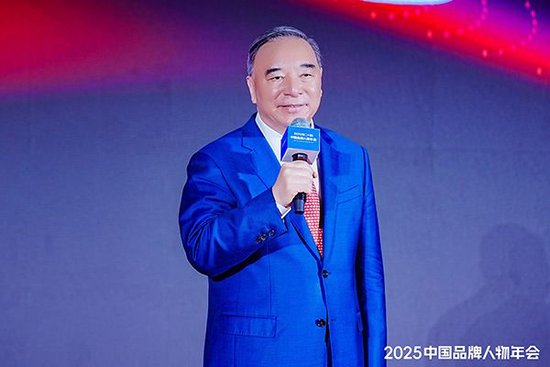
中国上市公司协会会长宋志平:品牌是企业最高境界
Xin Lang Cai Jing· 2026-01-19 07:03
Core Insights - The 20th China Brand Person Annual Conference is set to take place on December 29, 2025, in Shenzhen, focusing on the theme "Who Earns Respect for China" and gathering over 2,000 elites from various sectors to reflect on the development of Chinese brands and explore new trends and opportunities in brand building [1][9]. Group 1: Key Themes from the Conference - Brand is considered the highest realm of enterprise management, encompassing all aspects of a company, including technology, innovation, management, quality, credit, and service, reflecting the spirit of entrepreneurship [5][14]. - Quality is the foundation of a brand, and without quality and service, a brand lacks substance. The current market is shifting from speed and scale to quality and efficiency, emphasizing the importance of value over cost [6][14]. - Brand building is regarded as a "top executive project," requiring direct involvement from the company's leadership to ensure its success. Successful brands are often those where the CEO prioritizes brand development as a core mission [8][16]. Group 2: Recognition and Contributions - Song Zhiping, awarded the "TopBrand Lifetime Achievement Award," is recognized for his dual leadership roles in two state-owned enterprises and his contributions to the market-oriented reform of state-owned enterprises, influencing high-quality development and brand building in China [3][11]. - The conference highlights the transition of Chinese brands from a position of significant gap with developed countries to leading positions in various sectors, showcasing the rise of "national trends" driven by the younger generation's confidence [8][16].
利好来了,五部门联合发布
Zhong Guo Ji Jin Bao· 2026-01-19 06:34
Core Viewpoint - The release of the "Guiding Opinions on the Construction of Zero Carbon Factories" aims to enhance energy conservation and carbon reduction in the industrial sector, promoting green and low-carbon transformation while fostering new productive forces [1][6]. Group 1: Principles of Zero Carbon Factory Construction - The construction of zero carbon factories follows four principles: tailored strategies based on industry needs, systematic advancement, innovation-driven and technology-enabled approaches, and a commitment to transparency and standardization [4][10]. Group 2: Goals and Phased Implementation - The initiative will prioritize industries with urgent decarbonization needs and lower decarbonization difficulties, with a phased approach starting in 2026 to select benchmark zero carbon factories [4][11]. - By 2027, a batch of zero carbon factories will be established in sectors such as automotive, lithium batteries, photovoltaics, electronics, light industry, machinery, and computing facilities [4][11]. - By 2030, the initiative aims to expand to high carbon intensity industries like steel, non-ferrous metals, petrochemicals, building materials, and textiles, exploring new decarbonization pathways [4][11]. Group 3: Construction Pathways - Key pathways for construction include establishing a carbon emission accounting management system, accelerating the transition to a green and low-carbon energy structure, and enhancing energy efficiency through technological upgrades [5][12][13]. - The initiative emphasizes the importance of carbon footprint analysis for key products to drive collaborative carbon reduction across the entire supply chain [5][14]. - Digitalization and intelligent management will be leveraged to achieve precise measurement and control of energy consumption and carbon emissions [5][15]. Group 4: Implementation Requirements - Local industrial and information authorities are encouraged to develop specific implementation plans for zero carbon factory construction, promoting collaboration among government, enterprises, and markets [16][17]. - A comprehensive standard system will be established to support the management and evaluation of zero carbon factories, ensuring alignment with international standards [16][17].