新能源车

Search documents
行情看涨?新能源板块后续展望
Sou Hu Cai Jing· 2025-11-19 01:51
Core Viewpoint - The combination of policy, fundamentals, and capital flow is expected to create a positive synergy that will drive the sector to continue its upward trend [1][2]. Policy Perspective - The "anti-involution" policy and the "14th Five-Year Plan" are providing ongoing support for the industry. The "anti-involution" policy aims to combat vicious price wars and promote the exit of backward production capacity, which will systematically improve the competitive environment and profit expectations [1]. - The "14th Five-Year Plan" sets a high-quality development tone for the industry over the next five years, reinforcing the core position of new energy as a strategic emerging industry, with supportive policies expected to continue to emerge [1]. Fundamental Perspective - The improvement in supply-demand dynamics and the expectation of quarterly performance recovery are key factors determining the sustainability of the sector's market performance. The photovoltaic and lithium battery industries are seeing gradual improvements in supply-demand structures, with the photovoltaic industry expected to curb price wars and corporate profits projected to rebound by 2025 [1]. - The energy storage market is anticipated to maintain rapid growth, benefiting from sustained high demand in downstream sectors, leading to a quarterly performance recovery for related companies in the new energy supply chain starting from the second half of this year [1]. Capital Flow Perspective - Currently, institutional holdings in the new energy sector are relatively low, indicating potential for incremental capital inflow. The capital flow acts as an amplifier for market performance, and with the improvement in fundamentals and favorable policies, institutional interest is expected to rise [2]. - Passive capital has already begun to flow significantly into the sector, and as performance gradually materializes, more actively managed funds are likely to increase their allocations. New energy, as a long-term investment track with high certainty, is naturally attractive to long-term funds such as pension and insurance funds, suggesting a potential influx of capital into the sector [2]. - For ordinary investors, index-based investments are recommended as a more stable option, with various ETFs available to share in the industry's growth dividends [2].
当前计算机板块的核心主线仍围绕AI和科技自立自强展开,关注软件ETF、计算机ETF
Xin Lang Ji Jin· 2025-11-18 12:09
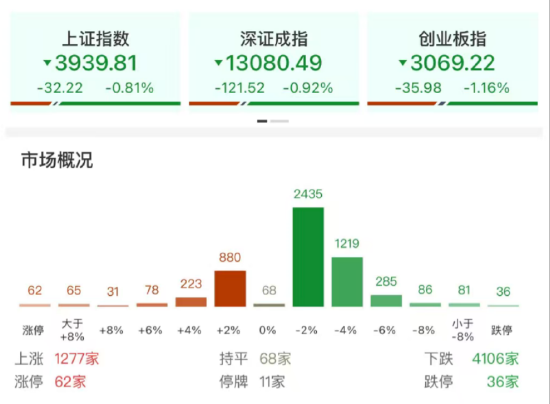
Market Overview - The market experienced fluctuations with major indices declining, where the Shanghai Composite Index and Shenzhen Component Index fell over 1% during the day [1] - The trading volume in the Shanghai and Shenzhen markets reached 1.93 trillion, an increase of 153 billion compared to the previous trading day [1] - The overall liquidity remains ample, and the market's active volume suggests that the adjustment space is manageable [1] AI and Computing Sector - The computing-related sector performed relatively well, driven by optimism about AI applications, despite concerns regarding the sustainability of AI investments [3] - Capital expenditures (Capex) for cloud service providers have significantly accelerated, with expected year-on-year growth exceeding 50% for 2025 [4] - Major tech companies are facing pressure on their balance sheets due to high Capex, which is comparable to their annual cloud revenues and constitutes about 60% of their operating cash flow [4][6] Investment Trends - The trend of domestic substitution in the semiconductor equipment sector is expected to gain momentum, particularly in light of the ongoing technological decoupling between China and the U.S. [7] - Investors are encouraged to focus on semiconductor equipment ETFs as a long-term investment strategy [7] - The software ETF saw a rise of 1.21%, indicating a rebound in AI application-related sectors after previous adjustments [8] Corporate Developments - Alibaba and Tencent are actively developing AI agents, with Alibaba launching the Qianwen app, which quickly rose in rankings on the iOS free chart [9] - Huawei is set to announce breakthrough AI technology that could significantly enhance the utilization of computing resources [9] Institutional Holdings - Institutional holdings in the computing sector have seen a slight increase to 3.2% in Q3 2025, although this remains historically low [10] - The core focus in the computing sector continues to revolve around AI and technological self-reliance, with opportunities in software and computing ETFs [10] New Energy Sector - The new energy sector experienced a noticeable pullback, primarily due to profit-taking after a recent surge, although the underlying fundamentals remain strong [11] - Future focus areas include high-demand sectors like energy storage and lithium batteries, as well as potential recovery in solar and lithium materials [11]

专访华创证券研究所副所长张瑜:看股做债,未来红利策略依然有效,十年战略级别看多黄金
Sou Hu Cai Jing· 2025-11-18 08:37
Core Viewpoint - The article emphasizes the necessity of expanding domestic demand to drive China's economic recovery and achieve high-quality development, while also addressing the resilience of foreign trade amidst external shocks and the ongoing revaluation of Chinese assets in a global context [2][5][12]. Economic Outlook - The worst phase of the economic cycle is believed to be passing, as all economic leading indicators are showing upward trends for the first time in three years, indicating potential improvement in the economic cycle [5][6]. - The GDP growth target of 5% for the year is considered achievable based on the economic data from the first three quarters [5]. Domestic Demand and Consumption - Key measures to boost domestic consumption include the deployment of policy financial tools and the release of local debt limits, alongside efforts to stabilize expectations and strengthen confidence in the economy [7]. - Confidence in long-term economic transformation and mid-term price recovery is crucial, with a focus on observable price signals such as stock and housing prices [7]. Foreign Trade and External Demand - China's foreign trade shows strong resilience, but external demand is expected to face short-term adjustment pressures, with a moderate recovery anticipated in the first half of the following year [8]. - Eleven out of twenty leading indicators suggest a potential recovery in external demand, although caution is advised due to the risk of demand overextension [8]. Industry Policy and New Economic Growth - The article outlines a clear framework for modernizing the industrial system, categorizing industries into traditional, emerging, and future sectors, each requiring tailored policy support [9][10]. - Traditional industries will focus on quality improvement and efficiency, while emerging industries will see a shift from subsidies to market-oriented support [10][11]. Investment Strategy - The investment landscape suggests a shift from bonds to equities, with a focus on dividend strategies across various industries, particularly those with low valuations and high dividend yields [5][12]. - The article highlights the ongoing strong momentum for gold, driven by non-traditional macro factors, and suggests a long-term bullish outlook on gold as global order remains unstable [12][14].

港股新能源车板块领跌
Di Yi Cai Jing Zi Xun· 2025-11-18 08:36
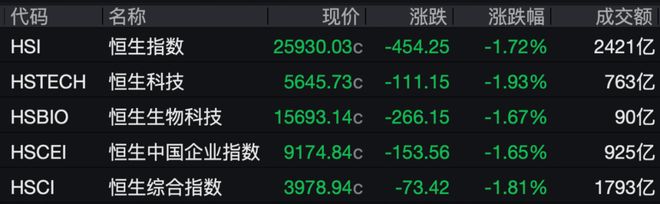
新能源车题材领跌,钢铁、有色金属、化工、煤炭跌幅居前,中国宏桥跌近6%。 个股方面,小鹏汽车跌逾10%,联想集团跌超4%,蔚来、快手跌超3%,腾讯音乐、理想汽车、小米集 团等跌超2%,百度健康、阿里健康等跌超1%,京东健康、阿里巴巴等小幅下跌;华虹半导体涨逾3%, 中芯国际、携程集团涨超1%。 编辑 | 钉钉 11月18日,香港恒生指数收跌1.72%,恒生科技指数跌1.93%。 | 代码 | 名称 | 现价 | 涨跌 | 涨跌幅 | 成交额 | | --- | --- | --- | --- | --- | --- | | HSI | 恒生指数 | 25930.03c | -454.25 | -1.72% | 2421亿 | | HSTECH | 恒生科技 | 5645.73c | -111.15 | -1.93% | 763亿 | | HSBIO | 恒生生物科技 | 15693.14c | -266.15 | -1.67% | 90亿 | | HSCEI | 恒生中国企业指数 | 9174.84c | -153.56 | -1.65% | 925亿 | | HSCI | 恒生综合指数 | 3978.94c ...
港股新能源车板块领跌
第一财经· 2025-11-18 08:28
11月18日,香港恒生指数收跌1.72%,恒生科技指数跌1.93%。 个股方面,小鹏汽车跌逾10%,联想集团跌超4%,蔚来、快手跌超3%,腾讯音乐、理想汽车、小米集团等跌超2%,百度健康、阿里健康等跌超1%, 京东健康、阿里巴巴等小幅下跌;华虹半导体涨逾3%,中芯国际、携程集团涨超1%。 编辑 | 钉钉 | 代码 | 名称 | 现价 | | 涨跌幅 | 成交额 | | --- | --- | --- | --- | --- | --- | | HSI | 恒生指数 | 25930.03c -454.25 | | -1.72% | 2421亿 | | HSTECH 恒生科技 | | 5645.73c -111.15 | | -1.93% | 763亿 | | HSBIO | 恒生生物科技 | 15693.14c -266.15 | | -1.67% | 90亿 | | HSCEI | | 恒生中国企业指数 9174.84c -153.56 | | -1.65% | 925亿 | | HSCI | 恒生综合指数 | 3978.94c | -73.42 | -1.81% | 1793亿 | 新能源车题材领跌,钢铁、 ...

AH股低开低走,AI应用逆势走强,恒指科指跌超1%,新能源车概念股走低
Hua Er Jie Jian Wen· 2025-11-18 06:16
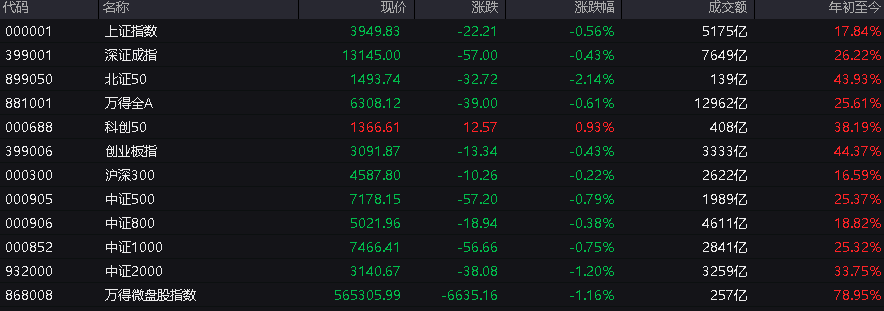
Market Overview - A-shares experienced a decline in the morning session, with the North Securities 50 Index dropping over 2% [1] - The Shanghai Composite Index closed at 3949.83 points, down 0.56% [1][8] - The Shenzhen Component Index closed at 13145.00 points, down 0.43% [2] - The ChiNext Index closed at 3091.87 points, down 0.43% [3] - The CSI 300 Index closed at 4587.80 points, down 0.22% [4] - The STAR 50 Index closed at 1366.61 points, up 0.93% [5] - The CSI 500 Index closed at 7178.15 points, down 0.79% [6] - The CSI 1000 Index closed at 7466.41 points, down 0.75% [7] Sector Performance - AI applications, semiconductor chips, CPO, and software development sectors led the gains, with stocks like Fushi Holdings and Inspur Software hitting the daily limit [1] - The battery sector faced significant declines, with stocks like Fengyuan Co. hitting the daily limit down [1][12] - Local stocks in Fujian, such as Sanmu Group, also saw substantial declines [1] Trading Volume - The total trading volume for the morning session reached 1.29 trillion yuan [1] AI Sector Developments - Positive news in the AI sector includes Alibaba's launch of the "Qianwen" project and the upcoming release of Google's Gemini 3.0 model [8] - China International Capital Corporation noted that the business model for AI applications is rapidly transitioning from concept validation to revenue generation, with demand expanding quickly [8] Market Sentiment - China Galaxy Securities anticipates that the year-end market will continue to exhibit a volatile structure, with a focus on themes like "anti-involution" and dividends [9] - The market is currently in a consolidation phase, with rapid rotation between sectors, particularly in technology and consumer sectors benefiting from policy support [9]

资金周报|前十月IPO受理同比激增超400%,证券ETF龙头(159993)获资金坚定布局(11/10-11/14)
Sou Hu Cai Jing· 2025-11-18 02:18
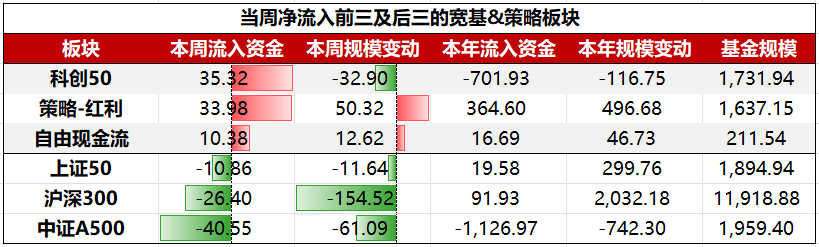
Market Overview - The total scale of equity ETFs in the market reached 48,557.73 billion yuan, with a decrease of 44.35 billion yuan in total scale over the past week, while total shares increased by 22.63 billion shares, resulting in a net inflow of 283.21 billion yuan [1] - Industry and thematic sector ETFs saw a net inflow of 185.41 billion yuan, primarily driven by inflows into the artificial intelligence sector, with all four major categories experiencing net inflows this week [2] Fund Inflow and Outflow Directions - In the broad-based and strategy ETF categories, the top three inflow sectors were: Sci-Tech 50 (+35.32 billion yuan), Strategy-Dividend (+33.98 billion yuan), and Free Cash Flow (+10.38 billion yuan). The top three outflow sectors were: Shanghai Stock 50 (-10.86 billion yuan), CSI 300 (-26.40 billion yuan), and CSI A500 (-40.55 billion yuan) [3][4] - In the industry and thematic sector ETFs, the top five inflow sectors were: Artificial Intelligence (+49.38 billion yuan), Non-Bank Financials (+30.57 billion yuan), Robotics (+15.81 billion yuan), Semiconductor Chips (+14.81 billion yuan), and Chemicals (+13.94 billion yuan). The top five outflow sectors were: Coal (-8.62 billion yuan), Non-Ferrous Metals (-6.70 billion yuan), New Energy Vehicles (-5.90 billion yuan), Banks (-5.28 billion yuan), and Traditional Chinese Medicine (-2.33 billion yuan) [5] Key Focus Areas - OPEC+ reported a decrease in oil production for October, averaging 43.02 million barrels per day, down by 73,000 barrels per day from September, impacting oil and gas ETFs positively with a four-week consecutive rise [6] - The ongoing regional tensions led to a suspension of exports from Russian Black Sea ports, affecting approximately 2% of global supply, equivalent to 2.2 million barrels per day [7] - The A-share IPO market has seen a significant increase in acceptance, with a year-on-year surge of over 400% in the first ten months of the year, indicating a robust market environment for securities ETFs [9] - The securities industry is expected to experience rapid growth in revenue and net profit, with a year-on-year increase of 42.55% in operating income and 62.38% in net profit for the first three quarters of 2025 [10][11]
平安证券(香港)港股晨报-20251118
Ping An Securities Hongkong· 2025-11-18 02:13
Market Overview - The Hong Kong stock market experienced fluctuations, with the Hang Seng Index closing at 23,831 points, down 145 points or 0.61% [1] - The market turnover decreased to 82.799 billion HKD, with net inflows of 484 million HKD recorded in the Hong Kong Stock Connect [1][5] - The US stock market also faced declines, with the Dow Jones falling 1.2% to 46,590 points, influenced by pressure on the technology sector [2] Sector Performance - In the Hong Kong market, local real estate, software, and 5G concept sectors saw significant declines, while gold stocks performed well [1] - The technology sector in the US was notably affected, with major companies like Nvidia and Apple experiencing stock price drops [2] - The report highlights the performance of various sectors, indicating that electric equipment, pharmaceutical, non-ferrous metals, chemicals, and banking sectors underperformed, while software services, consumer goods, coal, and real estate sectors showed strength [1] Investment Opportunities - The report suggests continued focus on sectors such as artificial intelligence, semiconductors, and industrial software, which are seen as new productivity drivers [3] - It emphasizes the value of Hong Kong stocks with Chinese assets, particularly in state-owned enterprises with lower valuations and higher dividends [3] - The report also points to opportunities in upstream non-ferrous metals benefiting from expectations of interest rate cuts by the Federal Reserve [3] Company Highlights - Baidu, as the largest Chinese search engine, is expanding its AI capabilities, with a focus on intelligent driving and related technologies [10] - The company reported a revenue of 32.713 billion CNY for Q2 2025, a year-on-year decrease of 3.59%, but a net profit increase of 33.42% [10] - The report indicates that Baidu's AI applications are gaining traction, with significant advancements in its AI strategy shared during the Baidu World Conference [10] Economic Data - The Ministry of Finance reported that the national general public budget revenue for the first ten months of the year reached 18.65 trillion CNY, a year-on-year increase of 0.8% [9] - The report highlights a significant increase in securities transaction stamp duty, which rose by 88.1% year-on-year, indicating an active secondary market [9] - The report also notes that the total credit card receivables in Hong Kong reached 151 billion HKD by the end of Q3 2025, reflecting a growing consumer credit environment [11]
小鹏汽车绩后暴跌,Q3营收翻番,净亏损大幅收窄近80%
Mei Ri Jing Ji Xin Wen· 2025-11-18 02:05
Group 1 - The Hong Kong stock market opened lower on November 18, with the Hang Seng Index down 0.80% at 26,172.27 points, and the Hang Seng Tech Index falling 1.25% [1] - Xpeng Motors reported a total vehicle delivery of 116,007 units for Q3 2025, a year-on-year increase of 149.3%, with total revenue reaching RMB 20.38 billion, up 101.8% year-on-year [1] - The company's net loss narrowed to approximately RMB 380 million, a decrease of 78.9% year-on-year and 20.3% quarter-on-quarter [1] Group 2 - Xpeng Motors expects Q4 2025 vehicle deliveries to be between 125,000 and 132,000 units, representing a year-on-year increase of approximately 36.6% to 44.3% [1] - Total revenue for Q4 2025 is projected to be between RMB 21.5 billion and RMB 23 billion, an increase of approximately 33.5% to 42.8% year-on-year [1] - Citic Securities maintains a "Buy" rating for Xpeng Motors, forecasting revenue of RMB 77.8 billion, RMB 115.4 billion, and RMB 141.9 billion for 2025-2027, with corresponding price-to-sales ratios of 2.2, 1.5, and 1.2 [2] Group 3 - The Hong Kong Stock Connect Auto ETF (159323) focuses on the Hong Kong new energy vehicle sector, including emerging car manufacturers like Xpeng and Li Auto, and is expected to benefit from advancements in robotics technology [3] - The Hang Seng Tech Index ETF (513180) includes major Chinese tech assets such as Xiaomi, NetEase, Tencent, Alibaba, and Meituan, providing a way for investors to access Hong Kong tech leaders without a Stock Connect account [3]
A股三大指数低开,这些板块涨了
第一财经· 2025-11-18 01:47
2025.11. 18 本文字数:491,阅读时长大约1分钟 作者 | 一财 阿驴 沪指低开0.24%,深成指低开0.31%,创业板指低开0.51%。 | 代码 | 名称 | 两日图 | 现价 | 涨跌 | 涨跌幅 | | --- | --- | --- | --- | --- | --- | | 000001 | 上证指数 | Varia | 3962.44 c | -9.59 | -0.24% | | 399001 | 深证成指 | Whis | 13161.70 c | -40.30 | -0.31% | | 399006 | 创业板指 | WW | 3089.38 c | -15.82 | -0.51% | 盘面上,厨卫电器、能源金属、房地产、盐湖提锂板块涨幅居前,煤炭、贵金属、有机硅概念走低。 09:21 港股开盘丨恒生指数低开0.8% 恒生指数低开0.8%,恒生科技指数跌1.25%。新能源车概念股走低,小鹏汽车跌逾7%;创新药概念 股回调。能源储存、机器人板块走强。 | HSTECH | 恒生科技 | Vival | 5684.81 | -72.07 | -1.25% | | --- | --- ...