
农林牧渔

Search documents
策略深度报告:A股主升初期调整后的应对策略
Huaxin Securities· 2025-09-17 06:42
Group 1 - The report highlights that the initial adjustments during the main upward phases of A-shares in 2015, 2017, and 2020 typically saw an average adjustment period of 11 trading days, with an average decline of nearly 5% for the overall market and a 20% pullback in popular sectors [5][28][32] - The report indicates that the current adjustment has lasted for 6 trading days with a decline of 2.35%, and popular sectors have experienced a pullback of 28.5%, suggesting that the adjustment is nearing completion and a consolidation phase is beginning [5][8][66] - The report suggests that the main upward phase of A-shares is characterized by a significant influx of household deposits into the market, which has been a driving force behind the current upward trend [15][17] Group 2 - The report outlines that the adjustment in 2015 was primarily driven by regulatory warnings and weak earnings reports, leading to a decline in market sentiment [33][36] - In 2017, the adjustment was influenced by disappointing macroeconomic data and external shocks, such as credit rating downgrades, which affected investor confidence [51][52] - The 2020 adjustment was marked by a significant outflow of northbound capital and the IPO of a major company, which created short-term liquidity pressure on the market [64][66] Group 3 - The report identifies key sectors to focus on during the current market phase, including interest rate-sensitive sectors (TMT, non-bank financials, and metals), sectors benefiting from a potential PPI recovery (chemicals, machinery, and consumer goods), and growth sectors that may see rotation (AI hardware, innovative pharmaceuticals, and defense) [8][66] - The report emphasizes that the style rotation in the market is contingent on fundamental performance, with growth sectors expected to continue leading, while a shift towards consumer and cyclical sectors may occur if earnings improve [7][8][66]
10:30,A股突然拉升!宁德时代,新高
Zheng Quan Shi Bao· 2025-09-17 05:02
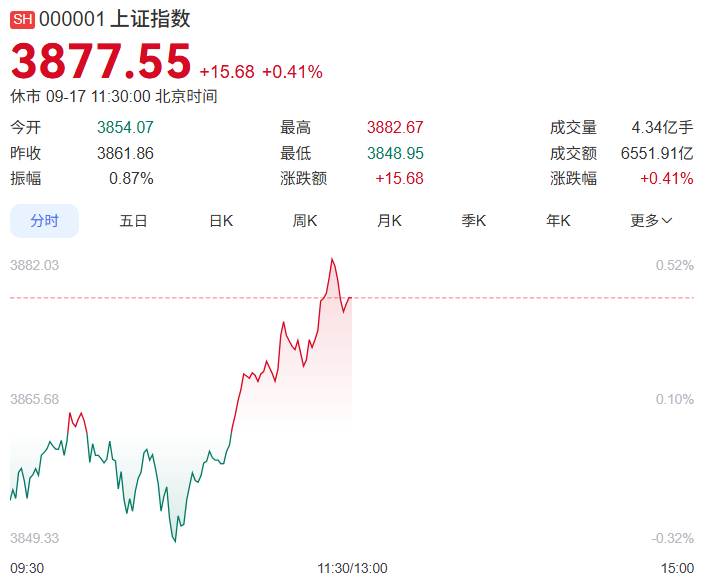
Market Performance - The A-share market experienced a narrow fluctuation in the morning of September 17, 2023, with a sudden collective rise in the three major indices around 10:30 AM, leading to all indices turning positive. The ChiNext Index rose over 1.5%, reaching a nearly three-year high, while the leading stock, CATL, hit a new high in its adjusted price [1][2] - By midday, the Shanghai Composite Index increased by 0.41%, the Shenzhen Component Index rose by 1.02%, and the ChiNext Index saw a gain of 1.74% [2] Stock Highlights - CATL, a leading stock in the ChiNext Index, surged with its adjusted price reaching a historical high, with an intraday increase approaching 8%. Other notable stocks included Changying Precision, which saw an intraday rise exceeding 16%, along with Sanhua Group, Yilian Network, Xinwangda, and Changchuan Technology, which also performed strongly [4] - In the Hong Kong market, the Hang Seng Index rose significantly, reaching a nearly four-year high, with Baidu Group-SW experiencing an intraday increase of over 12% and a cumulative rise of over 40% since September [9][10] Sector Performance - In terms of sector performance, the top gainers included the electric equipment, automotive, coal, and home appliance sectors, while the social services and agriculture sectors faced declines [7]


10:30,A股突然拉升!宁德时代,新高!
Zheng Quan Shi Bao· 2025-09-17 04:02
宁德时代(300750)引爆行情。 A股市场今天早盘窄幅震荡,10:30左右三大股指突然集体拉升,其中创业板指走势强劲,盘中再度创出近三年多新高。截至中午收盘,上证指数上涨 0.41%,深证成指上涨1.02%,创业板指上涨1.74%。 创业板指成份股中,龙头股宁德时代大涨,盘中复权价再创历史新高,涨幅一度接近8%。长盈精密(300115)大涨,盘中涨幅一度超过16%。此外,三 环集团(300408)、亿联网络(300628)、欣旺达(300207)、长川科技(300604)等多股盘中涨幅也居于市场前列。 行业板块方面,若按照申万一级行业划分,电力设备、汽车、煤炭、家用电器等板块盘中涨幅居前,社会服务、农林牧渔等板块盘中跌幅居前。 *ST东通四个交易日股价"腰斩" A股市场今天(9月17日)早盘窄幅震荡,10:30左右三大股指突然集体拉升,并全部翻红。其中创业板指涨超1.5%,盘中创出近三年多新高,龙头股宁德 时代复权价再创新高。 港股市场今天上午亦整体上行,恒生指数盘中再度刷新近四年新高。 创业板指大涨 "宁王"复权价再创新高 今天上午*ST东通(300379)股价再度跌停,这是该股连续第3个交易日"20cm ...

新世纪期货交易提示(2025-9-17)-20250917
Xin Shi Ji Qi Huo· 2025-09-17 02:06
Report Industry Investment Ratings - Iron ore: Oscillating bullish [2] - Coking coal and coke: Bullish [2] - Rebar: Rebound [2] - Glass: Bullish [2] - Soda ash: Rebound [2] - SSE 50 Index: Oscillating [2] - CSI 300 Index: Upward [2] - CSI 500 Index: Upward [4] - CSI 1000 Index: Upward [4] - 2 - year Treasury bond: Oscillating [4] - 5 - year Treasury bond: Oscillating [4] - 10 - year Treasury bond: Rebound [4] - Gold: High - level oscillation [4] - Silver: High - level oscillation [4] - Logs: Range - bound oscillation [6] - Pulp: Bottom consolidation [6] - Offset paper: Bearish [6] - Soybean oil: Wide - range oscillation [6] - Palm oil: Wide - range oscillation [6] - Rapeseed oil: Wide - range oscillation [6] - Soybean meal: Oscillating weakly [6] - Rapeseed meal: Oscillating weakly [6] - Soybean No. 2: Oscillating weakly [8] - Soybean No. 1: Oscillating weakly [8] - Live pigs: Oscillating strongly [8] - Rubber: Oscillating [10] - PX: Wait - and - see [10] - PTA: Oscillating [10] - MEG: Wait - and - see [10] - PR: Wait - and - see [10] - PF: Wait - and - see [10] Core Views The report analyzes the market conditions of various commodities and financial products, including the supply - demand relationship, price trends, and influencing factors. It provides investment ratings and suggestions for each product, considering factors such as industry policies, seasonal effects, and macro - economic indicators. For example, in the black industry, factors like steel mill production, mine policies, and demand changes affect the prices of iron ore, coking coal, and rebar; in the financial sector, policies and market sentiment impact the performance of stock indices and bonds; and in the agricultural and soft commodity sectors, factors such as weather, production, and consumption patterns play important roles [2][4][6][8][10]. Summary by Categories Black Industry - **Iron ore**: After steel mills resumed production, hot metal output rebounded to 2.4 million tons. Global iron ore shipments increased, with Australian and Brazilian shipments up 6.482 million tons. Demand recovered, and steel mills' profit ratio declined from a high. There is limited fundamental contradiction in the short term, and attention should be paid to whether the 2601 contract can hold at the previous high [2]. - **Coking coal and coke**: Mine shutdown news and "anti - involution" expectations drove the double - coke futures to rebound. Supply may be weaker than last year, and demand increased as hot metal output recovered. Coke started the second round of price cuts, with a cumulative reduction of 100 - 110 yuan/ton [2]. - **Rebar**: There is a lack of macro - level drivers, and "anti - involution" policy expectations are rising. Supply remains high, inventory pressure increases, and total demand is hard to show an inverse - seasonal performance. The profit of five major steel products declined, and the 2601 contract may oscillate strongly in the short term [2]. - **Glass**: The rise of glass futures was driven by stronger upstream fuel prices and improved macro - sentiment. The "coal - to - gas" conversion in Shahe may cause price fluctuations. Although the supply - demand contradiction has not improved substantially, inventory reduction provides some confidence [2]. - **Soda ash**: Currently, trading is about cold - repair, and the key lies in the cold - repair path. The real - estate industry is in an adjustment period, and attention should be paid to the improvement of real demand [2]. Financial Sector - **Stock indices**: The performance of different stock indices varied. Some sectors had capital inflows or outflows. Policies such as the "Measures on Expanding Service Consumption" and the "Regulations on the Management of Sales Fees of Publicly Offered Securities Investment Funds" may impact the market. It is recommended to control risk preference and hold long positions in stock indices [2][4]. - **Treasury bonds**: The yield of 10 - year Treasury bonds declined, and the central bank conducted reverse - repurchase operations. Market interest rates fluctuated, and it is recommended to hold long positions in Treasury bonds lightly [4]. Precious Metals - **Gold and silver**: Gold's pricing mechanism is shifting. Factors such as the US debt problem, geopolitical risks, Chinese physical gold demand, and the Fed's interest - rate policy affect gold prices. Silver also shows high - level oscillation. The current upward - driving logic has not completely reversed, and short - term factors include the Fed's interest - rate policy and geopolitical conflicts [4]. Light Industry and Agriculture - **Logs**: Port daily shipments increased slightly, and September arrivals are expected to be low. Supply pressure is not large, and the spot price is stable. It is expected to oscillate in a range [6]. - **Pulp**: Spot prices were strong, and the cost support from foreign prices increased. However, the paper industry's low profitability and high inventory pressure limit the demand for high - priced pulp, and prices are expected to consolidate at the bottom [6]. - **Offset paper**: Spot prices partially declined. Production is stable, but it is in the seasonal off - season. There is an oversupply situation, and it should be treated bearishly [6]. - **Oils and fats**: The production of Malaysian palm oil increased, and inventory rose. Domestic soybean oil has inventory pressure, but supply may tighten later. Oils and fats may oscillate widely, and attention should be paid to US soybean weather and Malaysian palm oil production and sales [6]. - **Meal products**: The US soybean yield decreased slightly, but production increased due to larger areas. Export demand is weak, and domestic supply pressure is significant. Meal products are expected to oscillate weakly [6][8]. - **Live pigs**: The average trading weight of live pigs increased slightly, and the slaughtering rate rose. Although demand is still restricted by high temperatures, it is expected to improve with school openings. The price may oscillate strongly, and the price difference between fat and standard pigs may widen slightly [8]. Soft Commodities and Polyesters - **Rubber**: Supply pressure decreased in Yunnan, and production increased in Hainan. Tire factory capacity utilization rose, and inventory decreased. Rubber prices may oscillate widely [10]. - **PX, PTA, MEG, PR, PF**: PX and PTA prices follow oil prices, with PX's near - month supply - demand weakening. MEG has low - level inventory and wide - balanced supply - demand in the medium term. PR and PF are affected by cost and demand factors, and their prices may oscillate or be in a wait - and - see state [10].
浙商早知道-20250917
ZHESHANG SECURITIES· 2025-09-16 23:31
Market Overview - On September 16, the Shanghai Composite Index rose by 0.04%, while the CSI 300 fell by 0.21%. The STAR Market 50 increased by 1.32%, the CSI 1000 rose by 0.92%, and the ChiNext Index went up by 0.68%. The Hang Seng Index decreased by 0.03% [3][4] - The best-performing sectors on September 16 were comprehensive (+3.63%), machinery and equipment (+2.06%), computer (+2.06%), retail (+1.96%), and automotive (+1.82%). The worst-performing sectors included agriculture, forestry, animal husbandry, and fishery (-1.29%), banking (-1.15%), non-ferrous metals (-0.99%), defense and military industry (-0.5%), and food and beverage (-0.38%) [3][4] - The total trading volume for the A-share market on September 16 was 23,670.69 billion yuan, with a net outflow of 3.188 billion Hong Kong dollars from southbound funds [3][4] Key Insights Consumption Strategy - In the medium to long term, the first "systematic 'slow' bull" is expected to release a wealth effect, potentially slowly boosting consumption. Insurance funds and foreign capital entering the market are favorable for consumer blue chips, with positive signals from central Huijin increasing holdings in liquor ETFs. A top-down perspective suggests that the broad consumption sector is likely to benefit [5] - The market perceives that the wealth effect of the bull market is not significant. However, it is believed that the bull market can indirectly drive the wealth effect through a specific transmission path: A-share bull market → stabilization of second-hand housing prices in first-tier cities → stabilization of second-hand housing prices in other cities → recovery of real estate wealth effect. Investment opportunities in the consumption sector are worth noting, particularly in blue-chip leaders and emerging growth areas [5] - The driving factors include support from policies, funds, and sentiment, indicating that the first "systematic 'slow' bull" has quietly arrived, which may enhance the Sharpe ratio of the A-share market and indirectly boost consumption [5] Bond Market Insights - The current bond market adjustment differs significantly from historical bear markets, as the fundamentals, monetary policy, and curve shapes do not resemble past bear markets. Instead, it is more akin to an emotional adjustment under continuous risk preference shocks, anti-involution, and fund fee reduction [7][8] - There is a need to gradually break the mindset of a one-sided decline in yields and adapt to a fluctuating market pattern. However, based on the economic fundamentals and the core tone of moderate policy easing, a major bull-bear reversal has not yet been established [7][8] - The three core signals for a bull-to-bear transition include: 1. Policy bottom: Signs of marginal tightening in macro policies or expressions of tightening monetary policy 2. Fundamental bottom: Consistent and positive surprises in high-frequency and economic data 3. Sentiment bottom: A fragile and crowded trading structure triggered by the above two signals, leading to self-reinforcing sell-offs and deleveraging [8][9]
固收、宏观周报:A股与黄金或横盘震荡,看多债市-20250916
Shanghai Securities· 2025-09-16 11:53
Report Overview - Report Date: September 16, 2025 [1] - Analyst: Zhang Hesheng [1] - SAC Number: S0870523100004 [1] 1. Report Industry Investment Rating - Not provided in the given content 2. Report's Core View - A shares and gold may experience sideways fluctuations, while the bond market presents an opportunity for long - positions. A shares are likely to remain in a high - level oscillation with good structural opportunities in areas like new energy, innovative drugs, rare earths, artificial intelligence, and securities. Long - term interest - rate bonds in the bond market are gradually becoming suitable for long - positions. Gold may move sideways in the short term and potentially break through upwards in the long term [11] 3. Summary by Related Content Stock Market - **US Stocks and Hong Kong Stocks**: In the past week (20250908 - 20250914), the Nasdaq, S&P 500, and Dow Jones Industrial Average changed by 2.03%, 1.59%, and 0.95% respectively, and the Nasdaq China Technology Index changed by 5.64%. The Hang Seng Index changed by 3.82% [2] - **A - shares**: Most A - share sectors rose. The Wind All - A Index rose 2.12%. The CSI A100, CSI 300, CSI 500, CSI 1000, CSI 2000, and Wind Micro - cap stocks changed by 1.54%, 1.38%, 3.38%, 2.45%, 2.16%, and 2.55% respectively. Among different styles, the Shanghai blue - chips and growth sectors (represented by SSE 50 and STAR 50) rose by 0.89% and 5.48% respectively, and the Shenzhen blue - chips and growth sectors (represented by SZSE 100 and ChiNext Index) rose by 1.66% and 2.10% respectively. The North Exchange 50 Index changed by - 1.07% [3] - **Industry Performance**: 26 out of 30 CITIC industries rose, with electronics, real estate, agriculture, forestry, animal husbandry, fishery, media, and computer leading the gains with weekly increases of over 4%. Semiconductor, science and technology innovation, chip, integrated circuit, and information technology innovation ETFs performed well, with weekly increases of over 7% [4] Bond Market - **Domestic Interest - rate Bonds**: In the past week (20250908 - 20250914), the 10 - year Treasury bond futures main contract fell 0.22% compared to September 5, 2025. The yield of the 10 - year active Treasury bond rose 4.10 BP to 1.8670%. Yields of all maturity varieties increased, with those of 20 - year and above varieties rising more [5] - **Funding Costs and Market Operations**: As of September 12, 2025, R007 was 1.4651%, up 0.85 BP from September 5, 2025, and DR007 was 1.4575%, up 2.03 BP. The central bank's net injection in the open market operations (reverse repurchase and central bank bill swaps) in the past week (20250908 - 20250914) was 196.1 billion yuan [6] - **Bond Market Leverage**: The bond market leverage level increased. The 5 - day average of inter - bank pledged repurchase volume increased from 7.31 trillion yuan on September 5, 2025, to 7.49 trillion yuan on September 12, 2025 [8] - **US Treasury Bonds**: In the past week (20250908 - 20250914), US Treasury bond yields decreased. As of September 12, 2025, the 10 - year US Treasury bond yield fell 4 BP to 4.06%. Yields of 10 - year and above maturity varieties decreased [9] Commodity Market - **Dollar and Gold**: In the past week (20250908 - 20250914), the US dollar index fell 0.12%. The US dollar depreciated against the euro, pound, and the on - shore and off - shore RMB. Gold prices rose, with the London spot gold price rising 1.57% to $3651.10 per ounce, and the COMEX gold futures price rising 1.26% to $3646.30 per ounce. Domestic gold prices also increased, with the Shanghai spot gold rising 2.33% to 830.41 yuan per gram and the futures rising 2.22% to 832.50 yuan per gram [10]
豫股专题:河南省上市公司2025半年度业绩总结
Zhongyuan Securities· 2025-09-16 09:28
Group 1 - The overall operating revenue and net profit of listed companies in Henan Province reached historical highs in H1 2025, with operating revenue of 508.77 billion yuan, a year-on-year increase of 0.99%, and net profit attributable to shareholders of 44.795 billion yuan, a year-on-year increase of 39.83% [4][10][12] - The profitability of listed companies improved, with a decrease in expense ratios. The overall gross profit margin for H1 2025 was 19.48%, up 1.28 percentage points year-on-year, while the net profit margin was 8.80%, up 2.44 percentage points year-on-year [4][39][41] - Industries such as machinery, electric power equipment and new energy, and agriculture showed excellent performance growth, while industries like basic chemicals and coal experienced significant declines [4][47] Group 2 - The machinery industry in Henan Province had a steady performance with a total operating revenue of 44.207 billion yuan in H1 2025, a year-on-year increase of 5.79%, and a net profit of 4.290 billion yuan, a year-on-year increase of 21.31% [48][49] - The pharmaceutical industry demonstrated significantly higher profit margins compared to the overall industry, with companies like Lingrui Pharmaceutical and Hualan Biological achieving gross profit margins of 81.33% and 75.26% respectively [41][44] - The electric power equipment and new energy sector showed a notable recovery in overall performance, with a year-on-year increase in net profit margin of 45.89% in Q2 2025 [49][50]


17.07亿元资金今日流出农林牧渔股
Zheng Quan Shi Bao Wang· 2025-09-16 09:24
资金面上看,两市主力资金全天净流出374.26亿元,今日有11个行业主力资金净流入,机械设备行业主 力资金净流入规模居首,该行业今日上涨2.06%,全天净流入资金55.08亿元,其次是计算机行业,日涨 幅为2.06%,净流入资金为49.45亿元。 主力资金净流出的行业有20个,有色金属行业主力资金净流出规模居首,全天净流出资金103.35亿元, 其次是电力设备行业,净流出资金为89.13亿元,净流出资金较多的还有银行、非银金融、医药生物等 行业。 农林牧渔行业今日下跌1.29%,全天主力资金净流出17.07亿元,该行业所属的个股共105只,今日上涨 的有39只;下跌的有61只,跌停的有2只。以资金流向数据进行统计,该行业资金净流入的个股有26 只,净流入资金居首的是诺普信,今日净流入资金4743.84万元,紧随其后的是中宠股份、罗牛山,净 流入资金分别为1829.77万元、1554.94万元。农林牧渔行业资金净流出个股中,资金净流出超5000万元 的有8只,净流出资金居前的有牧原股份、温氏股份、傲农生物,净流出资金分别为3.95亿元、1.66亿 元、1.66亿元。 农林牧渔行业资金流入榜 | 代码 | 简称 ...
综合行业今日涨3.62% 主力资金净流入1.45亿元
Zheng Quan Shi Bao Wang· 2025-09-16 09:24
Market Overview - The Shanghai Composite Index rose by 0.04% on September 16, with 21 out of the 28 sectors experiencing gains. The top-performing sectors were the comprehensive sector and machinery equipment, with increases of 3.62% and 2.06% respectively [1] - The sectors that saw declines included agriculture, forestry, animal husbandry, and fishery, which fell by 1.29%, and banking, which decreased by 1.15% [1] Capital Flow Analysis - The net outflow of capital from the two markets was 37.426 billion yuan, with 11 sectors experiencing net inflows. The machinery equipment sector led with a net inflow of 5.508 billion yuan, followed by the computer sector, which also saw a 2.06% increase and a net inflow of 4.945 billion yuan [1] - Conversely, 20 sectors experienced net outflows, with the non-ferrous metals sector leading the outflow at 10.335 billion yuan, followed by the power equipment sector with an outflow of 8.913 billion yuan. Other sectors with significant outflows included banking, non-bank financials, and pharmaceutical biology [1] Comprehensive Sector Performance - The comprehensive sector increased by 3.62% with a net inflow of 14.5 million yuan. Out of 16 stocks in this sector, 13 rose while 2 fell. The stocks with the highest net inflows included Dongyangguang with 206 million yuan, followed by Zhangzhou Development and Zhejiang Agricultural Shares with net inflows of 21.5552 million yuan and 9.8091 million yuan respectively [2] - The stocks with the highest net outflows in the comprehensive sector were Yuegui Shares, Nanjing New Hundred, and Te Li A, with outflows of 69.481 million yuan, 14.8845 million yuan, and 10.1847 million yuan respectively [2] Comprehensive Sector Capital Flow Ranking - The top stocks in the comprehensive sector based on capital flow included: - Dongyangguang: +7.37%, 4.42% turnover, 206.2576 million yuan inflow - Zhangzhou Development: +0.85%, 4.27% turnover, 21.5552 million yuan inflow - Zhejiang Agricultural Shares: +1.82%, 1.65% turnover, 9.8091 million yuan inflow - Other notable stocks included Zongyi Shares, Yatai Group, and Hongmian Shares, all showing positive performance and varying levels of capital inflow [2]


指数应用系列研究一:行业指数池构建、景气期限对比与三维组合策略
ZHONGTAI SECURITIES· 2025-09-16 06:36
Group 1: Industry Index Pool Construction - The report outlines the construction of an industry index pool that combines investability and representativeness, focusing on passive products tracking strong industry attributes [10][12]. - Since 2020, the scale of industry ETFs has experienced explosive growth, increasing from 85.8 billion yuan at the end of 2019 to over 310 billion yuan by the end of 2020, and approaching 900 billion yuan by August 2025 [10]. - The report categorizes various industry ETFs, highlighting that TMT, financial real estate, and pharmaceutical sectors have surpassed 100 billion yuan in ETF scale [10]. Group 2: Economic Prosperity Investment Practices - The report discusses the calculation of expected ROE growth for industries based on analysts' profit forecasts, comparing two fiscal years (FY1 and FY2) [20][21]. - It emphasizes that the FY2 grouping shows stronger monotonicity in performance compared to FY1, indicating better returns for the former [23][24]. - The backtesting period for the economic prosperity factor spans from January 1, 2018, to September 12, 2025, with a focus on marginal changes in industry index prosperity [27]. Group 3: Economic Trend Resonance Strategy - The economic trend resonance strategy combines fundamental marginal improvements with capital consensus, utilizing trend factors to quantify market sentiment [36][38]. - The constructed economic trend resonance portfolio has achieved an annualized return of 12.33% since 2018, outperforming the CSI 800 index by 11.13% [40][42]. - The portfolio's monthly excess return rate stands at 64%, with a profit-loss ratio of 1.30 [45]. Group 4: Economic Trend and Crowding Avoidance Strategy - The strategy integrates economic trend analysis with crowding avoidance to mitigate risks associated with overheated trading [49]. - The three-dimensional strategy has yielded an annualized return of 12.80% since 2018, exceeding the CSI 800 index by 11.60% [52][54]. - The portfolio's monthly excess return rate is 62%, with a profit-loss ratio of 1.47 [57]. Group 5: Current Industry Characteristics - As of August 2025, the report identifies industries that align with the economic trend resonance and crowding avoidance strategy, including the transportation index, home appliances, livestock, media, and oil and gas sectors [60]. - The expected growth rates for these sectors range from 1.1% to 9.6%, with varying levels of crowding and valuation metrics [60].