
航运业

Search documents
中美关税存谈判可能,关注马士基5月下半月价格情况
Hua Tai Qi Huo· 2025-04-24 03:01
1. Report Industry Investment Rating No relevant information provided. 2. Core Viewpoints of the Report - Geopolitical events such as the postponement of the Iran - US indirect talks and the uncertainty of US - China tariff policies are affecting the shipping market [4][5] - The shipping capacity in May is gradually increasing, with the monthly average weekly capacity around 270,500 TEU, a year - on - year increase of over 18% in 2024. There are many empty sailings on the US routes, and some ships may be transferred to European routes [4] - The 06 and 08 contracts are seasonal peak - season contracts, and the uncertainty of tariff policies affects their valuations. The probability of the Suez Canal reopening in June and August is decreasing [5] - The cargo volume on European routes is fair, but the US tariff policy has a significant impact on US routes. Ship companies are formulating route adjustment plans, and if more US - bound ships are transferred to European routes, European route freight rates will face pressure [5] - It is necessary to closely monitor the possibility of China - US negotiations. If negotiations occur and some goods are exempted from export tariffs, there may be supply - demand mismatches on US routes, which will have a positive impact on European routes. Due to the uncertainty of tariff policies, it is recommended to focus on arbitrage operations [5] 3. Summary According to Relevant Catalogs Market Analysis - Online quotes: Different shipping alliances and companies have different price trends. For example, Maersk's quotes have been decreasing, and some companies' quotes in May have significant changes. The price center in the first half of May will continue to decline to around $1,800 - $1,900/FEU, and Maersk's quotes for the second half of May are expected to be between $1,600 - $1,700/FEU [2][3] Geopolitical and Capacity - Geopolitical events: The Iran - US indirect talks' technical meeting was postponed to the 26th [4] - Capacity: The shipping capacity in May is gradually increasing, and there are many empty sailings on US routes. A total of 8 ships on US routes have been transferred to European routes after May, with a total capacity of 91,300 TEU [4] Contract and Price Analysis - Contracts: The 06 and 08 contracts are affected by tariff policies and seasonal factors. The 06 contract will gradually return to "real - world" trading, while the 08 contract will face a game between expectations and reality [5] - Price trends: The price increase expectation in May may be disappointed again. If more US - bound ships are transferred to European routes, European route freight rates will face pressure [5] Strategy - Unilateral: The main contract fluctuates [8] - Arbitrage: Suspend the long 06 and short 10 arbitrage, and focus on the long 08 and short 10 and long 08 and short 06 arbitrage operations [5][8] Market Data - As of April 24, 2025, the total open interest of all contracts of the Container Shipping Index European Line Futures is 93,217 lots, and the single - day trading volume is 95,684 lots. The closing prices of different contracts vary [6] - As of April 18, the SCFI (Shanghai - Europe route) price is $1,316/TEU, the SCFI (Shanghai - US West route) price is $2,103/FEU, and the SCFI (Shanghai - US East) price is $3,251/FEU. As of April 21, the SCFIS (Shanghai - Europe) is 1,508.44 points, and the SCFIS (Shanghai - US West) is 1,368.41 points [7] - In 2025, 82 container ships have been delivered, with a total capacity of 644,300 TEU. As of April 18, 2025, 26 ships with a capacity of 12,000 - 16,999 TEU have been delivered, with a total capacity of 390,000 TEU, and 3 ships with a capacity of over 17,000 TEU have been delivered, with a total capacity of 70,872 TEU [7]

美对华海运业发动“301条款”,或导向一个讽刺性局面
Hu Xiu· 2025-04-24 02:35
Core Points - The U.S. Trade Representative (USTR) announced the results of the 301 investigation into China's shipping, logistics, and shipbuilding industries, detailing new fee structures for Chinese shipping companies and vessels built in China [1][3]. Implementation Details - The implementation of the new measures will occur in two phases: the first phase will take effect in 180 days, imposing fees on Chinese shipowners and operators, as well as on non-U.S. shipping companies using vessels built in China. The fee structure will vary based on the type of vessel, calculated by net tonnage, with a maximum of five charges per year [3][4]. - The second phase, effective in three years, will impose fees on non-U.S. liquefied natural gas (LNG) vessels docking at U.S. ports, with rates increasing annually. The latest version of the proposal includes a 180-day buffer and narrows the scope of applicable vessels, enhancing the focus on China [4][5]. Industry Reactions - Industry leaders, such as Andrew Abbott, CEO of Atlantic Container Line (ACL), have expressed strong opposition to the legislation, indicating that it could force their company to exit the U.S. market due to the predominance of Chinese-built vessels in their fleet [5][6]. - Despite ACL's unique situation, the overall share of Chinese-built vessels in the global fleet is relatively low, with only 23% of the current fleet being constructed in China [6][7]. Market Statistics - According to Clarkson's data, Chinese-built container ships account for 39% of the global container fleet, while the order book for container ships in 2024 shows China with a 69% share, indicating a significant increase in new orders [7][9]. - The U.S. container shipping market exports approximately 13.9 million TEUs annually and imports 34 million TEUs, representing about 22.5% of global container shipping trade [12]. Cost Implications - If the new fees are implemented, the cost per container for routes from the U.S. West Coast could increase by $450 to $550, while East Coast routes may see increases of $200 to $300, representing significant percentages of current freight rates [13][17]. - Historical trends suggest that shipping companies are likely to pass these additional costs onto consumers, potentially leading to a market environment similar to that experienced during the pandemic [17]. Comparative Analysis - The U.S. container shipping market's dynamics are compared to the Russian market, which has faced similar external pressures. The U.S. market is expected to maintain supply levels, unlike the drastic changes seen in Russia following the Ukraine conflict [19][21]. - The differences in market size and operational structures between the U.S. and Russia highlight the potential for U.S. shipping companies to adapt rather than exit the market entirely [20][23]. Strategic Opportunities - The 301 legislation may inadvertently create strategic opportunities for Chinese shipping and shipbuilding industries, as market gaps left by exiting foreign companies could be filled by domestic firms [35][36]. - The potential restructuring of the U.S. shipping market could lead to increased market share for Chinese companies, particularly in logistics and shipping services [38][39]. Regulatory Implications - The legislation highlights the inefficacy of current international shipping governance systems, as it may lead to a decrease in the competitiveness of Chinese-built vessels in the global market [40][41]. - China is encouraged to develop its own regulatory framework to counteract the effects of the U.S. legislation, focusing on establishing standards that could enhance its competitive position in the shipping and shipbuilding sectors [43][44].

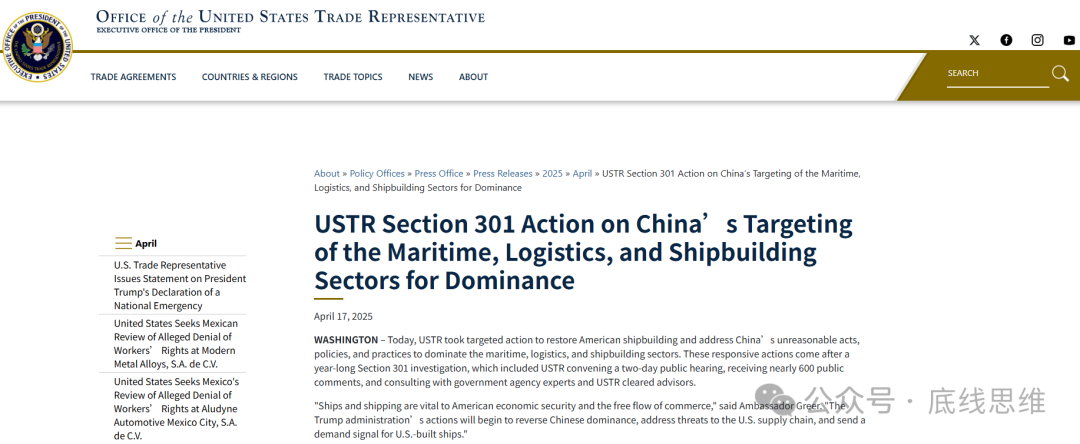
针对美301调查歧视性决定,中远海运发声!
Huan Qiu Wang· 2025-04-21 03:17
Core Viewpoint - The company firmly opposes the discriminatory decision made by the U.S. regarding the Section 301 investigation into China's maritime logistics and shipbuilding industries, arguing that it distorts fair competition and threatens the stability of global supply chains [1][2]. Group 1: Company Response - The company emphasizes its commitment to integrity, transparency, and compliance in international shipping and logistics services [1][2]. - It asserts that the U.S. measures will negatively impact the global shipping industry's normal operations and sustainable development [1][2]. - The company pledges to continue safeguarding client interests and providing reliable shipping and logistics solutions [1][2]. Group 2: Industry Impact - The company warns that the U.S. actions could undermine the security and resilience of global industrial and supply chains [1][2]. - It highlights the potential disruption to fair competition within the global shipping industry due to the U.S. decision [1][2].

金银回调,油价续涨:申万期货早间评论-20250418
申银万国期货研究· 2025-04-18 01:06
首席点评:金银回调,油价续涨 报告日期: 2025 年 4 月 18 日 申银万国期货研究所 李强指出,在政策制定实施和政府工作的方方面面,都要有稳预期的意识,特别要结合形势变化,提高 政策针对性、有效性。要讲究政策时机,在一些关键的时间窗口,推动各方面政策措施早出手、快出 手,对预期形成积极影响。欧洲央行如期下调利率 25 个基点,为自去年 6 月以来第七次下调利率。欧 央行行长拉加德表示,经济前景笼罩在极大的不确定性中,经济下行风险有所增加。美国 3 月新屋开工 数下降 11.4% ,创一年来最大降幅,高房价和抵押贷款利率高企导致需求疲软,使得建筑商对破土动 工缺乏信心。美国能源部备忘录报道称,特朗普政府考虑砍掉将近 100 亿美元清洁能源资金,可能会在 氢能源、碳捕捉、 ETC 领域削减(政府)资金支持。 重点品种: 玻璃、原油、 贵金属 玻璃 :周四,玻璃期货延续弱势,市场情绪仍有分歧,商品普遍受到关税冲击导致的对于内需消费的 观望情绪主导。玻璃自身目前库存缓慢去化,市场亦步亦趋。中期角度,目前经过 2 个月的玻璃累库, 等待开工后采购需求推动消化玻璃存量库存。本周玻璃生产企业库存 5624 万重箱, ...
关税2.0对全球贸易&航运市场的潜在影响
2025-04-15 14:30
Summary of Conference Call Records Industry Overview - The conference call primarily discusses the impact of new tariff policies, specifically Tariff 2.0, on the shipping and trade industries, particularly between the U.S. and China [1][2][3]. Key Points and Arguments 1. **Tariff 2.0 Overview**: The new tariff policy is referred to as a "composite right," focusing on traditional goods with increased tariffs [1]. 2. **Impact on Shipping Capacity**: The U.S. investigation into China's shipbuilding industry under Section 301 is expected to significantly affect global and Chinese markets, leading to increased costs and decreased operational efficiency for Chinese shipping companies [2]. 3. **Direct Trade Effects**: There is a noted decline in direct trade volume from China to the U.S., a shift in trade routes, and potential increases in shipping costs due to operational disruptions [3]. 4. **Long-term Economic Implications**: The long-term effects may include a slowdown in the U.S. economy, a shift in Chinese shipbuilding orders, and a restructuring of supply chains in manufacturing [3]. 5. **Market Strategies**: Recommendations include focusing on seasonal contracts during peak periods and monitoring cross-period strategies, particularly for contracts in June and August [4][5]. 6. **Global Trade Dynamics**: The relationship between global economic growth rates and trade volume growth rates is highlighted, indicating that trade significantly influences economic performance [6]. 7. **U.S. Trade Partners**: The U.S. has increased tariffs on imports from Canada and Mexico, with specific impacts on industries such as automotive parts and energy [7][22]. 8. **Trade Deficits**: The trade deficit with China has been growing, particularly in manufacturing, electronics, and transportation equipment, indicating a heavy reliance on Chinese imports [8][9]. 9. **301 Tariff Policy Effects**: The 301 tariffs have had a substantial impact on various sectors, with agriculture and manufacturing being notably affected [10][12]. 10. **Shipping Industry Adjustments**: The shipping industry is adjusting to increased service fees for Chinese-built vessels, which could lead to higher operational costs for foreign shipping companies using Chinese ships [27][28]. 11. **Future Trade Patterns**: There is a potential shift in manufacturing capacity from China to Southeast Asia, particularly Vietnam and India, as companies seek to avoid tariffs [19][20]. 12. **Economic Impact Projections**: The projected impact of Tariff 2.0 on the U.S. economy could lead to a GDP decline of approximately 1.8%, indicating significant economic repercussions [34]. Other Important but Overlooked Content - The call emphasizes the importance of monitoring specific shipping routes and the operational adjustments made by shipping companies in response to tariff changes [29][30]. - The discussion includes the potential for increased cooperation between the U.S. and its neighboring trade partners, which could mitigate some of the adverse effects of the tariffs [16][18]. - The call also touches on the broader implications of global supply chain adjustments and the need for companies to adapt to changing market conditions [36][37]. This summary encapsulates the critical insights from the conference call, focusing on the implications of tariff policies on the shipping and trade industries, as well as the broader economic context.
中国企业家该如何应对接下来的全球动荡?| 吴晓波激荡讲堂
吴晓波频道· 2025-04-10 00:31
Core Viewpoint - The article emphasizes the importance of understanding China's historical context to navigate the current turbulent economic landscape, particularly in light of recent global trade tensions and the impact of policies like tariffs [1][2][3]. Group 1: Historical Context of Chinese Modernization - The Opium War in 1840 marked the beginning of China's modernization journey, leading to significant efforts for national revival and social progress [6][7]. - Throughout history, Chinese entrepreneurs have played a crucial role in pivotal moments of national transformation, intertwining their entrepreneurial journeys with the country's modernization [7][9]. - The article outlines three waves of entrepreneurial evolution in China since the Opium War, highlighting the connection between entrepreneurs and national modernization [9]. Group 2: Three Waves of Entrepreneurial Evolution - The first wave occurred during the Self-Strengthening Movement, characterized by "official merchants" and "compradors," with key figures like Zeng Guofan and Li Hongzhang leading initiatives to modernize industry [10][12]. - The second wave emerged in the Republican era, where a new class of national entrepreneurs focused on consumer goods and industrial products, marking a golden age for private enterprise [16][18]. - The third wave followed the reform and opening-up period, where diverse entrepreneurs emerged, including township enterprise representatives and urban reform pioneers, driving economic growth through practical approaches [19][22][23]. Group 3: Current Economic and Geopolitical Landscape - The article discusses the current economic cycle starting in Q4 2024, which will significantly influence China's economic development through changes in fiscal, monetary, and real estate policies [27]. - It also highlights the unpredictable geopolitical landscape, particularly the implications of U.S.-China relations and the challenges posed by technological decoupling and factory relocations [27]. - The rapid advancements in technology, especially in AI, are reshaping traditional business models, necessitating entrepreneurs to adapt to these changes [27][29]. Group 4: Educational Initiative - The "2025 Wu Xiaobo Lecture Hall" aims to help entrepreneurs understand the historical context of China's modernization and its implications for future business strategies [29][30]. - The program will cover significant historical events and their impact on modern entrepreneurship, providing insights into the successes and failures of past business leaders [30][31]. - The initiative emphasizes the need for entrepreneurs to learn from history to navigate future uncertainties effectively [32].

全球货量增长叠加运价提升,中远海控预计Q1净利润同比增72% | 财报见闻
Hua Er Jie Jian Wen· 2025-04-07 13:10
中远海控第一季度净利润达132.23亿元,同比增长72.13%;归母净利润116.89亿元,同比增长73.04%。公司表示,2025年第一季度,全球集装箱货量较 上年同期仍然保持了一定的增长,一季度中国出口集装箱运价综合指数(CCFI)均值也同比实现了提升。 4月7日,中远海控公布2025Q1度业绩预增公告: 对于业绩预增主要原因,中远海控称,2025年第一季度,全球集装箱货量较上年同期仍然保持了一定的增长,一季度中国出口集装箱运价综合指数 (CCFI)均值也同比实现了提升。中远海控2025年企业经营发展取得良好开局。 中远海控2024年净利润同比增长105.78% 3月21日,公司公布的2024业绩显示: | | | | | 单位:元 币种:人民币 | | --- | --- | --- | --- | --- | | | 第一季度 | 第二季度 | 第三季度 | 第四季度 | | | (1-3月份) | (4-6月份) | (7-9月份) | (10-12月份) | | 营业收入 | 48,280,064,086.60 | 52,944,431,329.69 | 73,512,832,649.25 | 5 ...
150万美元"过路费":美国对中国船舶下黑手,全球航运业要变天?
Sou Hu Cai Jing· 2025-03-30 01:20
Core Insights - The recent imposition of a $1.5 million "service fee" by U.S. Customs on Chinese cargo ships is causing significant disruption in the global shipping industry, effectively acting as a barrier for Chinese vessels to dock at U.S. ports [1][2] - China's shipbuilding industry has rapidly advanced, with a strong manufacturing capability that includes both mass production of container ships and the intricate construction of specialized vessels like LNG carriers [1][2] - The U.S. strategy appears to be a calculated move to hinder China's maritime trade, but it may backfire as Chinese shipbuilders are adapting by exploring new shipping routes and optimizing vessel designs [2] Industry Impact - The $1.5 million fee is perceived as a substantial financial burden for Chinese shipowners, leading to a collective halt of vessels on U.S. routes, which has created a scenario of empty ports [1] - The situation has prompted stakeholders in Rotterdam and Singapore to reassess freight costs and shipping routes, indicating a ripple effect across the global shipping network [1] - Competitors in South Korea and Japan are unexpectedly benefiting from this disruption, as they may receive orders that would have otherwise gone to Chinese shipbuilders, although their own production capacities are limited [1] Strategic Responses - Chinese shipbuilding companies are proactively responding to the challenges posed by the U.S. fees by innovating in the design of new generation green vessels and testing alternative shipping routes, such as Arctic passages [2] - The evolving trade dynamics highlight a shift towards a more competitive landscape where traditional trade rules may be replaced by more aggressive tactics, reflecting a "jungle law" scenario [2] - The resilience of China's shipbuilding sector is underscored by its ability to produce high-quality vessels while also navigating complex maritime routes, showcasing its strength in the face of external pressures [2]

低碳燃料:通往净零排放的最后一公里:合成燃料对于航空和航运脱碳的作用
Deloitte· 2025-03-27 11:27
Group 1: Decarbonization Goals - Achieving net-zero greenhouse gas emissions by 2050 requires a fundamental shift from fossil fuel-based systems to highly renewable and electrified energy systems[6] - Aviation and shipping industries are responsible for approximately 1 billion tons of CO2 emissions annually, accounting for about 6% of global emissions[15] - By 2050, aviation CO2 emissions are expected to decrease by approximately 75%, while shipping emissions could reach near-zero levels, with a reduction of 95%[7] Group 2: Role of Low-Carbon Fuels - Sustainable aviation fuel (SAF) and synthetic fuels are projected to be the primary low-carbon fuel sources for aviation and shipping by 2050, with synthetic fuels expected to account for about 40% of aviation fuel supply[6][28] - To achieve the required levels of synthetic fuel supply by 2050, approximately 150 million tons of sustainable hydrogen and 700 million tons of climate-neutral CO2 will be needed[7] - The production of clean hydrogen, fuel synthesis, and direct air capture will require up to 10,000 TWh of clean electricity by 2050, equivalent to one-third of global electricity generation in 2023[8] Group 3: Economic and Technical Challenges - The cost of synthetic fuels is currently significantly higher than fossil fuels, with prices potentially remaining two to ten times higher without public support[9] - An estimated annual investment of about $130 billion will be necessary by 2050 to ensure sufficient supply of synthetic fuels, which is comparable to the total fuel expenditure of the aviation and shipping sectors[9] - The transition to low-carbon fuels involves overcoming major technical challenges, including the need for new fuel supply infrastructure and engine solutions for shipping[10] Group 4: Future Outlook and Collaboration - Policymakers play a crucial role in creating the initial conditions for the transition, including establishing regulatory frameworks and providing ongoing support[13] - International organizations can facilitate a coordinated global energy transition by implementing universal rules and certification systems for low-carbon fuels[13] - Collaboration among all stakeholders in the value chain is essential for achieving the decarbonization goals in aviation and shipping[11]
华源晨会精粹-2025-03-17
Hua Yuan Zheng Quan· 2025-03-16 23:30
Investment Ratings - The report does not explicitly state an investment rating for the industry Core Insights - The financial data for February 2025 shows an increase in social financing and new loans, indicating a potential recovery in economic activity [2][11][13] - The oil market is under pressure due to recession fears in the US, but there are opportunities for recovery as the US plans to replenish its strategic oil reserves [17][18][19] - The express delivery sector has shown strong growth in early 2025, with a 22.4% year-on-year increase in package volume [21][22] - The aviation industry is expected to benefit from macroeconomic recovery, with increased ticket bookings for domestic and international flights [20][23][24] Summary by Sections Fixed Income - New loans in February 2025 amounted to 1.01 trillion yuan, with social financing reaching 2.24 trillion yuan, indicating a year-on-year increase in social financing growth to 8.2% [2][11][13] - M2 growth was stable at 7.0%, and M1 growth is expected to rise further throughout the year [12][14] Transportation - The oil price has declined significantly, with Brent crude at $69.28 per barrel, creating opportunities for refiners to improve profit margins [17][18] - The shipping market is expected to benefit from supply tightness and geopolitical uncertainties, with recommendations to focus on companies like China Merchants Energy and COSCO Shipping [19][30] Express Delivery - The express delivery industry reported a strong performance in January and February, with a total of 284.8 billion packages delivered, reflecting a 22.4% increase year-on-year [21][22] - The sector is expected to see continued demand, with major players like ZTO Express and SF Express positioned for growth [29] Aviation - The aviation sector is experiencing a rebound in ticket bookings, with domestic flight reservations up 24% year-on-year for the Qingming Festival [20][23] - The industry is expected to benefit from a long-term supply-demand imbalance, with a focus on companies like China Southern Airlines and Hainan Airlines [20][29] Metals and New Materials - Copper prices are anticipated to rise due to supply disruptions from smelting plants reducing output [30] - The demand for copper is supported by recovering downstream industries, with expectations of a bullish trend in copper prices [30] North Exchange - The North Exchange is seeing new financing projects and a stable market environment, with a focus on companies that can provide consistent dividends and growth potential [10][30]