品牌服饰

Search documents
纺织服装行业二季度前瞻报告:品牌景气分化,制造情绪改善
ZHESHANG SECURITIES· 2025-07-23 12:51
Investment Rating - The industry investment rating is maintained as "Positive" [2] Core Views - The textile and apparel industry is experiencing a divergence in brand performance, with manufacturing sentiment improving [2] - Retail growth in the apparel sector showed a slight deceleration in Q2, but there is potential for improvement in Q3 due to a lower base from the previous year [3] - Key players in the H-share market, such as Anta Sports and 361 Degrees, are expected to maintain double-digit revenue growth in H1 2025, while other brands like Xtep and Li Ning are projected to achieve single-digit revenue growth [5][8] - A-share brands are showing mixed performance, with some companies like Weigang Medical and Hailan Home benefiting from strong retail growth and product expansion [8] Summary by Sections Textile Manufacturing - Sentiment in textile manufacturing is improving, focusing on stable growth for oversold leaders [2] - Key recommendations include Shenzhou International, Crystal International, and Huayi Group, which are expected to show resilience in performance [2] Brand Apparel - The brand apparel sector is witnessing a split in performance, with some companies achieving growth despite retail environment pressures [8] - Notable performers include Weigang Medical, Hailan Home, and Luolai Life, which are expected to see significant revenue and profit growth in Q2 [8][9] Market Outlook - The outlook for the second half of the year emphasizes focusing on industry leaders with positive operational changes and attractive valuations, such as Hailan Home and Weigang Medical [9] - The Hong Kong market for sports and functional apparel is expected to remain resilient, with recommendations for brands like Anta Sports and Bosideng [10]
【十大券商一周策略】3500点后,A股咋走?7月,不错!8—9月,风险较大!
券商中国· 2025-07-13 15:03
Group 1 - The current market is transitioning from a stock market to an incremental market, with A-shares experiencing high volatility in certain sectors while manufacturing sectors remain undervalued [1] - The "anti-involution" narrative is compared to the "Belt and Road" initiative, suggesting that it will help stimulate low-performing sectors in the context of increased capital inflow [1] - The valuation gap in Hong Kong stocks is becoming apparent, with insurance funds likely to expand their investment scope, indicating a favorable time to increase allocations to Hong Kong stocks [1] Group 2 - The "anti-involution" policy is expected to anchor the basic expectations of the midstream manufacturing sector, with short-term investment opportunities becoming more apparent [2] - The passing of the "Big and Beautiful" bill in the U.S. is expected to enhance fiscal stimulus, reducing the risk of a deep recession and improving visibility for China's supply-demand dynamics by 2026 [2] - The market has already begun to reflect a "bull market atmosphere," with the Shanghai Composite Index breaking through key levels, enhancing risk appetite and spreading profit-making effects [2] Group 3 - A-share market performance has been strong, driven by the upward trend in U.S. stocks and the positive impact of technology leaders reaching new highs [3] - The "anti-involution" policy is expected to alleviate domestic price pressures, with the upcoming earnings season providing a favorable environment for stocks with positive earnings forecasts [3] - The overall earnings improvement rate for A-shares is higher than the same period last year, indicating structural opportunities in high-growth TMT sectors and competitive midstream manufacturing [3] Group 4 - The "transformation bull market" is gaining momentum, driven by a systematic reduction in market discount rates and a favorable shift in economic structure [4] - The willingness of investors to accept risk is increasing, suggesting that the market may consolidate before making new highs [4] - Short-term focus should be on the "anti-involution" theme, with a rotation towards growth sectors continuing [4] Group 5 - Investment strategies should focus on three main areas: AI technology breakthroughs, consumer stock valuation recovery, and the rise of undervalued assets [5] - The recovery cycle in consumer stocks is supported by low valuations, declining interest rates, and policy catalysts, indicating potential opportunities in the sector [5] Group 6 - The capital return in A-shares is expected to stabilize and recover due to the "anti-involution" policy and the cessation of debt contraction [6] - The combination of domestic manufacturing recovery and overseas capital return will enhance the attractiveness of A-shares compared to other markets [6] - Recommended investment strategies include focusing on upstream resource products and capital goods that benefit from both domestic and international trends [6] Group 7 - The current market conditions resemble those of 2014, with a significant disconnect between market performance and earnings [7] - The "anti-involution" policy is seen as a positive signal, although its impact may be weaker than previous real estate policy shifts [7] - The market is expected to experience a similar trend to the second half of 2014, but tactical breakthroughs may not be smooth [7] Group 8 - The A-share index has recently surpassed 3500 points, with financial sectors and technology themes driving market momentum [8] - The market's valuation has recovered from the bottom, indicating that further gains will require increased trading volume [8] - Structural opportunities are abundant, with a focus on stable dividend assets, resource products, and new technology sectors [8] Group 9 - The core drivers of the current market breakthrough include rising policy expectations, the "anti-involution" investment theme, and improved trading activity [9] - July is viewed as a favorable window for investment, with a focus on TMT, non-bank financials, and military sectors [9] - The AI computing sector's performance is closely tied to the strong results of benchmark U.S. stocks, influencing A-share valuations [9] Group 10 - The market is in a new bullish phase, with investor sentiment improving and incremental capital entering the market [10] - The "anti-involution" policy is expected to alleviate income stagnation, potentially leading to a new phase of market growth [10] - Investment strategies should focus on sectors related to the "anti-involution" theme, stable currencies, and sectors with positive earnings forecasts [10]


国金证券:中美镜像下,资本回报的齿轮开始转动
智通财经网· 2025-07-13 11:15
Group 1 - The core viewpoint is that the current strong resonance between Chinese and American stock markets reflects optimistic expectations for future corporate capital returns, with A-shares stabilizing from historical lows and U.S. stocks maintaining high ROE levels [1][2] - The three main catalysts for stabilizing and recovering capital returns in A-shares are: (1) anti-involution leading to stabilization in industries previously constrained by excessive capital expansion, (2) overseas manufacturing demand exceeding service sector demand, and (3) the end of debt contraction cycles [2][3] - The current market pricing indicates that short-term stock prices are ahead of ROE, which aligns with historical bottoming characteristics, and while the absolute level of PB is not extreme, the low absolute level of ROE affects the elasticity and pace of PB recovery [3][4] Group 2 - The future state of capital returns is expected to shift, with domestic capital returns stabilizing and overseas capital returns potentially declining due to the combination of anti-involution, cessation of debt contraction, and the development of overseas manufacturing [4][5] - The relative advantage of the "barbell strategy" may diminish as ROE gradually recovers, with traditional industries such as coal, oil, steel, and utilities showing a higher proportion of low PB stocks compared to TMT and high-end manufacturing sectors [3][4] - Recommendations for asset allocation include focusing on upstream resource products and capital goods benefiting from increased overseas demand and domestic anti-involution policies, as well as exploring opportunities in new consumption sectors like hospitality and retail [5]

复盘供给侧改革:“反内卷”如何催生产能出清主升浪
Changjiang Securities· 2025-07-09 15:23
Group 1 - The report emphasizes the need to regulate low-price disorderly competition among enterprises and promote the orderly exit of backward production capacity, aiming to address the issue of "involution" in market competition [2][8] - Historical cases show that supply-side clearance driven by policy typically begins with market expectations, while the main upward trend requires improvements in industry structure to support cash flow and balance sheet recovery [8][10] - The current round of overcapacity is primarily concentrated in mid- and downstream industries, unlike the previous cycle which was focused on upstream resource sectors [9][10] Group 2 - The report suggests focusing on two main strategies: industries that have experienced prolonged supply-side clearance and are likely to see improvements in supply-demand dynamics, and industries that may benefit from policy-driven accelerated clearance [10][11] - For natural clearance, the report recommends monitoring demand-side indicators for upstream industries and supply-side indicators for mid- and downstream sectors, highlighting sectors such as agricultural chemicals, general machinery, pharmaceuticals, and components [10] - For policy-driven clearance, attention should be given to industries mentioned in recent policies aimed at addressing "involution," including photovoltaic, lithium batteries, automobiles, and cement [10][17]
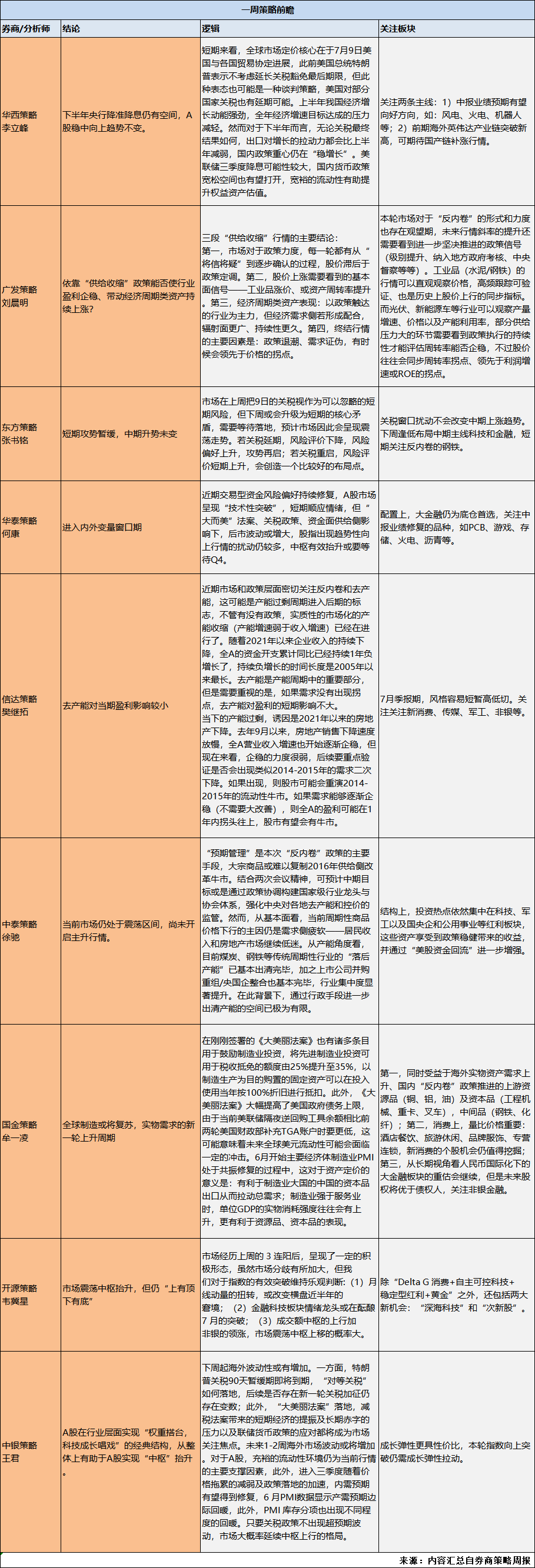
A股分析师前瞻:贸易协定进展是下周的关注焦点
Xuan Gu Bao· 2025-07-06 13:56
Group 1 - The focus of the brokerage strategy discussions this week is on the upcoming trade agreement progress and the sustainability of the "anti-involution" sector [1][2] - The Huaxi strategy team indicates that the core pricing in the global market is centered around the trade agreement progress on July 9, with potential tariff extensions being a negotiation tactic [1][3] - The A-share market is expected to maintain an upward trend, with two main lines of focus: positive mid-term performance expectations in sectors like wind power, thermal power, and robotics, and the potential for domestic chains to catch up following Nvidia's overseas breakthroughs [1][3] Group 2 - The Dongfang strategy team notes that the market previously viewed the July 9 tariff as a negligible short-term risk, but it may escalate into a core issue next week, leading to a volatile market [1][3] - The Zhongyin strategy team emphasizes that the current liquidity environment supports the market, and as the third quarter progresses, domestic demand expectations may improve if tariff policies do not experience unexpected fluctuations [1][3] - The Xuch team's analysis suggests that "expectation management" is a key tool in the "anti-involution" policy, with limited space for further capacity clearance in traditional cyclical industries like coal and steel due to already high industry concentration [2][4] Group 3 - The market is currently in a state of fluctuation, with the potential for increased volatility in the coming weeks due to the expiration of the 90-day tariff grace period and the implications of the "Great Beautiful Act" [5] - The overall sentiment in the A-share market is that the liquidity environment remains a primary support factor, with expectations for recovery in domestic demand as price pressures ease and policies are implemented [5] - The current cycle of capacity reduction is crucial, but its short-term impact on profitability may be limited if demand does not show signs of recovery [4][5]
纺织服饰周专题:服饰重点公司2025Q2业绩前瞻
GOLDEN SUN SECURITIES· 2025-07-06 12:15
Investment Rating - The report maintains a "Buy" rating for key companies in the textile and apparel sector, including Anta Sports, Bosideng, and Xtep International, among others [10]. Core Insights - The overall performance of the sportswear sector is stable, with a forecasted slowdown in revenue growth for Q2 2025 compared to Q1 2025 due to fluctuations in the consumer environment [1][4]. - The report emphasizes the importance of focusing on companies with strong fundamentals and quality, anticipating performance recovery and valuation increases in 2025 [4]. - The jewelry sector is experiencing significant disparities in performance among companies, influenced by high gold prices and varying consumer demand for gold jewelry [3][29]. Summary by Sections Sportswear Sector - The sportswear companies are expected to maintain a healthy inventory turnover ratio of around 5 as of the end of Q2 2025, despite a forecasted revenue growth slowdown [1][15]. - Anta Sports is projected to achieve over 10% revenue growth in H1 2025, while Li Ning's revenue is expected to remain flat with a 20% decline in net profit [1][18]. - Xtep International is anticipated to see a 5% revenue growth and a 10% increase in net profit for H1 2025 [1][19]. - 361 Degrees is expected to achieve a revenue growth of 10% to 15% and a similar increase in net profit for H1 2025 [1][19]. A-Share Brand Apparel - The A-share brand apparel sector is experiencing stable terminal retail performance, but individual company performance is diverging [2][20]. - Companies like Hailan Home are expected to see a revenue growth of 0% to 5% in Q2 2025, while Steady Medical is projected to grow by 15% to 25% [2][24]. - The report indicates that companies with healthy terminal performance and effective cost management may see year-on-year growth, while those struggling with revenue scale may face pressure [2][20]. Jewelry Sector - The jewelry sector is benefiting from rising gold prices, with retail sales of gold and silver jewelry expected to grow by 12.3% year-on-year in 2025 [3][29]. - Companies like Chow Tai Fook and Chao Hong Ji are highlighted for their strong product differentiation and market competitiveness, with Chow Tai Fook expected to see a 10% increase in operating profit year-on-year [7][29]. - However, companies like Lao Feng Xiang and Zhou Da Sheng are projected to experience revenue declines of 20% to 10% and 15% to 5%, respectively, due to fluctuating consumer demand [3][29]. Apparel Manufacturing - The apparel manufacturing sector is expected to see stable output in finished garments, while upstream textile manufacturing orders are affected by pessimistic expectations [3][6]. - Shenzhou International is projected to achieve a revenue growth of 10% to 15% in H1 2025, while Wei Xing Co. is expected to see a decline in both revenue and net profit by 10% to 15% [3][6]. - The report suggests that leading companies with integrated and international supply chains are likely to outperform the industry in the medium to long term [3][6].



珠宝美妆&纺服轻工行业2025年中期投资策略
2025-07-02 01:24
Summary of Key Points from the Conference Call Records Industry Overview Jewelry and Beauty Industry - The gold and jewelry industry is experiencing rapid growth in terminal sales, with a significant increase in demand for investment gold bars and coins, while the consumption of gold jewelry has declined year-on-year. [1][2] - High-end ancient gold and lightweight jewelry are becoming market hotspots, catering to the self-indulgent needs of the middle class and younger consumers. [1][4] - The cosmetics industry is seeing a slowdown in overall growth, with increased competition and the fading of e-commerce benefits. [1][13] Market Performance - In the first half of 2025, the gold and jewelry market performed strongly, with a retail sales growth rate exceeding 12% from January to May, significantly outpacing overall retail growth. [2] - Despite a general decline in terminal consumer demand, the demand for investment gold bars and coins has increased significantly, with gold jewelry consumption down 27% year-on-year in Q1 2025. [2] Company Performance Key Companies in Jewelry Sector - **Lao Pu Gold**: Exceeded expectations in store opening speed and saw an increase in profit margins due to product updates and revenue expansion. [6][7][8] - **Chow Tai Fook**: Achieved revenue growth through product upgrades and plans to open 20 new stores, with a focus on channel optimization. [9] - **Chao Hong Ji**: Attracted young consumers with trendy and high-end products, showing strong performance in Q1 2025. [10] - **Tai Bai Co.**: High proportion of investment gold products provides significant elasticity in the current market. [11] Cosmetics Sector - **Mao Ge Ping**: A high-end domestic makeup brand with strong product recognition and balanced online and offline channel development. [14][15] - **Shangmei Co.**: Showed strong growth during the 618 shopping festival, with significant increases in various product lines. [16] Sanitary Napkin and Oral Care Industry - The sanitary napkin industry faced short-term fluctuations due to public sentiment and promotional events, but Baia Co. is actively responding and expanding nationally. [17][18] - The oral care market remains stable, with rising demand for specialized products driving price increases. [18] Future Outlook Gold Price Expectations - Gold prices are expected to remain high in the second half of 2025, supported by geopolitical conflicts, safe-haven demand, and central bank purchases. [5] - Investment gold demand may cool down, but high-end ancient gold and lightweight jewelry are expected to continue growing. [5] Risks and Challenges - The furniture industry faces risks from potential real estate downturns, intensified price competition, and insufficient domestic demand leading to inventory buildup. [30][35] - The cosmetics industry is experiencing increased competition and a shift away from rapid growth, necessitating a focus on product development and operational capabilities. [13] Conclusion - The jewelry and beauty industries present significant investment opportunities, particularly in companies that are adapting to market changes and consumer preferences. [12]
轻工纺服行业周报:泡泡玛特popop珠宝品牌开业,持续关注板块催化-20250701
Shanghai Securities· 2025-07-01 11:18
Investment Rating - The industry investment rating is "Increase" (maintained) [4] Core Viewpoints - The light industry sector is experiencing rapid growth driven by the demand for trendy toys, with the Z generation leading new consumption trends. Products like blind boxes tap into deep emotional values. The integration of AI technologies with light manufacturing is expected to stabilize domestic demand and facilitate valuation recovery [2][3] - The recent opening of the first jewelry store by Pop Mart underlines its strategic expansion into the jewelry sector, enhancing its brand image and market presence [11] - The home appliance sector is set to benefit from government policies aimed at boosting consumption, with a focus on the "old for new" initiative, which is expected to stimulate demand further [9] Summary by Sections Market Review - During the week of June 23-27, 2025, the A-share SW textile and apparel industry index rose by 3.92%, while the light manufacturing industry increased by 3.64%. In comparison, the Shanghai Composite Index rose by 1.91% [1] Trendy Toy Sector - Pop Mart was recognized as one of the "100 Most Influential Companies" by Time magazine in 2025, marking a significant achievement for a Chinese trendy toy company. The opening of a flagship store in Hefei is expected to enhance its brand image and attract consumers [3][11] Export Chain - The demand for light industry exports, such as thermos cups and office furniture, remains stable, with expectations that tariff impacts will gradually diminish. Companies with proactive overseas capacity planning are recommended for investment [4][10] Home Appliance Sector - The government is set to release additional funds for the "old for new" consumption initiative in July 2025, which is expected to further stimulate home appliance demand [9] Sports and Outdoor Sector - The sports industry is becoming a significant driver of economic growth, with sustained consumer interest in outdoor apparel. Nike's recent financial performance indicates a recovery trend, particularly in the Chinese market [12][13] Textile Manufacturing - The textile and apparel sector has shown steady growth in both domestic and export markets, with a cumulative export of $116.67 billion from January to May 2025, reflecting a 1% year-on-year increase [14]
珠宝美妆、纺服轻工行业2025年中期投资策略:逢低布局产品结构化升级、运营提效的细分赛道龙头
CMS· 2025-06-28 08:29
Group 1: Gold and Jewelry - In H1 2025, gold prices surged, leading to a decline in gold jewelry consumption while investment gold consumption increased, continuing the trend from 2024 [13][17] - The report anticipates that in H2 2025, gold prices may fluctuate at high levels due to geopolitical conflicts and economic downturns, with central banks continuing to purchase gold [23] - Recommended companies include Laopuhuang, Chow Tai Fook, Chao Hong Ji, and Cai Bai Co., which are expected to benefit from the ongoing trends in gold consumption [23][24][26][30] Group 2: Cosmetics - The cosmetics market showed weak performance in H1 2025, with a cumulative year-on-year growth of 4.1% from January to May, lagging behind overall retail growth [32][35] - Long-term trends in the cosmetics industry remain focused on increasing penetration rates and domestic brand substitution, with a recommendation to focus on brands like Mao Ge Ping and Shangmei Co. for their strong performance and growth potential [35][36][42] - Mao Ge Ping is highlighted for its high-end positioning and significant growth in both online and offline channels, while Shangmei Co. has shown impressive performance during promotional events [36][42] Group 3: Personal Care - The personal care sector, particularly in sanitary napkins and oral care, is expected to maintain stable demand, with domestic brands leading the market [49][51] - The oral care segment is experiencing a shift towards higher-value products driven by consumer demand for efficacy, with domestic brands like Deng Kang Oral Care gaining market share [53][54] - Key companies to watch include Baiya Co. and Deng Kang Oral Care, which are well-positioned to capitalize on these trends [49][53] Group 4: Apparel and Footwear - The apparel retail sector showed moderate growth in H1 2025, with a year-on-year increase of 3.3% in retail sales from January to May [8][14] - Outdoor brands are performing exceptionally well, with high-end outdoor brands like Amer Sports and Anta showing significant revenue growth [8][15] - Recommended companies include Anta Sports for its strong outdoor brand growth and Mercury Home Textiles for its effective marketing strategies [15][16] Group 5: Textile Manufacturing - The textile manufacturing sector is witnessing a shift in export share towards Southeast Asia, with a notable decline in imports from China to the U.S. [8][18] - The report indicates that U.S. apparel imports from Southeast Asia are increasing, while imports from China are decreasing, suggesting a strategic shift in manufacturing locations [18][19] - Companies with diversified production capabilities across regions are recommended for investment consideration [18][19] Group 6: Home Furnishings - The home furnishings market is experiencing growth driven by government policies encouraging upgrades, with furniture retail sales in May 2025 showing a year-on-year increase of 25.6% [8][20] - Key players in the home furnishings sector include Gujia Home and Oppein Home, which are expected to benefit from the ongoing market trends [20][21]


纺织服装行业2025年中期投资策略:关注细分趋势下品牌机遇,把握业绩弹性制造企业
Minsheng Securities· 2025-06-10 00:23
Investment Rating - The report suggests a positive investment outlook for the textile and apparel industry, focusing on resilient brands and manufacturing companies with performance elasticity [1]. Core Insights - The textile and apparel sector has shown stable growth in retail consumption, with a notable increase in apparel sales, while textile manufacturing exports have displayed a mixed performance [2][4]. - The report highlights the importance of brand strength and market trends, particularly in the sportswear and outdoor segments, which are expected to perform well [3][46]. - The impact of international trade policies, particularly U.S. tariffs, continues to be a significant factor affecting the textile manufacturing sector [4]. Summary by Sections Section 1: Market Review - Retail sales in April 2025 showed a year-on-year growth of 5.1%, with apparel and footwear sales increasing by 2.2% [2][12]. - Textile exports from China decreased by 0.5% year-on-year in April 2025, underperforming compared to Vietnam and Bangladesh, which saw growth rates of 18.15% [2][15]. Section 2: Brand Apparel - The sportswear segment is highlighted for its resilience, with outdoor brands experiencing high demand. Key companies to watch include Anta Sports and Nike [3][46]. - Discount retail formats are rapidly emerging due to consumer demand for value, with companies like Hailan Home benefiting from this trend [3][46]. - Policies such as childcare subsidies are expected to stimulate consumption, benefiting companies like Luolai Life and Mercury Home Textiles [3][46]. Section 3: Textile Manufacturing - The report emphasizes the need to focus on companies with performance elasticity, recommending firms like Crystal International and Zhejiang Natural [4]. - The textile manufacturing sector is experiencing a shift towards increased market concentration, with leading companies such as Huayi Group and Shenzhou International being favored [4]. - The overall demand outlook remains cautious, with brands maintaining a conservative stance on consumer spending [4][19]. Section 4: Stock Performance - As of May 30, 2025, the A-share textile and apparel sector saw a slight increase of 1.87%, while the H-share sector rose by 8.7% [39]. - The report identifies top-performing stocks in both A-share and H-share markets, highlighting significant variances in performance among individual companies [35][39]. Section 5: Company Focus - Anta Sports is noted for its strong brand momentum and expansion into outdoor segments, with plans to increase international revenue [57]. - The report also highlights Tmall's potential for recovery due to improved inventory turnover and a focus on Nike brand sales [60].