债券

Search documents
央行:11月份债券市场共发行各类债券70179.3亿元
Zheng Quan Shi Bao Wang· 2025-12-31 09:56
Core Insights - The central point of the article is the performance of the bond market in November 2025, highlighting the total issuance and custody balances of various types of bonds [1] Group 1: Bond Issuance - In November, the total issuance of various bonds reached 70,179.3 billion yuan [1] - Government bonds issued amounted to 10,444.2 billion yuan, while local government bonds totaled 9,126.9 billion yuan [1] - Financial bonds issued were 11,955.0 billion yuan, and corporate credit bonds reached 13,948.8 billion yuan [1] - Credit asset-backed securities issued were 327.2 billion yuan, and interbank certificates of deposit issuance was 24,009.2 billion yuan [1] Group 2: Bond Custody Balances - As of the end of November, the total custody balance of the bond market was 196.3 trillion yuan [1] - The interbank market custody balance was 173.0 trillion yuan, while the exchange market custody balance was 23.2 trillion yuan [1] - By bond type, the custody balances were as follows: government bonds at 40.1 trillion yuan, local government bonds at 54.3 trillion yuan, financial bonds at 44.6 trillion yuan, corporate credit bonds at 34.8 trillion yuan, credit asset-backed securities at 1.0 trillion yuan, and interbank certificates of deposit at 20.3 trillion yuan [1] - The custody balance of commercial bank counter bonds was 2,740.7 billion yuan [1]
欧元区国债收益率反弹 欧元窄幅波动静候美联储纪要
Xin Lang Cai Jing· 2025-12-31 09:31
Group 1 - Eurozone government bond yields have slightly risen amid thin holiday trading, while the euro has experienced a minor decline [1] - The market is awaiting the release of the Federal Reserve's December meeting minutes at 19:00 GMT for insights on potential U.S. interest rate cuts in 2026 [1] - The euro has dropped by 0.15% to 1.1775 USD, influenced by a stronger dollar [1] Group 2 - Eurozone bond yields have rebounded, partially recovering from previous declines, with Spain's harmonized inflation rate easing slightly from 3.2% in November to 3.0% in December, supporting bond market performance [1] - The yield on Germany's 10-year government bonds increased by 2.5 basis points to 2.853%, while Spain's equivalent yield rose by 3.3 basis points to 3.283% [1]
10-year Treasury yield dips as investors await final economic data of 2025
CNBC· 2025-12-31 09:23
Core Viewpoint - The U.S. 10-year Treasury yield has slightly decreased as investors are awaiting economic data and assessing the market ahead of the New Year [1] Group 1: Treasury Yields - The yield on the 10-year Treasury dipped by 2 basis points to 4.108% [1] - The yield on the 2-year Treasury was last seen more than 1 basis point lower at 3.442% [1] - Yields and prices move in opposite directions, with one basis point equating to 0.01% [1]


债市日报:12月31日
Xin Hua Cai Jing· 2025-12-31 07:32
Core Viewpoint - The bond market ended weakly on the last trading day of 2025, with government bond futures declining across the board and interbank bond yields rising by approximately 1 basis point. The liquidity situation is expected to improve after the year-end, with a focus on economic performance in early 2026 and potential inflation data around the Spring Festival. The monetary policy is likely to remain neutral, while issues regarding demand for long-term and ultra-long-term bonds need to be addressed, but yield levels, spreads, and term spreads are expected to remain stable [1]. Market Performance - Government bond futures closed lower, with the 30-year main contract down 0.35% at 111.41, the 10-year main contract down 0.07% at 107.86, the 5-year main contract down 0.04% at 105.76, and the 2-year main contract down 0.03% at 102.454 [2]. - Interbank bond yields generally rose, with the 30-year government bond yield increasing by 1.5 basis points to 2.2775%, the 10-year policy bank bond yield rising by 0.15 basis points to 1.9505%, and the 7-year government bond yield up by 1.05 basis points to 1.738% [2]. Liquidity and Funding - The central bank announced a 7-day reverse repurchase operation of 5288 billion yuan at a fixed rate of 1.40%, with a net injection of 5028 billion yuan for the day after accounting for maturing reverse repos [4]. - Short-term Shibor rates rose across the board, with the overnight rate up by 8.0 basis points to 1.327%, the 7-day rate up by 36.7 basis points to 1.956%, the 14-day rate up by 8.2 basis points to 1.951%, and the 1-month rate up by 0.3 basis points to 1.588% [4]. Economic Indicators - According to the National Bureau of Statistics, the manufacturing purchasing managers' index (PMI) for December was 50.1%, the non-manufacturing business activity index was 50.2%, and the composite PMI output index was 50.7%, all showing an increase from the previous month and indicating an overall recovery in economic sentiment [5]. Institutional Insights - CITIC Securities anticipates a moderate growth in government bond supply in 2026, with concentrated net supply pressure expected in the second quarter. New general bond issuance is expected to maintain a slow pace, while new special bond issuance may peak towards the end of the second quarter [6]. - Huatai Fixed Income notes that the bond market adjustment is primarily driven by trading factors and medium-term supply-demand concerns, with market sentiment appearing fragile. The first quarter of 2026 is expected to see a "volatile and weak" market [6]. - China International Capital Corporation (CICC) suggests that demand for credit bonds may remain stable, with expectations of continued growth in demand post-year-end due to financial products and the "opening red" period, despite fluctuations in government bond yields [7].
2026固收年报:锚定下移,震荡趋稳
LIANCHU SECURITIES· 2025-12-31 07:29
Report Industry Investment Rating There is no information about the report industry investment rating in the provided content. Core Viewpoints of the Report - 2025 was a transformative year for the bond market, with yield trends shifting from a unilateral decline to narrow - range fluctuations, trading strategies evolving, market scale expanding, and asset correlations changing [3][15]. - In 2026, China's economy will feature "internal improvement, external stability, and structural optimization", with GDP growth target around 5%. Monetary policy will remain "moderately loose", and fiscal policy will be "actively expansionary" [4][5]. - The bond market in 2026 will see a positive supply trend, with institutional behavior showing "stable but changing allocation and contracting and differentiating trading". The relationship between stocks and bonds will shift from a "see - saw" to a "re - balanced" state [7][8][9]. Summary According to the Table of Contents 1. 2025 Bond Market Review - **Yield Trend**: Yields shifted from a unilateral decline to narrow - range fluctuations, with a pattern of "rising - falling - rising - fluctuating" for long - term yields and short - term yields anchored around policy rates [15][16]. - **Bond Products**: The bond market became a core financing channel for economic transformation, with a high - stock, fast - expanding, and government - bond - concentrated structure [18]. - **Trading Strategy**: Financial institutions' trading strategies shifted from "trend trading" to a "coupon + band" composite strategy, with commercial banks and insurance institutions as the main holders of interest - rate bonds and brokers and overseas institutions increasing market volatility [23]. - **Asset Linkage**: The traditional linkage between treasury bond yields and traditional assets (A - shares, US stocks, gold) was broken, showing "three reversals" [29]. 2. Fundamentals: Internal Improvement, Gradual Progress - **GDP Growth Target**: In 2025, the GDP growth target of 5% was basically achieved, with a "high - then - low" pattern. In 2026, the target may remain around 5% [37][38]. - **Consumption Growth**: In 2025, consumption momentum slowed and there was a clear trend of consumption downgrade. In 2026, consumption will moderately recover, but factors such as policy support, income, and balance - sheet repair will limit the improvement [41][42]. - **Investment Growth**: In 2025, investment growth turned negative, showing a "high - then - low" trend. In 2026, investment is expected to stop falling and stabilize, with infrastructure and manufacturing investment as the core driving forces, and the decline in real - estate investment will narrow slightly [44][45][47]. - **Export Growth**: In 2025, exports showed strong resilience. In 2026, export growth is expected to remain stable, supported by factors such as diversified trade markets, upgraded export product structures, and enterprise overseas investment [52][53]. - **Price Movement**: In 2025, prices rebounded at a low level. In 2026, CPI will moderately recover, PPI's decline will narrow, and the GDP deflator is expected to gradually recover but may still be in the negative range [59]. 3. Policy Front: Moderately Loose Monetary Policy, Actively Expansionary Fiscal Policy - **Monetary Policy**: In 2025, monetary policy was moderately loose and operation became more refined. In 2026, it will continue the "moderately loose" tone, focusing on precise measures and cross - cycle balance, with policy tools transforming from quantity - based to price - based [62][63]. - **Fiscal Policy**: In 2025, fiscal policy was significantly expansionary, with a higher deficit rate. In 2026, it will continue the "actively expansionary" main line, with characteristics of "stable total growth, optimized structure, and front - loaded rhythm" [68]. 4. Bond Supply: Scale Expansion and Structural Optimization - **2025**: The supply of interest - rate bonds increased significantly, with government bonds leading the expansion and a front - loaded fiscal leverage rhythm [75]. - **2026**: The bond market supply will be positive, featuring "scale expansion, front - loaded rhythm, investment in new areas, and longer terms", with the government bond scale expected to reach a record high [76]. 5. Institutional Behavior: Stable but Changing Allocation, Contracting and Differentiating Trading - **Allocation Disk**: Commercial banks' bond allocation will increase steadily, with a shift towards the medium - and short - term. Insurance institutions' demand for bond allocation may weaken, and there will be a re - balance between stocks and bonds [84][85]. - **Trading Disk**: The trading disk's allocation of interest - rate bonds will contract overall, with internal differentiation and more cautious strategies [86]. 6. Equity Disturbance: From "Strong Stocks, Weak Bonds" to "Stock - Bond Re - balance" - **2025**: The stock - bond relationship was mainly "strong stocks, weak bonds", with the strength of the equity market suppressing the bond market [95]. - **2026**: The equity market is likely to continue to recover, and the stock - bond relationship will shift from a "see - saw" to a "re - balanced" state, with the squeezing effect on the bond market weakening [99]. 7. Capital Price: Continued Loose Capital, Marginally Increased Volatility - **2025**: Capital prices showed a downward trend with converging volatility, with the central bank guiding the centralization of capital prices and suppressing short - term fluctuations [102]. - **2026**: Capital prices are expected to show a double - feature of "systematically downward centralization and magnified periodic volatility", with the central bank relying on multiple tools to maintain stability [103]. 8. Outlook for Major Asset Trends - **Treasury Bonds**: Yields may show a "quasi - inverted V" pattern, with an expected range of 1.6% - 1.9% for the 10 - year treasury bond yield [109][111]. - **A - shares**: The equity market is likely to show a pattern of "shock - strengthening and structural differentiation", focusing on new - quality productivity [112]. - **US Stocks**: US stocks will continue to rise with technology leading, but the upward slope may slow down, and there is a risk of valuation bubbles [113]. - **US Bonds**: US bond yields will show a downward - centralization and steepening curve, but supply pressure and inflation resilience will limit the downward space [114]. - **Gold**: Gold prices will likely remain high, fluctuating upwards, but the upward momentum may slow down [115].
迷雾中酝酿曙光——1月债券策略
Huafu Securities· 2025-12-31 04:54
Group 1 - The bond market in December remained in a volatile state, influenced by institutional behavior and concerns over potential risks in Q1, including government bond issuance and credit expansion impacts on bank credit [2][17] - The supply-demand imbalance for ultra-long bonds is a significant concern, with the issuance of super-long government bonds increasing substantially in recent years, particularly in 2025 [3][21] - The central economic work conference indicated that the fiscal deficit rate may remain at 4% in 2026, with only a slight expansion in government bond supply compared to 2025, despite concerns about the capacity of institutions to absorb large-scale local bond issuances [4][22] Group 2 - A total of 20 regions have announced their Q1 issuance plans, amounting to 1.688 trillion yuan, which is higher than the actual issuance in Q1 2025, indicating a more optimistic outlook for 2026 [4][23] - The anticipated net financing for government bonds in January, February, and March 2026 is estimated at 1.29 trillion, 0.86 trillion, and 1.25 trillion yuan respectively, totaling approximately 3.4 trillion yuan for the quarter, which is lower than the 4.1 trillion yuan in the same period of 2025 [35][32] - The central bank's monetary policy has shifted towards maintaining liquidity support, with a significant probability of a reserve requirement ratio cut in January, which could alleviate uncertainties regarding bank liabilities [6][60] Group 3 - The market is currently facing uncertainty regarding the impact of new public fund regulations, which aim to reshape the industry ecosystem without causing significant short-term disruptions [9][10] - Despite the ongoing concerns about credit expansion and its effects on bank liabilities, the central bank's recent statements suggest a more cautious approach to credit growth, potentially leading to a more stable liquidity environment [43][57] - The bond market may see opportunities for long-term bonds if extreme market fears do not materialize, with a focus on 3-5 year government bonds and perpetual bonds [10][8]
美国债市“高光时刻”难复制? 降息路径模糊叠加财政刺激 2026总回报或降档
智通财经网· 2025-12-31 03:48
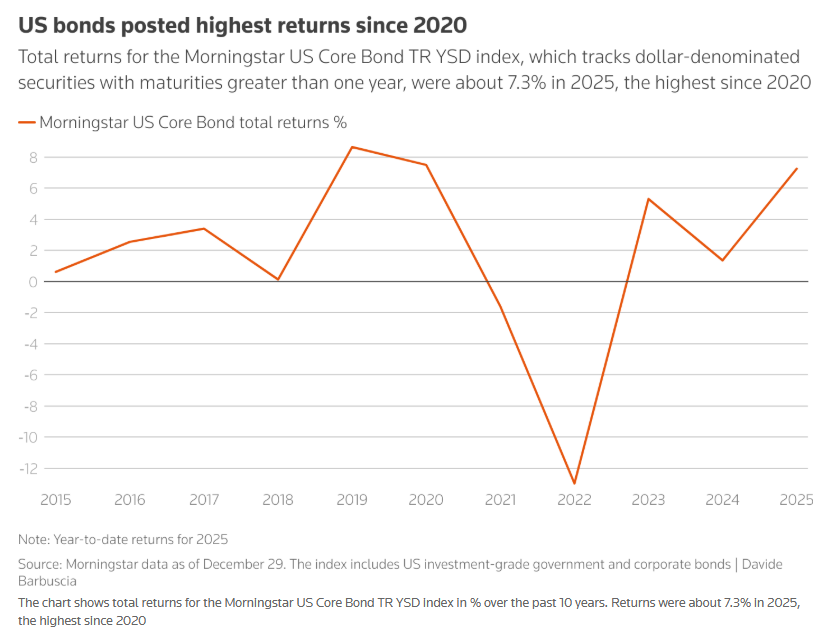
Group 1 - The U.S. bond market, including high-rated corporate bonds, is expected to face a more challenging environment in 2026 due to a potential slowdown in interest rate cuts by the Federal Reserve and the impact of fiscal stimulus measures from the Trump administration [1][6] - In 2025, the Federal Reserve's interest rate cuts, totaling 75 basis points, significantly boosted U.S. Treasury prices, leading to a strong performance in the bond market, with a total investment return of approximately 7.3%, the best since 2020 [2][5] - Market consensus suggests that total investment returns in 2026 may not match the strong performance of 2025, with expectations of smaller rate cuts and increased uncertainty regarding the Fed's actions [5][11] Group 2 - The yield on the benchmark 10-year U.S. Treasury bond has dropped over 40 basis points this year, currently around 4.1%, influenced by the Fed's rate cuts and global market dynamics [8][11] - The investment-grade corporate bond credit spread remains around 80 basis points, close to its lowest level since 1998, indicating a stable market despite potential future volatility [12][15] - Predictions for 2026 suggest that the credit spread for investment-grade corporate bonds may widen to 110 basis points, driven by increased issuance from U.S. tech companies, while total returns for high-rated bonds are expected to decline to around 3% [15][16] Group 3 - Concerns are rising regarding the credit risk of high-rated corporate bonds, particularly in the context of the AI investment boom, with some analysts predicting that these bonds may be subject to significant selling pressure [16][17] - Major tech companies, including Amazon and Oracle, are planning substantial debt issuances to fund AI infrastructure projects, raising concerns about their financial stability and potential default risks [17][18] - The market is witnessing a shift in credit risk perception, with Oracle's credit default swap spreads nearly doubling, indicating heightened concerns over its creditworthiness amid significant debt financing [17][18]

债市早报:2026年“两新”政策出炉;跨年资金成本继续上升,债市情绪有所修复
Jin Rong Jie· 2025-12-31 02:42
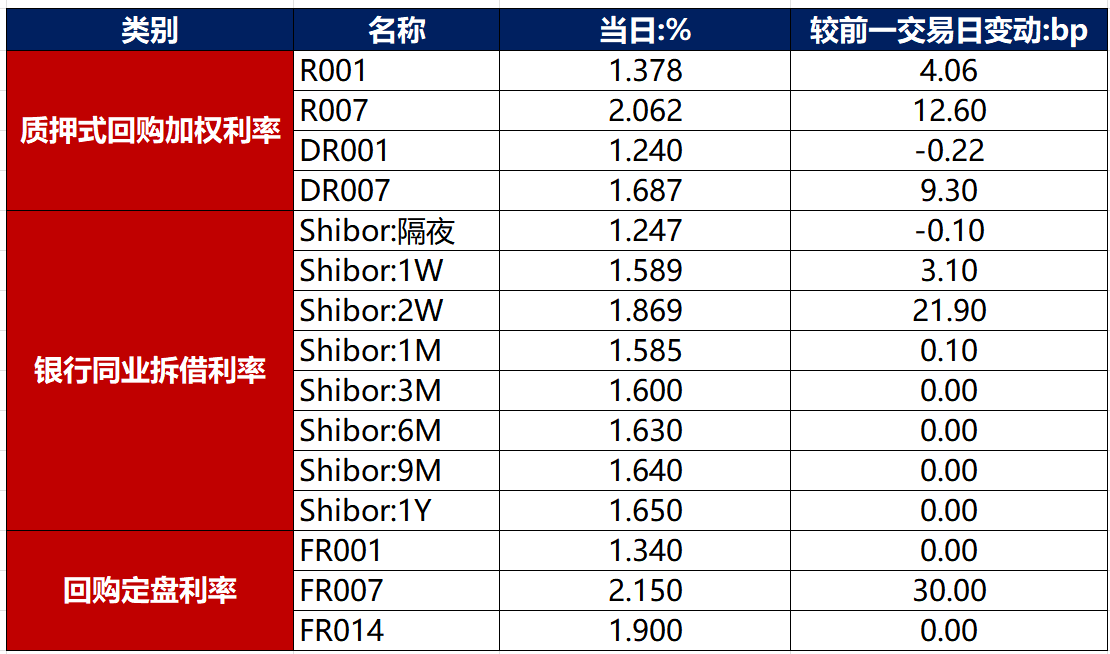
Group 1: Domestic News - The Ministry of Finance and the State Taxation Administration announced a reduction in the value-added tax on the sale of personal housing purchased for less than two years to 3%, effective from January 1, 2026 [2] - The National Development and Reform Commission and the Ministry of Finance released a notice regarding the "Two New" policy for 2026, optimizing the support scope, subsidy standards, and implementation mechanisms for large-scale equipment updates and consumer goods replacement [2] Group 2: Fiscal Oversight - The Ministry of Finance emphasized the need for effective supervision of local government debt and fiscal revenue, focusing on key regulatory tasks such as special long-term bonds and financial discipline [3] Group 3: International News - The Federal Reserve's December meeting minutes indicated that most officials expect further interest rate cuts if inflation trends align with their expectations, although some advocate for a pause in rate cuts [4] - The minutes noted that inflation has risen since the beginning of the year and remains high, with economic activity expanding at a moderate pace [4] Group 4: Commodity Market - International crude oil futures prices declined slightly, with WTI February futures down 0.22% to $57.95 per barrel, while COMEX gold futures rebounded by 0.43% to $4362.20 per ounce [5] Group 5: Financial Market - On December 30, the central bank conducted a reverse repurchase operation of 312.5 billion yuan at a fixed rate, resulting in a net cash injection of 253.2 billion yuan for the day [6] - Despite the central bank's cash injection, the funding costs continued to rise, with DR007 increasing by 9.30 basis points to 1.687% [7] Group 6: Bond Market Dynamics - The sentiment in the bond market improved, with long-term bonds recovering, while medium and short-term bonds remained weak [9] - The yield on the 10-year government bond rose by 0.20 basis points to 1.8600% [9] Group 7: Credit Bonds - CIFI Holdings announced that its debt restructuring plan, which includes cash recovery and debt-to-equity swaps, has taken effect, reducing approximately 43 billion yuan of debt [11] - Country Garden confirmed the effective date of its offshore debt restructuring as December 30 [11] Group 8: Convertible Bonds - The convertible bond market saw major indices rise, with the China Securities Convertible Bond Index increasing by 0.14% [14] - The trading volume in the convertible bond market reached 83.05 billion yuan, an increase of 4.96 billion yuan from the previous trading day [14]
地方债供给预测指南:从总量到节奏
INDUSTRIAL SECURITIES· 2025-12-31 01:39
1. Report Industry Investment Rating No relevant content provided. 2. Core Viewpoints of the Report - The net financing amount of local government bonds in 2026 is expected to rise overall compared to 2025, with preliminary forecasts of approximately 7.28 trillion, 7.66 trillion, and 8.04 trillion yuan under conservative, neutral, and optimistic scenarios respectively [1][16]. - The issuance rhythm of replacement bonds in Q1 2026 is expected to remain front - loaded, and the issuance rhythm of new special bonds may be faster than that in 2025 [4][34]. - The net financing amount of local government bonds in January 2026 is expected to be 649.9 billion yuan, with the issuance rhythm likely to be faster year - on - year, and the supply pressure in the second half of January is relatively large [4][41]. 3. Summary by Relevant Catalogs 3.1 2026 Local Government Bond Net Supply Estimation - **New Bonds**: The issuance scale mainly depends on the budget deficit ratio determined by the National People's Congress and the Chinese People's Political Consultative Conference in March each year, the distribution of central and local fiscal deficits, and the new special bond quota. As of the end of 2025, there is still an estimated 1.16 trillion yuan of space between the local government debt limit and the balance. The preliminary forecasts of the new bond issuance scale in 2026 under conservative, neutral, and optimistic scenarios are approximately 5.43 trillion, 5.72 trillion, and 6.00 trillion yuan respectively [2][8][10]. - **Special Refinancing Bonds**: The quota is arranged as needed. Referring to the 2025 level, the preliminary forecasts of the special refinancing bond issuance scale in 2026 under conservative, neutral, and optimistic scenarios are approximately 2.3 trillion, 2.4 trillion, and 2.5 trillion yuan respectively [2][15]. - **Net Repayment of Matured Local Government Bonds**: From 2021 to 2025, the average refinancing ratio of matured local government bonds was about 87.4%. Based on this ratio, the net repayment scale of matured local government bonds in 2026 is estimated to be about 456.1 billion yuan [2][16]. 3.2 How to Anticipate the Rhythm of Local Government Bond Net Supply Early? - **One - week - ahead Forecast**: Relatively accurate local government bond net supply data can be obtained 5 working days before issuance. Provincial financial departments are required to disclose key information such as the issuance scale and term at least 5 working days before the issuance of new general bonds, new special bonds, and refinancing bonds [21]. - **Monthly 21st Forecast**: On the 21st of each month, a preliminary judgment on the next - month's ten - day supply can be made. However, in practice, there are differences in information disclosure timeliness, issuance plan adjustments, and deviations between actual execution and plans. Subsequent forecasts can be dynamically revised by combining information such as national debt supply, local government bond quarterly issuance plans, local government bond limits, and local government bond weekly issuance data [22][23][29]. 3.3 Q1 2026 and January 2026 Local Government Bond Net Supply Forecast - **Policy Review and Outlook**: In Q1 2025, replacement bonds were issued intensively, and the issuance progress of new special bonds was lower than expected. In Q1 2026, it is expected that replacement bonds will maintain a front - loaded issuance trend, and the issuance rhythm of new special bonds may be faster [30][34]. - **Q1 2026 Local Government Bond Issuance Forecast**: As of December 28, 2025, the planned issuance total for Q1 2026 was about 1.75 trillion yuan. Assuming the same ratio as in 2025Q1, the actual issuance in 2026Q1 is expected to be 1.79 trillion yuan, with a corresponding net financing amount of 1.12 trillion yuan. The issuance term in 2026Q1 has no obvious pattern due to a small sample size [35][38]. - **January 2026 Local Government Bond Net Supply Forecast**: The net financing amount of local government bonds in January 2026 is expected to be 649.9 billion yuan, a year - on - year increase of 173.8 billion yuan. The supply pressure in the second half of January is relatively large. The issuance rhythm in January 2026 is likely to be faster than in the same period of 2025 [41][43]. - **Summary**: The issuance rhythm of local government bonds in January 2026 is expected to be significantly faster year - on - year. The planned issuance scale in 2026Q1 has decreased significantly year - on - year, but this is mainly due to incomplete disclosure of provincial and municipal issuance plans, so the year - on - year change has limited reference value [48].
欠中国的钱越来越少,美国却越来越焦虑了!美媒:17年来最低
Sou Hu Cai Jing· 2025-12-30 19:36
Core Viewpoint - China's holdings of US Treasury bonds have decreased significantly, dropping to $688.7 billion in October, a reduction of $11.8 billion from September, marking the lowest level since 2008, raising concerns about the stability of the US debt market [2][4][5] Group 1: China's Actions - China has been diversifying its foreign exchange reserves since 2019, reducing its reliance on US Treasury bonds to manage risks associated with currency depreciation and geopolitical tensions [5][7] - The recent reduction in US Treasury holdings is a strategic move by China to avoid overexposure to a single asset class, reflecting a long-term plan rather than a reactionary measure [2][5][8] Group 2: Global Implications - The decrease in China's holdings has led to a slight overall decline in foreign ownership of US Treasury bonds, which fell by $5.8 billion to approximately $9.24 trillion in October, indicating potential instability in the US debt market [4][6] - Japan and the UK have increased their holdings of US Treasury bonds, with Japan adding $10.7 billion and the UK $13.2 billion, suggesting a shift towards a more localized support system for US debt amid concerns over broader foreign investment [4][5] Group 3: Market Reactions - The media has reacted strongly to China's reduction in Treasury holdings, with reports highlighting the potential risks to US fiscal stability and the implications for borrowing costs if other countries follow suit [2][4][8] - The volatility in the US debt market is expected to increase following China's actions, as investor confidence shifts from blind faith to a more cautious approach, impacting the overall financing environment for the US government [7][8]