
医药

Search documents
兴证策略:如何看待本轮开门红的结构与延续性?
Xin Lang Cai Jing· 2026-01-11 10:28
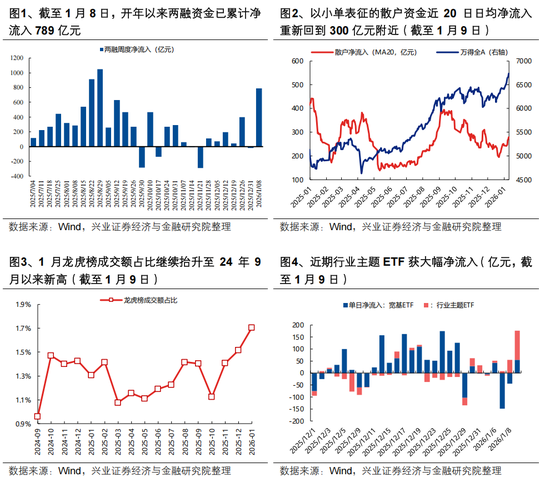
Group 1 - The current market rally, referred to as "开门红," is supported by improving macroeconomic data and ample liquidity, which enhances market risk appetite and attracts new capital inflows [1][9][40] - Various types of trading funds have shown accelerated entry into the market, including a net inflow of 78.9 billion yuan in margin financing since the beginning of the year and an average daily net inflow of retail funds returning to around 30 billion yuan [1][9][40] - The structural consensus among different types of funds is strong, focusing on sectors such as TMT (storage, AI applications), military (commercial aerospace), non-ferrous metals, new energy (controlled nuclear fusion), machinery (robots), and pharmaceuticals (innovative drugs, brain-machine interfaces) [2][35][38] Group 2 - The global stock market is experiencing a strong start in 2026, driven by expectations of loose liquidity, geopolitical changes, and emerging industrial trends, with A-shares reflecting this global narrative [5][38] - Key events such as the International Consumer Electronics Show (CES) and geopolitical developments are catalyzing themes in the market, enhancing the strategic value of resource products and driving structural similarities across global markets [5][38] - The market is currently in a favorable position with limited downside risk and significant potential for upward movement, supported by improved PMI and price data, as well as a high percentage of stocks still below their previous highs [11][44] Group 3 - The recent surge in the commercial aerospace sector has raised concerns about its current crowding and sustainability, with trading volume indicating a potential for further upward movement [16][51] - As the earnings forecast disclosure period approaches, the correlation between stock prices and earnings will increase, necessitating a focus on structural adjustments based on performance [21][57] - Industries with significant upward revisions in profit forecasts since November include technology (consumer electronics, computing), advanced manufacturing (new energy, military), and cyclical sectors (building materials, non-ferrous metals) [26][58]

策略周报:或有波动,但风险可控-20260111
Bank of China Securities· 2026-01-11 08:22
中银国际证券股份有限公司 具备证券投资咨询业务资格 策略研究 证券分析师:王君 (8610)66229061 jun.wang@bocichina.com 证券投资咨询业务证书编号:S1300519060003 证券分析师:徐沛东 (8621)20328702 peidong.xu@bocichina.com 证券投资咨询业务证书编号:S1300518020001 证券分析师:郭晓希 (8610)66229019 xiaoxi.guo@bocichina.com 证券投资咨询业务证书编号:S1300521110001 证券分析师:徐亚 (8621)20328506 ya.xu@bocichina.com 证券投资咨询业务证书编号:S1300521070003 证券分析师:高天然 | 观点回顾 4 | | --- | | 大势与风格 5 | | 中观行业与景气 7 | | 一周市场总览、组合表现及热点追踪 9 | | 风险提示 10 | tianran.gao@bocichina.com 证券投资咨询业务证书编号:S1300522100001 策略研究 | 证券研究报告 — 总量周报 2026 年 1 月 11 ...
去年12月发布回购预案公司数量环比增近六成,行业龙头领衔大额回购
Mei Ri Jing Ji Xin Wen· 2026-01-11 05:41
Group 1 - In December 2025, the enthusiasm for stock buybacks in the A-share market significantly increased, with both the number of companies announcing buyback plans and the total amount seeing substantial growth [1] - A total of 35 companies announced new buyback plans in December, representing an increase of nearly 60% compared to 22 companies in November [1] - The total proposed buyback amount for these 35 companies reached approximately 10.548 billion yuan, a 54.89% increase from 6.81 billion yuan in November [1] - Among these companies, 24 planned to buy back over 100 million yuan, accounting for 68.57% of the total [1] Group 2 - State-owned enterprises and industry leaders showed prominent performance in the buyback announcements, with notable companies like China Metallurgical Group and Dong'e Ejiao participating [1] - The companies with the highest proposed buyback amounts included China Metallurgical Group (2.5 billion yuan), Luxshare Precision (2 billion yuan), ZTE Corporation (1.2 billion yuan), and others, highlighting the financial strength and market responsibility of leading enterprises [1]




吉林发改委党组书记李平:高标准推进长春现代化都市圈建设
Xin Lang Cai Jing· 2026-01-11 04:50
Core Viewpoint - The construction of the Changchun Modern Urban Circle aims to enhance the city's radiating effect, promote urban integration, and serve as a driving force for high-quality development in Jilin Province and revitalization in Northeast China [1] Group 1: Urban Circle Development - The Changchun Modern Urban Circle, centered around Changchun City, includes Jilin City, Siping City, and Liaoyuan City, covering an area of approximately 29,700 square kilometers with a resident population of about 12.1 million [1] - The "Changchun Urban Circle Development Plan" was officially issued in October 2025, marking the transition from planning to implementation [1] Group 2: Industrial Collaboration - The urban circle will leverage its industrial foundation and educational resources to enhance industrial layout and collaborative systems, focusing on sectors like automotive, equipment manufacturing, green food, and fine chemicals [2] - A collaborative model will be established where R&D headquarters are in Changchun, manufacturing occurs within the circle, and innovation results are transformed and applied locally [2] Group 3: Infrastructure Connectivity - Key projects will be initiated in transportation, energy, water resources, and information sectors to improve connectivity and resource flow within the urban circle [3] - A comprehensive transportation network will be developed, including high-speed rail, highways, and aviation, alongside a robust energy and water resource system [3] Group 4: Public Services - The province aims to create a public service system that is equitable, high-quality, and regionally shared, focusing on education, healthcare, and employment security [4] - The goal is to ensure that the benefits of urban circle development are distributed fairly among the population [4] Group 5: Open Cooperation - The urban circle will promote industrial collaboration, transportation linkage, and innovation synergy with other cities in the province, creating five cooperative development zones [5] - New channels and platforms for open cooperation will be established with other provinces in Northeast China, enhancing the region's openness [5]
申万宏源服务业投资机会梳理专题报告:中国服务业含“科”量持续提升-20260110
Shenwan Hongyuan Securities· 2026-01-10 14:55
Group 1 - The report highlights that the service industry is increasingly merging with technology, leading to the emergence of top-tier listed companies in sectors such as fintech, logistics, enterprise services, and healthcare [2][10] - Countries are exploring unique paths to develop their service industries, with examples including the U.S. focusing on fintech innovation, Germany emphasizing industrial design, and Singapore building digital infrastructure [2][10] - China's national strategy aims to enhance service industry capacity and quality through targeted policies, including the removal of entry barriers in key sectors like telecommunications and healthcare [2][39] Group 2 - The report identifies three main investment directions in the service industry: productive services, lifestyle services, and emerging services [2][45] - Productive services are seen as a core engine, with sectors like testing, industrial software, and financial services highlighted for their growth potential [2][3][45] - Lifestyle services are focused on improving living standards and consumption upgrades, with high growth observed in areas such as gaming, aviation, and tourism [3][45] Group 3 - Emerging services are positioned as key to cultivating new productive forces, with rapid developments in AI and the integration of healthcare and pharmaceutical services [4][45] - The report emphasizes the importance of cross-border e-commerce as a new growth driver for foreign trade, leveraging China's supply chain advantages [4][45] - Specific companies such as Cintas and CVS Health are cited as examples of successful service firms in the U.S., showcasing effective business models and market strategies [1][15][18]
华金证券:春季行情主升时行业如何轮动?
Zhi Tong Cai Jing· 2026-01-10 11:27
Core Viewpoint - The current spring market is expected to favor technology growth and certain cyclical industries, with commercial aerospace and brain-computer interfaces emerging as key investment themes for the season [1][5]. Group 1: Spring Market Trends - The main phase of the spring market may witness a rebound, with industries benefiting from positive policies and trends likely to perform strongly [2]. - Historical data indicates that during the main phase of the spring market, sectors with low valuation sentiment and significant inflows of financing tend to experience a rebound [2]. - Industries such as communication, social services, and beauty care have shown strong performance during previous spring market phases due to favorable policies and industry trends [2]. Group 2: Technology and Cyclical Industries - Technology growth sectors like media, computing, and pharmaceuticals are expected to rebound in the upcoming spring market due to low valuations and sentiment [3]. - Supportive policies for technology growth and cyclical industries are likely to continue, with initiatives in commercial aerospace and artificial intelligence being implemented [3]. - The upward trend in industries related to commercial aerospace and artificial intelligence is anticipated to persist in the short term [3]. Group 3: Economic and Liquidity Outlook - The economy is expected to continue its weak recovery, with profit growth likely to rebound, as indicated by the rising PPI year-on-year growth [4]. - Macro liquidity is projected to further loosen, with potential interest rate cuts from the Federal Reserve and domestic central banks [4]. - Risk appetite in the market may continue to improve due to the implementation of positive policies and limited overseas risks [4]. Group 4: Investment Strategy - The focus should remain on technology growth and cyclical growth sectors, as theme indices typically outperform primary industry indices during the main phase of the spring market [5]. - Commercial aerospace and brain-computer interfaces are highlighted as key investment themes, with the space economy projected to reach $1.8 trillion by 2035 [5]. - Industries such as military (commercial aerospace), new energy (nuclear fusion, energy storage), media (AI applications, gaming), and computing (AI applications, brain-computer interfaces) are recommended for low-cost allocation [5].
春季行情主升时行业如何轮动?
Huajin Securities· 2026-01-10 11:19
Group 1: Market Trends - The spring market's main rising phase may see a rebound in growth sectors, particularly those with low valuation sentiment and significant future financing inflows[1] - Historical data shows that during the main rising phases, the Shanghai Composite Index has increased by approximately 4% to 22%, averaging around 19 trading days[10] - Key sectors that performed well during previous main rising phases include media, electronics, and non-ferrous metals, which experienced substantial financing inflows[1] Group 2: Sector Performance - In the current spring market, technology growth sectors such as media, computing, and pharmaceuticals are expected to rebound due to low valuations and sentiment[2] - Financing inflows since December 17, 2025, have been significant in sectors like electronics, non-ferrous metals, and defense, driven by ongoing industry trends[18] - The main rising phase typically sees theme indices outperforming primary industry indices, with notable gains in sectors like integrated circuits and digital marketing[42] Group 3: Economic Indicators - Short-term economic recovery remains weak, with CPI growth recorded at 0.8% and PPI at -1.9%, indicating a gradual improvement in industrial profitability[23] - The short-term liquidity environment is expected to loosen further, with potential interest rate cuts from the Federal Reserve and domestic central bank actions[31] - Risk appetite is likely to increase due to positive policy implementations and limited overseas risks, such as the anticipated Fed rate cut[38]
港股投资周报:物科技领涨,港股精选组合本周相对恒指超额4.12%-20260110
Guoxin Securities· 2026-01-10 08:27
Quantitative Models and Construction Methods 1. Model Name: Hong Kong Stock Selection Portfolio - **Model Construction Idea**: The model aims to select stocks with both fundamental support and technical resonance from an analyst-recommended stock pool[14][15] - **Model Construction Process**: - **Step 1**: Construct an analyst-recommended stock pool based on three types of analyst recommendation events: upward earnings forecast revisions, initial analyst coverage, and analyst report titles exceeding expectations[15] - **Step 2**: Perform dual-layer selection on the analyst-recommended stock pool using fundamental and technical dimensions to select stocks with both fundamental support and technical resonance[15] - **Step 3**: The backtest period for the Hong Kong Stock Selection Portfolio is from January 1, 2010, to December 31, 2025. Considering transaction costs in a fully invested state, the portfolio's annualized return is 19.08%, with an excess return of 18.06% relative to the Hang Seng Index[15] - **Model Evaluation**: The model demonstrates a strong performance with significant excess returns over the Hang Seng Index, indicating its effectiveness in stock selection[15] Model Backtest Results - **Hong Kong Stock Selection Portfolio**: - **Annualized Return**: 19.08%[15] - **Excess Return**: 18.06% relative to the Hang Seng Index[15] - **Information Ratio (IR)**: 1.19[20] - **Tracking Error**: 14.60%[20] - **Maximum Drawdown**: 23.73%[20] - **Return-to-Drawdown Ratio**: 0.76[20] Quantitative Factors and Construction Methods 1. Factor Name: Stable New High Stocks - **Factor Construction Idea**: The factor aims to identify stocks that have recently reached new highs and exhibit stable price paths, leveraging the momentum and trend-following strategies that are particularly effective in the Hong Kong market[21] - **Factor Construction Process**: - **Step 1**: Calculate the 250-day new high distance using the formula: $$ 250 \text{ day new high distance} = 1 - \frac{Close_t}{\text{ts\_max(Close, 250)}} $$ where $Close_t$ is the latest closing price, and $\text{ts\_max(Close, 250)}$ is the maximum closing price over the past 250 trading days[23] - **Step 2**: Screen stocks that have reached a 250-day new high in the past 20 trading days based on analyst attention, relative stock strength, price path stability, and new high continuity[23] - **Step 3**: Select stocks with the following criteria: - Analyst attention: At least 5 buy or hold ratings in the past 6 months - Relative stock strength: Top 20% in terms of price change over the past 250 days - Price path stability: Top 50% based on price displacement ratio and 250-day new high distance over the past 120 days - Trend continuity: Top 50 stocks based on the 250-day new high distance over the past 5 days[24] - **Factor Evaluation**: The factor effectively captures stocks with strong momentum and stable price paths, which are likely to continue their upward trends[21][23] Factor Backtest Results - **Stable New High Stocks**: - **Example Stocks**: J&T Express-W, China Eastern Airlines, Youran Dairy, Hansoh Pharmaceutical, China XLX Fertilizer, etc.[23][29] - **Sector Distribution**: Most new high stocks are in the cyclical sector, followed by finance, technology, consumer, manufacturing, and healthcare sectors[23][29]
LP周报丨20+20,北京朝阳一口气发了两只基金
投中网· 2026-01-10 07:07
Core Insights - The article highlights the significant investment activities and developments in the LP market, particularly focusing on the growth of funds in the Chaoyang District of Beijing and other regions, emphasizing the importance of capital in fostering innovation and technology-driven industries [5][6][13]. Investment Activities - Chaoyang District has established a robust ecosystem for high-tech enterprises, with 3,649 national high-tech companies and 25 unicorns projected by mid-2025 [5]. - Two new RMB funds, each with a scale of 2 billion yuan, have been launched to invest in AI, advanced manufacturing, and biopharmaceuticals [6][13]. - Huaye Tiancheng's fifth fund raised 1.76 billion yuan, exceeding its initial target of 1.5 billion yuan, with a high market-oriented capital ratio of 80% [8]. - Lakesun Capital's new fund focused on AI and semiconductor industries raised 400 million yuan [9]. - Dongfang Jiafu's sub-fund for small and medium enterprises successfully completed a first close of 1.6 billion yuan, targeting advanced manufacturing and life sciences [10]. - Warburg Pincus raised 3 billion USD for its financial sector fund, exceeding its initial target by 20% [11]. Fund Establishments - The establishment of the Xi'an Semiconductor Industry Development Fund with a capital of 1 billion yuan aims to leverage Xi'an's technological advantages in the semiconductor sector [15]. - The AIC equity investment fund in Xi'an, with a scale of 1 billion yuan, focuses on high-end equipment manufacturing [17]. - The Huazhong Medical Industry Fund, with a scale of 1 billion yuan, targets chemical innovation drugs and high-end medical devices [23]. - The establishment of the "Laoshan Science and Technology Innovation Mother Fund" with a total scale of 3 billion yuan aims to support emerging industries in Qingdao [20]. GP Recruitment - Zhejiang's special merger and acquisition fund is seeking GP partners to enhance its investment ecosystem, focusing on new-generation information technology and advanced manufacturing [27]. - The Shanxi Jinchuang Technology Innovation Fund is recruiting GP partners to support strategic emerging industries in the province [28].
港股IPO放量的影响与高效打新策略-华泰证券
Sou Hu Cai Jing· 2026-01-10 01:35
Group 1 - The Hong Kong IPO market has significantly rebounded in 2025, with 99 companies listed by December 12, raising over 250 billion HKD, accounting for 67% of the total fundraising for Chinese stocks, marking a 10-year high [1][18][20] - The IPO success rate in Hong Kong reached 73% in 2025, with an apparent return rate of 34%, both significantly higher than previous years, although the average one-hand winning rate dropped to 20%, the lowest in nearly a decade [1][20][22] - Looking ahead to 2026, the IPO financing in Hong Kong is expected to remain active, with 314 listing applications currently in processing, and the Hang Seng Index having increased by over 30% in 2025, which historically correlates with a more than 30% explanation of the following year's IPO activity [1][23][28] Group 2 - Key characteristics of the Hong Kong IPO market include a low listing rate of 37% since 2016 despite the registration system, no market capitalization requirements for IPO participation, and a significantly higher winning rate compared to A-shares [2][41][45] - The relationship between primary market financing and secondary market performance is weakly positive, driven by common factors such as a weak US dollar and low Hibor rates, with IPO financing typically representing a small proportion of market capitalization and trading volume, limiting the "liquidity extraction effect" [2][8][72] - Historical data shows that large IPOs tend to have a 56% probability of strengthening the Hang Seng Index post-listing, with consumer discretionary and technology sector IPOs providing some uplift to their respective sectors [9][77][79] Group 3 - A multi-dimensional screening model for selecting IPOs can enhance returns, with a scoring system based on market sentiment, company fundamentals, and issuance characteristics, indicating that selecting stocks with scores above 2.5 can improve returns by approximately 15 percentage points [10][31][41] - The performance of IPOs varies significantly across sectors, with consumer goods, non-ferrous metals, and pharmaceuticals showing strong performance, while sectors like home appliances and oil and petrochemicals lag behind [10][49]

