
电力设备

Search documents
电力设备行业2026年投资策略:国内电改与海外需求共振,风电电网迎来高质量发展
Hua Yuan Zheng Quan· 2026-02-08 13:35
Group 1 - The power industry is expected to achieve high-quality development as it enters a year of comprehensive marketization, driven by the "dual carbon" strategy and accelerated reforms in the electricity system [3][7][8] - The electricity market reform is set to fully unfold in the 15th Five-Year Plan, with significant policies introduced in the final year of the 14th Five-Year Plan that will have far-reaching impacts [3][11][12] - The core idea of the electricity reform is to reflect the different values of power sources (energy value, capacity value, adjustment value, and clean value) in market pricing, which has been historically dominated by energy value due to the predominance of coal power [8][10] Group 2 - The reform is expected to accelerate the construction of ultra-high voltage (UHV) and distribution networks, with UHV construction likely to speed up again as green electricity demand rises [3][16][24] - The investment in distribution networks has been low, with a continuous decline in the investment ratio, but this is expected to change as the demand for reliable power supply increases [28][34][41] - The introduction of capacity pricing for UHV and distribution networks is anticipated to stabilize project returns and promote the development of related projects [26][41] Group 3 - The surge in AI investments is projected to significantly increase electricity demand in the U.S., with OpenAI planning to deploy over 250GW of computing power by 2033, which could lead to a substantial electricity shortfall [45][49] - The U.S. electricity demand has been stagnant, but projections indicate that by 2030, peak load could approach 1000GW, driven largely by data centers [49][51] - The anticipated increase in electricity demand from AI investments presents a significant opportunity for companies involved in power generation and distribution [45][49] Group 4 - The profitability of wind turbine manufacturers is expected to improve, with domestic companies accelerating their international expansion as domestic bidding volumes remain high and prices trend upward [3][4] - Companies such as Goldwind Technology, Yunda Co., Mingyang Smart Energy, and Sany Heavy Industry are recommended for investment due to their competitive advantages in cost and market position [3][4]



震荡波动呈现收敛,新股板块向上活跃周期或依然在途
Huajin Securities· 2026-02-08 11:05
Group 1 - The new stock sector is showing signs of convergence in volatility, indicating that an upward active cycle may still be on the way [1][12] - The average increase of new stocks listed since 2025 is approximately 0.0%, with about 33.3% of new stocks achieving positive returns, an improvement from the previous week's 13.8% [12][29] - Structural highlights are emerging, particularly in sectors like photovoltaic and commercial aerospace, suggesting a potential rebound in active momentum [2][12] Group 2 - The average issuance price-to-earnings ratio for new stocks in February is 15.3X for the main board, significantly down from 23.9X in the previous month [13] - The average first-day closing price-to-earnings ratio for new stocks in February is 31.5X, a notable decrease from 58.9X in the previous month [17] - The first-day average increase for new stocks in February is 106.2%, down from 133.1% in the previous month, indicating a cooling in trading enthusiasm [20] Group 3 - Upcoming new stocks include Ai De Technology, Electric Science and Technology Blue Sky, and Linping Development, with varying industry focuses [4][35] - The expected issuance price-to-earnings ratio for new stocks pending listing is 57.1X for the science and technology board and 18.7X for the main board, indicating a slight increase in valuation [7][35] - The report suggests monitoring high-profile new stocks for potential differentiated performance due to rising industry theme heat [35][36] Group 4 - The report highlights specific stocks to watch, including Tongyu New Materials, Fengbei Biological, and He Yuan Biological-U, which are expected to perform well in the current market environment [46] - For mid-term investments, stocks like Jun Ding Da, Mai Jia Xin Cai, and Si Kan Technology are recommended for potential investment opportunities [46]
佛山又一企业冲刺港股IPO,将是第四家 “A+H” 双上市公司!
Sou Hu Cai Jing· 2026-02-08 09:36
Core Viewpoint - Igor Electric Co., Ltd., a leading Chinese power equipment company, is accelerating its international expansion by applying for a listing on the Hong Kong Stock Exchange, aiming to enhance its global presence and brand influence in the context of rapid energy transition and surging AI computing demand [1][3]. Group 1: Company Overview - Igor Electric has over 20 years of experience in the power equipment sector and is recognized as a global champion in providing power equipment and solutions [3]. - The company focuses on transformer equipment and operates in five high-growth sectors: renewable energy, data centers, industrial control, distribution, and lighting [3]. - Igor Electric has established 14 production bases across Asia, Europe, and America, along with five R&D centers, ensuring its products reach global markets [3]. Group 2: Financial Performance - In the first three quarters of 2025, Igor Electric reported a revenue of 3.808 billion yuan, representing a year-on-year growth of 17.41% [5]. - The demand for data center-related products surged, with orders increasing by over 400% year-on-year, reaching a historical high due to the release of North American production capacity and the explosion of AI data center needs [5]. Group 3: Listing and Future Plans - The funds raised from the Hong Kong listing will be allocated to expanding production at the Mexican factory (500 units of new energy transformers per month), the Texas factory in the U.S. (annual capacity of 21,000 distribution transformers), and a storage power station in Uzbekistan (70 million USD) [7]. - The listing is a strategic move to integrate global resources, enhance brand international influence, and lay the foundation for future expansion in the North American market [7]. - Igor Electric's internationalization reflects the broader trend of manufacturing companies in Foshan leveraging capital markets to achieve technological, brand, and market upgrades, contributing to the city's economic openness and high-quality development [7].


A股策略周报:节前博弈与长期布局如何权衡?-20260208
Ping An Securities· 2026-02-08 08:50
Core Viewpoints - The A-share market experienced fluctuations and adjustments last week, with small-cap stocks outperforming. The overall market sentiment declined due to sensitivity to labor market data and underwhelming earnings guidance from tech companies, leading to a 1.3% drop in the Shanghai Composite Index and a larger decline in the ChiNext Index, while the micro-cap index rose by 1.9% [2][11] - The U.S. manufacturing PMI returned to the expansion zone, while geopolitical tensions in the Middle East remain uncertain. The U.S. economy shows resilience, with the ISM manufacturing PMI rising significantly by 4.7 percentage points to 52.6% in January, although employment growth has not yet rebounded [2][3] - Domestic developments include high-level talks between China and Russia, as well as between China and the U.S., aimed at enhancing practical cooperation. The Chinese government is emphasizing proactive macroeconomic policies and has tightened regulations on virtual currencies [2][3] Recent Dynamics - The market calendar effect typically shows a balanced style before the Spring Festival, with small-cap growth stocks outperforming afterward. Historical data indicates that the average returns for major indices during the week before and after the festival are positive, with probabilities of positive returns ranging from 55% to 90% [2][3] - The report highlights that 18 out of 31 sectors achieved positive returns last week, with food and beverage, beauty care, and electric equipment sectors leading the gains, while sectors like non-ferrous metals and telecommunications saw significant declines [10][11] Market Performance - The A-share market saw a decrease in average daily trading volume to 2.41 trillion yuan, a 21.43% decline week-on-week. The financing balance also slightly decreased to 2.66 trillion yuan, with a net outflow of 5.62 billion yuan from equity ETFs [11][14] - The performance of major indices showed the Shanghai Composite Index down by 1.27%, the ChiNext Index down by 3.28%, and the STAR 50 Index down by 5.76%. In contrast, the micro-cap index saw a slight decline of 0.34% [11][14] Focus Areas - The report suggests focusing on sectors that may benefit from domestic demand recovery and technological upgrades, including technology growth sectors (TMT/innovative pharmaceuticals), advanced manufacturing sectors (new energy/military), and cyclical sectors (chemicals/non-ferrous metals/building materials) [2][3] - The report emphasizes the importance of aligning investment strategies with the long-term reform expectations under the "14th Five-Year Plan" and improving fundamentals [2][3]
转债周策略20260208:当前市场环境下的转债投资思路
Guolian Minsheng Securities· 2026-02-08 05:59
Group 1 - The current stock market is in a high volatility phase, while convertible bond valuations are at historically high levels. The proportion of convertible bond holdings by public funds has increased, indicating a shift in asset allocation towards convertible bonds and other equity assets due to high expectations in the stock market and a scarcity of assets in the bond market [1][12] - The medium to long-term outlook suggests that economic recovery and industrial structural upgrades will continue, with the stock market expected to maintain a trend of oscillating upward in 2026. Convertible bond valuations are supported by allocation demand, although the potential for further increases is limited [1][12] Group 2 - The investment strategy for convertible bonds should adopt a "winning probability" mindset, recognizing that different industries will experience varying degrees of prosperity. Public funds possess strong fundamental research capabilities, allowing them to actively price convertible bonds linked to improving fundamentals. High premium rates on some convertible bonds may still yield strong excess returns if the underlying stocks are in high-growth sectors [2][13] - Caution is advised regarding specific types of convertible bonds with excessively high premium rates, particularly those with less than six months remaining until maturity and those that may trigger early redemption clauses. These bonds face risks of rapid premium compression due to their contractual limitations [2][13] Group 3 - The weekly performance of the convertible bond index showed a slight increase of 0.05%, with certain sectors like food and beverage, beauty care, and electric equipment performing well. The median price of convertible bonds across various parity ranges has risen, indicating that valuations remain at relatively high historical levels [3][17] - The influx of incremental capital into the market is expected to continue, with a likely "spring excitement" rally at the beginning of the year, focusing on technology and high-end manufacturing investment opportunities. The chemical sector is anticipated to see improvements in demand, with well-structured supply and demand dynamics in certain sub-sectors expected to perform well [3][17] Group 4 - Suggested focus areas for convertible bonds include: (1) the rising demand for overseas computing power and the acceleration of AI industrialization driven by domestic model iterations, with recommendations for bonds from companies like Ruike and Qizhong; (2) high-end manufacturing is expected to remain strong, with recommendations for bonds from companies like Yake, Daimei, Huachen, Yubang, and Tairui; (3) the "anti-involution" trend may optimize supply and demand patterns in certain industries, with a recommendation for bonds from Youfa [4][18]
行业景气度跟踪报告(2026年2月):涨价品种出现分化,券商景气度高增
ZHESHANG SECURITIES· 2026-02-08 04:25
Upstream Sector - In the upstream cyclical products, there is a price divergence, with only gold prices rising while silver and other industrial metals have declined[1] - The PPI for coal mining and washing has improved, with a year-on-year growth of -8.9% in December, up from -11.80% in November[41] - Brent crude oil prices have decreased by 6.2% to $66.30 per barrel, while WTI crude oil prices fell by 4.7% to $62.14 per barrel[15] Midstream Sector - In the steel sector, iron ore and rebar prices have increased week-on-week, with rebar prices at 3,002 RMB per ton, up 1.6%[16] - The chemical products price index has decreased by 0.9% week-on-week, indicating a downward trend in major chemical product prices[16] - The shipping industry is experiencing a decline, with the Baltic Dry Index down by 5.6%[16] TMT Sector - The semiconductor sales cycle is on the rise, with a year-on-year growth of 22.9% in China[17] - The software industry has seen a cumulative profit growth of 7.3% year-on-year[17] - The film box office revenue in China has decreased by 69.11% year-on-year, indicating a significant drop in the media sector[17] Downstream Consumption - The price of Feitian Moutai has increased, supporting the strength of the liquor market[19] - The number of breeding sows in China has decreased by 2.9% year-on-year, indicating a decline in the agricultural sector[19] - The retail sales of consumer goods in December have shown a year-on-year decline of 0.9%[19] Financial and Real Estate Sector - The cumulative year-on-year decline in China's commercial housing sales area is 8.7%[20] - The cumulative year-on-year decline in real estate development investment is 17.2%[20] - The total trading volume in the two markets has increased, with the margin financing balance remaining high, indicating a robust brokerage environment[20]
金融产品周报:海外市场流动性有企稳迹象,情绪或会好转
Soochow Securities· 2026-02-08 03:24
Fund Size Statistics - The top three equity ETF types by fund size change are: Scale Index ETF (¥15.406 billion), Cross-border Industry Index ETF (¥6.624 billion), and Strategy Index ETF (¥5.384 billion) [9] - The bottom three equity ETF types by fund size change are: Theme Index ETF (-¥26.004 billion), Cross-border Scale Index ETF (-¥1.807 billion), and Cross-border Theme Index ETF (¥0.203 billion) [9] - The top three equity ETF products by fund size change are: CSI 500 ETF (¥2.832 billion), Chemical ETF (¥2.386 billion), and HuShen 300 ETF (¥2.229 billion) [9] - The bottom three equity ETF products by fund size change are: Communication ETF (-¥30.885 billion), Non-ferrous Metals ETF (-¥3.932 billion), and Gold Stock ETF (-¥2.963 billion) [13] Market Outlook - The macro timing model for February 2026 has a score of 0, indicating a historical 78.57% probability of the full A index rising in the following month, with an average increase of 3.37% [23] - A-shares are expected to experience a short-term volatile market, influenced by liquidity from overseas markets and the recent AI bubble discussions affecting tech growth stocks [23] - The recommendation is to adopt a balanced ETF allocation strategy due to the anticipated short-term fluctuations in the market [60]
中国企业全球化与出海系列一:越世界,越中国
Sou Hu Cai Jing· 2026-02-08 02:58
Group 1 - The core viewpoint of the article is that Chinese enterprises are entering an accelerated phase of going global, which is essential for the transformation and upgrading of a manufacturing country and reflects the shift in China's economic development model [1][6]. - The transition from a GDP-driven, investment-focused model to a GNI-driven, innovation-focused model is highlighted, emphasizing the need for companies to integrate global resources to enhance production efficiency and global competitiveness [1][6]. - Chinese companies are moving into the 2.0 era of going global, transitioning from product exports to a systematic approach that includes "capacity + brand + channel," aiming for high-value segments of the industrial chain [1][6]. Group 2 - The article notes that the global easing cycle and the upturn in overseas industrial and infrastructure capital expenditure provide unexpected resilience in external demand for Chinese companies [2][6]. - Emerging markets are experiencing rapid industrialization and urbanization, leading to explosive demand for infrastructure and production equipment, while developed markets are driven by green transformation and AI infrastructure needs [2][6]. - Chinese companies are encouraged to focus on three main lines for overseas expansion: capital goods (electric power equipment, engineering machinery), high-value components (communication equipment, innovative pharmaceuticals), and consumer goods (two-wheeled vehicles, gaming) [2][6]. Group 3 - The article emphasizes that the essence of going global for Chinese enterprises is to occupy high-value segments of the industrial chain, which is a key stage in the economic transformation of a manufacturing country [6][7]. - The competitive advantages of Chinese companies in capital and technology-intensive industries, such as electric power equipment and engineering machinery, are highlighted, along with the resilience of exports under tariff pressures [6][7]. - The overseas gross profit margins of non-financial listed Chinese companies have consistently exceeded domestic margins, particularly in sectors like engineering machinery and automotive components [1][6].

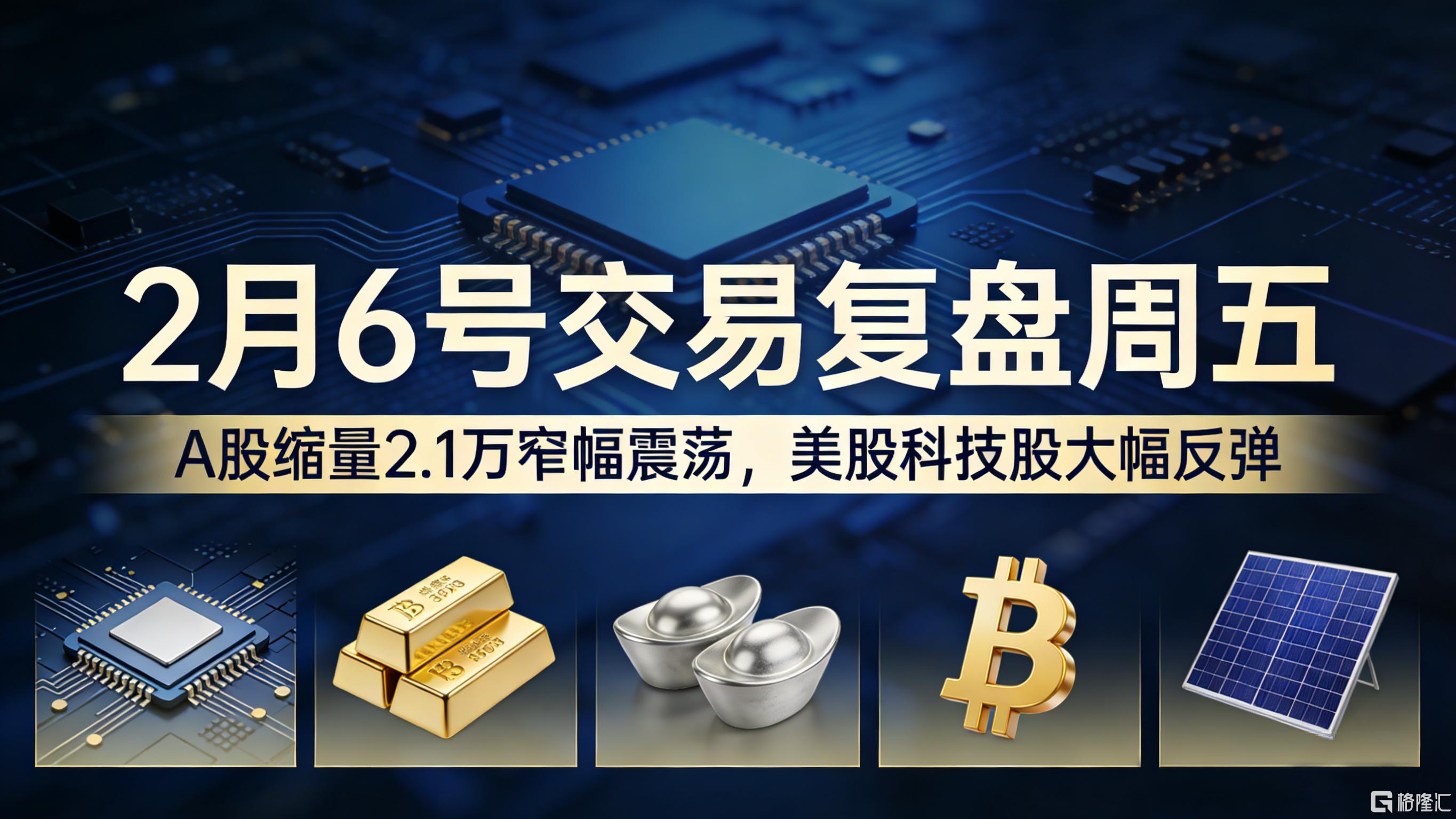
2月6号交易复盘周五——A股缩量2.1万窄幅震荡,美股科技股大幅反弹
Ge Long Hui· 2026-02-07 21:31
Group 1 - A-shares continued to shrink to 2.1 trillion, with northbound capital inflow of 10.2 billion, and the Shanghai Composite Index experienced two consecutive weekly declines, indicating ongoing market adjustments [1] - Major US tech stocks reported strong earnings but faced significant declines, raising concerns about their capital expenditure plans for 2026, which affected A-share semiconductor stocks, leading to a rebound in SMIC [1] - The latest high-performing stocks include consumer sector stocks like Hangzhou Jiexin and Huangting International, while the photovoltaic sector is supported by GCL-Poly Energy, indicating a rotation in market focus [1] Group 2 - The high volatility in the futures market for gold and silver led to widespread liquidation among retail investors, with significant losses for speculators, while some capital players reportedly profited immensely from this downturn [2] - Silver prices plummeted from 121 to 64 USD, a drop of 40%, while gold fell from 5596 to 4393 USD, a maximum decline of 21%, resulting in substantial wealth loss for investors [2] - Despite the volatility, there was a rebound in tech stocks and precious metals on Friday, suggesting a potential for a more stable market environment moving forward [2]
策略周专题(2026年2月第1期):坚守布局,持股过节
EBSCN· 2026-02-07 08:56
Group 1 - The A-share market experienced fluctuations and adjustments, with major indices generally declining, particularly the ChiNext and CSI 500, while the Shanghai 50 and SME 100 saw smaller declines. The current valuation of the Sci-Tech 50 and Wind All A indices is relatively high, with their PE(TTM) percentile above 90% since 2010 as of February 6, 2026 [1][11][14] - The report highlights a positive outlook for the upcoming spring market, suggesting that favorable policies and fundamental factors may emerge in the coming months. However, a short-term correction is anticipated before the Spring Festival due to tightening liquidity and reduced trading enthusiasm among investors [3][25] - The report emphasizes the importance of maintaining positions during the holiday period, as historical data indicates that the market tends to perform well in the 20 trading days following the Spring Festival [3][31] Group 2 - Key industries to focus on include electronics, power equipment, machinery, non-ferrous metals, communications, and computers, which are expected to show growth and independent prosperity in February. The report suggests that investors should pay attention to these sectors [4][34][35] - The report identifies short-term investment opportunities in the "price increase" theme, particularly in chemical raw materials and petroleum and petrochemical sectors, while recommending a mid-term strategy to accumulate positions in the metals sector after it stabilizes [4][35] - The report notes that the second-hand housing market in several key cities showed signs of recovery in January, with significant year-on-year increases in transaction volumes, indicating a potential rebound in the real estate sector [21][22]