
非银金融

Search documents
港股投资价值深度解析:价值趋合理 稀缺资产成关注焦点
Zhong Guo Zheng Quan Bao· 2025-12-02 20:22
Market Overview - As of November 28, 2025, the Hong Kong Stock Exchange has 2,664 listed companies with a total market capitalization of approximately HKD 48 trillion [1] - The Hang Seng Index and the Hang Seng Tech Index have increased by 29% and 25% respectively this year, indicating significant market rotation [2][3] - The overall valuation of Hong Kong stocks is currently within a reasonable range, with a focus on scarce assets such as internet leaders and innovative pharmaceuticals [1][8] Market Structure - The market is characterized by a high concentration of value in large-cap companies, with 65% of companies having a market cap of HKD 0-20 billion, but only accounting for 1.80% of the total market capitalization [2] - Institutional investors dominate trading, contributing 85% of the transaction volume, with international investors making up 60% of the market [1][2] Valuation Insights - The AH premium index is currently at 121, which is historically low, indicating that Hong Kong stocks are not significantly overvalued nor is there substantial room for valuation recovery [3] - The valuation of the Hang Seng Index is at a historically high level compared to the CSI 300, while the Hang Seng Tech Index remains relatively low in absolute valuation terms [3] Asset Highlights - Key scarce assets in the Hong Kong market include internet leaders, innovative pharmaceuticals, new consumption, and dividend stocks, while high-end manufacturing is relatively weak [4][7] - Internet leaders like Tencent and Alibaba are seen as core highlights, with significant capital expenditures and a strong user ecosystem [4][5] - The innovative pharmaceutical sector is viewed as a "first-tier market" with a higher "innovation content" compared to A-shares, benefiting from favorable listing rules for biotech companies [5][6] Investment Dynamics - The investor structure is increasingly international, with a notable inflow of southbound funds, which have reached a cumulative net inflow of HKD 13,820 billion this year, a 90% increase year-on-year [7][8] - Despite the presence of quality assets, the market has passed the high-return investment phase, and the uncertainty of incremental capital inflows suggests a mixed outlook for future market performance [8]



博格是止疼药~2025年12月2日 市场温度
Sou Hu Cai Jing· 2025-12-02 18:35
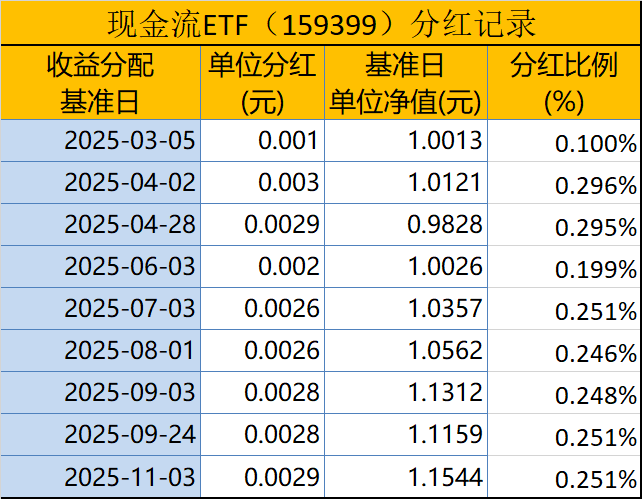
Group 1 - The cash flow ETF has shown a significant increase in performance, with a growth rate of 15.96% since its launch, compared to the 4.95% increase of the CSI Dividend Index [4] - The cash flow ETF's assets have grown from 1.6 billion units at launch to nearly 3.9 billion units, indicating increasing investor interest [4] - The cash flow ETF tracks the FTSE China A-Share Free Cash Flow Focus Index, which currently has a price-to-earnings (P/E) ratio of less than 14 times, suggesting it is undervalued [4] Group 2 - The innovation drug sector in Hong Kong is highlighted as having better value compared to A-shares, with leading companies concentrated in Hong Kong due to earlier listings [8] - The innovation drug sector has seen significant valuation adjustments this year, placing it in a reasonable range for future recovery [8] - The industry fundamentals are strong, with improved profitability for listed companies and ongoing policy support for innovation [8][9] Group 3 - The Hang Seng Technology Index is currently valued at around 20 times P/E, presenting a compelling investment opportunity [8] - The report suggests that the market is likely to experience a period of "boring" fluctuations without significant movements, advising investors to hold core positions [8] - The report emphasizes the importance of active management in the innovation drug sector, as internal differentiation may lead to better returns than simply tracking the index [10]

深度 | 股票型ETF全解析
Xin Lang Cai Jing· 2025-12-02 11:45
Overview of Stock ETFs - The number of stock ETFs in China reached 1,040 with a total scale of 3.70 trillion yuan as of September 2025, which is 2.53 times that of 2023 [3][7] - Stock ETFs have surpassed the scale of actively managed funds, reaching 1.2 times their size [8] - Stock ETFs can be categorized into five types: broad-based index ETFs, industry index ETFs, thematic index ETFs, strategy index ETFs, and style index ETFs [3][16] Characteristics of Different Types of Stock ETFs - Broad-based index ETFs dominate the market, accounting for 67.61% of the total scale, with significant institutional investor participation [4][20] - Industry index ETFs show significant scale concentration, particularly in the non-bank financial sector, which accounts for nearly 40% of the total scale [40] - Thematic index ETFs are numerous but have a more dispersed scale, providing a wide range of investment options for hot themes [4][57] - Strategy and style index ETFs primarily focus on stable dividend products, with ongoing improvements in the index system [4][72] Performance Analysis of Stock ETFs - In various market conditions, stock ETFs have shown the ability to provide optimal choices, with broad-based ETFs offering stability during market downturns [4][27] - In a bullish market, thematic ETFs related to semiconductors and AI have provided aggressive investment options [4][32] - The performance of broad-based index ETFs is characterized by their ability to capture the overall market trend, while thematic ETFs exhibit higher volatility and responsiveness to market sentiment [4][65] Market Expansion and Future Outlook - The rapid expansion of stock ETFs in China indicates a growing acceptance among both institutional and individual investors, with significant room for future growth [5][7] - The increasing participation of institutional investors in broad-based index ETFs reflects a preference for stable and diversified investment strategies [20][34]
两融周报|融资净买入额超过113亿元
Xin Lang Cai Jing· 2025-12-02 11:44
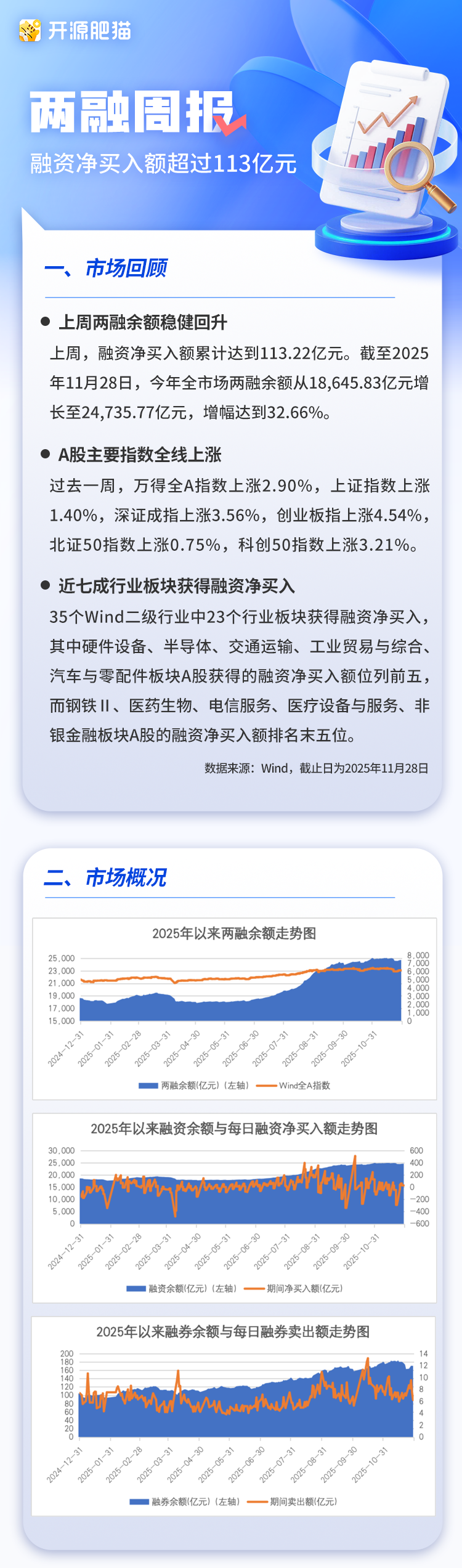
Core Viewpoint - The automotive and parts sector in A-shares has seen significant net buying in financing, ranking among the top five, while sectors such as steel II, pharmaceuticals, telecommunications services, medical devices, and non-bank financials have ranked among the bottom five in net buying [24]. Market Overview - As of November 28, 2025, the financing net buying amounts for various sectors have shown a clear disparity, with 23 out of 35 Wind secondary industry sectors experiencing net buying [24][25]. - The major indices in A-shares have all risen, with the Wind All A Index increasing by 2.90%, the Shanghai Composite Index by 1.40%, the Shenzhen Component Index by 3.56%, the ChiNext Index by 4.54%, the North 50 Index by 0.75%, and the Sci-Tech 50 Index by 3.21% [23]. Financing Net Buying Rankings - The top five sectors for net buying in the past week include: - Industrial Trade and Comprehensive: 94.90 billion - Semiconductor: 33.84 billion - Automotive and Parts: 7.81 billion - Hardware Equipment: 6.82 billion - Transportation: 6.57 billion [31] - The bottom five sectors for net buying in the past week include: - Medical Devices and Services: -1.31 billion - Steel II: -1.99 billion - Pharmaceuticals: -3.89 billion - Telecommunications Services: -4.90 billion - Non-Bank Financials: -24.50 billion [32]. Financing Balance Rankings - The top five sectors by financing balance are: - Hardware Equipment: 3,446.36 billion - Non-Bank Financials: 1,827.97 billion - Semiconductors: 1,800.99 billion - Electrical Equipment: 1,791.24 billion - Software Services: 1,500.74 billion [33].
12月2日深证国企股东回报R(470064)指数跌0.36%,成份股洋河股份(002304)领跌
Sou Hu Cai Jing· 2025-12-02 11:00
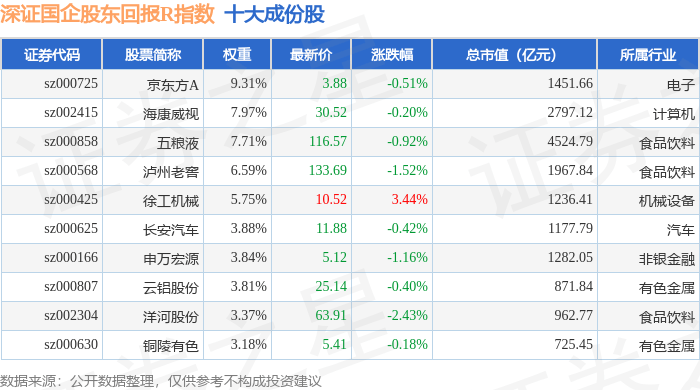
Core Points - The Shenzhen State-Owned Enterprises Shareholder Return Index (470064) closed at 2227.58 points, down 0.36%, with a trading volume of 18.448 billion yuan and a turnover rate of 0.74% [1] - Among the index constituents, 18 stocks rose while 31 stocks fell, with XCMG Machinery leading the gainers at 3.44% and Yanghe Brewery leading the decliners at 2.43% [1] Group 1: Index Performance - The Shenzhen State-Owned Enterprises Shareholder Return Index reported a decline of 0.36% on the trading day [1] - The total trading volume for the index was 18.448 billion yuan, indicating a relatively low turnover rate of 0.74% [1] Group 2: Stock Performance - The top-performing stock was XCMG Machinery, which increased by 3.44% [1] - The worst-performing stock was Yanghe Brewery, which decreased by 2.43% [1] - The index's top ten constituents included major companies such as BOE Technology Group, Hikvision, and Wuliangye, with varying weightings and market capitalizations [1] Group 3: Capital Flow - The index constituents experienced a net outflow of 769 million yuan from institutional investors, while retail investors saw a net inflow of 701 million yuan [3] - XCMG Machinery had a net inflow of 118 million yuan from institutional investors, despite overall negative trends in capital flow for many stocks [3] Group 4: Index Adjustments - Recent adjustments to the index included the addition of 10 new stocks and the removal of 10 existing stocks, reflecting changes in market dynamics [4] - Notable additions included companies from various sectors such as machinery, transportation, and food and beverage [4]






中观高频景气图谱:上游企稳回升,中游分化修复
Guoxin Securities· 2025-12-02 09:56
Group 1 - The overall performance of upstream resource products remains low, but internal structure continues to differentiate, with coal industry stability and slight price increases in thermal coal [4] - The manufacturing sector shows an overall recovery, with notable performance in machinery and equipment, while the automotive industry is experiencing marginal improvements [4] - Downstream consumption sectors exhibit varied recovery dynamics, with significant improvements in social services and entertainment, while the real estate sector shows signs of marginal recovery [4] Group 2 - The banking system maintains ample liquidity, with stable growth in M2 and social financing, indicating marginal improvements in the funding environment [4] - The transportation sector shows continued differentiation, with significant growth in port container throughput, while comprehensive freight rates face slight pressure due to geopolitical and supply-demand factors [4] - The environmental sector is experiencing a recovery in performance, with improved air quality rates and sustained high levels of related infrastructure investment [4] Group 3 - The chemical industry is under pressure, with prices of PVC and methanol continuing to decline, while the performance of the basic chemical sector is closely linked to fuel oil and methanol futures prices [5][10] - The steel industry shows a correlation between excess returns and various operational metrics, including iron ore operating rates and steel production inventories [21][25] - The non-ferrous metals sector maintains relative stability, with slight increases in copper and aluminum prices, and its performance is linked to the LME base metals index [27][32] Group 4 - The construction materials sector is facing weak demand, with cement and glass prices remaining in negative territory, and its performance is correlated with cement price indices [38][39] - The coal industry shows a correlation between excess returns and thermal coal closing prices, indicating a relationship with market dynamics [39][43] - The oil and petrochemical sector continues to experience weak performance, with expanding year-on-year declines in gasoline and natural gas prices [44] Group 5 - The electric equipment sector's performance is linked to the prices of photovoltaic components and polysilicon, indicating a recovery phase [46][52] - The automotive sector shows a correlation between excess returns and tire operating rates, with daily average sales of passenger vehicles also being a significant indicator [54][60] - The machinery sector's performance is associated with the BPI and machinery price indices, reflecting its recovery trajectory [61][62] Group 6 - The retail sector's performance is linked to the Yiwu order price index, indicating a recovery in trade activities [89] - The agricultural sector shows a correlation between excess returns and the food price index, with specific attention to the dynamics of vegetable prices and pig feed ratios [92][93] - The food and beverage sector's performance is associated with various agricultural product price indices, reflecting market trends [94][98]
基金经理研究系列报告之八十七:广发基金杨冬:团队赋能,“主观+量化”打造多策略产品矩阵
Shenwan Hongyuan Securities· 2025-12-02 09:43
Group 1: Report Industry Investment Rating - No relevant content provided Group 2: Core Views of the Report - Yang Dong's fundamental quantitative team provides a product matrix with diverse strategies and low correlations, and the excess returns come from the comprehensive support of the team and the platform [115][116][117] - Yang Dong's team's products mainly fall into two categories: bottom - position funds aiming to beat mainstream indices and style - enhancing funds for enhanced performance [115] Group 3: Summary According to the Table of Contents 1. Guangfa Fund Yang Dong: Combining Subjective Research and Quantitative Investment to Build a Product Matrix with High Strategy Uniqueness and Wide Coverage - **Fund Manager Introduction**: Yang Dong, with a master's degree in finance, has 19 years of securities experience and 16 years of investment management experience. He has worked at Guangfa Fund since 2006 and currently holds multiple positions. His team uses a framework combining "subjective long - only + quantitative investment" to pursue excess returns [11] - **Managed Product Situation**: Yang Dong manages 8 public funds with a total scale of 25.065 billion yuan. The products can be divided into subjective long - only products and "subjective + quantitative" products, each with different investment scopes, strategies, and characteristics [13] - **Product Line with Different Positions and Unique Strategies**: From the perspective of user needs, the products are divided into bottom - position funds and style - enhancing funds. Most products have "subjective + quantitative" features, with differences in position ratios. The products pursue strategy differentiation, and most have low correlations [17][19][24] 2. Subjective Long - Only Products: The Choice for Bottom - Position, Balancing Equilibrium, Value, and Growth Styles - **Guangfa Multi - Factor**: An equilibrium - style fund that has outperformed three major indices for 8 consecutive years. It has a "close - to - benchmark + outstanding - excess - return" bottom - position fund attribute, with balanced industry style and moderate rotation, and strong stock - selection ability [26][34][45] - **Guangfa Value Pilot**: A product with value - growth attributes and outstanding performance elasticity. It focuses on PB and ROE, has a unique industry structure, and its performance comes from stock - selection and industry contributions, with an emphasis on Hong Kong stocks [53][57][60] - **Guangfa Balanced Growth**: An actively - selected product with high rolling win - rates and many days of reaching new highs within the year. It has low - valuation characteristics among growth funds, with balanced industry allocation and a focus on growth, and the ability to select stocks to contribute excess returns [64][68][79] 3. "Subjective + Quantitative" Products: Style Enhancement, Differentiated Smart Beta + Focus on Sectors - **Guangfa Steady Strategy**: A dividend - style enhanced product that has achieved outstanding absolute and excess returns since Yang Dong took office. It balances income elasticity and drawdown control, combines high dividends and growth, and actively allocates Hong Kong stocks [86][89][96] - **Guangfa Growth Smart Selection**: Positioned as a growth - style enhanced product, it shows relatively stable excess returns compared to the benchmark. It emphasizes high - growth sectors, has the ability to rotate industries, and focuses on A - share growth opportunities [99][102] - **Guangfa Smart Selection Series**: The three "Smart Selection" products use a composite strategy of "subjective long - only + active quantification + AI enhancement". Taking Guangfa Manufacturing Smart Selection and Guangfa Technology Smart Selection as examples, they have high industry concentration, a "quantitative - led + active - enhanced" stock - selection feature, and have achieved excess returns compared to the relevant index [105][109][112] 4. Summary - Yang Dong's team's products meet the two solutions provided by public funds: bottom - position funds and style - enhancing funds. The team provides a diverse product matrix with low correlations, and the excess returns come from the comprehensive support of the team and the platform, which is in line with the requirements of the "Action Plan for Promoting the High - Quality Development of Public Funds" [115][116][118]
华安基金:大盘科技股反弹,创业板50指数上周涨4.68%
Xin Lang Cai Jing· 2025-12-02 06:53
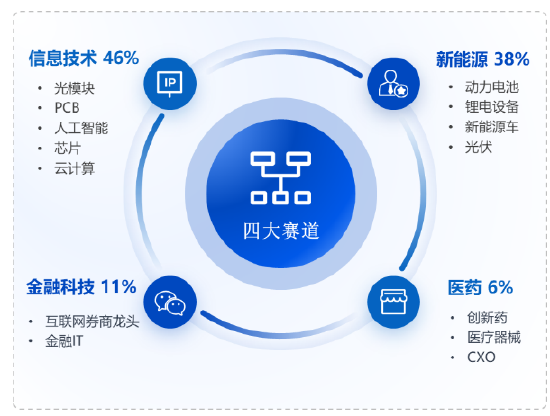
Market Overview - The A-share market showed an overall upward trend last week, with major indices rebounding: CSI 300 rose by 1.6%, CSI 500 by 3.1%, CSI 1000 by 3.8%, ChiNext 50 by 4.7%, and STAR 50 by 3.2% [1][10] - The average daily trading volume in the A-share market was around 17,400 billion yuan, indicating high market investment enthusiasm [1][10] - Recent market hotspots are concentrated in AI applications, commercial aerospace, military industry, semiconductors, and innovative pharmaceuticals [1][10] Investment Recommendations - It is suggested to focus on high-growth sectors and diversify investments, utilizing ETFs to gain exposure to related products such as ChiNext 50 ETF (159949) [1][10] ChiNext 50 Index Insights - The ChiNext 50 Index serves as a direct financing platform for growth-oriented innovative enterprises, focusing on four key sectors: information technology, new energy, financial technology, and pharmaceuticals [1][11] - The index has a significant concentration in the information technology sector, comprising 46%, with 20% weight in optical modules [4][15] - The index's performance is superior in terms of optical module content, new energy photovoltaic content, and financial technology compared to the ChiNext Index and mainstream broad-based indices [3][13] Sector Analysis Technology, AI, and Communication - The optical module demand is driven by the explosive growth in AI computing power, with major companies like Google and NVIDIA significantly increasing capital expenditures [4][15] - The supply-demand tension in the optical chip industry continues, with leading companies securing production capacity through partnerships with upstream suppliers [4][15] New Energy - Recent hotspots in the new energy sector include energy storage, solid-state batteries, controllable nuclear fusion, photovoltaics, wind power, and new energy vehicles [5][15] - By the end of October, the installed capacity of solar power generation in the country increased by 43.8% year-on-year, while wind power capacity grew by 21.4% [5][15] - Global sales of new energy vehicles saw a strong growth of 31% year-on-year in Q3, with pure electric vehicles increasing by 48% [5][15] Pharmaceuticals and Biotechnology - The pharmaceutical and biotechnology sector is experiencing growth driven by policy support, technological innovation, and development in niche areas [6][16] - The oral PROTAC drug HP518 has received clinical trial approval, with no similar products available domestically or internationally [6][16] - The overall sector is becoming more active due to advancements in AI-assisted diagnostic technologies and breakthroughs in 3D printing materials compatible with the human immune system [6][16] ChiNext 50 ETF Performance - The ChiNext 50 ETF (159949) tracks the ChiNext 50 Index and focuses on high-quality leading companies in five key technology sectors: new energy vehicles, biomedicine, electronics, photovoltaics, and internet finance [7][16] - The ETF has a robust liquidity profile, with an average daily trading volume of 1.454 billion yuan over the past year, ranking among the top ETFs on the Shenzhen Stock Exchange [7][16] - The latest fund size is 25.207 billion yuan, making it one of the largest funds related to the ChiNext index [7][16] Top Holdings in ChiNext 50 ETF - The top ten weighted stocks in the ChiNext 50 ETF include: - CATL (宁德时代) - 23.99% weight, 0.86% weekly increase [8][18] - Zhongji Xuchuang (中际旭创) - 11.10% weight, 10.88% weekly increase [8][18] - Xinyi Sheng (新易盛) - 7.64% weight, 15.93% weekly increase [8][18] - Dongfang Fortune (东方财富) - 7.31% weight, 0.43% weekly increase [8][18] - Sungrow Power (阳光电源) - 6.67% weight, 8.94% weekly increase [8][18]

金融工程定期:港股量化:组合超额创新高,12月维持高股息配置
KAIYUAN SECURITIES· 2025-12-02 06:45
Quantitative Models and Construction Methods - **Model Name**: Hong Kong CCASS Preferred 20 Portfolio **Model Construction Idea**: The model leverages CCASS data from the Hong Kong Stock Exchange to track and replicate the monthly holdings of high-performing brokers. The goal is to identify brokers with superior performance and construct a portfolio based on their holdings[4][38][40] **Model Construction Process**: 1. At the end of each month, all brokers are ranked based on their standardized excess Sharpe ratio and monthly win rate. These two metrics are equally weighted to form a composite score 2. The top N brokers with the highest composite scores are selected to form a pool of high-performing brokers (N=10) 3. The holdings of these brokers are aggregated, and the top M stocks by weight are retained (M=20) 4. The selected stocks are equally weighted to construct the portfolio Formula: $ \text{Composite Score} = \text{Standardized Excess Sharpe Ratio} + \text{Monthly Win Rate} $ **Model Evaluation**: The model effectively identifies high-performing brokers and constructs a portfolio with consistent excess returns and risk-adjusted performance[40][41][42] Model Backtesting Results - **Hong Kong CCASS Preferred 20 Portfolio**: - November 2025 performance: Portfolio return 0.13%, Hang Seng Index return -0.18%, excess return 0.32%[42] - Full period (2020.1–2025.11): - Annualized excess return: 19.7% - Annualized volatility: 7.6% - Sharpe ratio: 2.59 - Maximum drawdown: -6.0% - Monthly win rate: 78.9%[42][43][45] - Annual performance breakdown: - 2020: Annualized excess return 37.4%, Sharpe ratio 3.85, maximum drawdown -5.4%, monthly win rate 91.7% - 2021: Annualized excess return 11.5%, Sharpe ratio 1.40, maximum drawdown -5.1%, monthly win rate 50.0% - 2022: Annualized excess return 12.2%, Sharpe ratio 1.48, maximum drawdown -4.5%, monthly win rate 75.0% - 2023: Annualized excess return 20.3%, Sharpe ratio 2.99, maximum drawdown -3.7%, monthly win rate 75.0% - 2024: Annualized excess return 22.5%, Sharpe ratio 3.38, maximum drawdown -3.7%, monthly win rate 91.7% - 2025: Annualized excess return 15.9%, Sharpe ratio 3.17, maximum drawdown -2.0%, monthly win rate 90.9%[43][44][45]
资金踊跃布局港股红利类资产!港股通红利ETF(513530)连续24个交易日获资金净流入
Xin Lang Cai Jing· 2025-12-02 05:19
Core Viewpoint - The Hong Kong dividend assets are attracting attention due to their defensive characteristics in the current environment of weak economic recovery and uncertainty in overseas liquidity and domestic policies [1][9]. Group 1: Market Performance - High dividend sectors such as banks, non-bank financials, coal, and oil & petrochemicals in Hong Kong stocks collectively rose in early trading on December 25, 2025 [1][9]. - The Hong Kong Dividend ETF (513530) has seen continuous net inflows for 24 trading days since October 28, 2025, accumulating 778 million yuan, leading to a fund size increase to 2.891 billion yuan, a new high [2][10]. - The trading volume on December 1, 2025, reached 185 million yuan, a 153% increase from the previous trading day, with net inflows growing by 245% [2][10]. Group 2: Dividend Yield and Performance - The Hong Kong Dividend ETF tracks the Hong Kong High Dividend (CNY) Index, which has a dividend yield of 5.63%, significantly higher than the 1.82% yield of the 10-year government bond [2][10]. - The total return index of the Hong Kong High Dividend (CNY) has increased by 35.10% over the past year, outperforming other major dividend indices such as the CSI Dividend and Shenzhen Dividend indices [3][11]. Group 3: Seasonal Trends and Institutional Behavior - The Hong Kong dividend sector typically experiences a notable calendar effect from late December to mid-January, driven by institutional reallocations to high-dividend assets for yield locking and insurance companies' peak premium income [12][11]. Group 4: ETF Characteristics and Management - The Hong Kong Dividend ETF (513530) is the first ETF in the A-share market that can invest in the CSI Hong Kong High Dividend Investment Index through the QDII model, supporting T+0 trading and potentially reducing dividend tax costs for investors [4][13]. - The fund manager, Huatai-PB Fund, has over 19 years of experience in index investment and has developed a comprehensive range of dividend-themed ETFs [15].