
通信

Search documents
陆家嘴财经早餐2026年2月2日星期一
Wind万得· 2026-02-01 22:37
Group 1 - The State Taxation Administration has announced an adjustment to the personal VAT threshold, raising the per-transaction threshold from 500 yuan to 1000 yuan, with specific cases subject to a monthly threshold of 100,000 yuan [3] - The global market is focused on significant events this week, including the release of the first 2025 annual report from the Shanghai Stock Exchange, various industry conferences, and the upcoming release of January's foreign exchange and gold reserve data in China [3] - The "OPEC+" members have agreed to maintain their current production levels, with no increase in oil output planned for March, emphasizing their commitment to market stability [4] Group 2 - The draft of the Cybercrime Prevention Law is open for public consultation, aiming to regulate online payment and promotional activities to combat cybercrime effectively [5] - In January, domestic car manufacturers reported sales growth, with several companies like NIO and Leap Motor showing significant year-on-year increases in vehicle deliveries [15] - The AI computing power infrastructure is experiencing explosive growth, with transformer orders for data centers extending into 2027 due to high demand [15] Group 3 - The A-share market is witnessing a shift from resource-driven to cyclical growth, with a focus on industries like chemicals, non-ferrous metals, and renewable energy, while caution is advised in the precious metals sector [8] - As of January 31, 2025, 53.6% of A-share listed companies have issued positive earnings forecasts, with notable performance in sectors like non-ferrous metals and hardware equipment [8] - The semiconductor sector is highlighted as a key performer in the A-share market, with expectations of continued growth driven by supply-demand imbalances [9] Group 4 - The real estate market in China shows signs of recovery, with the A-share and Hong Kong real estate indices both experiencing significant weekly gains [9] - The telecommunications sector is set to see an increase in VAT from 6% to 9% starting January 1, 2026, impacting company revenues and profits [9] - The gold market has seen significant volatility, with recent price fluctuations prompting warnings from major banks regarding investment risks [24]


近3000家上市公司披露业绩预告 近四成企业业绩预喜
Sou Hu Cai Jing· 2026-02-01 15:02
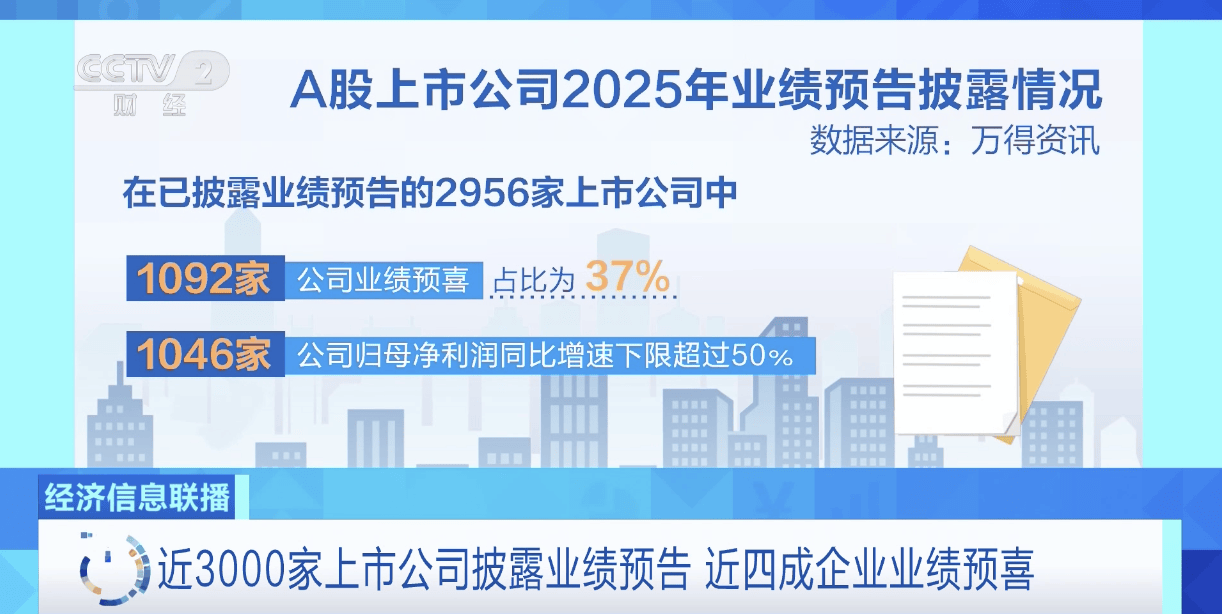
Group 1 - Among the listed companies that have disclosed performance forecasts, 1,092 companies are expected to have positive earnings, accounting for 37% of the total. Of these, 1,046 companies have a lower limit of net profit growth exceeding 50%, and 603 companies have a lower limit exceeding 100% [2] - The semiconductor sector is expected to see significant growth, with annual profits increasing over 300% year-on-year due to the positive impact of AI trends spreading across the industry chain [2][3] - The automotive sector has a positive forecast ratio exceeding 50%, with annual profits expected to grow approximately 140%, driven by manufacturing advantages and increased export orders [3] Group 2 - The non-ferrous metals sector is projected to see a year-on-year profit growth exceeding 40% in the first three quarters, with further price increases in copper and gold expected in the fourth quarter, leading to an overall annual profit growth exceeding 100% [4] - Experts predict that the A-share market is likely to maintain a stable and positive trend through 2026, driven by the restructuring of international order and domestic industrial innovation trends [6] - AI is expected to gradually enter the application realization phase by 2026, with certain sectors such as home appliances, engineering machinery, commercial buses, and power grid equipment anticipated to have relatively favorable growth opportunities [8]
周末黑天鹅!金银价格暴跌 创1980年以来最大单日跌幅
Zhong Guo Ji Jin Bao· 2026-02-01 14:39
Group 1: Market Reactions - Gold prices experienced the largest single-day drop since 1980, with spot gold falling over 12% to a low of $4682 per ounce, closing down 9.25% at $4880 per ounce [1] - Silver prices also saw a historic decline, with spot silver dropping over 36% to a low of $74.28 per ounce, closing down 26.42% at $85.259 per ounce [1] - The decline in precious metals was triggered by the nomination of Kevin Walsh as the new Federal Reserve Chairman, which eased concerns about the Fed yielding to pressure for lower interest rates [1] Group 2: Economic Indicators - The official manufacturing PMI for January was reported at 49.3%, a decrease of 0.8 percentage points from the previous month, indicating a decline in manufacturing activity [2] - Large enterprises reported a PMI of 50.3%, while medium and small enterprises reported PMIs of 48.7% and 47.4%, respectively, both below the critical threshold [2] Group 3: Regulatory Developments - The China Securities Regulatory Commission (CSRC) emphasized the need to consolidate the stable and positive momentum of the capital market, focusing on risk prevention, strong regulation, and high-quality development [3] - The CSRC plans to expand the types of strategic investors and clarify minimum shareholding requirements, allowing various institutional investors to participate as strategic investors [6] Group 4: Company Performance Forecasts - Aerospace Development is expected to report a net loss of between 1 billion to 1.65 billion yuan for 2025 [9] - Deep Blue Technology anticipates a net loss of between 12.581 billion to 15.573 billion yuan for 2025, with potential delisting risk [10] - Zhongji Xuchuang forecasts a net profit increase of 89.50% to 128.17% year-on-year for 2025 [11] - New Yisheng expects a net profit increase of 231% to 249% year-on-year for 2025, with fourth-quarter performance exceeding expectations [11] - Cambrian Technology predicts a net profit of 1.85 billion to 2.15 billion yuan for 2025, marking a turnaround from losses [11] - Wentai Technology anticipates a net loss of between 9 billion to 13.5 billion yuan for 2025 [12] - Overseas Chinese Town A expects a net loss of between 13 billion to 15.5 billion yuan for 2025 [13] Group 5: Analyst Insights - CITIC Securities suggests that the recent ETF redemption wave has ended, and a recovery window for large-cap stocks is opening, with a focus on sectors with pricing power [13] - Shenwan Hongyuan predicts a range-bound market, with short-term adjustments expected as the market digests previous gains [14] - Guojin Securities emphasizes the importance of monitoring price increases across various sectors, including oil, chemicals, and consumer goods [18] - Industrial and resource sectors are expected to show clear paths to profit recovery, with attention on short-term pullback opportunities [24]
A股和港股,各有一个重磅的事件要落地了
表舅是养基大户· 2026-02-01 13:33
Group 1 - The article emphasizes that the current investment performance is unlikely to be sustainable, highlighting the importance of a reasonable approach, long-term capital, and a calm mindset when increasing positions in the market [2][4][5] - A significant event in the A-share market is the regulatory response to a fund company's violation of sales practices, leading to the removal of real-time valuation and other features from various e-commerce fund sales platforms [13][15][18] - The Hong Kong stock market is experiencing a surge in IPOs, with the Hong Kong Securities and Futures Commission focusing on issues arising from the increased number of new listings, which may lead to a reassessment of listing standards [19][22][23] Group 2 - Tencent's recent actions in AI applications, including a viral red envelope campaign, indicate a strong push towards AI integration, suggesting that 2023 may be a pivotal year for AI applications [24][25][26] - The article discusses the potential impact of global liquidity shocks on the stock market, predicting a likely lower opening for both Hong Kong and A-shares due to recent market volatility [8][10][12] - The article highlights several key sectors to watch, including AI, commercial aerospace, robotics, and optical modules, with specific companies providing earnings forecasts that may influence market dynamics [28][32][34][37]

量化择时周报:趋势指标进入边缘位置,由重仓位到重结构
ZHONGTAI SECURITIES· 2026-02-01 13:30
Investment Rating - The industry rating is "Overweight," indicating an expected increase of over 10% relative to the benchmark index in the next 6 to 12 months [16]. Core Insights - The market is currently in an upward trend, with the core observation being whether the profit-making effect is positive. The market trend line is near 6800 points, and the profit-making effect is at the zero value edge, suggesting the potential for a halt in the upward trend [5][8]. - The short-term outlook indicates continued outflows from broad-based ETFs, particularly the CSI 300 ETF, which is exerting pressure on the index. A significant drop in non-ferrous metals has also dampened short-term risk appetite [7][8]. - The industry trend configuration model suggests waiting for reversal signals in the liquor and real estate sectors, while the TWO BETA model continues to recommend the technology sector, focusing on rebound opportunities in commercial aerospace [6][8]. Summary by Sections Market Overview - The WIND All A index is in an upward trend, with a significant distance of 6.77% between the short-term (20-day) and long-term (120-day) moving averages, indicating a continued upward trend [5][9]. - The market experienced a decline of 1.59% last week, with small-cap stocks (CSI 1000) down 2.55% and mid-cap stocks (CSI 500) down 2.56%. The CSI 300 saw a slight increase of 0.08%, while the SSE 50 rose by 1.13% [2][7]. Valuation Metrics - The PE ratio of the WIND All A index is at the 90th percentile, indicating a high valuation level, while the PB ratio is at the 50th percentile, suggesting a moderate valuation level [9][11]. Positioning Recommendations - The report recommends a 70% allocation to absolute return products based on the WIND All A index, reflecting a cautious but optimistic stance on market conditions [9][10]. - The performance trend model highlights the importance of focusing on the computing power-related industry chain and suggests waiting for significant volume reductions in high-performing cyclical sectors such as industrial non-ferrous metals and chemicals [6][14].
2026新旧共舞:一定要注意“再均衡”
Guotou Securities· 2026-02-01 13:00
Group 1 - The core view of the report emphasizes the importance of "rebalancing" in the investment strategy for 2026, highlighting the dual focus on AI technology, overseas equipment, and global pricing resources as the main consensus among institutional investors [1][2] - The report indicates that the share of technology and overseas sectors in A-share profits (excluding finance) is approaching 40% by Q4 2025, suggesting a significant shift in the profit structure towards high-end technology and manufacturing, which is expected to reshape the A-share profit landscape and drive a new upward cycle in 2026-2027 [1][2] - The report outlines a transition from "new triumphing over old" in 2025 to "new and old dancing together" in 2026, where "new" refers to AI technology moving downstream and "old" refers to traditional industries stabilizing and growing through overseas business [2][3] Group 2 - The report highlights that global pricing resources, particularly gold, are experiencing a shift in asset allocation due to narratives of de-globalization and financialization, with a notable increase in trading sentiment driven by interest rate cuts and a weak dollar [2][3] - It is noted that the pricing of resource commodities is becoming increasingly differentiated, with financial attributes of resource pricing outperforming those based on commodity attributes [2][3] - The report stresses the need to be cautious of the assumption that the dollar will remain weak throughout 2026, as there may be a return to commodity attributes and a decline in financial attributes, making supply-demand fundamentals more critical for resource price increases [3] Group 3 - Observations from Q4 2025 indicate a significant increase in institutional holdings in sectors such as non-ferrous metals, communications, basic chemicals, non-bank financials, and machinery, while reductions were noted in pharmaceuticals, computing, electronics, media, and power equipment [9][10] - The report identifies a divergence in institutional investment in the AI industry chain, with a decrease in holdings in sectors with weaker earnings visibility, while sectors with strong earnings visibility, such as optical modules, saw increases [10][11] - The report also notes that institutional investors are increasingly favoring resource commodities that benefit from price increases, particularly in the non-ferrous and chemical sectors, indicating a strategic shift towards these areas [10][11]
招商策略:指数震荡,涨价扩散
Xin Lang Cai Jing· 2026-02-01 12:50
Market Outlook - The market is expected to remain volatile in February, with a stronger performance anticipated post-Spring Festival due to policy catalysts and the upcoming Two Sessions [2][11][19] - The focus will be on cyclical price increases and AI applications, particularly in sectors like oil and petrochemicals, construction materials, and steel [2][11][19] Industry and Sector Recommendations - Recommended sectors include cyclical and technology areas, with a focus on electronics (semiconductors), media (advertising, gaming, film), machinery (automation, engineering), power equipment (batteries, grid equipment, photovoltaic), basic chemicals, and social services [3][5][16] - The investment strategy should emphasize growth style, with a preference for large-cap stocks initially, followed by small-cap stocks [3][16] Liquidity and Capital Supply - February is expected to see continued net inflows of incremental capital, with foreign capital likely to continue net inflows before the Spring Festival and a rebound in financing post-holiday [4][12] - The macro liquidity environment remains stable, supported by government bond issuance and central bank measures to counterbalance liquidity gaps [4][12] Earnings and Profitability Trends - Earnings forecasts indicate a recovery in profitability, particularly in sectors experiencing price increases, such as industrial metals and AI-driven technology [5][13][55] - The performance of high-growth sectors is expected to be strong, with a focus on cyclical price increases and export-oriented high-end manufacturing [5][55][57] ETF and Fund Flow Dynamics - Significant outflows from ETFs have been observed, particularly from broad-based indices, while thematic and sector-specific ETFs have seen inflows [31][34][39] - The adjustment in financing margin requirements has contributed to a cooling effect on market activity, with a notable impact on large-cap stocks [43][44]
2026年2月策略观点:关注业绩,持股过节-20260201
EBSCN· 2026-02-01 12:42
Group 1 - The A-share market showed a significant upward trend in January 2026, with major indices rising, particularly the Sci-Tech 50 and CSI 500, while the Shanghai Composite Index increased by 3.8% [5][10] - Market trading volume increased significantly, with a record high of 3.99 trillion yuan on January 14, 2026, reflecting a recovery in investor sentiment [10][18] - The performance of various sectors was mixed, with non-ferrous metals and media leading gains, while banking and home appliances lagged behind [15][18] Group 2 - The report suggests maintaining a "growth + value" strategy in the Hong Kong stock market, as the overall trend is positive due to earnings recovery, improved liquidity, and low valuations [3][4] - The report emphasizes that small-cap stocks typically outperform during the spring market, driven by increased risk appetite and the influx of retail investors [71][88] - Key sectors to focus on include electronics, power equipment, machinery, non-ferrous metals, and communications, which are expected to perform well in February 2026 [3][4][73] Group 3 - The spring market is anticipated to be characterized by a focus on growth and cyclical sectors, with historical data indicating that these sectors often perform well during this period [73][88] - The report highlights that the consumer sector may receive policy support, as the government emphasizes domestic demand and market expansion [88][89] - Earnings forecasts for 2025 show improvement across various industries, particularly in non-ferrous metals, steel, and media, indicating a positive outlook for these sectors [61][81]
顶层设计指引,未来产业前景广阔
Guotou Securities· 2026-02-01 12:36
Investment Rating - The report maintains an investment rating of "Outperform the Market - A" [5] Core Insights - The future industry is expected to become a new economic growth point, with significant potential in quantum technology, embodied intelligence, and 6G technology. The report emphasizes the need for strategic planning and government support due to the long cultivation cycle and high market risks associated with future industries [1][11] - Quantum technology is highlighted as the leading sector within future industries, with four key areas expected to drive disruptive innovation: quantum computing, quantum communication, quantum measurement, and post-quantum cryptography [2][12] - Embodied intelligence is identified as a crucial application of artificial intelligence, facilitating the development of humanoid robots and advancing the robotics industry [2][12] - The second phase of 6G technology trials has been initiated in China, with over 300 key technologies developed, focusing on integrating satellite internet as a foundational infrastructure for 6G [3][13] Summary by Sections Industry Investment Rating - The report assigns an "Outperform the Market - A" rating, indicating an expected investment return exceeding the CSI 300 Index by 10% or more over the next six months [5][24] Future Industry Overview - The future industry encompasses a wide range of sectors, including information technology, bio-manufacturing, energy, and high-end equipment manufacturing, with substantial investment value due to its broad development space [1][11] Quantum Technology - Quantum computing is poised to solve complex problems beyond the capabilities of traditional computers, with potential breakthroughs in drug discovery and materials science. Quantum communication aims to enhance secure information transmission, while quantum measurement will improve precision in various fields [2][12] Embodied Intelligence - Embodied intelligence enhances AI's ability to interact with environments, leading to measurable and verifiable applications. Humanoid robots are expected to be key carriers of these algorithms, paving the way for general artificial intelligence [2][12] 6G Technology - The report notes that the first phase of 6G technology trials has been completed, with the second phase now underway, focusing on creating an integrated network that includes satellite internet as a critical infrastructure component [3][13]
量化择时周报:趋势指标进入边缘位置,由重仓位到重结构-20260201
ZHONGTAI SECURITIES· 2026-02-01 11:51
Quantitative Models and Construction Methods 1. Model Name: Timing System Signal - **Model Construction Idea**: The model uses the distance between the short-term and long-term moving averages of the WIND All A Index to determine the market trend. A significant positive distance indicates an upward trend, while a negative distance suggests a downward trend [2][7][13] - **Model Construction Process**: 1. Define the short-term moving average (20-day) and long-term moving average (120-day) of the WIND All A Index 2. Calculate the distance between the two moving averages: $ Distance = \frac{Short\text{-}term\ MA - Long\text{-}term\ MA}{Long\text{-}term\ MA} $ Where: - Short-term MA = 20-day moving average - Long-term MA = 120-day moving average 3. If the absolute value of the distance exceeds 3%, the market is considered to be in a trend (upward or downward depending on the sign of the distance) [2][7][13] - **Model Evaluation**: The model effectively captures market trends and provides a clear signal for timing decisions. However, it may be sensitive to short-term market fluctuations [2][7][13] 2. Model Name: Industry Trend Allocation Model - **Model Construction Idea**: This model identifies industry allocation opportunities based on medium-term reversal expectations and performance trends [6][8][14] - **Model Construction Process**: 1. Monitor industries with potential for medium-term reversal, such as real estate and liquor, and wait for reversal signals 2. Use the "TWO BETA" framework to recommend high-growth sectors like technology and commercial aerospace 3. Focus on performance trends in industries with high growth potential, such as computing power-related industries and upstream cyclical sectors like industrial metals and chemicals [6][8][14] - **Model Evaluation**: The model provides a structured approach to industry allocation, balancing medium-term reversal opportunities with high-growth sectors. However, its reliance on reversal signals may delay entry into emerging trends [6][8][14] 3. Model Name: Position Management Model - **Model Construction Idea**: This model determines the optimal equity allocation for absolute return products based on valuation and market trends [9] - **Model Construction Process**: 1. Assess the valuation of the WIND All A Index using PE and PB ratios 2. Combine valuation levels with short-term trend signals to recommend equity allocation levels 3. Current recommendation: 70% equity allocation for absolute return products, as the WIND All A Index PE is at the 90th percentile (high level) and PB is at the 50th percentile (medium level) [9] - **Model Evaluation**: The model provides a systematic approach to position management, balancing valuation and trend considerations. However, it may not fully account for sudden market shocks [9] --- Model Backtesting Results 1. Timing System Signal - Distance between 20-day and 120-day moving averages: 6.77% (absolute value significantly greater than 3%, indicating an upward trend) [2][7][13] 2. Industry Trend Allocation Model - No specific numerical backtesting results provided in the report [6][8][14] 3. Position Management Model - WIND All A Index PE: 90th percentile (high level) - WIND All A Index PB: 50th percentile (medium level) - Recommended equity allocation: 70% [9] --- Quantitative Factors and Construction Methods 1. Factor Name: Moving Average Distance Factor - **Factor Construction Idea**: Measures the distance between short-term and long-term moving averages to capture market trends [2][7][13] - **Factor Construction Process**: 1. Define short-term (20-day) and long-term (120-day) moving averages 2. Calculate the distance using the formula: $ Distance = \frac{Short\text{-}term\ MA - Long\text{-}term\ MA}{Long\text{-}term\ MA} $ 3. Use the absolute value of the distance to determine the trend strength [2][7][13] - **Factor Evaluation**: The factor is simple and intuitive, effectively capturing market trends. However, it may lag during rapid market reversals [2][7][13] --- Factor Backtesting Results 1. Moving Average Distance Factor - Distance: 6.77% (indicating a strong upward trend) [2][7][13]