纯碱

Search documents
国泰君安期货:能源化工:玻璃纯碱后市如何演绎
Guo Tai Jun An Qi Huo· 2025-08-14 11:04
Industry Investment Rating - Not provided in the content Core Views - The medium-term adjustment of both glass and soda ash markets is not over. For glass, wait until the end of delivery to consider anti-deflation and anti-involution. For soda ash, it rises based on expectations and falls due to delivery [4][5] - There is a possibility that the market will return to the negative feedback channel until the end of delivery. Anti-deflation and anti-involution can interrupt the negative feedback cycle [24] - The real estate industry is weak, with tight funds and lackluster transactions, which has a negative impact on the glass and soda ash industries [25][30] - Although anti-involution is weakening, there is still a possibility of trading anti-deflation in macro asset allocation [35] Summary by Relevant Catalogs Glass Glass Views - The main pressures include weak terminal demand, high futures premiums, large warehouse receipt pressure during the 09 contract period, and the lack of significant inclination in the previously hyped anti-involution policy. The main bullish logics are large positions, the unchanged trend of anti-deflation policies, and the possibility of market-driven production cuts [4] Supply - Side Situation - Cold - repaired production lines in 2025 have a total daily melting capacity of 11,680 tons/day; newly ignited production lines have a total daily melting capacity of 12,110 tons/day; potential newly ignited production lines have a total daily melting capacity of 14,000 tons/day; potential复产 production lines have a total daily melting capacity of 8,130 tons; potential cold - repaired production lines have a total daily melting capacity of 6,900 tons/day [44][45][46] - Short - term production reduction space is limited. If demand is poor in the third quarter, there may be a certain scale of production reduction in the fourth quarter. The current in - production capacity is about 159,000 tons/day [52] Price and Profit - Market prices have gradually declined in the past two weeks. Futures have rebounded, the basis has strengthened, and the monthly spread is still weak. The 01 contract has a premium of nearly 150 yuan/ton over the 09 contract. Profits vary by fuel type, with petroleum coke having a profit of about 130 yuan/ton, and natural gas and coal - fired having profits of about - 150 and 111 yuan/ton respectively [64][70][74] Inventory and Downstream开工 - Recent transactions have declined significantly, and inventories in various regions have increased. Regional price differences tend to widen. The supply - side current output is 159,000 tons/day, and it is expected that demand will exceed 5 million tons for at least 2 - 3 months in the second half of 2025 [81][86][90] Soda Ash Soda Ash Views - The main pressures are high supply and high inventory, with large warehouse receipt pressure during the 09 contract period. The main bullish logics are the unchanged trend of anti - deflation policies, concentrated inventory structure, improved export markets, and the linkage between stocks and futures [5] Supply and Maintenance - Some soda ash plants have resumed production, and the operating rate has increased. The current capacity utilization rate is 85.4%. The weekly output of heavy soda has reached 423,000 tons/week. The inventory is about 1.865 million tons, with 717,000 tons of light soda ash and 1.148 million tons of heavy soda ash [106][108][111] Price and Profit - Market quotes have been lowered, and the reduction range of traders' quotes is greater than that of manufacturers. The nominal prices in Shahe and Hubei are about 1,250 - 1,300 yuan/ton. The profit of the soda ash industry varies by region and production method, with the joint - alkali profit in East China (excluding Shandong) being 68 yuan/ton and the ammonia - alkali profit in North China being 56 yuan/ton [121][123][127] Market Scenarios - The market scenario of soda ash is becoming increasingly weak. Under different demand assumptions (weak, neutral, and optimistic), there are different supply - demand gaps [129] Anti - Involution, Anti - Deflation, and Real Estate - "Anti - deflation and anti - involution" are necessary for building a unified national market. The real estate industry has debt repayment pressure in the first half of 2025, with weak investment and lackluster transactions [8][29][30] Photovoltaic Glass - The overall transaction in the domestic photovoltaic glass market is good, and the inventory has been continuously decreasing. The prices of 2.0mm and 3.2mm coated panels have increased. The number of in - production production lines is 408, with a total daily melting capacity of 89,290 tons/day. The sample inventory days are about 26.93 days, showing a downward trend [94][96][98]
综合晨报-20250814
Guo Tou Qi Huo· 2025-08-14 10:43
Report Industry Investment Ratings No relevant content provided. Core Views of the Report - The international oil price is expected to decline, with the fourth - quarter Brent crude oil price central falling to around $63 per barrel from $67 per barrel in the third quarter [2] - For precious metals, wait patiently for opportunities to enter the market on dips during the oscillatory trend [3] - Copper prices are difficult to break through effectively, and it is advisable to short on rallies [4] - Aluminum prices will mainly oscillate in the short - term, with resistance at 21,000 yuan [5] - For various commodities, different investment strategies are proposed based on their respective supply - demand and market conditions Summary by Commodity Categories Energy Commodities - **Crude Oil**: The IEA's August report increased supply growth forecasts and slightly decreased demand growth forecasts. The fourth - quarter Brent central may fall to around $63 per barrel from $67 per barrel in the third quarter. There is still upward risk due to potential supply disruptions, but the overall driving force is downward [2] - **Fuel Oil & Low - Sulfur Fuel Oil**: In August, the Asian fuel oil market has sufficient arrivals, and the low - sulfur fuel oil market is under pressure due to the expected release of the third - batch quota and weakening costs [18] - **Asphalt**: Supply - demand is expected to tighten marginally. With low inventory, the price has some support, and the recent BU cracking is considered strong [19] - **Liquefied Petroleum Gas**: Overseas exports are loose, but there is support from increased East Asian chemical procurement. The price has stabilized slightly. The domestic market is in a low - level oscillation [20] Metal Commodities - **Precious Metals**: After the release of the US CPI data, the market fully priced in a Fed rate cut in September. Wait patiently for opportunities to enter the market on dips during the oscillatory trend [3] - **Base Metals** - **Copper**: Chile's refined copper output may increase but the growth rate may fall short of expectations again. It is difficult for copper prices to break through 79,500 yuan, and it is advisable to short on rallies [4] - **Aluminum**: The social inventory of aluminum ingots is accumulating, but the peak may occur in August. The price will mainly oscillate in the short - term, with resistance at 21,000 yuan [5] - **Zinc**: The domestic market has weak demand and increasing supply, and the social inventory may rise further. Wait patiently for short - selling opportunities above 23,500 yuan per ton [8] - **Lead**: The price is in a wide - range oscillation. It is advisable to hold long positions with a stop - loss at 16,600 yuan per ton [9] - **Nickel & Stainless Steel**: The fundamentals of nickel are poor, and it is advisable to actively short during the later stage of the rebound [10] - **Tin**: Selectively go short for the short - term at low prices [11] - **Carbonate Lithium**: The futures price oscillates, and attention should be paid to risk management [12] - **Industrial Silicon**: The self - clearing of production capacity is difficult, and the price is affected by related varieties. Pay attention to the support at 8,300 yuan per ton [13] - **Polysilicon**: The price is expected to operate in the range of 48,000 - 53,000 yuan per ton. It is recommended to short cautiously at the lower end of the range [14] Agricultural Commodities - **Soybean & Palm Oil**: Affected by the rapeseed anti - dumping policy and the US Department of Agriculture's supply - demand report, the short - term price volatility should be enlarged, and attention should be paid to the changes in positions [33] - **Rapeseed & Rapeseed Oil**: The domestic rapeseed and rapeseed oil market is expected to remain relatively strong, and a bullish view is maintained [34] - **Soybean No. 1**: Affected by the rapeseed anti - dumping policy and the US Department of Agriculture's supply - demand report, short - term attention should be paid to the fluctuations of surrounding varieties [35] - **Eggs**: The spot price is stable, and the futures market is in a situation of near - term weakness and long - term strength. Attention should be paid to the demand in the peak season and the progress of capacity elimination [37] - **Cotton**: The US Department of Agriculture's August supply - demand report was bullish. Domestic inventory is decreasing, and it is advisable to buy on dips [38] - **Sugar**: The US sugar price is under pressure, and the domestic sugar price is expected to oscillate [39] - **Apples**: The market's trading focus has shifted to the new - season output estimate. It is advisable to wait and see for now [40] Others - **Grain & Oil Chemicals** - **Urea**: The short - term supply - demand is loose, and the market is likely to oscillate within a range [21] - **Methanol**: The domestic market is strong in the inland and weak in the ports. With the approaching peak - season demand, attention should be paid to macro - sentiment and downstream stocking [22] - **Pure Benzene**: There is an expected seasonal improvement in supply - demand in the second half of the third quarter, and it is advisable to conduct month - spread trading [23] - **Styrene**: The price is in a consolidation pattern, with limited upward and downward movement [24] - **Polypropylene, Plastic & Propylene**: Propylene prices are supported, polyethylene demand is expected to increase, and polypropylene is in a weak - adjustment state [25] - **PVC & Caustic Soda**: PVC prices are expected to oscillate weakly, and caustic soda prices are under pressure at high levels [26] - **PX & PTA**: Affected by oil prices, the prices are falling. PX is expected to have a good valuation in the third quarter [27] - **Ethylene Glycol**: The supply - demand pressure is alleviating, and short - term performance is weak due to oil prices [28] - **Short - Fiber & Bottle - Chip**: Short - fiber can be considered for long - position allocation in the medium - term, and bottle - chip is under long - term over - capacity pressure [29] - **Financial Products** - **Stock Index**: The market is in an active state, with a positive macro - driving force. It is recommended to increase the allocation of technology - growth sectors and also pay attention to consumption and cyclical sectors [43] - **Treasury Bonds**: The futures are oscillating. The probability of a steeper yield curve is increasing [44]
情绪降温,价格回落
Zhong Xin Qi Huo· 2025-08-14 04:20
Report Industry Investment Rating - The overall outlook for the black building materials industry is "Oscillation" [7] Core Viewpoints - The sentiment in the coking coal market cooled down, and the prices of the black building materials sector declined. However, the fundamentals of the black building materials industry are relatively healthy, and there is still a chance to resonate with macro - level positive factors. Before new driving forces emerge, the prices are expected to oscillate within the current range, with limited downside potential [1][2][7] Summary by Category Iron Element - **Supply**: Overseas mine shipments decreased slightly on a month - on - month basis, and the arrival volume at 45 ports returned to the level of the same period last year. Supply is relatively stable with no obvious increase [2] - **Demand**: The profitability rate of steel enterprises reached the highest level in the same period of the past three years. Iron - water production decreased slightly due to regular maintenance in steel mills but remained at a high level year - on - year. The possibility of production cuts due to profit reasons in the short term is small. Attention should be paid to whether there are production - restriction policies in the second half of the month [2] - **Inventory**: The total inventory of iron ore in port areas increased mainly because of the concentrated arrival of floating cargoes, but the inventory accumulation was limited. The fundamentals have limited negative driving forces, and the price is expected to oscillate in the future [2] Carbon Element - **Supply**: In the main production areas, some coal mines reduced production due to factors such as changing working faces and over - production inspections. Although some previously shut - down or production - reduced coal mines are gradually resuming production, short - term supply disruptions will continue. In terms of imports, the adjustment of the error threshold for the actual weight and declared weight of customs - cleared vehicles at the Ganqimao Port affected the number of customs - cleared vehicles, and the decline in the mining capacity of the TT mining area restricted coking coal transportation. Short - term imports of Mongolian coal may be restricted [3][13] - **Demand**: Coke production remained stable, and the rigid demand for coking coal was strong. Coal mines had many pre - sold orders and no obvious inventory pressure. After the exchange restricted positions, the sentiment declined, but the short - term futures market still had support under healthy fundamentals [3][13] Alloys - **Manganese Silicon**: The ex - factory price of manganese ore increased, and the demand for manganese ore was supported by the recovery of the start - up rate of manganese - silicon manufacturers. With acceptable port inventory pressure, the quotation center of manganese ore gradually moved up. In an environment of industry profit restoration, the resumption of production by manufacturers continued, and the supply - demand relationship of manganese silicon may gradually become looser. Attention should be paid to the "anti - involution" policies with specific production - restriction requirements [3] - **Silicon Iron**: The current market inventory pressure is not large, and the price is expected to oscillate in the short term. However, in the long - term, as the supply - demand gap is expected to be filled, there are still hidden concerns in the fundamentals, and the upside potential of the price is not optimistic. Attention should be paid to the dynamics of the coal market and the adjustment of electricity costs [3] Glass - **Demand**: In the off - season, demand declined, deep - processing orders decreased on a month - on - month basis, and the inventory days of original glass increased on a month - on - month basis, indicating speculative purchases by downstream players. After the decline in the futures market, the sentiment in the spot market cooled down, the middle - stream sales increased, and the production - sales ratio of the upstream decreased significantly [4][15] - **Supply**: There is still one production line waiting to produce glass. The upstream inventory decreased slightly, and there were no prominent internal contradictions, but there were many market - sentiment disturbances. The recent increase in coal prices strengthened the cost support, but the fundamentals remained weak. In the short term, the futures and spot prices are expected to oscillate widely [4][15] Soda Ash - **Supply**: The over - supply situation has not changed. Although there are expectations of supply decline due to environmental concerns in Qinghai, the long - term supply pressure still exists, and production is expected to continue to increase [17] - **Demand**: Heavy - soda ash is expected to maintain rigid procurement. The daily melting volume of float glass is expected to be stable, while the daily melting volume of photovoltaic glass has continued to decline. The demand for light - soda ash from downstream industries is weak, mainly for periodic restocking. The market is affected by sentiment, and although the large monthly spread eases some delivery pressure, the downstream's willingness to take delivery is weak. In the long run, the price center will continue to decline to promote capacity reduction [17] Specific Products - **Steel**: Speculative sentiment was poor, spot trading was weak, and the supply increased while demand decreased during the off - season, with inventory accumulating. However, exports are expected to remain resilient. The fundamentals of steel are marginally weakening, but low inventory and potential production - restriction policies before the parade still provide short - term support [8] - **Iron Ore**: Demand is at a high level, supply is stable, and the fundamentals have limited negative driving forces. The price is expected to oscillate [8][9] - **Scrap Steel**: Supply decreased while demand increased, and the fundamentals are gradually strengthening. The price is expected to oscillate [10] - **Coke**: After the sixth round of price increases was implemented, the supply - demand structure remains tight in the short term, and the futures market still has support. Attention should be paid to potential production - restriction policies related to the parade [12] - **Coking Coal**: Short - term supply is tight due to disturbances. After the exchange restricted positions, the sentiment declined, but the short - term futures market still has support under healthy fundamentals [13] - **Manganese Silicon**: The current market inventory pressure is limited, and the price is expected to oscillate in the short term. However, the supply pressure is expected to increase in the future, and the upside potential of the price is limited [17] - **Silicon Iron**: The current market inventory pressure is not large, and the price is expected to oscillate in the short term. In the long term, there are hidden concerns in the fundamentals, and the upside potential of the price is not optimistic [18]
大越期货纯碱早报-20250814
Da Yue Qi Huo· 2025-08-14 02:31
1. Report Industry Investment Rating - Not provided in the content 2. Core View of the Report - The fundamentals of soda ash show strong supply and weak demand. In the short term, it is expected to mainly move in a volatile manner. The industry's supply - demand mismatch pattern has not been effectively improved. Although there are some potential positive factors such as the upcoming summer maintenance peak, the overall situation is still bearish due to high supply, weak terminal demand, and high inventory [2][5]. 3. Summary by Relevant Catalogs 3.1 Daily View - **Fundamentals**: Alkali plants have few overhauls, supply remains high; downstream float glass daily melting volume is stable, while photovoltaic daily melting volume drops significantly, terminal demand weakens, and soda ash plant inventories are at a historical high; outlook is bearish [2]. - **Basis**: The spot price of heavy - quality soda ash in Hebei Shahe is 1,260 yuan/ton, the closing price of SA2601 is 1,383 yuan/ton, with a basis of - 123 yuan, and the futures price is higher than the spot price; outlook is bearish [2]. - **Inventory**: The national soda ash plant inventory is 1.8651 million tons, an increase of 3.86% from the previous week, and the inventory is above the 5 - year average; outlook is bearish [2]. - **Disk**: The price is above the 20 - day line, and the 20 - day line is upward; outlook is bullish [2]. - **Main Position**: The main position is net short, and short positions increase; outlook is bearish [2]. - **Expectation**: Given the supply - demand situation, soda ash is expected to move in a volatile manner in the short term [2]. 3.2 Impact Factors Summary - **Positive Factors**: The upcoming summer maintenance peak will lead to a decline in production [3]. - **Negative Factors**: Since 2023, soda ash production capacity has expanded significantly, and there are still large production plans this year. The production of heavy - alkali downstream photovoltaic glass has decreased, weakening the demand for soda ash. The sentiment of the "anti - involution" policy has faded [5]. 3.3 Soda Ash Futures Market - The closing price of the main contract decreased from 1,409 yuan/ton to 1,383 yuan/ton, a decrease of 1.85%. The low - end price of heavy - quality soda ash in Shahe decreased from 1,275 yuan/ton to 1,260 yuan/ton, a decrease of 1.18%. The main basis decreased from - 134 yuan/ton to - 123 yuan/ton, a decrease of 8.21% [6]. 3.4 Soda Ash Spot Market - The low - end price of heavy - quality soda ash in Hebei Shahe is 1,260 yuan/ton, a decrease of 15 yuan/ton from the previous day [12]. - **Production Profit**: The profit of heavy - quality soda ash using the North China ammonia - soda process is - 23.80 yuan/ton, and that using the East China co - production process is 18.50 yuan/ton. The production profit has rebounded from a historical low [15]. - **Operating Rate and Production**: The weekly operating rate of the soda ash industry is 85.41%, and the operating rate is expected to decline seasonally. The weekly production is 744,600 tons, including 423,400 tons of heavy - quality soda ash, with production at a historical high [18][20]. - **Capacity Changes**: In 2023, the new production capacity was 6.4 million tons; in 2024, it was 1.8 million tons; in 2025, the planned new production capacity is 7.5 million tons, with 1 million tons actually put into production [21]. 3.5 Fundamental Analysis - Demand - **Sales - to - Production Ratio**: The weekly sales - to - production ratio of soda ash is 90.69% [25]. - **Downstream Demand**: The daily melting volume of national float glass is 159,600 tons, and the operating rate is stable at 75.19%. The price of photovoltaic glass continues to fall, and under the influence of the "anti - involution" policy, the industry has cut production, and the in - production daily melting volume has decreased significantly [28][31]. 3.6 Fundamental Analysis - Inventory - The national soda ash plant inventory is 1.8651 million tons, an increase of 3.86% from the previous week, and the inventory is above the 5 - year average [34]. 3.7 Fundamental Analysis - Supply - Demand Balance Sheet - The supply - demand balance sheets from 2017 to 2024E show various data such as effective capacity, production, operating rate, imports, exports, and supply - demand differences. The supply - demand situation has fluctuated over the years, and in 2024E, the supply - demand difference is 157,000 tons [35].

黑色产业链日报-20250813
Dong Ya Qi Huo· 2025-08-13 10:02
Report Industry Investment Rating No relevant content provided. Core Viewpoints - The short - term macro environment for steel is positive, with supply contraction expectations, stable cost support, and the steel futures market may show a volatile and upward - biased pattern. The long - term trend depends on the actual demand during the peak season [3]. - Iron ore prices are bounded, with short - term stable fundamentals and long - term focus on hot - rolled coil inventory pressure. The current oscillation needs macro changes to break [20]. - For coal and coke, although there are import substitution effects, considering policy expectations and support for finished product prices, the medium - to - long - term trend is not pessimistic [29]. - The price of ferroalloys follows coal price fluctuations. In the short - term, there are still expectations of supply contraction, and in the long - term, demand support may weaken [45]. - The supply of soda ash exceeds demand, with high inventory and weak demand. Attention should be paid to cost fluctuations and price cuts by alkali plants [55]. - The glass market is in a weak balance, with high intermediate inventory and weak sales. Attention should be paid to policy guidance and short - term sentiment changes [80]. Summary by Directory Steel - **Supply**: Coal mine over - production governance and the "276 - working - day" policy support costs. There are expectations of supply contraction due to restrictions during the Tangshan parade [3]. - **Demand**: Steel export orders have improved slightly, but the price inversion still exists. The market depends on the actual demand during the peak season [3]. - **Price Data**: On August 13, 2025, the closing prices of steel futures contracts such as rebar and hot - rolled coil decreased compared to the previous day. The basis and spreads also showed corresponding changes [4][8][13]. Iron Ore - **Market Trend**: Iron ore prices are in a following state, with limited fundamental contradictions. The anti - spread is strengthening, and the price range is bounded [20]. - **Price Data**: On August 13, 2025, the closing prices of iron ore futures contracts decreased slightly compared to the previous day. The basis and some spot prices changed [21]. - **Fundamental Data**: Daily hot - metal production is stable at around 2.4 million tons, and port inventories are maintained. There are small changes in shipping and other data [24]. Coal and Coke - **Supply**: There are supply - side disturbances such as coal mine over - production inspections in Shanxi, but the import substitution effect is significant [29]. - **Demand**: Due to the support of finished product prices, steel mill profits are resilient, and the medium - to - long - term demand for coal and coke is not pessimistic [29]. - **Price Data**: On August 13, 2025, the basis, spreads, and costs of coal and coke futures and spot prices changed compared to the previous day [33][34][35]. Ferroalloys - **Market Trend**: The price of ferroalloys follows coal price fluctuations. There are still expectations of supply contraction in the short - term, and long - term demand support may weaken [45]. - **Price Data**: On August 13, 2025, the basis, spreads, and spot prices of silicon - iron and silicon - manganese changed compared to the previous day [46][48]. Soda Ash - **Supply - Demand Situation**: Supply is high, demand is weak, inventory is at a record high, and the market is in a state of supply exceeding demand [55]. - **Price Data**: On August 13, 2025, the prices of soda ash futures contracts decreased compared to the previous day, and the spreads also changed [56]. Glass - **Market Situation**: The market is in a weak balance, with high intermediate inventory, weak sales, and pressure on spot prices [80]. - **Price Data**: On August 13, 2025, the prices of glass futures contracts decreased compared to the previous day, and the spreads and basis changed [81]. - **Sales Data**: The sales rate in different regions shows certain fluctuations [82].
黑色建材日报:短期供给受限,双焦易涨难跌-20250813
Hua Tai Qi Huo· 2025-08-13 07:59
Report Industry Investment Rating No relevant content provided. Core Viewpoints - Short - term supply of coking coal and coke is limited, making their prices prone to rise and hard to fall; the macro sentiment for glass and soda ash is positive, with soda ash prices rising significantly; steel prices are continuously rebounding, and ferroalloys are oscillating and consolidating [1][3] - Glass prices are expected to oscillate, and soda ash prices are also expected to oscillate; silicon manganese and silicon iron prices are expected to maintain an oscillating trend [2][5] Summary by Related Catalogs Glass and Soda Ash Market Analysis - Glass: The glass futures market showed a strong and oscillating trend yesterday. In the spot market, downstream procurement sentiment was cautious, with demand mainly for immediate needs [1] - Soda Ash: The soda ash futures market rose significantly yesterday. In the spot market, downstream transactions were stable, with a wait - and - see attitude [1] Supply - Demand and Logic - Glass: As market sentiment subsided, glass pricing returned to its fundamental logic. Currently, glass supply has not been effectively cleared, speculative demand has weakened, supply - demand remains relatively loose, and spot prices have declined. The previous premium in the futures market provided good opportunities for spot - futures arbitrage, and the rapid increase in registered glass warehouse receipts suppressed the price of the 09 contract. Attention should be paid to the impact of macro - policies on glass supply and demand [1] - Soda Ash: The market is again worried that stricter environmental inspections in Qinghai will affect local soda ash production capacity elimination. Since Qinghai has a large proportion of soda ash production capacity, if affected, it will improve the supply - demand imbalance to some extent. Currently, soda ash production is continuously increasing with further growth expected, while consumption may weaken further, and inventory growth pressure is high. Therefore, soda ash prices are easily stimulated by news in the short term, but long - term supply - demand contradictions will still suppress prices [1] Strategy - Glass: Oscillating [2] - Soda Ash: Oscillating [2] Silicon Manganese and Silicon Iron Market Analysis - Silicon Manganese: As steel prices continued to rebound, the silicon manganese futures market oscillated. In the spot market, the final pricing of mainstream steel procurement is still under negotiation. The price of 6517 silicon manganese in the northern market is 5800 - 5900 yuan/ton, and in the southern market, it is 5820 - 5920 yuan/ton [3] - Silicon Iron: The silicon iron futures market oscillated and consolidated yesterday. In the spot market, the market is waiting for HBIS's pricing. The ex - factory price of 72 - grade silicon iron natural lumps in the main production areas is 5400 - 5500 yuan/ton, and the price of 75 - grade silicon iron is 5750 - 5900 yuan/ton [3] Supply - Demand and Logic - Silicon Manganese: As market sentiment stabilized, the futures market returned to the fundamentals of the commodity. Currently, silicon manganese production and demand have slightly increased, and manufacturers' inventory has decreased month - on - month, being at a medium level compared to the same period. The quotation of manganese ore to China has slightly increased, causing the cost of silicon manganese to rise slightly, which supports the spot price. The 09 contract still has a certain discount, which also supports the futures price. However, considering the continuous increase in manganese ore port inventory, the cost support is weak, and the silicon manganese industry has an obvious supply surplus. A certain degree of loss is needed to suppress production release. It is expected that silicon manganese prices will continue to oscillate. Attention should be paid to manganese ore cost support, silicon manganese inventory, and manganese ore shipments in the future [3] - Silicon Iron: Currently, silicon iron production has rapidly increased, demand has slightly increased, and manufacturers' inventory has increased month - on - month, being at a relatively high level compared to the same period. The increase in chemical coke prices has driven up the cost of silicon iron, which supports the spot price. However, considering that the futures market is slightly at a premium, and the silicon iron industry has an obvious supply surplus, a certain degree of loss is needed to suppress production release. It is expected that silicon iron prices will continue to oscillate. Attention should be paid to cost support and the impact of industrial policies on the black sector in the future [4] Strategy - Silicon Manganese: Oscillating [5] - Silicon Iron: Oscillating [5]
纯碱期价震荡运行,高库存+弱需求+仓单压顶,反弹行情能走多远?
Jin Shi Shu Ju· 2025-08-13 07:34
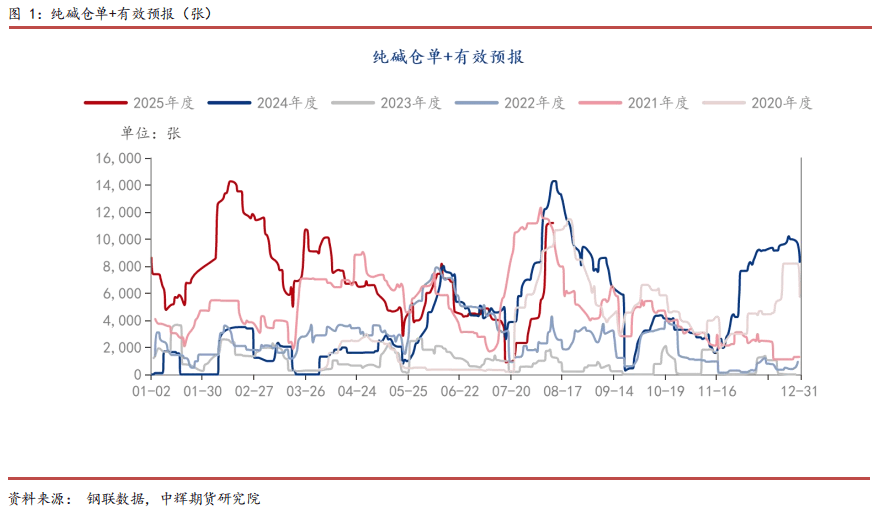
Core Viewpoint - The recent increase in soda ash futures prices is driven by market sentiment rather than fundamental improvements, influenced by environmental rumors from Qinghai, coal price movements, and macroeconomic emotions, contrasting sharply with high inventory levels [1][3][5]. Group 1: Environmental Expectations - The "Qinghai environmental event" has sparked bullish sentiment in the market, with concerns about potential reductions in local soda ash supply, although production remains normal [3][6]. - Market speculation and rumors have contributed to a significant rebound in soda ash prices, with the current trading focus primarily on policy uncertainties [3][6]. Group 2: Cost and Sector Linkage - The strength in soda ash prices is also supported by rising upstream raw material costs, particularly coal, which has a significant impact on soda ash production costs [4][6]. - The industrial sector's performance is mixed, with some sectors benefiting from policy expectations while others, like soda ash, face challenges due to high operating rates and low demand [4][6]. Group 3: High Inventory Pressure - The soda ash industry is experiencing sustained high supply pressure, with weekly production at 730,000 tons and an operating rate of 87.13% [6]. - Inventory levels have reached historical highs, with soda ash stockpiles climbing to 1.8762 million tons, indicating a lack of substantial demand recovery [6][7]. Group 4: Market Sentiment and Risks - The optimistic sentiment in the futures market is challenged by significant delivery pressures, with a total of 11,200 delivery warrants expected, nearing historical peaks [7]. - The current market dynamics suggest a struggle between positive sentiment and weak fundamentals, with expectations of short-term price fluctuations but a lack of sustained upward movement without actual supply reductions [8].

青海环保事件需关注实际的影响 纯碱区间震荡
Jin Tou Wang· 2025-08-13 07:04
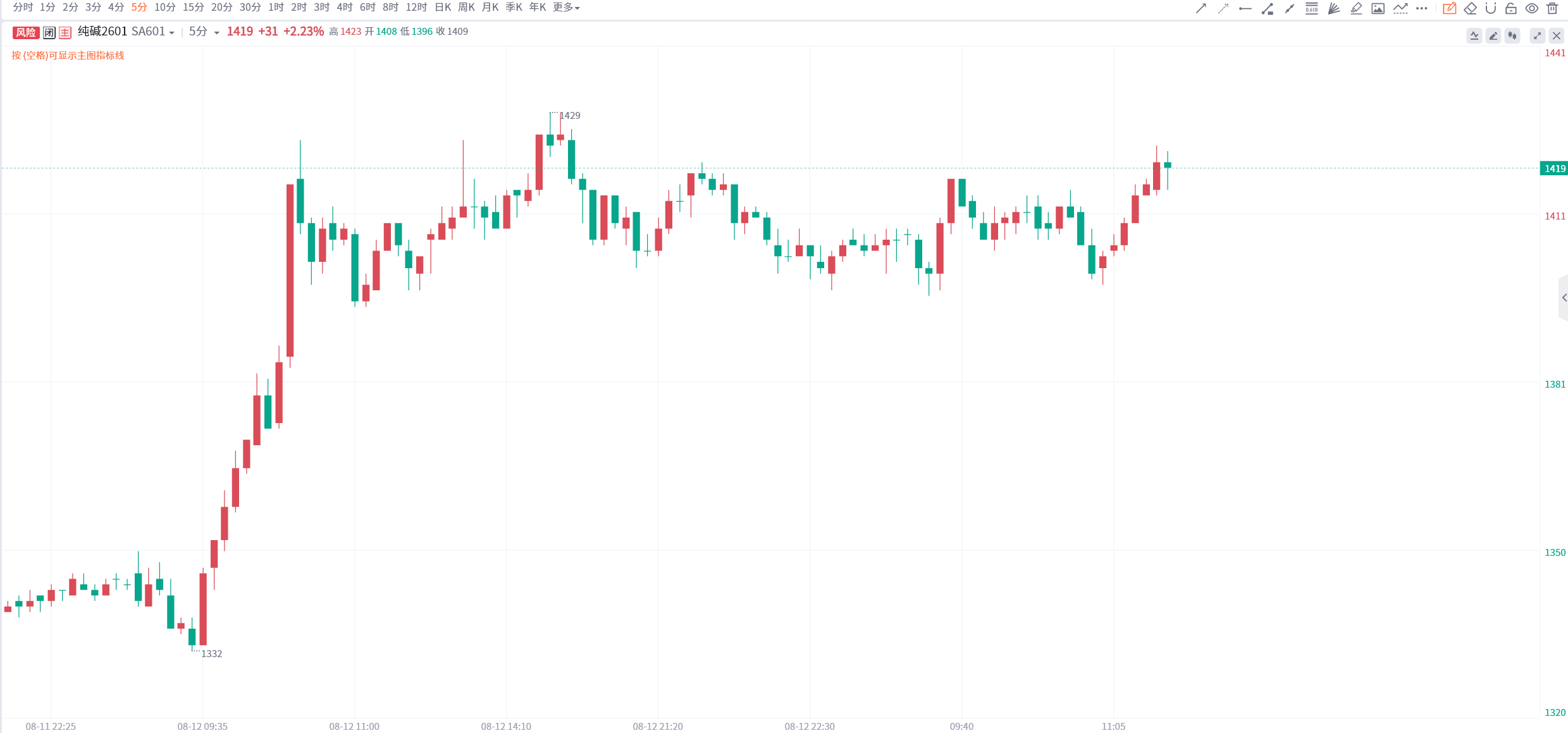
Core Viewpoint - The soda ash futures market is experiencing a volatile upward trend, with the main contract reaching 1410.00 CNY/ton, reflecting a 1.59% increase [1] Industry Summary - As of August 13, 2023, the soda ash production in China is showing mixed operational statuses: Henan Haohua Junhua's facility is running steadily with stable prices, while Tangshan Sanyou's 2.3 million tons/year facility is operating at about 70% capacity, and Shandong Haitai's 1.5 million tons/year facility has increased its load to around 70% [2] - Last week, the domestic soda ash production reached 744,600 tons, marking a 6.4% increase compared to the previous week [2] Market Sentiment - According to Zhengzhou Commodity Exchange, the number of soda ash futures warehouse receipts remained unchanged at 11,194 contracts compared to the previous trading day [3] - Insights from Zhengxin Futures indicate that the soda ash industry structure has not significantly improved, with supply remaining high and demand primarily driven by basic needs. The market is facing upward inventory pressure, making it difficult for fundamentals to provide adequate support. The market sentiment continues to influence price fluctuations, leading to a range-bound movement in soda ash prices [4] - Guotou Anxin Futures highlights the need to monitor the actual impact of environmental events in Qinghai, noting that market sentiment is currently more influential than fundamental changes. The industry continues to face inventory accumulation, with prices experiencing a downward adjustment. Despite some support from the photovoltaic sector, the industry is still in a significant loss phase, suggesting a continuation of capacity reduction trends. The market is expected to remain under pressure in the long term due to supply constraints and a weak market reality [4]
[中辉能化-纯碱专题]-纯碱现货疲弱,警惕过度炒作
Sou Hu Cai Jing· 2025-08-13 06:13
Core Viewpoint - The soda ash futures market has experienced significant volatility, with prices initially rising over 200 CNY/ton due to "anti-involution" sentiment, followed by a rapid decline as speculative trading subsided. Current market conditions suggest a potential for further price fluctuations driven by speculative sentiment, despite weak spot prices [1] Group 1: Market Dynamics - Soda ash futures prices have seen a rollercoaster effect, with a notable increase followed by a return to previous levels within a week [1] - The production costs for soda ash have increased due to rising coal prices, with costs in East China at 1624.5 CNY/ton (up 10 CNY) and in North China at 1244 CNY/ton (up 1 CNY) as of August 7 [1][12] - The expectation of supply contraction in the soda ash market is being fueled by speculative trading, despite the absence of any official capacity exit policies [1][12] Group 2: Supply and Demand Analysis - The soda ash market is currently facing an oversupply situation, with a reported excess of 7.9 million tons per week in heavy soda ash production against consumption [8] - Light soda ash also shows signs of oversupply, with inventories increasing to 71.76 million tons [8] - Despite good export performance, both enterprise and social inventories are rising significantly, indicating a persistent oversupply that may limit price increases [8] Group 3: Trading Recommendations - The recommended trading strategy is to operate within a wide price range, with an estimated price range of 1200 to 1500 CNY/ton [2][15] - Investors are advised to adopt a strategy of buying low and selling high, avoiding chasing prices in a volatile market [1][12]
8.12纯碱日评:纯碱市场个别地区报价上调
Sou Hu Cai Jing· 2025-08-13 02:20
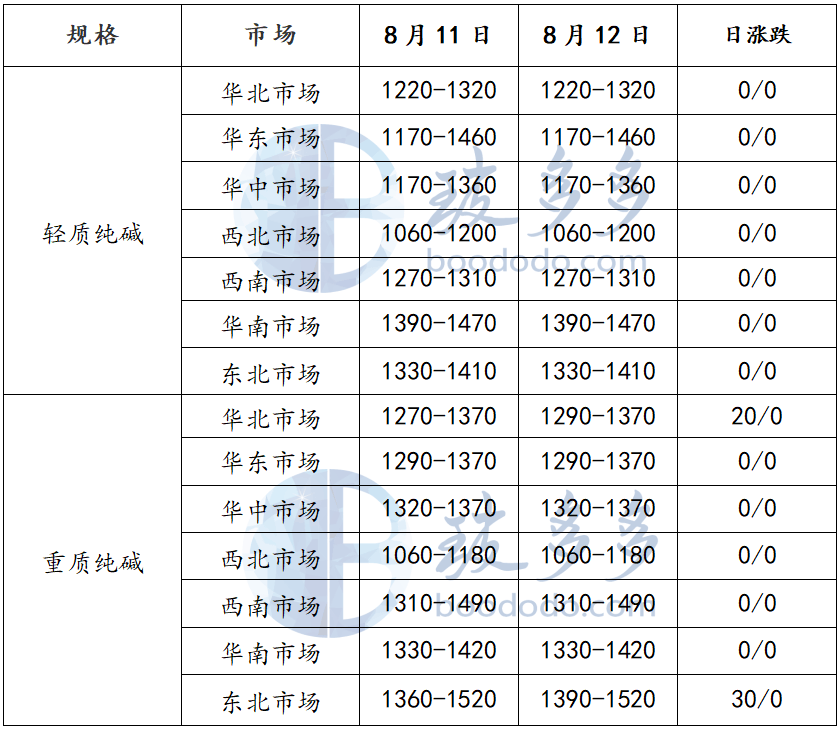
Core Viewpoint - The domestic soda ash market is currently stable with slight fluctuations in prices, while downstream demand remains weak, leading to inventory pressure for soda ash companies [2][6]. Price Analysis - As of August 12, the price range for light soda ash in North China is 1220-1320 CNY/ton, and for heavy soda ash, it is 1290-1370 CNY/ton. In Northeast China, light soda ash is priced at 1330-1410 CNY/ton, and heavy soda ash at 1390-1520 CNY/ton [2][3]. Market Dynamics - The overall operation of soda ash plants is stable, with a relatively high industry operating rate and sufficient market supply. However, the downstream demand sentiment is poor, leading to a cautious purchasing atmosphere [2][6]. Futures Market - On August 12, the main contract for soda ash (SA2601) opened at 1345 CNY/ton and closed at 1409 CNY/ton, with an intraday increase of 5.31%. The market was influenced by potential environmental disruptions in Qinghai and rising costs, despite the lack of significant improvement in the fundamentals [5][6]. Future Outlook - The number of companies undergoing maintenance is low, resulting in a loose supply in the soda ash market. With limited order growth and a lack of clear driving factors, short-term soda ash prices are expected to maintain a narrow fluctuation trend [6].