钢铁

Search documents
策略周报:两会前后市场如何演绎?
Guoxin Securities· 2026-02-28 10:50
Market Performance Insights - Historical data shows a high probability of market gains before and after the Two Sessions, with the probability of increase being 76.2% for the Shanghai Composite Index in the 20 trading days before the sessions[19] - The average gain for the Shanghai Composite Index before the Two Sessions is 1.8%, while the average gain after is 3.1%[20] - The probability of small-cap stocks outperforming large-cap stocks is nearly 90% before the Two Sessions, but drops to 50% afterward[20] Sector Analysis - Resource sectors such as steel and non-ferrous metals have shown high probabilities of gains before the Two Sessions, with probabilities exceeding 80%[22] - Consumer sectors tend to perform better during the Two Sessions, with a 60% probability of gains in industries like food and beverage[20] - Post-Two Sessions, real estate and consumer sectors have a high probability of gains, with real estate at 76.2%[20] Policy Impact - The Two Sessions serve as a critical window for observing economic policy directions, influencing market sentiment and performance[24] - Pre-Two Sessions, there is typically an increase in growth-stabilizing policy expectations, leading to active trading[24] - Post-Two Sessions, the acceleration of policy implementation often boosts optimistic market expectations, particularly for cyclical sectors[24] Current Market Conditions - The spring market rally continues, with the Shanghai Composite Index showing a 3.7% increase since February 3, and a recent weekly gain of 2.0%[1] - Recent trading volumes have increased, with average daily trading rising from 2.1 trillion to 2.4 trillion yuan[1] - Leverage funds have shifted from outflows to inflows, indicating improved market sentiment, with net purchases reaching 258.7 billion yuan recently[1] Investment Strategy - A balanced allocation strategy is recommended, focusing on sectors like AI applications, resources, and real estate, given the current market dynamics[29] - The anticipated continuation of the spring rally is supported by positive macroeconomic policies and increased liquidity in the market[28] - The focus on expanding domestic demand is expected to be a key theme in the upcoming Two Sessions, influencing investment opportunities[24]
A股TTM、全动态估值全景扫描:A股估值扩张,钢铁行业领涨
Western Securities· 2026-02-28 10:21
Core Conclusions - The overall valuation of A-shares has expanded this week, with the steel industry leading the gains. The weak accumulation of winter storage for steel this year has resulted in lower inventory pressure, and the seasonal increase in steel demand post-holiday, combined with strong price recovery expectations due to PPI rebound, supports a rebound in the steel sector. The current full dynamic valuation of the steel industry is at the historical 45.3 percentile, indicating further room for valuation improvement [1][8]. Valuation Overview - The overall PE (TTM) of A-shares increased from 23.10 times last week to 23.59 times this week, while the PB (LF) rose from 1.86 times to 1.90 times [10]. - The main board's PE (TTM) rose from 18.37 times to 18.79 times, and PB (LF) increased from 1.54 times to 1.57 times [18]. - The ChiNext board's PE (TTM) increased from 77.83 times to 80.11 times, and PB (LF) rose from 4.59 times to 4.69 times [20]. - The Sci-Tech Innovation board's PE (TTM) decreased from 227.96 times to 208.25 times, while PB (LF) increased from 5.75 times to 5.82 times [23]. Industry Valuation Levels - From a static PE (TTM) perspective, major industries such as consumer discretionary, midstream manufacturing, cyclical, and consumer staples have absolute and relative valuations above the historical median. Notably, consumer discretionary and midstream manufacturing are above the historical 90th percentile, while essential consumer goods, services, and financial services have relative valuations below the historical 10th percentile [28]. - In terms of PB (LF), industries like resources, cyclical, midstream manufacturing, TMT, and midstream materials have absolute and relative valuations above the historical median, with resources and cyclical industries exceeding the historical 90th percentile. Conversely, consumer staples, services, financial services, and essential consumer goods have both absolute and relative valuations below the historical median, with relative valuations below the historical 10th percentile [31]. - Analyzing full dynamic PE, industries such as consumer discretionary, midstream manufacturing, cyclical, and midstream materials have absolute and relative valuations above the historical median, while financial services and essential consumer goods are below the historical median, with consumer staples having relative valuations below the historical 10th percentile [33]. Performance and Yield Comparison - Current industries like construction materials, power equipment, media, non-bank financials, and steel exhibit both low valuations and high performance growth, indicating potential investment opportunities [3][52]. - The A-share non-financial equity risk premium (ERP) decreased from 0.70% to 0.63%, and the equity-bond yield spread fell from -0.20% to -0.25% this week [53].
策略周报:两会前后市场如何演绎?-20260228
Guoxin Securities· 2026-02-28 09:26
Core Conclusions - Historical data indicates a high probability of market gains before and after the Two Sessions, with cyclical industries showing stronger performance [2][19] - Market performance around the Two Sessions is closely tied to policy expectations, which significantly influence market trends [3][24] - The spring market rally is expected to continue, supported by multiple positive factors, with a balanced allocation strategy recommended, particularly emphasizing AI applications and sectors like resources, real estate, and liquor [1][28] Market Performance Analysis - Since mid-December last year, the spring market rally has gradually unfolded, with a notable increase in trading volume post-holiday. The Shanghai Composite Index has seen a rise of 3.7% from February 3 to the present, with the CSI 300 and the Wind All A Index increasing by 2.3% and 5.2%, respectively [1][13] - Historical analysis from 2005 onwards shows that the market tends to rise significantly in the 20 trading days before the Two Sessions, with probabilities of 76.2% for the Shanghai Composite Index and 85.7% for the Wind All A Index [19][20] Style and Sector Performance - Before the Two Sessions, small-cap stocks outperform, with an 85.7% probability of gains, while post-Two Sessions, the performance of large-cap stocks improves [20][22] - Cyclical sectors tend to perform better before and after the Two Sessions, with resource sectors like steel and non-ferrous metals showing high probabilities of gains [20][22] Policy Influence - The Two Sessions serve as a critical window for observing economic policy directions, with expectations for stable growth policies to rise before the meetings, leading to increased trading activity [3][24] - Post-Two Sessions, as policies are clarified and implemented, there is often a seasonal uptick in high-frequency data, which can enhance optimistic market expectations [3][24] Investment Opportunities - The report suggests a balanced investment approach, focusing on cyclical sectors and real estate, alongside technology driven by AI applications. The resource sector is expected to benefit from domestic policies and global liquidity conditions [28][29] - The real estate sector is highlighted as having a 76.2% probability of gains post-Two Sessions, with recent policy changes in major cities indicating a recovery in the housing market [20][29]
A股市场运行周报第81期:主线未彰显、震荡或继续,维持弹性、继续等待
ZHESHANG SECURITIES· 2026-02-28 07:20
Market Overview - The A-share market continued to show strong fluctuations, with major indices displaying significant divergence, where the Shanghai Composite Index rose by 1.98% for the week[10] - The ChiNext Index and the STAR 50 Index increased by 1.05% and 1.20% respectively, while the Hang Seng Technology Index fell by 1.41%[10][52] Sector Performance - The non-ferrous metals sector rebounded significantly by 9.77%, driven by rare earth and minor metals, while the media and consumer finance sectors weakened, with declines of 5.10% and 1.18% respectively[13][50] - Resource sectors such as steel, chemicals, and oil & petrochemicals saw increases of 12.27%, 7.15%, and 5.61% respectively[50] Market Sentiment and Trading Dynamics - The average daily trading volume in the Shanghai and Shenzhen markets increased to 2.42 trillion yuan, up from 2.09 trillion yuan the previous week[21] - Margin trading data showed a slight increase, with the total margin balance reaching 2.66 trillion yuan, up from 2.58 trillion yuan[29] Investment Strategy - The recommendation is to maintain flexibility in medium-term positions while being cautious and waiting for trend opportunities, and to selectively trade lower-tier stocks for short-term gains[53] - Focus on sectors such as securities, construction materials, and banking, while increasing attention to event-driven opportunities in the oil and petrochemical industries[53] Risk Factors - Risks include potential underperformance of domestic economic recovery and uncertainties in global geopolitical situations[54]
可转债周报(2026年2月24日至2026年2月27日):本周有所下跌-20260228
EBSCN· 2026-02-28 05:45
Group 1: Investment Rating The document does not mention the industry investment rating. Group 2: Core Views - The convertible bond market declined this week. It is recommended that investors track market supply and policy rhythm, select bonds carefully, maintain a moderate position, and adjust the portfolio structure to seek more returns [1][4] Group 3: Summary by Directory Market Conditions - From February 24 to February 27, 2026 (4 trading days), the CSI Convertible Bond Index fell by -0.23% (last week's change was +1.08%), and the CSI All-Share Index rose by +2.74% (last week's change was +1.07%). Since 2026, the CSI Convertible Bond Index has risen by +6.77%, and the CSI All-Share Index has risen by +8.10% [1] - By rating, high-rated bonds (AAA), medium-high-rated bonds (AA+), medium-rated bonds (AA), medium-low-rated bonds (AA-), and low-rated bonds (AA- and below) fell by -0.76%, -0.25%, -1.57%, -1.53%, and -0.42% respectively this week, with medium-high-rated bonds having the smallest decline [1] - By convertible bond size, large-scale convertible bonds (bond balance > 2 billion yuan), medium-large-scale convertible bonds (balance between 1.5 and 2 billion yuan), medium-scale convertible bonds (balance between 1 and 1.5 billion yuan), small-medium-scale convertible bonds (balance between 0.5 and 1 billion yuan), and small-scale convertible bonds (balance < 0.5 billion yuan) changed by -0.80%, +0.02%, -2.84%, -1.34%, and -0.89% respectively this week, with medium-large-scale convertible bonds rising and the rest falling [2] - By conversion parity, ultra-high parity bonds (conversion value > 130 yuan), high parity bonds (conversion value between 120 and 130 yuan), medium-high parity bonds (conversion value between 110 and 120 yuan), medium parity bonds (conversion value between 100 and 110 yuan), medium-low parity bonds (conversion value between 90 and 100 yuan), low parity bonds (conversion value between 80 and 90 yuan), and ultra-low parity bonds (conversion value < 80 yuan) changed by -4.25%, +1.79%, -3.48%, -1.66%, +0.73%, -4.17%, and -0.92% respectively this week, with high parity bonds having the highest increase [2] Convertible Bond Valuation - As of February 27, 2026, there were 384 outstanding convertible bonds (386 at the end of last week), with a balance of 537.419 billion yuan (541.848 billion yuan at the end of last week) [3] - The average convertible bond price was 142.60 yuan (141.58 yuan at the end of last week), with a percentile of 99.87% (from the beginning of 2023 to February 27, 2026) [3] - The average convertible bond parity was 111.01 yuan (108.45 yuan at the end of last week), with a percentile of 100.00% [3] - The average convertible bond conversion premium rate was 31.83% (34.85% at the end of last week), with a percentile of 37.02% [3] Convertible Bond Performance and Allocation Direction - The convertible bond market declined this week. Investors are advised to track market supply and policy rhythm, select bonds carefully, maintain a moderate position, and adjust the portfolio structure to seek more returns [4] Convertible Bond Increase Ranking - The top 15 convertible bonds in terms of increase this week include Youcai Convertible Bond, Shuangliang Convertible Bond, and Guanglian Convertible Bond, etc., with detailed information such as the underlying stock, industry, closing price, convertible bond increase, and underlying stock increase provided [19]
7.4到6.84,人民币升值"核爆"!国内通胀、资产价格要全面起飞?
Sou Hu Cai Jing· 2026-02-28 04:27
Core Viewpoint - The offshore and onshore RMB exchange rates against the US dollar have both surpassed the 6.84 mark, marking a significant appreciation from a low of 7.4, described as a "nuclear explosion" level of increase [1][3]. Exchange Rate Movement - Since February 20, the RMB has experienced five consecutive days of appreciation, with the offshore RMB rising over 600 basis points, nearly 1% [3]. - By February 26, the offshore RMB had appreciated nearly 1400 basis points, reaching a 2% increase, breaking through key levels of 6.9 and 6.85 [5]. - On February 26, the RMB's midpoint against the dollar was reported at 6.9228, an increase of 93 basis points from the previous day, marking a new high since mid-May 2023 [5]. Factors Driving Appreciation - The stabilization of Sino-US economic relations since November 2025 has been a crucial factor, enhancing market confidence in the RMB [12]. - The depreciation of the US dollar, influenced by a criminal investigation into the Federal Reserve Chairman, has also contributed to the RMB's strength [12]. - Positive domestic economic signals, such as a rebound in PPI and a bullish stock market, have attracted global capital towards RMB assets, further supporting the currency's appreciation [14]. - The release of pent-up demand for foreign exchange, driven by high export growth, has accelerated the RMB's rise [14]. Impact on Inflation - Concerns about domestic inflation rising due to RMB appreciation are somewhat valid, but the actual impact is expected to be mild, leading to input-driven deflation rather than inflation [18]. - A 10% nominal trade-weighted appreciation of the RMB could lower CPI inflation by approximately 0.1 percentage points and PPI inflation by about 1 percentage point [20]. - The current PPI is still in a deflationary zone, and the deflationary pressure from RMB appreciation highlights the importance of boosting domestic demand [22]. Asset Price Effects - The appreciation of the RMB is expected to have a more pronounced impact on domestic asset prices, but it will not lead to a "full-scale surge" across all asset types [24]. - Industries with high import dependency, such as petrochemicals and industrial metals, will benefit from reduced import costs, enhancing profitability and asset values [26]. - Sectors with dollar-denominated debt, like aviation and real estate, will see improved financial conditions due to the RMB's strength [28]. - Core RMB assets, including banks and insurance, are likely to attract more global capital, driving steady price increases [30]. - However, not all assets will benefit; real estate in lower-tier cities may continue to struggle due to demographic and economic factors [32]. Future Outlook - The RMB's significant appreciation from 7.4 to 6.84 will bring changes to the domestic economy and capital markets, but these changes are not expected to be revolutionary [34]. - The appreciation trend may continue for a while but is unlikely to be a one-sided increase, with potential for increased volatility as the exchange rate approaches a reasonable range [36]. - The strengthening of the RMB reflects the improvement of domestic economic strength and market confidence in the Chinese economy, which is beneficial for long-term economic development and asset security for individuals [38].

多部委政策支持+碳市场压力,氢冶金项目密集突破
势银能链· 2026-02-28 03:20
Core Viewpoint - The article emphasizes the acceleration of decarbonization in the steel industry in China, driven by the implementation of carbon trading regulations and the adoption of innovative hydrogen metallurgy technologies [2][3]. Group 1: Policy and Regulatory Framework - The steel industry in China accounts for approximately 15% of the country's total carbon emissions, exceeding 1.8 billion tons annually [2]. - The "Interim Regulations on Carbon Emission Trading" will officially include the steel industry in the national carbon trading market starting in 2024, making carbon management a critical factor for competitiveness and financing [2]. - The "Implementation Plan for Accelerating Clean and Low-Carbon Hydrogen Applications in the Industrial Sector" identifies metallurgy as a priority area for clean hydrogen application, aiming for large-scale implementation by 2027 [3]. Group 2: Technological Innovations - Breakthrough technologies such as hydrogen metallurgy and electric arc furnaces are transitioning from demonstration to industrialization, becoming key strategies for the steel industry to enhance green competitiveness [2]. - Hydrogen serves as a clean reducing agent and heat source in steel production, replacing traditional coke in blast furnace processes, thereby eliminating carbon emissions at the source [2]. Group 3: Industry Developments and Milestones - By 2025, major hydrogen metallurgy projects from companies like Angang Steel, Hebei Steel, and Baosteel are expected to achieve significant progress, showcasing diverse exploration trends [4]. - Hebei Steel has developed a hydrogen-based vertical furnace direct reduction process, achieving zero carbon emissions in ironmaking, and signed the world's first hydrogen metallurgy green steel export order [4]. - Longi Hydrogen's project in Hebei has successfully operated a hydrogen-rich smelting industrial demonstration project for a year, utilizing advanced alkaline water electrolysis systems [4]. Group 4: Future Outlook - Hydrogen metallurgy is projected to be a crucial component of the steel industry's decarbonization strategy, with Bloomberg New Energy Finance indicating a focus on hydrogen direct reduction combined with electric arc furnace processes by 2030 [7].


摩洛哥高度关注欧盟“欧洲制造”汽车新规走向
Shang Wu Bu Wang Zhan· 2026-02-28 02:31
Group 1 - The EU is planning to introduce new regulations linking public subsidies to the local manufacturing ratio of products in Europe, particularly in the automotive sector, where electric vehicles must have a 70% localization ratio for parts (excluding batteries) to qualify for subsidies [1] - This initiative is part of the Industrial Accelerator Act (IAA) framework, aimed at strengthening local supply chains and reducing reliance on external sources [1] - The announcement of the related proposal has been delayed from February 26 to March 4 due to internal disagreements on the geographical definition of "European manufacturing," indicating potential adjustments to the legislation [1] Group 2 - The European public subsidy policy is increasingly emphasizing local added value, with stricter environmental regulations leading automotive companies to focus investments on electric platforms, battery systems, and smart technologies [2] - Morocco's automotive industry is deeply integrated into the European supply chain, making its performance highly dependent on European market demand and policy changes, with signs of a year-on-year decline expected by 2025 [2] - If the "European manufacturing" standards tighten further and are linked to subsidy eligibility or market access, Moroccan automotive manufacturers may face risks of order migration and slowed new investments, impacting local employment stability and economic growth [2]
未知机构:东财策略每日复盘20260227一市场概况2月27日A股结-20260228
未知机构· 2026-02-28 02:30
Summary of Key Points from Conference Call Records Company/Industry Overview - The records pertain to the A-share market in China, specifically focusing on the performance of various sectors and macroeconomic indicators as of February 27, 2026 [1][2]. Core Insights and Arguments - **Market Performance**: - The Shanghai Composite Index increased by 0.39% to close at 4162 points, while the Shenzhen Component Index decreased by 0.06% and the ChiNext Index fell by 1.04% [1]. - Total trading volume reached 2.49 trillion yuan, an increase of over 500 billion yuan compared to the previous day [1]. - A total of 3271 stocks rose, while 2068 stocks declined throughout the day [1]. - **Sector Performance**: - The top five performing sectors included: - Steel: +3.37% - Coal: +3.20% - Non-ferrous Metals: +3.10% - Utilities: +2.27% - Agriculture, Forestry, Animal Husbandry, and Fishery: +2.06% [1]. - The bottom five performing sectors were: - Building Materials: -1.45% - Telecommunications: -1.38% - Electronics: -0.71% - Automotive: -0.41% - Home Appliances: -0.39% [1]. - **Thematic Insights**: - The CPO concept faced declines due to external market pressures, while the commercial aerospace sector continued to rise, and rare earth permanent magnets showed strength [2]. - AI applications experienced a rebound [2]. Additional Important Information - **Monetary Policy**: - The People's Bank of China announced a reduction in the foreign exchange risk reserve ratio for forward foreign exchange sales from 20% to 0%, effective March 2, 2026, to support enterprises in managing exchange rate risks [2]. - **Space Exploration Initiatives**: - The China Manned Space Engineering Office plans to implement two manned flight missions and one cargo spacecraft supply mission in 2026, with astronauts from Hong Kong and Macau expected to participate [2]. - **Supply Chain Challenges**: - U.S. aerospace and semiconductor suppliers are facing significant rare earth shortages, leading at least two suppliers to refuse certain customer orders [2]. - **Market Outlook**: - High trading volumes indicate ample market liquidity, suggesting a continuation of structural rotation and a volatile upward trend [2]. - Short-term focus on domestic computing power hardware is advised, with potential price increases in rare earths and strategic metals driven by supply constraints and value reassessment [2]. - The upcoming Two Sessions and the emphasis on the 14th Five-Year Plan are expected to enhance interest in new productive forces [2]. - Attention is warranted on U.S. and European trade policies towards China, which may impact market risk appetite [2].
模具钢市场洞察 | 全球前16强生产商排名及市场份额
QYResearch· 2026-02-28 02:06
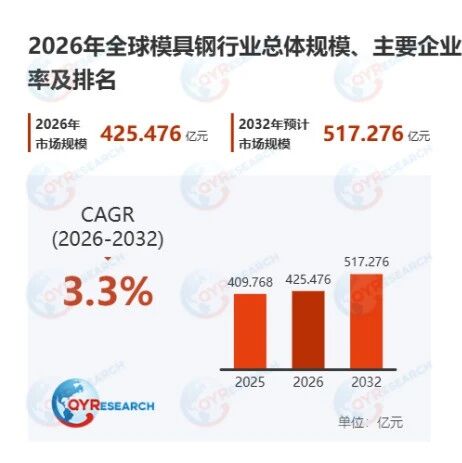
Global Market Overview - The global die steel market is projected to reach USD 6.257 billion by 2032, with a compound annual growth rate (CAGR) of 3.3% in the coming years [4]. Key Manufacturers and Market Share - Major global manufacturers of die steel include Voestalpine, Swiss Steel Group, Tiangong International, Datong Special Steel, Northeast Special Steel, and others. The top five manufacturers hold approximately 41% of the market share [6]. Industry Drivers - The demand for die steel is increasing due to the manufacturing industry's shift towards high precision, efficiency, and consistency. Industries such as automotive (including new energy), home appliances, 3C electronics, packaging, and general machinery are driving the consumption and renewal of die steel [9]. Challenges in the Market - The die steel market faces constraints primarily from cost and process coordination uncertainties. Fluctuations in upstream alloy element and energy prices affect material cost stability. High-end die steel requires stringent cleanliness, uniformity, and defect control, posing challenges for suppliers [10]. Industry Development Opportunities - Growth opportunities are mainly seen in high-end, green manufacturing, and service-oriented delivery. The expansion of large integrated die-casting, ultra-high-strength steel hot forming, and precision stamping is expected to increase the demand for high-performance die steels [11].