科技

Search documents
情绪指标低位+盈利驱动,港股迎反弹!机构:科技或仍是主线
Jin Rong Jie· 2025-12-12 03:28
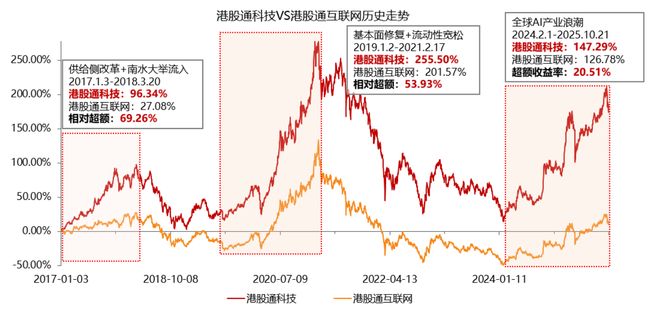
Group 1 - The core viewpoint of the news highlights the strong performance of Hong Kong technology stocks, with notable gains from companies like SenseTime, Horizon Robotics, Xiaomi, Li Auto, ZTE, and Meituan, indicating a positive market sentiment in the tech sector [1] - The repurchase activity among Hong Kong-listed companies has significantly increased, with over 700 million shares repurchased in November alone, showing a marked increase compared to previous months [1] - Tencent Holdings resumed its share buyback on November 18, accumulating a total buyback amount of HKD 11.443 billion since then, while Xiaomi has also shown a strong buyback commitment, reflecting enhanced confidence in their stock [1] Group 2 - The Hong Kong Stock Connect Technology ETF tracks a technology index with a current P/E ratio of 25.90, which has expanded by 8% since the beginning of the year, indicating that the index's rise is primarily driven by earnings rather than valuation expansion [2] - Historical data suggests that after significant adjustments, the Hong Kong Stock Connect Technology Index tends to exhibit stronger resilience and explosive growth, having increased by 209.77% from early 2017 to the third quarter of 2025, outperforming the Hong Kong Internet Index [2] - According to China International Capital Corporation, the current valuation levels in the Hong Kong market remain attractive, with key investment opportunities identified in sectors such as technology innovation and new productive forces, which are expected to be major themes in the coming years [4]

信达国际控股港股晨报-20251212
Xin Da Guo Ji Kong Gu· 2025-12-12 02:04
Core Insights - The report highlights the potential for Zijin Mining (2899) with a target price of HKD 38.00, indicating a potential upside of 14.9% from the current price of HKD 33.08 [10][15] - The macroeconomic environment suggests a supportive stance for the Hong Kong stock market, with the Hang Seng Index expected to find short-term support around 25,000 points [2][4] Company Analysis - Zijin Mining has faced supply disruptions due to the shutdown of several large mines, leading to downward revisions in global copper production forecasts for 2025 and 2026 [10] - The company is expected to benefit from increased demand for copper driven by AI investments, green energy transitions, and defense spending, with projections indicating a supply-demand imbalance over the next decade [11] - Zijin Mining's operational performance has exceeded market expectations, with a 10% year-on-year increase in revenue to RMB 254.2 billion and a 55% increase in net profit to RMB 37.86 billion in the first three quarters of the year [12] - The company has a diversified global mining portfolio, operating in 17 countries, which helps mitigate risks associated with supply chain disruptions [13] - If metal prices continue to rise, earnings forecasts for 2026 could be adjusted upwards, with projected earnings per share increasing by approximately 28% to RMB 2.475 [14] Industry Insights - The macroeconomic focus includes stabilizing the real estate market and promoting domestic demand, with the central economic work conference emphasizing the need for targeted fiscal policies [4][18] - The retail sector is expected to undergo innovation and transformation during the 14th Five-Year Plan period, with increased policy support anticipated [4][18] - The automotive industry in China is projected to see significant growth, with exports expected to reach 7 million vehicles in 2025, driven by strong demand for AI-related electronic products [4][18]
当低利率邂逅风偏回归,资产配置被动为盾,主动为矛
Orient Securities· 2025-12-12 01:55
Group 1 - The report highlights two main challenges for asset allocation in 2026: a long-term challenge of reduced hedging effectiveness between stocks and bonds due to low interest rates, and a short-term challenge of market risk preferences returning to the middle from extremes [10][15][16] - The report emphasizes the importance of increasing income and reducing volatility in a low interest rate environment, suggesting that income can be enhanced by broadening asset types, while volatility can be managed through refined risk management tools [17][18][29] Group 2 - The report discusses the shift in risk preferences, noting that in recent years, investor sentiment has polarized, but there is now a trend of returning to a more balanced risk appetite [15][42] - It suggests that low-volatility strategies should incorporate more flexibility, while high-volatility strategies need to focus on risk control, indicating a shift in investment focus towards mid-cap blue-chip stocks and commodities like gold [44][45] Group 3 - The report outlines a dual approach to asset allocation: passive strategies as a shield for risk diversification and active strategies as a sword for enhancing returns, particularly in the context of low interest rates and changing market dynamics [46][47] - It recommends focusing on commodities, overseas assets, and alternative investments like REITs to achieve better risk-adjusted returns in the current market environment [52][54]
提质扩容,发力新领域新赛道
Sou Hu Cai Jing· 2025-12-12 00:07
Core Viewpoint - The article discusses the recent implementation of a plan by the Ministry of Industry and Information Technology and five other departments to enhance the adaptability of supply and demand in consumer goods, aiming to stimulate consumption and economic growth. Group 1: Consumption Trends - The article highlights the emergence of new cultural and tourism products, such as ice and snow sports experiences, which are contributing to a "hot economy" from previously underutilized "cold resources" [2] - The release of the Beijing Winter Olympics mascot "Bing Dwen Dwen" has seen a significant consumer demand, indicating a robust market for cultural products [2] - The film "Zootopia 2" has outperformed expectations in the Chinese market, showcasing the potential of the domestic box office [2] Group 2: Supply and Demand Adaptation - The article emphasizes the shift in consumer demand from mere availability to quality, as outlined in the "14th Five-Year Plan," which calls for an expansion of high-quality consumer goods and services [2] - It discusses the structural mismatch in supply and demand, particularly in the elderly care market, where the market size is expected to grow from 2.6 trillion yuan to 5.4 trillion yuan from 2014 to 2024, yet there are challenges in meeting consumer needs [3] Group 3: Innovation and New Consumption Models - The article stresses the importance of innovation in driving consumption, highlighting the need for new products, services, and experiences to meet evolving consumer preferences [4] - It notes the role of technology and digitalization in enhancing production capabilities and developing high-quality consumer goods [4] - The article mentions the increasing international presence of Chinese brands, such as the expansion of "Mixue Ice City" with over 5,000 overseas stores, reflecting a growing global consumer market [4] Group 4: Market Opportunities - The article identifies potential in traditional consumption sectors, such as the success of a clothing company in producing yoga apparel, and the food industry’s shift towards low glycemic index products [5] - It highlights the emergence of new consumption hotspots, particularly in urban areas, where international brands are being integrated into local markets [5] - The article points out the opportunities in new technology sectors, such as wearable devices and elder care robots, which are benefiting from the "AI+" trend [6] Group 5: Economic Growth and Consumer Potential - The article concludes that consumption is a crucial driver of economic growth and that enhancing supply-demand adaptability will unleash consumer potential, contributing to the overall stability and growth of the Chinese economy [6]
提质扩容,发力新领域新赛道(评论员观察)
Ren Min Ri Bao· 2025-12-11 22:11
Core Viewpoint - The article discusses the recent implementation plan by the Ministry of Industry and Information Technology and five other departments to enhance the adaptability of supply and demand in consumer goods, aiming to stimulate consumption and economic growth. Group 1: Consumption Trends - The article highlights the emergence of new cultural and tourism products related to winter sports and heritage experiences, which are contributing to the "hot economy" from "cold resources" [2] - The release of the Beijing Winter Olympics mascot "Bing Dwen Dwen" has seen a significant consumer demand, indicating a robust market for cultural products [2] - The film "Zootopia 2" has outperformed expectations in the Chinese market, showcasing the potential of the large domestic market [2] Group 2: Supply and Demand Adaptation - The article emphasizes the shift in consumer demand from mere availability to quality, as outlined in the "14th Five-Year Plan," which calls for expanding the supply of quality consumer goods and services [2] - It points out the structural mismatch in supply and demand, particularly in the elderly products market, where the market size is expected to grow from 2.6 trillion yuan to 5.4 trillion yuan from 2014 to 2024 [3] - The need for businesses to align their production with consumer preferences is highlighted, suggesting that policies should focus on fostering high-end brands and innovative products [3] Group 3: Innovation and Quality - The article stresses the importance of innovation in driving consumption, with new products and services being essential for meeting consumer demands [4] - It mentions the role of technology and digitalization in enhancing production capabilities and developing high-quality consumer goods [4] - The expansion of international markets for Chinese brands, such as the significant growth of overseas stores for brands like Mixue Ice City, is noted as a way to elevate consumption levels [4] Group 4: Market Opportunities - The article identifies potential in traditional consumption sectors, suggesting that there are still opportunities for growth through innovative approaches [5] - New consumption hotspots are emerging, with cities like Shanghai integrating international brands and outdoor economies to boost local consumption [6] - The rise of health-focused brands and technology in sectors like wearable devices and elder care is highlighted as a response to changing consumer needs [6] Group 5: Economic Impact - The article concludes that consumption is a crucial engine for economic growth, and the current period of rapid consumption structure upgrade is vital for unleashing market potential [6] - It emphasizes that enhancing supply-demand adaptability will stimulate domestic demand and support sustainable economic development [6]
提质扩容,发力新领域新赛道(评论员观察) ——供需更适配 消费活力足①
Ren Min Ri Bao· 2025-12-11 21:57
Core Insights - The article discusses the recent implementation of a plan by six departments, including the Ministry of Industry and Information Technology, aimed at enhancing the adaptability of supply and demand in consumer goods, with a focus on five key tasks to stimulate consumption [1] Group 1: Consumption Trends - The article highlights the emergence of new cultural and tourism products, such as ice and snow sports experiences, which are contributing to a "hot economy" from previously underutilized "cold resources" [2] - The success of the Beijing Winter Olympics mascot "Bing Dwen Dwen" and the strong box office performance of "Zootopia 2" in China indicate a robust consumer market that exceeds expectations [2] - The shift in consumer demand from mere availability to quality reflects a growing emphasis on high-quality products and services, as outlined in the "14th Five-Year Plan" [2][3] Group 2: Supply and Demand Adaptation - The article emphasizes the importance of addressing structural mismatches in supply and demand, particularly in the elderly care market, where the market size is projected to grow from 2.6 trillion yuan to 5.4 trillion yuan from 2014 to 2024 [3] - It suggests that businesses should focus on producing what consumers want, such as high-end brands in jewelry and cosmetics, to better meet diverse consumer needs [3] Group 3: Innovation and New Consumption - The article stresses the significance of innovation in driving consumption, highlighting the need for new products, services, and experiences to meet evolving consumer demands [4] - It notes that the integration of technology and digitalization is crucial for enhancing existing production capacities and developing high-quality products [4] - The expansion of international brands and the success of Chinese brands in global markets, such as the rapid growth of overseas stores for brands like Mixue Ice City, demonstrate the potential for increased consumption levels [4] Group 4: Market Opportunities - The article identifies opportunities in traditional consumption sectors, suggesting that there is still potential for growth through innovative approaches, such as the production of yoga apparel and low glycemic index food products [5] - It highlights the emergence of new consumption hotspots, particularly in urban areas, where brands are adapting to health trends and cultural heritage [6] - The article concludes that the acceleration of consumption structure upgrades is critical for stimulating domestic demand and supporting economic stability [6]
降息靴子落地 A股冲高回落
Sou Hu Cai Jing· 2025-12-11 16:55
Group 1 - The A-share market experienced a collective decline on Thursday, with the Shanghai Composite Index falling by 0.70% to close at 3873.32 points, the Shenzhen Component down by 1.27% to 13147.39 points, and the ChiNext Index decreasing by 1.41% to 3163.67 points [1] - The trading volume in the Shanghai and Shenzhen markets reached 185.71 billion yuan, an increase of 78.6 billion yuan compared to the previous trading day, indicating heightened market activity [1] - Despite initial positive reactions to the Federal Reserve's interest rate cut of 25 basis points and the initiation of quantitative easing, the market faced a sharp downturn in the afternoon, leading to a broad-based decline in stocks [1][2] Group 2 - The market's internal structure revealed a "buy the rumor, sell the news" phenomenon, with significant gains in growth sectors like the ChiNext Index, suggesting that optimistic expectations for the Fed's policy shift had already been priced in [2] - The external market environment provided additional tightening signals, with Oracle's stock plummeting over 11% post-earnings, raising concerns about potential valuation bubbles in the AI sector, which negatively impacted related stocks in the A-share market [2] - Technically, the market showed a volume decline, with all three major indices breaking below the 5-day moving average, indicating a potential shift back to a consolidation phase unless a strong recovery occurs [3]
股指期货将偏强震荡,黄金、白银、铜、焦煤期货将偏强震荡,纸浆期货将震荡偏强,螺纹钢、铁矿石期货将偏弱震荡
Guo Tai Jun An Qi Huo· 2025-12-11 13:18
Report Industry Investment Rating No relevant content provided. Core Viewpoints - Through macro - fundamental analysis and technical analysis, the report predicts the trend of today's futures main contracts. Index futures, gold, silver, copper, aluminum, alumina, lithium carbonate, coking coal, soda ash, and methanol futures are likely to have a relatively strong oscillation; pulp futures are likely to oscillate with a relatively strong trend; 30 - year treasury bond and polysilicon futures are likely to have a wide - range oscillation; tin and fuel oil futures are likely to oscillate weakly; rebar, hot - rolled coil, iron ore, and soybean meal futures are likely to have a relatively weak oscillation; and glass futures are likely to oscillate and consolidate [2][3][4][7]. Summary by Related Catalogs Futures Market Outlook - **Stock Index Futures**: On December 10, the main contracts of stock index futures showed different trends. On December 11, they are expected to have a relatively strong oscillation. For the whole of December 2025, they are expected to have a relatively strong wide - range oscillation. For example, IF2512 had a resistance of 4590 and 4614 points and a support of 4555 and 4525 points on December 11 [13][14][15][17][18]. - **Treasury Bond Futures** - **Ten - year Treasury Bond Futures**: On December 10, the main contract T2603 rose slightly. On December 11, it is expected to have a relatively strong oscillation with a resistance of 108.12 and 108.20 yuan and a support of 107.92 and 107.74 yuan [34]. - **Thirty - year Treasury Bond Futures**: On December 10, the main contract TL2603 rebounded. On December 11, it is expected to have a wide - range oscillation with a support of 112.3 and 112.0 yuan and a resistance of 113.1 and 113.6 yuan [37][38]. - **Precious Metal Futures** - **Gold Futures**: On December 10, the main contract AU2602 rebounded slightly. In December 2025, it is expected to have a relatively strong wide - range oscillation. On December 11, it is expected to have a relatively strong oscillation with a resistance of 961.0 and 963.3 yuan/gram and a support of 951.5 and 945.5 yuan/gram [41]. - **Silver Futures**: On December 10, the main contract AG2602 rose significantly. In December 2025, it is expected to oscillate with a relatively strong trend and set a new high. On December 11, it is expected to have a relatively strong oscillation and set a new high, with a resistance of 14419 and 14600 yuan/kg and a support of 14000 and 13892 yuan/kg [47]. - **Base Metal Futures** - **Copper Futures**: On December 10, the main contract CU2601 stopped falling and rebounded. In December 2025, it is expected to oscillate with a relatively strong trend and set a new high. On December 11, it is expected to have a relatively strong oscillation with a resistance of 92500 and 93300 yuan/ton and a support of 91400 and 90700 yuan/ton [52]. - **Aluminum Futures**: On December 10, the main contract AL2602 stopped falling and rebounded. In December 2025, it is expected to oscillate with a relatively strong trend. On December 11, it is expected to have a relatively strong oscillation with a resistance of 22090 and 22230 yuan/ton and a support of 21790 and 21750 yuan/ton [58][59]. - **Alumina Futures**: On December 10, the main contract AO2601 fell weakly. In December 2025, it is expected to oscillate weakly and set a new low. On December 11, it is expected to have a relatively strong oscillation with a resistance of 2525 and 2553 yuan/ton and a support of 2474 and 2460 yuan/ton [64]. - **Tin Futures**: On December 10, the main contract SN2601 rose strongly. In December 2025, it is expected to oscillate with a relatively strong trend. On December 11, it is expected to oscillate weakly with a resistance of 322600 and 324200 yuan/ton and a support of 312300 and 310300 yuan/ton [68]. - **Energy and Chemical Futures** - **Fuel Oil Futures**: On December 10, the main contract FU2601 stopped falling and rebounded slightly. On December 11, it is expected to oscillate weakly with a resistance of 2427 and 2437 yuan/ton and a support of 2350 and 2330 yuan/ton [102]. - **Methanol Futures**: On December 10, the main contract MA601 fell. On December 11, it is expected to have a relatively strong oscillation with a resistance of 2089 and 2104 yuan/ton and a support of 2053 and 2038 yuan/ton [105]. - **Coking Coal Futures**: On December 10, the main contract JM2605 fell. In December 2025, it is expected to have a relatively weak wide - range oscillation. On December 11, it is expected to have a relatively strong oscillation with a resistance of 1083 and 1110 yuan/ton and a support of 1050 and 1039 yuan/ton [90]. - **Polysilicon Futures**: On December 10, the main contract PS2605 fell slightly. On December 11, it is expected to have a wide - range oscillation with a resistance of 56670 and 57350 yuan/ton and a support of 54020 and 52750 yuan/ton [71]. - **Lithium Carbonate Futures**: On December 10, the main contract LC2605 rose strongly. In December 2025, it is expected to have a wide - range oscillation. On December 11, it is expected to have a relatively strong oscillation with a resistance of 97300 and 98800 yuan/ton and a support of 95900 and 93500 yuan/ton [74]. - **Glass Futures**: On December 10, the main contract FG601 fell weakly. In December 2025, it is expected to have a relatively weak wide - range oscillation. On December 11, it is expected to oscillate and consolidate with a resistance of 978 and 984 yuan/ton and a support of 950 and 930 yuan/ton [94]. - **Soda Ash Futures**: On December 10, the main contract SA601 fell weakly. In December 2025, it is expected to have a relatively weak wide - range oscillation and set a new low. On December 11, it is expected to have a relatively strong oscillation and set a new low, with a resistance of 1115 and 1121 yuan/ton and a support of 1080 and 1060 yuan/ton [99]. - **Agricultural Futures** - **Soybean Meal Futures**: On December 10, the main contract M2605 fell slightly. On December 11, it is expected to oscillate weakly with a resistance of 2763 and 2770 yuan/ton and a support of 2738 and 2728 yuan/ton [107]. - **Pulp Futures**: On December 10, the main contract SP2605 fell slightly. On December 11, it is expected to oscillate with a relatively strong trend with a resistance of 5678 and a daily limit of 5696 yuan/ton and a support of 5444 and 5430 yuan/ton [109]. - **Building Materials Futures** - **Rebar Futures**: On December 10, the main contract RB2605 stopped falling and rebounded. In December 2025, it is expected to have a wide - range oscillation. On December 11, it is expected to oscillate weakly with a resistance of 3123 and 3140 yuan/ton and a support of 3075 and 3066 yuan/ton [80]. - **Hot - Rolled Coil Futures**: On December 10, the main contract HC2605 stopped falling and rebounded. On December 11, it is expected to oscillate weakly with a resistance of 3282 and 3298 yuan/ton and a support of 3248 and 3238 yuan/ton [83]. - **Iron Ore Futures**: On December 10, the main contract I2605 stopped falling and rebounded. In December 2025, it is expected to have a wide - range oscillation. On December 11, it is expected to oscillate weakly with a resistance of 770 and 778 yuan/ton and a support of 761 and 758 yuan/ton [86]. Macro News and Trading Tips - There are reports that China is considering restricting the purchase of NVIDIA's advanced H200 chips [8]. - China's November CPI increased by 0.7% year - on - year, hitting the highest since March 2024; the core CPI increased by 1.2% year - on - year. The CPI decreased by 0.1% month - on - month, and the PPI increased by 0.1% month - on - month [8]. - The IMF believes that the Chinese economy shows significant resilience and is expected to grow by 5.0% and 4.5% in 2025 and 2026 respectively [8]. - The Fed cut interest rates by 25 basis points for the third time this year, lowered the federal funds rate target range to 3.50% - 3.75%, and launched a short - term treasury bond purchase plan of about $40 billion per month [9]. - The US government's November budget deficit decreased to $173 billion [11]. - The US third - quarter employment cost index increased by 3.5% year - on - year, hitting a four - year low [11]. - The ECB may raise its economic growth forecast, and the Bank of Canada maintained its benchmark interest rate at 2.25% [10][11]. Commodity Futures Related Information - The SHFE adjusted the daily limit range, margin ratio for hedging positions, and general positions of the silver futures AG2602 contract [11]. - On December 10, international precious metal futures generally rose, crude oil futures rose, and most London base metals rose [12]. - The on - shore RMB against the US dollar rose on December 10, and the US dollar index fell [13][16].
全球资产配置资金流向月报(2025年11月):11月中国与新兴市场流入加速,发达市场流入减速-20251211
Shenwan Hongyuan Securities· 2025-12-11 13:08
Market Overview - In November, the U.S. non-farm payrolls increased by 119,000, significantly exceeding the market expectation of 50,000, while the unemployment rate rose by 0.1 percentage points to 4.4%, the highest level since November 2021[3] - The Federal Reserve lowered interest rates by 25 basis points on December 10, totaling a 75 basis point reduction for the year, with three dissenting votes indicating increased internal division[3] Global Asset Flows - Global funds saw a significant inflow into the money market, with approximately $2,530 billion in November, up from $1,290 billion in October[3] - In the equity markets, developed markets saw an inflow of $720 billion in November, down from $840 billion in October, while emerging markets experienced an inflow of $380 billion, up from $220 billion[3] - The bond market saw a notable increase in inflows, with global government bonds attracting $270 billion in November compared to $70 billion in October[3] China Market Insights - In November, China's equity market attracted $180.74 billion, accounting for 44.65% of the total inflow into emerging markets, while the fixed income market saw an inflow of $29.26 billion, representing 31.78%[3] - Passive equity funds were the main contributors to the inflow in emerging markets, with $424.48 billion flowing into emerging markets and $191.85 billion into China's equity market in November[3] Country Allocation Trends - As of October, global funds allocated 61.9% to the U.S. stock market, a slight increase of 0.3 percentage points from September, while the allocation to China's stock market decreased by 0.1 percentage points[3] - The allocation to China's stock market is currently at a 10-year percentile of 37.9%, indicating potential for future growth[3] Risk Factors - Short-term asset price fluctuations may not represent long-term trends, and there is a risk of deeper-than-expected economic recession in Europe and the U.S.[3]
2026年中国消费新图景报告
Sou Hu Cai Jing· 2025-12-11 10:37
Core Insights - The report by NielsenIQ outlines the evolving landscape of China's consumer market, highlighting a shift in consumer attitudes and behaviors against a backdrop of economic stability and increasing consumption contributions [1] Group 1: Consumer Sentiment and Behavior - Consumers are increasingly optimistic about their financial situations, yet approximately 40% remain cautious in their spending habits [1][8] - Economic conditions and family happiness are the two primary concerns for consumers, with product safety and quality being foundational in purchasing decisions [1][10] - Over 60% of consumers are willing to pay a premium for products that enhance their life experiences [1] Group 2: Generational Insights - The Baby Boomer generation (aged 61 and above) represents less than 20% of the population but shows a strong willingness to spend, with 70% eager to consume and nearly 80% willing to pay a premium for products that support a fulfilling retirement [2] - Generation X (aged 44 to 59) is characterized by a pragmatic approach to spending, with over one-third identifying as cautious consumers and nearly half only purchasing items they deem necessary [3] - Millennials (aged 29 to 44) prioritize experiences and are willing to pay more for superior quality and safety, with transparency in supply chains and sustainability being key factors in their purchasing decisions [4] - Generation Z (aged 18 to 27) focuses on community recognition and efficiency, showing a preference for products that resonate with their interests and are less influenced by traditional endorsements [5] Group 3: Market Trends and Recommendations - The report emphasizes the need for brands to clearly define their value propositions and target specific generational cohorts to foster deep connections with consumers [5] - Brands should leverage technology to enhance product experiences and integrate social responsibility and sustainability into their core values to build long-term trust with consumers [4][5]