
消费

Search documents
英大证券晨会纪要-20250811
British Securities· 2025-08-11 02:22
Market Overview - The market is currently experiencing a phase of consolidation, with the Shanghai Composite Index reaching new highs but failing to maintain those gains, indicating a need for time and space to digest recent movements [3][4][5] - The market sentiment is cautious, with a notable divergence between indices, particularly a stronger Shanghai index compared to weaker Shenzhen and ChiNext indices, reflecting internal market discrepancies [4][20] - Trading volume has decreased, with a total turnover of approximately 1.7 trillion, suggesting a lack of enthusiasm for chasing higher prices, which may hinder the ability to initiate a new upward trend [4][20] Sector Performance - Traditional sectors such as cement, engineering machinery, and hydropower have shown strong rebounds, while AI application sectors have collectively declined, negatively impacting market sentiment [3][19] - The military industry has seen significant gains, with a notable increase in stock prices, supported by government policies and geopolitical tensions that may act as catalysts for further growth [11][12] - The robotics sector has also experienced substantial growth, with a 60% increase in related stocks since early January, although a recent pullback suggests caution is warranted [12] - Precious metals have risen due to factors such as the onset of a rate-cutting cycle by the Federal Reserve and increased geopolitical tensions, which have driven demand for gold as a safe-haven asset [14] - The semiconductor sector remains a focal point for investment, with expectations of continued growth driven by government support and rising global demand for AI and high-performance computing [16] Investment Strategy - The report emphasizes the importance of selecting stocks with high certainty in performance and reasonable valuations, particularly those benefiting from policy support or industry trends [5][21] - Investors are advised to focus on sectors with structural opportunities, such as semiconductors, AI, and healthcare, while being cautious of stocks that have risen significantly without strong fundamental backing [5][21] - The outlook for the A-share market suggests a "slow bull" trend, with structural opportunities requiring enhanced stock-picking skills and timing [5][21]
国泰海通 · 晨报0811|宏观、海外策略
国泰海通证券研究· 2025-08-10 14:39
Macro Overview - The article highlights a rebound in inflation expectations in the US, with both 5-year and 10-year inflation expectations rising in August, indicating a marginal improvement in investor confidence [2][3] - Major economic indicators show mixed results: initial jobless claims increased, ISM non-manufacturing PMI declined, and durable goods orders fell month-on-month in June [2] - In Europe, the Eurozone investment confidence index turned negative again, while retail sales showed a year-on-year increase in June, and PPI saw a slight rebound [2] Policy Insights - The US labor market is showing signs of slowing down, creating a dilemma for the Federal Reserve regarding monetary policy; the European Central Bank is not expected to cut interest rates in the short term; the Bank of Japan is maintaining its current interest rates but may exit its wait-and-see mode by the end of the year [3] Hong Kong Market Liquidity - The article estimates that the total financing scale for IPOs and refinancing in Hong Kong could reach nearly HKD 300 billion this year, with IPO financing expected to be around HKD 1,500 billion [6] - The peak of stock unlocks in Hong Kong occurred in Q2 2025, with a total unlock amount of HKD 444.8 billion, accounting for 50% of the annual total; the pressure for significant reductions in holdings is limited moving forward [7][8] - The article anticipates that net inflows from southbound trading could exceed HKD 1.2 trillion this year, providing a substantial liquidity source for the Hong Kong market [9]


中信建投:全球市场流动性宽松预期推升风险偏好
Xin Lang Cai Jing· 2025-08-10 10:58
Group 1 - The core viewpoint is that expectations of liquidity easing are driving an increase in global market risk appetite, with strong performances in AH shares and US stocks, while bond market interest rates are declining [1] - Market attention is focused on three main clues: the impact of tariffs on US inflation, the potential reversal of the "Goldilocks" narrative due to a slowdown in US economic data, and the pricing window for domestic policy expectations [1] - Upcoming events such as the China-US tariff negotiations and the US July CPI data are highlighted as key focal points for the market [1] Group 2 - Global commodity prices are showing divergence, with gold and copper prices rebounding while crude oil is experiencing a pullback [1] - With the implementation of livelihood policies, consumer spending is expected to receive support [1] - Statements from Federal Reserve officials and inflation data will influence future interest rate and exchange rate trends [1]

机构论后市丨牛市氛围不会轻易消失;下半年市场或冲击新高
Di Yi Cai Jing· 2025-08-10 09:51
Group 1 - The bull market atmosphere is unlikely to disappear easily, with technology and manufacturing sectors potentially becoming the main themes [1] - In July, high-risk capital saw significant inflows, while foreign and insurance capital allocations also increased [2] - The market may reach new highs in the second half of the year, with a focus on both short-term and long-term themes [3] Group 2 - The innovative drug sector is expected to benefit from new pricing mechanisms and supportive policies, leading to faster cash flow returns for high-quality innovative drug manufacturers [4] - The solid-state battery industry is at a critical point of industrialization, driven by policy support, technological advancements, and growing downstream demand [5] - The white liquor industry is undergoing a transformation, with stock prices likely to reach a turning point ahead of demand-side recovery [6][7]
最后24小时,54国站队中国:要让中国成为全球顶流,特朗普没料到
Sou Hu Cai Jing· 2025-08-10 08:22
Group 1 - The recent global tariff order signed by Trump has led to significant backlash, with 54 countries expressing support for China and advocating for its leadership in the global economy [1][4] - The tariff measures imposed by the U.S. on 69 countries have resulted in severe economic impacts, such as a 35% tariff on Canadian auto parts, a 50% tariff on Brazilian soybeans, and a 25% tariff on Indian industrial products [4][8] - Even small and impoverished nations like Lesotho are affected, facing a 15% tariff due to accusations of currency manipulation and overcapacity, highlighting the widespread confusion and anger among affected populations [8] Group 2 - The burden of the tariffs is primarily falling on American consumers, with nearly 90% of tariff revenues being borne by U.S. importers, leading to increased prices for goods such as a 40% rise in shoe prices at Walmart and an overall annual expenditure increase of at least $2,400 per American household [10] - In response to the tariffs, China has proactively established a free trade zone with 53 African countries, significantly boosting trade, with exports of South African citrus to China surging by 88.6% [13][15] - China's economic presence in Africa is growing, with exports of construction machinery increasing by 58.5%, and the internal trade volume of the African free trade zone rising from $192.2 billion to $520 billion [15] Group 3 - The unilateral tariff policies of the U.S. are accelerating global support for China, particularly in Africa, where over 55% of smartphones and 70% of solar panels are produced by China, overshadowing U.S. influence [17] - The U.S. is facing unprecedented challenges to its hegemonic system, with legal rulings against Trump's tariffs and retaliatory measures from traditional allies, including a 25% retaliatory tariff from the EU [19] - The increasing support for China from 54 countries indicates a potential shift in global trade dynamics, with the possibility of the end of dollar hegemony as China signs 31 economic partnership agreements [23][27]

港股IPO新规,最全解读!
Sou Hu Cai Jing· 2025-08-09 17:06
Core Viewpoint - The Hong Kong Stock Exchange (HKEX) has revamped its IPO rules after 27 years to better align with the current market dynamics, focusing on more accurate pricing and attracting quality companies to list in Hong Kong [2][3]. Group 1: Reasons for Rule Changes - The changes are driven by a significant shift in market composition, where institutional investors now account for nearly 90% of trading, compared to over 50% by retail investors 27 years ago [3]. - The goal of the new rules is to enhance pricing accuracy and satisfy both institutional and retail investors, thereby encouraging more companies to consider listing on the HKEX [3]. Group 2: Key Contents of New Rules - The minimum allocation of shares to the book-building portion has been reduced from 50% to 40%, which aims to increase the public offering share and ease the pressure on companies to find anchor investors, ultimately improving IPO success rates [6]. - The allocation mechanism for public offerings has been adjusted to allow issuers to choose between two options: - Mechanism A allows for a flexible adjustment of shares based on demand, with a maximum reallocation of 35% to retail investors if oversubscribed [7][8]. - Mechanism B introduces a fixed allocation percentage of 10%-60% for retail investors, with no reallocation mechanism [8]. - A new tiered mechanism for public shareholding requirements has been introduced, where larger companies face lower public shareholding thresholds, thus reducing share dilution for major shareholders [10][12]. Group 3: Implications for Companies - Companies must choose between Mechanism A and B based on their shareholder strategy, with different implications for retail investor engagement and institutional investor stability [14]. - The requirement for at least 40% of shares to be allocated to institutional investors emphasizes the importance of institutional participation in determining pricing, which can lead to more rational pricing and reduced stock price volatility post-IPO [9][15]. - Companies are advised to maintain strong relationships with institutional investors well in advance of their IPO, ensuring transparency and realistic projections to build trust [16].
结构性行情主导A股“攻守兼备”策略重要性凸显
Zhong Guo Zheng Quan Bao· 2025-08-08 21:03
Group 1 - The A-share market has shown significant activity, with the Shanghai Composite Index stabilizing above 3600 points and a year-to-date increase of 8.45% as of August 8, with an average daily trading volume exceeding 1.4 trillion yuan [1][2] - The current market rally is driven by both liquidity and positive policy expectations, with a notable increase in investor participation and financing balances since late June [2][3] - Analysts suggest a dual strategy of investing in both technology growth and high-dividend assets, emphasizing the importance of long-term patience to avoid frequent trading due to short-term profit chasing [1][4] Group 2 - The market is believed to have substantial upside potential, with the current valuation levels being lower compared to previous instances when the index surpassed 3600 points, indicating a higher concentration of emerging industries, particularly hard technology [3][4] - Investment strategies for the second half of the year should focus on stability first, followed by aggressive positioning as uncertainties diminish, with key areas of interest including industrial metals, lithium batteries, innovative pharmaceuticals, and AI-related sectors [3][4] - The shift in investment strategy from short-term trading to a more patient, long-term holding approach is recommended, with an emphasis on diversifying investments across multiple promising sectors and maintaining a balanced portfolio [5][6]
8月8日A股指数最新估值汇总
Zheng Quan Zhi Xing· 2025-08-08 14:39
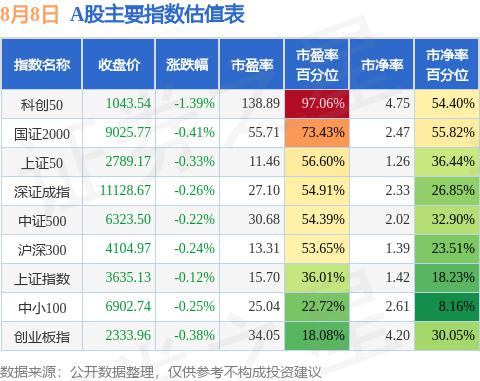
Market Overview - A-shares closed lower on August 8, with the Shanghai Composite Index down 0.12% at 3635.13 points, the Shenzhen Component Index down 0.26% at 11128.67 points, and the ChiNext Index down 0.38% at 2333.96 points [1][2] Index Performance - The ChiNext Index has a relatively low price-to-earnings (P/E) percentile of 18.08%, while the Sci-Tech 50 Index has a high P/E percentile of 97.06% [1][2] - The software index shows a high P/E percentile of 99.42%, while the 800 Consumer Index has a low P/E percentile of 7.21% [4][5] Sector Analysis - The software index closed at 14757.33 with a P/E of 301.40 and a decline of 2.80% [5] - The banking sector, represented by the China Securities Banking Index, has a P/E of 7.42 and a high P/E percentile of 95.44% [5] - The semiconductor materials and equipment sector has a P/E of 65.42 with a P/E percentile of 49.10% [5] Style Strategy - The Guosen Value Index has a high P/E percentile of 98.76%, indicating a potential overvaluation [7][8] - The Large Cap Growth Index has a lower P/E percentile of 47.11%, suggesting a more moderate valuation [7][8]
港股评级汇总 | 里昂维持中芯国际跑赢大市评级
Xin Lang Cai Jing· 2025-08-08 08:05
Group 1: Semiconductor Industry - Citi maintains an "outperform" rating for SMIC with a target price of HKD 59.2, reporting a 1.7% quarter-over-quarter revenue decline to USD 2.21 billion, which is better than expected. Gross margin was 20.4%, exceeding the 18-20% forecast range, while net profit was USD 132.5 million, 24% below market expectations. Q3 revenue is expected to grow by 7% quarter-over-quarter to USD 2.34 billion, slightly below market expectations [1] - Citi maintains an "outperform" rating for Hua Hong Semiconductor, raising the target price to HKD 50.5. The company began price adjustments in Q2, which are expected to reflect in the second half, leading to a single-digit increase in average selling prices. The 2026 and 2027 earnings forecasts were raised by 18% and 12%, respectively, while the 2023 earnings forecast was lowered by 31% due to increased taxes [2] Group 2: Pharmaceutical Industry - CMB International maintains a "buy" rating for BeiGene with a target price of HKD 225, noting that Q2 2025 performance exceeded expectations, with core product sales continuing to grow. The company is positioned as a benchmark for Chinese innovative drugs, with strong global sales of its products. The second half of 2025 is expected to be a critical period for new product approvals and clinical data releases, which may catalyze stock price growth [2] Group 3: Gaming and Hospitality Industry - CICC maintains an "outperform" rating for MGM China, reporting Q2 2025 results that exceeded expectations, with net income and adjusted EBITDA recovering to pre-pandemic levels, driven by strong performance in Macau. Management expects continued strong performance during the summer and is focused on product updates and high-end market segments [3] Group 4: Telecommunications Infrastructure - CICC maintains a "strong buy" rating for China Tower, highlighting its position as a global leader in communication infrastructure. The company's strategic layout and shared mechanisms are expected to release significant profits as existing assets depreciate. Long-term growth is anticipated from new business drivers and deepened sharing mechanisms [4] Group 5: Consumer Goods Industry - CICC maintains an "outperform" rating for Uni-President China, reporting H1 2025 results that exceeded market expectations. The beverage business remains stable amid increased competition, while the food business continues to grow. Cost advantages and improved capacity utilization are driving margin improvements, with a steady growth trend expected for the year [5] Group 6: Technology Industry - CICC maintains an "outperform" rating for Xiaomi Group with a target price of HKD 70, forecasting a 64.84% year-over-year increase in adjusted net profit for Q2 2025. The company remains among the top three globally in smartphone shipments, with strong IoT revenue expected. The release of new production capacity is anticipated to enhance order delivery [6] - CICC maintains a "buy" rating for AsiaInfo Technologies, noting that while H1 2025 revenue was pressured by cost-cutting measures from operators, innovative business trends are positive. Revenue from AI model applications and delivery services is expected to grow significantly, helping to stabilize overall revenue [7] Group 7: Robotics Industry - CICC initiates coverage on Yujiang with an "outperform" rating and a target price of HKD 61, highlighting the company's focus on collaborative robots and product line expansion. The company is expected to show significant growth potential and diverse international business layouts [8] Group 8: Medical Services Industry - Citi maintains an "outperform" rating for Tigermed with a target price of HKD 62.6, noting an 83% increase in stock price year-to-date as the Chinese innovative drug market improves. Net profit forecasts for 2025-2027 have been raised by 31%, 30%, and 30%, respectively, with positive sales growth in Q2 [9]



公募“后浪”汹涌而来 控制回撤成必修课
Shang Hai Zheng Quan Bao· 2025-08-08 07:17
Core Viewpoint - A new generation of fund managers is emerging in the public fund industry, demonstrating impressive performance by capitalizing on structural opportunities in the new consumption and innovative pharmaceutical sectors [1][2][4]. Group 1: Performance of Young Fund Managers - As of June 20, 2025, five out of the top ten actively managed equity funds have managers with less than three years of experience [2]. - Notable performances include Liang Furui's Changcheng Pharmaceutical Industry Selected Mixed Fund, which achieved a return of 71.21% this year, and was his first fund managed since its establishment in October 2023 [2]. - Another example is the Huazhong Pharmaceutical Biotechnology Stock Fund, managed by Sang Xiangyu, which has also exceeded a 60% return this year [2]. Group 2: Investment Focus and Background - Young fund managers have successfully identified opportunities in the innovative pharmaceutical sector, with many having strong professional backgrounds in relevant fields [4]. - Liang Furui has six years of experience in pharmaceutical research, while Sang Xiangyu has a dual background in bioengineering and economics, and Liu Haihao has been involved in consumer sector research for several years before becoming a fund manager [4]. Group 3: Market Conditions and Fund Establishment - The timing of fund establishment has been favorable, with several top-performing funds launched in late 2023, allowing managers to fully benefit from the rising innovative pharmaceutical market [5]. - The rapid establishment of these funds, often in a small scale, has enabled fund companies to effectively capitalize on market opportunities [5]. Group 4: Balancing Risk and Return - While young fund managers have shown strong performance, there is a need for them to learn how to manage drawdowns effectively, especially in a cyclical market [7]. - Funds with concentrated holdings, such as the Zhonghang Preferred Navigation Mixed Fund, have experienced significant volatility, highlighting the risks associated with aggressive investment strategies [7][8]. - Industry experts emphasize the importance of providing young managers with opportunities while also encouraging a shift towards long-term, value-oriented investment strategies as their fund sizes grow [8].