
有色

Search documents
【金融工程】止盈意愿上升,风格切换或将持续——市场环境因子跟踪周报(2025.10.23)
华宝财富魔方· 2025-10-23 09:06
Group 1 - The article emphasizes the potential for a market style shift in the fourth quarter, suggesting a reduction in positions within the technology growth sector and a shift towards broader indices and low-volatility dividend stocks [2][6] - The macro strategy team indicates that external short-term disturbances are expected to be less significant than in April, with positive signals anticipated from the 20th Central Committee's Fourth Plenary Session and the "15th Five-Year Plan" [2][6] - The report notes an increase in market volatility and a tendency for profit-taking and portfolio adjustments following the release of favorable signals in October [2][6] Group 2 - In the equity market, the style has shifted towards large-cap stocks, with a preference for value over growth, while the volatility of large-cap stocks has increased [8][9] - The report highlights a decrease in the proportion of stocks rising within the market, alongside a decline in the concentration of trading among the top 100 stocks [8][9] - Market activity has shown increased volatility, with a mixed performance in turnover rates across different sectors [8][9] Group 3 - In the commodity market, trends for precious metals, energy, non-ferrous metals, and agricultural products have strengthened, while the black metal sector has weakened [14][15] - The report indicates an increase in liquidity for precious metals, contrasting with a decline in liquidity for other sectors [14][15] Group 4 - The options market experienced heightened implied volatility due to unexpected tariff announcements, leading to a temporary spike in fear among investors [19] - The report notes that the indicators for the small-cap/growth style have not shown signs of improvement, despite previous strength [19] Group 5 - The convertible bond market adjusted in line with the stock market, maintaining stable conversion premiums, which suggests a good defensive characteristic compared to the stock market [22] - The report mentions a decline in pure bond premiums and a significant drop in market transaction volumes post-holiday [22]


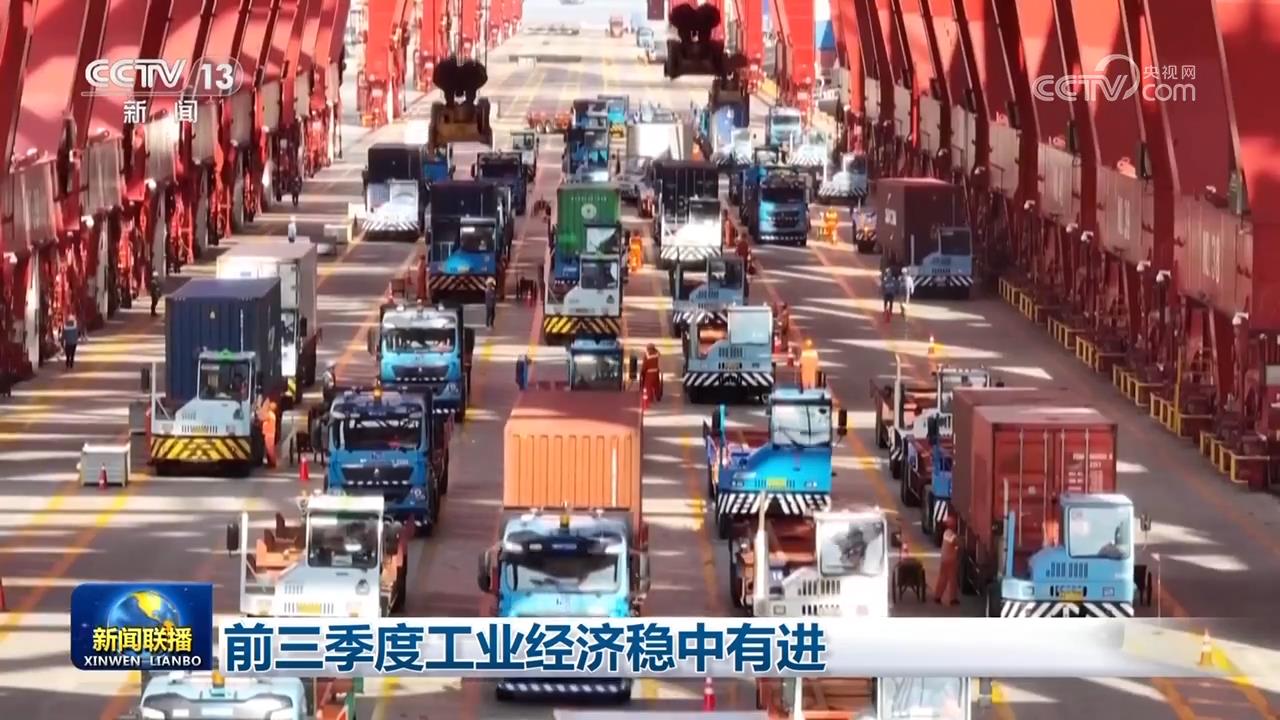
前三季度工业经济稳中有进
Yang Shi Wang· 2025-10-22 12:43
Group 1 - The core viewpoint is that China's industrial production has achieved rapid growth in the first three quarters of the year, supported by more proactive macro policies, leading to significant improvements in corporate profitability and a stable industrial economy [1] Group 2 - In the first three quarters, most industries and products in China's industrial economy experienced growth, with industrial product exports accelerating. The export delivery value of large-scale industries increased by 3.3% year-on-year, and in September, it turned to a growth of 3.8% from a decline in August [3] Group 3 - The industrial structure is continuously optimizing, with the added value of large-scale equipment manufacturing increasing by 9.7%, accounting for 35.9% of the total added value of large-scale industries, maintaining above 30% for 31 consecutive months. The transformation towards intelligence and greenness is accelerating [5] Group 4 - Corporate profitability has improved, with profits of large-scale industrial enterprises increasing by 0.9% year-on-year from January to August, reversing the declining trend since May. Notably, industries such as non-ferrous metals and electrical machinery saw double-digit profit growth of 12.7% and 11.5%, respectively [7] Group 5 - The capacity utilization rate of industrial enterprises has rebounded quarter-on-quarter, with 21 out of 41 major industrial categories experiencing a rise in capacity utilization, indicating an improvement in corporate expectations [9]
A股集体下跌!场内近3000股飘绿
Qi Huo Ri Bao Wang· 2025-10-22 12:34
Group 1 - A-shares experienced a collective decline on October 22, with the Shanghai Composite Index slightly down by 0.07% to 3913.76 points, the Shenzhen Component down by 0.62% to 12996.61 points, and the ChiNext Index down by 0.79% to 3059.32 points [1] - The total trading volume in the Shanghai, Shenzhen, and Beijing markets was 1690.5 billion yuan, a decrease of over 200 billion yuan compared to the previous day [1] - Nearly 3000 stocks were in the red, with sectors such as coal, non-ferrous metals, brokerage, and semiconductors declining, while the oil sector saw strong gains, with companies like Keli Co., Ltd. rising over 10% [1] Group 2 - Goldman Sachs released a report suggesting that despite potential pullbacks in Chinese stocks, investors should shift their mindset from "selling on highs" to "buying on lows," predicting a 30% increase in the MSCI China Index by the end of 2027 [2] - Dongguan Securities noted that the index is at a high point, with increased capital divergence, warning of potential short-term fluctuations due to profit-taking, but also highlighted that economic recovery in Q4 is expected to be supported by policies [2] - The report emphasized that the expectation of interest rate cuts by the Federal Reserve could attract foreign capital inflows, enhancing the allocation value of A-shares and potentially driving domestic funds into the stock market [2]


午评:沪指跌0.44%,煤炭、有色等板块走低,人造肉概念逆市活跃
Zheng Quan Shi Bao Wang· 2025-10-22 04:31
Core Viewpoint - The market is experiencing a downward trend with the Shanghai Composite Index falling by 0.44% and various sectors such as coal and non-ferrous metals declining, while the artificial meat concept remains active [1] Market Performance - As of the midday close, the Shanghai Composite Index is at 3899.05 points, down 0.44%, the Shenzhen Component is down 0.81%, and the ChiNext Index is down 0.89%. In contrast, the North China 50 Index has risen by 1.19% [1] - The total trading volume across the Shanghai, Shenzhen, and North exchanges reached 1.1142 trillion yuan [1] Sector Analysis - Sectors such as coal, non-ferrous metals, semiconductors, and brokerage firms are experiencing declines, while engineering machinery, real estate, oil, and pharmaceuticals are seeing gains. The artificial meat, industrial mother machines, and biological vaccine concepts are particularly active [1] Economic Outlook - Dongguan Securities indicates that the index has reached a high point, leading to increased capital divergence and potential short-term fluctuations due to profit-taking. However, as tariff disturbances are gradually resolved, the economy is expected to continue recovering in the fourth quarter supported by policy measures [1] - The expectation of interest rate cuts by the Federal Reserve may attract foreign capital inflows, while the decline in domestic risk-free interest rates enhances the investment value of A-shares, potentially driving more domestic capital into the stock market [1] Investment Strategy - The market may face short-term fluctuations, but the medium-term upward trend is expected to continue. It is advised to maintain flexible positions, avoid blind chasing of highs, and actively adjust holdings based on economic conditions and valuation [1]
A股午盘|沪指跌0.44% 黄金等有色行业集体下挫
Di Yi Cai Jing· 2025-10-22 03:56
Market Performance - The Shanghai Composite Index fell by 0.44%, the Shenzhen Component Index decreased by 0.81%, and the ChiNext Index dropped by 0.89% [1] - The gold and other non-ferrous metal industries experienced a collective decline, while lithium batteries, storage chips, and rare earth sectors saw widespread losses [1] - Real estate and banking sectors showed the highest gains, with active performance in nuclear fusion, wind power, and deep earth technology concepts [1] Technical Indicators - A MACD golden cross signal has formed, indicating a positive trend for certain stocks [2]
科技风格是否会切换,红利是否会接力?机构:“再平衡”后,科技或仍是主线
Mei Ri Jing Ji Xin Wen· 2025-10-22 03:04
Group 1 - A-shares and Hong Kong stocks experienced a decline, with major indices opening lower and the ChiNext index briefly turning positive before falling [1] - The Hang Seng Technology Index dropped over 1%, with most tech stocks declining, while the largest A-share ETF in the same sector saw a nearly 2% drop [1] - The market is currently undergoing a "rebalancing" phase, with a potential shift in investment styles driven by defensive thinking, although the core drivers of the bull market remain intact [1] Group 2 - The investment strategy emphasizes maintaining confidence in the bull market, focusing on technology as the primary driver and PPI trading as a secondary approach [2] - Key sectors to watch include technology growth and self-sufficiency, with specific attention to batteries, power grids, robotics, and AI applications [2] - There are opportunities in cyclical sectors benefiting from marginal PPI improvements, such as steel, chemicals, and real estate, which may see valuation recovery [2]
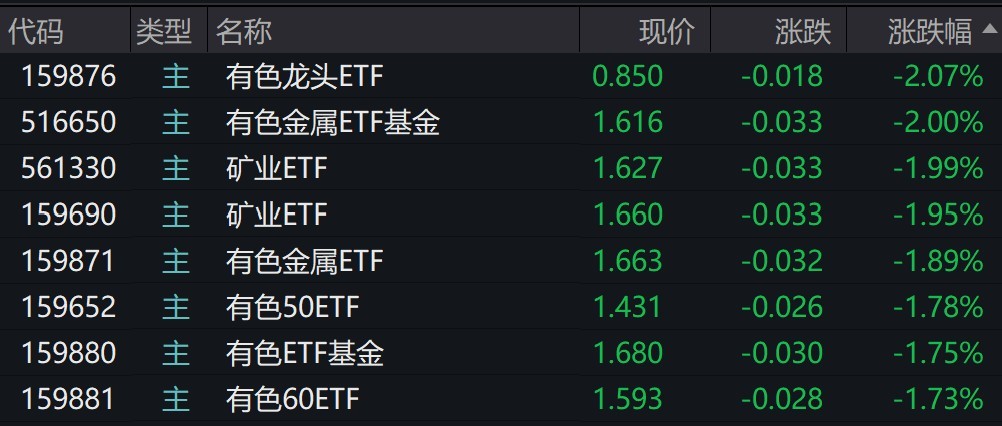
有色金属概念股早盘走低,有色、矿业相关ETF跌约2%
Mei Ri Jing Ji Xin Wen· 2025-10-22 03:01
Group 1 - The core viewpoint indicates that non-ferrous metal stocks are experiencing a decline, with significant drops in companies such as Shandong Gold, Zhongjin Gold, and Chifeng Gold, all falling over 4%, while Zijin Mining and Northern Rare Earth dropped over 2% [1] - Related ETFs in the non-ferrous and mining sectors have also seen a decline of approximately 2% [1] Group 2 - Specific ETF performance shows that the Non-Ferrous Leading ETF is priced at 0.850, down by 2.07%, while the Non-Ferrous Metal ETF Fund is at 1.616, down by 2.00% [2] - A brokerage report suggests that the non-ferrous metal sector will continue to face high market volatility risks in 2025 due to uncertainties from both demand and supply sides [2] - Emerging demand in the downstream structure of copper and aluminum is expected to support a long-term upward shift in the price center of non-ferrous metals [2]





FICC日报:A股飘红迎反弹,贸易变量扰动市场情绪-20251022
Hua Tai Qi Huo· 2025-10-22 02:58
1. Report Industry Investment Rating - The overall rating for commodities and stock index futures is neutral [5] 2. Core Viewpoints - Domestic economic expectations are strong but the reality is weak. In August, China's economic data showed signs of weakness, and in September, exports were resilient. The M2 - M1 gap reached a new low for the year. To address external pressure, China has proposed policies to stabilize growth, with new policy - based financial instruments totaling 500 billion yuan. The GDP in Q3 increased by 4.8% year - on - year, and the growth rate of total retail sales of consumer goods in September slowed to 3% compared to August, while the added value of industrial enterprises above the designated size increased by 6.5% year - on - year. The housing prices in 70 large and medium - sized cities declined month - on - month in September [1] - Sino - US tariff frictions have intensified. As the extension of Sino - US tariffs is about to expire on November 10, the US has taken multiple measures such as adding Chinese companies to the entity list and imposing tariffs on various imported products. China has responded with measures like export controls on rare earth technology and imposing special port fees on US ships. The two sides agreed to hold a new round of economic and trade consultations as soon as possible [2] - The US government shutdown has affected the release of economic data. The US 9 - month Markit manufacturing and service PMI decreased slightly. The market has underestimated the severity of the shutdown, and attention should be paid to its development [3] - For commodities, it is advisable to wait and see in the near term. The black sector is affected by downstream demand expectations, the non - ferrous sector is constrained by long - term supply, the energy sector has a relatively loose supply in the medium term, the "anti - involution" space in the chemical sector is worthy of attention, agricultural products are driven by tariffs and inflation expectations, and short - term risks in precious metals should be guarded against [4] 3. Summary by Related Catalogs Market Analysis - Domestic economic situation: In August, China's economic data weakened, with characteristics of "slow industry, weak investment, and light consumption". In September, exports were resilient, and the M2 - M1 gap reached a new low for the year. The GDP in Q3 increased by 4.8% year - on - year, the growth rate of total retail sales of consumer goods in September slowed to 3% compared to August, and the added value of industrial enterprises above the designated size increased by 6.5% year - on - year. Housing prices in 70 large and medium - sized cities declined month - on - month in September. The government has proposed policies to stabilize growth, with new policy - based financial instruments totaling 500 billion yuan. On October 21, the A - share market strengthened, with the Shanghai Composite Index returning above 3900 points and the ChiNext Index rising more than 3%. The AI computing hardware sector soared, while sectors such as coal, gas, and precious metals declined [1] - Sino - US tariff frictions: As the extension of Sino - US tariffs is about to expire on November 10, the US has taken multiple measures such as adding Chinese companies to the entity list and imposing tariffs on various imported products. China has responded with measures like export controls on rare earth technology and imposing special port fees on US ships. The two sides agreed to hold a new round of economic and trade consultations as soon as possible [2] - US government shutdown: On October 15, the US Republican Party's temporary appropriation bill failed to advance in the Senate. The release of multiple economic data has been delayed. The US 9 - month Markit manufacturing and service PMI decreased slightly. The market has underestimated the severity of the shutdown, and attention should be paid to its development [3] Commodity Market - Overall strategy: It is advisable to wait and see in the near term. The volatility of previously bullish sectors is high, and the risk of price fluctuations is large [4] - Black sector: Still affected by downstream demand expectations, attention should be paid to the "anti - involution" situation [4] - Non - ferrous sector: Long - term supply constraints remain unrelieved, and it has been boosted by global easing expectations recently [4] - Energy sector: The medium - term supply is considered relatively loose. OPEC + announced that eight oil - producing countries will increase production by 137,000 barrels per day in November [4] - Chemical sector: The "anti - involution" space of products such as methanol, caustic soda, and urea is worthy of attention [4] - Agricultural products: Driven by tariffs and inflation expectations in the short term, but need to wait for fundamental signals and pay attention to the impact of Sino - US negotiations [4] - Precious metals: The market has overreacted in the short term, and the lease rates of gold and silver are relatively high. Short - term price fluctuations should be guarded against, and opportunities to buy on dips can be grasped in the long term [4] Strategy - The overall rating for commodities and stock index futures is neutral [5] Important News - Stock market: On October 21, the market strengthened throughout the day, with the Shanghai Composite Index returning above 3900 points and the ChiNext Index rising more than 3%. More stocks rose than fell, with over 4,600 stocks in the Shanghai, Shenzhen, and Beijing stock markets rising, and the trading volume reached 1.89 trillion yuan. The Shanghai Composite Index rose 1.36%, the Shenzhen Component Index rose 2.06%, and the ChiNext Index rose 3.02% [6] - International news: On October 21, the Japanese cabinet led by Ishiba Shigeru resigned, and Takamachi Sanae was elected as the new prime minister. European leaders signed a joint statement supporting an immediate cease - fire and peace talks, while the Russian foreign minister said the "immediate cease - fire" plan violated previous agreements [3][6] - Commodity news: On October 21, spot gold fell below $4,200 per ounce, with an intraday decline of 3.8%, the largest decline in four years [4]
宏观日报:关注有色、能源上游价格波动-20251022
Hua Tai Qi Huo· 2025-10-22 02:54
Industry Investment Rating - No industry investment rating information is provided in the report. Core Viewpoints - The report focuses on the price fluctuations of upstream non - ferrous metals and energy, and also presents the latest developments in the production and service industries, as well as the current situation of different industrial chains [1][2]. Summary by Directory 1. Middle - level Event Overview Production Industry - The Guangdong Provincial People's Government Office issued the "Action Plan for High - quality Development of the Manufacturing Industry Empowered by Artificial Intelligence in Guangdong Province (2025 - 2027)", supporting enterprises to use various intelligent computing resources for industrial model development, promoting the construction of edge data centers, and emphasizing core software research and the synergy between AI and industrial Internet [1]. Service Industry - The Civil Aviation Administration announced the winter - spring flight schedule for 2025, starting from October 26, with domestic flight times contracting for two consecutive seasons, with a 1.0% decline in 2024 and a 1.8% decline in 2025. From October 15, global shipping giants collectively raised prices, with freight rates on multiple routes increasing by 600 - 2000 US dollars per container [1]. 2. Industry Overview Upstream - Non - ferrous metals: Gold prices have declined. Energy: International oil prices have continued to fall. Chemicals: PTA prices have slightly decreased [2]. Middle - stream - Chemicals: PX operating rate is at a high level. Energy: Power plant coal consumption is at a low level [2][3]. Downstream - Real estate: The sales of commercial housing in first, second, and third - tier cities have declined. Services: The number of domestic flights has increased [4]. 3. Key Industry Price Index Tracking - **Agriculture**: On October 21, the spot price of corn was 2180.0 yuan/ton (- 0.26% year - on - year), eggs were 6.0 yuan/kg (1.69% year - on - year), palm oil was 9306.0 yuan/ton (- 0.60% year - on - year), cotton was 14741.8 yuan/ton (0.35% year - on - year), and the average wholesale price of pork was 17.7 yuan/kg (- 2.80% year - on - year) [39]. - **Non - ferrous Metals**: On October 21, the spot price of copper was 85788.3 yuan/ton (- 0.25% year - on - year), zinc was 21922.0 yuan/ton (- 1.24% year - on - year), aluminum was 20943.3 yuan/ton (0.14% year - on - year), nickel was 122850.0 yuan/ton (0.23% year - on - year), and another type of aluminum was 17075.0 yuan/ton (0.63% year - on - year) [39]. - **Ferrous Metals**: On October 20, the spot price of rebar was 3131.8 yuan/ton (- 0.29% year - on - year), iron ore was 792.9 yuan/ton (- 1.26% year - on - year), and wire rod was 3295.0 yuan/ton (- 0.68% year - on - year) [39]. - **Non - Metals**: On October 21, the spot price of glass was 14.6 yuan/square meter (- 6.82% year - on - year), natural rubber was 14516.7 yuan/ton (0.58% year - on - year), and the China Plastics City Price Index was 779.6 (- 0.75% year - on - year) [39]. - **Energy**: On October 21, the spot price of WTI crude oil was 57.0 US dollars/barrel (- 4.15% year - on - year), Brent crude oil was 61.0 US dollars/barrel (- 3.65% year - on - year), liquefied natural gas was 3820.0 yuan/ton (2.85% year - on - year), and coal was 797.0 yuan/ton (0.76% year - on - year) [39]. - **Chemicals**: On October 21, the spot price of PTA was 4369.8 yuan/ton (- 2.02% year - on - year), polyethylene was 7076.7 yuan/ton (- 0.79% year - on - year), urea was 1570.0 yuan/ton (- 0.63% year - on - year), and soda ash was 1203.6 yuan/ton (- 1.23% year - on - year) [39]. - **Real Estate**: On October 21, the national cement price index was 133.7 (- 0.80% year - on - year), the building materials composite index was 111.5 (- 0.60% year - on - year), and the national concrete price index was 91.2 (- 0.18% year - on - year) [39].
研究所晨会观点精萃-20251022
Dong Hai Qi Huo· 2025-10-22 01:07
Report Summary 1) Report Industry Investment Rating No industry investment rating is provided in the report. 2) Core Viewpoints of the Report - The market is influenced by the optimistic sentiment of the China - US trade agreement, with the US dollar index rebounding and global risk appetite rising. The domestic economic growth is accelerating, and the market is generally optimistic about the China - US trade negotiations. The increase in domestic policy support boosts domestic risk appetite. The short - term macro - upward drive has strengthened, and attention should be paid to the progress of China - US trade negotiations and the implementation of domestic incremental policies [2][3]. - Different asset classes have different trends: stocks are expected to be strongly volatile in the short term; bonds are expected to be volatile; commodities show different trends in different sectors, with some in a state of shock and some with clear short - term trends [2]. 3) Summary by Related Catalogs Macro - finance - **Macro**: Overseas, the US dollar rebounds due to the optimistic sentiment of the China - US trade agreement, and global risk appetite rises. Domestically, economic growth accelerates, and the market is optimistic about trade negotiations. Policy support increases, and the short - term macro - upward drive strengthens. For assets, stocks are strongly volatile in the short term and can be cautiously bought; bonds are volatile and should be cautiously observed; different commodity sectors have different trends [2]. - **Stock Index**: Driven by sectors such as combustible ice, fruit chains, and construction machinery, the domestic stock market rises significantly. With economic growth and policy support, the short - term macro - upward drive strengthens. It is recommended to cautiously buy in the short term [3]. - **Precious Metals**: The precious metals market falls at night. Due to the rise of the US dollar and profit - taking, the short - term is in a high - level correction, but the medium - and long - term upward pattern remains unchanged. Short - term long positions should be reduced on rallies, and medium - and long - term positions should be bought on dips [3]. Black Metals - **Steel**: The steel futures and spot markets continue to fluctuate. Trade conflicts are expected to ease, and there are expectations for policies, which support prices. However, the fundamentals are weak, demand is weak, and it is expected to weaken further after late October. Supply is likely to decline. There is no trending market, and the upward and downward space is limited in the short term [4]. - **Iron Ore**: The spot price is flat, and the futures price rebounds slightly. The iron - water production is expected to decline further. Steel mills replenish stocks slightly. Global shipments increase, and arrivals decrease. The port inventory rises. It is recommended to treat it with a range - bound thinking [6]. - **Silicon Manganese/Silicon Iron**: The spot prices decline slightly, and the futures prices fluctuate. The demand for ferroalloys decreases. The supply of silicon manganese increases slightly. The prices of both are expected to continue to fluctuate in the range [7]. Chemicals - **Soda Ash**: The main contract fluctuates in the range. Supply is in the capacity - release period, and demand increases slightly. It should be treated with a bearish view in the medium and long term [8]. - **Glass**: The main contract fluctuates in the range. Supply increases, and demand is weak after the "Golden September and Silver October". It is recommended to operate in the short - term range [8]. Non - ferrous Metals and New Energy - **Copper**: The Shanghai copper price fluctuates and falls, affected by the weak commodity atmosphere and the decline of gold. The US copper inventory is high, and the domestic de - stocking is less than expected. Although the Indonesian mine is shut down, it will resume production next year, and the supply is expected to increase. It is expected to maintain high - level volatility [9]. - **Aluminum**: The Shanghai aluminum price rises slightly. The external market is stronger than the domestic market, and the domestic fundamentals are poor. The inventory decline is slow. The London inventory decreases. It is expected to fluctuate in the range in the short term [10]. - **Tin**: The supply is tight in the short term, and the demand improvement is limited. The price is at a high level, which suppresses consumption. The inventory decreases this week. It is expected to maintain high - level volatility [11]. - **Lithium Carbonate**: The main contract falls slightly. The supply and demand both increase, the inventory decreases, and the market is expected to be strongly volatile [12]. - **Industrial Silicon**: The main contract falls. The production reaches a new high, and the inventory does not accumulate during the wet season. The 2511 contract faces the pressure of warehouse - receipt digestion. It is expected to fluctuate in the range [12]. - **Polysilicon**: The main contract falls. The warehouse - receipt quantity increases, and there is pressure from the concentrated cancellation of warehouse receipts in November. The supply is high, and the demand is low. It is necessary to wait for the implementation of the state - reserve news [13][14]. Energy and Chemicals - **Methanol**: The domestic methanol market is weak, and the port market has a weakening basis. The short - term supply decreases, the demand for olefins is high, and the inventory decreases slightly. However, the traditional downstream demand is weak, and the supply pressure will increase. It is expected to fluctuate in the short term [15]. - **PP**: The market price falls in part. The supply growth rate is higher than the demand, the inventory is high, and the cost support weakens. It is necessary to focus on the recovery of downstream demand [16]. - **LLDPE**: The price of polyethylene is adjusted. The supply increases, the inventory accumulates, and the demand is differentiated. The cost support weakens, and the market is under pressure in the short term [16]. - **Urea**: The urea market is weak. The production is expected to increase, the demand for compound fertilizers is ending, the agricultural demand is warming up, and the export is shrinking. The short - term market may rise slightly after a stalemate, but there is still a risk of decline [17]. Agricultural Products - **US Soybeans**: The rise of US soybeans pauses. The sowing in Brazil is progressing smoothly, and the weather in Argentina is good. The CBOT soybean assets are mainly in a wait - and - see state. The trade between China and the US is the key factor for the future market [18][19]. - **Soybean Meal/Rapeseed Meal**: The oil - mill operating rate is high, the soybean meal delivery is urgent, and the terminal procurement is cautious. The oil - mill profit is in deficit, and the willingness to support the price is strong. There is a supply gap risk in the domestic market before the South American new soybeans are listed. The soybean meal is expected to stabilize after a decline, and the rapeseed meal is mainly affected by the soybean meal [19]. - **Soybean Oil/Rapeseed Oil**: The soybean oil market is in the peak season, and the price difference between soybean oil and palm oil provides consumption expectations. The rapeseed oil inventory is decreasing, and the spot basis is stable [19]. - **Palm Oil**: The domestic palm oil arrives in large quantities, the inventory increases, and the basis is weak. The production and export growth rates in Malaysia decline [20]. - **Corn**: The corn market price is strong, the new - season corn is on the market, the downstream demand is positive, the price is close to the cost line, and farmers' reluctance to sell may increase [20]. - **Pigs**: After the festival, the production and inventory reduction accelerate, the pig price falls to a new low, and the profit is in deficit. There is support for restocking in some areas, and the supply is expected to decrease in late October, which will stabilize the price. Unless the demand increases seasonally, it is difficult for the price to recover significantly [20].