航空

Search documents
解放军封岛演习 台湾多条航线大面积取消
Xin Lang Cai Jing· 2025-12-30 04:56
2022年美国众院议长佩洛西窜访台湾后,解放军举行了"利剑""雷霆"系列军演,台防务部门称,此前的 军演均未搭配发布民航限航。(凤凰卫视陈耀辉 综合报道) 责任编辑:凌辰 来源:凤凰卫视 解放军东部战区29日在台岛周边举行演习,东部战区发布联合演训区公告及示意图,要求船只和飞行器 不要进入,演训区几乎将台湾完全封锁包围。台湾华信航空及立荣航空29日公告,30日台湾往返马祖航 线全日取消,台湾往返金门航线晚间6点前全数取消。台湾媒体推算,两家台湾航司共计将取消金门及 马祖航班逾80班次,受影响旅客约6000人,30日18时前受影响国际航班估计超过850班次,涉及逾10万 旅客。 解放军东部战区29日在台岛周边举行演习,东部战区发布联合演训区公告及示意图,要求船只和飞行器 不要进入,演训区几乎将台湾完全封锁包围。台湾华信航空及立荣航空29日公告,30日台湾往返马祖航 线全日取消,台湾往返金门航线晚间6点前全数取消。台湾媒体推算,两家台湾航司共计将取消金门及 马祖航班逾80班次,受影响旅客约6000人,30日18时前受影响国际航班估计超过850班次,涉及逾10万 旅客。 2022年美国众院议长佩洛西窜访台湾后,解放 ...
国信证券:油汇改善利好航空板块 快递龙头竞争优势强化
智通财经网· 2025-12-30 03:59
Shipping Industry - The shipping market is experiencing a seasonal downturn, with oil shipping rates under pressure due to the holiday season and geopolitical tensions affecting supply [2] - Despite entering a low season, the oil shipping demand structure is improving, suggesting a potential upward trend in rates [2] - The container shipping market is expected to face significant pressure on rates by 2026 due to ongoing trade risks and the delivery of new capacity [2] Aviation Industry - Domestic passenger flight volumes have increased slightly, with overall and domestic flights up by 1.3% and 1.5% respectively compared to the previous week [3] - The average ticket price for economy class during the upcoming New Year holiday is projected at 597 yuan, reflecting a 1.1% decrease from 2024 but a 6.7% increase from 2025 [3] - The aviation sector is expected to benefit from a recovering domestic economy, with significant potential for earnings growth as supply constraints from aircraft manufacturers persist [3] Express Delivery Industry - The "anti-involution" policy has led to price increases in the express delivery sector, with most regions in China experiencing price hikes since July [4] - The profitability of express delivery companies is expected to improve in Q4 due to these price increases, despite a decline in overall package volume growth [4] - Companies like Zhongtong and Yuantong are outperforming the market, benefiting from a reduced reliance on low-cost packages [4] Investment Recommendations - The company recommends investing in growth-oriented value stocks and cyclical stocks at low price points, including Zhongtong Express, Yuantong Express, China Eastern Airlines, and others [5]





巴菲特正式交棒!“安全边际大师”塞斯·卡拉曼长文致敬:为何他史上最佳,独一无二……
聪明投资者· 2025-12-30 03:57
Core Viewpoint - Warren Buffett will retire as CEO of Berkshire Hathaway on January 1, 2026, after 60 years in the role, handing over to Greg Abel, who will take on the role of chairman behind the scenes. Buffett's legacy includes a company valued at over $1 trillion, with post-tax profitability nearing $50 billion and cash reserves exceeding $350 billion [4][5]. Group 1 - The transition of CEO has generated significant buzz in the business and investment communities since Buffett's unexpected announcement of retirement at the shareholder meeting in May [5]. - Buffett's cautious approach in recent years has slowed down the company's performance, with Berkshire's large cash holdings negatively impacting its results [6][7]. - As of December 29, 2025, Berkshire Hathaway's Class A shares increased by 10.44%, lagging behind the S&P 500's 17.41% gain, and the company has underperformed the index over the past 3, 10, and 15 years [7]. Group 2 - Over 80% of Berkshire's revenue comes from the U.S., and the company has diversified its business, resembling a mutual fund in the stock market [8]. - Greg Abel, who has been with Berkshire for many years and has experience in managing its energy and non-insurance businesses, is seen as an unknown factor in the eyes of the public [9]. - Analysts note that while Abel has strong operational and financial management skills, he lacks the investment management experience and reputation that Buffett built over 60 years [10]. Group 3 - Buffett's investment strategy is characterized by a focus on value investing, viewing stocks as ownership in businesses and planning for long-term holds [30]. - His investment process involves thorough due diligence, recognizing quality companies, and waiting for exceptional opportunities to invest [30]. - Buffett's unique approach includes increasing his holdings when stock prices drop, contrasting with the typical investor behavior of selling during downturns [31]. Group 4 - Buffett's success is attributed to five core traits: alertness and decisiveness in judgment, simplicity in analysis, the ability to distinguish between great and mediocre investments, long-term focus, and flexibility in improving investment strategies [34][36]. - He has navigated various market conditions, maintaining exceptional performance despite increasing competition and market complexities [36]. - Buffett emphasizes the importance of investing in quality companies and holding them for the long term, which has proven to be a successful strategy [36][40]. Group 5 - Buffett's philanthropic efforts include a significant donation of $31 billion to the Gates Foundation, which doubled its annual funding capacity, and he co-founded the "Giving Pledge" to encourage billionaires to donate a majority of their wealth [62][63]. - His approach to investing and philanthropy reflects a commitment to traditional American values and a belief in the long-term potential of the U.S. economy [20][60]. - Buffett's legacy is not only in his financial achievements but also in his life philosophy, which emphasizes doing the right thing for businesses and shareholders [66].

【立方早知道】多家公司回应商业航天业务情况/锂矿龙头被移送起诉/12连板大牛股停牌核查
Sou Hu Cai Jing· 2025-12-30 02:33
Group 1: Tariff Adjustments - The State Council's Tariff Commission announced a tariff adjustment plan for 2026, effective from January 1, 2026, which includes a temporary import tariff rate lower than the most-favored-nation rate for 935 items to enhance the linkage between domestic and international markets [1] - The plan continues to grant zero tariff treatment on 100% of products to 43 least developed countries with which China has diplomatic relations, promoting economic cooperation [1] Group 2: Commercial Aerospace Developments - Multiple A-share listed companies have disclosed their involvement in the commercial aerospace sector, with Zai Sheng Technology indicating that its aerospace products currently contribute a minimal portion to overall revenue [3] - Aerospace Intelligent Equipment reported long-term collaborations with several aerospace enterprises on its space chip products [4] - China Aviation Heavy Industry has established a supply capability for key forgings to multiple commercial rocket companies, forming a dedicated supply system for commercial aerospace [4] Group 3: Financial Performance of State-Owned Enterprises - From January to November 2025, the total operating revenue of state-owned and state-controlled enterprises increased by 1.0% year-on-year, while total profits decreased by 3.1% [9] - The tax payable by these enterprises reached 52,803.0 billion yuan, reflecting a slight increase of 0.2% year-on-year [9] Group 4: Precious Metals Market - On December 29, international precious metals experienced significant declines, with gold dropping by $205 to around $4,320, a decrease of 4.52%, and silver falling by over 10% [10] - Analysts suggest that gold prices are likely to fluctuate in 2026, influenced by U.S. Federal Reserve policies and economic conditions [10] Group 5: Corporate Actions and Investments - Longyan Group announced plans to introduce seven strategic investors through a capital increase of 2 billion yuan for its subsidiary [19] - Ganfeng Lithium reported that it is under investigation for insider trading, but its operations remain normal [20][21] - *ST Panda has been placed under investigation by the China Securities Regulatory Commission for information disclosure violations [23] Group 6: Mergers and Acquisitions - Unigroup Guowei is planning to acquire controlling or full ownership of Ruineng Semiconductor Technology through a share issuance and cash payment [24][25] - Minmetals Development intends to purchase equity stakes in Minmetals Mining and Luzhong Mining, with the transaction expected to constitute a major asset restructuring [27] - Semiconductor manufacturer SMIC plans to acquire a 49% stake in SMIC North for approximately 40.6 billion yuan [29][30]



2026年中国宏观经济五大趋势展望:环球市场动态
citic securities· 2025-12-30 02:01
Market Overview - A-shares experienced a pullback after an initial rise, with the Shanghai Composite Index closing up 0.04% at 3,965 points, marking a nine-day winning streak, while the Shenzhen Component and ChiNext Index fell by 0.49% and 0.66% respectively[15] - The Hang Seng Index declined by 0.71% to 25,635 points, with major tech stocks like Alibaba dropping 1.8%[10] - The KOSPI index in South Korea rose by 2.2% to 4,220 points, leading gains in the Asia-Pacific region[20] Economic Predictions for China - In 2026, China's macroeconomic growth is expected to be driven by domestic demand recovery, with investment shifting from total pressure to structural optimization[5] - Export growth is anticipated to remain resilient, supported by easing US-China relations and diversified market deployments, contributing to a moderate appreciation of the RMB[5] Commodity and Forex Market - Gold and silver prices fell by 4.5% and 8.7% respectively after reaching new highs, while copper prices hit a historical peak due to supply concerns[26] - International crude oil prices rose over 2%, with WTI crude oil reaching $58.08 per barrel[26] Fixed Income Market - Global focus on geopolitical developments has led to increased risk aversion, with European bond markets showing significant gains and US Treasury yields slightly rising[4] - The yield on 10-year US Treasuries decreased by approximately 1.8 basis points to 4.11%[29] Sector Performance - In the US market, technology stocks are expected to yield a reasonable target of 20% returns in 2026, driven by EPS growth despite potential market volatility[8] - The carbon fiber sector is projected to benefit from the booming commercial aerospace industry, with companies like Jilin Chemical Fiber and Guangwei Composite expected to gain[18]
中泰期货晨会纪要-20251230
Zhong Tai Qi Huo· 2025-12-30 01:47
Core Insights - China is set to become the first economy to pay interest on its central bank digital currency, with the new digital yuan framework starting on January 1, 2026, marking a transition from "digital cash" to "digital deposit currency" [10] - The People's Liberation Army has begun military exercises around Taiwan, indicating heightened geopolitical tensions in the region [10] - The State Council has announced a tariff adjustment plan for 2026, which includes temporary lower import tariffs on 935 items to enhance the synergy between domestic and international markets [10] - The automotive market in China is expected to see complex growth dynamics in 2026, influenced by early government subsidies and seasonal factors [11] - Hong Kong's private residential prices have increased for six consecutive months, suggesting a potential end to the downward trend since 2021 [11] - The global memory industry is expected to experience a prolonged "super cycle" due to strong demand for AI servers and enterprise SSDs, lasting at least until 2027 [11] - TSMC has commenced mass production of its 2nm technology, which is anticipated to be the most advanced semiconductor technology in terms of density and energy efficiency [12] Macroeconomic Insights - The A-share market shows mixed performance, with the Shanghai Composite Index slightly up by 0.04% while the Shenzhen Component Index fell by 0.49% [14] - Industrial profits for large enterprises have shown a decline in growth rate as of November [14] - The central economic work conference emphasized the importance of stabilizing industrial growth and addressing "involution" competition [14][15] Commodity Insights - The steel market is expected to maintain a volatile trend, with iron ore prices under pressure due to weak demand from the real estate sector and slow construction progress [18][19] - The coal and coke prices may experience short-term fluctuations, influenced by production and safety inspections in coal mines [20][21] - The silicon metal market is facing pressure from the establishment of polysilicon platform companies, which may affect future production expectations [30] - The lithium carbonate market is showing signs of weakening demand, with expectations of inventory accumulation in the first quarter of 2026 [29] - The agricultural sector, particularly cotton and sugar, is experiencing mixed signals with supply pressures and seasonal demand fluctuations [33][35] Energy Sector Insights - Crude oil prices are expected to remain under pressure due to oversupply, despite geopolitical tensions in regions like Ukraine and the Middle East [46] - Fuel oil prices are influenced by geopolitical factors and are expected to follow crude oil price trends [47] - The plastic market is facing supply pressures, with expectations of weak demand impacting prices [48]
国金策略牟一凌:A股新的主线浮出水面 市场不在聚焦单一叙事
Xin Lang Cai Jing· 2025-12-30 01:17
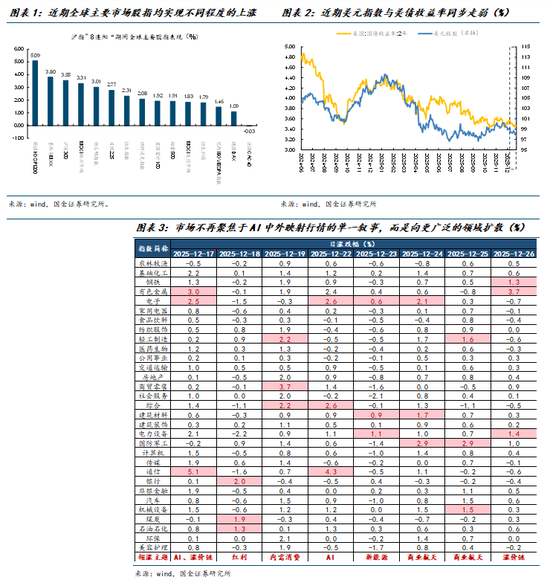
炒股就看金麒麟分析师研报,权威,专业,及时,全面,助您挖掘潜力主题机会! 国金证券研究 作者:牟一凌、吴晓明、吴慧敏 摘要 ■ 投资逻辑 跨年行情缓步开启,市场不在聚焦单一叙事 近期A股市场连续上涨,市场期待的跨年行情逐渐启动。在国内外基本面尚未出现重大变化之际,当下 反弹更像是前期分母端流动性紧缩预期边际缓和后的全球风险资产共振修复,海外主要股指均实现不同 程度的上涨。值得一提的是市场逐渐不再聚焦于AI中外映射行情的单一叙事,而是向更广泛的领域扩 散,呈现出AI、内需、涨价链、新的产业主题(商业航天)轮涨的格局。单一叙事驱动下的市场上涨 具备不稳定与高波动性,真正的牛市往往是广泛市场机会涌现与形成合力,在当前市场缓步向上,行业 轮动加速之际,2026年新的投资主线也正在慢慢浮出水面。 如何理解近期各产业链涨价:实物消耗的扩散与汇聚 当下涨价链成为市场焦点,通过梳理各行业涨价函具体内容与业内分析可以看到,原材料价格的上涨成 为价格主要推升因素;与此同时,反内卷政策的效果也正在显现,在面临上游涨价,下游压价的困境 时,部分企业开始选择自发减产与联合提价的方式维护产业合理竞争秩序。往后看由于需求端的景气程 度差异 ...
牛市早报|贵金属重挫,2026年关税调整方案公布
Xin Lang Cai Jing· 2025-12-30 00:26
Market Data - As of December 29, the Shanghai Composite Index rose by 0.04% to 3965.28 points, while the Shenzhen Component Index fell by 0.49% to 13537.1 points and the ChiNext Index decreased by 0.66% to 3222.61 points [1] - In the U.S. market, all three major indices closed lower, with the Dow Jones down by 0.51%, the Nasdaq down by 0.5%, and the S&P 500 down by 0.35% [1] - International oil prices increased, with light crude oil futures for February 2026 rising by $1.34 to $58.08 per barrel (up 2.36%) and Brent crude oil futures for February rising by $1.30 to $61.94 per barrel (up 2.14%) [1] Economic News - The State Council Tariff Commission announced a tariff adjustment plan effective January 1, 2026, which includes a temporary import tariff rate lower than the most-favored-nation rate for 935 items to enhance the linkage between domestic and international markets [2] - From January to November 2025, state-owned enterprises in China reported a total operating revenue of 7,562.576 billion yuan, a year-on-year increase of 1.0%, while total profits decreased by 3.1% to 371.945 billion yuan [2] - The asset-liability ratio of state-owned enterprises was reported at 65.2% as of the end of November, an increase of 0.3 percentage points year-on-year [2] Regulatory Developments - The State Administration for Market Regulation has set key tasks for 2026, focusing on fair competition governance, breaking administrative monopolies, and enhancing the quality of business entities [3] - The Ministry of Finance and the State Taxation Administration announced new tax deduction rules for advertising and business promotion expenses, effective from January 1, 2026, allowing certain companies to deduct up to 30% of their annual sales revenue [3] - A new regulation on food entrusted production management will take effect on December 1, 2026, aimed at clarifying responsibilities and preventing food safety risks [4] Corporate Developments - The restructuring plan for 38 companies under Suning Electric Group has been approved, with total debts amounting to 238.73 billion yuan, including 18.807 billion yuan of confirmed debts [6] - Airbus secured a significant order from domestic airlines for 55 A320 series aircraft, with a catalog price exceeding $8.2 billion, to be delivered between 2028 and 2032 [6]
国金证券:新的主线正在浮出水面 把握当下切换窗口期
Di Yi Cai Jing· 2025-12-30 00:25
Core Viewpoint - The new investment themes for 2026 are emerging in the commodity market, real industry chain, and foreign exchange market, driven by a scenario where investment exceeds consumption, leading to increased physical consumption across various manufacturing sectors [1] Group 1: Investment Opportunities - Focus on AI investments and the recovery of global manufacturing, particularly in industrial resource products such as copper, aluminum, tin, lithium, crude oil, and oil transportation [1] - Attention to China's equipment export chain, which has global comparative advantages and is confirmed at the bottom of the cycle, including power grid equipment, energy storage, lithium batteries, photovoltaics, engineering machinery, and commercial vehicles [1] - Identify domestic manufacturing sectors that are showing signs of bottom reversal, such as chemicals (dyeing, coal chemicals, pesticides, polyurethane, titanium dioxide) and wafer manufacturing [1] Group 2: Consumer Recovery - Capture the recovery in consumption driven by inbound tourism and rising household income, focusing on sectors like aviation, hotels, duty-free shops, and food and beverages [1] Group 3: Non-Banking Financial Sector - Benefit from the expansion of the capital market and the bottoming out of long-term asset returns, particularly in non-bank financial sectors such as insurance and brokerage [1]

财经早知道|金银巨震Comex白银跌超7% 追觅向全体员工额外奖1克黄金
Sou Hu Cai Jing· 2025-12-30 00:25
Group 1 - New stocks listed include Shuangxin Environmental Protection, Yufan Technology, and Qiangyi Co., Ltd. [2] - The National Investment Silver LOF will be suspended from trading on December 30, 2025, until 10:30 AM on the same day [2] - The 2025 China Green Hydrogen Industry Conference will be held in Beijing on December 30 [2] Group 2 - U.S. major stock indices closed lower, with the Dow Jones down 0.51% at 48,461.93 points, the S&P 500 down 0.35% at 6,905.74 points, and the Nasdaq down 0.5% at 23,474.35 points [2] - COMEX gold futures fell 4.45% to $4,350.2 per ounce, and COMEX silver futures dropped 7.2% to $71.64 per ounce [2] Group 3 - China will become the first economy to pay interest on its central bank digital currency, with the new digital RMB framework set to launch on January 1, 2026 [4] - The global trade friction measures in October decreased by 7.3% year-on-year, with the electronics industry having the highest trade friction index [5] Group 4 - The Ministry of Finance reported that from January to November, state-owned enterprises generated total operating revenue of 7,562.576 billion yuan, a year-on-year increase of 1.0% [8] - The State Council Tariff Commission announced adjustments to import tariff rates for 935 items starting January 1, 2026 [7] Group 5 - Meta announced the acquisition of AI company Manus, marking its third-largest acquisition to date [21] - TSMC's 2nm technology has commenced mass production as scheduled in the fourth quarter [22] Group 6 - Spring Airlines plans to purchase 30 Airbus A320neo aircraft for a transaction amount not exceeding $4.128 billion [30] - Ganfeng Lithium has been indicted for insider trading, but its operations remain normal [29]