农产品

Search documents
文化融入智造 广货风行全球
Guang Zhou Ri Bao· 2026-01-16 02:37
Core Insights - The article emphasizes the integration of Lingnan characteristics into the global market, showcasing Guangzhou's rich cultural heritage and its evolution as a commercial hub, particularly through the "Guangdong Goods Going Global" initiative [2] Group 1: Open Innovation - Guangzhou's ability to lead in intelligent manufacturing is attributed to its spirit of "open innovation and continuous change," which has historical roots in craftsmanship and modern technological advancements [5] - The city has positioned itself as a hub for global technology resources, particularly in the smart connected electric vehicle sector, which is seen as a new engine for Guangdong goods to enter international markets [5][7] Group 2: Cultural Integration - The article highlights the importance of cultural integration in the textile and apparel industry, with products from various regions in Guangdong gaining global recognition, thus establishing the province's "global voice" in these sectors [8][9] - The upcoming "Please Come to Guangdong for the New Year" cultural tourism initiative aims to promote local customs and attract international visitors, enhancing the global appeal of Guangdong's lifestyle [9] Group 3: Consumer Experience - The launch of the Haixinsha Technology Island aims to bridge the gap between technological achievements and consumer experiences, showcasing "Guangdong Goods Manufacturing" as a market favorite [7] - Innovative marketing strategies, such as the "Sui Nong Ji" agricultural consumption map and themed community group buying, are being employed to enhance the visibility and sales of local agricultural products [10][11]


商务预报:1月5日至11日食用农产品价格总体平稳 生产资料价格小幅上涨
Shang Wu Bu Wang Zhan· 2026-01-16 02:10
Group 1: Agricultural Products Market - The national market prices for edible agricultural products remained stable compared to the previous week, with a slight increase in production material prices by 1.0% [1] - Average wholesale prices for six types of fruits saw minor increases, with citrus, watermelon, and bananas rising by 1.7%, 1.4%, and 0.5% respectively [1] - Wholesale prices for meat products experienced slight fluctuations, with pork priced at 18.67 yuan per kilogram, increasing by 0.9%, while beef and lamb decreased by 0.2% [1] - Average wholesale price for 30 types of vegetables was 5.68 yuan per kilogram, showing a decrease of 0.9%, with specific vegetables like zucchini, cabbage, and tomatoes dropping by 8.2%, 5.0%, and 4.4% respectively [1] Group 2: Production Materials Market - Prices for non-ferrous metals continued to rise, with aluminum, copper, and zinc increasing by 5.2%, 3.3%, and 2.8% respectively [2] - Rubber prices saw a slight increase, with synthetic rubber and natural rubber rising by 1.7% and 1.4% respectively [2] - Fertilizer prices experienced minor increases, with urea and compound fertilizers rising by 0.6% and 0.2% respectively [2] - Steel prices showed slight recovery, with hot-rolled strip steel, welded steel pipes, and channel steel priced at 3521 yuan, 3712 yuan, and 3560 yuan per ton, increasing by 0.7%, 0.5%, and 0.5% respectively [2] - Coal prices showed slight fluctuations, with thermal coal priced at 777 yuan per ton, increasing by 0.4%, while anthracite and coking coal decreased by 0.9% and 0.4% respectively [2] - Prices for basic chemical raw materials experienced minor fluctuations, with methanol and polypropylene increasing by 1.1%, while sulfuric acid and soda ash decreased by 0.4% and 0.3% respectively [2] - Wholesale prices for finished oil products saw slight declines, with 0 diesel, 95 gasoline, and 92 gasoline decreasing by 0.6%, 0.3%, and 0.2% respectively [2]

宏观金融类:文字早评2026/01/16星期五-20260116
Wu Kuang Qi Huo· 2026-01-16 01:56
Report Industry Investment Rating No relevant information provided. Core Viewpoints of the Report - For the stock index, the long - term policy support for the capital market remains unchanged. In the short term, pay attention to the market rhythm and adopt the strategy of buying on dips [2][4]. - For treasury bonds, the economic recovery momentum needs further observation, and the capital situation is expected to be stable. The bond market is expected to fluctuate in the first quarter [6][8]. - For precious metals, it is recommended to hold existing long positions, and there are significant risks in opening new long or short positions [9][10]. - For non - ferrous metals, most metal prices are expected to fluctuate at high levels, and specific operations should refer to the corresponding price ranges [12][13][15]. - For black and building materials, steel prices are affected by inventory and demand, and the prices of related products such as iron ore, coking coal, and coke are expected to fluctuate in a range [35][37][44]. - For energy and chemicals, different products have different strategies. For example, rubber can be considered for short - selling if it breaks below a certain level, and crude oil is recommended for short - term waiting and seeing [58][63][64]. - For agricultural products, different products have different outlooks. For example, the short - term pig price may support the near - month contract, while the egg price may have different strategies for near - month and far - month contracts [88][90][92]. Summary by Relevant Catalogs Stock Index - **行情资讯**: The central bank lowered the interest rates of various structural monetary policy tools by 0.25 percentage points. In December, the M2 balance was 340.29 trillion yuan, with a year - on - year increase of 8.5%. The 2nd Commercial Space Industry Development Conference will be held in March, and the central bank lowered the minimum down payment ratio for commercial housing loans to 30% [2]. - **期指基差比例**: The basis ratios of IF, IC, IM, and IH for different contract periods are provided [3]. - **策略观点**: The regulatory adjustment of the margin ratio for margin trading is to prevent short - term market overheating. In the long run, the policy supports the capital market. In the short term, pay attention to the market rhythm and buy on dips [4]. Treasury Bonds - **行情资讯**: On Thursday, the closing prices and changes of TL, T, TF, and TS main contracts are provided. The central bank announced the social financing scale and money supply data for 2025 and the adjustment of structural monetary policy tool interest rates [5][6]. - **流动性**: The central bank conducted 1793 billion yuan of 7 - day reverse repurchase operations on Thursday, with a net investment of 1694 billion yuan [7]. - **策略观点**: The December financial data shows a stable total social financing scale. The economic recovery momentum needs further observation, and the capital situation is expected to be stable. The bond market is expected to fluctuate in the first quarter [8]. Precious Metals - **行情资讯**: The prices and changes of Shanghai gold and silver, COMEX gold and silver, the US 10 - year Treasury yield, and the US dollar index are provided. Trump announced not to impose tariffs on key metals, and the inflation data has an impact on the market [9]. - **策略观点**: The current international gold price is rising steadily, and the silver price is rising rapidly. It is recommended to hold existing long positions, and there are significant risks in opening new long or short positions [10]. Non - Ferrous Metals Copper - **行情资讯**: The geopolitical situation and commodity prices affect the copper price. The London copper price fell, and the Shanghai copper price rebounded after a decline. The inventory and basis information are also provided [12]. - **策略观点**: The sentiment is not pessimistic. The copper supply is in a tight situation, and the copper price is expected to fluctuate at a high level in the short term [13]. Aluminum - **行情资讯**: The decline in crude oil and precious metals prices led to a fall in the aluminum price. The inventory and basis information are provided [14]. - **策略观点**: The sentiment is neutral to positive. The domestic inventory has a cumulative pressure, but the overseas low - inventory and strong spot support the aluminum price, which is expected to fluctuate at a high level in the short term [15]. Zinc - **行情资讯**: The zinc price rose. The inventory, basis, and other information are provided, and the LME announced restrictions on certain zinc brands [16][17]. - **策略观点**: The zinc industry situation has not improved significantly, but the zinc price has a large room for a supplementary increase compared with copper and aluminum. Observe the trends of leading varieties and the Shanghai - London ratio [18]. Lead - **行情资讯**: The lead price rose. The inventory, basis, and other information are provided, and the LME announced restrictions on certain lead brands [19]. - **策略观点**: The lead industry situation is complex, and the lead price may follow the sector for a supplementary increase due to strong macro - sentiment [20]. Nickel - **行情资讯**: The nickel price was strong. The spot price, cost, and other information are provided [22]. - **策略观点**: The nickel has a large excess pressure, but the macro - factors support the price. It is recommended to wait and see in the short term, and the price is expected to fluctuate widely [23]. Tin - **行情资讯**: The tin price continued to rise. The supply, demand, and inventory information are provided [24]. - **策略观点**: Although the tin market demand is weak and the supply is expected to improve, the price is expected to fluctuate with the market sentiment. It is recommended to wait and see [24]. Lithium Carbonate - **行情资讯**: The lithium carbonate price index and contract price changes are provided. The inventory decreased, and the export tax - rebate policy adjusted [25]. - **策略观点**: The lithium carbonate price fluctuates greatly. It is recommended to wait and see or try with a light position [26]. Alumina - **行情资讯**: The alumina index fell. The basis, overseas price, and inventory information are provided [28]. - **策略观点**: The ore price is expected to decline, and the alumina smelting capacity is in excess. It is recommended to wait and see and consider short - selling on rallies [29]. Stainless Steel - **行情资讯**: The stainless - steel price rose. The spot price, raw material price, and inventory information are provided [30]. - **策略观点**: The nickel ore supply is expected to be tight, and the stainless - steel price is expected to fluctuate at a high level in the short term [31]. Cast Aluminum Alloy - **行情资讯**: The cast aluminum alloy price fell. The inventory and trading volume information are provided [32]. - **策略观点**: The cost supports the price, but the demand is average. The price is expected to move sideways in the short term [33]. Black and Building Materials Steel - **行情资讯**: The prices of rebar and hot - rolled coil changed. The inventory and demand information are provided [35]. - **策略观点**: The steel production has increased slightly, the apparent demand has improved, but the inventory is still high. Pay attention to the de - stocking progress and policy changes [36]. Iron Ore - **行情资讯**: The iron ore price fell. The inventory and basis information are provided [37][38]. - **策略观点**: The overseas iron ore shipment volume is declining. The iron ore price is expected to fluctuate in the short term [39]. Coking Coal and Coke - **行情资讯**: The coking coal price fell, and the coke price rose. The spot price, basis, and technical analysis information are provided [40][41]. - **策略观点**: The coking coal price was driven by the market atmosphere and policy expectations. The double - coke price is expected to fluctuate in a range in the short term, but be cautious of market sentiment shocks [42][44]. Glass and Soda Ash - **玻璃行情资讯**: The glass price fell. The inventory and trading information are provided [46]. - **玻璃策略观点**: The glass daily melting volume has decreased, and the cost supports the price. However, the terminal demand is weak, and it is recommended to wait and see [46]. - **纯碱行情资讯**: The soda - ash price fell. The inventory and trading information are provided [47]. - **纯碱策略观点**: The soda - ash supply is under pressure, the demand is weak, and the price is expected to be weak [47]. Manganese Silicon and Ferrosilicon - **行情资讯**: The prices of manganese silicon and ferrosilicon fell. The spot price, basis, and technical analysis information are provided [48]. - **策略观点**: The commodity market sentiment may continue, but be cautious of market sentiment shocks. The future market trends are affected by the overall market sentiment and cost factors [49][50]. Industrial Silicon and Polysilicon - **工业硅行情资讯**: The industrial silicon price fell. The inventory and basis information are provided [51]. - **工业硅策略观点**: The industrial silicon supply and demand are difficult to change significantly. The price is expected to be under pressure, and pay attention to supply - side disturbances [52][54]. - **多晶硅行情资讯**: The polysilicon price fell. The inventory and basis information are provided [55]. - **多晶硅策略观点**: The polysilicon price was affected by market sentiment and policy. The price is expected to be weak in the short term, and it is recommended to operate cautiously [56]. Energy and Chemicals Rubber - **行情资讯**: The rubber price fluctuated weakly. The tire factory's operating rate, inventory, and spot price information are provided [58][59][61]. - **策略观点**: The rubber seasonality is weak. Adopt a neutral strategy. Consider short - selling if the RU2605 contract breaks below 16000, and partially build positions for the strategy of buying NR main contract and short - selling RU2609 [62]. Crude Oil - **行情资讯**: The crude oil price fell, and the prices of related refined products changed. The US EIA weekly data shows the inventory changes [63]. - **策略观点**: Although the geopolitical premium has disappeared, the OPEC supply has not increased significantly. It is recommended to wait and see in the short term and adopt a range - trading strategy [64]. Methanol - **行情资讯**: The regional spot and futures prices of methanol changed [65]. - **策略观点**: The methanol valuation is low, and the future pattern is expected to improve. It is feasible to buy on dips [66]. Urea - **行情资讯**: The regional spot and futures prices of urea changed [67][68]. - **策略观点**: The import window has opened, and the fundamental outlook is bearish. It is recommended to take profits on rallies [69]. Pure Benzene and Styrene - **行情资讯**: The prices, basis, and supply - demand information of pure benzene and styrene are provided [70]. - **策略观点**: The styrene non - integrated profit has room for upward repair. It is recommended to go long on the non - integrated profit before the first quarter [71]. PVC - **行情资讯**: The PVC price fell. The cost, supply - demand, and inventory information are provided [72]. - **策略观点**: The PVC supply is strong, and the demand is weak. It is recommended to short on rallies in the medium term [73]. Ethylene Glycol - **行情资讯**: The ethylene glycol price fell. The supply - demand, inventory, and cost information are provided [76]. - **策略观点**: The ethylene glycol supply is high, the inventory is accumulating, and the valuation may be compressed in the medium term. Be cautious of rebound risks in the short term [77]. PTA - **行情资讯**: The PTA price fell. The supply - demand, inventory, and cost information are provided [78]. - **策略观点**: The PTA supply is expected to be high in the short term, and the demand will decline. It is expected to accumulate inventory during the Spring Festival. Pay attention to long - buying opportunities on dips in the medium term [79]. p - Xylene - **行情资讯**: The p - xylene price fell. The supply - demand, inventory, and cost information are provided [80]. - **策略观点**: The p - xylene is expected to accumulate inventory slightly before the maintenance season. Pay attention to long - buying opportunities following the crude oil price in the medium term [81][82]. Polyethylene (PE) - **行情资讯**: The PE price fell. The supply - demand, inventory, and basis information are provided [83]. - **策略观点**: The PE price may be supported by inventory reduction. It is recommended to go long on the LL5 - 9 spread on dips [84]. Polypropylene (PP) - **行情资讯**: The PP price rose. The supply - demand, inventory, and basis information are provided [85]. - **策略观点**: The PP supply pressure will ease in the first half of 2026. The price may bottom out when the oversupply pattern changes [86]. Agricultural Products Live Pigs - **行情资讯**: The live pig prices in different regions changed. The northern farms are waiting for price increases, and the southern market may reduce prices to increase sales [88]. - **策略观点**: The low price and festival effect stimulate consumption. The short - term spot price may support the near - month contract. In the medium term, pay attention to the pressure on the near - contract and wait for rallies to short. In the long term, wait for price drops to go long [90]. Eggs - **行情资讯**: The egg prices in different regions were stable or rising. The supply and demand are relatively normal, and some people are still bullish [91]. - **策略观点**: The late Spring Festival drives the near - month contract to be strong. However, the supply is large, and it is recommended to short on rallies for the near - month contract. For the far - month contract, be cautious of over - valued pressure [92]. Soybean and Rapeseed Meal - **行情资讯**: The protein meal futures prices were weakly volatile. The USDA data shows the global soybean production and consumption situation. The domestic soybean inventory and oil - mill operating rate are provided [93][94]. - **策略观点**: The January USDA report is slightly bearish, but the overall situation is better than in 2024/25. It is recommended to wait and see in the short term [95]. Oils - **行情资讯**: The oil futures prices fell. The USDA and other data show the production, consumption, and inventory situation of different oils [96][97][98]. - **策略观点**: The current fundamental situation of palm oil is weak, but the long - term outlook is optimistic. It is recommended to wait and see in the short term [99]. Sugar - **行情资讯**: The sugar futures price was volatile. The UNICA and other data show the sugar production and export situation in Brazil [100][101]. - **策略观点**: The raw sugar price has fallen below the support level. The international sugar price may rebound after the northern hemisphere's harvest in February. The short - term downward space of the domestic sugar price is limited. It is recommended to wait and see [102]. Cotton - **行情资讯**: The cotton futures price fell slightly. The USDA data shows the global cotton production and consumption situation. The domestic cotton inventory and spinning - mill operating rate are provided [103][104][105]. - **策略观点**: The January USDA report is neutral. The Zhengzhou cotton price is mainly affected by the domestic market. Wait for price corrections to go long [106].
招商期货-期货研究报告:商品期货早班车-20260116
Zhao Shang Qi Huo· 2026-01-16 01:55
1. Report Industry Investment Ratings - No industry investment ratings are provided in the report. 2. Core Views of the Report - Different commodities have diverse market performances, fundamentals, and trading strategies. For example, in the gold market, prices are expected to rise, while in the basic metal market, opportunities for stable buying are awaited. In the black industry and energy - chemical sectors, the market is complex and requires different strategies such as holding short positions, waiting and seeing, or taking short - term and medium - term actions according to specific situations. In the agricultural product market, prices generally show a trend of shock, and corresponding trading strategies are formulated based on supply - demand relationships [1][2][5] 3. Summary by Relevant Catalogs Gold Market - **Market Performance**: On Thursday, precious metals continued to fluctuate. The price of London gold remained at $4,600 per ounce, and the price of London silver remained at $93 per ounce [1] - **Fundamentals**: In November, the total scale of US Treasury bonds held by countries and regions outside the US increased by $112.8 billion to $9.36 trillion. China's mainland holdings of US Treasury bonds decreased by $6.1 billion to $682.6 billion. Many Fed officials supported Powell, and the Trump administration decided not to impose comprehensive tariffs on key minerals such as silver and platinum. Domestic gold ETFs continued to have a small inflow of 0.8 tons [1] - **Trading Strategy**: It is recommended to go long on gold, and wait and see on silver [1] Basic Metals Copper - **Market Performance**: The copper price fluctuated weakly yesterday [2] - **Fundamentals**: The Trump administration did not impose tariffs on key minerals, the US dollar index strengthened, and the US Congress proposed a $2.5 - billion key mineral strategic reserve plan. The supply of copper ore remained tight, and the downstream point - price increased after the price decline [2] - **Trading Strategy**: Wait for a clearer opportunity to buy on stabilization [2] Aluminum - **Market Performance**: The closing price of the main electrolytic aluminum contract decreased by 0.89% to 24,375 yuan/ton, and the domestic 0 - 3 month spread was - 295 yuan/ton. The LME price was $3,162 per ton [2] - **Fundamentals**: Electrolytic aluminum plants maintained high - load production, and the operating capacity increased slightly. The weekly aluminum product start - up rate increased slightly [2] - **Trading Strategy**: The electrolytic aluminum price had a small correction. It is expected to maintain a shock pattern in the short term, and focus on the movement of the main funds [2] Alumina - **Market Performance**: The closing price of the main alumina contract decreased by 0.39% to 2,789 yuan/ton, and the domestic 0 - 3 month spread was - 119 yuan/ton [2] - **Fundamentals**: The operating capacity of alumina plants remained stable, and electrolytic aluminum plants maintained high - load production [2] - **Trading Strategy**: The supply of alumina is gradually recovering, the inventory is continuously accumulating, and it is expected to continue the weak shock in the short term [3] Zinc and Lead - **Market Performance**: On January 15, the main contracts of zinc and lead closed at 25,090 yuan/ton and 17,550 yuan/ton, up 615 yuan and 165 yuan respectively from the previous trading day. The domestic 0 - 3 month spreads were - 40 yuan/ton and - 100 yuan/ton, and the overseas 0 - 3 month spreads were - 14.32 dollars/ton and - 43.33 dollars/ton respectively [3] - **Fundamentals**: The zinc market was obviously driven by macro - sentiment and funds, but the fundamental support was insufficient. The lead market showed a weak reality, with weak consumption, increasing inventory, and expanding spot discounts [3] - **Trading Strategy**: Hold a wait - and - see attitude towards zinc, and operate in the range or be bearish on lead [3] Other Metals (Silicon, Lithium Carbonate, Polysilicon, etc.) - **Market Performance and Fundamentals**: Each metal has its own characteristics. For example, the silicon market has supply reduction and demand - side anti - involution; the lithium carbonate market has price fluctuations affected by supply and demand; the polysilicon market has production reduction and inventory changes [3] - **Trading Strategy**: The silicon market can consider short - selling on rallies; the lithium carbonate market is expected to have price support; the polysilicon market is expected to have a weak shock in the low position [3] Tin - **Market Performance**: The tin price rose first and then fell yesterday [4] - **Fundamentals**: The Trump administration did not impose tariffs on key minerals, the US dollar index strengthened, and the US Congress proposed a key mineral strategic reserve plan. The supply of tin ore remained tight, and Indonesia's tin ingot exports needed time [4] - **Trading Strategy**: Wait for an opportunity to buy on stabilization [4] Black Industry Rebar - **Market Performance**: The main 2605 contract of rebar closed at 3,161 yuan/ton, down 9 yuan/ton from the previous night's closing price [5] - **Fundamentals**: The building material apparent demand increased by 150,000 tons to 1.9 million tons, and the output decreased by 10,000 tons to 1.9 million tons. The steel supply and demand were weak, and the structural differentiation was significant [5] - **Trading Strategy**: Hold short positions in the rebar 2605 contract, with a reference range of 3,130 - 3,180 [5] Iron Ore - **Market Performance**: The main 2605 contract of iron ore closed at 815 yuan/ton, up 1 yuan/ton from the previous night's closing price [5] - **Fundamentals**: The iron - making water output decreased by 15,000 tons to 2.28 million tons, and the port inventory increased by 2.8 million tons to 1.66 billion tons. The fourth round of coke price cuts was implemented. The iron ore maintained a forward discount structure, and the valuation was slightly high [5] - **Trading Strategy**: Hold a wait - and - see attitude, with a reference range of 805 - 835 [5] Coking Coal - **Market Performance**: The main 2605 contract of coking coal closed at 1,180 yuan/ton, down 13.5 yuan/ton from the previous night's closing price [5] - **Fundamentals**: The iron - making water output decreased by 15,000 tons to 2.28 million tons, and the steel mill profit deteriorated. The fourth round of coke price cuts was implemented. The supply - side inventory was differentiated, and the overall inventory level was low. The futures valuation was high [5] - **Trading Strategy**: Hold a wait - and - see attitude, and aggressive investors can try to short the coking coal 2605 contract, with a reference range of 1,155 - 1,200 [5] Agricultural Product Market Soybean Meal - **Market Performance**: The CBOT soybean rose overnight, driven by the strengthening of US soybean oil [7] - **Fundamentals**: The supply was loose in the near term, and there was a large - supply expectation in South America in the long term. The US soybean crushing was strong, but the export was weak [7] - **Trading Strategy**: The US soybean was supported by the bullish expectation of US biodiesel, but it was still in the process of finding a bottom in the medium term. The domestic far - month contract was suppressed by the large - supply expectation in South America, and the near - month contract depended on the game between the reserve release volume and customs clearance [7] Corn - **Market Performance**: The corn futures price was strong, and the spot price rose [7] - **Fundamentals**: The grain sales progress was slower than the same period last year, and farmers were reluctant to sell. The downstream inventory increased, and the procurement enthusiasm would decline. The supply - demand contradiction was not large [7] - **Trading Strategy**: The futures price is expected to fluctuate within a range [7] Oils and Fats - **Market Performance**: The Malaysian palm oil futures rose overnight, driven by the strengthening of US soybean oil [7] - **Fundamentals**: The supply was in a weak seasonal decline, and the export improved month - on - month. The overall pattern was loose in the near term and in a weak seasonal decline in the long term [7] - **Trading Strategy**: The oils and fats were strong, trading on the bullish expectation of US biodiesel. Pay attention to the production and biodiesel policy in the medium term [7] Cotton - **Market Performance**: The ICE US cotton futures price fell overnight, and the international crude oil price dropped significantly [7] - **Fundamentals**: The US cotton export sales increased significantly. India's cotton production was expected to increase. The domestic Zhengzhou cotton futures price began to fluctuate narrowly, and the medium - term upward trend was still valid [7] - **Trading Strategy**: Hold a wait - and - see attitude, with a price range reference of 14,600 - 15,000 yuan/ton [7] Eggs - **Market Performance**: The egg futures price continued to rise, and the spot price rose [7] - **Fundamentals**: The laying - hen inventory decreased, but the capacity reduction slowed down. The Spring Festival stocking boosted demand, and the inventory decreased [7] - **Trading Strategy**: The futures price is expected to be strong in shock [7] Pigs - **Market Performance**: The pig futures price fluctuated narrowly, and the spot price rose [7] - **Fundamentals**: The January slaughter volume was expected to be low first and then high, and the demand was stable in the short term. The supply pressure was not large in the short term, and the high - end - of - year demand supported the price [7] - **Trading Strategy**: The futures price is expected to be strong in shock [7] Energy Chemical LLDPE - **Market Performance**: The main LLDPE contract fell slightly yesterday. The spot price in North China was 6,700 yuan/ton, and the 05 - contract basis was stable. The overseas market price was stable, and the import window was closed [9] - **Fundamentals**: The supply pressure slowed down, and the demand in the downstream agricultural film market weakened month - on - month, while the demand in other fields was stable [9] - **Trading Strategy**: In the short term, the market is expected to be in shock, with the upside space limited by the import window. In the medium term, it is recommended to go long on dips [9] PVC - **Market Performance**: The V05 contract closed at 4,870, down 0.3% [9] - **Fundamentals**: The PVC was at the bottom and waiting for macro - guidance. The supply was at a high level, and the demand weakened seasonally. The social inventory was at a high level [9] - **Trading Strategy**: Hold a wait - and - see attitude due to the increasing supply and weakening demand [9] PTA - **Market Performance**: The PX CFR China price was $882 per ton, and the PTA East China spot price was 5,047 yuan/ton. The spot basis was - 65 yuan/ton [9] - **Fundamentals**: The PX supply was at a high level, and the PTA supply was also high. The polyester factory load decreased slightly, and the downstream entered the off - season [9] - **Trading Strategy**: The PX has strong expectations to support the price, and there may be a correction pressure in the short term. The PTA has a seasonal inventory increase in the off - season, and the medium - term supply - demand pattern will improve. Pay attention to the opportunity to go long on the 05 - contract processing margin [9] Methanol - **Market Performance**: Due to the geopolitical situation in Venezuela and Iran, the methanol futures price rose first and then continued to adjust in shock. As of January 15, the methanol 05 contract closed at 2,273 yuan/ton [9] - **Fundamentals**: The export tax - refund cancellation of photovoltaic products had little impact on methanol. The domestic methanol production was at a high level, and the port inventory was expected to remain at a high level. The Iranian methanol loading volume in January was expected to be low [9] - **Trading Strategy**: It is expected to rise in shock in the near future [9] Glass - **Market Performance**: The fg01 contract closed at 1,087, down 0.5% [10] - **Fundamentals**: The glass production reduction increased significantly. The supply decreased, and the inventory decreased from a high level. The downstream demand was in the off - season, and the price was at the bottom [10] - **Trading Strategy**: Hold a wait - and - see attitude due to the decreasing supply and weakening demand [10] PP - **Market Performance**: The main PP contract fell slightly yesterday. The spot price in East China was 6,450 yuan/ton, and the 01 - contract basis was stable. The overseas market price was stable, the import window was closed, and the export window was open [10] - **Fundamentals**: The supply pressure increased, and the downstream start - up rate increased month - on - month [10] - **Trading Strategy**: In the short term, the market is expected to be in shock, with the upside space limited by the import window. In the medium - to - long term, the supply - demand pattern will improve slightly, and it is recommended to go short on rallies [10] Crude Oil - **Market Performance**: The oil price dropped significantly yesterday. Due to the uncertainty of the US - Iran situation, the risk premium was difficult to fully withdraw, and it may remain in shock in the short term [10] - **Fundamentals**: The supply pressure was large, and the demand was in the off - season. The OECD oil product inventory was higher than the five - year average [10] - **Trading Strategy**: It is not recommended to chase the high price. Wait for an opportunity to go short on rallies, or buy out - of - the - money put options on rallies [10] Styrene - **Market Performance**: The main EB contract fluctuated slightly yesterday. The spot price in East China was 7,160 yuan/ton, and the overseas market price was stable. The import window was closed [10] - **Fundamentals**: The pure - benzene inventory was at a normal - to - high level, and the short - term supply - demand of styrene weakened. The downstream start - up rate increased month - on - month [10] - **Trading Strategy**: In the short term, the market is expected to be in shock, with the upside space limited by the import window. In the medium - to - long term, it is recommended to go long on styrene or pure - benzene spreads on dips in the second quarter [10] Soda Ash - **Market Performance**: The sa05 contract closed at 1,194, down 2% [11] - **Fundamentals**: The soda - ash price was at the bottom, the expectation improved, and the inventory was at a high level. The supply was large, and the downstream demand was weak [11] - **Trading Strategy**: It is recommended to go long on glass and short on soda ash [11]
油脂油料早报-20260116
Yong An Qi Huo· 2026-01-16 01:17
Report Summary 1) Report Industry Investment Rating No information provided on the report industry investment rating. 2) Core Viewpoints - The U.S. soybean and soybean meal export sales and shipment data in the week ending January 8 showed significant changes, with soybean export sales and shipments increasing compared to the previous week and four - week average, while soybean meal export shipments decreased [1]. - The U.S. December 2025 soybean crushing volume reached the second - highest in history, and the soybean oil inventory expanded to a 19 - month high [1]. - Different institutions have different forecasts for Brazil's 2025/26 soybean production, with CONAB slightly lowering the forecast, while Agroconsult and RaboResearch predicting an increase [1]. - The Trump administration is expected to finalize the 2026 biofuel quota in early March, and there are considerations regarding the bio - based diesel quota [1]. - Malaysia lowered the reference price of crude palm oil in February, reducing the export tariff, and the palm oil export volume from January 1 - 15, 2026 increased compared to the previous month [1]. 3) Summary by Relevant Content U.S. Soybean and Soybean Meal Export Data - In the week ending January 8, U.S. current - market - year soybean export sales net increased by 206.19 million tons, up 135% from the previous week and 54% from the four - week average, with an export shipment of 163.74 million tons, up 47% from the previous week and 71% from the four - week average. New sales were 213.39 million tons for the current market year and 1 million tons for the next market year. Sales to the Chinese mainland net increased by 122.41 million tons, and shipments to the Chinese mainland were 90.11 million tons [1]. - In the week ending January 8, U.S. current - market - year soybean meal export sales net increased by 34.06 million tons, up 115% from the previous week and 15% from the four - week average. Export shipments were 30.52 million tons, down 39% from the previous week and 18% from the four - week average. New sales were 35.92 million tons for the current market year and 0 tons for the next market year [1]. U.S. Soybean Crushing and Inventory Data - In December 2025, the U.S. soybean crushing volume was 224.991 million bushels, up 4.1% from November and 8.9% from December 2024, slightly lower than the record high in October. The total soybean crushing volume in 2025 was nearly 2.4 billion bushels [1]. - As of December 31, 2025, the U.S. soybean oil inventory increased to 1.642 billion pounds, up 8.5% from the end of November and 32.8% from December 2024 [1]. Brazil's Soybean Production Forecast - CONAB lowered the forecast of Brazil's 2025/26 soybean production to 176.12 million tons, slightly lower than the December forecast, with a slightly decreased yield per hectare and a slightly lower export volume forecast [1]. - Agroconsult predicted that Brazil's 2025/26 soybean production would reach a record 182.2 million tons, an increase of 4 million tons from the November estimate and 10.1 million tons from the previous year [1]. - RaboResearch predicted that Brazil's 2025 - 26 soybean planting area would increase by 2%, and if the current yield trend continued, the production could reach a new record of 177 million tons. The export volume was expected to remain at the 2025 record level of 111 million tons, and the crushing volume was expected to increase by 2 million tons to 60 million tons [1]. Biofuel Policy - The Trump administration is expected to finalize the 2026 biofuel blending quota in early March, keep the quota at a similar level to the current proposal, and is considering a bio - based diesel quota between 5.2 billion and 5.6 billion gallons, and may abandon the plan to penalize renewable fuel and its raw material imports [1]. Malaysia's Palm Oil Data - Malaysia lowered the reference price of crude palm oil in February, reducing the export tariff to 9%. The reference price was 3,846.84 Malaysian ringgit per ton (equivalent to 950 US dollars) [1]. - AmSpec reported that Malaysia's palm oil product export volume from January 1 - 15, 2026 was 690,642 tons, up 17.5% from the same period last month, while ITS reported an export volume of 727,440 tons, up 18.6% from the same period last month [1]. Spot Prices - Spot prices of various products such as soybean meal in Jiangsu, rapeseed meal in Guangdong, soybean oil in Jiangsu, palm oil in Guangzhou, and rapeseed oil in Jiangsu from January 9 - 15, 2026 showed certain fluctuations [2].
农产品早报-20260116
Yong An Qi Huo· 2026-01-16 01:11
【行情分析】: 玉米:元旦过后,市场交投情绪依旧偏稳,政策性轮储继续补充市场玉米供应。短期看,在产地依旧挺价惜售的氛围下,虽然有储备轮储补 充,但是供应增量依旧受限。再加上当期渠道整体库存量不高,下游又有备货的预期的支撑下,玉米价格有望维持阶段性偏强的表现。中长期 来看,需重点关注结构变化,今年粮源依旧存在供应缺口的情况下,重点关注未来进口政策和国内拍储政策变化。 淀粉:深加工行业整体保持稳定,持续的高开机和高企的产业库存保证供应的充足,下游消费预期逐步升温,年关将近,传统的备货旺季也将 持续对消费形成支撑。短期看,供需端均保持稳定的情况下,预计现货价格仍将稳中偏强运行,主要关注节前下游备货积极性变化,这将决定 未来一个月时间里,企业调价意愿。中长期需重点关注下游消费节奏变化,这将成为价格走势的关键支撑因素,季节性旺季过后,企业库存是 否会持续去化将成为未来淀粉定价的关键因素。 | 白糖 | | 现货价格 | | 基差 | | 进口利润 | 仓单 | | --- | --- | --- | --- | --- | --- | --- | --- | | 日期 | 柳州 | 南宁 | 昆明 | 柳州基差 | 泰 ...
格林大华期货早盘提示:三油-20260116
Ge Lin Qi Huo· 2026-01-16 01:01
1. Report Industry Investment Rating - Not provided in the report 2. Core Viewpoints - For the vegetable oil sector, the US biofuel policy boosts global vegetable oil prices, but currently, it's hard to form a trending direction. In the medium - to - long - term, it's advisable to adopt a long - position mindset of buying on dips for soybean and palm oil, and hold short - term long positions for rapeseed oil, paying attention to its rebound strength[2]. - For the two - meal (soybean meal and rapeseed meal) sector, the 05 contracts are expected to oscillate at the bottom in the medium - term with intraday trading, and short positions can be gradually arranged for the 09 contracts[4]. 3. Summary by Relevant Content 3.1 Agricultural, Livestock, and Edible Oil Sector 3.1.1 Market Review - On January 15th, under the double negative factors of Malaysia lowering the export tariff of crude palm oil in February and the easing of the Iranian crisis with a drop in international crude oil prices, palm oil led the decline in the vegetable oil sector. The main soybean oil contract Y2605 closed at 7,938 yuan/ton, down 0.77% day - on - day in terms of closing price, with a daily reduction of 3,882 lots. The main palm oil contract P2605 closed at 8,578 yuan/ton, down 1.94% day - on - day, with a daily reduction of 8,279 lots. The main rapeseed oil contract OI2605 closed at 8,828 yuan/ton, down 1.35% day - on - day, with a daily increase of 12,208 lots[1]. 3.1.2 Important News - On January 15th, NYMEX crude oil futures fell sharply, ending a five - day rally, with the 2 - month crude oil futures contract down 2.83 dollars or 4.6%, settling at 59.19 dollars per barrel[1]. - Discussions on canola seeds between Beijing and Canada have achieved results, and negotiations are still ongoing[1]. - The Trump administration is expected to finalize the 2026 biofuel blending ratio quota in early March, basically following the initial proposal, and abandoning a plan to penalize imports of renewable fuels and raw materials. The US EPA is considering setting the 2026 biodiesel usage between 5.2 billion and 5.6 billion gallons, close to the initially proposed 5.61 billion gallons[1]. - Indonesia has cancelled the plan to increase the mandatory biodiesel blending ratio to 50% (B50) this year and will maintain the current 40% blending ratio. However, the B50 mandatory addition plan is expected to start in the second half of 2026[1][2]. - Indian buyers have locked in a large amount of soybean oil purchases from April to July 2026, 150,000 tons per month of South American soybean oil[1]. - Malaysia has lowered the reference price of crude palm oil in February, and the export tariff has dropped to 9%[1]. - From January 1st to 10th, Malaysia's palm oil export volume was 504,400 tons, a 29.2% increase from 390,442 tons in the same period of December, but exports to China decreased by 31,000 tons to 18,000 tons[1]. - As of the end of the second week of 2026, the total inventory of the three major edible oils in China was 2.1417 million tons, a weekly decrease of 104,800 tons, a 4.67% month - on - month decrease, and a 7.76% year - on - year increase[2]. 3.1.3 Market Logic - Externally, the easing of the US - Iran situation has pressured international crude oil prices, but the US government's approval of the 2026 biofuel quota has boosted the price of US soybean oil. Malaysian palm oil prices initially fell but recovered due to the sharp rise in US soybean oil[2]. - Domestically, for soybean oil, the news is mixed. Customs has tightened the clearance of imported soybeans, but the auction of domestic old imported soybeans was fully sold, and the Spring Festival stocking is still ongoing. For palm oil, Indonesia's cancellation of the B50 plan in 2026 has led to a recovery in import profits and inventory accumulation. For rapeseed oil, the discussion on canola seeds has achieved results, but short - selling funds entered the market, and then the price rebounded at night[2]. 3.1.4 Trading Strategy - Unilateral: New long positions can be entered for soybean and palm oil, and short - term long positions can be held for rapeseed oil, paying attention to its rebound strength. Provide support and resistance levels for each contract[2]. - Arbitrage: Exit the previously concerned strategy of expanding the spread between soybean and palm oil[2]. 3.2 Two - Meal (Soybean Meal and Rapeseed Meal) Sector 3.2.1 Market Review - On January 15th, the market basically digested the negative news of Canadian rapeseed's return to the Chinese market. With weak oil and strong meal, the near - month contracts of the two - meal oscillated, and the far - month contracts were bearish. The main soybean meal contract M2605 closed at 2,740 yuan/ton, down 0.40% day - on - day, with a daily increase of 6,160 lots[2]. 3.2.2 Important News - The auction of 1.1396 million tons of imported soybeans was fully sold, with a base price of 3,630 - 3,790 yuan/ton and an average transaction price of 3,809.55 yuan/ton, mostly at a premium[3]. - The 2025/26 global soybean outlook includes increased production, higher crushing volume, reduced exports, and increased ending stocks. Global soybean production is raised by 3.1 million tons to 425.7 million tons, mainly due to increased production in Brazil and the US[3]. - As of January 9th, the 2025/26 Brazilian soybean harvest progress was 0.53%, compared with 0.05% in the same period last year and a five - year average of 0.39%[3]. - As of December 30th, the 2025/26 Argentine soybean sowing was 82% complete, with good growth conditions[3]. - Brazil's soybean exports in December 2025 were estimated to be 3.38 million tons, a 69% year - on - year increase. The estimated soybean exports in January 2026 are 2.4 million tons, a 114% year - on - year increase, and the 2026 exports are expected to reach a record 112 million tons[3]. - As of the end of the second week of 2026, the total domestic inventory of imported soybeans was 7.488 million tons, an increase of 612,000 tons from the previous week[3]. 3.2.3 Market Logic - Externally, the US new - year biofuel usage plan has boosted the price of US soybeans. - Domestically, the spot price of the oil mill is stable, and the near - month basis is strong. Before the Spring Festival, the spot price is likely to rise. The negotiation on reducing the Canadian rapeseed tariff is ongoing and effective, and there are rumors of opening the import of Canadian rapeseed meal, which suppresses the futures market[4]. 3.2.4 Trading Strategy - The 05 contracts of the two - meal are expected to oscillate at the bottom in the medium - term, with intraday trading. Short positions can be gradually arranged for the 09 contracts. Provide support and resistance levels for each contract. There is no arbitrage strategy for now[4].
瑞达期货红枣产业日报-20260115
Rui Da Qi Huo· 2026-01-15 11:53
Group 1: Investment Rating - No investment rating information is provided in the report Group 2: Core View - The acquisition of grey jujubes in Xinjiang production areas has ended. The raw material acquisition in the production areas is priced according to quality, adhering to the principle of high - quality products commanding high prices. The market focus has shifted to the consumer end. Traders commonly hoard raw materials in Xinjiang. As the twelfth lunar month approaches, the holiday stocking demand is expected to drive the market into a phased peak in sales. Currently, the spot price remains generally stable, and there may be short - term fluctuations in jujube prices [2] Group 3: Summary by Directory Futures Market - The closing price of the main jujube futures contract was 9,040 yuan/ton, a decrease of 90 yuan. The main contract's open interest was 122,345 lots, an increase of 1,227 lots - The net long position of the top 20 futures holders was - 20,619 lots, a decrease of 1,738 lots. The number of warehouse receipts was 3,211, an increase of 232 - The total valid warehouse receipt forecast was 411, a decrease of 93 [2] 现货市场 - The unified price of Kashgar jujubes was 6.5 yuan/kg, unchanged; the wholesale price of first - grade grey jujubes in Hebei was 4.1 yuan/jin, unchanged - The unified price of Alar jujubes was 5.65 yuan/kg, unchanged; the wholesale price of first - grade grey jujubes in Henan was 4.15 yuan/jin, unchanged - The unified price of Aksu jujubes was 5.15 yuan/kg, unchanged; the price of special - grade jujubes in Henan was 9.47 yuan/kg, a decrease of 0.03 yuan - The price of special - grade jujubes in Hebei was 9.5 yuan/kg, unchanged; the price of special - grade jujubes in Guangdong was 10 yuan/kg, unchanged - The price of first - grade jujubes in Guangdong was 8.8 yuan/kg, unchanged [2] Upstream Market - The annual jujube output was 6.069 million tons, an increase of 3.187 million tons. The jujube planting area was 1.993 million hectares, a decrease of 41,000 hectares [2] Industry Situation - The national jujube inventory was 15,300 tons, a decrease of 349 tons. The monthly jujube export volume was 3,537,566 kg, an increase of 1,332,346 kg - The cumulative monthly jujube export volume was 29,291,188 kg, an increase of 3,537,566 kg [2] Downstream Situation - The cumulative quarterly sales volume of jujubes by Hao Xiang Ni was 36,480.43 tons, a decrease of 2,981.06 tons. The cumulative year - on - year jujube production growth rate was 1.47%, a decrease of 34.59 percentage points - The average daily number of incoming trucks at Ruyifang Market was 6.2, an increase of 0.8. The monthly average wholesale price of jujubes was 10.33 yuan/kg, an increase of 0.46 yuan - In Hebei Cuierzhuang Market, 5 trucks of jujubes arrived, including sub - standard and finished products. Local processing factories mainly processed and sold their own goods, and holders were actively selling [2] Industry News - Downstream merchants made purchases as needed. Some holders reported improved sales. In the Guangdong market, 8 trucks of jujubes arrived, the market was full, prices were stable, and market transactions were acceptable [2]
深哈合作再“落子” 深圳出海e站通哈尔滨分中心挂牌
2 1 Shi Ji Jing Ji Bao Dao· 2026-01-15 10:47
Group 1 - The cooperation between Shenzhen and Harbin has been upgraded, with the establishment of mutual service centers aimed at enhancing international market access for Heilongjiang's manufacturing and agricultural products [1][2] - During the "14th Five-Year Plan" period, Heilongjiang's foreign trade is expected to double compared to 2020, with an annual growth rate of 19.3%, and trade with Russia is projected to increase from 13% in 2020 to over 15% by 2025 [1] - Shenzhen, as China's leading foreign trade city, has achieved a total import and export volume of 18.9 trillion yuan since the beginning of the "14th Five-Year Plan," accounting for 9.5% of the national total, indicating significant potential for collaboration [1] Group 2 - Shenzhen's "Outreach E-Station" has established a robust service ecosystem, gathering over 200 quality service providers and integrating more than 70 cross-border public services, demonstrating its effectiveness in supporting national enterprises [2] - The establishment of the "Shenzhen Professional Institutions Service Heilongjiang Enterprises Going Abroad Alliance" aims to provide comprehensive professional services, enhancing accessibility to international services for Heilongjiang enterprises [2] - A cooperation agreement was signed between the Harbin Free Trade Zone and the Qianhai Shekou Free Trade Zone to share over 100 reform experiences in investment trade facilitation and financial innovation [2][3] Group 3 - The collaboration aims to connect coastal and border areas, facilitating access to high-standard international trade rules and jointly exploring markets in Russia, Mongolia, and Northeast Asia [3] - Since the establishment of the partnership in 2017, the Shenzhen-Harbin Industrial Park has registered 703 enterprises with a total registered capital of 24.2 billion yuan, fostering the development of digital economy, biotechnology, and high-end equipment manufacturing [3] - Key cooperation projects signed during the conference include initiatives in agricultural industrialization, cross-border legal services, and cold chain data services, covering multiple critical sectors [3][4] Group 4 - The collaboration between Heilongjiang's Shangzhi City and Shenzhen Agricultural Investment Group aims to promote the standardization, branding, and digital development of high-quality agricultural products [4] - The Shenzhen Qianhai Belt and Road Legal Services Alliance and Harbin Lawyers Association will focus on resource sharing and collaborative services for outbound enterprises [4] - Shenzhen Qianhai Yueshi Information Technology Co., Ltd. and Heilongjiang Food Cold Chain Logistics Association plan to invest a total of 1 billion yuan over five years to establish the "Heilongjiang Quality Agricultural Products Cold Chain Data Service Center" [4]
商品日报(1月15日):基本金属强势不改但压力略显 地缘局势降温贵金属原油上行受阻
Xin Lang Cai Jing· 2026-01-15 10:33
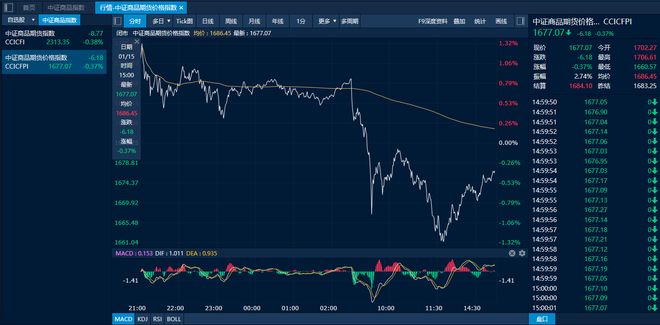
Group 1 - The domestic commodity futures market on January 15 saw more declines than increases, with the main contracts for tin, nickel, and stainless steel rising over 8%, 4%, and 3% respectively, while palladium and platinum fell over 4% [1][3] - The China Securities Commodity Futures Price Index closed at 1677.07 points, down 6.18 points or 0.37% from the previous trading day, and the Commodity Futures Index closed at 2313.35 points, down 8.77 points or 0.38% [1] Group 2 - The strong performance of the metal sector continued, with tin and nickel prices rising due to tightening policies in Indonesia, although there was a slight pullback from intraday highs [3][4] - Tin's supply is expected to tighten as Indonesia sets production quotas significantly below market expectations, while nickel prices are supported by potential reductions in mining quotas, although uncertainties remain regarding actual supply [4] - The agricultural sector, particularly egg prices, is experiencing a rebound due to pre-Spring Festival stocking, with egg futures rising over 2% and reaching a one-month high [4][5] Group 3 - Precious metals have seen a correction after recent highs, with platinum and palladium dropping over 4%, while gold and silver remain strong despite a cooling market sentiment [5][6] - The oil market is under pressure due to reduced geopolitical risks, leading to a decline in downstream polyester chain products, with paraxylene futures falling by 2.49% [6]