
机械

Search documents
由创新高个股看市场投资热点
量化藏经阁· 2025-08-22 11:32
Group 1 - The report tracks stocks, industries, and sectors that are reaching new highs, serving as market indicators and highlighting the effectiveness of momentum and trend-following strategies [1][4][24] - As of August 22, 2025, the Shanghai Composite Index, Shenzhen Component Index, CSI 300, CSI 500, CSI 1000, CSI 2000, ChiNext Index, and Sci-Tech 50 Index all have a distance to their 250-day highs of 0.00%, indicating they are at their recent peaks [5][24] - Among the CITIC first-level industry indices, home appliances, defense and military, comprehensive, media, and computer industries are closest to their 250-day highs, while food and beverage, coal, real estate, banking, and consumer services are further away [8][24] Group 2 - A total of 1,606 stocks reached 250-day highs in the past 20 trading days, with the most significant numbers in the machinery, pharmaceuticals, and electronics sectors [2][13][24] - The highest proportion of new high stocks is found in the defense and military, non-ferrous metals, and pharmaceuticals industries, with respective proportions of 52.94%, 51.61%, and 44.88% [13][16] - The manufacturing and technology sectors have the most stocks reaching new highs this week, with respective counts of 512 and 403 [16][24] Group 3 - The report identifies 48 stocks that have shown stable new highs, with the technology and manufacturing sectors contributing the most, having 22 and 12 stocks respectively [3][21][25] - Within the technology sector, the electronics industry has the highest number of new high stocks, while the automotive industry leads in the manufacturing sector [21][25]






投降美国恶果来了!日本关键数据全面披露,损失高达3.5万亿日元
Sou Hu Cai Jing· 2025-08-22 05:58
Core Insights - The recent trade agreements between Japan and the EU signal a potential end to Trump's trade war, but the long-term impacts are just beginning to emerge [1] - The new trade agreement between the US and Japan has resulted in a significant increase in tariffs, from an initial threat of 50% down to 15%, which is still a substantial rise from the previous 2.5% [1] - Japanese companies are projected to face a loss of approximately 3.5 trillion yen (around 238 billion USD) in operating profits due to US tariff policies [3] Group 1: Economic Impact on Japanese Companies - The 42 major Japanese companies analyzed are primarily in the automotive, electrical, and machinery sectors, indicating that these industries will bear the brunt of the economic pressure [3] - The overall sentiment among Japanese businesses regarding future economic conditions is pessimistic, especially for small enterprises facing intensified market competition [3] Group 2: Strategic Shifts and Industry Trends - The US's macroeconomic policies are limiting Japan's ability to achieve substantial profits, as previous trade surpluses are now constrained by US policy controls [3][5] - The trend of industrial relocation is becoming more pronounced, with the US focusing on revitalizing its manufacturing sector, which may lead to Japanese industries being compelled to shift operations back to the US [5] - The forced investment requirement of 550 billion USD from Japan further exacerbates the likelihood of industry relocation, regardless of Japan's willingness [5] Group 3: Long-term Consequences for Japan's Economy - The consequences of the current trade agreements could be disastrous for Japan, as the US is targeting industries that are foundational to Japan's economic stability [7] - The potential relocation of these key industries could lead to a significant economic downturn for Japan, with severe implications for its overall economic health [7]

为什么说这次是慢牛?
雪球· 2025-08-22 04:26
Core Viewpoint - The article discusses the establishment of a bull market in A-shares, characterizing it as a "slow bull" driven by structural improvements in the economy and long-term capital inflows [2][6]. Historical Bull Markets - The article reviews past bull markets in A-shares: - 1999-2001: A leveraged bull market followed by adjustments, driven by speculative trading and lessons learned [4]. - 2005-2007: A comprehensive bull market supported by institutional reforms and macroeconomic prosperity, with blue-chip stocks leading the rally [4]. - 2008-2009: A fundamental bull market driven by economic recovery post-global financial crisis, led by cyclical industries [4]. - 2014-2015: A liquidity-driven bull market characterized by high expectations for reforms but lacking fundamental support, leading to significant corrections [5]. Current Bull Market Characteristics - The current bull market is described as a "systematic slow bull" due to several factors: - The macroeconomic environment has changed, with a focus on structural improvements rather than rapid stimulus [6]. - The nature of capital has shifted from speculative to long-term investments, with state-owned and institutional investors providing stability [7]. - There is a significant reallocation of household assets, with a large amount of savings seeking new investment avenues, particularly in the stock market [7]. - Ongoing industrial upgrades are evident, with advancements in AI, innovative pharmaceuticals, and renewable energy sectors contributing to economic growth [8]. Investment Directions - The article identifies two main investment directions: - **Hardcore High Technology**: Focus on new economy sectors such as AI, innovative pharmaceuticals, robotics, renewable energy, and semiconductors, which are expected to be core assets for the next decade [11]. - **Super High Dividends**: Investment in traditional sectors like finance, machinery, and cyclical industries, which have potential for valuation recovery as long as the economy remains stable [12]. - The overall market logic suggests a "systematic bull market" driven by China's rise and advantages, emphasizing the importance of finding personal wealth opportunities within this "slow bull" environment [12].

A股VS美股:“跑赢”行情的来龙与去脉
Minsheng Securities· 2025-08-21 13:59
Group 1: A-Share vs. U.S. Market Performance - A-shares have outperformed U.S. stocks, with a relative excess return exceeding 15% since mid-2025, marking the highest level since 2015[1] - A-shares have outperformed U.S. stocks in approximately 41% of the months since the 1990s, with A-shares rising while U.S. stocks fell in about 18.5% of those months[11] - The probability of A-shares outperforming U.S. stocks increases when both markets rise, with A-shares winning approximately 54% of the time in such scenarios[11] Group 2: Factors Influencing Performance - Valuation changes (PE) have a more significant impact on A-share performance compared to earnings growth (EPS), indicating that valuation plays a dominant role in A-share price movements[16] - Key sectors that tend to perform well during A-share outperformance include machinery, finance, military, and computer industries, with cyclical industries like metals and coal performing well during economic recoveries[19] Group 3: Market Dynamics and Future Outlook - A-share outperformance typically begins with rapid price increases driven by monetary policy shifts, fiscal improvements, and external risk releases[23] - The current A-share rally is expected to continue, supported by domestic policy adjustments and a focus on enhancing market attractiveness and stability[27] - Future scenarios for continued outperformance include either a joint market adjustment with U.S. stocks declining more significantly or sustained upward momentum in A-shares[28] Group 4: Risks and Considerations - Risks include domestic economic growth and policy implementation falling short of expectations, potential global economic slowdown due to tariff impacts, and heightened geopolitical tensions leading to increased asset price volatility[29]
创新构建“1+N+X”,聊城制造业数字化转型成效显著
Qi Lu Wan Bao Wang· 2025-08-21 12:19
Group 1 - The core viewpoint emphasizes that promoting digital transformation in manufacturing is essential for building a strong manufacturing city and achieving high-quality industrial economic development [1] - The city has established a "1+N+X" mechanism to support digital transformation, which includes creating a new industrial smart platform, planning multiple industry platforms, and cultivating various application scenarios [1][2] - The government has issued policies to support high-quality development in manufacturing, with a focus on digital transformation initiatives [1][4] Group 2 - The city is actively advancing the construction of digital transformation service platforms, focusing on key industrial chains and clusters, and has initiated five provincial-level "industry brain" pilot projects [2] - A digital transformation assessment system for small and medium-sized enterprises has been launched, with 1,312 companies evaluated this year [2] - The "Chat City Enterprise Home" intelligent service system has been developed to provide one-stop services, including policy interpretation and supply-demand matching, with nearly 400 solutions and service products available [2] Group 3 - The city encourages collaboration between service providers and manufacturing enterprises to explore digital technology applications and has identified five pilot projects for industry-wide transformation [3] - The city is leveraging opportunities in "artificial intelligence + manufacturing" and has successfully selected five projects for provincial-level industry model initiatives [3] - Several companies have been recognized for their digital transformation achievements, including Dong'e Ejiao Co., Ltd., which was named a "digital leader" by the Ministry of Industry and Information Technology [3] Group 4 - A comprehensive policy framework has been established to stimulate enterprise transformation, including action plans and funding support totaling nearly 280 million yuan since 2022 [4] - The policies cover various aspects such as technological upgrades, platform construction, and exemplary cases to ensure effective implementation [4] - Specific financial incentives have been introduced to support enterprises in areas like industrial internet platforms and smart factories, encouraging active participation in these initiatives [4]


策略研究深度报告:后关税时代,中国制造的全球竞争力
Guolian Minsheng Securities· 2025-08-21 11:23
Group 1 - The report highlights the formation of a new global trade framework in the "post-tariff" era, emphasizing the reduction of trade deficits and the return of manufacturing to the U.S. as key objectives of the Trump administration [4][6][25] - The average rate of the new "reciprocal tariffs" is approximately 20%, down from 29% in April, indicating a narrowing of differences among various economies [7][14] - The report constructs a quantitative assessment framework based on three dimensions: price elasticity, share resilience, and capacity elasticity, to analyze the competitive advantages and challenges faced by Chinese manufacturing [4][8] Group 2 - Chinese manufacturing maintains a price advantage, with most products showing a price advantage concentrated in the 0%-75% range, suggesting that even under extreme assumptions of tariff costs, many products still hold competitive pricing [8][10] - The resilience of market share is crucial, as certain products like small appliances and air conditioners exhibit both price advantages and strong market shares, indicating higher demand resilience [8][10] - The report notes that while tariff risks cannot be completely eliminated, the globalization of supply chains is mitigating some of these risks, particularly in key manufacturing sectors [9][10] Group 3 - Certain core products from Chinese manufacturing are expected to maintain strong export competitiveness despite current tariff conditions, with specific categories like electronics and home appliances showing notable resilience [10][22] - The report emphasizes that U.S. importers may find it less cost-effective to switch suppliers in the short term, as the overall impact of tariffs on exports is lower than anticipated [10][22] - The analysis suggests that the ongoing trade negotiations and tariff adjustments will continue to shape the competitive landscape for Chinese manufacturing in the global market [25]
关税对欧盟出口冲击有多大?欧洲出口型优势是否仍在
Di Yi Cai Jing· 2025-08-21 11:02
Group 1 - The core viewpoint of the articles highlights the significant slowdown in European exports to the U.S. due to the impact of tariffs imposed by the Trump administration, with EU exports to the U.S. dropping by 10% year-on-year in June, reaching a low of approximately €40 billion ($46.8 billion) [1][4] - The trade surplus of the EU narrowed from €15.6 billion in May to €2.8 billion in June, primarily due to weak chemical exports, which are crucial for many European economies [1][4] - Germany's trade surplus with the U.S. decreased by 12.8% year-on-year, with exports to the U.S. declining by 3.9% in the first half of the year, significantly affecting its industrial output and overall economic growth [1][4][5] Group 2 - The European Central Bank's President Lagarde indicated that the Eurozone's economic growth is expected to slow down in the third quarter due to the adverse effects of U.S. tariffs, which have already begun to manifest in the second quarter [6] - The Oxford Economics report noted a significant drop in imports from the EU to the U.S. since April, with the EU being a major source of U.S. imports, particularly pharmaceuticals, in the first quarter [6] - The ongoing tariff situation has prompted the EU to seek diversification in trade relationships, with negotiations for free trade agreements with countries like the UAE and New Zealand being initiated [8][10]

关税对欧盟出口冲击有多大?欧洲出口型优势是否仍在|全球贸易观察
Di Yi Cai Jing· 2025-08-21 10:27
Group 1 - The core viewpoint is that while the US remains an important trade partner for Europe, there is a need for Europe to diversify its trade relationships and leverage its export-oriented economy [1][5] - EU exports to the US have significantly slowed down, with a 10% year-on-year decline in June, reaching a low of approximately 40 billion euros (about 46.8 billion USD) [1][3] - Germany's trade surplus with the US has decreased by 12.8% year-on-year, attributed to the competitive pressure from US tariffs [1][3] Group 2 - The EU's trade surplus has narrowed primarily due to weak chemical exports, a key sector for many European economies [3] - The introduction of various tariffs, including a 15% tariff on most EU goods, has negatively impacted Germany's automotive and machinery exports, which fell by 8.6% and 7.9% respectively in the first half of the year [4] - The US's recent expansion of tariffs to include 407 product categories, such as wind turbines and heavy machinery, complicates the pricing and competitiveness of European exports [4] Group 3 - The European Central Bank's President, Lagarde, indicated that the eurozone's economic growth is expected to slow down in the third quarter due to the impact of US tariffs [5] - The Oxford Economics report noted a significant decline in EU exports to the US since April, with current import levels from the EU falling below the average for 2024 [5] - Despite the challenges, the eurozone showed resilience with a 0.1% growth in the second quarter, although future export recovery remains uncertain due to a strong euro and overall market volatility [6] Group 4 - The EU is actively seeking to diversify its trade relationships by initiating or reviving trade negotiations with developed and emerging markets, including the UAE and New Zealand [6] - There are ongoing discussions for a free trade agreement with India, aiming for a balanced and mutually beneficial deal by the end of the year [6] - The need for regional cooperation in response to rising US trade barriers is emphasized, particularly in industries like semiconductors, where global collaboration is essential [7]

崔东树:近几年中国汽车出口表现优秀 2025年依旧保持月度小幅增长特征
智通财经网· 2025-08-21 08:01
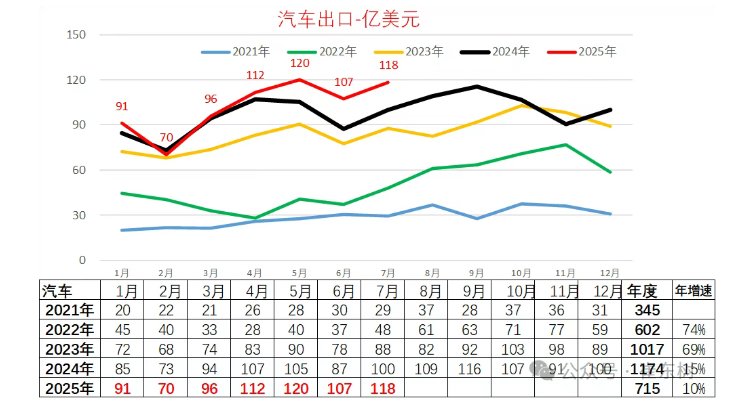
Core Insights - China's automobile exports have shown explosive growth, increasing from $34.5 billion in 2021 to $117.4 billion in 2024, with a continued monthly growth trend expected in 2025 [1] - The overall trade performance of China remains stable with a notable increase in export quality, contributing significantly to the economy and global supply chains [3][6] Export Performance - In the first seven months of 2025, China's exports reached $213.04 billion, marking a $12.25 billion increase compared to the previous year [9][10] - The export of automobiles has been particularly strong, with July 2025 exports reaching $3.218 billion, indicating a robust performance in the automotive sector [8][11] Trade Surplus - China maintained a significant trade surplus, with a surplus of $16.55 billion with the United States and $16.28 billion with Hong Kong in the first seven months of 2025 [10][12] - The overall trade surplus for China is projected to be close to $300 billion for the year, reflecting a strong export performance despite global demand challenges [15] Regional Contributions - Key contributors to China's export growth include Hong Kong, Vietnam, and India, while trade deficits were noted with Australia, South Korea, and Russia [3][10] - The automotive sector, particularly electric vehicles and components, has been a standout performer in exports, showcasing China's competitive edge in this industry [1][16]
养老金二季度动向:截至8月21日,共现身38只个股前十大流通股东
Xin Lang Cai Jing· 2025-08-21 00:35
据Wind数据统计显示,8月21日,养老金现身8只个股前十大流通股东,合计持股5349.14万股,合计持 股市值达14.15亿元。国药股份、华峰铝业、海兴电力持股数量居前,养老金分别持有0.18亿股、0.10亿 股、0.07亿股。从养老金持股市值来看,国药股份、盐津铺子、海兴电力排名居前,持股市值分别为 5.20亿元、3.17亿元、1.73亿元。截至8月21日,养老金二季度共现身38只个股前十大流通股东,合计持 股3.23亿股,合计持股市值达79.75亿元。其中,7只个股持股数量超千万,海油发展、宏发股份、深圳 机场持股数量居前,养老金分别持有0.52亿股、0.28亿股、0.24亿股。从养老金持股行业分布来看,主 要集中在化工、制药、机械,分别有4只、3只、3只。 ...