
家电

Search documents
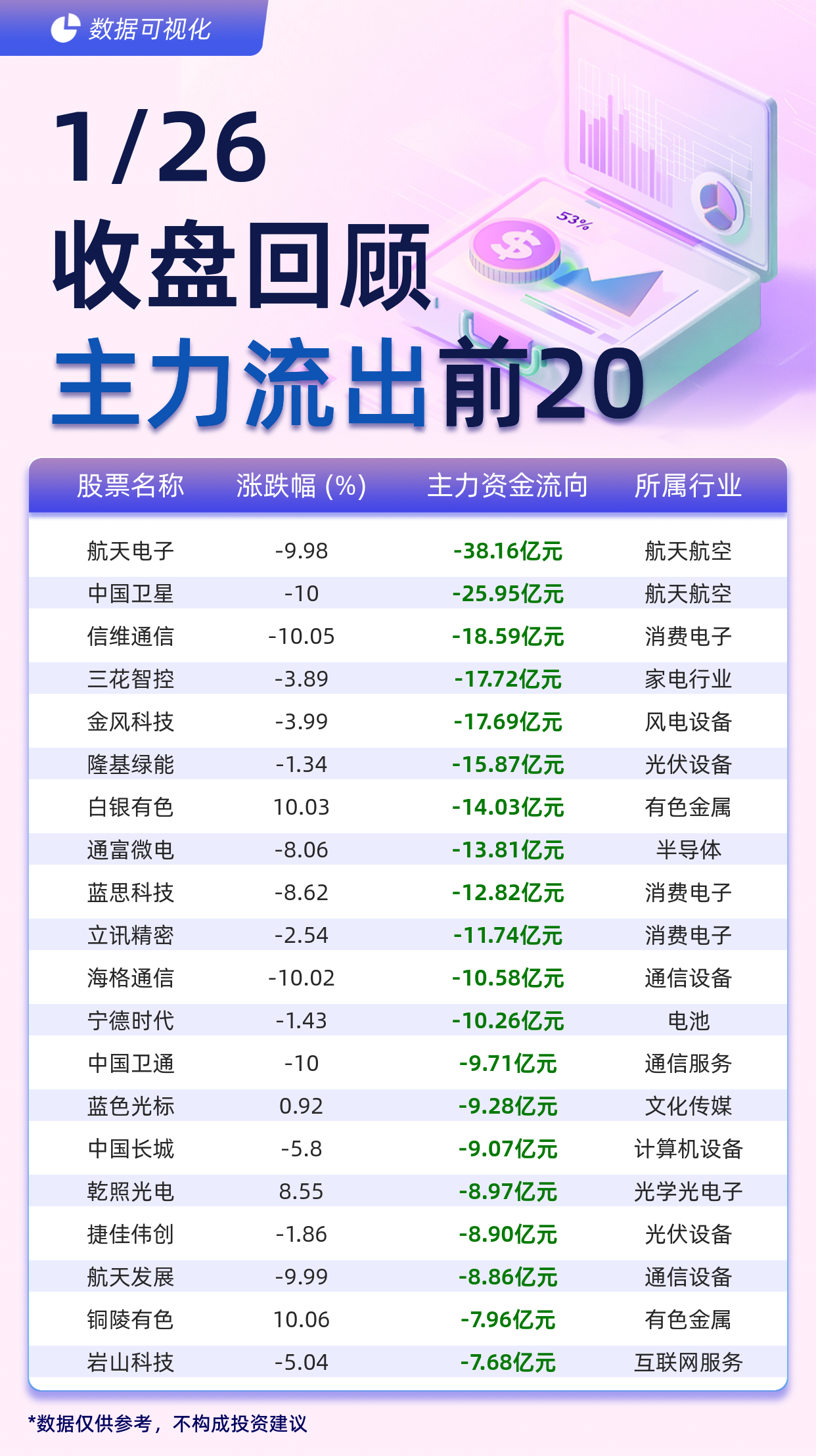
主力个股资金流出前20:航天电子流出38.16亿元、中国卫星流出25.95亿元
Jin Rong Jie· 2026-01-26 07:37
Core Viewpoint - The data indicates significant outflows of main funds from various stocks, particularly in the aerospace and consumer electronics sectors, reflecting a bearish sentiment among investors. Group 1: Stock Performance and Fund Flow - Aerospace stocks, such as Aerospace Electronics and China Satellite, experienced the largest fund outflows, with -38.16 billion and -25.95 billion respectively, and declines of -9.98% and -10% in their stock prices [1][2] - Other notable stocks with significant outflows include Xinwei Communication (-18.59 billion, -10.05%), Sanhua Intelligent Control (-17.72 billion, -3.89%), and Goldwind Technology (-17.69 billion, -3.99%) [1][2] - The outflow from Longi Green Energy was -15.87 billion with a stock price decrease of -1.34%, indicating a relatively smaller decline compared to others in the same sector [1][2] Group 2: Sector Analysis - The consumer electronics sector saw major outflows, particularly from companies like Xinwei Communication and Lens Technology, with outflows of -18.59 billion and -12.82 billion respectively [1][2] - The wind power equipment sector, represented by Goldwind Technology, also faced significant outflows, reflecting potential challenges in the renewable energy market [1][2] - The communication equipment sector, including companies like Haige Communication and China Satellite, showed substantial fund outflows, indicating investor caution in this area [1][3]







中国宏观周报(2026年1月第4周)-20260126
Ping An Securities· 2026-01-26 07:09
Industrial Sector - In January, daily average pig iron production and float glass operating rates remained stable, while asphalt and some chemical products saw a decline in operating rates[4] - The apparent demand for major steel products decreased, while cement clinker capacity utilization increased[4] - The operating rate for automotive semi-steel tires increased, while full-steel tire operating rates declined[20] Real Estate - New home sales in 30 major cities decreased by 38.5% year-on-year as of January 23, with a similar decline of 38.6% for the month of January[21] - The second-hand housing listing price index fell by 0.93% week-on-week, a decrease of 0.46 percentage points from the previous value[25] Domestic Demand - Retail sales of passenger cars from January 1 to 18 dropped by 28% year-on-year, with a slight expected increase of 0.3% for the entire month due to the Spring Festival timing[29] - Major home appliance retail sales fell by 34.5% year-on-year as of January 16, a decline of 3.3 percentage points from the previous value[33] - The volume of postal express deliveries decreased by 5.4% year-on-year as of January 18, a drop of 3.2 percentage points from the previous value[32] External Demand - Port cargo throughput increased by 3.4% year-on-year as of January 18, an improvement of 1.7 percentage points from the previous value[35] - Container throughput at ports rose by 7.6% year-on-year, also showing an increase from previous values[35] Price Trends - The Nanhua Industrial Index rose by 1.1%, while the Nanhua Black Raw Materials Index fell by 0.9% and the Nanhua Nonferrous Metals Index increased by 3.0%[36] - The agricultural product wholesale price index rose by 1.7% week-on-week[40]
南京:持续推进家电、汽车等重点品类以旧换新工作,支持绿色产品消费
Jin Rong Jie· 2026-01-26 07:01
Core Viewpoint - The Nanjing Municipal Government has issued policies aimed at accelerating the cultivation of new productive forces to promote high-quality development, focusing on boosting consumption and supporting green product consumption [1] Group 1: Consumption Promotion - Implementation of special actions to boost consumption, including the continuation of the national and provincial policies for replacing old consumer goods with new ones [1] - Promotion of key categories such as home appliances and automobiles through replacement programs [1] - Encouragement of major commercial enterprises to conduct themed consumption promotion activities through the "Four Seasons Appointment" series [1] Group 2: Financial Support - Acceleration of the construction of a modern commercial circulation system with financial support of up to 40% of effective investment [1] - Maximum support amount for a single project is set at 20 million yuan, while the cumulative support amount for a single enterprise can reach up to 30 million yuan [1]
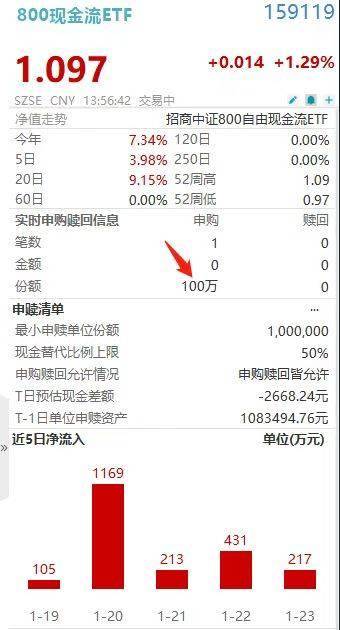
唯一低费率800现金流ETF(159119)盘中冲击年内第8次历史新高!白银有色封板!
Sou Hu Cai Jing· 2026-01-26 06:37
Core Insights - The 800 Cash Flow ETF (159119) has shown strong performance, rising 1.20% and reaching a new high for the year, indicating robust market interest and inflows [1][2] - This ETF focuses on companies with strong cash generation capabilities, primarily in sectors like automotive, oil and petrochemicals, and home appliances, representing a shift towards high-quality dividend investments [1][2] Group 1: ETF Performance - The 800 Cash Flow ETF (159119) is the only low-fee ETF in the market with a rate of 0.2% per year, highlighting its unique position [1][2] - The ETF has experienced a net inflow for seven consecutive days, reflecting sustained investor interest [1] Group 2: Investment Strategy - The ETF selects "cash cows" from the top 800 companies, emphasizing strong cash flow generation as a criterion for investment [1][2] - The investment philosophy is evolving from short-term trading expectations to a focus on fundamental value, indicating a deeper market shift towards quality and sustainability in earnings [1][2]

2025Q4家电板块基金持仓点评:行业重仓仍处低位,白电持仓环比提升
Guolian Minsheng Securities· 2026-01-26 06:04
Investment Rating - The report maintains an "Outperform" rating for the home appliance industry [3] Core Insights - The home appliance sector's fund holding ratio remains low at 2.40% for Q4 2025, with a slight increase of 0.08 percentage points from the previous quarter, which is still at a low level compared to historical data since 2010 [6][9] - The white goods segment saw an increase in holdings, while the vacuum cleaner segment experienced a reduction in allocation [17][21] - There is a divergence in northbound holdings, with some companies like Hisense Home Appliances and Bull Group seeing increases, while others like Vatti and Roborock saw declines [42] Summary by Sections Home Appliance Sector Fund Holding Ratio - The fund holding ratio for the home appliance sector in Q4 2025 is 2.40%, ranking 12th among all sectors, with a cumulative increase of 4.09% in the CITIC home appliance index, also ranking 12th in absolute returns [6][9][14] White Goods Increase and Vacuum Cleaner Reduction - The fund holding ratios for sub-segments in Q4 2025 are as follows: white goods at 1.88% (+0.24 percentage points), small appliances at 0.71% (+0.08 percentage points), upstream appliances at 0.27% (-0.16 percentage points), black goods at 0.08% (-0.03 percentage points), kitchen appliances at 0.03% (-0.01 percentage points), and lighting at 0.03% (stable) [17][21] Northbound Holdings Divergence - The northbound holdings for the home appliance sector showed mixed results in Q4 2025, with increases for Hisense Home Appliances (+0.78 percentage points), Bull Group (+0.41 percentage points), and Yitian Smart (+0.41 percentage points), while declines were noted for Vatti (-2.31 percentage points), Roborock (-1.69 percentage points), and XGIMI (-1.47 percentage points) [42][44] Investment Recommendations - The report recommends leading white goods companies such as Midea Group, Haier Smart Home, Gree Electric Appliances, and Hisense Home Appliances, as well as TV leader Hisense Visual and cleaning appliance leaders Roborock and Ecovacs [57]





2025年我国消费呈现新亮点 入境消费潜力有效激发
Yang Shi Xin Wen· 2026-01-26 05:17
Group 1: Consumer Market Trends - In 2025, China's consumer market is expected to show new highlights, with strong demand in home appliances, mobile phones, and new energy vehicles [1] - Retail sales for daily home appliances, such as refrigerators, are projected to grow by 17.4%, while sales for kitchen appliances and communication devices are expected to increase by 12.9% and 18.6% respectively [1] - The sales volume and revenue of new energy passenger vehicles are forecasted to rise by 24.3% and 21.1% respectively [1] Group 2: Cultural and Tourism Consumption - The integration of culture and tourism is expected to ignite new consumption vitality, with sales revenue from cultural performances projected to grow by 17.3% [1] - Revenue from travel agencies and related services, scenic spots, and leisure activities is expected to increase by 11.2%, 26.1%, and 14.6% respectively [1] Group 3: Digital and Health Consumption - Digital empowerment is driving new consumption, with internet life service platforms and food delivery sales expected to grow by 9.4% and 13.3% respectively [2] - The digital cultural service sector is projected to see a sales revenue increase of 16.6% [2] - The sports and health industry is experiencing strong demand, with revenue from sports consulting services expected to grow by 27.8% [2] Group 4: Elderly Consumer Demand - The increasing population of the elderly is driving demand for elderly care services, with revenue from elderly care and social assistance expected to grow by 24.9% and 23.1% respectively [2] - Revenue from nursery services is projected to increase by 5.4% [2] Group 5: Inbound Tourism and Shopping - Measures to optimize the shopping experience for inbound tourists have led to a 305% increase in the number of foreign travelers processing tax refunds [3] - Sales of tax refund goods are expected to grow by 95.9%, with the total tax refund amount increasing by 95.8% [3]
税收数据显示:2025年国内消费呈现多方面新亮点
Xin Hua Cai Jing· 2026-01-26 05:08
Core Insights - The 20th Central Committee of the Communist Party of China emphasizes the need to boost consumption through targeted actions, with significant growth expected in various sectors by 2025 [1][4] Group 1: Consumer Demand Trends - Household appliance consumption is projected to grow, with retail sales of refrigerators, gas stoves, and mobile phones increasing by 17.4%, 12.9%, and 18.6% respectively [1] - The demand for new energy vehicles continues to rise, with sales volume and revenue expected to increase by 24.3% and 21.1% respectively in 2025 [1] Group 2: Cultural and Tourism Consumption - The integration of culture and tourism is expected to enhance consumer vitality, with sales in cultural and artistic performances increasing by 17.3% [2] - Revenue from travel agencies, scenic spots, and leisure activities is projected to grow by 11.2%, 26.1%, and 14.6% respectively [2] Group 3: Digital and Technological Impact - The incorporation of AI and VR technologies is driving new consumption patterns, with internet service platforms and food delivery services seeing revenue growth of 9.4% and 13.3% respectively [2] - Digital cultural services are also expected to thrive, with sales projected to increase by 16.6% [2] Group 4: Health and Sports Consumption - The sports economy is emerging as a new engine for consumption, with revenue from sports exhibition services and consulting services expected to grow by 12.2% and 27.8% respectively [2] - Health-related services are becoming a new consumption hotspot, with sales in health consulting, wellness services, and sports health services increasing by 11.7%, 12%, and 16.5% respectively [2] Group 5: Demographic Consumption Patterns - The aging population is driving demand for elder care services, with growth rates of 24.9%, 23.1%, and 15.4% in elder care, social assistance, and nursing home services respectively [3] - The expansion of tax refund policies for outbound tourists is stimulating inbound consumption, with the number of tourists benefiting from tax refunds increasing by 305% and sales of tax refund goods rising by 95.9% [3] Group 6: Policy Impact on Consumption - The diverse highlights of the 2025 consumption market reflect the effectiveness of targeted government policies aimed at stimulating consumption, promoting quality and diversified consumption structures [4]
2025年湖南“以旧换新”相关商品零售额增长26.4%
Jin Rong Jie· 2026-01-26 03:33
今日,2025年度全省经济社会发展情况新闻发布会在长沙举行。发布会介绍,2025年,湖南聚焦效益与 结构,全方位扩大内需,需求结构持续改善。全省社会消费品零售总额21204.59亿元,同比增长 3.6%。"以旧换新"相关商品零售额增长26.4%、比上年加快14.7个百分点,其中家具类零售额增长 24.9%、家电类零售额增长23.1%、 新能源 汽车零售额增长9.0%。 ...
宏观周周谈-当前的核心矛盾是什么
2026-01-26 02:49
Summary of Key Points from Conference Call Records Industry and Company Overview - The discussion primarily revolves around macroeconomic trends, inflation expectations, and the performance of various industries in the context of the Chinese and U.S. markets. [1][2][3] Core Insights and Arguments Market Sentiment - Market sentiment has improved, particularly in second and third-tier cities, indicating a recovery in market activity to about 50-66% of previous levels. [2] Inflation Expectations - A "pork-oil resonance" phenomenon is anticipated in 2026, signaling the end of deflation and a return to inflation, with a CPI central tendency expected to reach 0.5% and PPI likely turning positive in Q3. [1][3][4] Industry Focus - Industries that may benefit from the positive PPI include resource-related sectors and raw materials, while the technology sector's valuations are no longer seen as advantageous. [1][4] U.S. Stock Market Outlook - The U.S. stock market is expected to experience a rally from May to August 2026, potentially boosting related sectors such as computing power. However, the main focus remains on the implications of PPI turning positive. [1][6] PPI Impact on Industries - Positive PPI is expected to favor industries such as construction materials, non-ferrous metals, steel, and basic chemicals, while sectors like machinery, automotive, electronics, pharmaceuticals, and home appliances show strong alpha correlation but weak beta correlation. [1][7][8] Currency Exchange Rate - The Chinese yuan is projected to appreciate significantly, with the effective exchange rate expected to return to levels seen at the end of 2024. This appreciation will benefit yuan-denominated assets, including Hong Kong stocks. [1][9] Geopolitical Risks - Geopolitical risks are increasing due to the disintegration of the old international order, U.S. strategic adjustments, and rising global political uncertainties. Key areas of concern include the Russia-Ukraine conflict, the situation in Iran, and developments in U.S.-China relations. [1][10][11] Other Important but Potentially Overlooked Content Specific Industry Dynamics - The relationship between PPI and various industries has shifted, with some sectors like real estate losing their previous correlation with PPI, while others have become more competitive due to changes in consumer behavior and market dynamics. [1][7][8] Recent Developments in Geopolitical Situations - The situation in Greenland has shown signs of easing, with diplomatic negotiations taking precedence over military threats. However, tensions remain in the Middle East, particularly regarding Iran and the ongoing Russia-Ukraine conflict. [10][11][12][14] U.S.-China Relations - Recent developments indicate a potential stabilization in U.S.-China relations, with high-level diplomatic engagements expected to continue throughout the year. [15][16]
铝研究-从家电领域看铝代铜前景分析与展望
2026-01-26 02:49
Summary of Aluminum Replacement for Copper in the Air Conditioning Industry Industry Overview - The focus is on the air conditioning industry and the trend of replacing copper with aluminum in heat exchangers due to cost advantages and resource security [1][6]. Key Points and Arguments 1. **Cost Advantage**: Aluminum prices are approximately one-fourth of copper prices, leading to significant cost savings in air conditioning production [1][6]. 2. **Performance Efficiency**: Full aluminum microchannel heat exchangers can improve thermal conversion efficiency by about 10% compared to full copper, while also reducing weight by half and refrigerant usage by nearly half [1][3]. 3. **Technical Feasibility**: Aluminum heat exchangers can achieve 90% of copper's performance, with potential improvements to 96%-98% through structural optimization and the addition of rare earth alloys [1][10]. 4. **Market Adoption**: Major air conditioning companies like Haier, Midea, Gree, Xiaomi, and Aux have begun mass production of aluminum products, with Haier having a high export ratio [1][11]. 5. **Projected Growth**: The penetration rate of aluminum replacement technology is expected to reach over 80% by 2027, driven by price advantages and the plans of leading companies [2][22]. Additional Important Content 1. **Material Comparison**: Four main technical paths for heat exchanger materials are identified: aluminum replacing copper, non-wing (plate-type) heat exchangers, and aluminum-copper composite heat exchangers, each with distinct advantages and disadvantages [2][5]. 2. **Environmental Impact**: The use of aluminum or composite materials contributes to lightweight design, enhancing energy efficiency and reducing refrigerant usage, thus promoting environmental sustainability [7]. 3. **Standardization Efforts**: Ongoing efforts in the industry include the establishment of technical standards, testing and validation of new materials, and collaboration among leading brands to ensure product reliability and performance consistency [7][8]. 4. **Consumer Acceptance**: Consumer acceptance of aluminum components varies, with lower acceptance in high-end markets compared to mid-range and low-end markets [18]. 5. **Challenges**: Key challenges include higher maintenance costs and potential reductions in product lifespan, with estimates suggesting a decrease of 20% in lifespan when using aluminum instead of copper [16][20]. Conclusion The air conditioning industry is poised for a significant shift towards aluminum as a replacement for copper in heat exchangers, driven by cost efficiency, performance improvements, and environmental considerations. Major players are already adapting their strategies to align with this trend, indicating a robust future for aluminum technology in this sector.